
3 5 REVIEWING KEY CONCEPTS Focus Question What
- Slides: 11
3. 5. REVIEWING KEY CONCEPTS Focus Question: What have we learnt? In small groups, create your own definition of (1) Sustainable fishing (2) Maximum sustainable yield (3) Unsustainable fishing Act it out! For one of your definitions create a 30 second skit showing the meaning of the term from the perspective of a fisher person! Source: MSC. ORG MAHI / ACTIVITY Complete Topic 3 summary quiz on the following slides or play using Kahoot! 35
REVIEWING KEY CONCEPTS – QUIZ 1. True or False - A sustainable catch is one that can carry on forever? 2. Which of the following is NOT a principle applied by Marine Stewardship Council when certifying sustainable fishery – Principle 1: Sustainability of the fish stock – Principle 2: Environmental Impacts – Principle 1: Economic viability assessment – Principle 3: Effective Management 36
REVIEWING KEY CONCEPTS – QUIZ 3. Which of the following is LEAST useful to the MSC under Principle 1 to tell if a fish CATCH is sustainable? 1. Knowing the size of the fish stock / population 2. Scientists calculations on the health of the fish stocks 3. Knowing what fish stock a fish has come from 4. Knowing what other fish the boat caught 4. True or False - Sustainable fishing means making sure fish populations don’t drop below levels where they can reproduce themselves 5. True or False - Fisheries work with scientists to understand how the fish and shellfish population grows and shrinks over time 37
REVIEWING KEY CONCEPTS – QUIZ 6. True or False - How a fish population grows & shrinks over time is controlled by births, migrations in & out of the fishery, and deaths (including fish caught) 7. Which of the following is NOT true of sustainable yield for a fishery? 1. Sustainable yield is a scientific calculation 2. Sustainable yield shows how much fish can be caught without overfishing 3. Sustainable yields are set to enable high catches & declining fish stocks 4. Sustainable yields aim to prevent overfishing & decline of fish stocks 8. True or False - Population biomass is the total weight of fish in the population 38
REVIEWING KEY CONCEPTS – QUIZ 9. In fishing, size does matter! Which of the following is NOT true? 1. Healthy fish stocks need large, mature fish (the ‘spawners’) 2. A fished population of fish is always healthy even with no big fish present 3. Without big fish reproduction slows and fish stocks decline 4. Not enough large mature fish means there will be less young healthy fish 10. Which of the following is not true of commercial fishing in Aotearoa NZ? 1. Commercial fisheries are managed under the QMS (Quota Management System) 2. There are no limits to the number of fish that can be caught 3. Scientists use info from commercial fishers to work out fishery size 4. Commercial fishers must report their catches 39
REVIEWING KEY CONCEPTS – QUIZ 11. True or False - The number of fish in a population is also known as 'abundance’ 12. Which of the following can be a type of impact arising from the decline of a fish stock? 1. Environmental impacts 2. Social & cultural impacts 3. Economic impacts 40
REVIEWING KEY CONCEPTS – QUIZ ANSWERS 1. True or False - A sustainable catch is one that can carry on forever? TRUE 2. Which of the following is NOT a principle applied by Marine Stewardship Council when certifying sustainable fishery – Principle 1: Sustainability of the fish stock – Principle 2: Environmental Impacts – Principle 1: Economic viability assessment – Principle 3: Effective Management 41
REVIEWING KEY CONCEPTS – QUIZ ANSWERS 3. Which of the following is LEAST useful to the MSC under Principle 1 to tell if a fish CATCH is sustainable? 1. Knowing the size of the fish stock / population 2. Scientists calculations on the health of the fish stocks 3. Knowing what fish stock a fish has come from 4. Knowing what other fish the boat caught 4. True or False - Sustainable fishing means making sure fish populations don’t drop below levels where they can reproduce themselves TRUE 5. True or False - Fisheries work with scientists to understand how the fish and shellfish population grows and shrinks over time TRUE 42
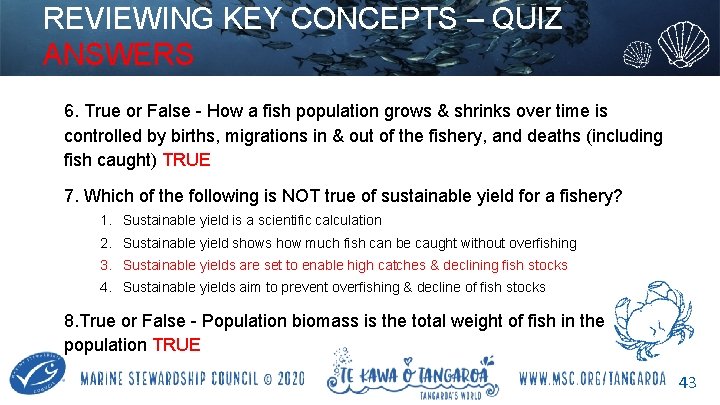
REVIEWING KEY CONCEPTS – QUIZ ANSWERS 6. True or False - How a fish population grows & shrinks over time is controlled by births, migrations in & out of the fishery, and deaths (including fish caught) TRUE 7. Which of the following is NOT true of sustainable yield for a fishery? 1. Sustainable yield is a scientific calculation 2. Sustainable yield shows how much fish can be caught without overfishing 3. Sustainable yields are set to enable high catches & declining fish stocks 4. Sustainable yields aim to prevent overfishing & decline of fish stocks 8. True or False - Population biomass is the total weight of fish in the population TRUE 43
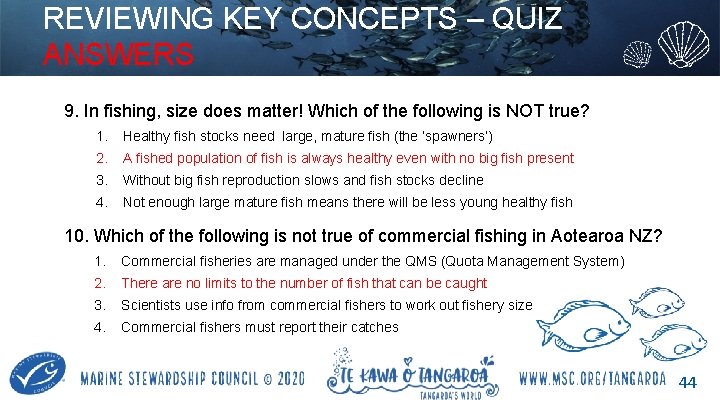
REVIEWING KEY CONCEPTS – QUIZ ANSWERS 9. In fishing, size does matter! Which of the following is NOT true? 1. Healthy fish stocks need large, mature fish (the ‘spawners’) 2. A fished population of fish is always healthy even with no big fish present 3. Without big fish reproduction slows and fish stocks decline 4. Not enough large mature fish means there will be less young healthy fish 10. Which of the following is not true of commercial fishing in Aotearoa NZ? 1. Commercial fisheries are managed under the QMS (Quota Management System) 2. There are no limits to the number of fish that can be caught 3. Scientists use info from commercial fishers to work out fishery size 4. Commercial fishers must report their catches 44
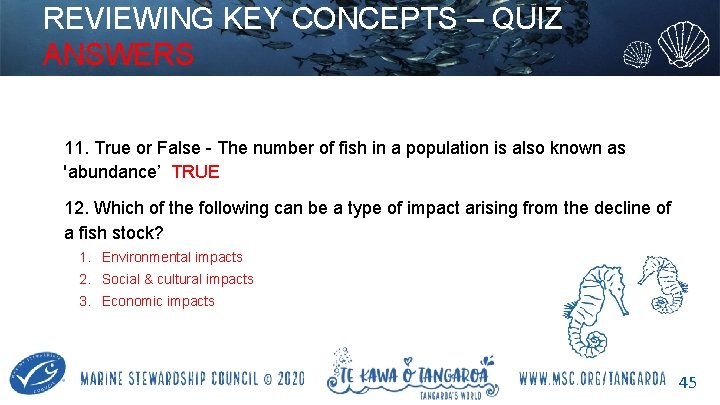
REVIEWING KEY CONCEPTS – QUIZ ANSWERS 11. True or False - The number of fish in a population is also known as 'abundance’ TRUE 12. Which of the following can be a type of impact arising from the decline of a fish stock? 1. Environmental impacts 2. Social & cultural impacts 3. Economic impacts 45