
3 5 Repairs to Rail fracture Periods1 REPAIR

- Slides: 39
3. 5 Repairs to Rail fracture Periods-1
REPAIR TO RAIL FRACTURES
UNUSUAL OCCURRENCES • Unusual Occurrences: List of unusual occurrences: • (a) Rail fractures or replacement of defective rail/ glued joint. • (b) Damage to SEJ. • (c) Buckling or tendency towards buckling. • (d) Factors causing disturbance to LWR/CWR such as accidents, breaches etc.
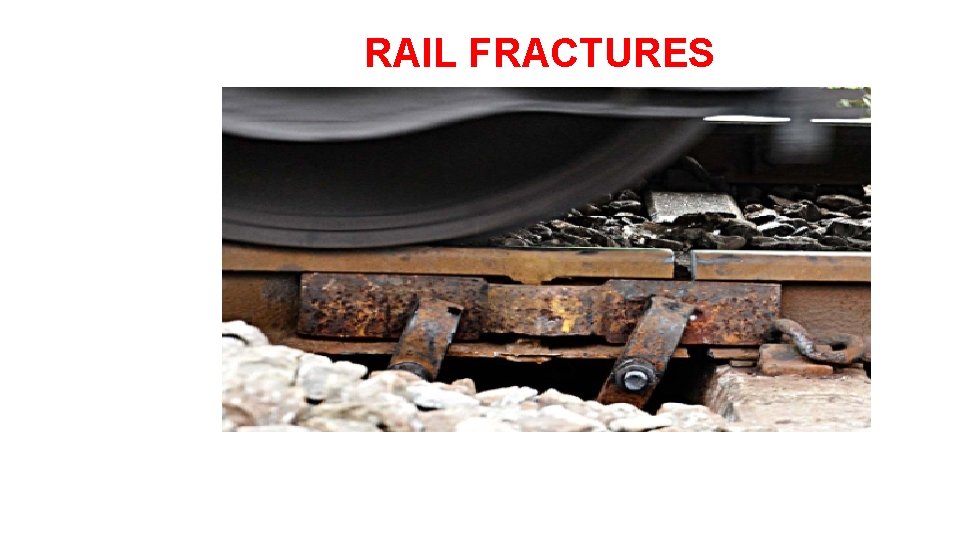
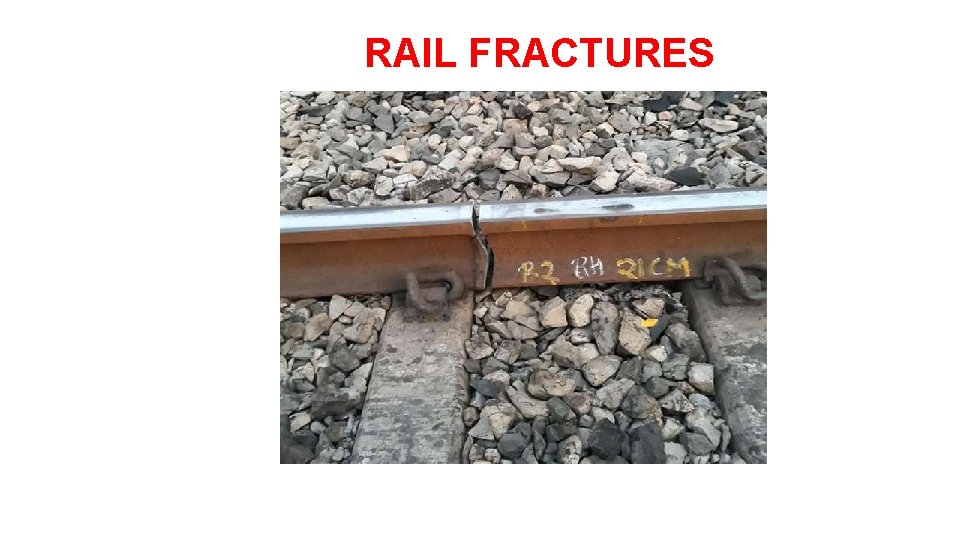
RAIL FRACTURES
RAIL FRACTURES
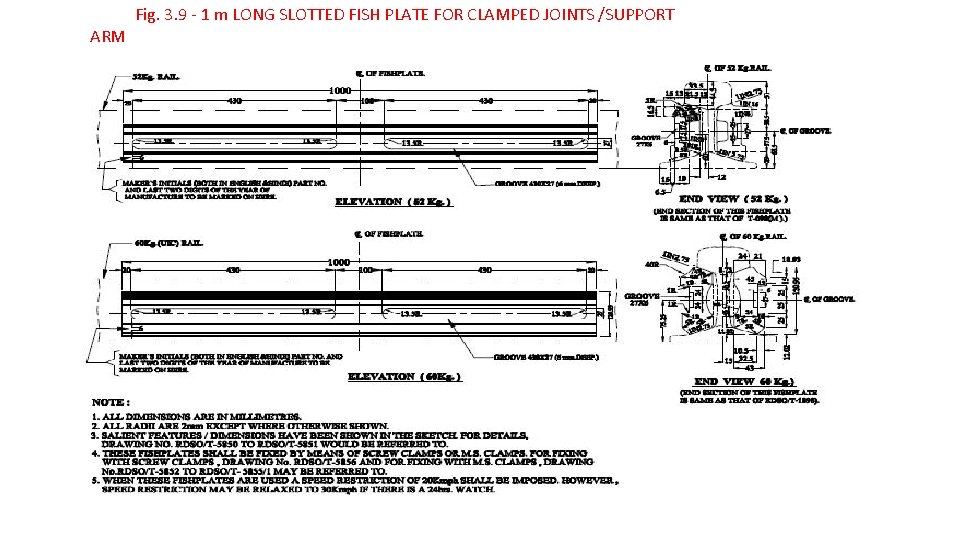
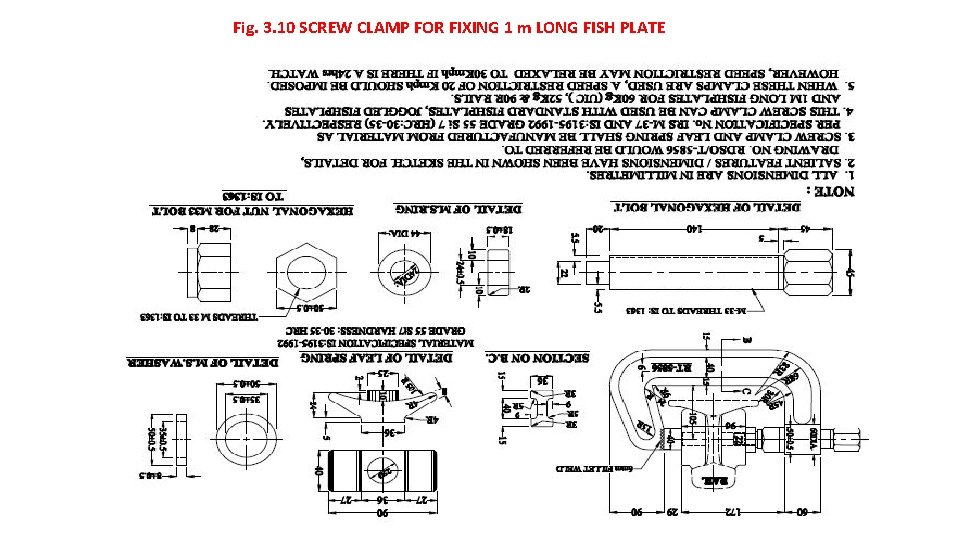
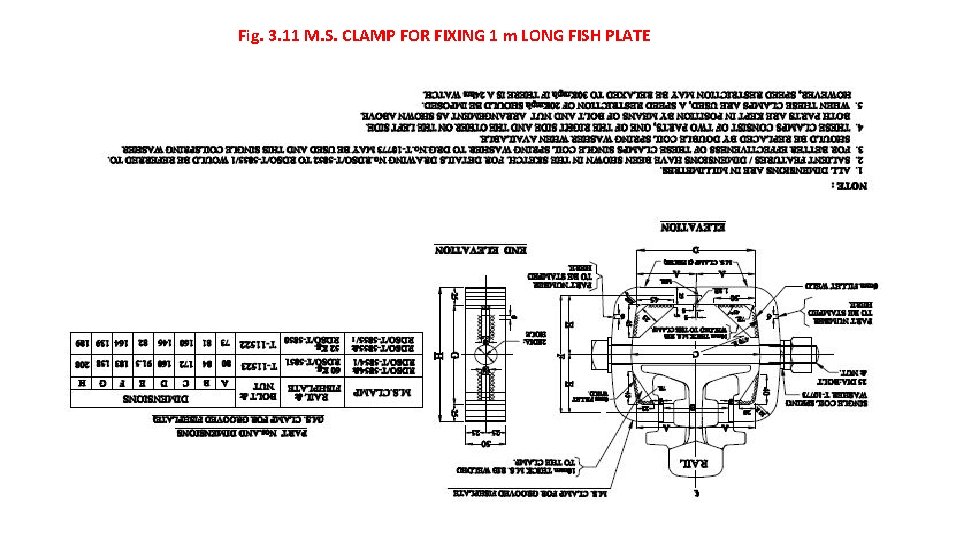
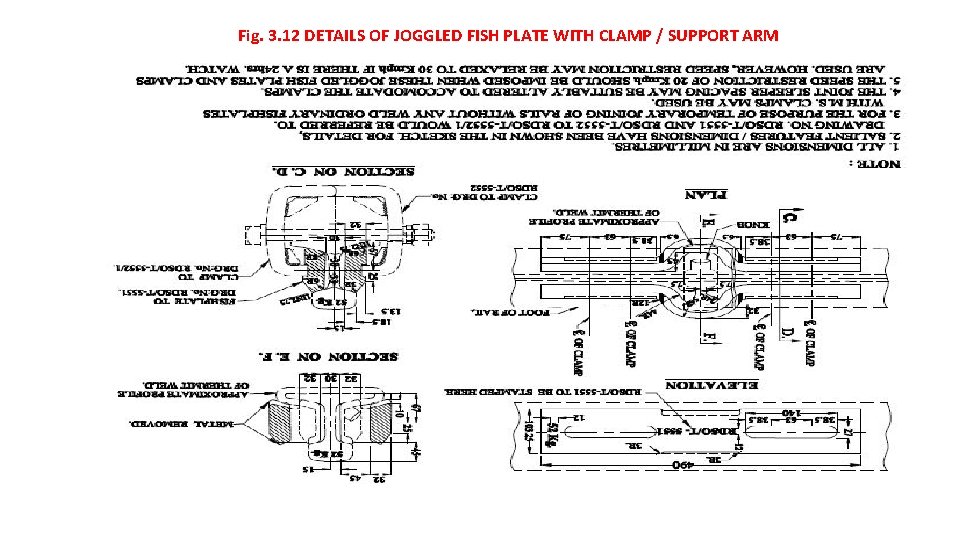
Rectification of Rail Fractures: • (1) Equipment required: • (a) Special 1 m long fishplates with screw clamps and joggled fishplates with bolted clamps (for fractures at welded joints) as per arrangement shown in Fig. 3. 9, 3. 10, 3. 11 & 3. 12. • (b) Steel tape capable of reading upto one mm • (c) Alumino-thermic welding and finishing equipment • (d) Equipment for de-stressing
Rectification of Rail Fractures: (contd. . ) • (2) Procedure for repairs: • If any fracture takes place on LWR/CWR, immediate action shall be taken by the official who detected the fracture to suspend the traffic and to protect the line. He shall report the fracture to the Gangmate /Keyman/JE/ SSE (P. Way). Repairs shall be carried out in four stages as described below: • (a) Emergency repairs • (b) Temporary repairs • (c) Permanent repairs • (d) De-stressing
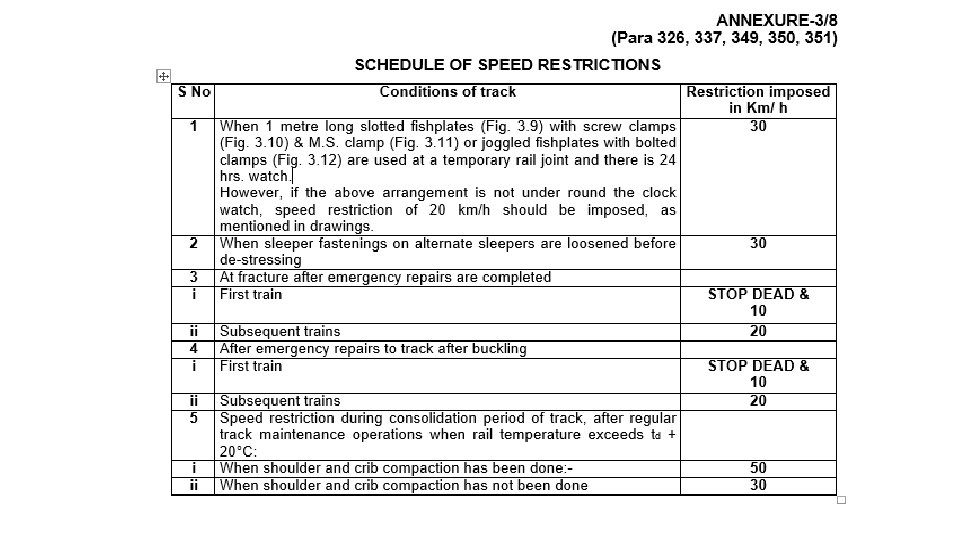
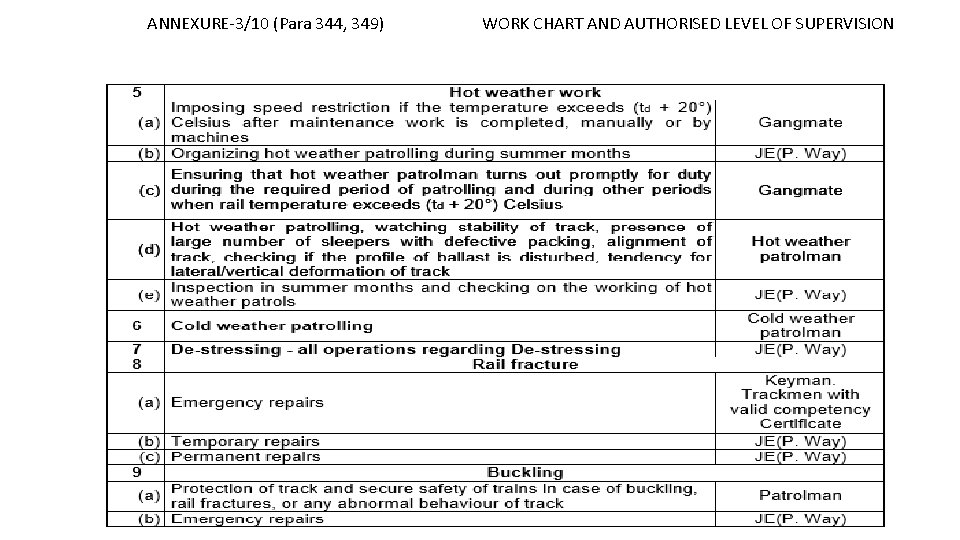
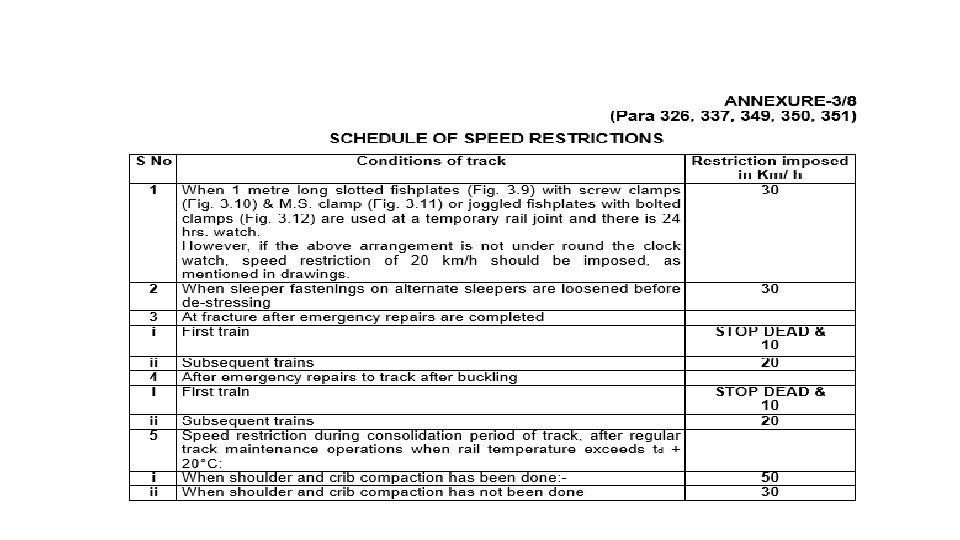
Rectification of Rail Fractures: (contd. . ) • (3) Emergency repairs: • The fractured rails shall be joined by using the arrangements shown in Fig. 3. 9, 3. 10, 3. 11 & 3. 12 given in next slide with or without insertion of closure rail piece as per site conditions and feasibility. The traffic may then be resumed at a speed as mentioned in Annexure 3/8 and by authority as mentioned in Annexure 3/10.
ARM Fig. 3. 9 - 1 m LONG SLOTTED FISH PLATE FOR CLAMPED JOINTS /SUPPORT
Fig. 3. 10 SCREW CLAMP FOR FIXING 1 m LONG FISH PLATE
Fig. 3. 11 M. S. CLAMP FOR FIXING 1 m LONG FISH PLATE
Fig. 3. 12 DETAILS OF JOGGLED FISH PLATE WITH CLAMP / SUPPORT ARM
ANNEXURE-3/10 (Para 344, 349) WORK CHART AND AUTHORISED LEVEL OF SUPERVISION
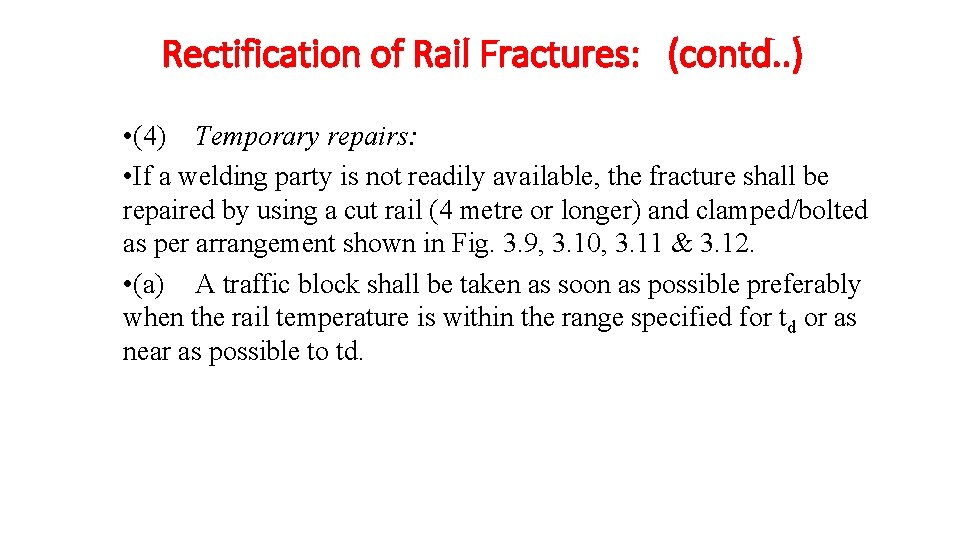
Rectification of Rail Fractures: (contd. . ) • (4) Temporary repairs: • If a welding party is not readily available, the fracture shall be repaired by using a cut rail (4 metre or longer) and clamped/bolted as per arrangement shown in Fig. 3. 9, 3. 10, 3. 11 & 3. 12. • (a) A traffic block shall be taken as soon as possible preferably when the rail temperature is within the range specified for td or as near as possible to td.
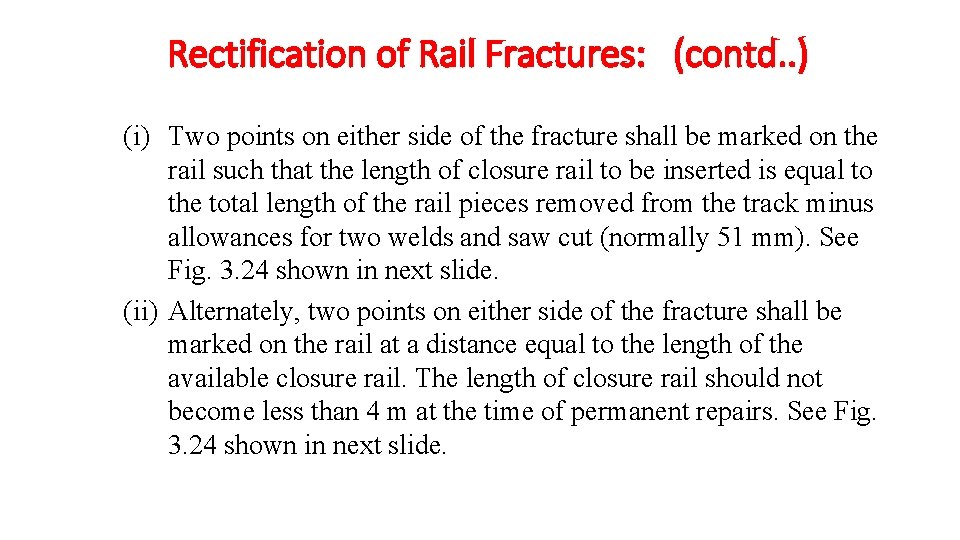
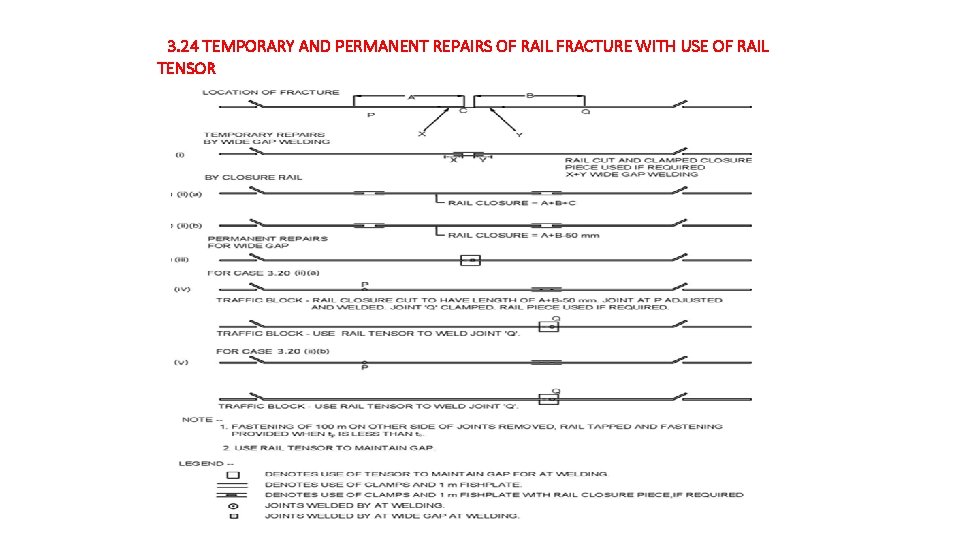
Rectification of Rail Fractures: (contd. . ) (i) Two points on either side of the fracture shall be marked on the rail such that the length of closure rail to be inserted is equal to the total length of the rail pieces removed from the track minus allowances for two welds and saw cut (normally 51 mm). See Fig. 3. 24 shown in next slide. (ii) Alternately, two points on either side of the fracture shall be marked on the rail at a distance equal to the length of the available closure rail. The length of closure rail should not become less than 4 m at the time of permanent repairs. See Fig. 3. 24 shown in next slide.
Rectification of Rail Fractures: (contd. . ) • (b) The rails shall then be cut through at these points simultaneously, if possible. The closure rail shall then be inserted and joined See Fig. 3. 24 shown in next slide. After joining, the traffic shall then be resumed at restricted speed in accordance with Annexure-3/8 of IRPWM. • (c) In case closure rail as per Sub Para (4) (a) (i) above is inserted, one of the joints may have to be provided with closure piece of adequate width and joined by one metre fishplate and clamps.
3. 24 TEMPORARY AND PERMANENT REPAIRS OF RAIL FRACTURE WITH USE OF RAIL TENSOR
Permanent Repairs: • (a) If the fracture is such that, wide gap AT welding can be adopted, then the total length of fractured ends to be cut shall be equal to the gap required for wide gap welding. Once the two ends are cut, a gap required for wide gap welding will be created by using rail tensors and joint welded by wide gap AT welding technique. • (b) In case rail closure as per Sub Para (4) (a) (i) has been provided for temporary repairs, one joint of the closure rail shall be welded without rail tensor after setting correct gap for welding. However, to ensure correct gap during welding of the other joint, tensor shall be used.
Permanent Repairs: (contd. . ) (c) In case rail closure as per Sub Para (4) (a) (ii) has been provided at the time of temporary repairs, the rail closure shall be suitably cut such that the length of the rail to be finally inserted in track is equal to length of rail removed from track after fracture minus allowances for two welds i. e. 50 mm. Once the closure rail is cut, the closure rail will be welded as given in Sub Para (5) (b).
Permanent Repairs: (contd. . ) (d) It is necessary to carry out local destressing of 125 m on either side for equalization of stresses, induced in LWR due to permanent repair. Explanatory note is given in annexure 3/17. After welding of joints, at rail temperature below td, a length of track equal to 125 m on either side be unfastened and tapped to ensure equalization of stress and then refastened The details of equalization of forces shall be entered in to TMS under local destressing in weld fracture report.
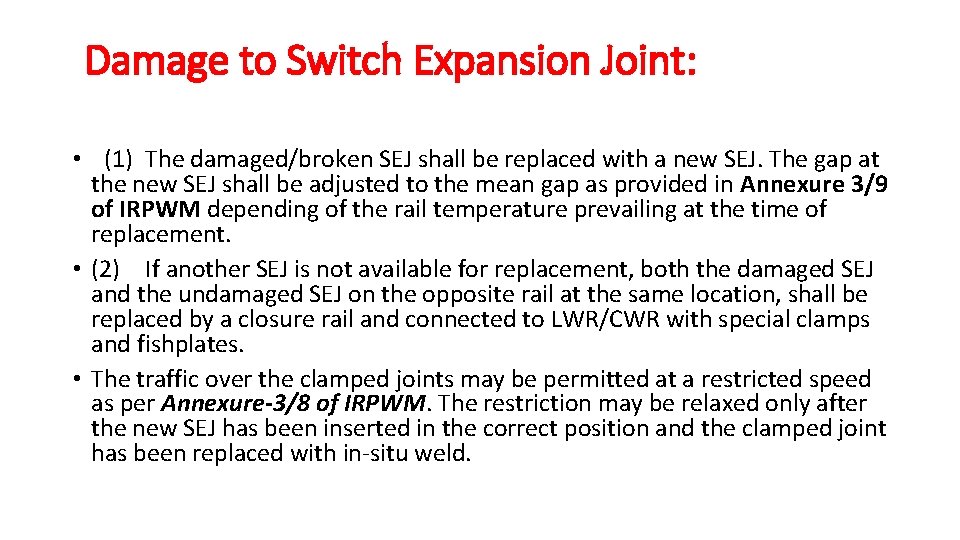
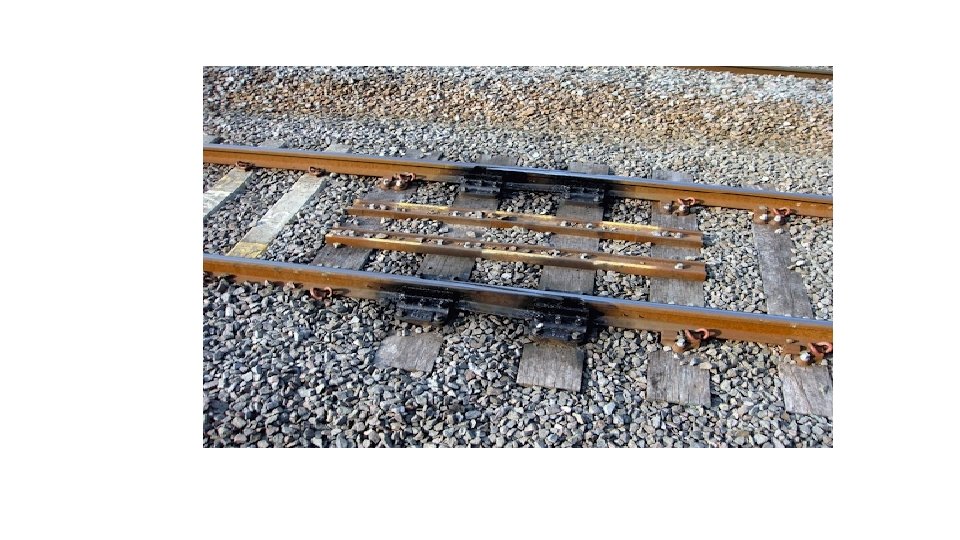
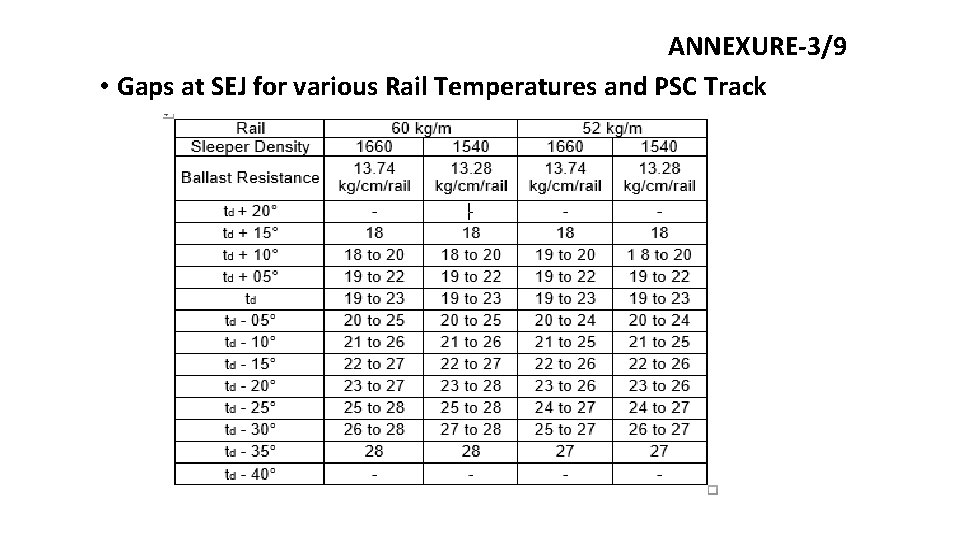
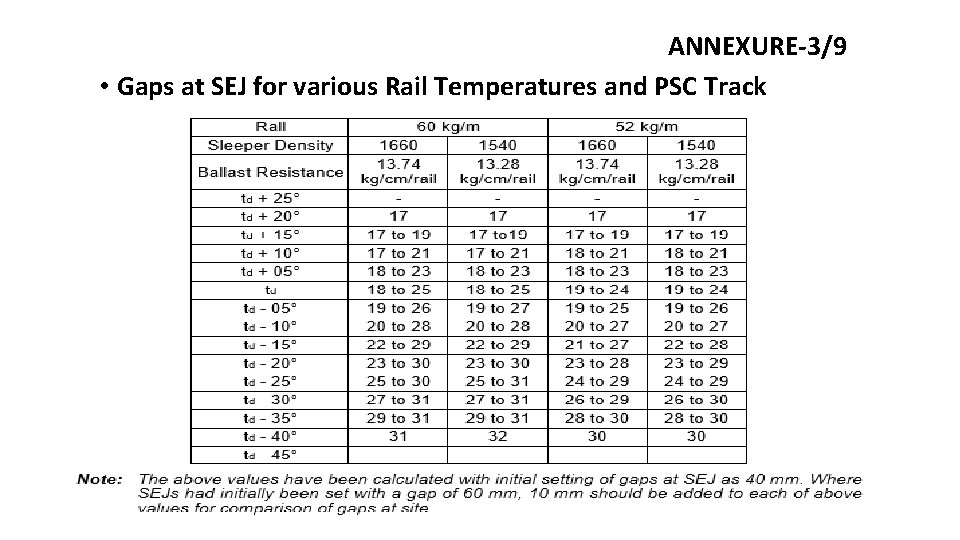
Damage to Switch Expansion Joint: • (1) The damaged/broken SEJ shall be replaced with a new SEJ. The gap at the new SEJ shall be adjusted to the mean gap as provided in Annexure 3/9 of IRPWM depending of the rail temperature prevailing at the time of replacement. • (2) If another SEJ is not available for replacement, both the damaged SEJ and the undamaged SEJ on the opposite rail at the same location, shall be replaced by a closure rail and connected to LWR/CWR with special clamps and fishplates. • The traffic over the clamped joints may be permitted at a restricted speed as per Annexure-3/8 of IRPWM. The restriction may be relaxed only after the new SEJ has been inserted in the correct position and the clamped joint has been replaced with in-situ weld.
ANNEXURE-3/9 • Gaps at SEJ for various Rail Temperatures and PSC Track
ANNEXURE-3/9 • Gaps at SEJ for various Rail Temperatures and PSC Track
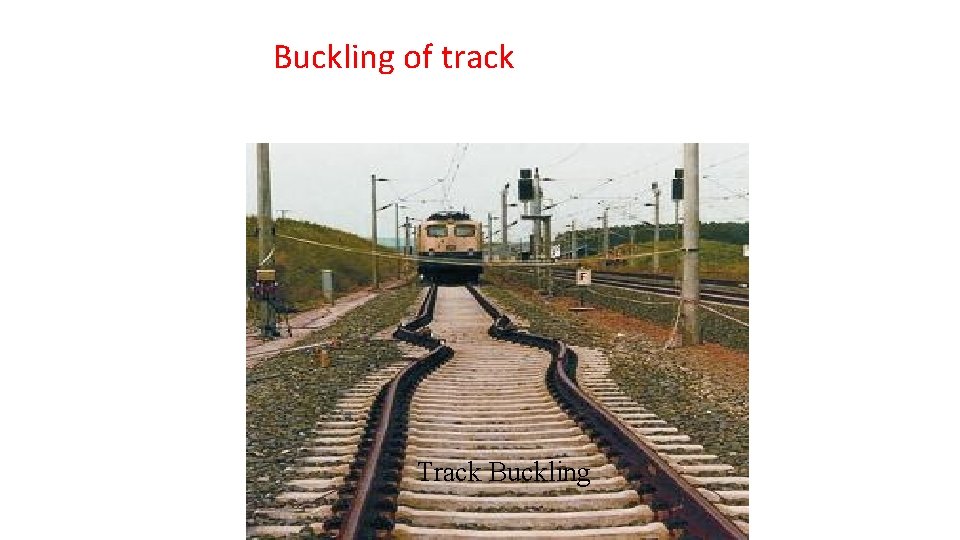
Buckling of track Track Buckling
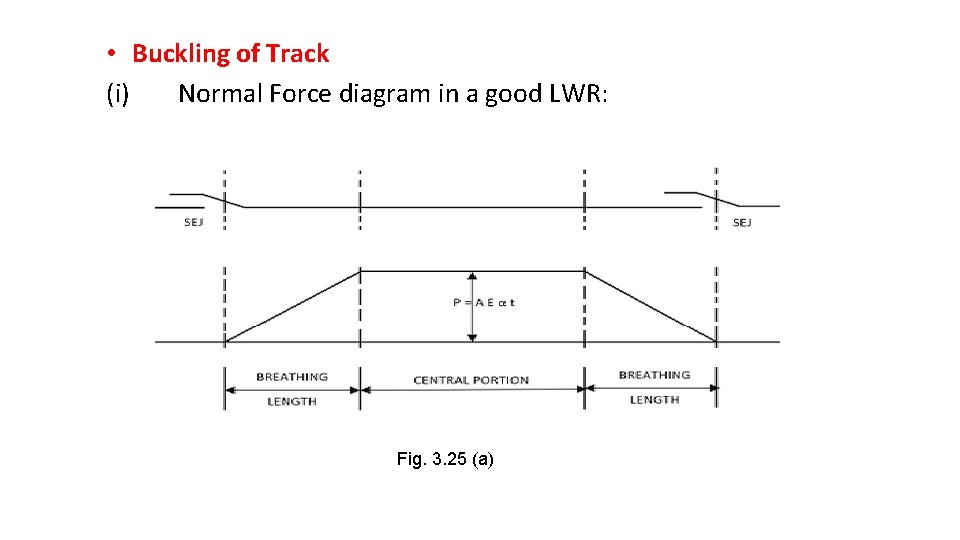
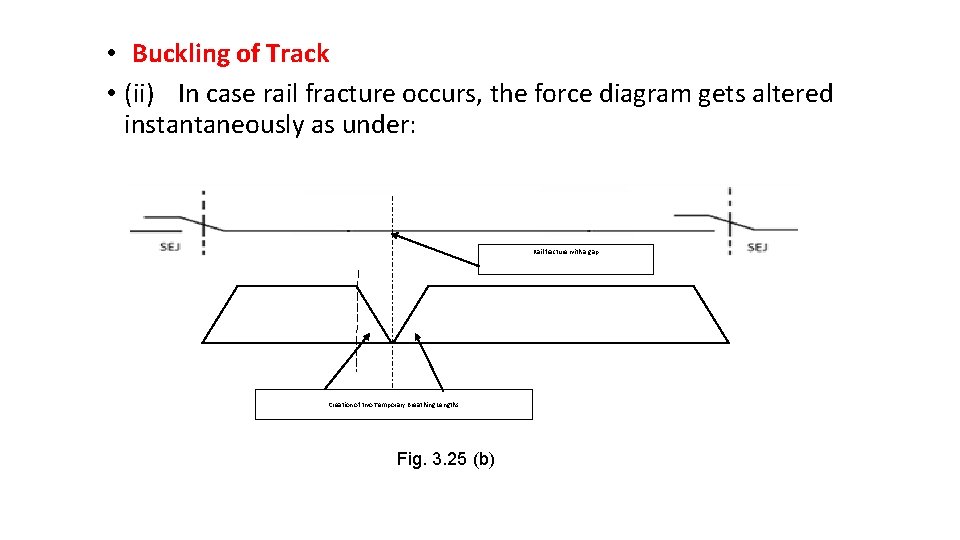
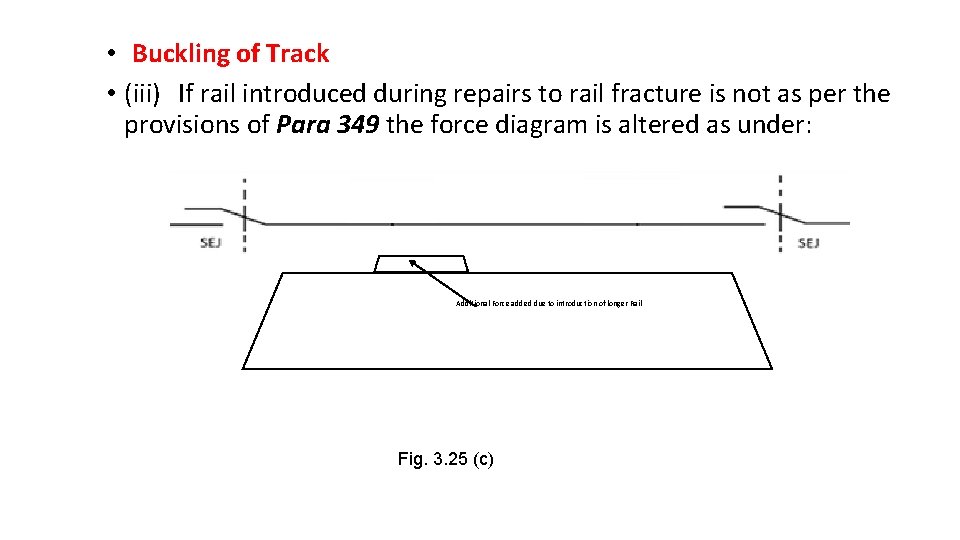
• Buckling of Track • (1) General: • Buckling or a tendency towards buckling may occur, among others, in the following circumstances: • (a) Failure to adhere to the temperature ranges specified for various laying and maintenance activities on LWR/CWR. • (b) Inadequate resistance to longitudinal, lateral and vertical movement of track due to deficiencies in ballast section or/and inadequate ballast consolidation. • (c) Use of ineffective fastenings or missing fastenings resulting in loss of creep resistance and torsional resistance. • (d) Excessive settlement of formation. • (e) Repair to fractures or replacement of defective rails not as per procedure prescribed in Para 349, which can lead to the disturbance to the force diagram in the LWR as explained below (fig. 3. 25 (a), (b) (c)).
• Buckling of Track (i) Normal Force diagram in a good LWR: Fig. 3. 25 (a)
• Buckling of Track • (ii) In case rail fracture occurs, the force diagram gets altered instantaneously as under: Rail fracture with a gap Creation of two Temporary Breathing Lengths Fig. 3. 25 (b)
• Buckling of Track • (iii) If rail introduced during repairs to rail fracture is not as per the provisions of Para 349 the force diagram is altered as under: Additional Force added due to introduction of longer Rail Fig. 3. 25 (c)
• Buckling and its investigation: • (a) Tendency towards buckling will usually manifest itself through kinks in track. Kinks may also arise from incorrect slewing or lifting operations. By tapping sleepers for hollowness, it may be possible to notice if there is any tendency towards vertical buckling.
• Buckling and its investigation: • (b) As soon as the tendency for buckling is detected, the traffic shall be suspended and the track protected. The track shall then be stabilized by heaping ballast on the shoulders upto the top of the web of the rail obtaining the ballast from inter-sleeper spaces between the rails. Thereafter full investigation shall be made to find out the cause of the tendency for buckling. • (c) Each case or buckling shall be investigated by ADEN soon after its occurrence and a detailed report submitted to DEN/Sr. DEN.
Repairs to buckled track (a) When the track actually buckles, the traffic shall be suspended and the cause of buckling ascertained. • (b) The rectification shall normally be carried out in the following stages under the supervision of JE/SSE/P. Way: • i) Emergency repairs • ii) Permanent repairs • iii) De-stressing.
Repairs to buckled track. (contd. . ) (i) Emergency repairs: • The buckled rails shall preferably be gas cut adequately apart not less than 6. 5 m. The track shall then be slewed to the correct alignment and cut rails of the required lengths shall be inserted to close the gaps making due provision for welding of joints on both sides. The cut rails shall then be connected by use of special fishplates and screw clamps and the line opened to traffic with speed restriction as indicated in Annexure-3/8.
Repairs to buckled track. (contd. . ) • (ii) Permanent repairs: • As soon as possible, the clamped joints shall be welded adopting the same procedure as in Para 349(4) and (5) of IRPWM. Additional pair of cut rails and rail cutting equipment shall also be required to adjust the gaps in case they have been disturbed in the intervening period. • The speed restriction shall be removed after welding.
Repairs to buckled track • (iii) The length of track of minimum 500 m on either side of the location of buckling of the affected LWR shall be de-stressed as soon as possible as per Para 340 / 341 of IRPWM and complete LWR shall be inspected by ADEN and further action as deemed necessary shall be taken.
Breaches, Temporary Girders and Diversions • (1) The affected portion shall be isolated by insertion of SEJs preferably within the temperature range specified for td. • (2) The track thus isolated shall be replaced by fish plated / SWR track, which shall be box, anchored, if necessary. • (3) In the breached sections where the new banks are constructed, the formation shall be fully consolidated before laying LWR again. • (4) In case of diversions and insertion of temporary girders, SEJ shall be inserted to isolate the portion where such work is required to be done. • (5) The LWR panels in the affected portion shall be de-stressed immediately after the LWR are restored
THANKS