
3 5 Limits At Infinity North Dakota Sunset


- Slides: 18
3. 5 Limits At Infinity North Dakota Sunset Photo by Vickie Kelly, 2006 Greg Kelly, Hanford High School, Richland, Washington
Objectives • Determine (finite) limits at infinity. • Determine the horizontal asymptotes, if any, of the graph of a function. • Determine limits at infinity.
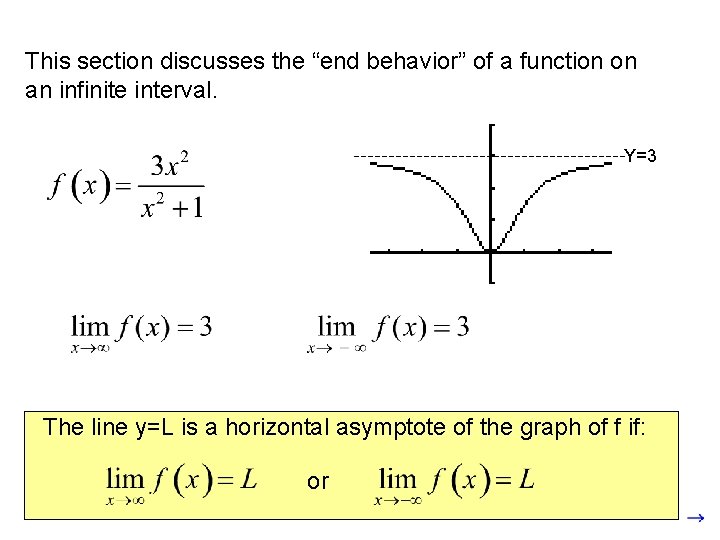
This section discusses the “end behavior” of a function on an infinite interval. Y=3 The line y=L is a horizontal asymptote of the graph of f if: or
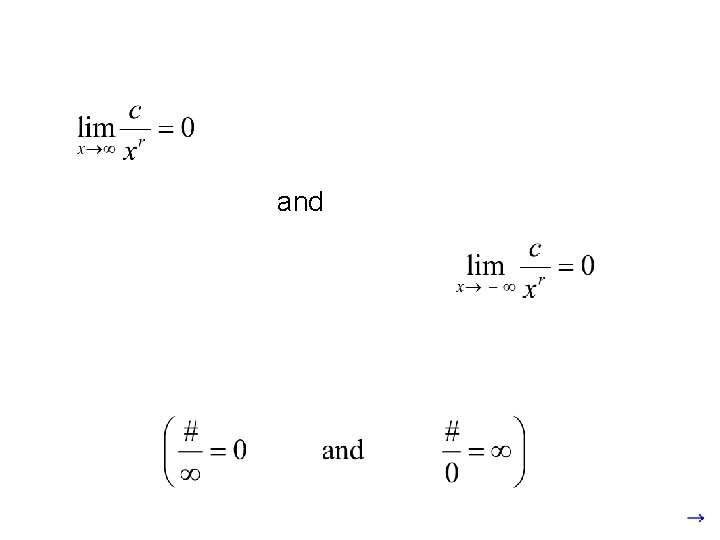
and
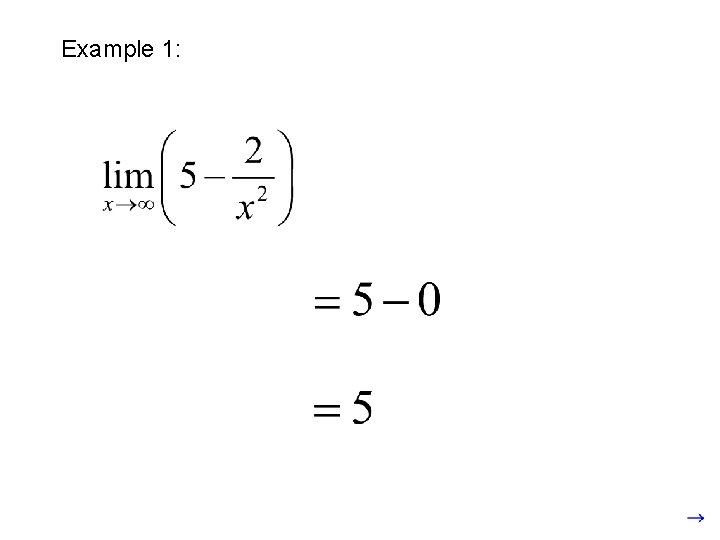
Example 1:
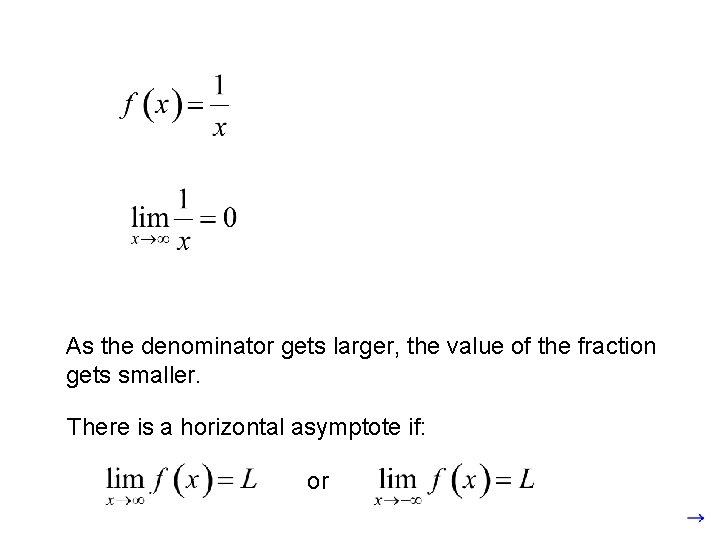
As the denominator gets larger, the value of the fraction gets smaller. There is a horizontal asymptote if: or
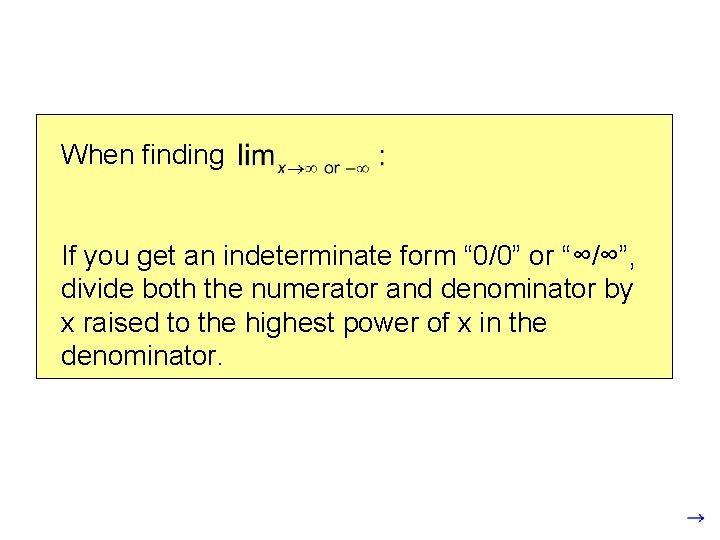
When finding If you get an indeterminate form “ 0/0” or “∞/∞”, divide both the numerator and denominator by x raised to the highest power of x in the denominator.
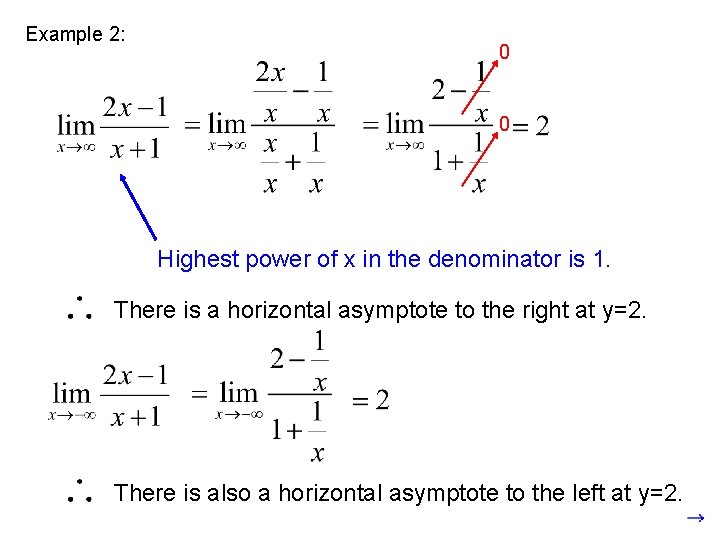
Example 2: 0 0 Highest power of x in the denominator is 1. There is a horizontal asymptote to the right at y=2. There is also a horizontal asymptote to the left at y=2.
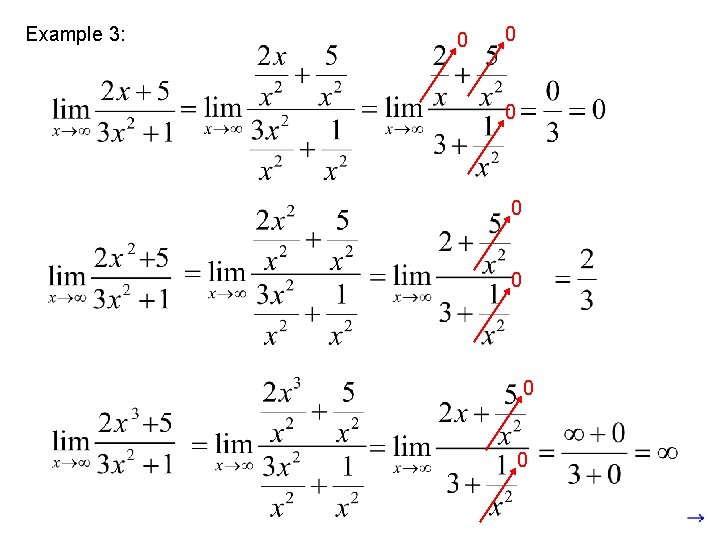
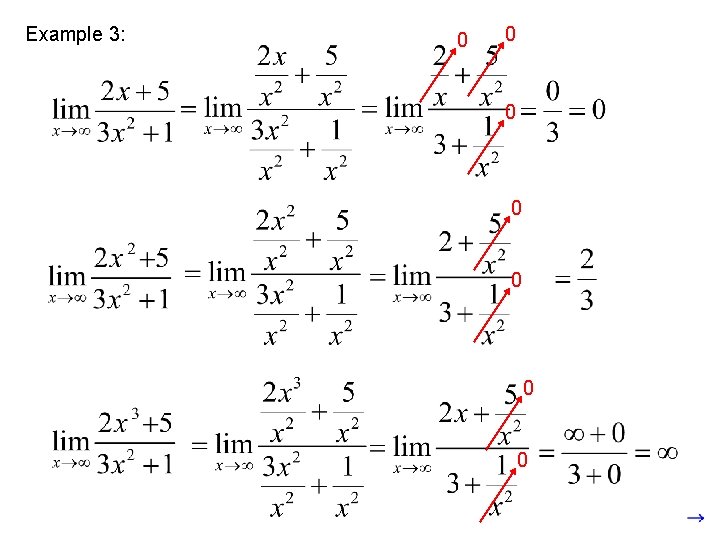
Example 3: 0 0 0 0
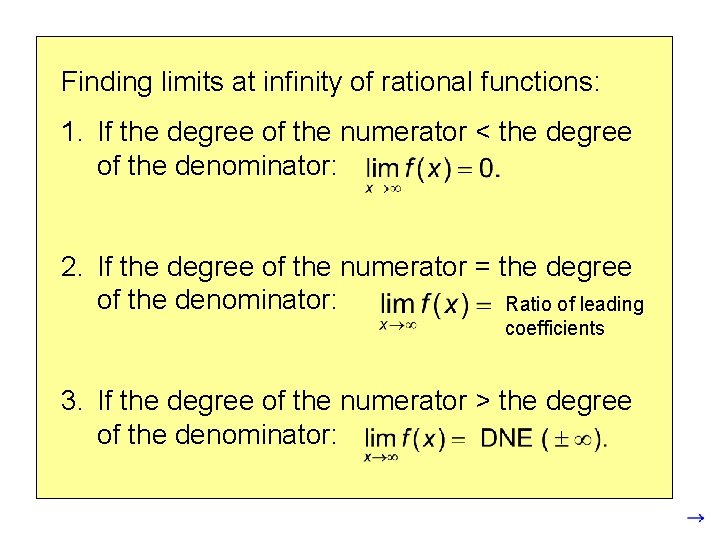
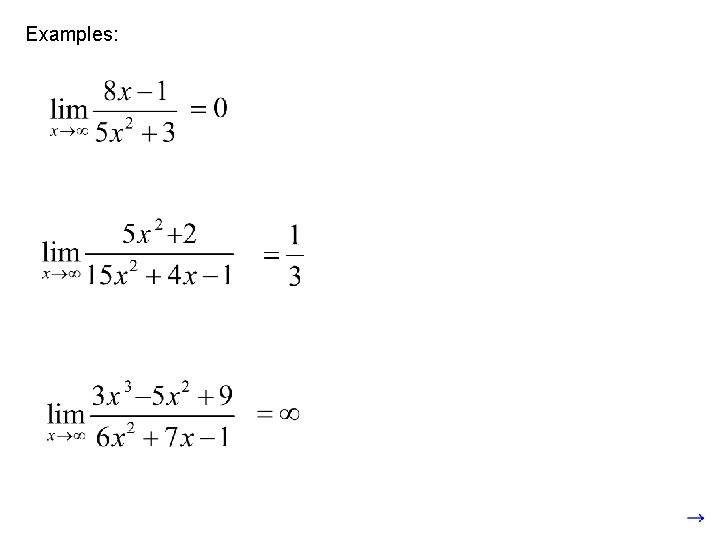
Finding limits at infinity of rational functions: 1. If the degree of the numerator < the degree of the denominator: 2. If the degree of the numerator = the degree of the denominator: Ratio of leading coefficients 3. If the degree of the numerator > the degree of the denominator:
Example 3: 0 0 0 0
Examples:
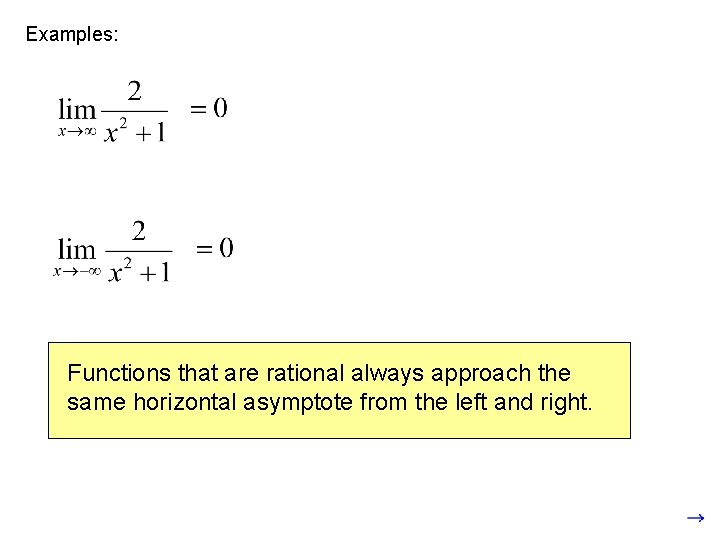
Examples: Functions that are rational always approach the same horizontal asymptote from the left and right.
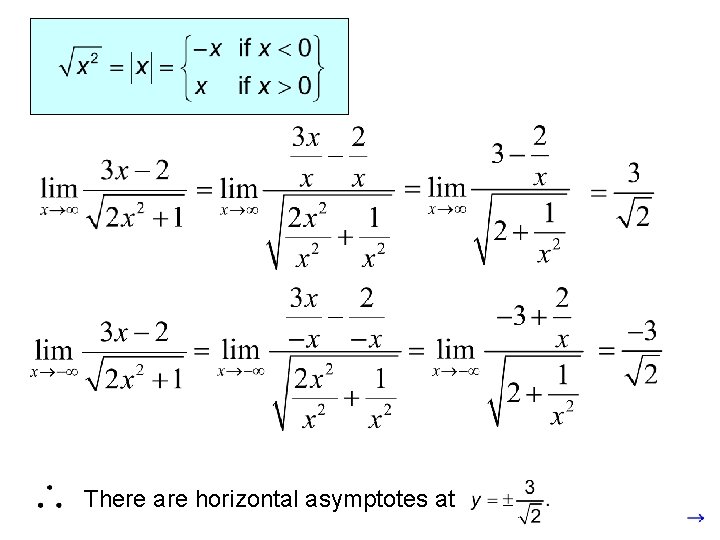
There are horizontal asymptotes at
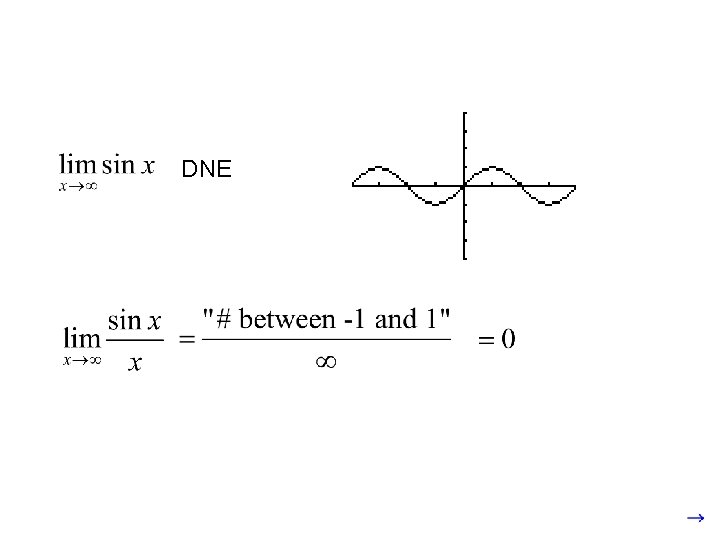
DNE
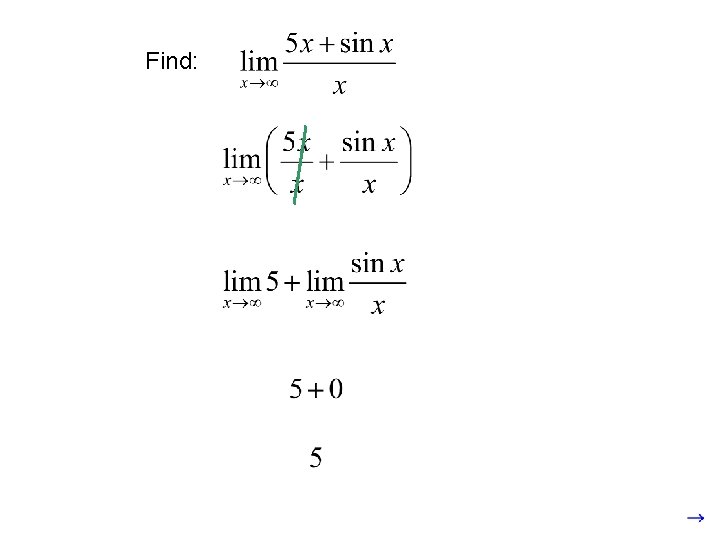
Find:
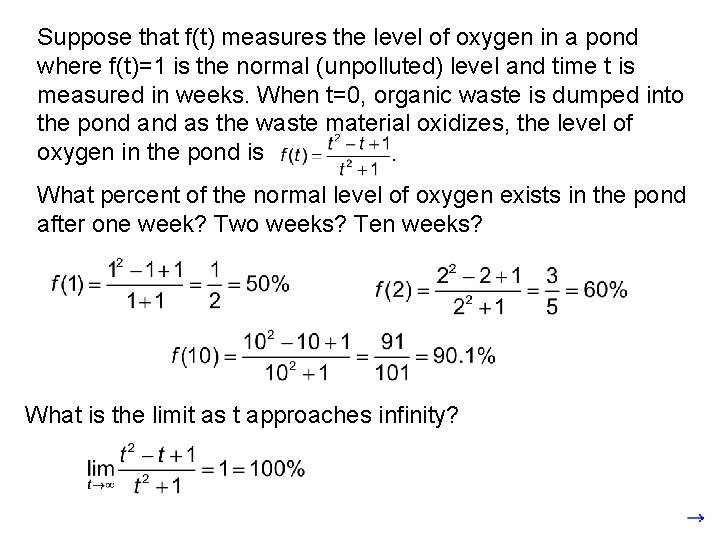
Suppose that f(t) measures the level of oxygen in a pond where f(t)=1 is the normal (unpolluted) level and time t is measured in weeks. When t=0, organic waste is dumped into the pond as the waste material oxidizes, the level of oxygen in the pond is What percent of the normal level of oxygen exists in the pond after one week? Two weeks? Ten weeks? What is the limit as t approaches infinity?
Homework 3. 5 (page 199) #1 -6 all #7 -31 odd, 32, 33, 37, 39, 49 (skip tables & graphing calculator directions) #51, 55, 59, 61, 65, 73, 75 (find the horizontal asymptotes only)