
3 4 Mesh analysis for circuits without current









- Slides: 28
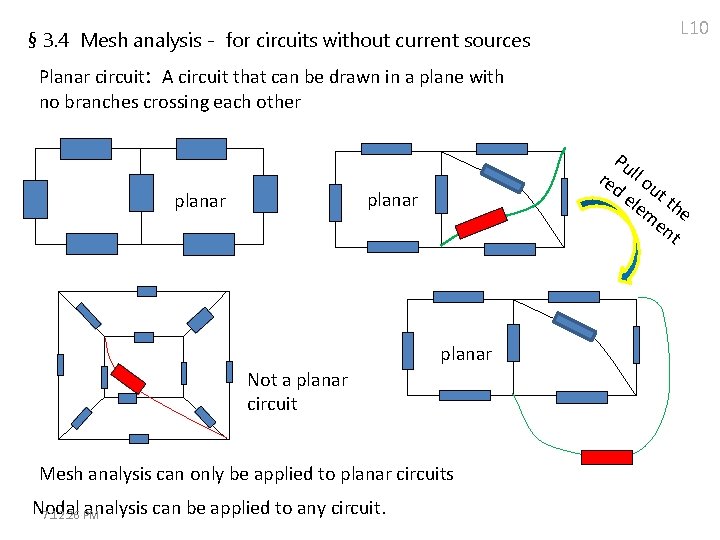
§ 3. 4 Mesh analysis - for circuits without current sources L 10 Planar circuit: A circuit that can be drawn in a plane with no branches crossing each other Pu re ll o d e ut lem the en t planar Not a planar circuit Mesh analysis can only be applied to planar circuits Nodal analysis can be applied to any circuit. 7: 12: 26 PM
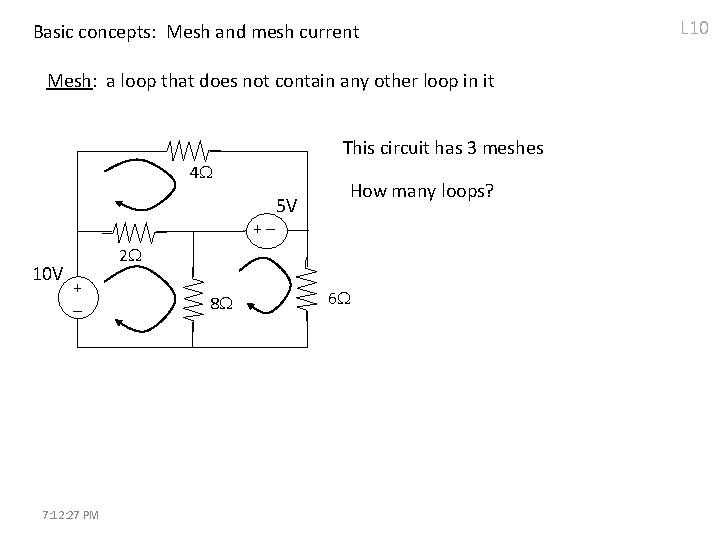
Basic concepts: Mesh and mesh current Mesh: a loop that does not contain any other loop in it This circuit has 3 meshes 4 +- 10 V 5 V How many loops? 2 + - 7: 12: 27 PM 8 6 L 10
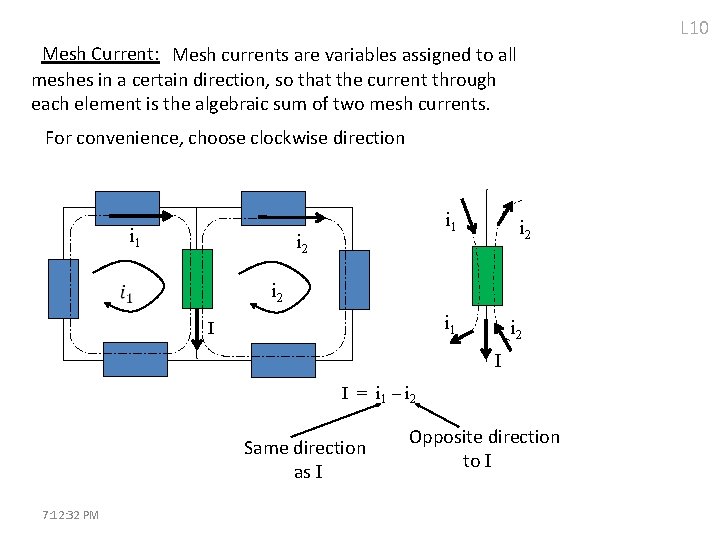
L 10 Mesh Current: Mesh currents are variables assigned to all meshes in a certain direction, so that the current through each element is the algebraic sum of two mesh currents. For convenience, choose clockwise direction i 1 i 2 i 2 i 1 I i 2 I I = i 1 – i 2 Same direction as I 7: 12: 32 PM Opposite direction to I
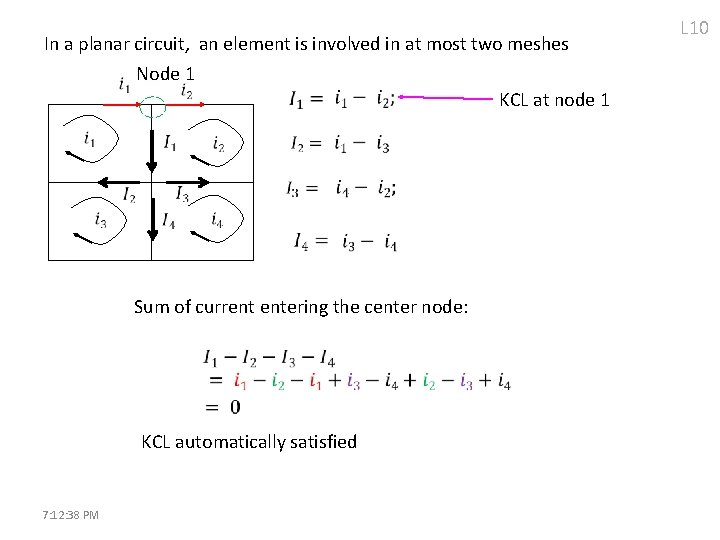
In a planar circuit, an element is involved in at most two meshes Node 1 KCL at node 1 Sum of current entering the center node: KCL automatically satisfied 7: 12: 38 PM L 10
Basic Idea of mesh analysis: L 10 Express branch voltages in terms of mesh currents. Form equations by applying KVL along the meshes. Basic step: Express resistor voltages in terms of mesh currents By ohm’s law: R Enters at + Enters at -
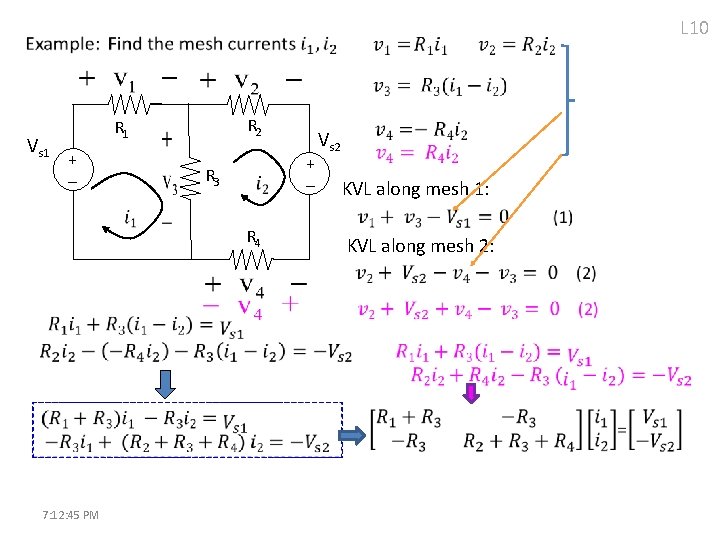
L 10 Vs 1 R 2 R 1 + - R 3 R 4 7: 12: 45 PM Vs 2 KVL along mesh 1: KVL along mesh 2:
Summary of general steps for circuit without current sources Step 1: Assign mesh currents, i 1, i 2, …, in Step 2: Assign resistor voltages with polarity, and express these voltages in terms of mesh currents Step 3: Apply KVL along each mesh to obtain n equations with respect to mesh currents (first in terms of voltages, then plug in the expressions from step 2) Step 4: Solve equations for mesh currents. Obtain everything else asked 7: 12: 46 PM L 10
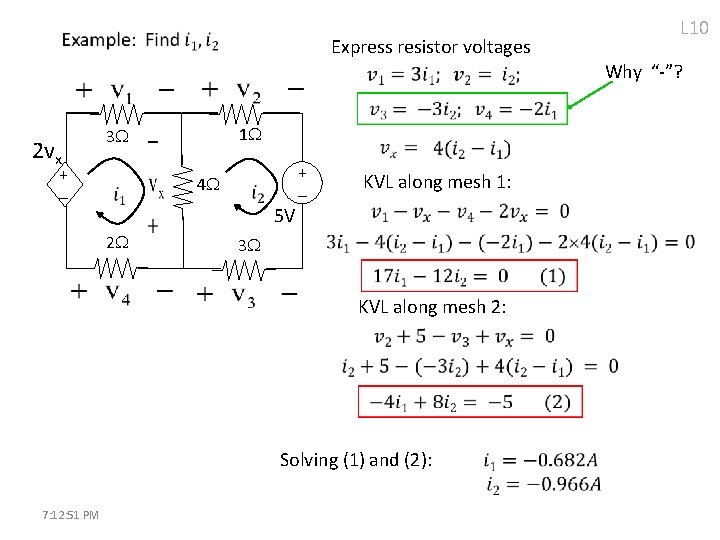
Express resistor voltages L 10 Why “-”? 2 vx 1 3 + - 4 5 V 2 + - KVL along mesh 1: 3 KVL along mesh 2: Solving (1) and (2): 7: 12: 51 PM
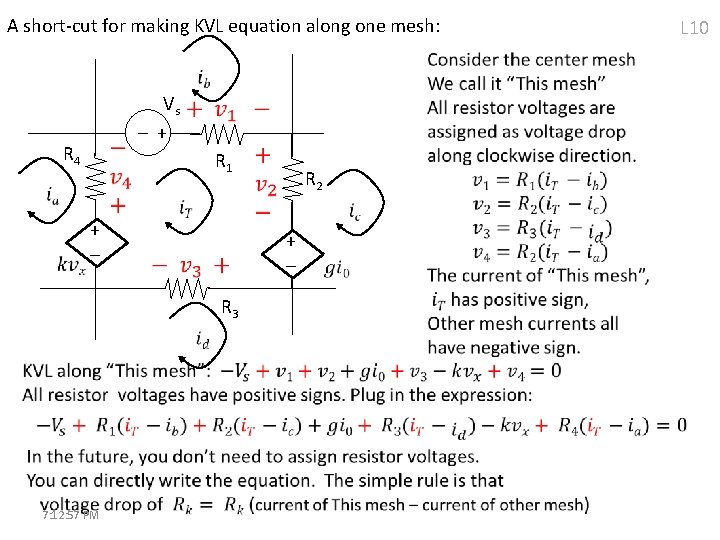
A short-cut for making KVL equation along one mesh: Vs + - R 4 R 1 + - + R 3 7: 12: 57 PM R 2 L 10
Clockwise along mesh 1: Previous example: 2 vx 1 3 + - 4 5 V 2 3 + - Voltage drop across 3 : Voltage drop across 4 : Voltage drop across 2 : Clockwise along mesh 2: Voltage drop across 1 : Voltage drop across 3 : Voltage drop across 4 : 7: 13: 02 PM L 10
KVL along mesh 1: Mesh 2: Mesh 3:
R 10 2Ω 6Ω 6Ω 2Ω 4Ω 7: 13: 11 PM 4Ω
R 10 7: 13: 11 PM
R 10 i 1 i 3 i 2 7: 13: 12 PM
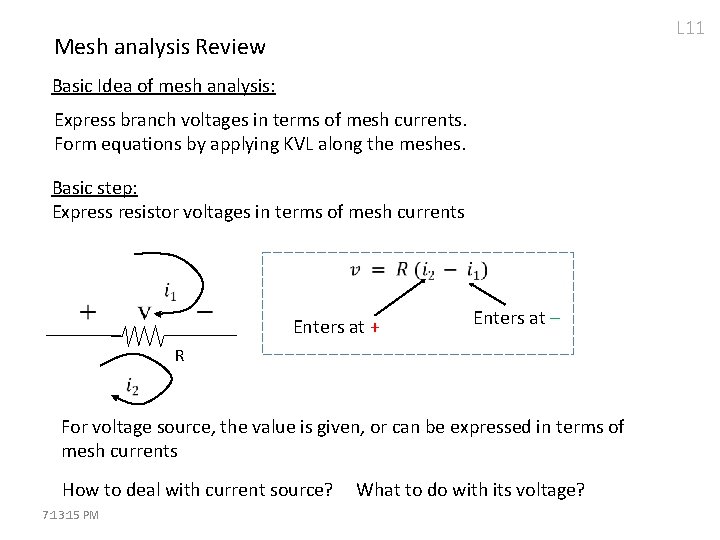
L 11 Mesh analysis Review Basic Idea of mesh analysis: Express branch voltages in terms of mesh currents. Form equations by applying KVL along the meshes. Basic step: Express resistor voltages in terms of mesh currents Enters at + Enters at - R For voltage source, the value is given, or can be expressed in terms of mesh currents How to deal with current source? 7: 13: 15 PM What to do with its voltage?
§ 3. 5 Mesh analysis with current source What is the trouble with current source? How to express its voltage in terms of mesh currents? Its voltage cannot be expressed in terms of mesh currents Posing problems for making equations by KVL Case 1: The current source exists only in one mesh -- at the boundary of the circuit 10 V 3 4 + - 6 5 A 3 KVL along mesh 1 7: 13: 21 PM One equation is enough L 11
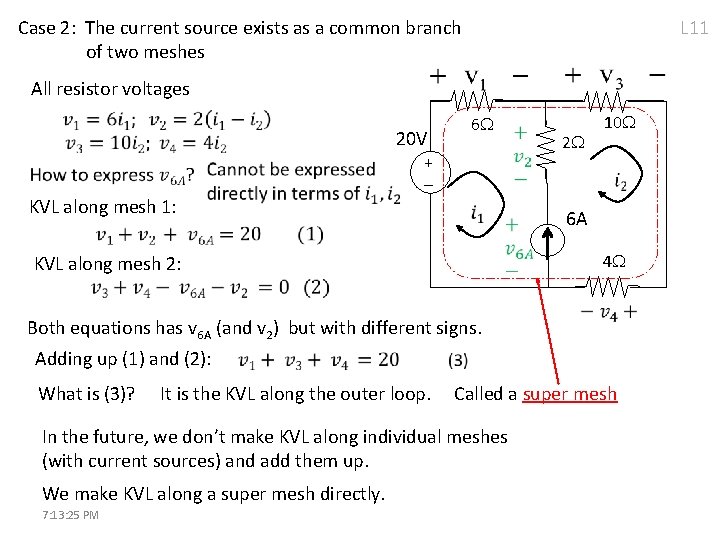
L 11 Case 2: The current source exists as a common branch of two meshes All resistor voltages 20 V 6 + - KVL along mesh 1: 2 10 6 A 4 KVL along mesh 2: Both equations has v 6 A (and v 2) but with different signs. Adding up (1) and (2): What is (3)? It is the KVL along the outer loop. Called a super mesh In the future, we don’t make KVL along individual meshes (with current sources) and add them up. We make KVL along a super mesh directly. 7: 13: 25 PM
L 11 Super mesh: is formed by combining two or more meshes All resistor voltages 20 V 6 2 + - KVL along super mesh: i 2 i 1 Plug in voltage expressions: 10 6 A 4 A super mesh a It comes from the 6 A current source: You can also consider (Eq 2) as KCL at node a. 7: 13: 32 PM The purpose of making a super mesh is to avoid the voltage of a current source in a KVL equation.
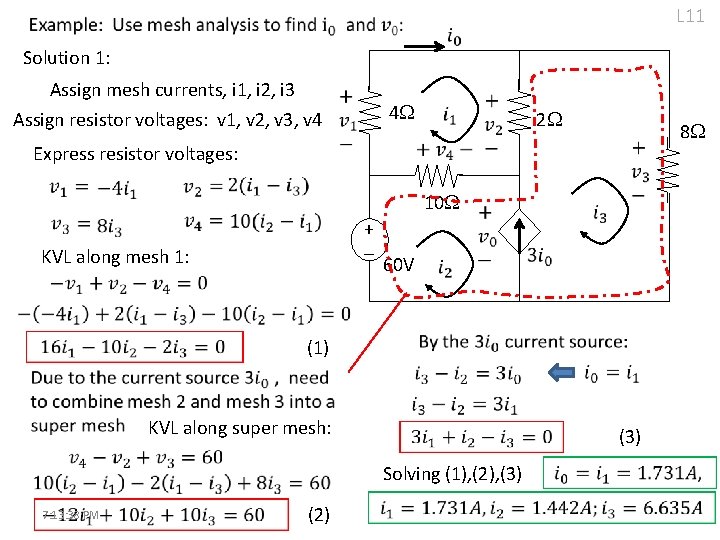
L 11 Solution 1: Assign mesh currents, i 1, i 2, i 3 Assign resistor voltages: v 1, v 2, v 3, v 4 4 2 8 Express resistor voltages: 10 + - KVL along mesh 1: 60 V (1) KVL along super mesh: (3) Solving (1), (2), (3) 7: 13: 38 PM (2)
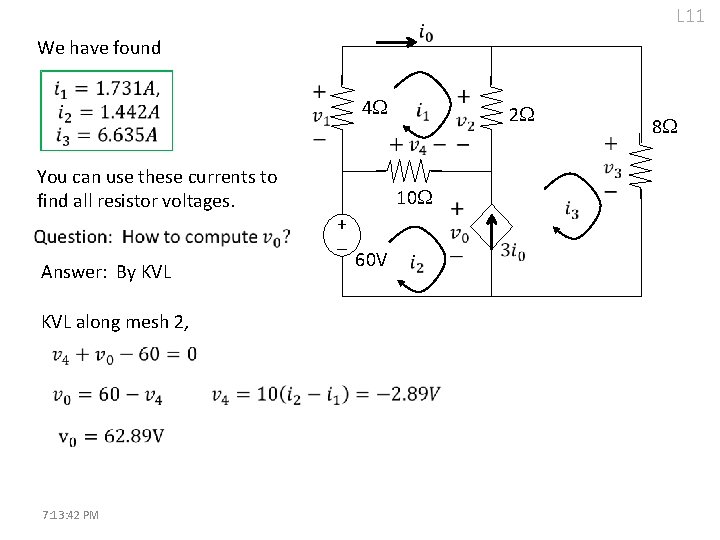
L 11 We have found 4 You can use these currents to find all resistor voltages. Answer: By KVL along mesh 2, 7: 13: 42 PM 2 10 + - 60 V 8
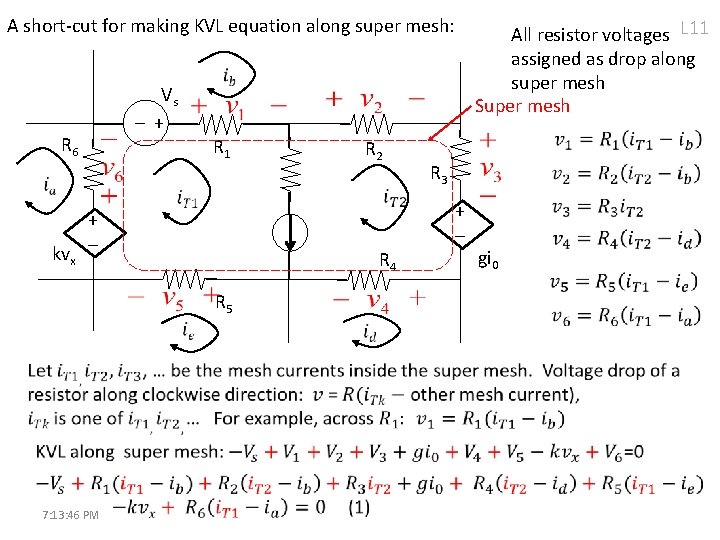
A short-cut for making KVL equation along super mesh: All resistor voltages L 11 assigned as drop along super mesh Super mesh Vs + - R 6 R 1 + kvx - R 4 R 5 7: 13: 46 PM R 2 R 3 + - gi 0
L 11 Previous example, approach 2: Using shortcut to make KVL equations: KVL along mesh 1 4 2 8 10 KVL along super mesh: + - 60 V Another approach: Instead of making KVL along super mesh, We can also make KVL along outer mesh: Observe that 7: 13: 47 PM You must use (3) and two of (1), (2’) (1), (2), (3) or (1)(2’)(3) or (2)(2’)(3)
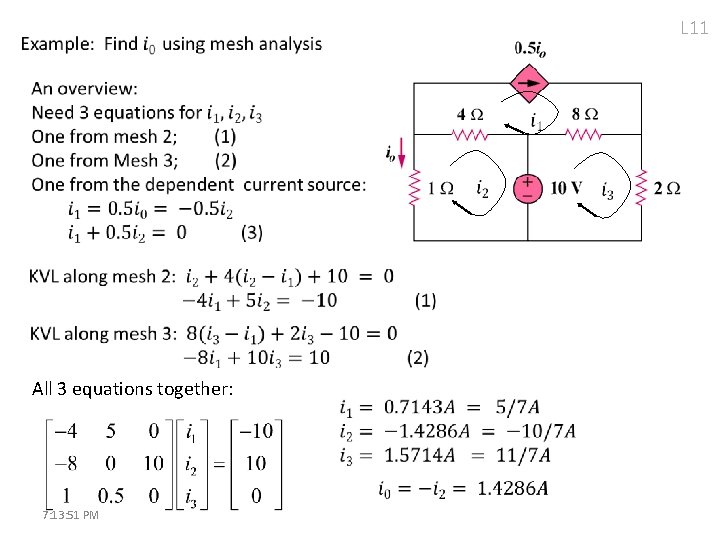
L 11 All 3 equations together: 7: 13: 51 PM
Now we have found Need to find the voltage across this current source. Need other voltages and KVL. Supplies power! 7: 13: 54 PM L 11
Practice 5: Find the mesh currents and vx 7: 13: 59 PM R 11
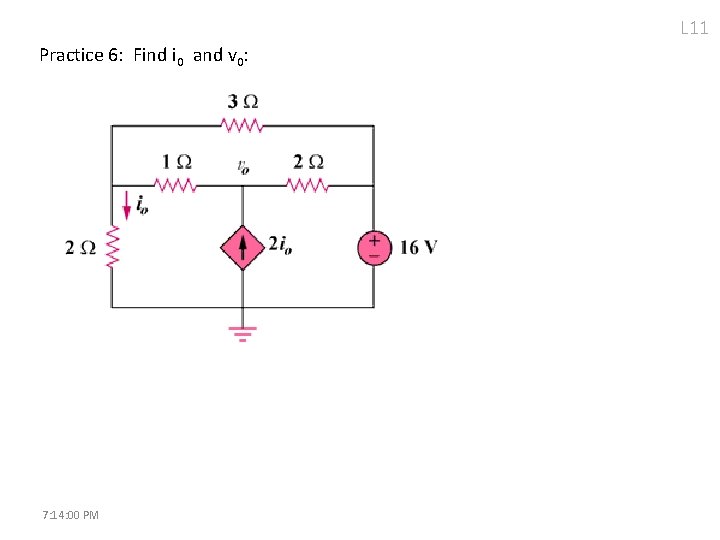
L 11 Practice 6: Find i 0 and v 0: 7: 14: 00 PM
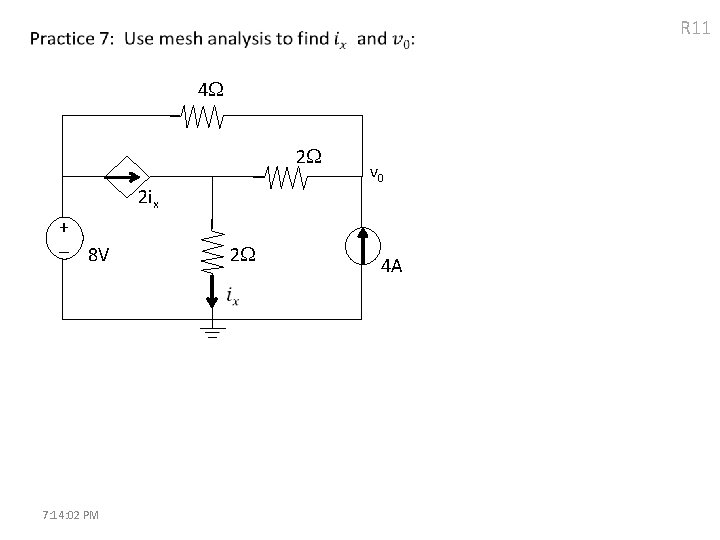
R 11 4 2 2 ix + - 8 V 7: 14: 02 PM 2 v 0 4 A