
3 3 The Addition Rule Mutually Exclusive Events


- Slides: 7
§ 3. 3 The Addition Rule
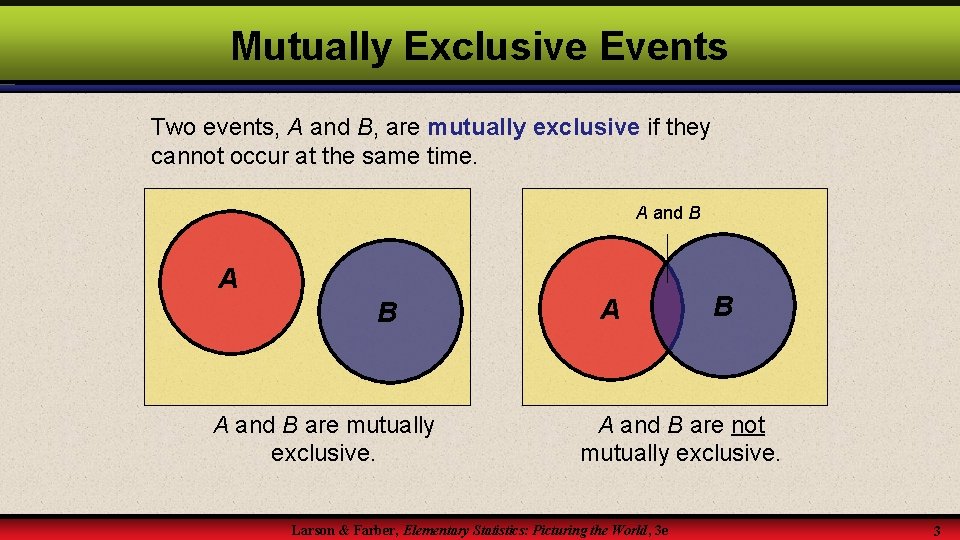
Mutually Exclusive Events Two events, A and B, are mutually exclusive if they cannot occur at the same time. A and B are mutually exclusive. A B A and B are not mutually exclusive. Larson & Farber, Elementary Statistics: Picturing the World, 3 e 3
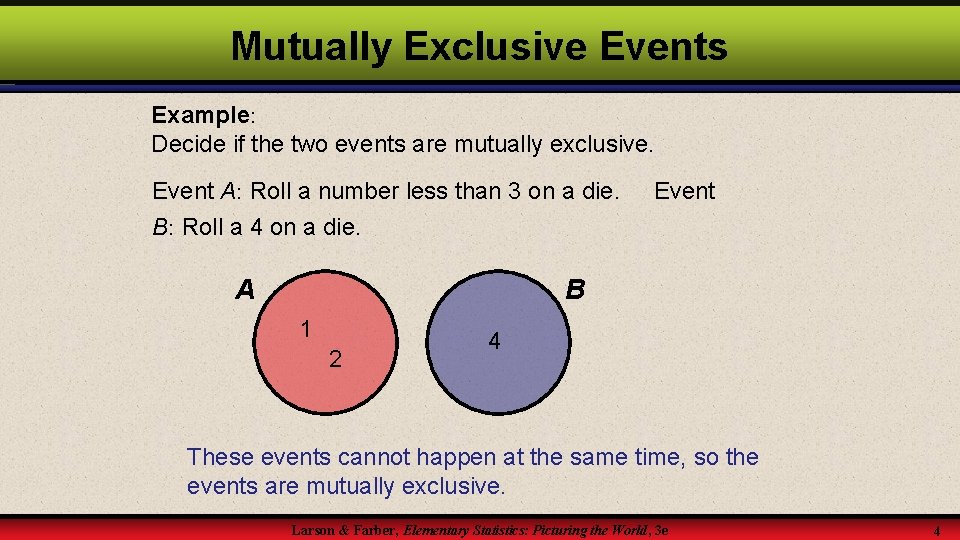
Mutually Exclusive Events Example: Decide if the two events are mutually exclusive. Event A: Roll a number less than 3 on a die. Event B: Roll a 4 on a die. A B 1 2 4 These events cannot happen at the same time, so the events are mutually exclusive. Larson & Farber, Elementary Statistics: Picturing the World, 3 e 4
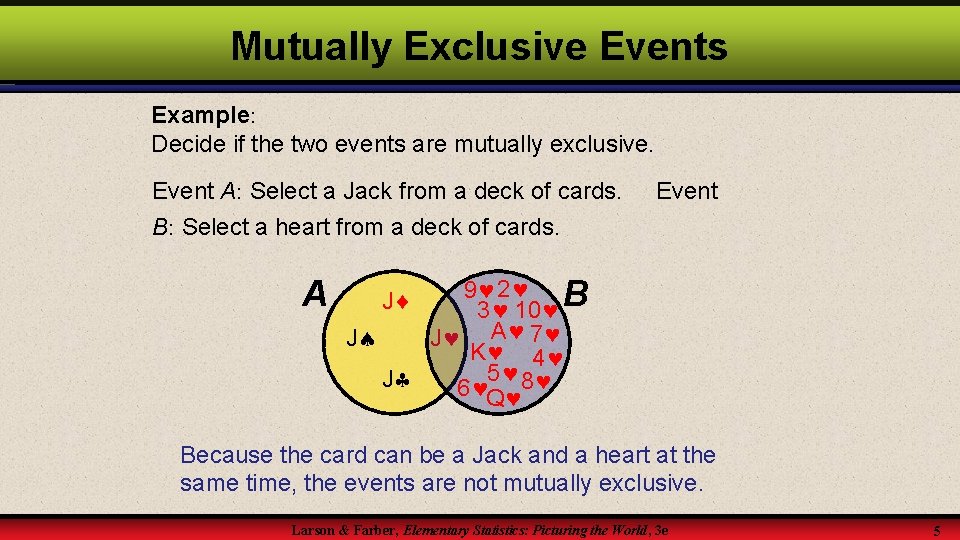
Mutually Exclusive Events Example: Decide if the two events are mutually exclusive. Event A: Select a Jack from a deck of cards. Event B: Select a heart from a deck of cards. A 9 2 B 3 10 J J A 7 K 4 5 J 6 Q 8 J Because the card can be a Jack and a heart at the same time, the events are not mutually exclusive. Larson & Farber, Elementary Statistics: Picturing the World, 3 e 5
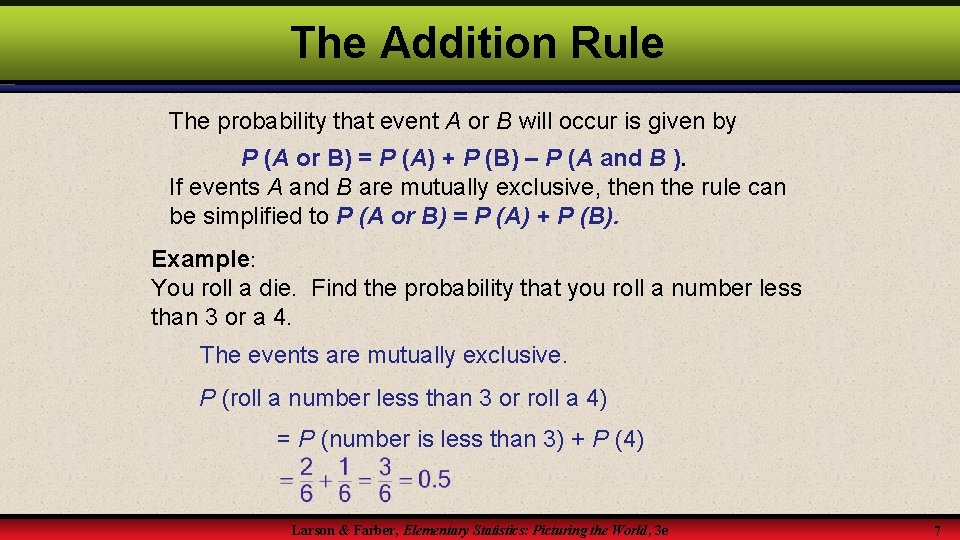
The Addition Rule The probability that event A or B will occur is given by P (A or B) = P (A) + P (B) – P (A and B ). If events A and B are mutually exclusive, then the rule can be simplified to P (A or B) = P (A) + P (B). Example: You roll a die. Find the probability that you roll a number less than 3 or a 4. The events are mutually exclusive. P (roll a number less than 3 or roll a 4) = P (number is less than 3) + P (4) Larson & Farber, Elementary Statistics: Picturing the World, 3 e 7
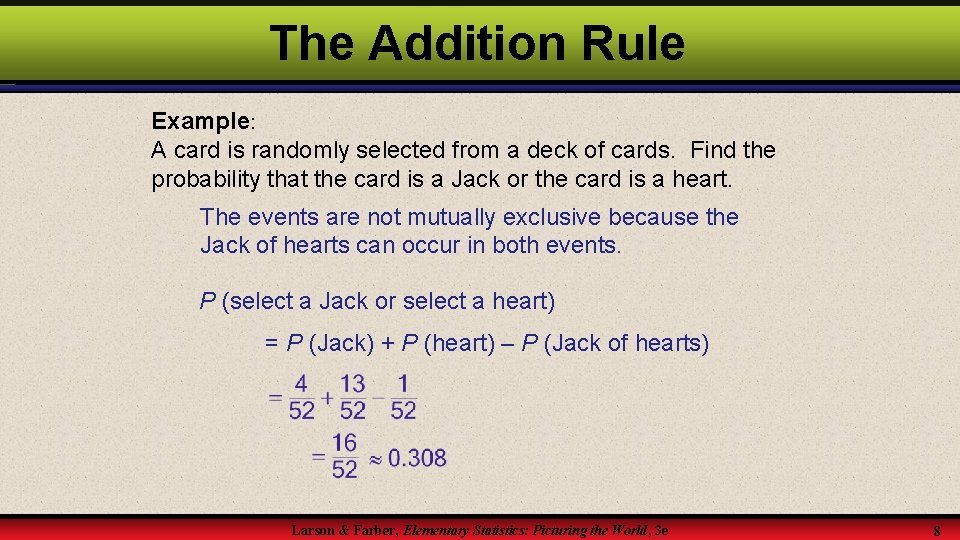
The Addition Rule Example: A card is randomly selected from a deck of cards. Find the probability that the card is a Jack or the card is a heart. The events are not mutually exclusive because the Jack of hearts can occur in both events. P (select a Jack or select a heart) = P (Jack) + P (heart) – P (Jack of hearts) Larson & Farber, Elementary Statistics: Picturing the World, 3 e 8