
3 3 Subtractions of Whole Numbers The meaning
3 -3 Subtractions of Whole Numbers • The meaning of subtraction by studying various models. • The inverse relationship between addition and subtraction. • Subtraction algorithms, including the standard algorithm, and how to use them. • Subtraction with number bases other than ten. • Mental subtraction computational skills and estimation techniques. ALWAYS LEARNING Copyright © 2020, 2016, 2012 Pearson Education, Inc. 1
Subtraction Models Subtraction of whole numbers can be modeled in several different ways: § Take-Away Model – views subtraction as a second set of objects being taken away from the original set § Number-Line Model – subtraction is represented by moving left on the number line a given number of units. ALWAYS LEARNING Copyright © 2020, 2016, 2012 Pearson Education, Inc. 2

Subtraction Models § Missing Addend Model – an algebraic-type of reasoning is used where students compute a difference by determining the value of an “unknown” addend. ALWAYS LEARNING Copyright © 2020, 2016, 2012 Pearson Education, Inc. 3
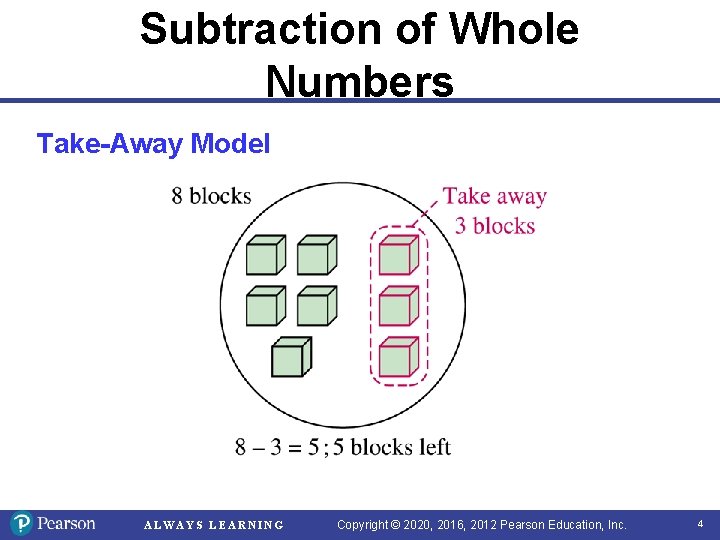
Subtraction of Whole Numbers Take-Away Model ALWAYS LEARNING Copyright © 2020, 2016, 2012 Pearson Education, Inc. 4
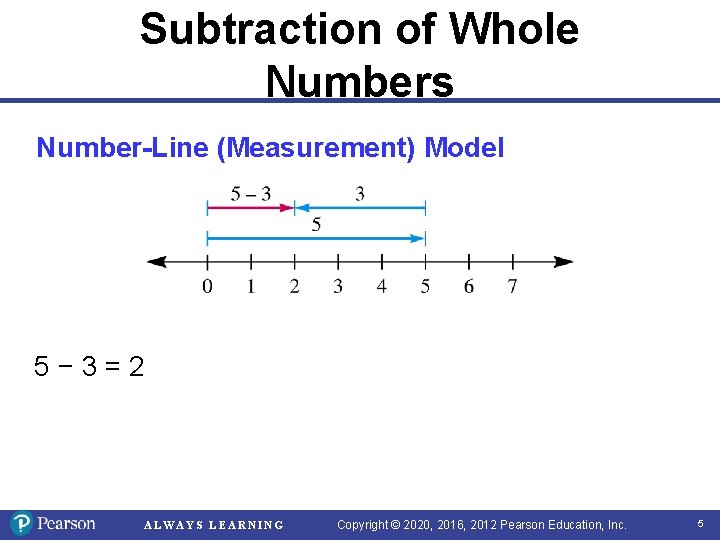
Subtraction of Whole Numbers Number-Line (Measurement) Model 5− 3=2 ALWAYS LEARNING Copyright © 2020, 2016, 2012 Pearson Education, Inc. 5
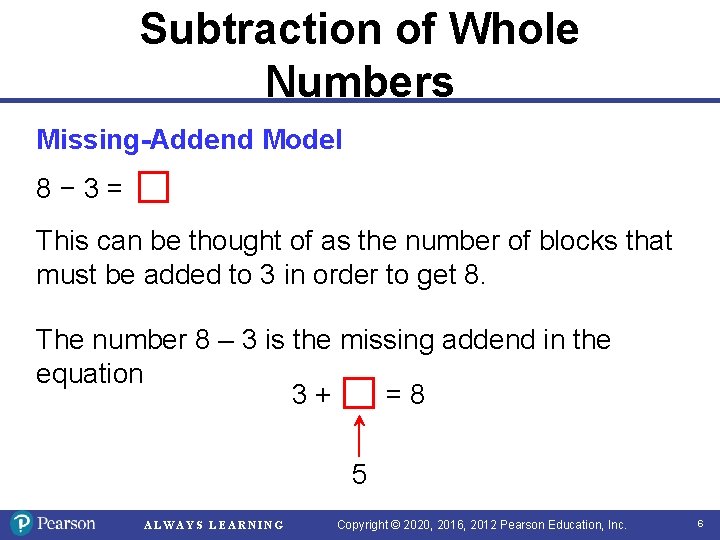
Subtraction of Whole Numbers Missing-Addend Model 8− 3= This can be thought of as the number of blocks that must be added to 3 in order to get 8. The number 8 – 3 is the missing addend in the equation 3+ =8 5 ALWAYS LEARNING Copyright © 2020, 2016, 2012 Pearson Education, Inc. 6
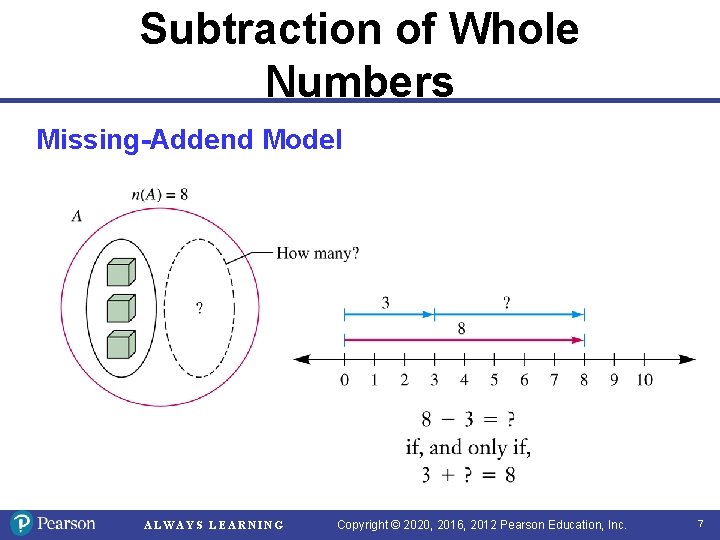
Subtraction of Whole Numbers Missing-Addend Model ALWAYS LEARNING Copyright © 2020, 2016, 2012 Pearson Education, Inc. 7
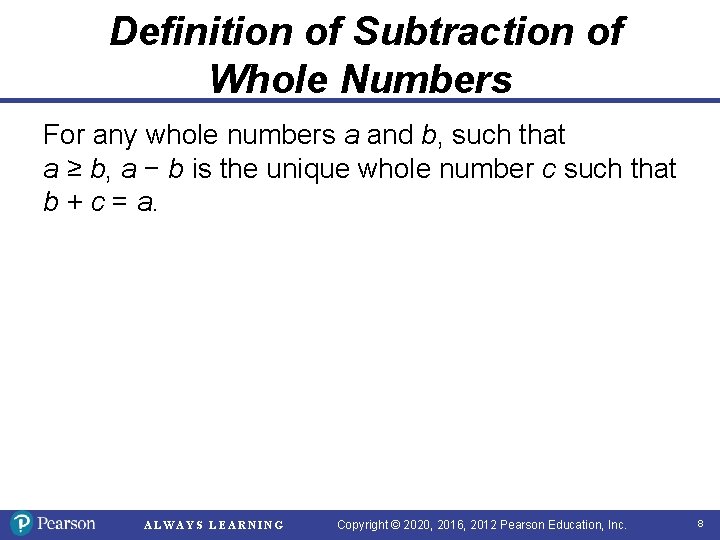
Definition of Subtraction of Whole Numbers For any whole numbers a and b, such that a ≥ b, a − b is the unique whole number c such that b + c = a. ALWAYS LEARNING Copyright © 2020, 2016, 2012 Pearson Education, Inc. 8
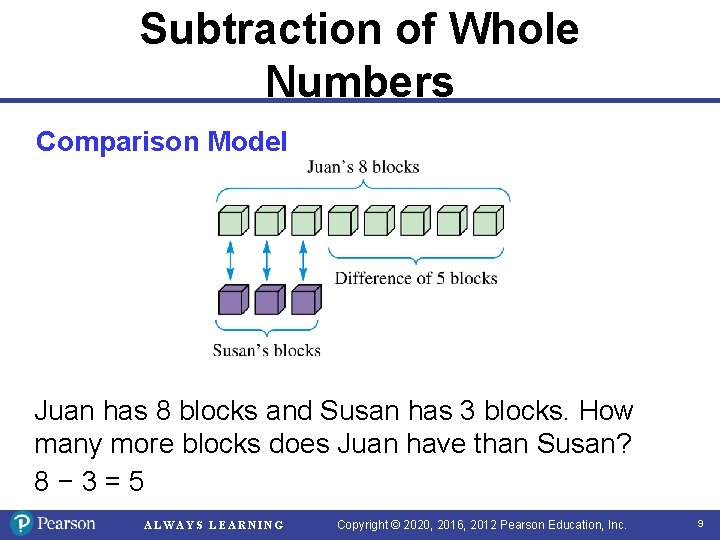
Subtraction of Whole Numbers Comparison Model Juan has 8 blocks and Susan has 3 blocks. How many more blocks does Juan have than Susan? 8− 3=5 ALWAYS LEARNING Copyright © 2020, 2016, 2012 Pearson Education, Inc. 9
Properties of Subtraction It can be shown that if a < b, then a − b is not meaningful in the set of whole numbers. Therefore, subtraction is not closed on the set of whole numbers. ALWAYS LEARNING Copyright © 2020, 2016, 2012 Pearson Education, Inc. 10
Introductory Algebra Using Whole-Number Addition and Subtraction Sentences such as 9 + 5 = ☼ and 12 − ◊ = 4 can be true or false depending on the values of ☼ and ◊. For example, if ☼ = 10, then 9 + 5 = ☼ is false. If ◊ = 8, then 12 − ◊ = 4 is true. If the value that is used makes the equation true, it is a solution to the equation. ALWAYS LEARNING Copyright © 2020, 2016, 2012 Pearson Education, Inc. 11
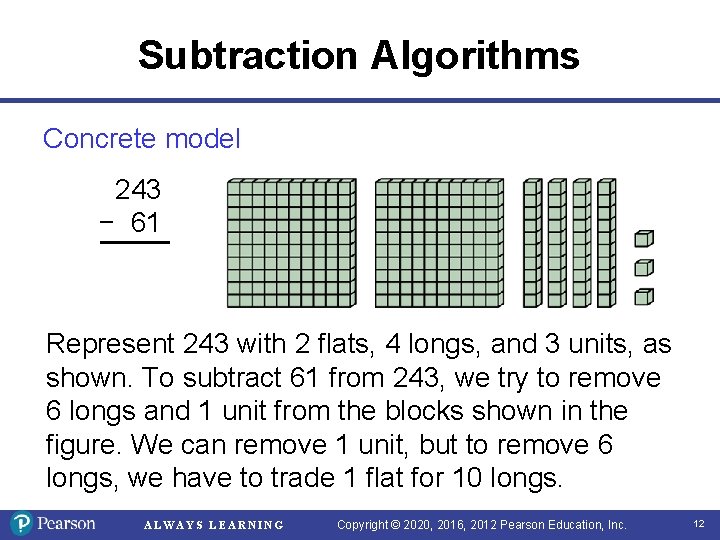
Subtraction Algorithms Concrete model 243 − 61 Represent 243 with 2 flats, 4 longs, and 3 units, as shown. To subtract 61 from 243, we try to remove 6 longs and 1 unit from the blocks shown in the figure. We can remove 1 unit, but to remove 6 longs, we have to trade 1 flat for 10 longs. ALWAYS LEARNING Copyright © 2020, 2016, 2012 Pearson Education, Inc. 12
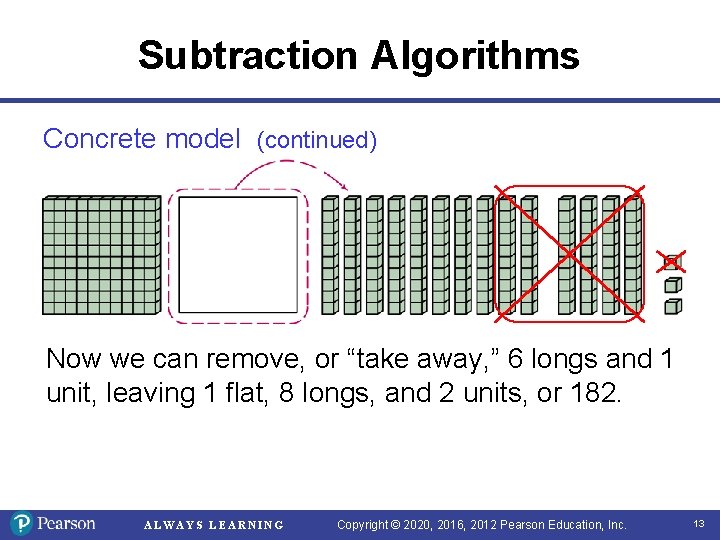
Subtraction Algorithms Concrete model (continued) Now we can remove, or “take away, ” 6 longs and 1 unit, leaving 1 flat, 8 longs, and 2 units, or 182. ALWAYS LEARNING Copyright © 2020, 2016, 2012 Pearson Education, Inc. 13
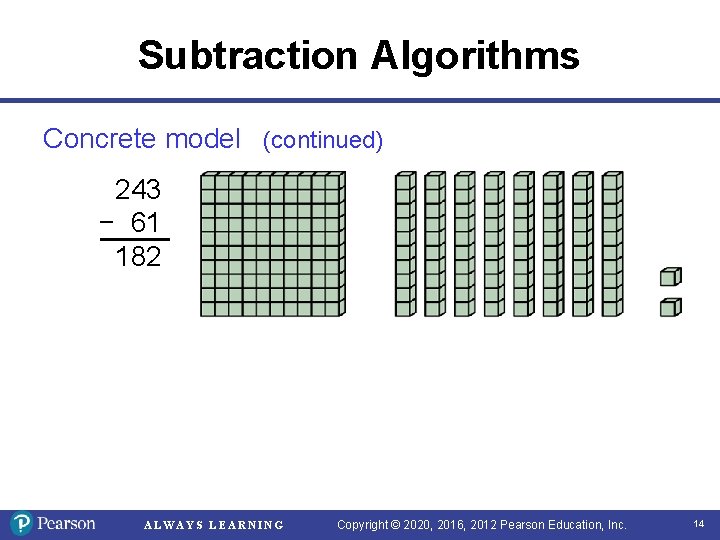
Subtraction Algorithms Concrete model (continued) 243 − 61 182 ALWAYS LEARNING Copyright © 2020, 2016, 2012 Pearson Education, Inc. 14
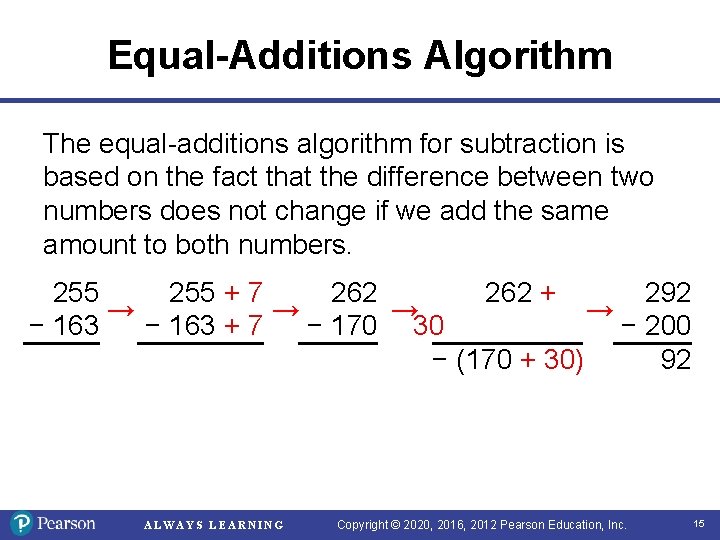
Equal-Additions Algorithm The equal-additions algorithm for subtraction is based on the fact that the difference between two numbers does not change if we add the same amount to both numbers. 255 + 7 262 + 292 → → − 163 + 7 − 170 30 − 200 − (170 + 30) 92 ALWAYS LEARNING Copyright © 2020, 2016, 2012 Pearson Education, Inc. 15
Counting-Up Algorithm This algorithm can be best described as the “making change” method. It is the way that cashiers and tellers give change for purchases. Today, with calculators and computerized cash registers, it has become sort of a lost art. However, it is a way to do subtraction “in your head. ” It uses the idea of the missing addend model for subtraction. Students are encouraged to count up to nice numbers, which are multiples of 10, 1000, etc. ALWAYS LEARNING Copyright © 2020, 2016, 2012 Pearson Education, Inc. 16
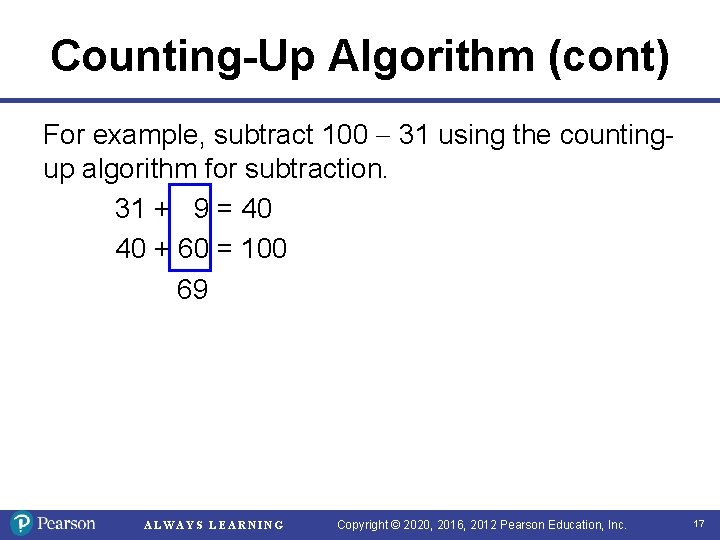
Counting-Up Algorithm (cont) For example, subtract 100 31 using the countingup algorithm for subtraction. 31 + 9 = 40 40 + 60 = 100 69 ALWAYS LEARNING Copyright © 2020, 2016, 2012 Pearson Education, Inc. 17
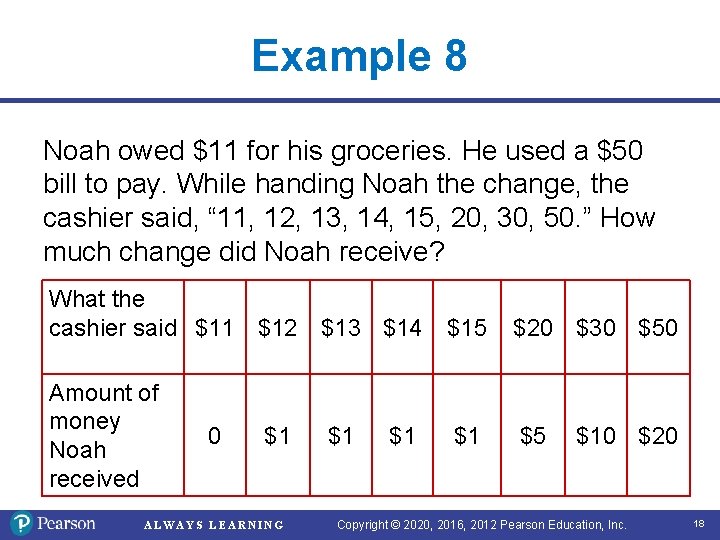
Example 8 Noah owed $11 for his groceries. He used a $50 bill to pay. While handing Noah the change, the cashier said, “ 11, 12, 13, 14, 15, 20, 30, 50. ” How much change did Noah receive? What the cashier said $11 $12 $13 $14 Amount of money Noah received 0 $1 ALWAYS LEARNING $1 $1 $15 $20 $30 $50 $1 $5 $10 $20 Copyright © 2020, 2016, 2012 Pearson Education, Inc. 18
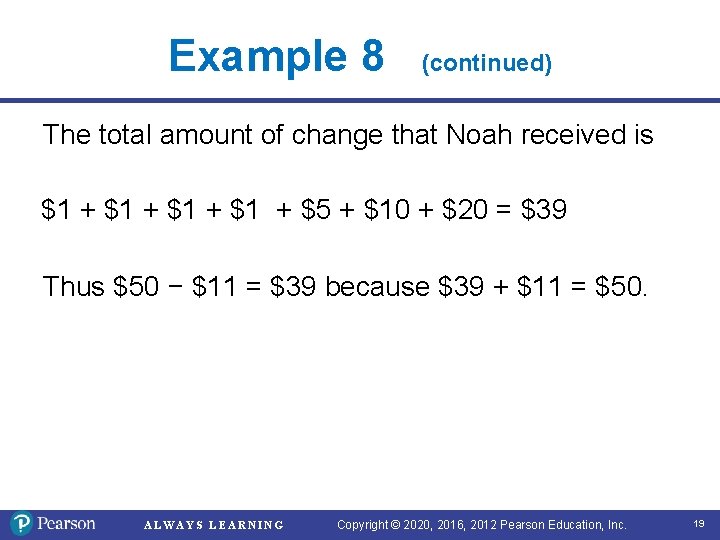
Example 8 (continued) The total amount of change that Noah received is $1 + $5 + $10 + $20 = $39 Thus $50 − $11 = $39 because $39 + $11 = $50. ALWAYS LEARNING Copyright © 2020, 2016, 2012 Pearson Education, Inc. 19
Trades-First Algorithm This algorithm is very similar to the standard algorithm, except that all regrouping is done before any of the subtraction is carried out. Using baseten blocks may help with students understanding how to subtract. ALWAYS LEARNING Copyright © 2020, 2016, 2012 Pearson Education, Inc. 20
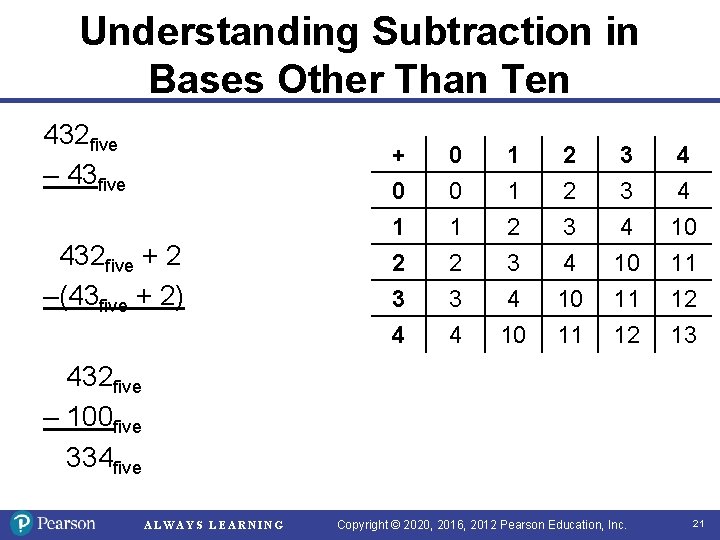
Understanding Subtraction in Bases Other Than Ten 432 five – 43 five 432 five + 2 –(43 five + 2) + 0 1 2 0 0 1 2 1 1 2 3 2 2 3 4 3 3 4 10 4 4 10 11 3 4 4 10 10 11 11 12 12 13 432 five – 100 five 334 five ALWAYS LEARNING Copyright © 2020, 2016, 2012 Pearson Education, Inc. 21
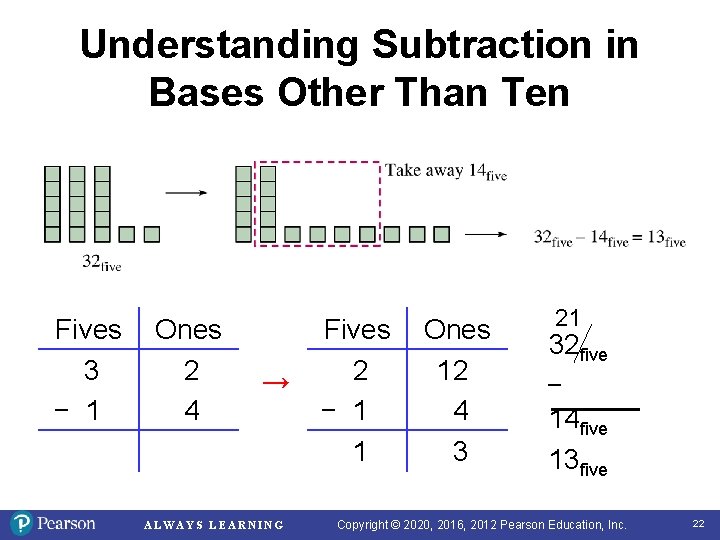
Understanding Subtraction in Bases Other Than Ten Fives 3 − 1 Ones 2 4 → ALWAYS LEARNING Fives 2 − 1 1 Ones 12 4 3 21 32 five − 14 five 13 five Copyright © 2020, 2016, 2012 Pearson Education, Inc. 22
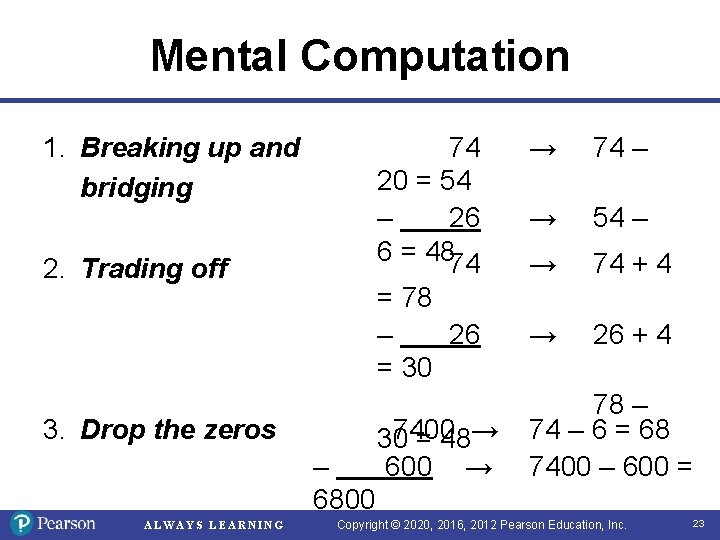
Mental Computation 1. Breaking up and bridging 74 20 = 54 – 26 6 = 4874 2. Trading off 3. Drop the zeros – 6800 ALWAYS LEARNING → 74 – → 54 – → 74 + 4 = 78 – 26 = 30 → 26 + 4 7400 30 = 48→ 600 → 78 – 74 – 6 = 68 7400 – 600 = Copyright © 2020, 2016, 2012 Pearson Education, Inc. 23
- Slides: 23