
3 3 Solving Conversion Problems Chapter 3 Scientific
3. 3 Solving Conversion Problems > Chapter 3 Scientific Measurement 3. 1 Using and Expressing Measurements 3. 2 Units of Measurement 3. 3 Solving Conversion Problems 1 Copyright © Pearson Education, Inc. , or its affiliates. All Rights Reserved.
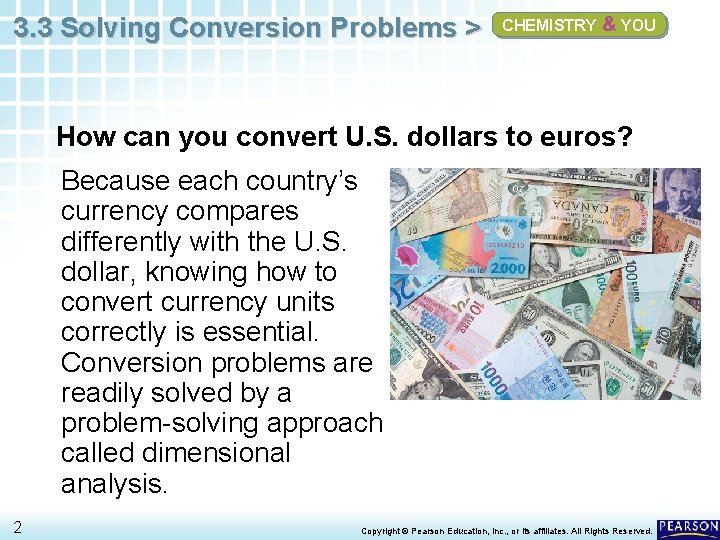
3. 3 Solving Conversion Problems > CHEMISTRY & YOU How can you convert U. S. dollars to euros? Because each country’s currency compares differently with the U. S. dollar, knowing how to convert currency units correctly is essential. Conversion problems are readily solved by a problem-solving approach called dimensional analysis. 2 Copyright © Pearson Education, Inc. , or its affiliates. All Rights Reserved.
3. 3 Solving Conversion Problems > Conversion Factors • If you think about any number of everyday situations, you will realize that a quantity can usually be expressed in several different ways. • For example: • 1 dollar = 4 quarters = 10 dimes = 20 nickels = 100 pennies • These are all expressions, or measurements, of the same amount of money. 3 Copyright © Pearson Education, Inc. , or its affiliates. All Rights Reserved.
3. 3 Solving Conversion Problems > Conversion Factors • The same thing is true of scientific quantities. • For example: • 1 meter = 10 decimeters = 100 centimeters = 1000 millimeters • These are different ways to express the same length. 4 Copyright © Pearson Education, Inc. , or its affiliates. All Rights Reserved.
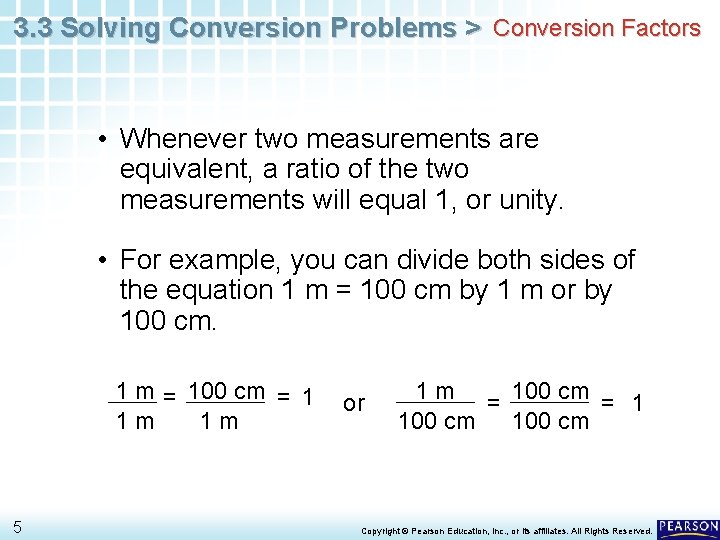
3. 3 Solving Conversion Problems > Conversion Factors • Whenever two measurements are equivalent, a ratio of the two measurements will equal 1, or unity. • For example, you can divide both sides of the equation 1 m = 100 cm by 1 m or by 100 cm. 1 m = 100 cm = 1 1 m 1 m 5 or 1 m = 100 cm = 1 100 cm Copyright © Pearson Education, Inc. , or its affiliates. All Rights Reserved.
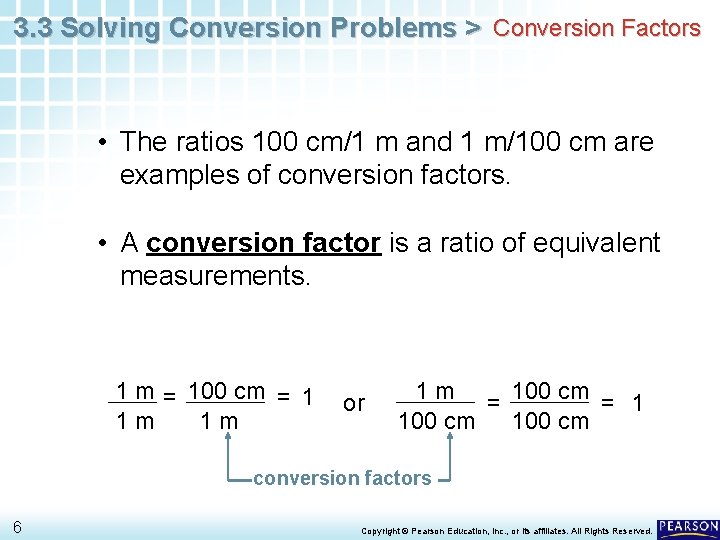
3. 3 Solving Conversion Problems > Conversion Factors • The ratios 100 cm/1 m and 1 m/100 cm are examples of conversion factors. • A conversion factor is a ratio of equivalent measurements. 1 m = 100 cm = 1 1 m 1 m or 1 m = 100 cm = 1 100 cm conversion factors 6 Copyright © Pearson Education, Inc. , or its affiliates. All Rights Reserved.
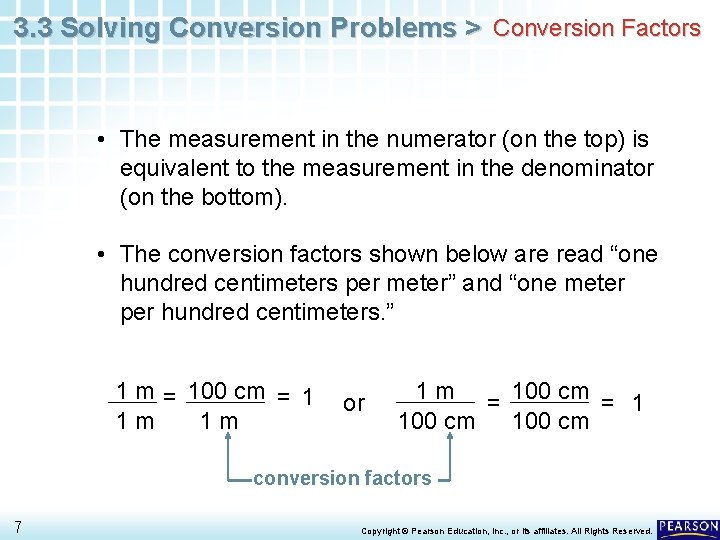
3. 3 Solving Conversion Problems > Conversion Factors • The measurement in the numerator (on the top) is equivalent to the measurement in the denominator (on the bottom). • The conversion factors shown below are read “one hundred centimeters per meter” and “one meter per hundred centimeters. ” 1 m = 100 cm = 1 1 m 1 m or 1 m = 100 cm = 1 100 cm conversion factors 7 Copyright © Pearson Education, Inc. , or its affiliates. All Rights Reserved.
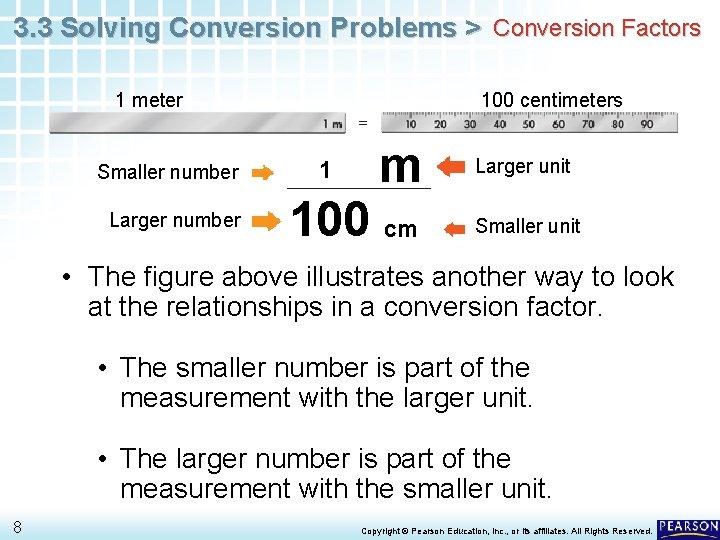
3. 3 Solving Conversion Problems > Conversion Factors 1 meter Smaller number Larger number 100 centimeters 1 m Larger unit 100 cm Smaller unit • The figure above illustrates another way to look at the relationships in a conversion factor. • The smaller number is part of the measurement with the larger unit. • The larger number is part of the measurement with the smaller unit. 8 Copyright © Pearson Education, Inc. , or its affiliates. All Rights Reserved.
3. 3 Solving Conversion Problems > Conversion Factors • Conversion factors are useful in solving problems in which a given measurement must be expressed in some other unit of measure. 9 Copyright © Pearson Education, Inc. , or its affiliates. All Rights Reserved.
3. 3 Solving Conversion Problems > Conversion Factors What happens when a measurement is multiplied by a conversion factor? 10 Copyright © Pearson Education, Inc. , or its affiliates. All Rights Reserved.
3. 3 Solving Conversion Problems > Conversion Factors When a measurement is multiplied by a conversion factor, the numerical value is generally changed, but the actual size of the quantity measured remains the same. • For example, even though the numbers in the measurements 1 g and 10 dg (decigrams) differ, both measurements represent the same mass. 11 Copyright © Pearson Education, Inc. , or its affiliates. All Rights Reserved.
3. 3 Solving Conversion Problems > Dimensional Analysis • Many problems in chemistry are conveniently solved using dimensional analysis, rather than algebra. • Dimensional analysis is a way to analyze and solve problems using the units, or dimensions, of the measurements. • Sample Problem 3. 9 explains dimensional analysis by using it to solve an everyday situation. 12 Copyright © Pearson Education, Inc. , or its affiliates. All Rights Reserved.
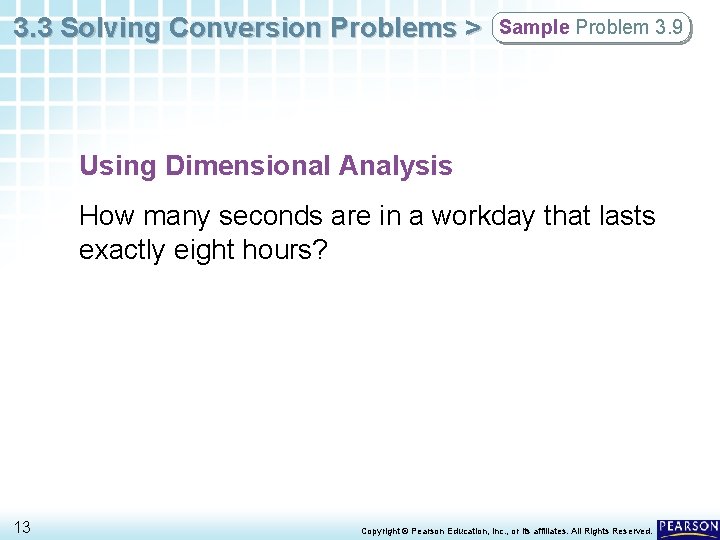
3. 3 Solving Conversion Problems > Sample Problem 3. 9 Using Dimensional Analysis How many seconds are in a workday that lasts exactly eight hours? 13 Copyright © Pearson Education, Inc. , or its affiliates. All Rights Reserved.
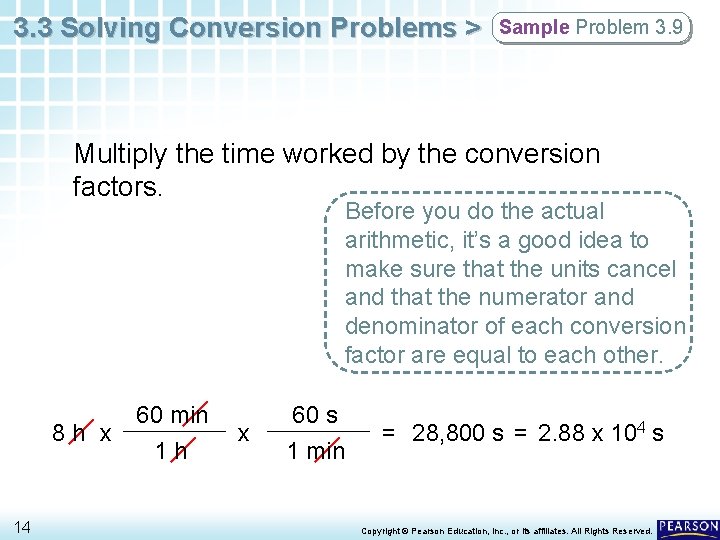
3. 3 Solving Conversion Problems > Sample Problem 3. 9 Multiply the time worked by the conversion factors. Before you do the actual arithmetic, it’s a good idea to make sure that the units cancel and that the numerator and denominator of each conversion factor are equal to each other. 8 h x 14 60 min 1 h x 60 s 1 min = 28, 800 s = 2. 88 x 104 s Copyright © Pearson Education, Inc. , or its affiliates. All Rights Reserved.
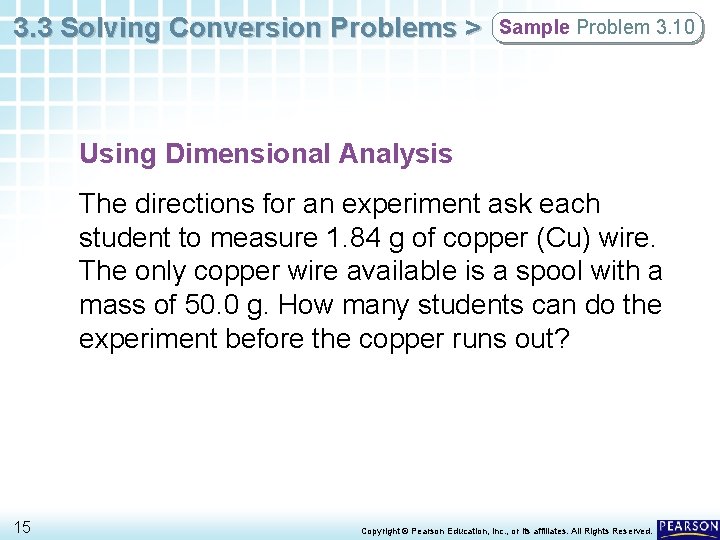
3. 3 Solving Conversion Problems > Sample Problem 3. 10 Using Dimensional Analysis The directions for an experiment ask each student to measure 1. 84 g of copper (Cu) wire. The only copper wire available is a spool with a mass of 50. 0 g. How many students can do the experiment before the copper runs out? 15 Copyright © Pearson Education, Inc. , or its affiliates. All Rights Reserved.
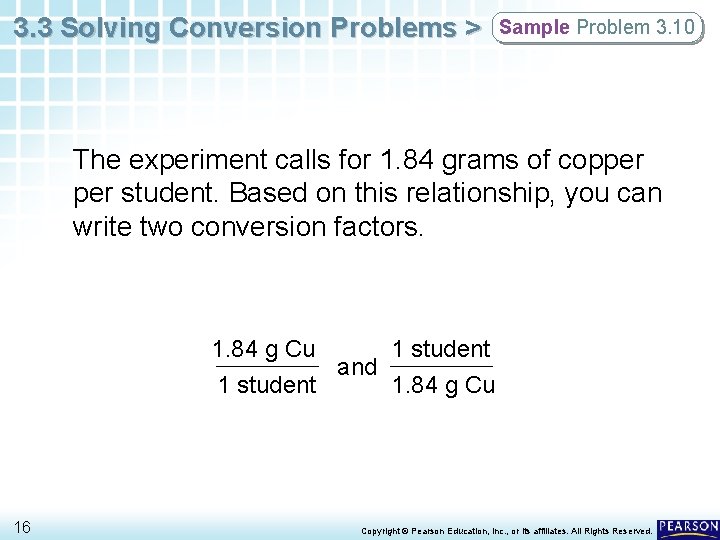
3. 3 Solving Conversion Problems > Sample Problem 3. 10 The experiment calls for 1. 84 grams of copper student. Based on this relationship, you can write two conversion factors. 1. 84 g Cu 1 student and 1 student 1. 84 g Cu 16 Copyright © Pearson Education, Inc. , or its affiliates. All Rights Reserved.
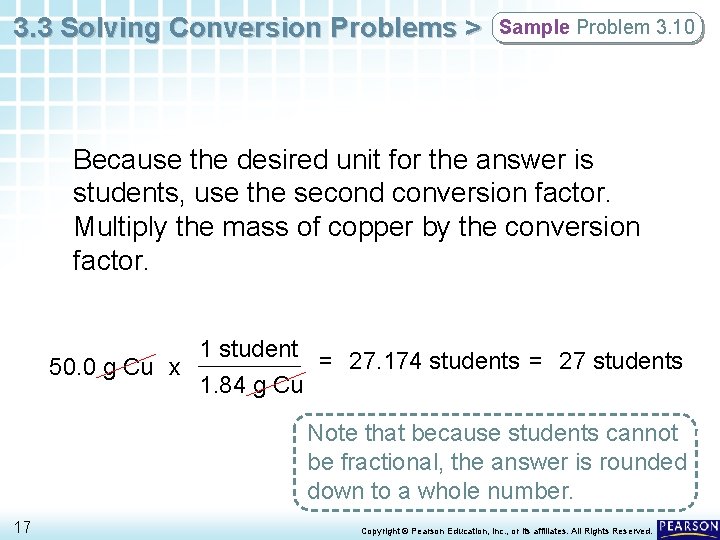
3. 3 Solving Conversion Problems > Sample Problem 3. 10 Because the desired unit for the answer is students, use the second conversion factor. Multiply the mass of copper by the conversion factor. 1 student = 27. 174 students = 27 students 50. 0 g Cu x 1. 84 g Cu Note that because students cannot be fractional, the answer is rounded down to a whole number. 17 Copyright © Pearson Education, Inc. , or its affiliates. All Rights Reserved.
3. 3 Solving Conversion Problems > CHEMISTRY & YOU If the exchange rate between U. S. dollars and euros is 0. 7 euro to every dollar, what is the conversion factor that allows you to convert from U. S. dollars to euros? 18 Copyright © Pearson Education, Inc. , or its affiliates. All Rights Reserved.
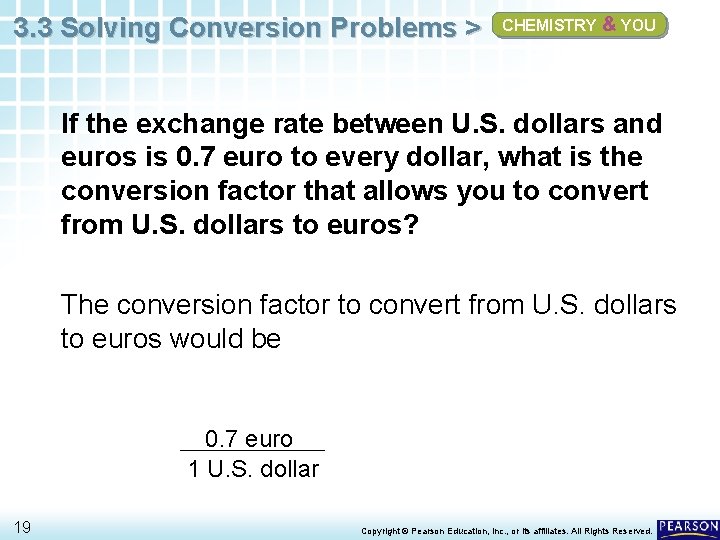
3. 3 Solving Conversion Problems > CHEMISTRY & YOU If the exchange rate between U. S. dollars and euros is 0. 7 euro to every dollar, what is the conversion factor that allows you to convert from U. S. dollars to euros? The conversion factor to convert from U. S. dollars to euros would be 0. 7 euro 1 U. S. dollar 19 Copyright © Pearson Education, Inc. , or its affiliates. All Rights Reserved.
3. 3 Solving Conversion Problems > Dimensional Analysis What kinds of problems can you solve using dimensional analysis? 20 Copyright © Pearson Education, Inc. , or its affiliates. All Rights Reserved.
3. 3 Solving Conversion Problems > Dimensional Analysis Simple Unit Conversions • In chemistry, as in everyday life, you often need to express a measurement in a unit different from the one given or measured initially. Dimensional analysis is a powerful tool for solving conversion problems in which a measurement with one unit is changed to an equivalent measurement with another unit. 21 Copyright © Pearson Education, Inc. , or its affiliates. All Rights Reserved.
3. 3 Solving Conversion Problems > Dimensional Analysis Multistep Problems • Many complex tasks in your life are best handled by breaking them down into smaller, manageable parts. • Similarly, many complex word problems are more easily solved by breaking the solution down into steps. • When converting between units, it is often necessary to use more than one conversion factor. 22 Copyright © Pearson Education, Inc. , or its affiliates. All Rights Reserved.
3. 3 Solving Conversion Problems > Sample Problem 3. 13 Converting Between Metric Units The diameter of a sewing needle is 0. 073 cm. What is the diameter in micrometers? 23 Copyright © Pearson Education, Inc. , or its affiliates. All Rights Reserved.
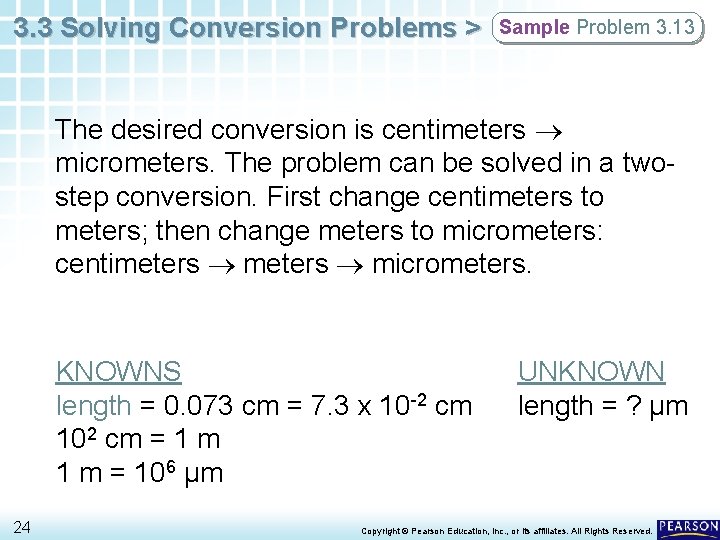
3. 3 Solving Conversion Problems > Sample Problem 3. 13 The desired conversion is centimeters micrometers. The problem can be solved in a twostep conversion. First change centimeters to meters; then change meters to micrometers: centimeters micrometers. KNOWNS length = 0. 073 cm = 7. 3 x 10 -2 cm 102 cm = 106 μm 24 UNKNOWN length = ? μm Copyright © Pearson Education, Inc. , or its affiliates. All Rights Reserved.
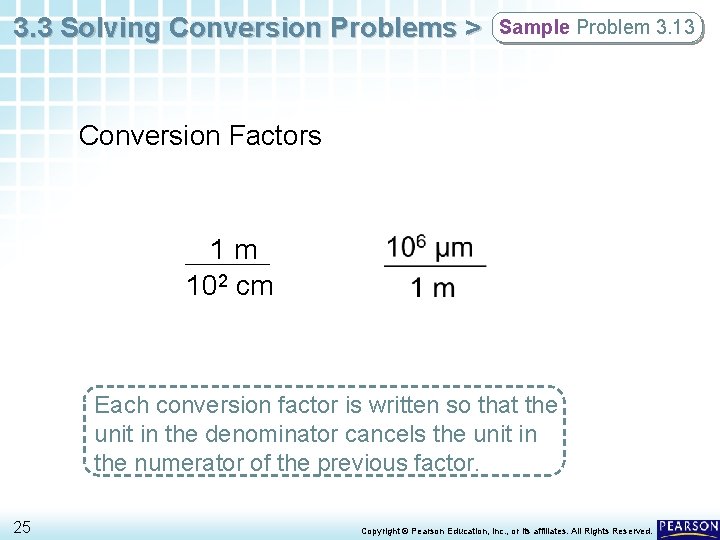
3. 3 Solving Conversion Problems > Sample Problem 3. 13 Conversion Factors 1 m 102 cm Each conversion factor is written so that the unit in the denominator cancels the unit in the numerator of the previous factor. 25 Copyright © Pearson Education, Inc. , or its affiliates. All Rights Reserved.
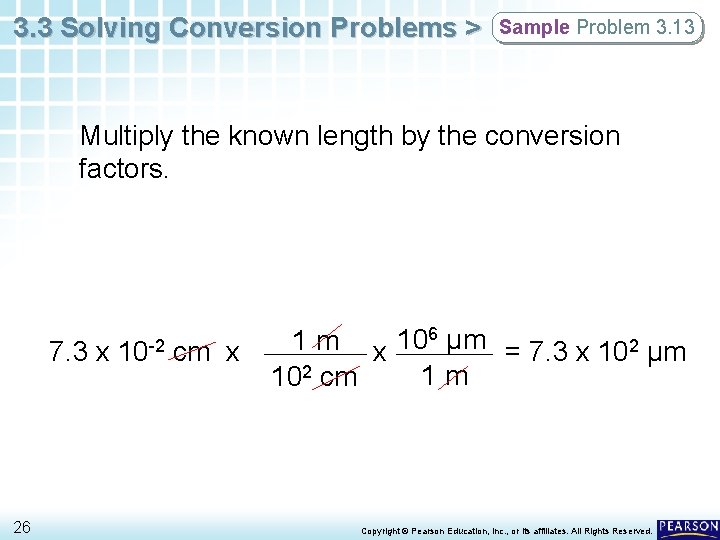
3. 3 Solving Conversion Problems > Sample Problem 3. 13 Multiply the known length by the conversion factors. 7. 3 x 26 10 -2 cm x 106 μm = 7. 3 x 102 μm 1 m 102 cm Copyright © Pearson Education, Inc. , or its affiliates. All Rights Reserved.
3. 3 Solving Conversion Problems > • Example: • How many eggs do you have if a dozen eggs have a mass of 660 g and you have a total mass of 4. 5 kg? 27 Copyright © Pearson Education, Inc. , or its affiliates. All Rights Reserved.
3. 3 Solving Conversion Problems > What kind of problems can you solve using dimensional analysis? 28 Copyright © Pearson Education, Inc. , or its affiliates. All Rights Reserved.
3. 3 Solving Conversion Problems > What kind of problems can you solve using dimensional analysis? Problems that require the conversion of a measurement from one unit to another can be solved using dimensional analysis. 29 Copyright © Pearson Education, Inc. , or its affiliates. All Rights Reserved.
3. 3 Solving Conversion Problems > END OF 3. 3 30 Copyright © Pearson Education, Inc. , or its affiliates. All Rights Reserved.
- Slides: 30