
3 3 1 3 2 3 3 3
- Slides: 104
3 3 -1 3 -2 3 -3 3 -4 Slide 1 BANKING SERVICES Checking Accounts Reconcile a Bank Statement Savings Accounts Explore Compound Interest Financial Algebra © Cengage/South-Western
3 3 -5 3 -6 3 -7 3 -8 Slide 2 BANKING SERVICES Compound Interest Formula Continuous Compounding Future Value of Investments Present Value of Investments Financial Algebra © Cengage/South-Western
3 -1 CHECKING ACCOUNTS OBJECTIVES Understand how checking accounts work. Complete a check register. Slide 3 Financial Algebra © Cengage/South-Western
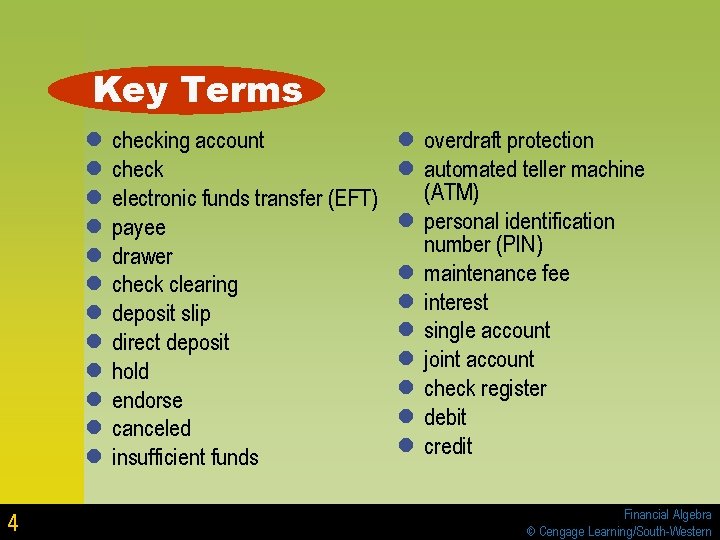
Key Terms l l l 4 checking account check electronic funds transfer (EFT) payee drawer check clearing deposit slip direct deposit hold endorse canceled insufficient funds l overdraft protection l automated teller machine (ATM) l personal identification number (PIN) l maintenance fee l interest l single account l joint account l check register l debit l credit Financial Algebra © Cengage Learning/South-Western
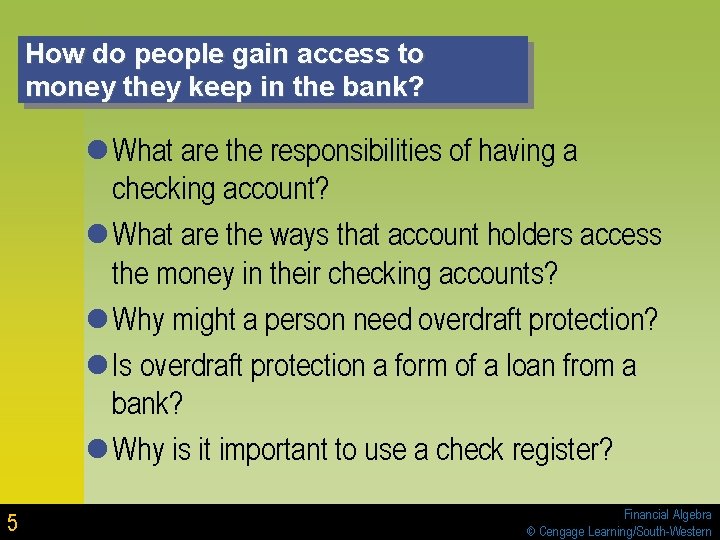
How do people gain access to money they keep in the bank? l What are the responsibilities of having a checking account? l What are the ways that account holders access the money in their checking accounts? l Why might a person need overdraft protection? l Is overdraft protection a form of a loan from a bank? l Why is it important to use a check register? 5 Financial Algebra © Cengage Learning/South-Western
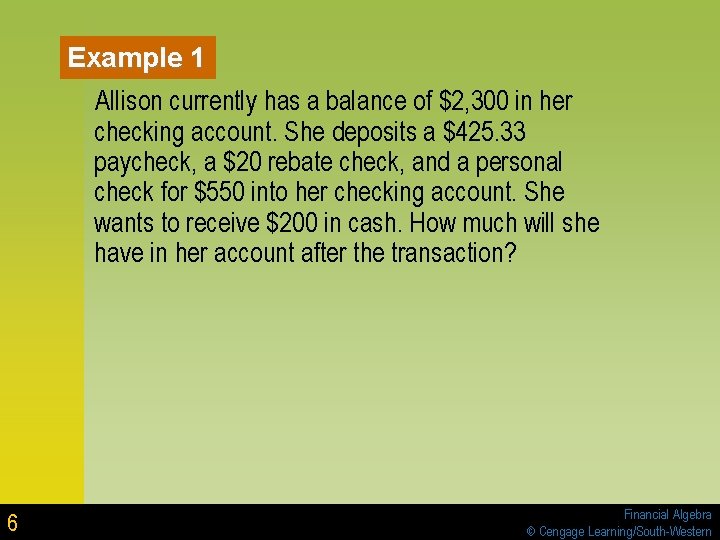
Example 1 Allison currently has a balance of $2, 300 in her checking account. She deposits a $425. 33 paycheck, a $20 rebate check, and a personal check for $550 into her checking account. She wants to receive $200 in cash. How much will she have in her account after the transaction? 6 Financial Algebra © Cengage Learning/South-Western
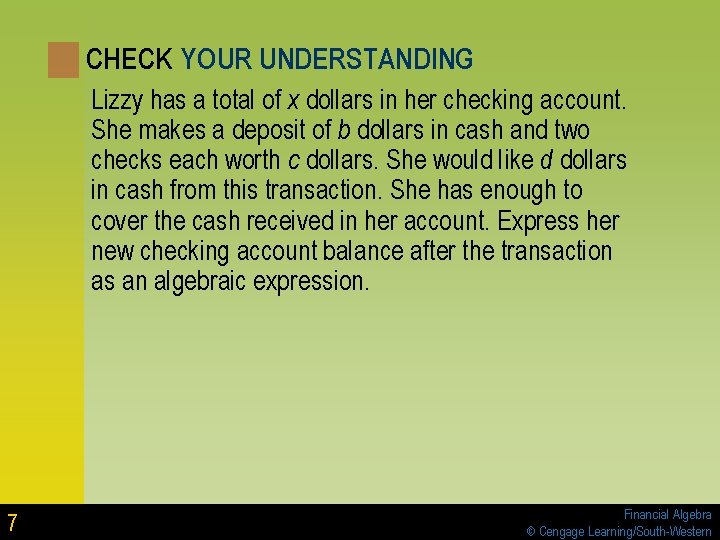
CHECK YOUR UNDERSTANDING Lizzy has a total of x dollars in her checking account. She makes a deposit of b dollars in cash and two checks each worth c dollars. She would like d dollars in cash from this transaction. She has enough to cover the cash received in her account. Express her new checking account balance after the transaction as an algebraic expression. 7 Financial Algebra © Cengage Learning/South-Western
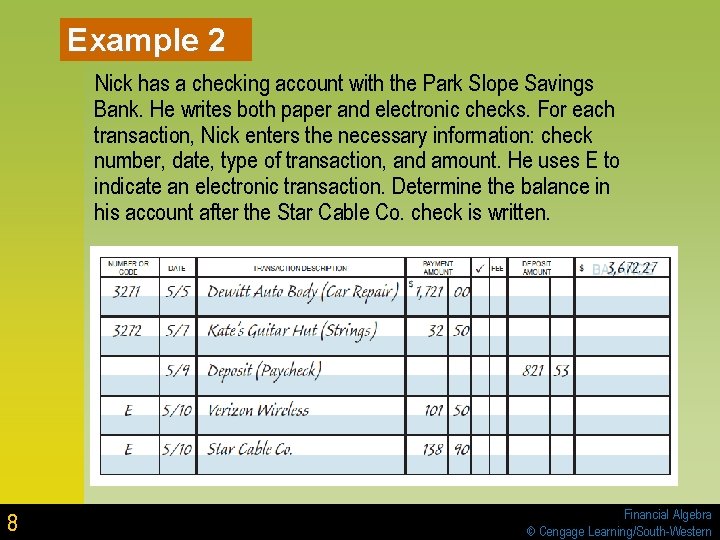
Example 2 Nick has a checking account with the Park Slope Savings Bank. He writes both paper and electronic checks. For each transaction, Nick enters the necessary information: check number, date, type of transaction, and amount. He uses E to indicate an electronic transaction. Determine the balance in his account after the Star Cable Co. check is written. 8 Financial Algebra © Cengage Learning/South-Western
CHECK YOUR UNDERSTANDING Nick writes a check to his friend James Sloan on May 11 for $150. 32. What should he write in the check register and what should the new balance be? 9 Financial Algebra © Cengage Learning/South-Western
EXTEND YOUR UNDERSTANDING Would the final balance change if Nick had paid the cable bill before the wireless bill? Explain. 10 Financial Algebra © Cengage Learning/South-Western
3 -2 RECONCILE A BANK STATEMENT OBJECTIVES Reconcile a checking account with a bank statement by hand by using a spreadsheet. Slide 11 Financial Algebra © Cengage/South-Western
Key Terms l l l 12 account number bank statement period starting balance ending balance l l outstanding deposits outstanding checks balancing reconciling Financial Algebra © Cengage Learning/South-Western
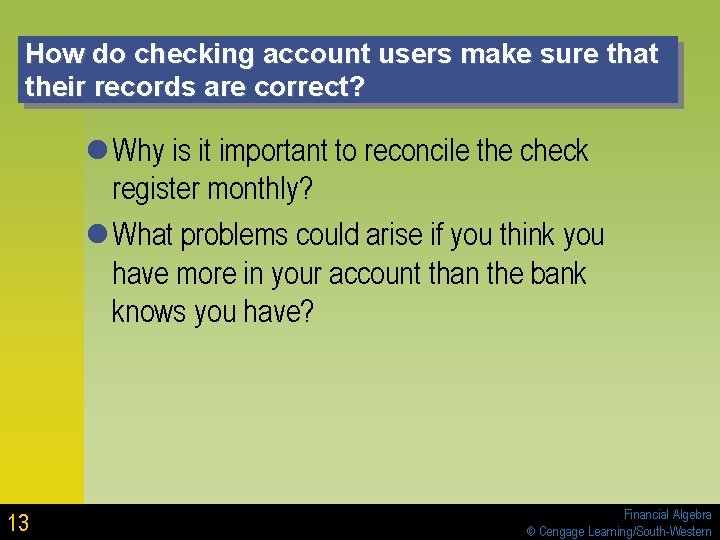
How do checking account users make sure that their records are correct? l Why is it important to reconcile the check register monthly? l What problems could arise if you think you have more in your account than the bank knows you have? 13 Financial Algebra © Cengage Learning/South-Western
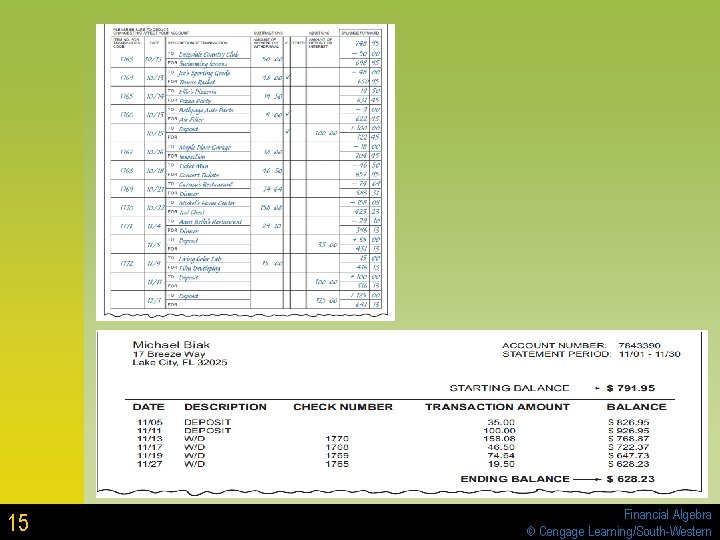
Example 1 The next slide has a bank statement and check register for Michael Biak’s checking account. What steps are needed to reconcile Michael’s bank statement? 14 Financial Algebra © Cengage Learning/South-Western
15 Financial Algebra © Cengage Learning/South-Western
CHECK YOUR UNDERSTANDING Name some reasons why a check may not have cleared during the monthly cycle and appear on the bank statement. 16 Financial Algebra © Cengage Learning/South-Western
Example 2 Use algebraic formulas and statements to model the check register balancing process. 17 Financial Algebra © Cengage Learning/South-Western
CHECK YOUR UNDERSTANDING Nancy has a balance of $1, 078 in her check register. The balance on her bank account statement is $885. 84. Not reported on her bank statement are deposits of $575 and $250 and two checks for $195 and $437. 84. Is her check register balanced? Explain. 18 Financial Algebra © Cengage Learning/South-Western
EXAMPLE 3 Marina and Brian have a joint checking account. They have a balance of $3, 839. 25 in the check register. The balance on the bank statement is $3, 450. 10. Not reported on the statement are deposits of $2, 000, $135. 67, $254. 77, and $188. 76 and four checks for $567. 89, $23. 83, $598. 33, and $1, 000. Reconcile the bank statement using a spreadsheet. 19 Financial Algebra © Cengage Learning/South-Western
CHECK YOUR UNDERSTANDING Write a formula to calculate the sum of the outstanding checks. 20 Financial Algebra © Cengage Learning/South-Western
3 -3 SAVINGS ACCOUNTS OBJECTIVES Learn the basic vocabulary of savings accounts. Compute simple interest using the simple interest formula. Slide 21 Financial Algebra © Cengage/South-Western
Key Terms l l l 22 savings account interest rate principal simple interest formula l l l statement savings minimum balance money market account certificate of deposit (CD) maturity Financial Algebra © Cengage Learning/South-Western
What types of savings accounts do banks offer customers? l What banking services does your family use? l Where does the money that banks lend out for loans come from? l What is the value of compound interest? l What are the advantages of direct deposit? 23 Financial Algebra © Cengage Learning/South-Western
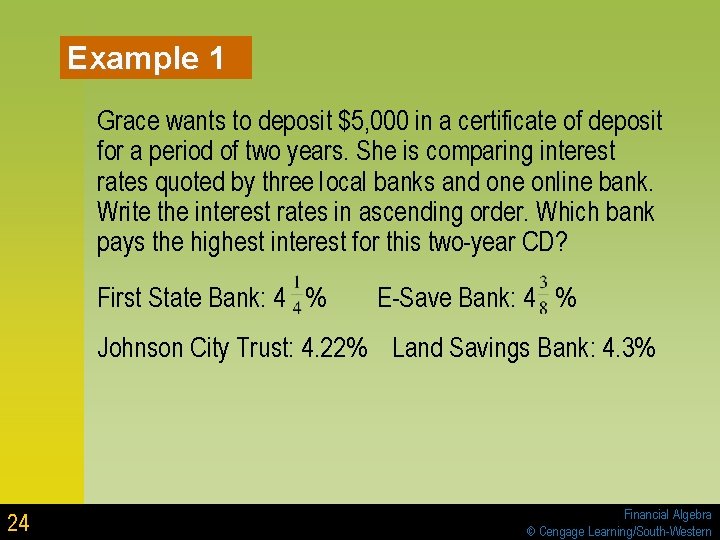
Example 1 Grace wants to deposit $5, 000 in a certificate of deposit for a period of two years. She is comparing interest rates quoted by three local banks and one online bank. Write the interest rates in ascending order. Which bank pays the highest interest for this two-year CD? First State Bank: 4 % E-Save Bank: 4 % Johnson City Trust: 4. 22% Land Savings Bank: 4. 3% 24 Financial Algebra © Cengage Learning/South-Western
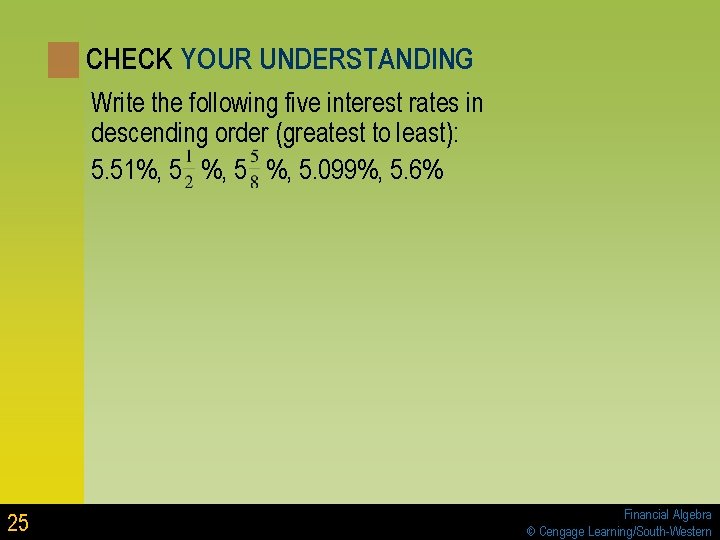
CHECK YOUR UNDERSTANDING Write the following five interest rates in descending order (greatest to least): 5. 51%, 5. 099%, 5. 6% 25 Financial Algebra © Cengage Learning/South-Western
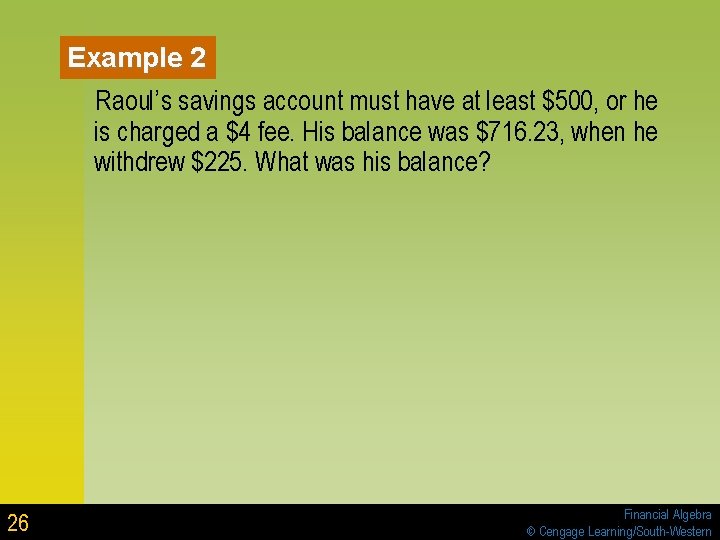
Example 2 Raoul’s savings account must have at least $500, or he is charged a $4 fee. His balance was $716. 23, when he withdrew $225. What was his balance? 26 Financial Algebra © Cengage Learning/South-Western
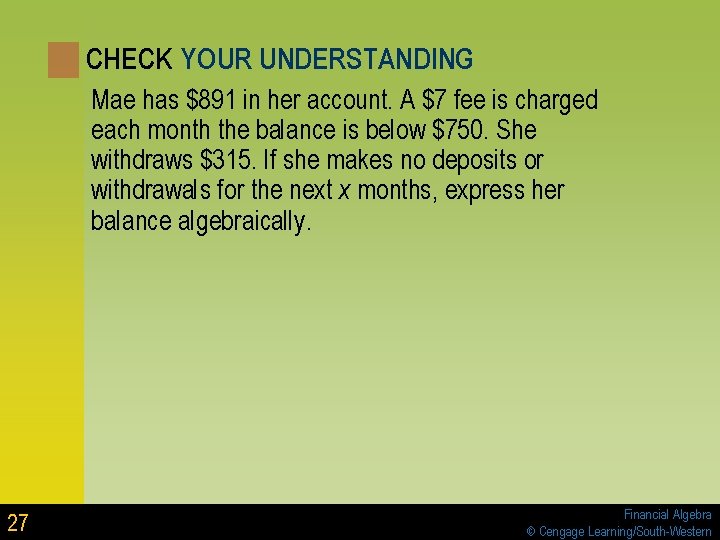
CHECK YOUR UNDERSTANDING Mae has $891 in her account. A $7 fee is charged each month the balance is below $750. She withdraws $315. If she makes no deposits or withdrawals for the next x months, express her balance algebraically. 27 Financial Algebra © Cengage Learning/South-Western
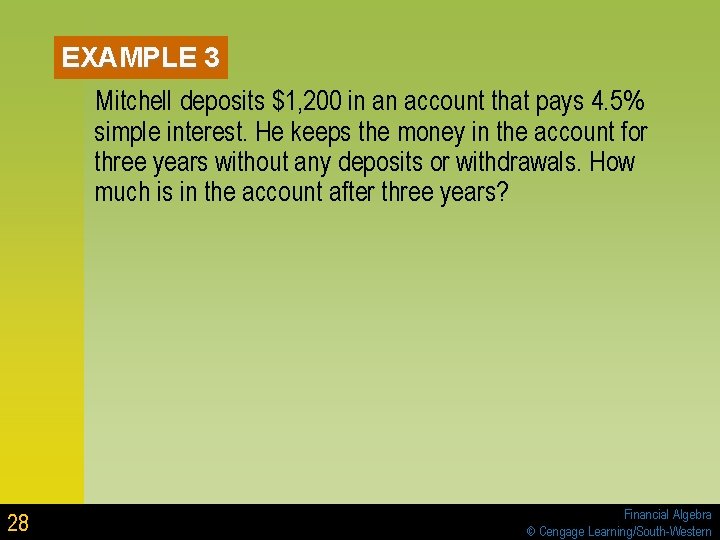
EXAMPLE 3 Mitchell deposits $1, 200 in an account that pays 4. 5% simple interest. He keeps the money in the account for three years without any deposits or withdrawals. How much is in the account after three years? 28 Financial Algebra © Cengage Learning/South-Western
CHECK YOUR UNDERSTANDING How much simple interest is earned on $4, 000 in 3½ years at an interest rate of 5. 2%? 29 Financial Algebra © Cengage Learning/South-Western
EXAMPLE 4 How much simple interest does $2, 000 earn in 7 months at an interest rate of 5%? 30 Financial Algebra © Cengage Learning/South-Western
CHECK YOUR UNDERSTANDING How much simple interest would $800 earn in 300 days in a non-leap year at an interest rate of 5. 71%? Round to the nearest cent. 31 Financial Algebra © Cengage Learning/South-Western
EXAMPLE 5 How much principal must be deposited to earn $1, 000 simple interest in 2 years at a rate of 5%? 32 Financial Algebra © Cengage Learning/South-Western
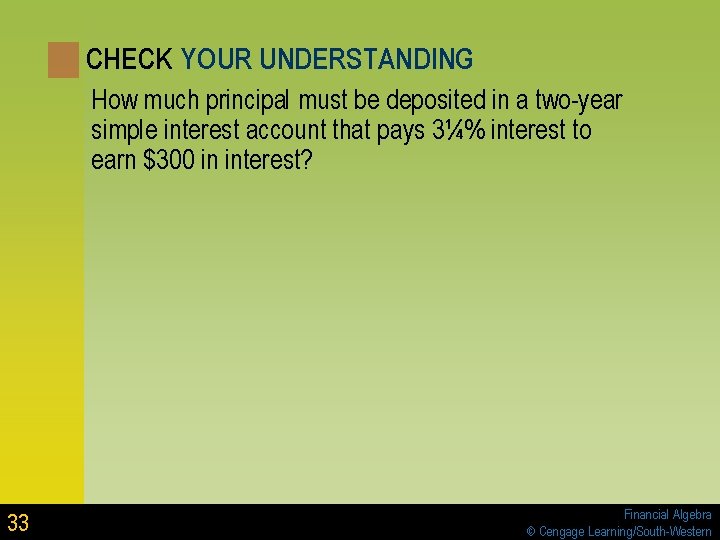
CHECK YOUR UNDERSTANDING How much principal must be deposited in a two-year simple interest account that pays 3¼% interest to earn $300 in interest? 33 Financial Algebra © Cengage Learning/South-Western
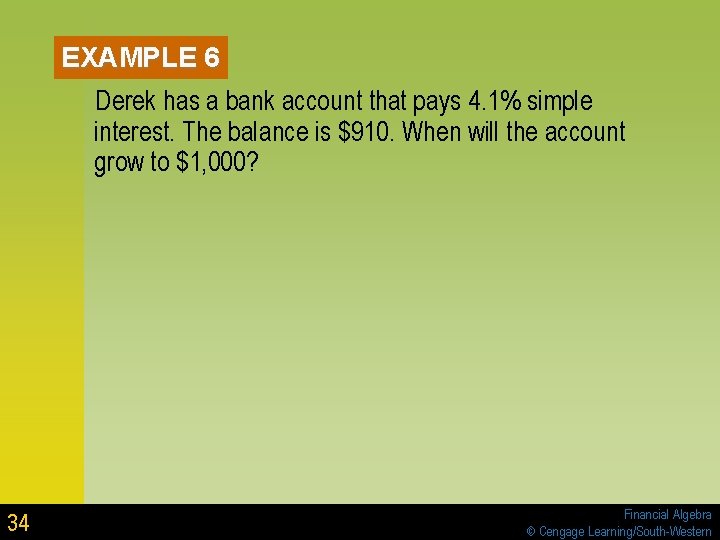
EXAMPLE 6 Derek has a bank account that pays 4. 1% simple interest. The balance is $910. When will the account grow to $1, 000? 34 Financial Algebra © Cengage Learning/South-Western
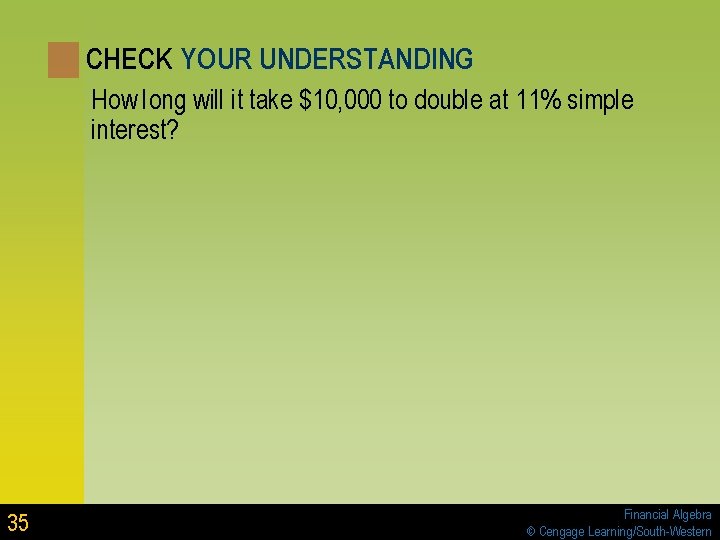
CHECK YOUR UNDERSTANDING How long will it take $10, 000 to double at 11% simple interest? 35 Financial Algebra © Cengage Learning/South-Western
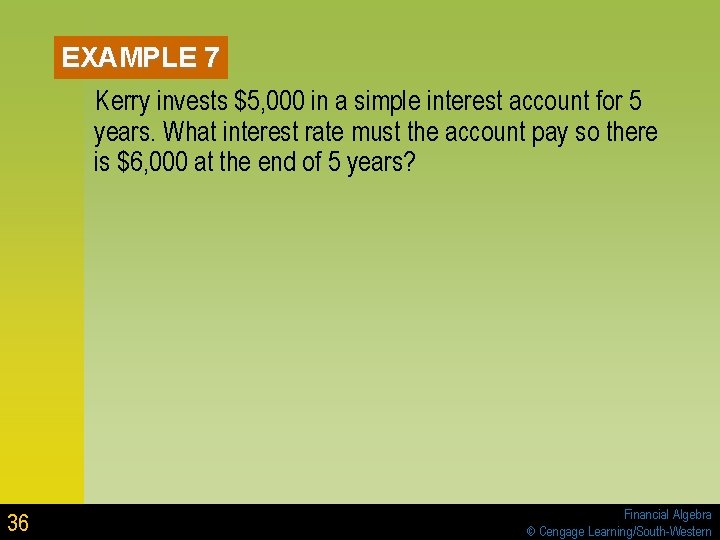
EXAMPLE 7 Kerry invests $5, 000 in a simple interest account for 5 years. What interest rate must the account pay so there is $6, 000 at the end of 5 years? 36 Financial Algebra © Cengage Learning/South-Western
CHECK YOUR UNDERSTANDING Marcos deposited $500 into a 2. 5 -year simple interest account. He wants to earn $200 interest. What interest rate must the account pay? 37 Financial Algebra © Cengage Learning/South-Western
3 -4 EXPLORE COMPOUND INTEREST OBJECTIVES Understand the concept of getting interest on your interest. Compute compound interest using a table. Slide 38 Financial Algebra © Cengage/South-Western
Key Terms l compound interest l annual compounding l semiannual compounding l quarterly compounding l daily compounding l crediting 39 Financial Algebra © Cengage Learning/South-Western
What is compound interest? l Could interest be compounded every hour? l How many hours are in a year? l Could interest be compounded every minute? 40 Financial Algebra © Cengage Learning/South-Western
Example 1 How much interest would $1, 000 earn in one year at a rate of 6%, compounded annually? What would be the new balance? 41 Financial Algebra © Cengage Learning/South-Western
CHECK YOUR UNDERSTANDING How much would x dollars earn in one year at a rate of 4. 4% compounded annually? 42 Financial Algebra © Cengage Learning/South-Western
Example 2 Maria deposits $1, 000 in a savings account that pays 6% interest, compounded semiannually. What is her balance after one year? 43 Financial Algebra © Cengage Learning/South-Western
CHECK YOUR UNDERSTANDING Alex deposits $4, 000 in a savings account that pays 5% interest, compounded semiannually. What is his balance after one year? 44 Financial Algebra © Cengage Learning/South-Western
EXAMPLE 3 How much interest does $1, 000 earn in three months at an interest rate of 6%, compounded quarterly? What is the balance after three months? 45 Financial Algebra © Cengage Learning/South-Western
CHECK YOUR UNDERSTANDING How much does $3, 000 earn in six months at an interest rate of 4%, compounded quarterly? 46 Financial Algebra © Cengage Learning/South-Western
EXAMPLE 4 How much interest does $1, 000 earn in one day at an interest rate of 6%, compounded daily? What is the balance after a day? 47 Financial Algebra © Cengage Learning/South-Western
CHECK YOUR UNDERSTANDING How much interest does x dollars earn in one day at an interest rate of 5%, compounded daily? Express the answer algebraically. 48 Financial Algebra © Cengage Learning/South-Western
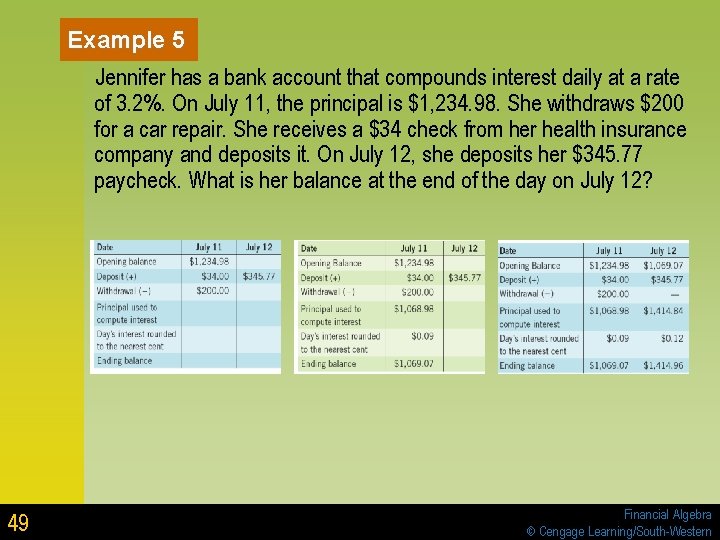
Example 5 Jennifer has a bank account that compounds interest daily at a rate of 3. 2%. On July 11, the principal is $1, 234. 98. She withdraws $200 for a car repair. She receives a $34 check from her health insurance company and deposits it. On July 12, she deposits her $345. 77 paycheck. What is her balance at the end of the day on July 12? 49 Financial Algebra © Cengage Learning/South-Western
CHECK YOUR UNDERSTANDING On January 7, Joelle opened a savings account with $900. It earned 3% interest, compounded daily. On January 8, she deposited her first paycheck of $76. 22. What was her balance at the end of the day on January 8? 50 Financial Algebra © Cengage Learning/South-Western
3 -5 COMPOUND INTEREST FORMULA OBJECTIVES Become familiar with the derivation of the compound interest formula. Make computations using the compound interest formula. Slide 51 Financial Algebra © Cengage/South-Western
Key Terms l compound interest formula l annual percentage rate (APR) l annual percentage yield (APY) 52 Financial Algebra © Cengage Learning/South-Western
What are the advantages of using the compound interest formula? l How did the use of computers make it easier for banks to calculate compound interest for each account? l Without the help of computers, how long do you think it would take you to calculate the compound interest for an account for a five year period? 53 Financial Algebra © Cengage Learning/South-Western
Example 1 Jose opens a savings account with principal P dollars that pays 5% interest, compounded quarterly. What will his ending balance be after one year? 54 Financial Algebra © Cengage Learning/South-Western
CHECK YOUR UNDERSTANDING Rico deposits $800 at 3. 87% interest, compounded quarterly. What is his ending balance after one year? Round to the nearest cent. 55 Financial Algebra © Cengage Learning/South-Western
Example 2 If you deposit P dollars for one year at 5% compounded daily, express the ending balance algebraically. 56 Financial Algebra © Cengage Learning/South-Western
CHECK YOUR UNDERSTANDING Nancy deposits $1, 200 into an account that pays 3% interest, compounded monthly. What is her ending balance after one year? Round to the nearest cent. 57 Financial Algebra © Cengage Learning/South-Western
EXTEND YOUR UNDERSTANDING Nancy receives two offers in the mail from other banks. One is an account that pays 2. 78% compounded daily. The other account pays 3. 25% compounded quarterly. Would either of these accounts provide Nancy with a better return than her current account? If so, which account? 58 Financial Algebra © Cengage Learning/South-Western
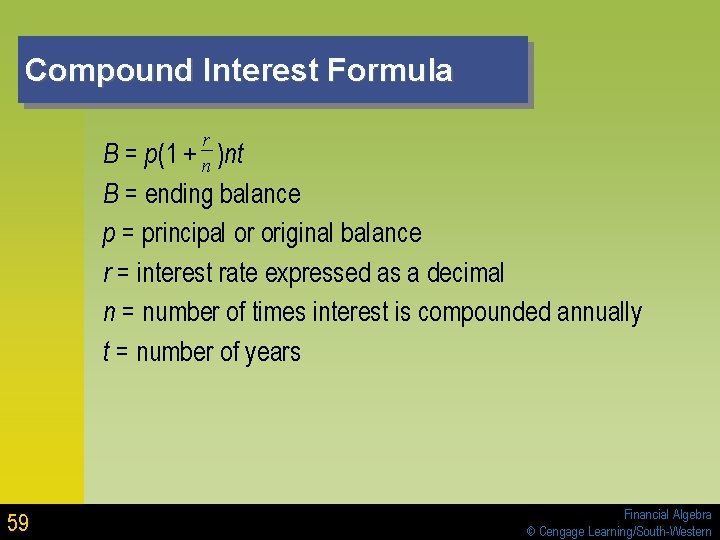
Compound Interest Formula r + n )nt B = p(1 B = ending balance p = principal or original balance r = interest rate expressed as a decimal n = number of times interest is compounded annually t = number of years 59 Financial Algebra © Cengage Learning/South-Western
EXAMPLE 3 Marie deposits $1, 650 for three years at 3% interest, compounded daily. What is her ending balance? 60 Financial Algebra © Cengage Learning/South-Western
CHECK YOUR UNDERSTANDING Kate deposits $2, 350 in an account that earns interest at a rate of 3. 1%, compounded monthly. What is her ending balance after five years? Round to the nearest cent. 61 Financial Algebra © Cengage Learning/South-Western
EXTEND YOUR UNDERSTANDING Write an algebraic expression for the ending balance after k years of an account that starts with a balance of $2, 000 and earns interest at a rate of 3. 5%, compounded daily. 62 Financial Algebra © Cengage Learning/South-Western
EXAMPLE 4 Sharon deposits $8, 000 in a one year CD at 3. 2% interest, compounded daily. What is Sharon’s annual percentage yield (APY) to the nearest hundredth of a percent? 63 Financial Algebra © Cengage Learning/South-Western
CHECK YOUR UNDERSTANDING Barbara deposits $3, 000 in a one year CD at 4. 1% interest, compounded daily. What is the APY to the nearest hundredth of a percent? 64 Financial Algebra © Cengage Learning/South-Western
EXTEND YOUR UNDERSTANDING Consider an amount x deposited into a CD at 2. 4% interest compounded daily, and the same amount deposited into a CD at the same rate that compounds monthly. Explain why, after 1 year, the balance on a CD that compounds daily is greater than the CD that compounded monthly. 65 Financial Algebra © Cengage Learning/South-Western
3 -6 CONTINUOUS COMPOUNDING OBJECTIVES Compute interest on an account that is continuously compounded. Slide 66 Financial Algebra © Cengage/South-Western
Key Terms l l l 67 limit finite infinite continuous compounding exponential base (e) continuous compound interest formula Financial Algebra © Cengage Learning/South-Western
How can interest be compounded continuously? l Can interest be compounded l Daily? l Hourly? l Each minute? l Every second? l If $1, 000 is deposited into an account and compounded at 100% interest for one year, what would be the account balance at the end of the year? 68 Financial Algebra © Cengage Learning/South-Western
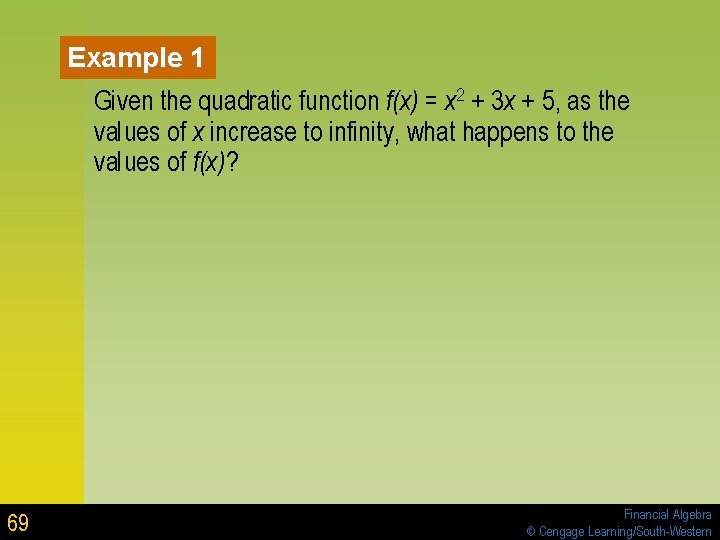
Example 1 Given the quadratic function f(x) = x 2 + 3 x + 5, as the values of x increase to infinity, what happens to the values of f(x)? 69 Financial Algebra © Cengage Learning/South-Western
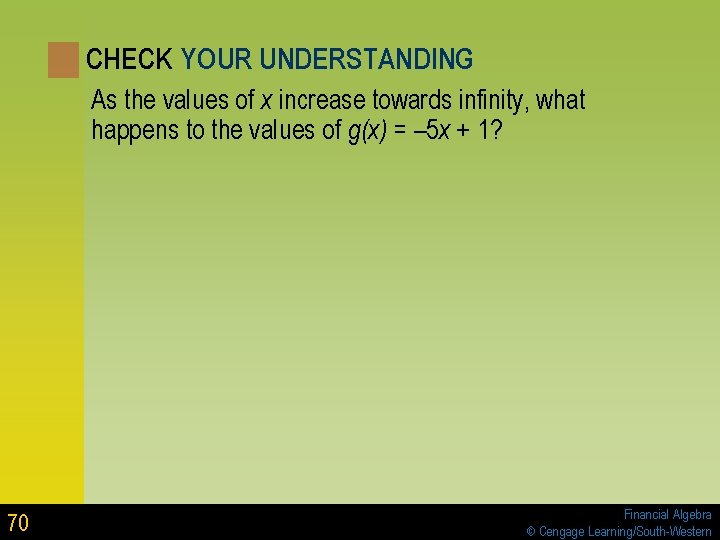
CHECK YOUR UNDERSTANDING As the values of x increase towards infinity, what happens to the values of g(x) = – 5 x + 1? 70 Financial Algebra © Cengage Learning/South-Western
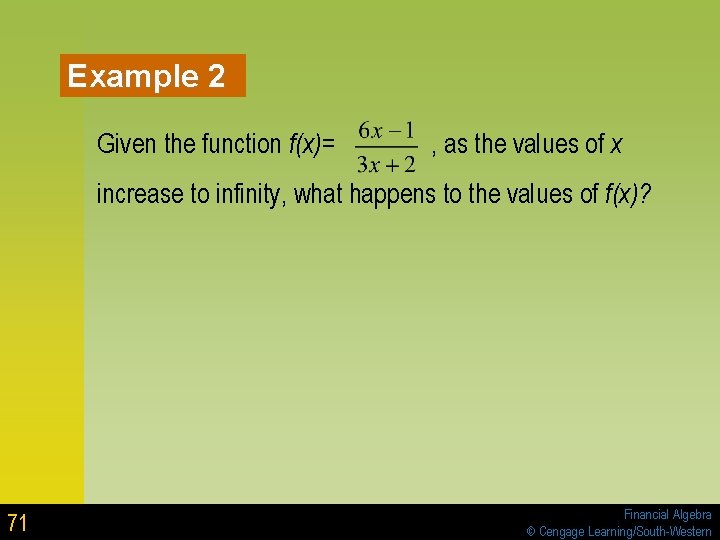
Example 2 Given the function f(x)= , as the values of x increase to infinity, what happens to the values of f(x)? 71 Financial Algebra © Cengage Learning/South-Western
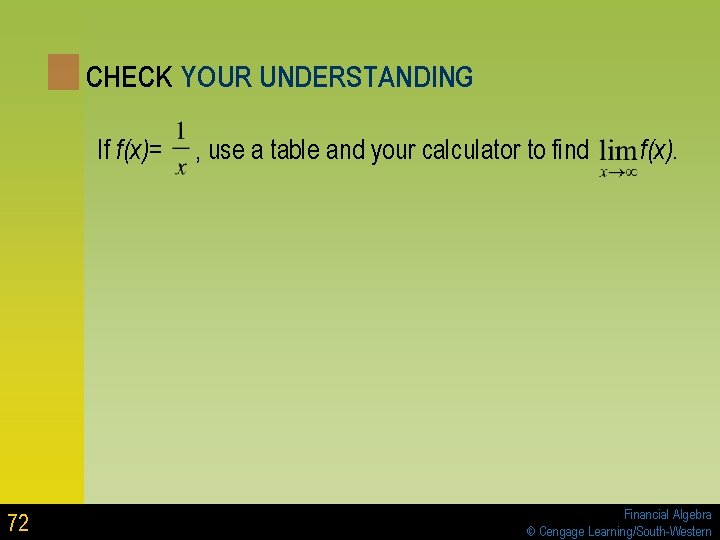
CHECK YOUR UNDERSTANDING If f(x)= 72 , use a table and your calculator to find f(x). Financial Algebra © Cengage Learning/South-Western
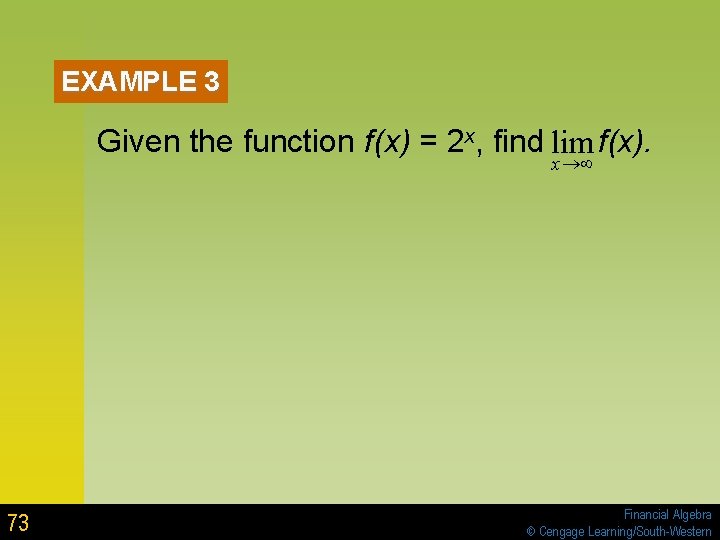
EXAMPLE 3 Given the function f(x) = 2 x, find lim f(x). x ®¥ 73 Financial Algebra © Cengage Learning/South-Western
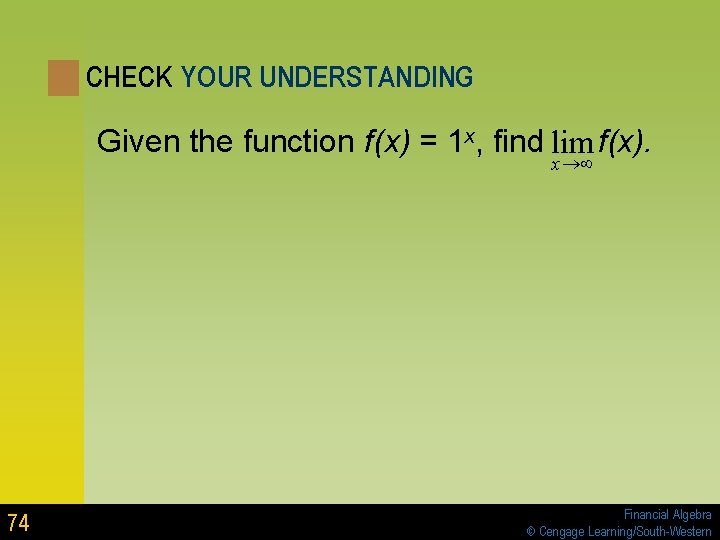
CHECK YOUR UNDERSTANDING Given the function f(x) = 1 x, find lim f(x). x ®¥ 74 Financial Algebra © Cengage Learning/South-Western
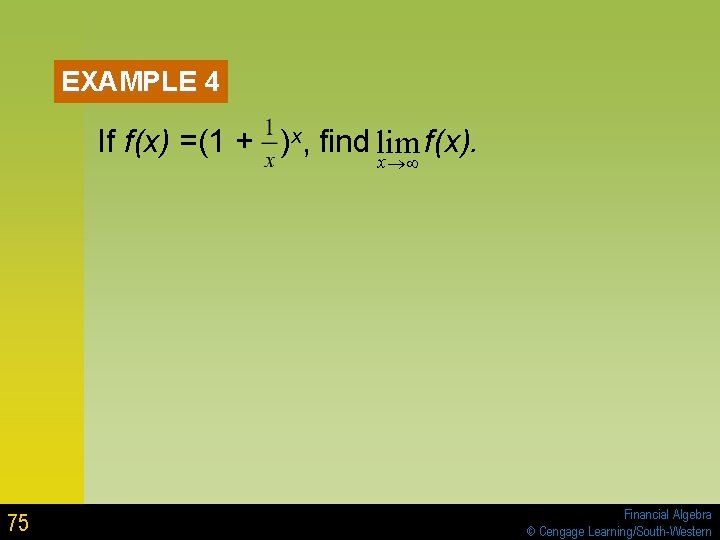
EXAMPLE 4 If f(x) =(1 + )x, find lim f(x). x®¥ 75 Financial Algebra © Cengage Learning/South-Western
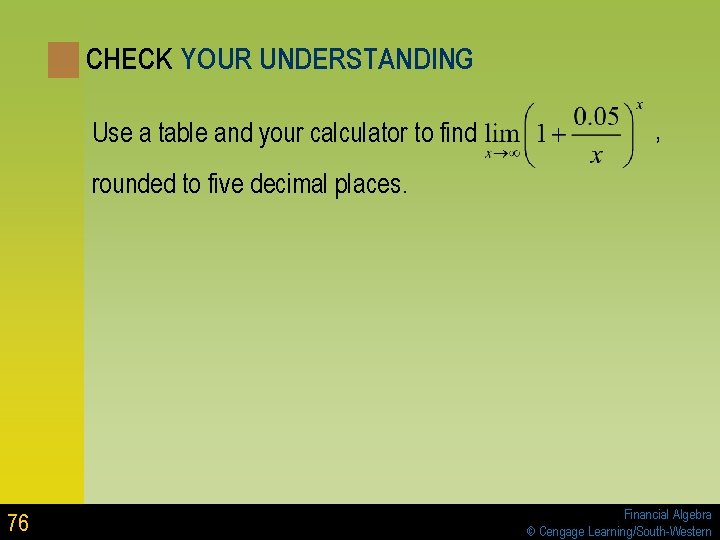
CHECK YOUR UNDERSTANDING Use a table and your calculator to find , rounded to five decimal places. 76 Financial Algebra © Cengage Learning/South-Western
EXAMPLE 5 If you deposited $1, 000 at 100% interest, compounded continuously, what would your ending balance be after one year? 77 Financial Algebra © Cengage Learning/South-Western
CHECK YOUR UNDERSTANDING The irrational, exponential base e is so important in mathematics that it has a single-letter abbreviation, e, and has its own key on the calculator. When you studied circles, you studied another important irrational number that has a single-letter designation and its own key on the calculator. The number was π. Recall that π = 3. 141592654. Use the e and π keys on your calculator to find the difference between eπ and πe. Round to the nearest thousandth. 78 Financial Algebra © Cengage Learning/South-Western
EXAMPLE 6 If you deposit $1, 000 at 4. 3% interest, compounded continuously, what would your ending balance be to the nearest cent after five years? 79 Financial Algebra © Cengage Learning/South-Western
CHECK YOUR UNDERSTANDING Craig deposits $5, 000 at 5. 12% interest, compounded continuously for four years. What would his ending balance be to the nearest cent? 80 Financial Algebra © Cengage Learning/South-Western
3 -7 FUTURE VALUE OF INVESTMENTS OBJECTIVES Calculate the future value of a periodic deposit investment. Graph the future value function. Interpret the graph of the future value function. Slide 81 Financial Algebra © Cengage/South-Western
Key Terms l l 82 future value of a single deposit investment periodic investment biweekly future value of a periodic deposit investment Financial Algebra © Cengage Learning/South-Western
How can you effectively plan for the future balance in an account? l How can you calculate what the value of a deposit will be after a certain amount of time? l If you want your balance to be a specific amount at the end of a period of time, how do you determine how much your initial deposit and subsequent deposits should be? l Remember to consider the annual interest rate when considering your answer. 83 Financial Algebra © Cengage Learning/South-Western
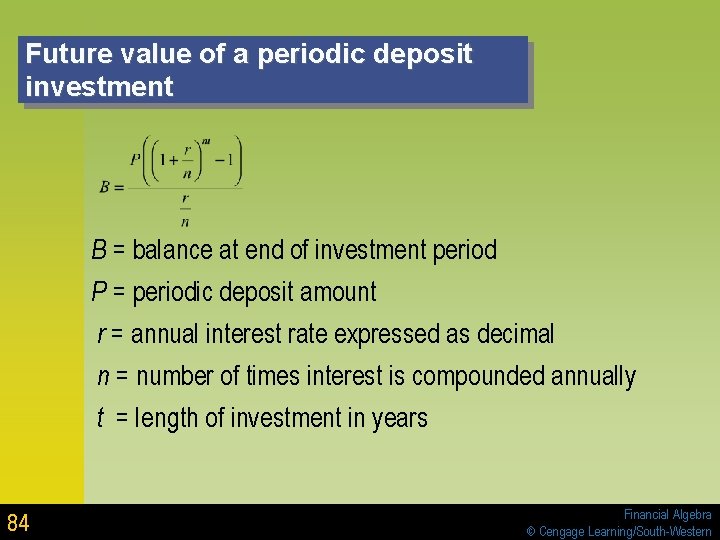
Future value of a periodic deposit investment B = balance at end of investment period P = periodic deposit amount r = annual interest rate expressed as decimal n = number of times interest is compounded annually t = length of investment in years 84 Financial Algebra © Cengage Learning/South-Western
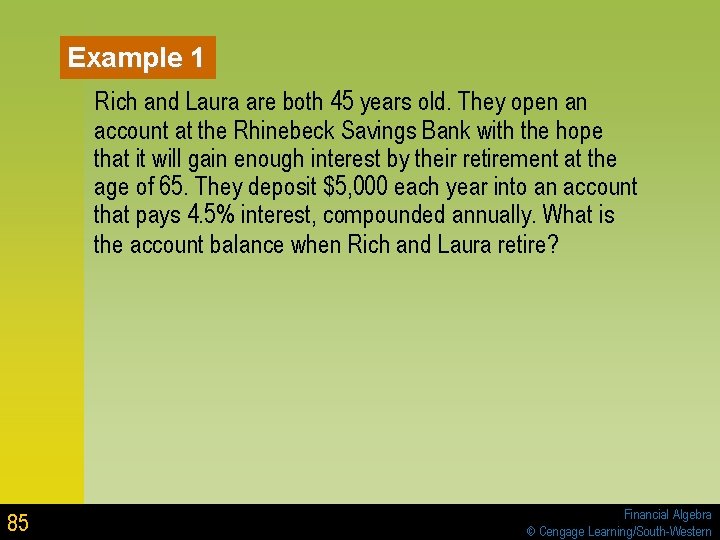
Example 1 Rich and Laura are both 45 years old. They open an account at the Rhinebeck Savings Bank with the hope that it will gain enough interest by their retirement at the age of 65. They deposit $5, 000 each year into an account that pays 4. 5% interest, compounded annually. What is the account balance when Rich and Laura retire? 85 Financial Algebra © Cengage Learning/South-Western
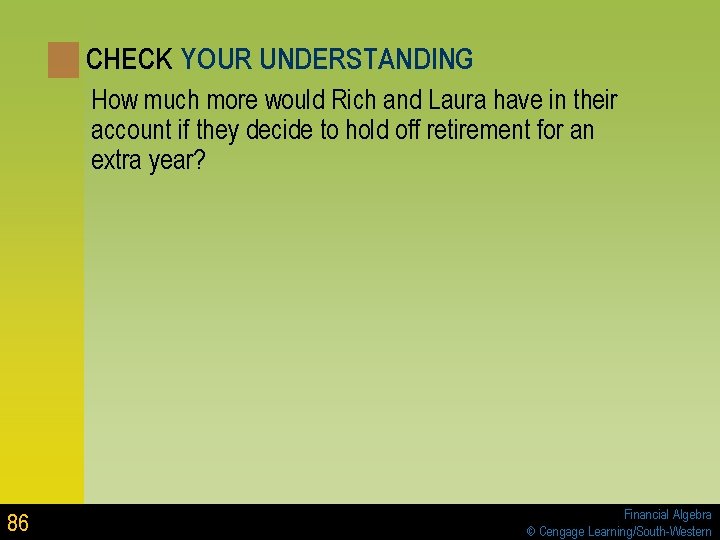
CHECK YOUR UNDERSTANDING How much more would Rich and Laura have in their account if they decide to hold off retirement for an extra year? 86 Financial Algebra © Cengage Learning/South-Western
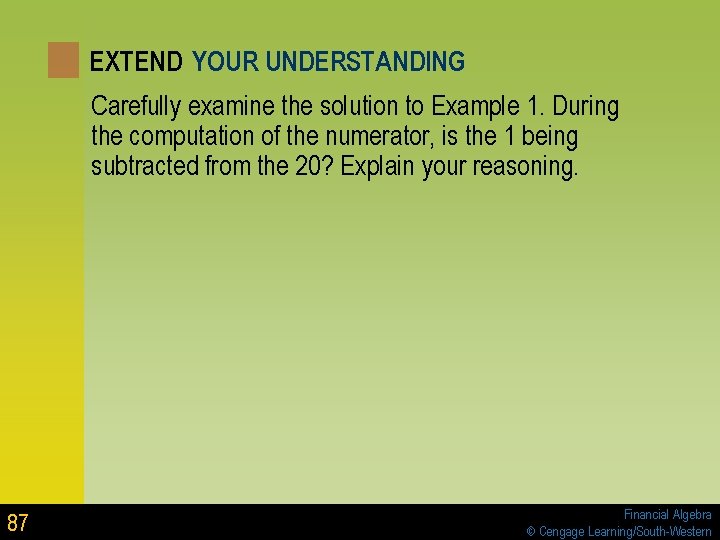
EXTEND YOUR UNDERSTANDING Carefully examine the solution to Example 1. During the computation of the numerator, is the 1 being subtracted from the 20? Explain your reasoning. 87 Financial Algebra © Cengage Learning/South-Western
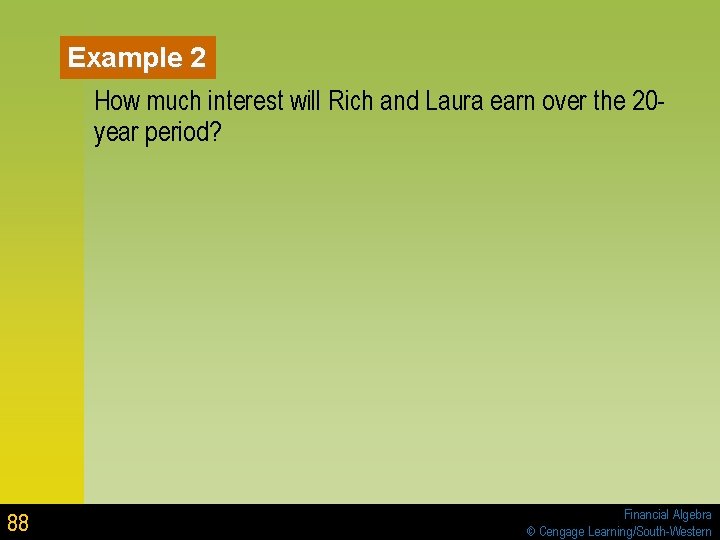
Example 2 How much interest will Rich and Laura earn over the 20 year period? 88 Financial Algebra © Cengage Learning/South-Western
CHECK YOUR UNDERSTANDING Use Example 1 Check Your Understanding. How much more interest would Rich and Laura earn by retiring after 21 years? 89 Financial Algebra © Cengage Learning/South-Western
EXAMPLE 3 Linda and Rob open an online savings account that has a 3. 6% annual interest rate, compounded monthly. If they deposit $1, 200 every month, how much will be in the account after 10 years? 90 Financial Algebra © Cengage Learning/South-Western
CHECK YOUR UNDERSTANDING Would opening an account at a higher interest rate for fewer years have assured Linda and Rob at least the same final balance? 91 Financial Algebra © Cengage Learning/South-Western
EXAMPLE 4 Construct a graph of the future value function that represents Linda and Rob’s account for each month. Use the graph to approximate the balance after 5 years. 92 Financial Algebra © Cengage Learning/South-Western
CHECK YOUR UNDERSTANDING Construct a graph for Rich and Laura’s situation in Example 1. 93 Financial Algebra © Cengage Learning/South-Western
3 -8 PRESENT VALUE OF INVESTMENTS OBJECTIVES Calculate the present value of a single deposit investment. Calculate the present value of a periodic deposit investment. Slide 94 Financial Algebra © Cengage/South-Western
Key Terms l present value of a single deposit investment l present value of a periodic deposit investment 95 Financial Algebra © Cengage Learning/South-Western
How can you determine what you need to invest now to reach a financial goal? l What large purchases do you see in your future? l If you know you will need a specific amount of money in the future, how do you determine how much money to deposit l Now, in a single deposit, to reach the specific amount needed in the future? l Beginning now, but in multiple deposits over a period of time, to reach the specific amount needed in the future? 96 Financial Algebra © Cengage Learning/South-Western
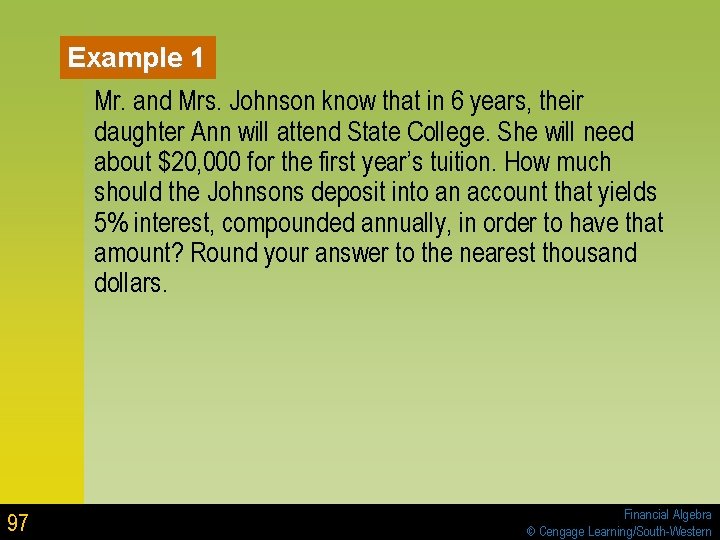
Example 1 Mr. and Mrs. Johnson know that in 6 years, their daughter Ann will attend State College. She will need about $20, 000 for the first year’s tuition. How much should the Johnsons deposit into an account that yields 5% interest, compounded annually, in order to have that amount? Round your answer to the nearest thousand dollars. 97 Financial Algebra © Cengage Learning/South-Western
CHECK YOUR UNDERSTANDING How many years would it take for $10, 000 to grow to $20, 000 in the same account? 98 Financial Algebra © Cengage Learning/South-Western
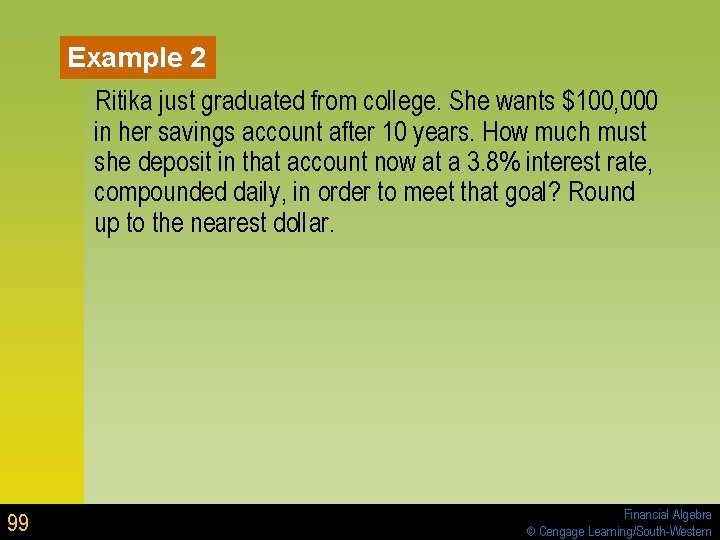
Example 2 Ritika just graduated from college. She wants $100, 000 in her savings account after 10 years. How much must she deposit in that account now at a 3. 8% interest rate, compounded daily, in order to meet that goal? Round up to the nearest dollar. 99 Financial Algebra © Cengage Learning/South-Western
CHECK YOUR UNDERSTANDING How does the equation from Example 2 change if the interest is compounded weekly? 100 Financial Algebra © Cengage Learning/South-Western
EXAMPLE 3 Nick wants to install central air conditioning in his home in 3 years. He estimates the total cost to be $15, 000. How much must he deposit monthly into an account that pays 4% interest, compounded monthly, in order to have enough money? Round up to the nearest hundred dollars. 101 Financial Algebra © Cengage Learning/South-Western
CHECK YOUR UNDERSTANDING Write the formula to find the present value of an x-dollar balance that is reached by periodic investments made semiannually for y years at an interest rate of r. 102 Financial Algebra © Cengage Learning/South-Western
EXAMPLE 4 Randy wants to have saved a total of $200, 000 by some point in the future. He is willing to set up a direct deposit account with a 4. 5% APR, compounded monthly, but is unsure of how much to periodically deposit for varying lengths of time. Graph a present value function to show the present values for Randy’s situation from 12 months to 240 months. 103 Financial Algebra © Cengage Learning/South-Western
CHECK YOUR UNDERSTANDING Use the graph to estimate how much to deposit each month for 1 year, 10 years, and 20 years. 104 Financial Algebra © Cengage Learning/South-Western