
3 2 Quadratic Equations Functions Zeros and Models
- Slides: 18
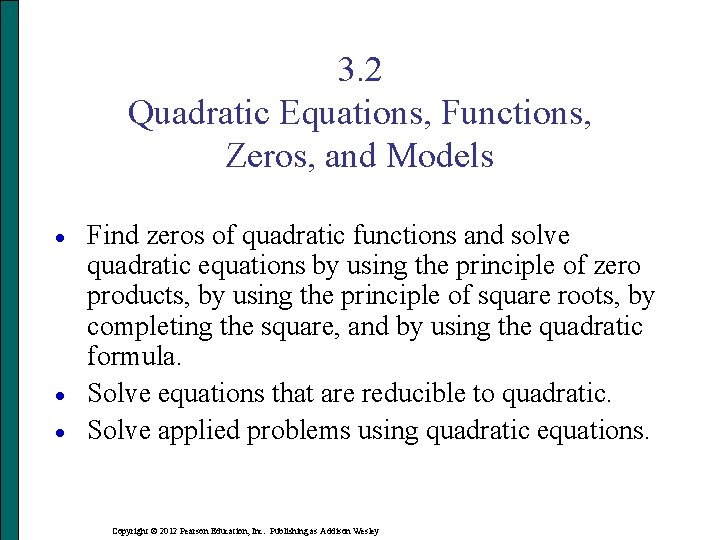
3. 2 Quadratic Equations, Functions, Zeros, and Models · · · Find zeros of quadratic functions and solve quadratic equations by using the principle of zero products, by using the principle of square roots, by completing the square, and by using the quadratic formula. Solve equations that are reducible to quadratic. Solve applied problems using quadratic equations. Copyright © 2012 Pearson Education, Inc. Publishing as Addison Wesley
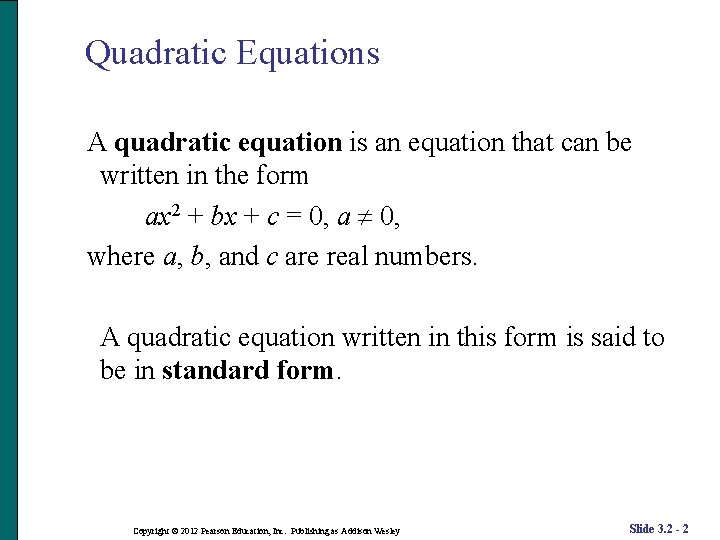
Quadratic Equations A quadratic equation is an equation that can be written in the form ax 2 + bx + c = 0, a 0, where a, b, and c are real numbers. A quadratic equation written in this form is said to be in standard form. Copyright © 2012 Pearson Education, Inc. Publishing as Addison Wesley Slide 3. 2 - 2
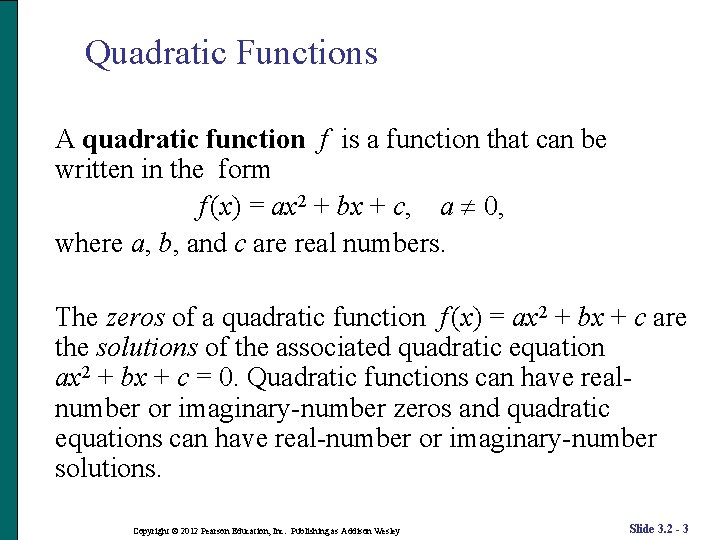
Quadratic Functions A quadratic function f is a function that can be written in the form f (x) = ax 2 + bx + c, a 0, where a, b, and c are real numbers. The zeros of a quadratic function f (x) = ax 2 + bx + c are the solutions of the associated quadratic equation ax 2 + bx + c = 0. Quadratic functions can have realnumber or imaginary-number zeros and quadratic equations can have real-number or imaginary-number solutions. Copyright © 2012 Pearson Education, Inc. Publishing as Addison Wesley Slide 3. 2 - 3
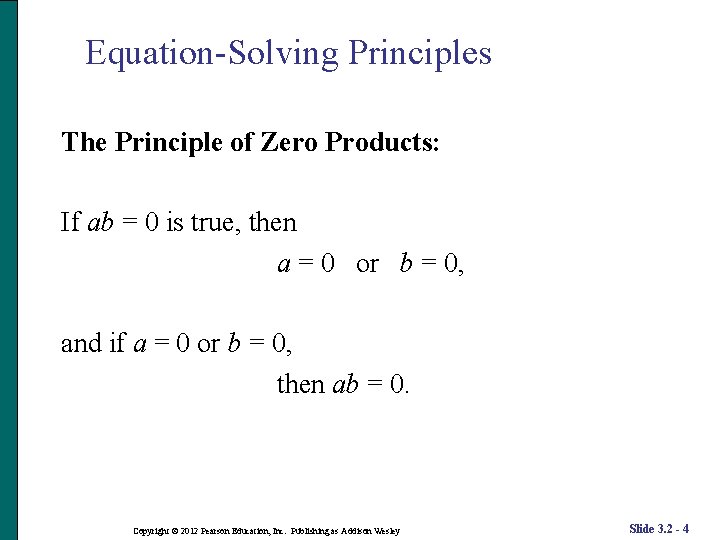
Equation-Solving Principles The Principle of Zero Products: If ab = 0 is true, then a = 0 or b = 0, and if a = 0 or b = 0, then ab = 0. Copyright © 2012 Pearson Education, Inc. Publishing as Addison Wesley Slide 3. 2 - 4
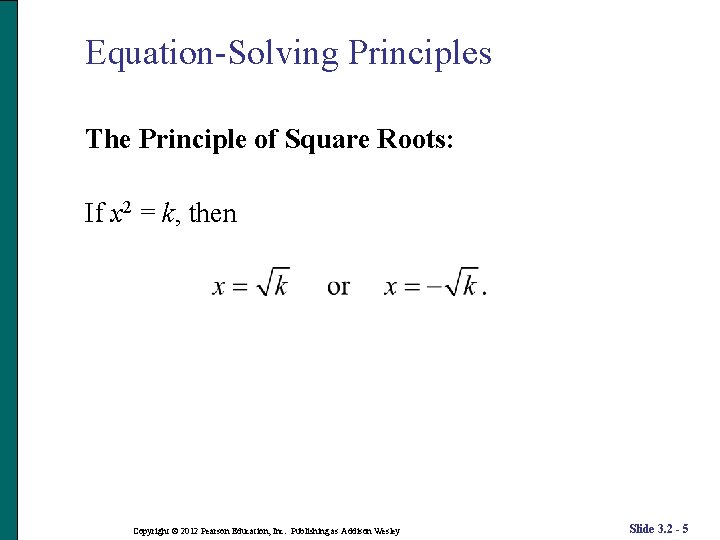
Equation-Solving Principles The Principle of Square Roots: If x 2 = k, then Copyright © 2012 Pearson Education, Inc. Publishing as Addison Wesley Slide 3. 2 - 5
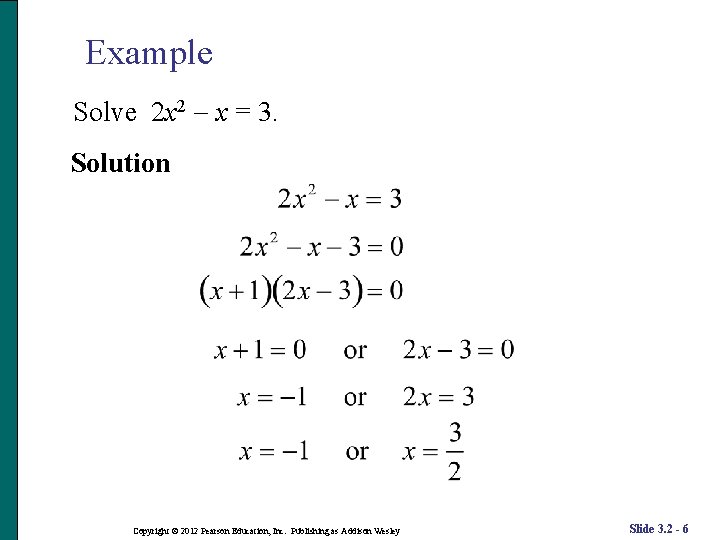
Example Solve 2 x 2 x = 3. Solution Copyright © 2012 Pearson Education, Inc. Publishing as Addison Wesley Slide 3. 2 - 6
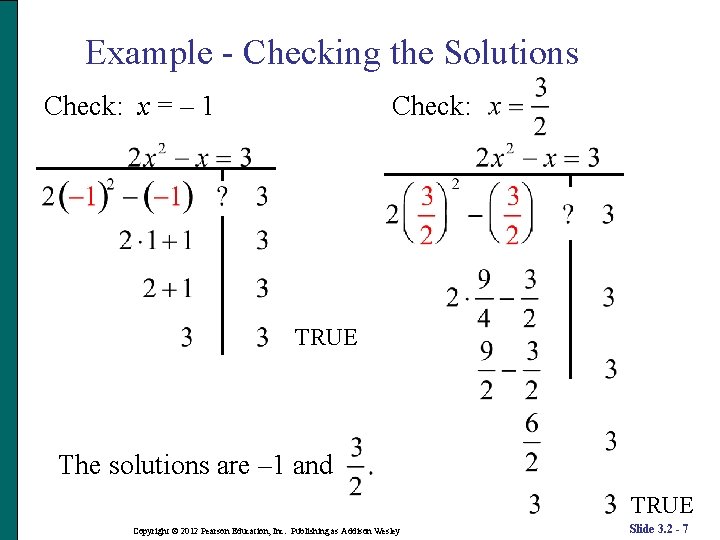
Example - Checking the Solutions Check: x = – 1 Check: TRUE The solutions are – 1 and TRUE Copyright © 2012 Pearson Education, Inc. Publishing as Addison Wesley Slide 3. 2 - 7
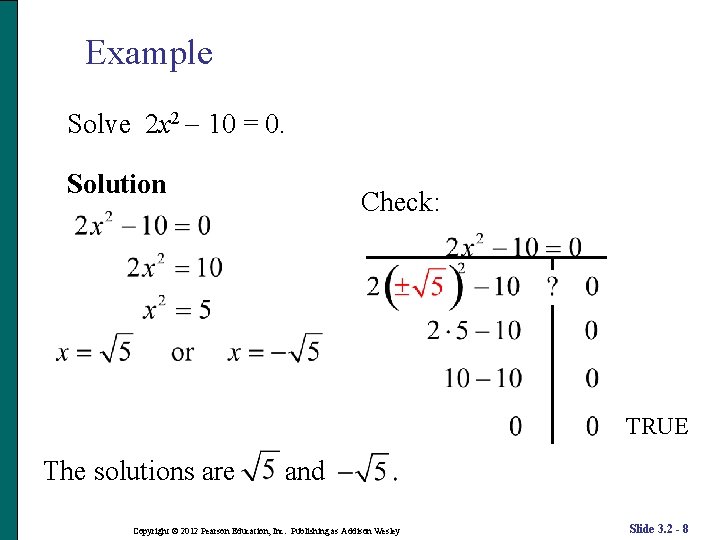
Example Solve 2 x 2 10 = 0. Solution Check: TRUE The solutions are and Copyright © 2012 Pearson Education, Inc. Publishing as Addison Wesley Slide 3. 2 - 8
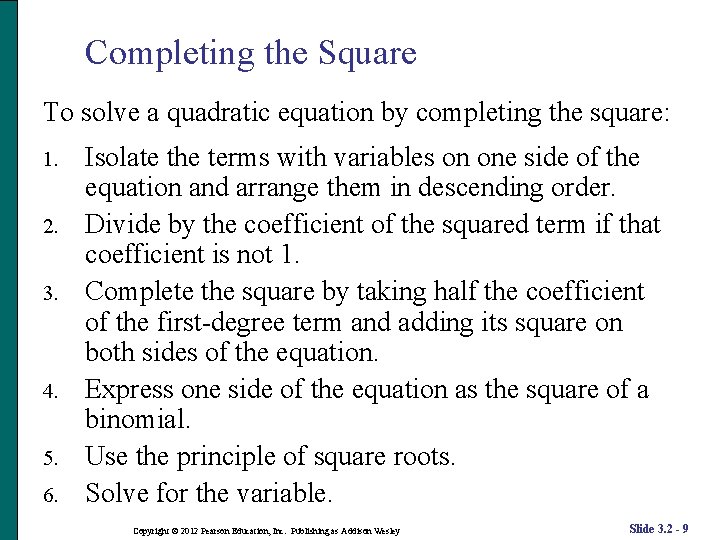
Completing the Square To solve a quadratic equation by completing the square: 1. 2. 3. 4. 5. 6. Isolate the terms with variables on one side of the equation and arrange them in descending order. Divide by the coefficient of the squared term if that coefficient is not 1. Complete the square by taking half the coefficient of the first-degree term and adding its square on both sides of the equation. Express one side of the equation as the square of a binomial. Use the principle of square roots. Solve for the variable. Copyright © 2012 Pearson Education, Inc. Publishing as Addison Wesley Slide 3. 2 - 9
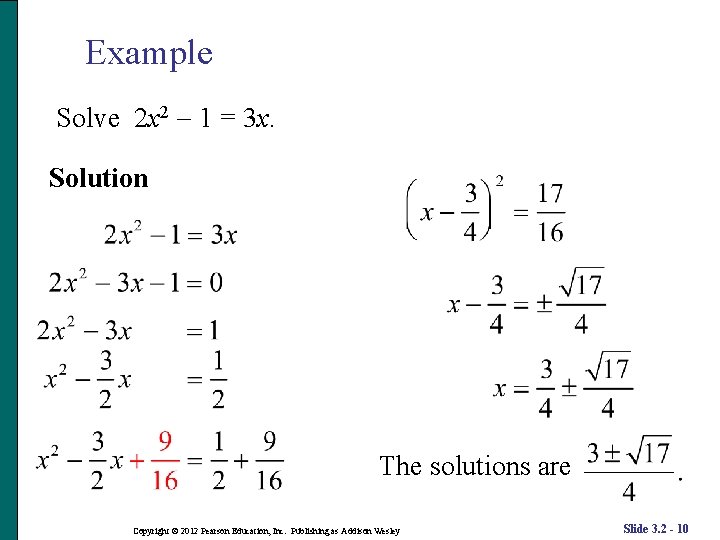
Example Solve 2 x 2 1 = 3 x. Solution The solutions are Copyright © 2012 Pearson Education, Inc. Publishing as Addison Wesley Slide 3. 2 - 10
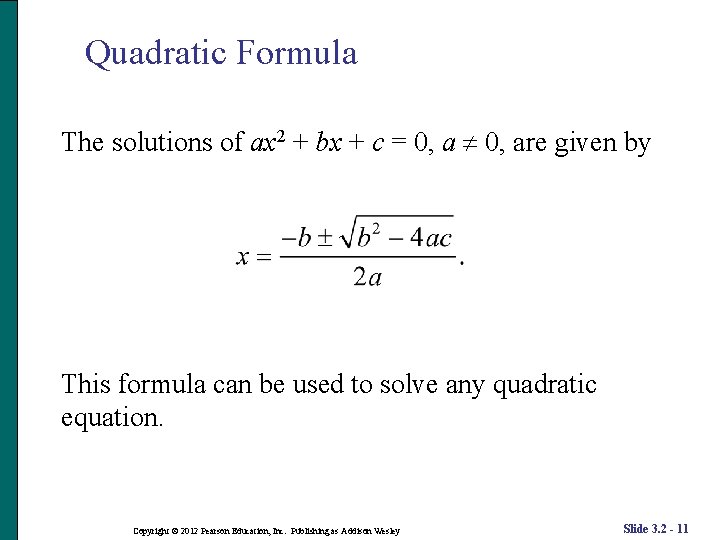
Quadratic Formula The solutions of ax 2 + bx + c = 0, are given by This formula can be used to solve any quadratic equation. Copyright © 2012 Pearson Education, Inc. Publishing as Addison Wesley Slide 3. 2 - 11
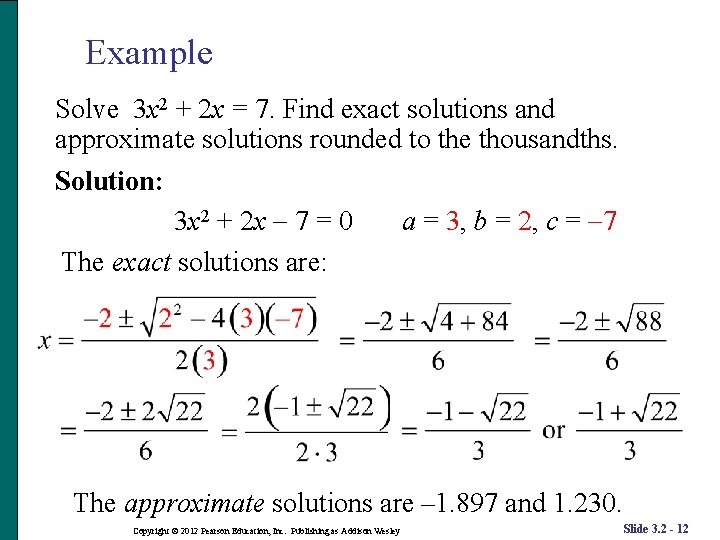
Example Solve 3 x 2 + 2 x = 7. Find exact solutions and approximate solutions rounded to the thousandths. Solution: 3 x 2 + 2 x 7 = 0 a = 3, b = 2, c = 7 The exact solutions are: The approximate solutions are – 1. 897 and 1. 230. Copyright © 2012 Pearson Education, Inc. Publishing as Addison Wesley Slide 3. 2 - 12
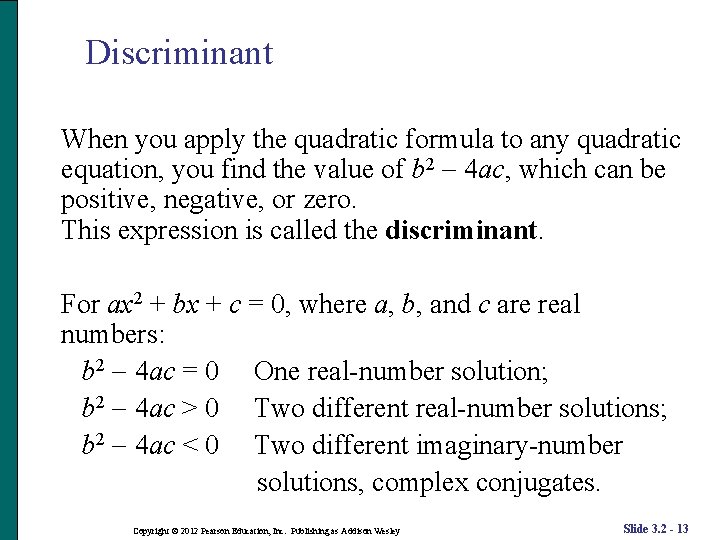
Discriminant When you apply the quadratic formula to any quadratic equation, you find the value of b 2 4 ac, which can be positive, negative, or zero. This expression is called the discriminant. For ax 2 + bx + c = 0, where a, b, and c are real numbers: b 2 4 ac = 0 One real-number solution; b 2 4 ac > 0 Two different real-number solutions; b 2 4 ac < 0 Two different imaginary-number solutions, complex conjugates. Copyright © 2012 Pearson Education, Inc. Publishing as Addison Wesley Slide 3. 2 - 13
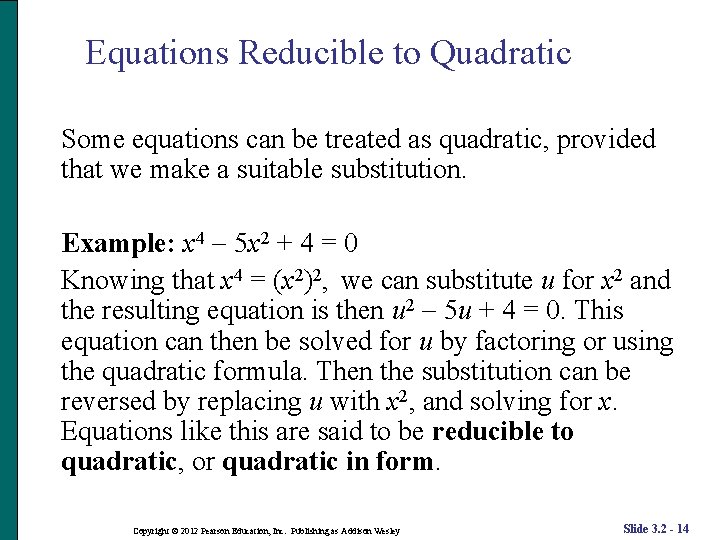
Equations Reducible to Quadratic Some equations can be treated as quadratic, provided that we make a suitable substitution. Example: x 4 5 x 2 + 4 = 0 Knowing that x 4 = (x 2)2, we can substitute u for x 2 and the resulting equation is then u 2 5 u + 4 = 0. This equation can then be solved for u by factoring or using the quadratic formula. Then the substitution can be reversed by replacing u with x 2, and solving for x. Equations like this are said to be reducible to quadratic, or quadratic in form. Copyright © 2012 Pearson Education, Inc. Publishing as Addison Wesley Slide 3. 2 - 14
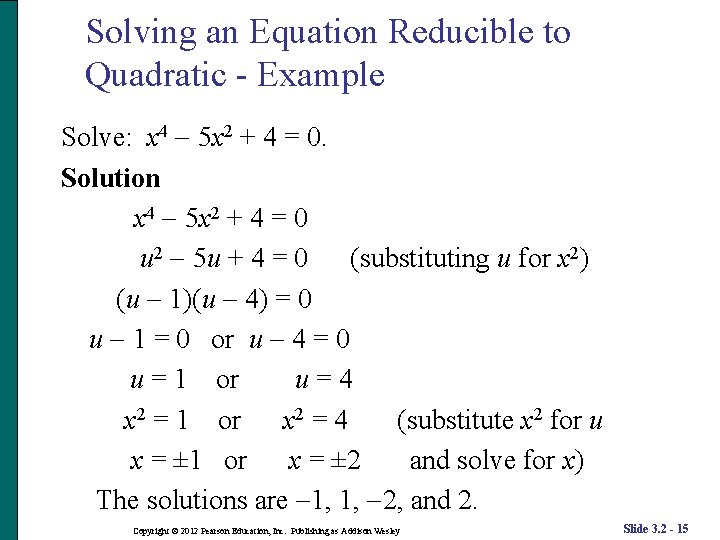
Solving an Equation Reducible to Quadratic - Example Solve: x 4 5 x 2 + 4 = 0. Solution x 4 5 x 2 + 4 = 0 u 2 5 u + 4 = 0 (substituting u for x 2) (u 1)(u 4) = 0 u 1 = 0 or u 4 = 0 u = 1 or u=4 x 2 = 1 or x 2 = 4 (substitute x 2 for u x = ± 1 or x = ± 2 and solve for x) The solutions are 1, 1, 2, and 2. Copyright © 2012 Pearson Education, Inc. Publishing as Addison Wesley Slide 3. 2 - 15
Applications Some applied problems can be translated to quadratic equations. Example Time of Free Fall. The Petronas Towers in Kuala Lumpur, Malaysia are 1482 ft tall. How long would it take an object dropped from the top reach the ground? Copyright © 2012 Pearson Education, Inc. Publishing as Addison Wesley Slide 3. 2 - 16
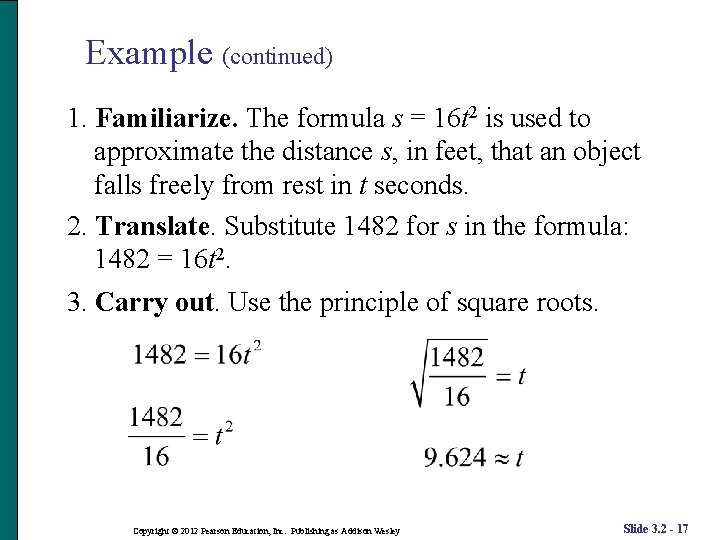
Example (continued) 1. Familiarize. The formula s = 16 t 2 is used to approximate the distance s, in feet, that an object falls freely from rest in t seconds. 2. Translate. Substitute 1482 for s in the formula: 1482 = 16 t 2. 3. Carry out. Use the principle of square roots. Copyright © 2012 Pearson Education, Inc. Publishing as Addison Wesley Slide 3. 2 - 17
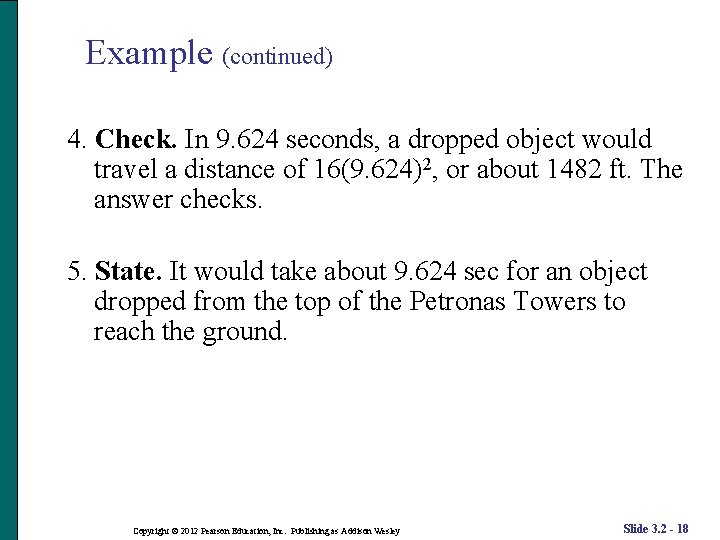
Example (continued) 4. Check. In 9. 624 seconds, a dropped object would travel a distance of 16(9. 624)2, or about 1482 ft. The answer checks. 5. State. It would take about 9. 624 sec for an object dropped from the top of the Petronas Towers to reach the ground. Copyright © 2012 Pearson Education, Inc. Publishing as Addison Wesley Slide 3. 2 - 18