
3 2 Formal Amendment The Bill of Rights
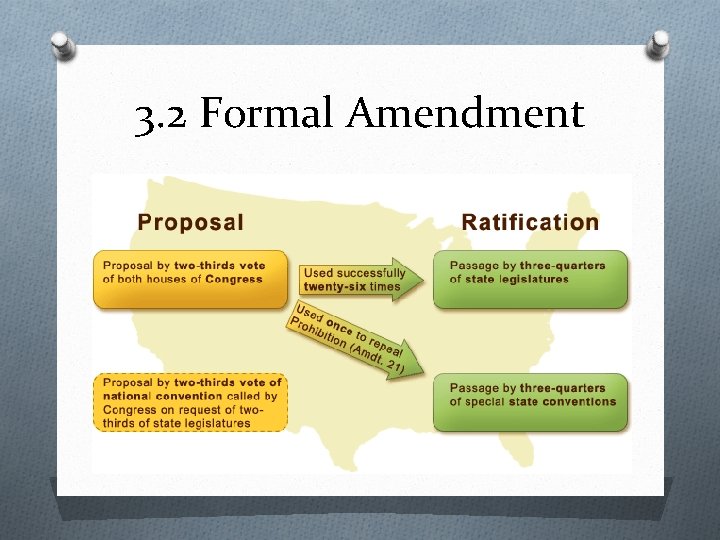
3. 2 Formal Amendment
The Bill of Rights O set out the constitutional guarantees of liberty, security, and of fair and equal treatment before the law O note that women’s right to vote is not there nor the prohibition of slavery O proposed by Congress in 1789 and came about from opposition to Constitution
The Civil War Amendments O 13 th (1868) – ended slavery O 14 th (1868) – defined American citizenship and guaranteed due process and equal protection of the law to all citizens O 15 th (1870) - outlawed restrictions on the right to vote based on race, color, or previous condition of servitude O (free citizens vote)
Extension of Voting Rights O 17 th – direct election of Senators (1913) O 19 th – women’s right to vote (1920) O 23 rd – gave electoral votes to D. C. (1961) O 24 th – eliminated poll taxes (1964) O 26 th – lowered voting age to 18 (1971)
Extension of National Gov’t Powers O 16 th – federal income tax O 18 th - prohibition
3. 3 Informal Amendments: Change by Other Means Informal amendment is the process by which over time many changes have been made in the Constitution which have not involved any changes in its written word.
1. Basic Legislation by Congress • • Lower Federal courts Presidential Succession Minimum Wage and Safety Laws Economic Stimulus
2. Executive Action • Starting wars • Louisiana Purchase • Executive Agreements and Orders
3. Court Decisions • Marbury v. Madison (Judicial Review) • Roe v. Wade (women’s rights) • Brown v. Board of Education (social issues)
4. Customs/Traditions • Cabinet • Annual state of the Union Address (written for 112 years – speech began in 1913) • Vice President becoming president – until 25 th • No 3 rd Term – until 22 nd Amendment
5. Political Party Practices • • Nomination process Electoral College Election laws Congressional leadership
Assignment • Read text pages 60 -62 • DQ 3. 4
- Slides: 12