
3 2 Families of Graphs n Learning Target
- Slides: 9
3. 2 Families of Graphs
n Learning Target: – I can identify the transformations of simple graphs. – I can sketch graphs of related function
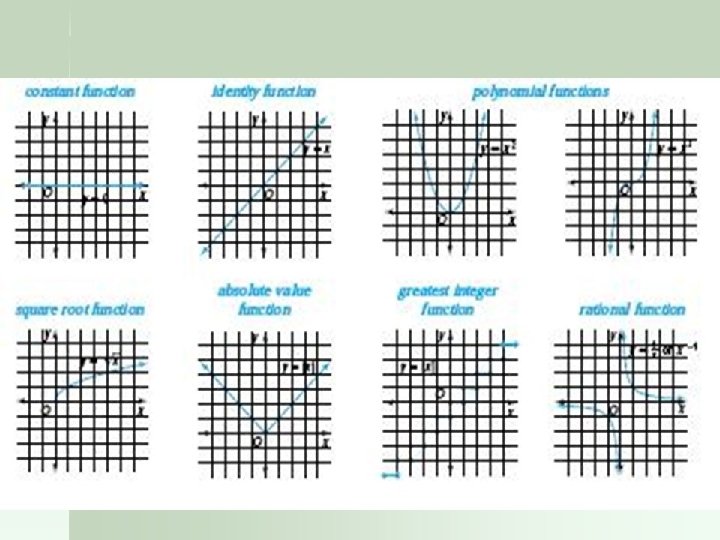
Family of graphs – a group of graphs that displays one or more similar characteristics n Parent graph – basic graph that is transformed to create other members in a family of graphs. n Reflections and translations of the parent function can affect the appearance of the graph. The transformed graph may appear in a different location but it will resemble the parent graph.
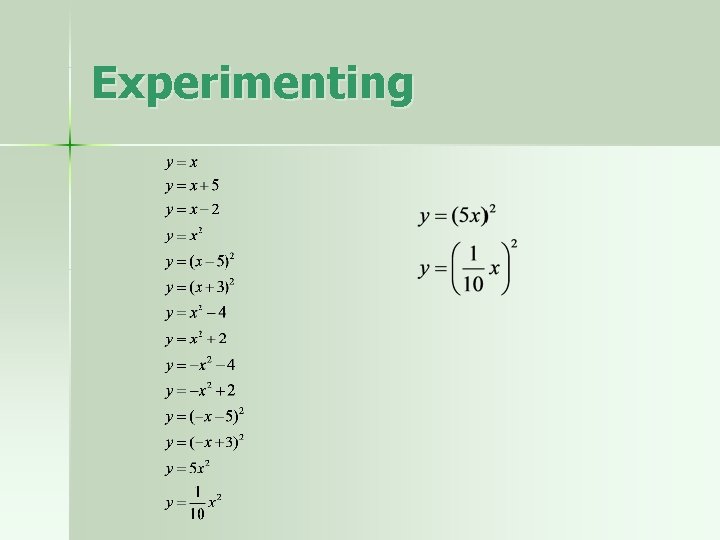
Experimenting
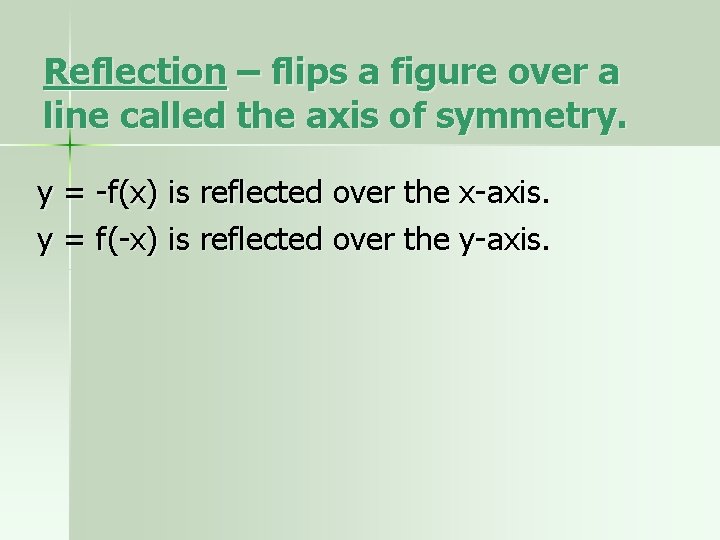
Reflection – flips a figure over a line called the axis of symmetry. y = -f(x) is reflected over the x-axis. y = f(-x) is reflected over the y-axis.
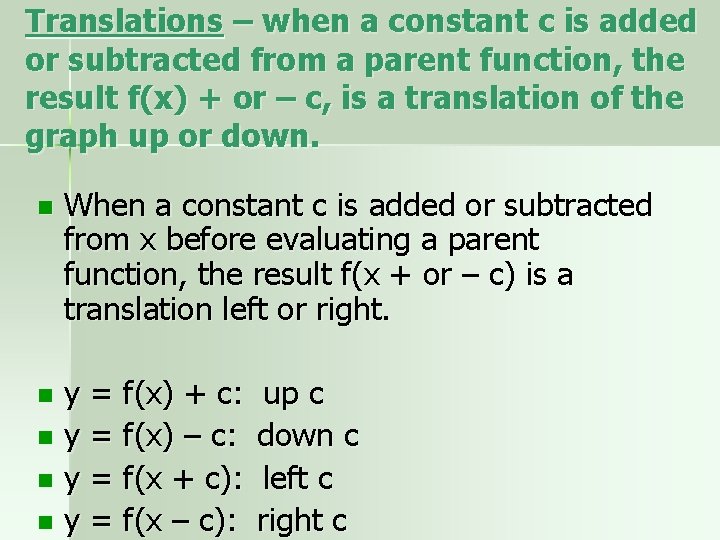
Translations – when a constant c is added or subtracted from a parent function, the result f(x) + or – c, is a translation of the graph up or down. n When a constant c is added or subtracted from x before evaluating a parent function, the result f(x + or – c) is a translation left or right. y = f(x) + c: n y = f(x) – c: n y = f(x + c): n y = f(x – c): n up c down c left c right c
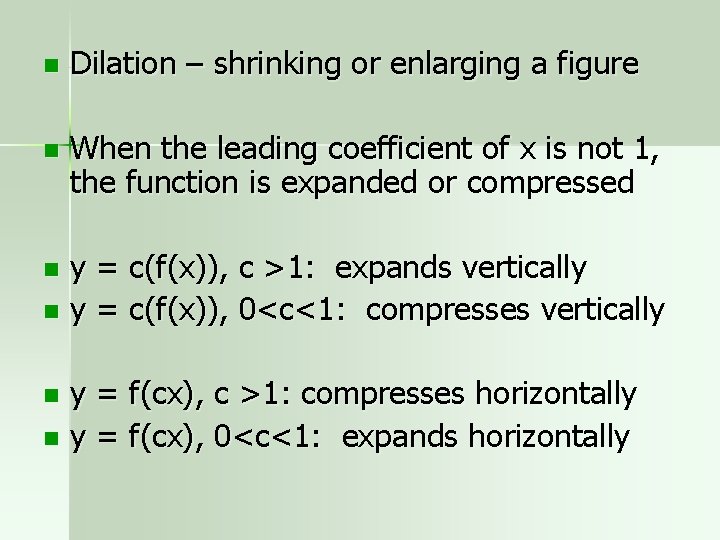
n Dilation – shrinking or enlarging a figure n When the leading coefficient of x is not 1, the function is expanded or compressed y = c(f(x)), c >1: expands vertically n y = c(f(x)), 0<c<1: compresses vertically n y = f(cx), c >1: compresses horizontally n y = f(cx), 0<c<1: expands horizontally n
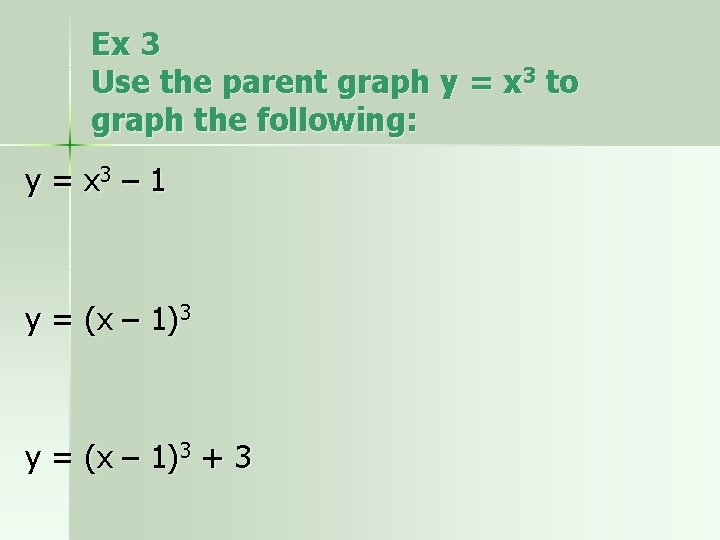
Ex 3 Use the parent graph y = x 3 to graph the following: y = x 3 – 1 y = (x – 1)3 + 3