
3 2 Cognitive and Emotional Development Schemas a


- Slides: 6
3. 2 Cognitive and Emotional Development • Schemas: a conceptual framework a person uses to make sense of the world • Assimilation: the process of fitting objects and experiences into ones’ schemas • Accommodation: the adjustment of one’s schemas to include newly observed events and experiences.
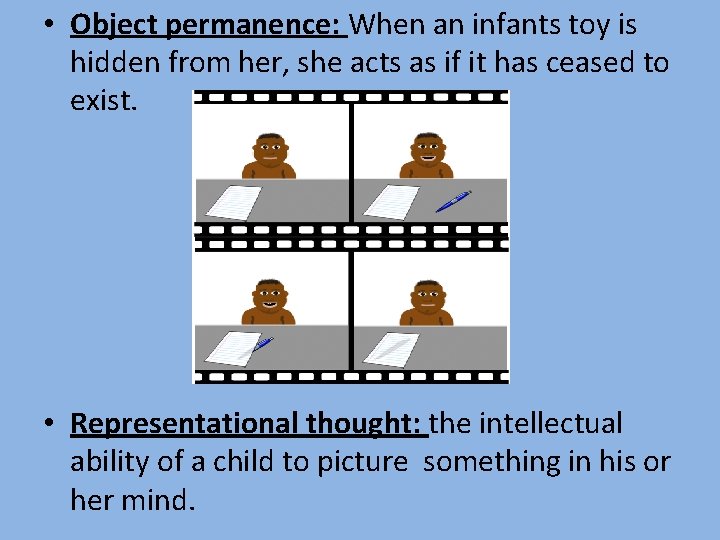
• Object permanence: When an infants toy is hidden from her, she acts as if it has ceased to exist. • Representational thought: the intellectual ability of a child to picture something in his or her mind.
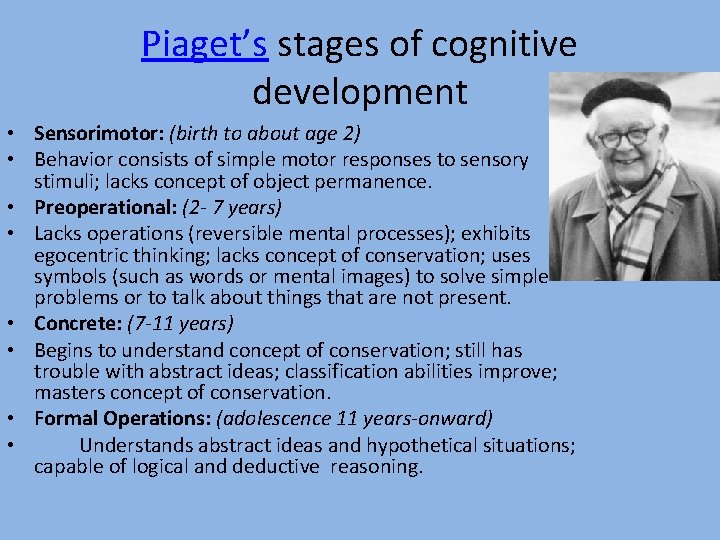
Piaget’s stages of cognitive development • Sensorimotor: (birth to about age 2) • Behavior consists of simple motor responses to sensory stimuli; lacks concept of object permanence. • Preoperational: (2 - 7 years) • Lacks operations (reversible mental processes); exhibits egocentric thinking; lacks concept of conservation; uses symbols (such as words or mental images) to solve simple problems or to talk about things that are not present. • Concrete: (7 -11 years) • Begins to understand concept of conservation; still has trouble with abstract ideas; classification abilities improve; masters concept of conservation. • Formal Operations: (adolescence 11 years-onward) • Understands abstract ideas and hypothetical situations; capable of logical and deductive reasoning.
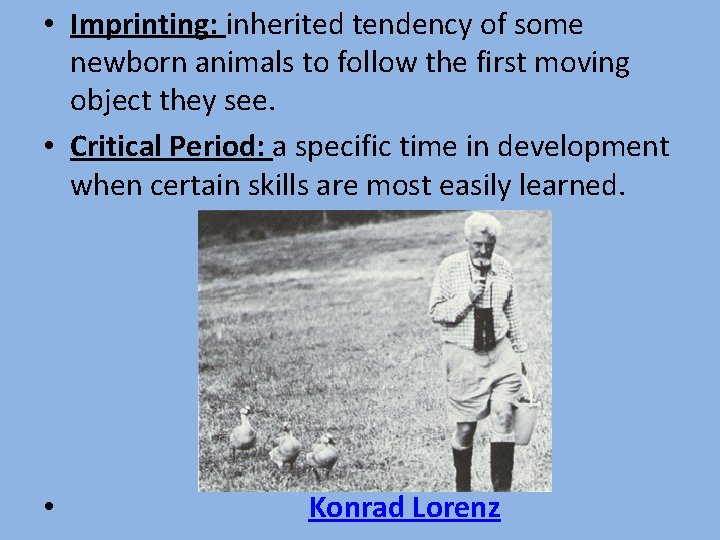
• Imprinting: inherited tendency of some newborn animals to follow the first moving object they see. • Critical Period: a specific time in development when certain skills are most easily learned. • Konrad Lorenz
Harry Harlow: Surrogate mothers • What makes the mother so important?
• Secure attachment: Balance the need to explore and the need to be close. They welcome their mother back and are free of anger. • Avoidant Attachment: The infants avoid or ignore the mother when she leaves or returns. • Resistant attachment: Infants are not upset when the mother leaves but reject her or act angrily when she returns.