
3 1 Introduction to CPU Central processing unit
- Slides: 24
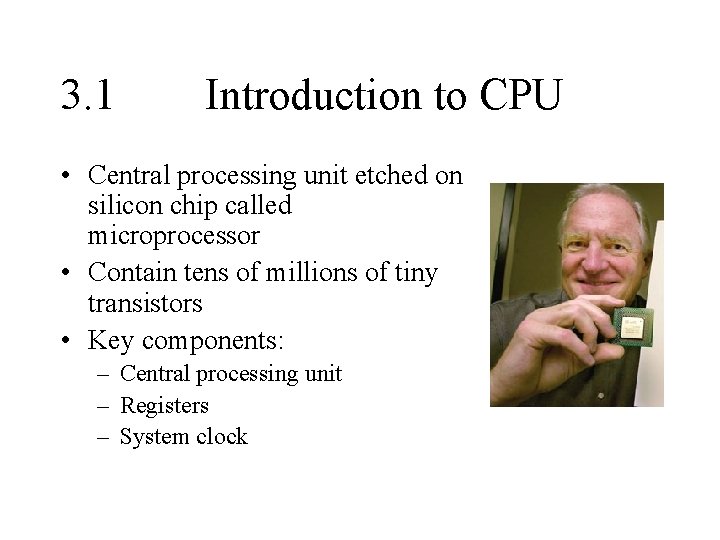
3. 1 Introduction to CPU • Central processing unit etched on silicon chip called microprocessor • Contain tens of millions of tiny transistors • Key components: – Central processing unit – Registers – System clock
Types of Chips • Intel makes a family of processors – Pentium III and Pentium 4 processors in most PCs – Celeron processor sold for low-cost PCs – Xeon and Itanium for high-end workstations and network servers • Other processors – Cyrix and AMD make Intel-compatible microprocessors – Power. PC chips used primarily in Macintosh computers – HP’s Alpha microprocessor used in high-end servers
Microprocessor Speeds • Measure of system clock speed – How many electronic pulses the clock produces per second – Usually expressed in gigahertz (GHz) • Billions of machine cycles per second • Some old PCs measured in megahertz (MHz) • Comparison of clock speed only meaningful between identical microprocessors • CPU cycle time – inverse of clock rate
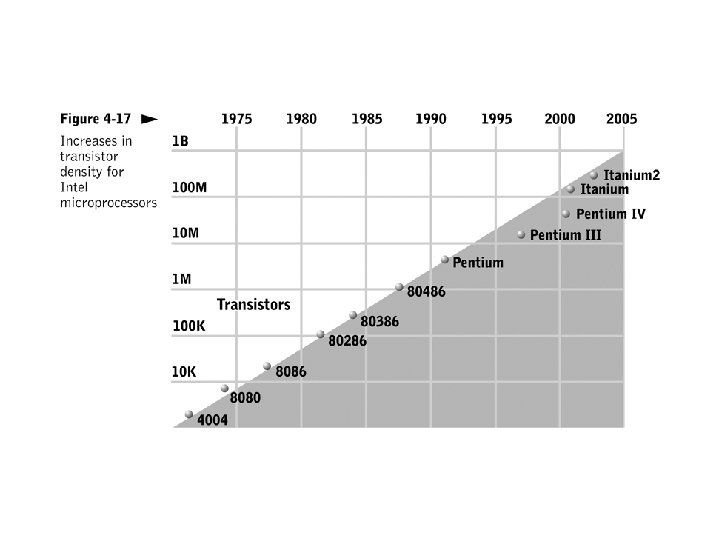
Current Technology Capabilities and Limitations • Moore’s Law – Rate of increase in transistor density on microchips doubles every 18 -24 months with no increase in unit cost • Rock’s Law – Cost of fabrication facilities for chip generation doubles every four years • Increased packing density • Electrical resistance
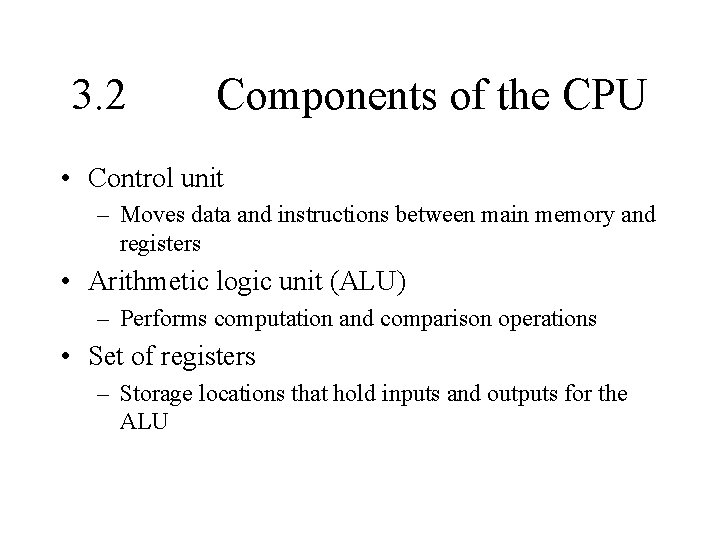
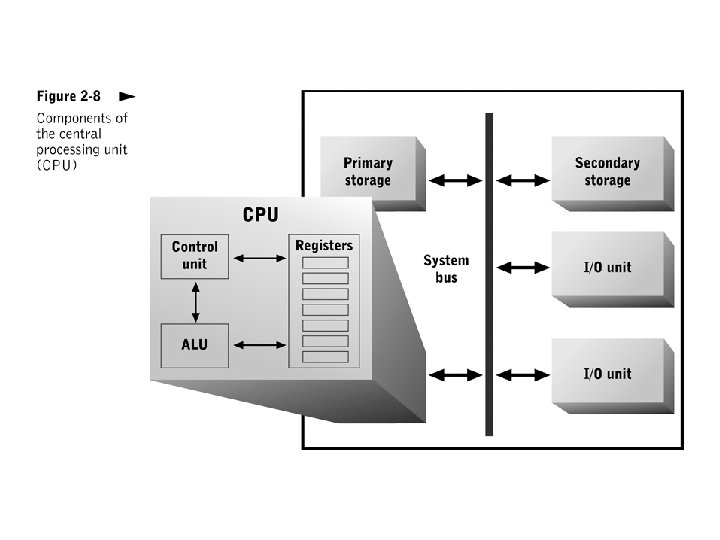
3. 2 Components of the CPU • Control unit – Moves data and instructions between main memory and registers • Arithmetic logic unit (ALU) – Performs computation and comparison operations • Set of registers – Storage locations that hold inputs and outputs for the ALU
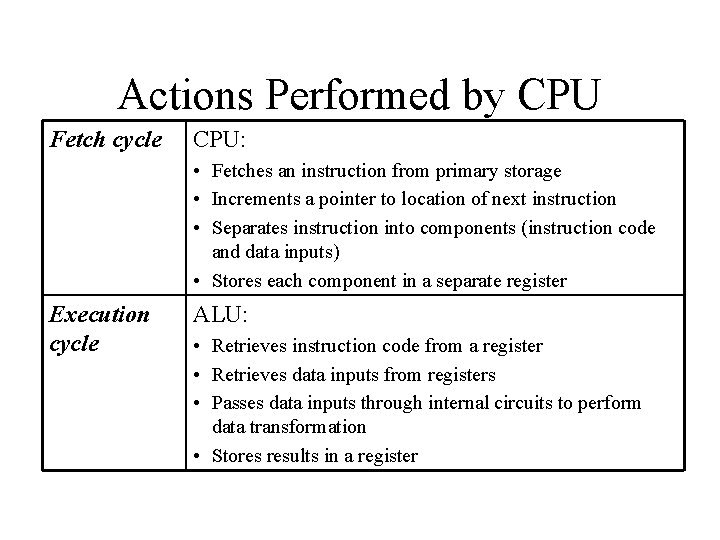
Actions Performed by CPU Fetch cycle CPU: • Fetches an instruction from primary storage • Increments a pointer to location of next instruction • Separates instruction into components (instruction code and data inputs) • Stores each component in a separate register Execution cycle ALU: • Retrieves instruction code from a register • Retrieves data inputs from registers • Passes data inputs through internal circuits to perform data transformation • Stores results in a register
CPU Registers • Primary roles – Hold data for currently executing program that is needed quickly or frequently (generalpurpose registers) – Store information about currently executing program and about status of CPU (specialpurpose registers)
General-Purpose Registers • Hold intermediate results and frequently needed data items • Used only by currently executing program • Implemented within the CPU; contents can be read or written quickly • Increasing their number usually decreases program execution time to a point
Special-Purpose Registers • Track processor and program status • Types – Instruction register – Instruction pointer – Program status word (PSW) • Stores results of comparison operation • Controls conditional branch execution • Indicates actual or potential error conditions
Word Size • Number of bits a CPU can process simultaneously • Increasing it usually increases CPU efficiency, up to a point • Other computer components should match or exceed it for optimal performance • Implications for system bus design and physical implementation of memory
3. 3 The Physical CPU • Electrical device implemented as siliconbased microprocessor • Contains millions of switches, which perform basic processing functions • Physical implementation of switches and circuits
Transistors • Electronic switches that may or may not allow electric current to pass through – If current passes through, switch is on, representing a 1 bit – Otherwise, switch is off, representing a 0 bit
Switches and Gates • Basic building blocks of computer processing circuits • Electronic switches – Control electrical current flow in a circuit – Implemented as transistors • Gates – An interconnection of switches – A circuit that can perform a processing function on an individual binary electrical signal, or bit
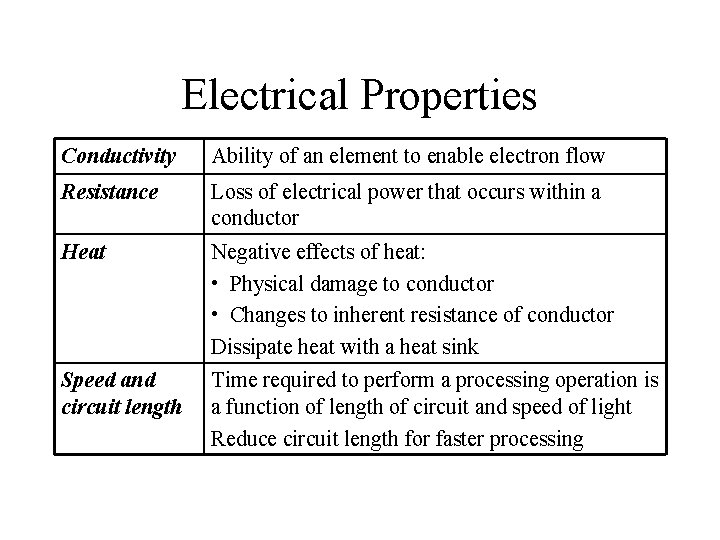
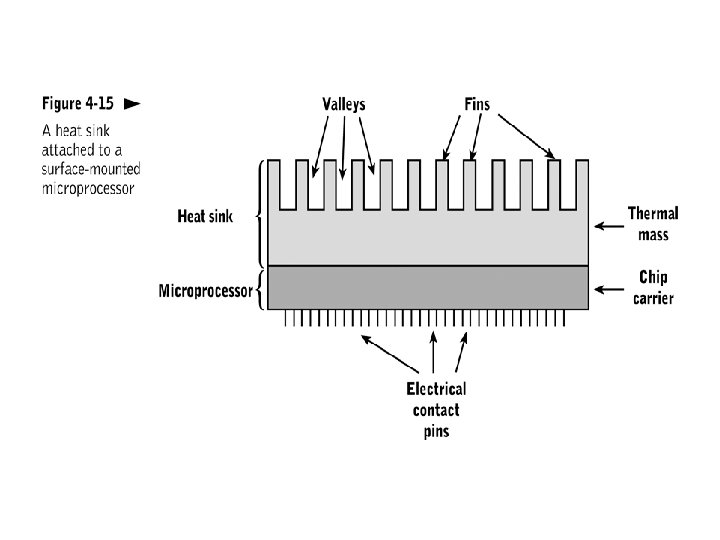
Electrical Properties Conductivity Ability of an element to enable electron flow Resistance Loss of electrical power that occurs within a conductor Heat Negative effects of heat: • Physical damage to conductor • Changes to inherent resistance of conductor Dissipate heat with a heat sink Speed and circuit length Time required to perform a processing operation is a function of length of circuit and speed of light Reduce circuit length for faster processing
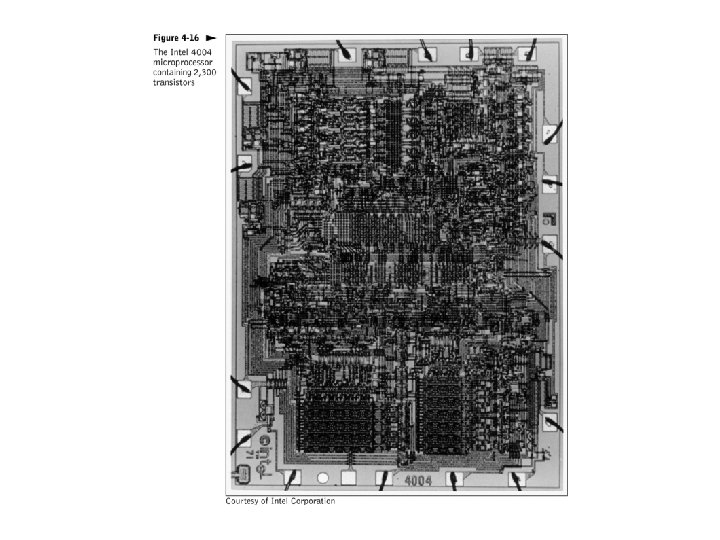
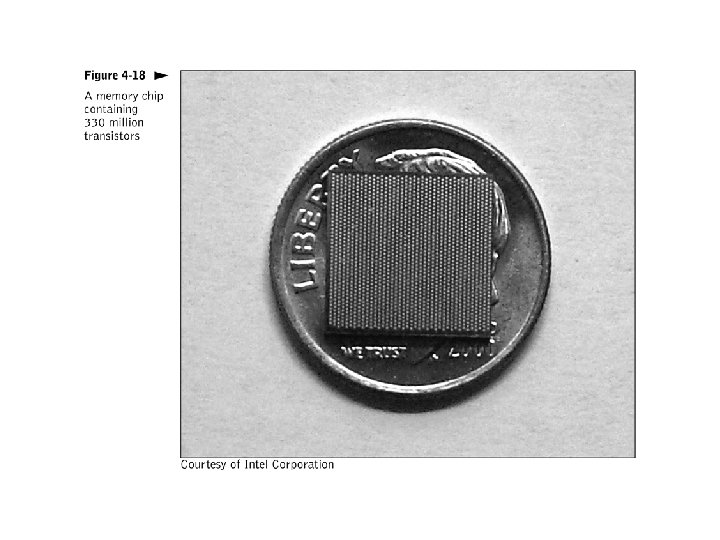
Processor Fabrication • Performance and reliability of processors has increased with improvements in materials and fabrication techniques – Transistors and integrated circuits (ICs) – Microchips and microprocessors • First microprocessor (1971) – 2, 300 transistor • Current memory chip – 300 million transistors
3. 4 Future Trends • Semiconductors are approaching fundamental physical size limits • Technologies that may improve performance beyond semiconductor limitations – Optical processing – Hybrid optical-electrical processing – Quantum processing
Optical Processing • Could eliminate interconnection and simplify fabrication problems; photon pathways can cross without interfering with one another • Eliminating wires would improve fabrication cost and reliability • Not enough economic incentive to be a reality yet
Electro-Optical Processing • Devices provide interface between semiconductor and purely optical memory and storage devices – Gallium arsenide (both optical and electrical properties) – Silicon-based semiconductor devices (encode data in externally generated laser light)
Quantum Processing • Uses quantum states to simultaneously encode two values per bit (qubit) • Uses quantum processing devices to perform computations • Theoretically well-suited to solving problems that require massive amounts of computation