
3 1 Chapter 3 MOTIVATION AND MEANING WHAT









- Slides: 25
3– 1 Chapter 3 MOTIVATION AND MEANING: WHAT MAKES PEOPLE WANT TO WORK? Copyright © 2014 Pearson Education, Inc. Publishing as Prentice Hall.
Chapter 3: Motivation and Meaning 3– 2 1. Define motivation. 2. Understand the characteristics of meaningful work. 3. Recognize the links between motivation and psychology. 4. Learn why it is important to be able to critique theories of motivation. 5. Define the basic and higher-order needs theories of motivation. Copyright © 2014 Pearson Education, Inc. Publishing as Prentice Hall.
Chapter 3: Motivation and Meaning 3– 3 6. Distinguish between the three-needs, equity, expectancy, and goal-setting theories and explain their popularity. 7. Describe learning theories that relate to motivation. 8. Outline how theories of motivation can be integrated into daily professional and personal life. 9. Describe how HR can help motivate employees. Copyright © 2014 Pearson Education, Inc. Publishing as Prentice Hall.
1. What Is Motivation? 3– 4 Introduction Motivation: a set of influences and forces It takes personal effort, great leadership, and a positive environment to sustain passionate engagement with work. Copyright © 2014 Pearson Education, Inc. Publishing as Prentice Hall.
2. What Makes Work Meaningful? 3– 6 The Flow Experience Flow As an Ideal Working State Motivation: It’s Up to You Find Inspiration Right Career Right Aspects of Job Copyright © 2014 Pearson Education, Inc. Publishing as Prentice Hall.
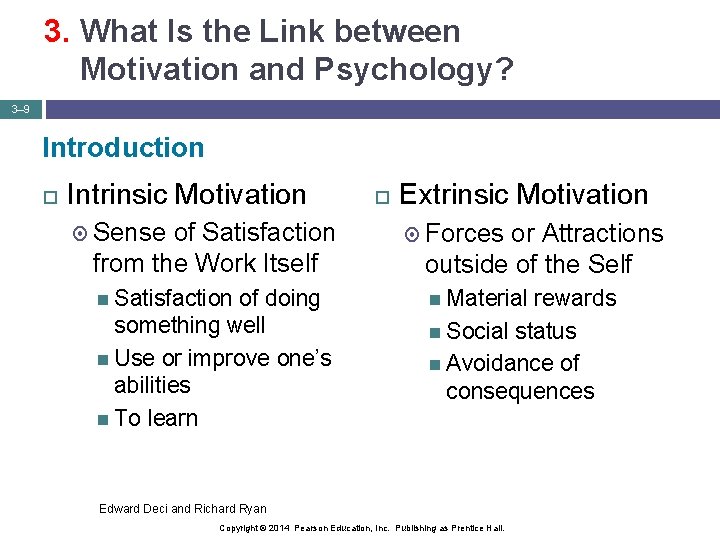
3. What Is the Link between Motivation and Psychology? 3– 9 Introduction Intrinsic Motivation Sense of Satisfaction from the Work Itself Satisfaction of doing something well Use or improve one’s abilities To learn Extrinsic Motivation Forces or Attractions outside of the Self Material rewards Social status Avoidance of consequences Edward Deci and Richard Ryan Copyright © 2014 Pearson Education, Inc. Publishing as Prentice Hall.
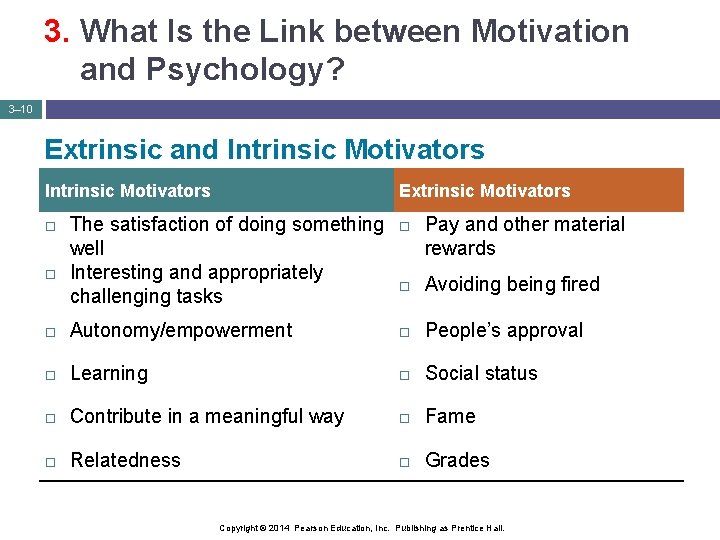
3. What Is the Link between Motivation and Psychology? 3– 10 Extrinsic and Intrinsic Motivators Extrinsic Motivators The satisfaction of doing something well Interesting and appropriately challenging tasks Pay and other material rewards Avoiding being fired Autonomy/empowerment People’s approval Learning Social status Contribute in a meaningful way Fame Relatedness Grades Copyright © 2014 Pearson Education, Inc. Publishing as Prentice Hall.
Personality Traits 3 -11 Personality Traits └ Particular tendencies to feel, think, and act in certain ways that can be used to describe the personality of every individual Manager’s personalities influence their behavior and approach to managing people and resources Copyright © 2014 Pearson Education, Inc. Publishing as Prentice Hall.
Manager’s and Traits 3 -12 Personality traits that enhance managerial effectiveness in one situation may actually impair it in another Copyright © 2014 Pearson Education, Inc. Publishing as Prentice Hall.
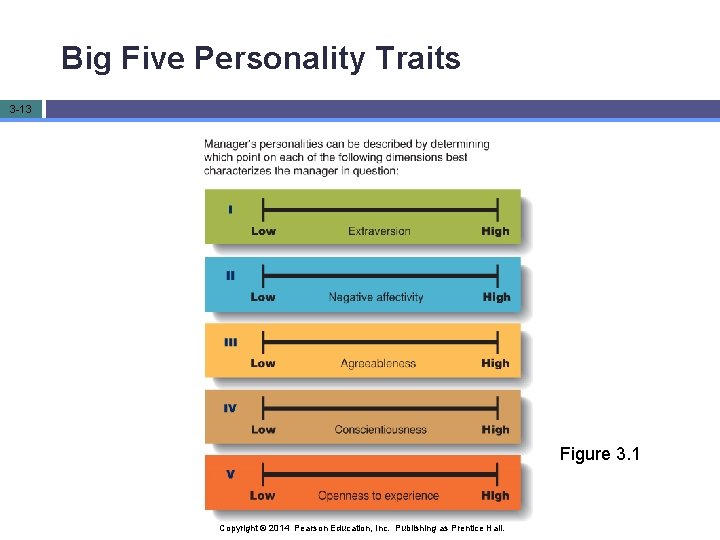
Big Five Personality Traits 3 -13 Figure 3. 1 Copyright © 2014 Pearson Education, Inc. Publishing as Prentice Hall.
Big Five Personality Traits 3 -14 Extraversion └ tendency to experience positive emotions and moods and feel good about oneself and the rest of the world Copyright © 2014 Pearson Education, Inc. Publishing as Prentice Hall.
Big Five Personality Traits 3 -15 Emotional Stability └ tendency to experience negative emotions and moods, feel distressed, and be critical of oneself and others Copyright © 2014 Pearson Education, Inc. Publishing as Prentice Hall.
Big Five Personality Traits 3 -16 Agreeableness └ tendency to get along well with others Conscientiousness └ tendency to be careful, scrupulous (dependable), and persevering Copyright © 2014 Pearson Education, Inc. Publishing as Prentice Hall.
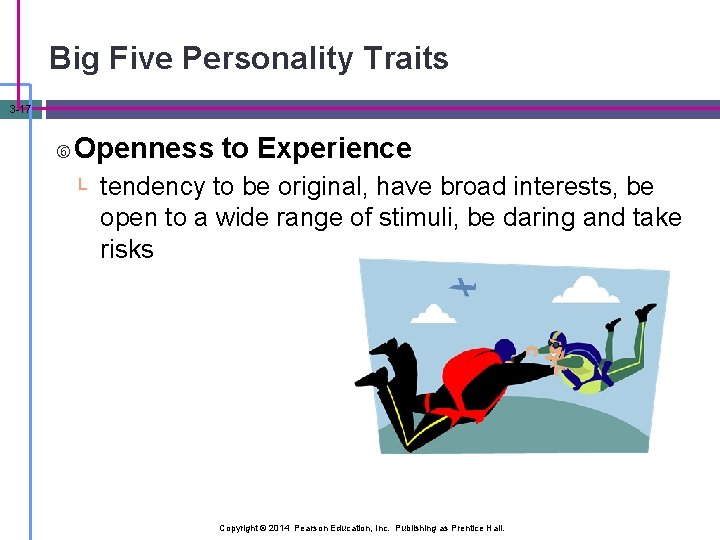
Big Five Personality Traits 3 -17 Openness to Experience └ tendency to be original, have broad interests, be open to a wide range of stimuli, be daring and take risks Copyright © 2014 Pearson Education, Inc. Publishing as Prentice Hall.
Other Personality Traits 3 -18 Internal locus of control └ └ Belief that you are responsible for your own fate Own actions and behaviors are major and decisive determinants of job outcomes Copyright © 2014 Pearson Education, Inc. Publishing as Prentice Hall.
Other Personality Traits 3 -19 External locus of control └ The tendency to place responsibility for one’s fate in outside forces and to believe one’s own behavior has little impact on outcomes. Copyright © 2014 Pearson Education, Inc. Publishing as Prentice Hall.
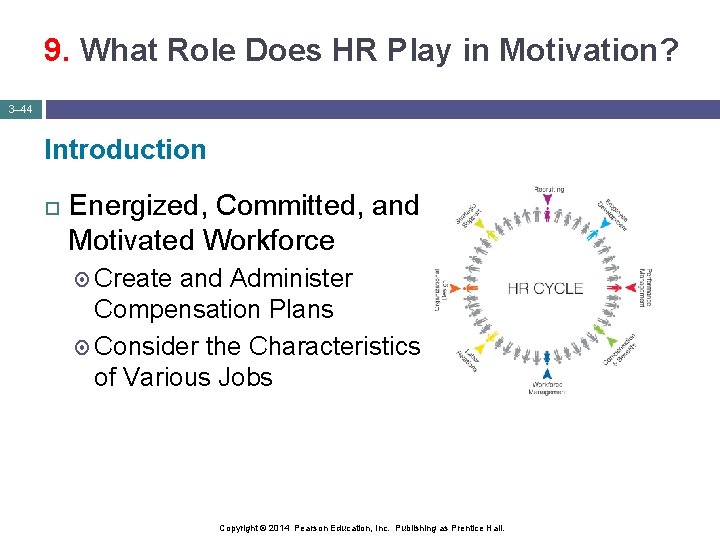
9. What Role Does HR Play in Motivation? 3– 44 Introduction Energized, Committed, and Motivated Workforce Create and Administer Compensation Plans Consider the Characteristics of Various Jobs Copyright © 2014 Pearson Education, Inc. Publishing as Prentice Hall.
9. What Role Does HR Play in Motivation? 3– 45 Compensation and Reward Programs Compensation Plans Monetized Plans Individual Compensation Group Compensation Merit-Based Compensation Packages Compensation Schedules Copyright © 2014 Pearson Education, Inc. Publishing as Prentice Hall.
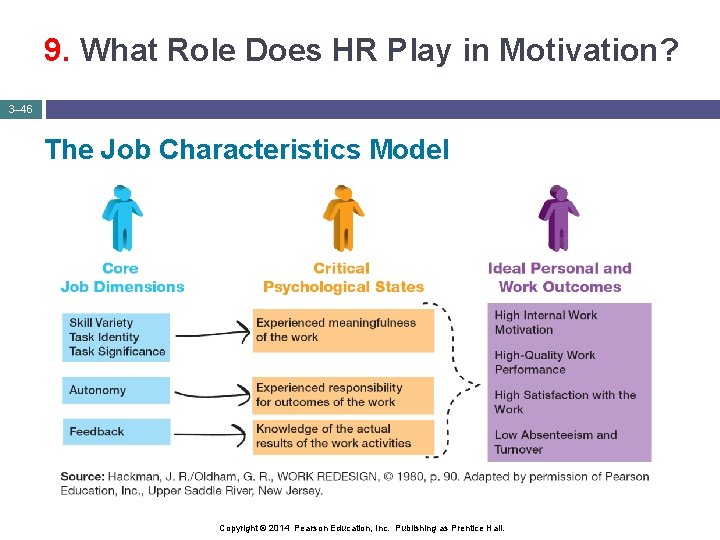
9. What Role Does HR Play in Motivation? 3– 46 The Job Characteristics Model Copyright © 2014 Pearson Education, Inc. Publishing as Prentice Hall.
9. What Role Does HR Play in Motivation? 3– 47 The Job Characteristics Model Core Job Dimensions Enhancement Job Enrichment Job Enlargement Job Rotation Copyright © 2014 Pearson Education, Inc. Publishing as Prentice Hall.
9. What Role Does HR Play in Motivation? 3– 48 Discussion Questions Pay is often considered a primary motivator. Is it for you? Why or why not? Use theories presented in this chapter to support your stance. Individual, group, and merit-based compensation approaches are intended to motivate workers and enhance organizational performance. What are some potential unintended consequences of each approach? Copyright © 2014 Pearson Education, Inc. Publishing as Prentice Hall.
10. What Can We All Do About Motivation? 3– 49 Self-Awareness and Motivation Ultimately Responsible for Motivating Yourself Understand Your Own Feelings Understand Your Own Motivation Monitor Your Response to Work Empathy and Motivation Empathy Better Able to Connect with People Important in Multicultural Settings Copyright © 2014 Pearson Education, Inc. Publishing as Prentice Hall.
10. What Can We All Do About Motivation? 3– 50 Discussion Questions Think about a relationship with a school or work colleague that you are motivated to improve. Practice self-awareness by examining your role in this relationship: What are you doing to make it better? What have you done to create the current problems? What emotions have driven your behavior? For the same relationship, practice empathy. What do you think is driving the other person’s behavior? What motivates him or her to act in certain ways? What emotions is he or she expressing? Copyright © 2014 Pearson Education, Inc. Publishing as Prentice Hall.
11. A Final Word on Motivation and Meaning at Work 3– 51 Summary Many theories that attempt to explain motivation. Almost everything we do as employees, managers, or leaders involves harnessing talent and energy. It is important for you to find ways to use your talents, engage your passion, and bring others along with you. Copyright © 2014 Pearson Education, Inc. Publishing as Prentice Hall.
3– 52