
3 1 2 1 Skill Skill Continuum and



- Slides: 29
3. 1. 2. 1 Skill, Skill Continuum and Transfer of Skill Learning objectives To understand the characteristics of skill. To be able to describe the different types of skill classification. To be able to categorise skills based on different criteria. To be able to explain the 4 ways learning can be transferred. To understand how a coach may use theory of learning transfer.
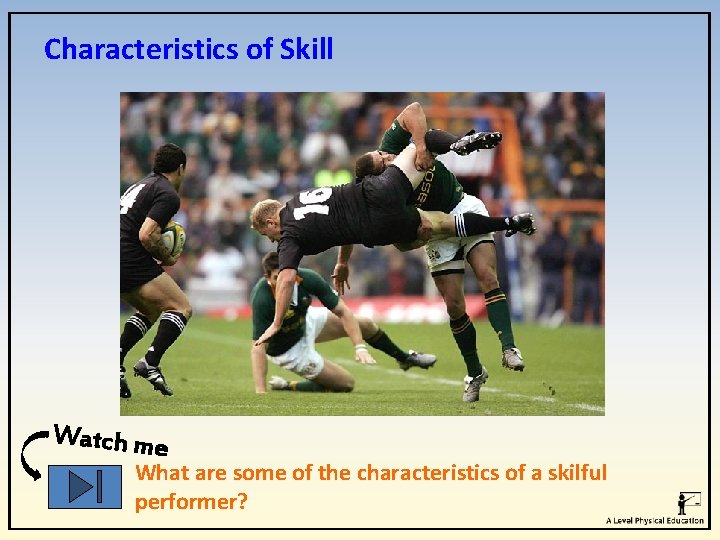
Characteristics of Skill Watch me What are some of the characteristics of a skilful performer?
Skills are learnt and developed from ability after a period of practice. To produce a skilled performance, the player must practise so that the required abilities are enhanced.
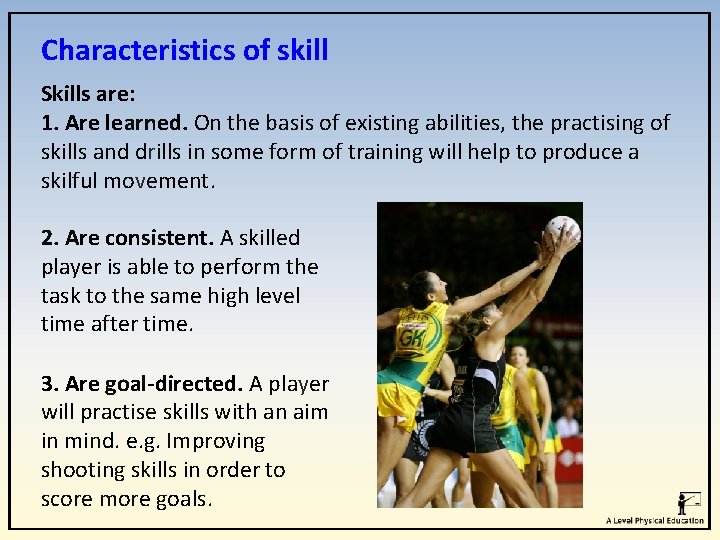
Characteristics of skill Skills are: 1. Are learned. On the basis of existing abilities, the practising of skills and drills in some form of training will help to produce a skilful movement. 2. Are consistent. A skilled player is able to perform the task to the same high level time after time. 3. Are goal-directed. A player will practise skills with an aim in mind. e. g. Improving shooting skills in order to score more goals.
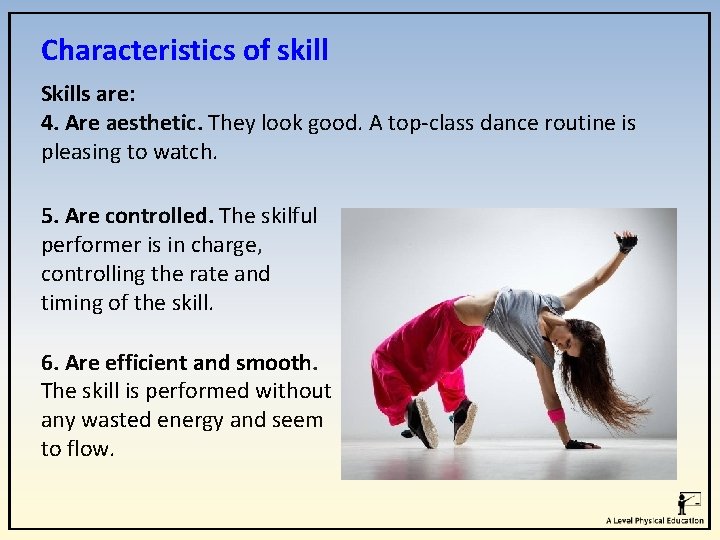
Characteristics of skill Skills are: 4. Are aesthetic. They look good. A top-class dance routine is pleasing to watch. 5. Are controlled. The skilful performer is in charge, controlling the rate and timing of the skill. 6. Are efficient and smooth. The skill is performed without any wasted energy and seem to flow.
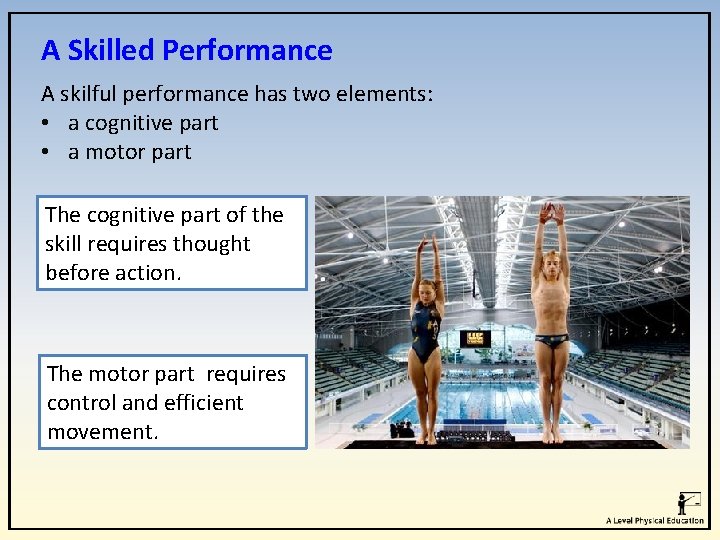
A Skilled Performance A skilful performance has two elements: • a cognitive part • a motor part The cognitive part of the skill requires thought before action. The motor part requires control and efficient movement.
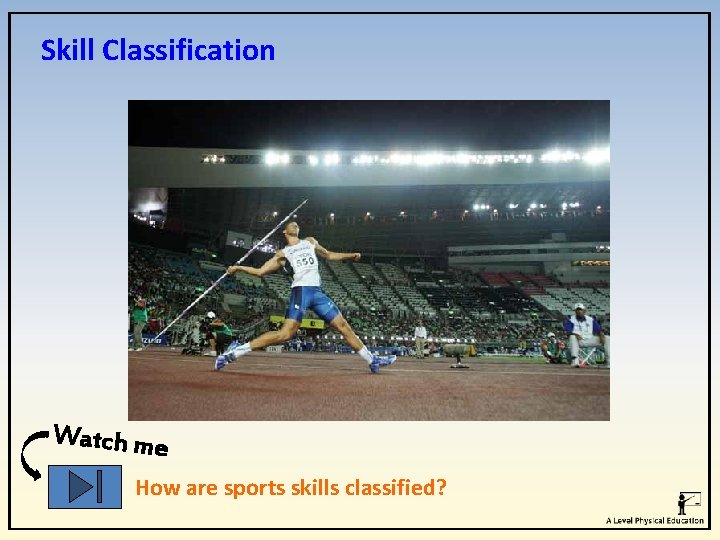
Skill Classification Watch me How are sports skills classified?
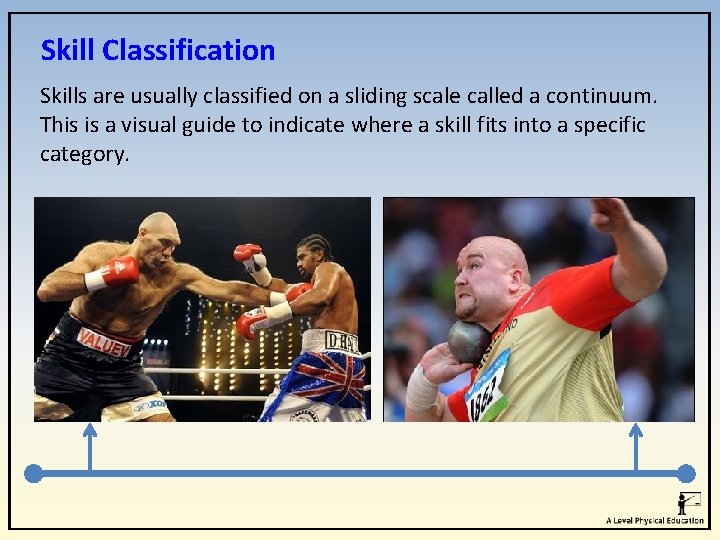
Skill Classification Skills are usually classified on a sliding scale called a continuum. This is a visual guide to indicate where a skill fits into a specific category.
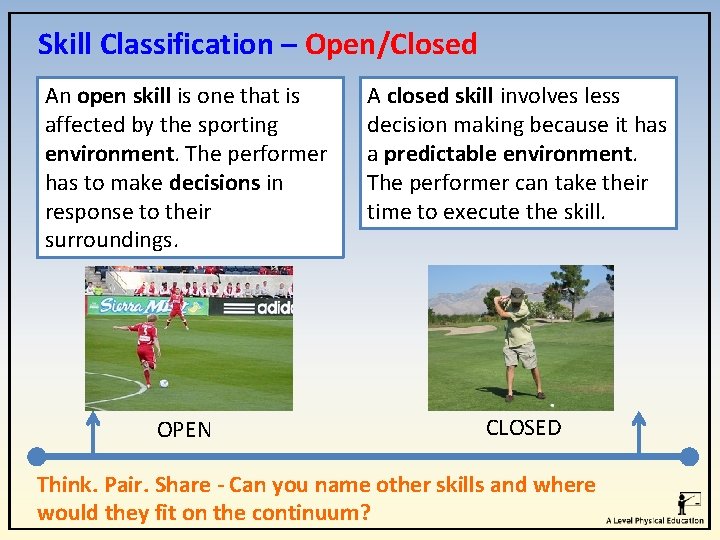
Skill Classification – Open/Closed An open skill is one that is affected by the sporting environment. The performer has to make decisions in response to their surroundings. A closed skill involves less decision making because it has a predictable environment. The performer can take their time to execute the skill. OPEN CLOSED Think. Pair. Share - Can you name other skills and where would they fit on the continuum?
Skill Classification – Continuity A discrete skill has a short time span and a clear beginning and end. DISCRETE A serial skill has several discrete elements which are put together. SERIAL A continuous skill has no clear beginning or end. CONTINUOUS Think. Pair. Share - Can you name other skills and where would they fit on the continuum?
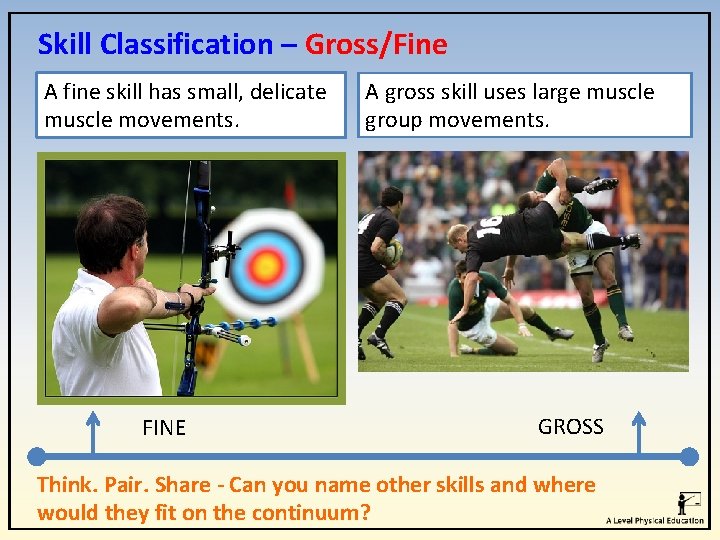
Skill Classification – Gross/Fine A fine skill has small, delicate muscle movements. FINE A gross skill uses large muscle group movements. GROSS Think. Pair. Share - Can you name other skills and where would they fit on the continuum?
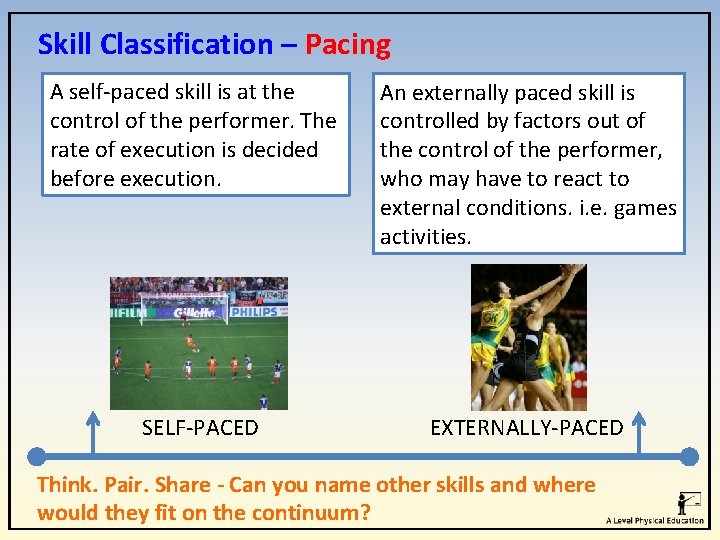
Skill Classification – Pacing A self-paced skill is at the control of the performer. The rate of execution is decided before execution. SELF-PACED An externally paced skill is controlled by factors out of the control of the performer, who may have to react to external conditions. i. e. games activities. EXTERNALLY-PACED Think. Pair. Share - Can you name other skills and where would they fit on the continuum?
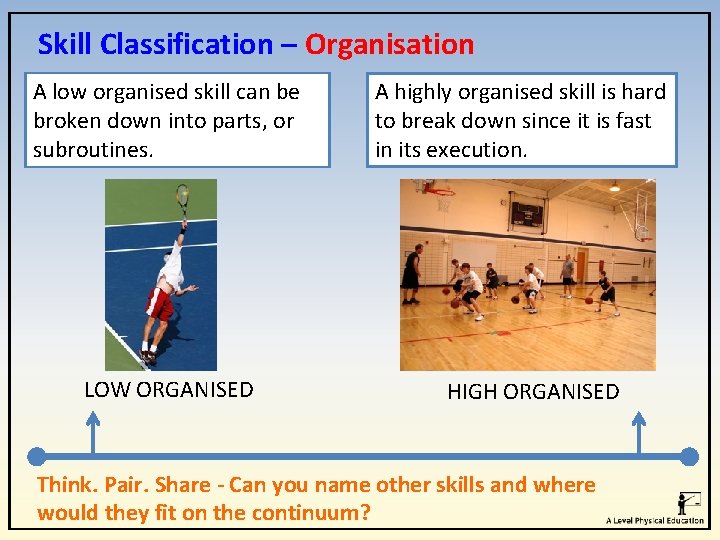
Skill Classification – Organisation A low organised skill can be broken down into parts, or subroutines. LOW ORGANISED A highly organised skill is hard to break down since it is fast in its execution. HIGH ORGANISED Think. Pair. Share - Can you name other skills and where would they fit on the continuum?
Skill Classification – Muscular Involvement A complex skill involves a high level of decision making and has a large cognitive or thinking element to it. COMPLEX Simple skills have a limited amount of information to process. The skill has a smaller cognitive element. BASIC/SIMPLE Think. Pair. Share - Can you name other skills and where would they fit on the continuum?
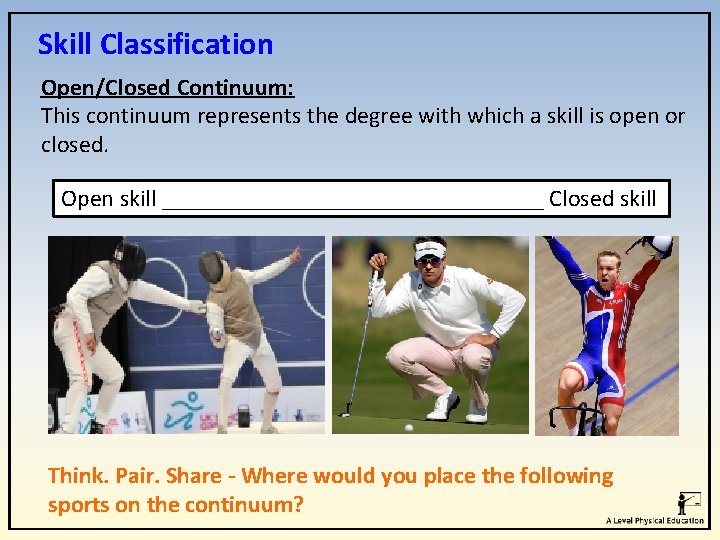
Skill Classification Open/Closed Continuum: This continuum represents the degree with which a skill is open or closed. Open skill ________________ Closed skill Think. Pair. Share - Where would you place the following sports on the continuum?
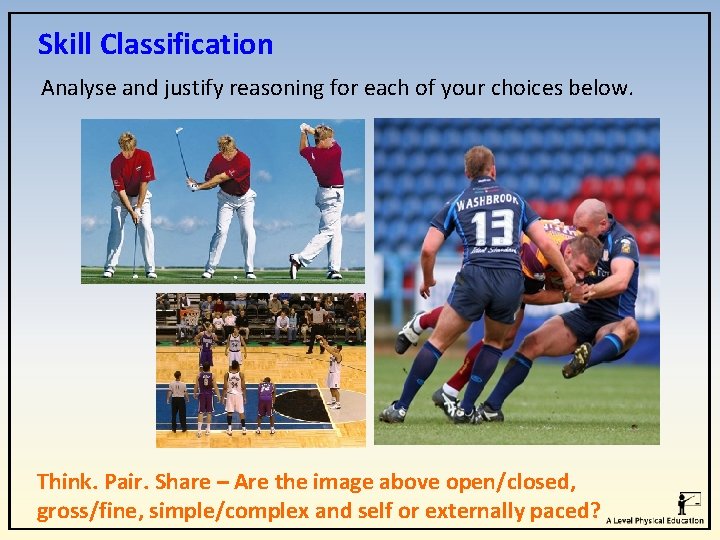
Skill Classification Analyse and justify reasoning for each of your choices below. Think. Pair. Share – Are the image above open/closed, gross/fine, simple/complex and self or externally paced?
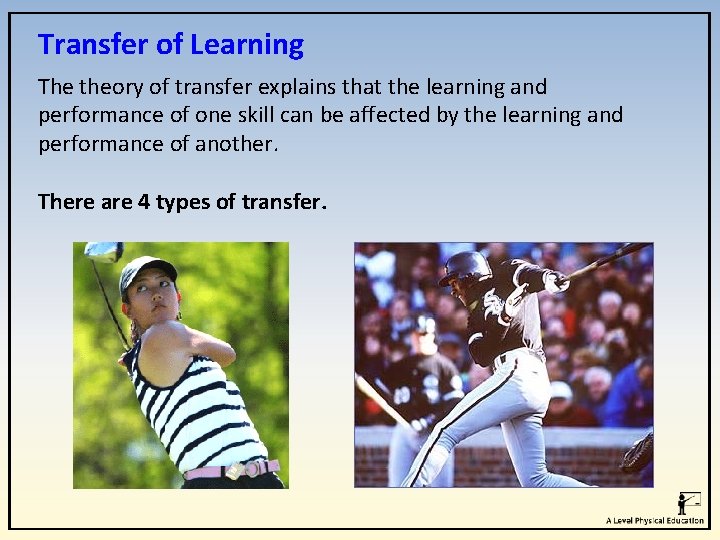
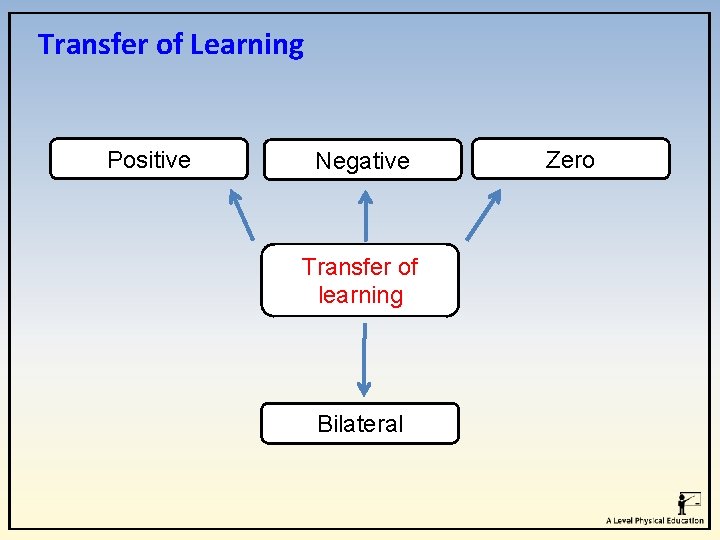
Transfer of Learning The theory of transfer explains that the learning and performance of one skill can be affected by the learning and performance of another. There are 4 types of transfer.
Transfer of Learning Positive Negative Transfer of learning Bilateral Zero
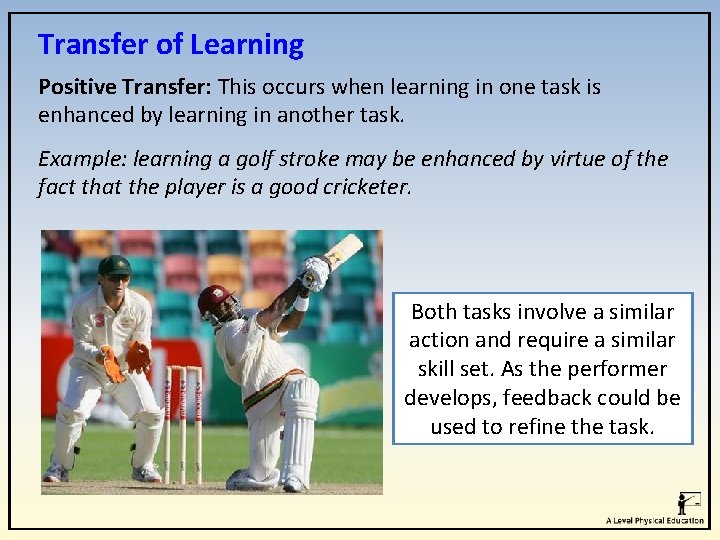
Transfer of Learning Positive Transfer: This occurs when learning in one task is enhanced by learning in another task. Example: learning a golf stroke may be enhanced by virtue of the fact that the player is a good cricketer. Both tasks involve a similar action and require a similar skill set. As the performer develops, feedback could be used to refine the task.
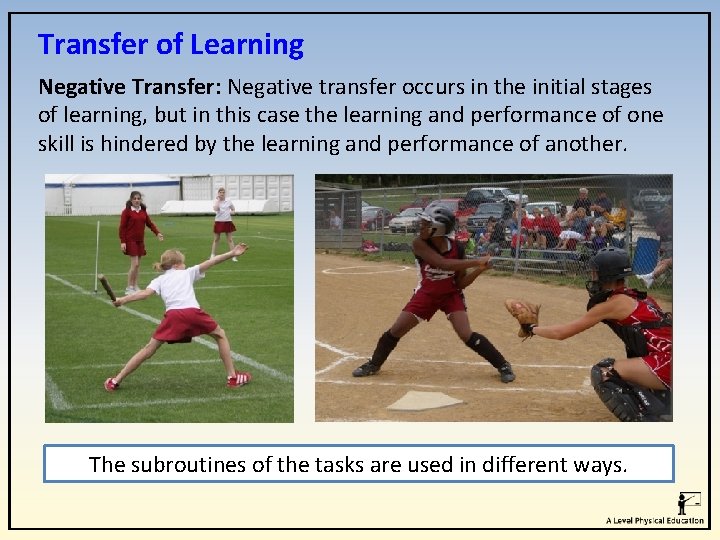
Transfer of Learning Negative Transfer: Negative transfer occurs in the initial stages of learning, but in this case the learning and performance of one skill is hindered by the learning and performance of another. The subroutines of the tasks are used in different ways.
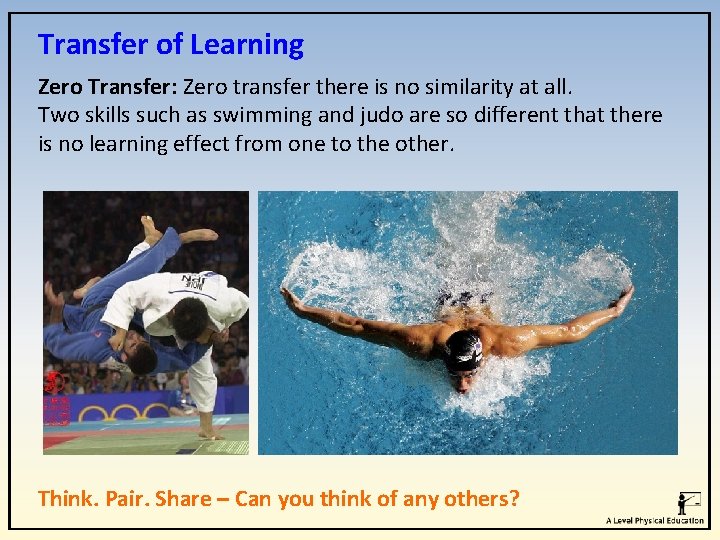
Transfer of Learning Zero Transfer: Zero transfer there is no similarity at all. Two skills such as swimming and judo are so different that there is no learning effect from one to the other. Think. Pair. Share – Can you think of any others?
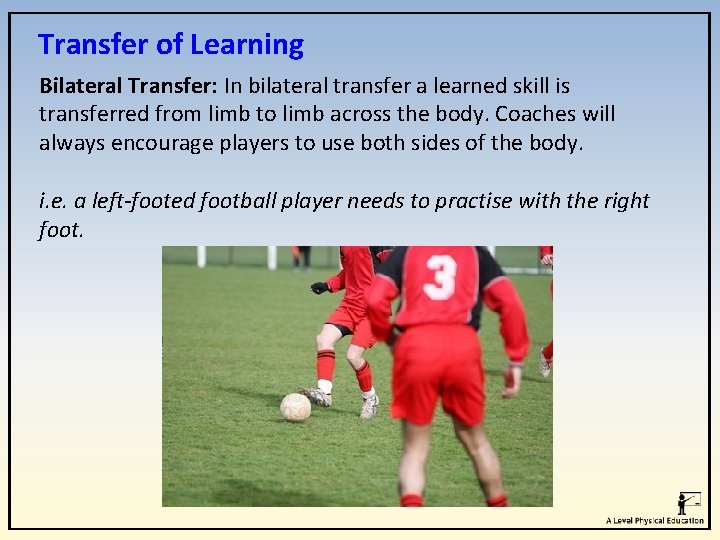
Transfer of Learning Bilateral Transfer: In bilateral transfer a learned skill is transferred from limb to limb across the body. Coaches will always encourage players to use both sides of the body. i. e. a left-footed football player needs to practise with the right foot.
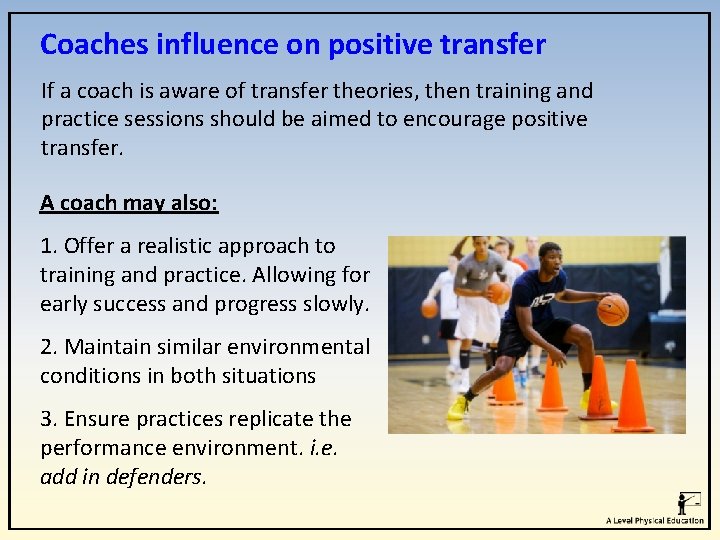
Coaches influence on positive transfer If a coach is aware of transfer theories, then training and practice sessions should be aimed to encourage positive transfer. A coach may also: 1. Offer a realistic approach to training and practice. Allowing for early success and progress slowly. 2. Maintain similar environmental conditions in both situations 3. Ensure practices replicate the performance environment. i. e. add in defenders.
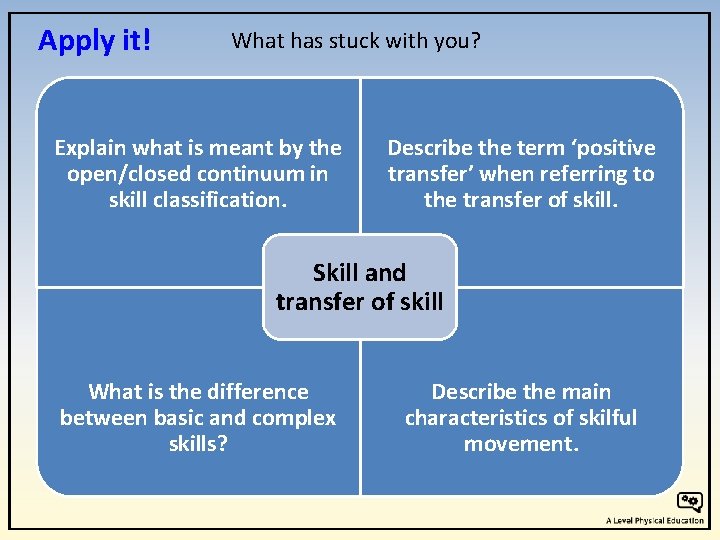
Apply it! What has stuck with you? Explain what is meant by the open/closed continuum in skill classification. Describe the term ‘positive transfer’ when referring to the transfer of skill. Skill and transfer of skill What is the difference between basic and complex skills? Describe the main characteristics of skilful movement.
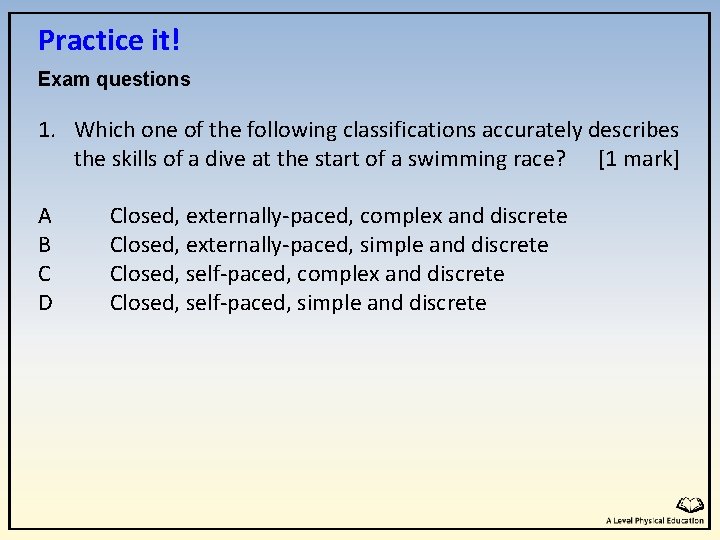
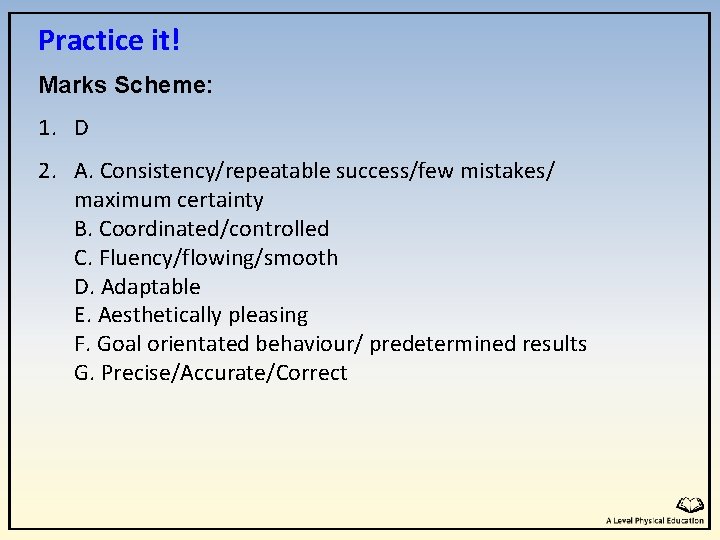
Practice it! Exam questions 1. Which one of the following classifications accurately describes the skills of a dive at the start of a swimming race? [1 mark] A B C D Closed, externally-paced, complex and discrete Closed, externally-paced, simple and discrete Closed, self-paced, complex and discrete Closed, self-paced, simple and discrete
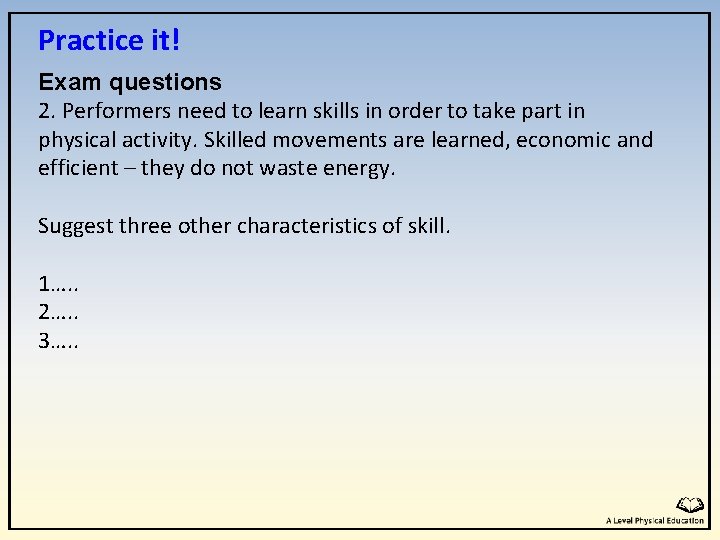
Practice it! Exam questions 2. Performers need to learn skills in order to take part in physical activity. Skilled movements are learned, economic and efficient – they do not waste energy. Suggest three other characteristics of skill. 1…. . 2…. . 3…. .
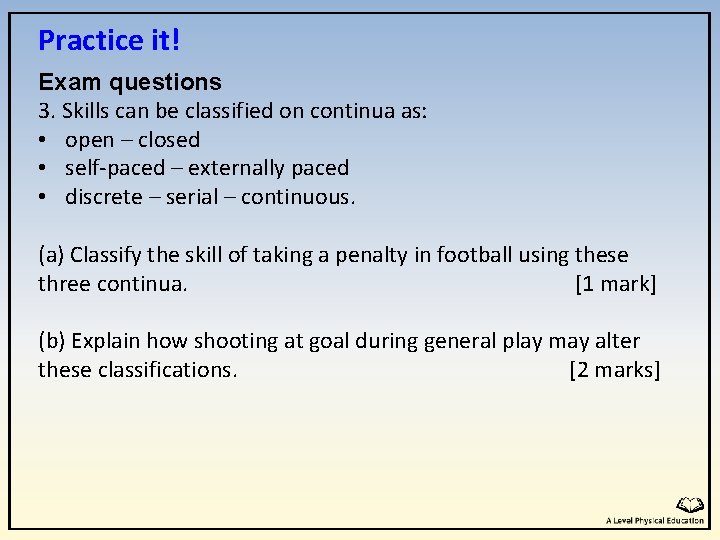
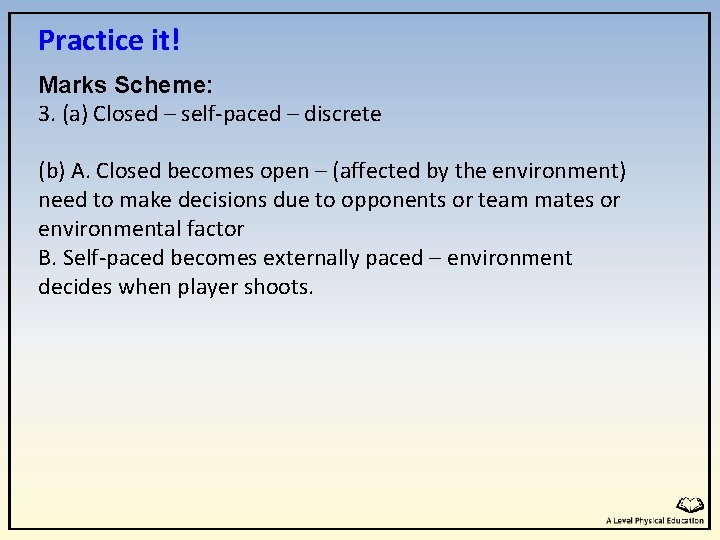
Practice it! Exam questions 3. Skills can be classified on continua as: • open – closed • self-paced – externally paced • discrete – serial – continuous. (a) Classify the skill of taking a penalty in football using these three continua. [1 mark] (b) Explain how shooting at goal during general play may alter these classifications. [2 marks]
Practice it! Marks Scheme: 1. D 2. A. Consistency/repeatable success/few mistakes/ maximum certainty B. Coordinated/controlled C. Fluency/flowing/smooth D. Adaptable E. Aesthetically pleasing F. Goal orientated behaviour/ predetermined results G. Precise/Accurate/Correct
Practice it! Marks Scheme: 3. (a) Closed – self-paced – discrete (b) A. Closed becomes open – (affected by the environment) need to make decisions due to opponents or team mates or environmental factor B. Self-paced becomes externally paced – environment decides when player shoots.