
29 The Monetary System Power Point Slides prepared
- Slides: 49
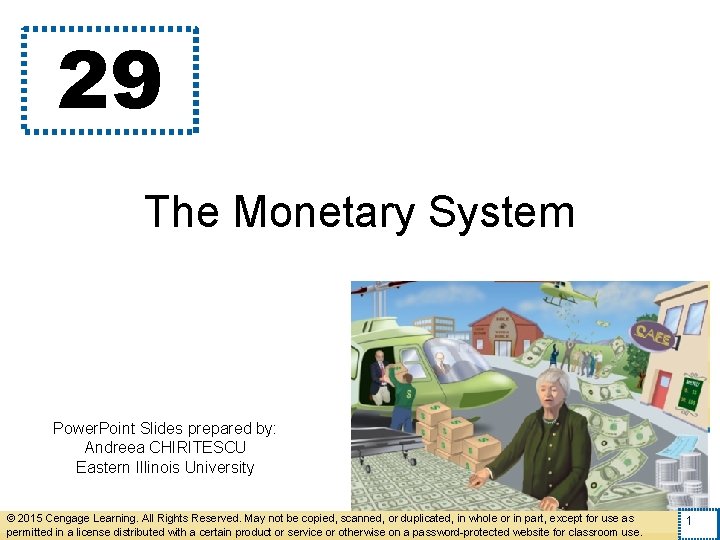
29 The Monetary System Power. Point Slides prepared by: Andreea CHIRITESCU Eastern Illinois University © 2015 Cengage Learning. All Rights Reserved. May not be copied, scanned, or duplicated, in whole or in part, except for use as permitted in a license distributed with a certain product or service or otherwise on a password-protected website for classroom use. 1
The Meaning of Money • Money – Set of assets in an economy – That people regularly use – To buy goods and services from other people • The functions of money – Medium of exchange – Unit of account – Store of value © 2015 Cengage Learning. All Rights Reserved. May not be copied, scanned, or duplicated, in whole or in part, except for use as permitted in a license distributed with a certain product or service or otherwise on a password-protected website for classroom use. 2
The Meaning of Money • Medium of exchange – Item that buyers give to sellers when they want to purchase goods and services • Unit of account – Yardstick people use to post prices and record debts © 2015 Cengage Learning. All Rights Reserved. May not be copied, scanned, or duplicated, in whole or in part, except for use as permitted in a license distributed with a certain product or service or otherwise on a password-protected website for classroom use. 3
The Meaning of Money • Store of value – Item that people can use to transfer purchasing power • From the present to the future • Liquidity – Ease with which an asset can be converted into the economy’s medium of exchange © 2015 Cengage Learning. All Rights Reserved. May not be copied, scanned, or duplicated, in whole or in part, except for use as permitted in a license distributed with a certain product or service or otherwise on a password-protected website for classroom use. 4
The Kinds of Money • Commodity money – Money that takes the form of a commodity with intrinsic value • Gold, cigarettes • Intrinsic value – Item would have value even if it were not used as money • Gold standard - Gold as money • Or paper money that is convertible into gold on demand © 2015 Cengage Learning. All Rights Reserved. May not be copied, scanned, or duplicated, in whole or in part, except for use as permitted in a license distributed with a certain product or service or otherwise on a password-protected website for classroom use. 5
The Kinds of Money • Fiat money – Money without intrinsic value – Used as money because of government decree – “This note is legal tender for all debts, public and private” • Fiat – Order or decree © 2015 Cengage Learning. All Rights Reserved. May not be copied, scanned, or duplicated, in whole or in part, except for use as permitted in a license distributed with a certain product or service or otherwise on a password-protected website for classroom use. 6
Money in the U. S. Economy • Money stock – Quantity of money circulating in the economy • Currency – Paper bills and coins in the hands of the public • Demand deposits – Balances in bank accounts; depositors can access on demand by writing a check © 2015 Cengage Learning. All Rights Reserved. May not be copied, scanned, or duplicated, in whole or in part, except for use as permitted in a license distributed with a certain product or service or otherwise on a password-protected website for classroom use. 7
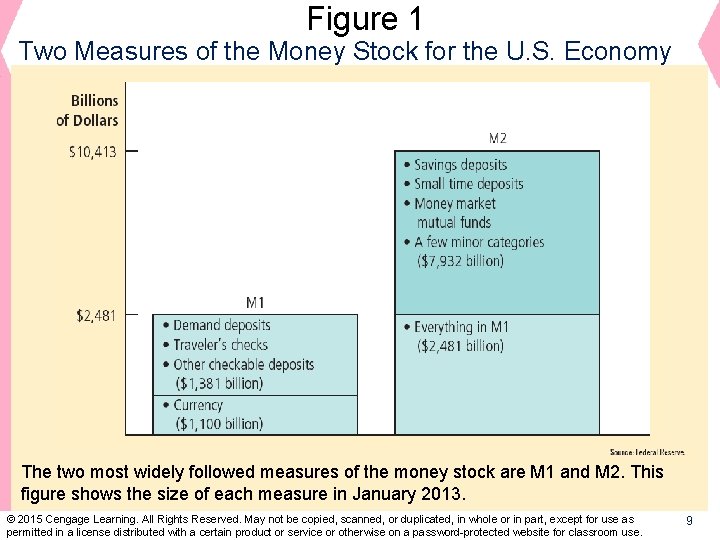
Money in the U. S. Economy • Measures of money stock – M 1 • Demand deposits, Traveler’s checks • Other checkable deposits, Currency – M 2 • Everything in M 1 • Savings deposits, Small time deposits • Money market mutual funds • A few minor categories © 2015 Cengage Learning. All Rights Reserved. May not be copied, scanned, or duplicated, in whole or in part, except for use as permitted in a license distributed with a certain product or service or otherwise on a password-protected website for classroom use. 8
Figure 1 Two Measures of the Money Stock for the U. S. Economy The two most widely followed measures of the money stock are M 1 and M 2. This figure shows the size of each measure in January 2013. © 2015 Cengage Learning. All Rights Reserved. May not be copied, scanned, or duplicated, in whole or in part, except for use as permitted in a license distributed with a certain product or service or otherwise on a password-protected website for classroom use. 9
Where is all the currency? • January 2013: $1. 1 trillion currency outstanding – Implies the average adult holds about $4, 490 of currency – Much of the currency is held abroad – Much of the currency is held by drug dealers, tax evaders, and other criminals • Currency is not a particularly good way to hold wealth • Can be lost or stolen; doesn’t earn interest © 2015 Cengage Learning. All Rights Reserved. May not be copied, scanned, or duplicated, in whole or in part, except for use as permitted in a license distributed with a certain product or service or otherwise on a password-protected website for classroom use. 10
The Federal Reserve System • The Federal Reserve (the Fed) – The central bank of the United States • Central bank – Institution designed to • Oversee the banking system • Regulate the quantity of money in the economy © 2015 Cengage Learning. All Rights Reserved. May not be copied, scanned, or duplicated, in whole or in part, except for use as permitted in a license distributed with a certain product or service or otherwise on a password-protected website for classroom use. 11
The Fed’s Organization • The Federal Reserve – Created in 1913 – After a series of bank failures in 1907 – Purpose: to ensure the health of the nation’s banking system © 2015 Cengage Learning. All Rights Reserved. May not be copied, scanned, or duplicated, in whole or in part, except for use as permitted in a license distributed with a certain product or service or otherwise on a password-protected website for classroom use. 12
The Fed’s Organization • Board of governors – 7 members, 14 -year terms • Appointed by the president and confirmed by the Senate – The chairman • Directs the Fed staff • Presides over board meetings • Testifies regularly about Fed policy in front of congressional committees. • Appointed by the president (4 -year term) © 2015 Cengage Learning. All Rights Reserved. May not be copied, scanned, or duplicated, in whole or in part, except for use as permitted in a license distributed with a certain product or service or otherwise on a password-protected website for classroom use. 13
The Fed’s Organization • The Federal Reserve System – Federal Reserve Board in Washington, D. C. – 12 regional Federal Reserve Banks • Major cities around the country • The presidents are chosen by each bank’s board of directors © 2015 Cengage Learning. All Rights Reserved. May not be copied, scanned, or duplicated, in whole or in part, except for use as permitted in a license distributed with a certain product or service or otherwise on a password-protected website for classroom use. 14
The Fed’s Organization • The Fed’s jobs – Regulate banks and ensure the health of the banking system • Regional Federal Reserve Banks • Monitors each bank’s financial condition • Facilitates bank transactions - clearing checks • Acts as a bank’s bank • The Fed – lender of last resort © 2015 Cengage Learning. All Rights Reserved. May not be copied, scanned, or duplicated, in whole or in part, except for use as permitted in a license distributed with a certain product or service or otherwise on a password-protected website for classroom use. 15
The Fed’s Organization • The Fed’s jobs – Control the money supply • Quantity of money available in the economy • Monetary policy – By Federal Open Market Committee (FOMC) • Money supply – Quantity of money available in economy • Monetary policy – Setting of the money supply © 2015 Cengage Learning. All Rights Reserved. May not be copied, scanned, or duplicated, in whole or in part, except for use as permitted in a license distributed with a certain product or service or otherwise on a password-protected website for classroom use. 16
Federal Open Market Committee • FOMC – 7 members of the board of governors – 5 of the twelve regional bank presidents • All twelve regional presidents attend each FOMC meeting, but only five get to vote – Meets about every 6 weeks in Washington, D. C. – Discuss the condition of the economy – Consider changes in monetary policy © 2015 Cengage Learning. All Rights Reserved. May not be copied, scanned, or duplicated, in whole or in part, except for use as permitted in a license distributed with a certain product or service or otherwise on a password-protected website for classroom use. 17
Federal Open Market Committee • Fed’s primary tool: open-market operation – Purchase & sale of U. S. government bonds • FOMC - increase the money supply – The Fed: open-market purchase • FOMC - decrease the money supply – The Fed: open-market sale © 2015 Cengage Learning. All Rights Reserved. May not be copied, scanned, or duplicated, in whole or in part, except for use as permitted in a license distributed with a certain product or service or otherwise on a password-protected website for classroom use. 18
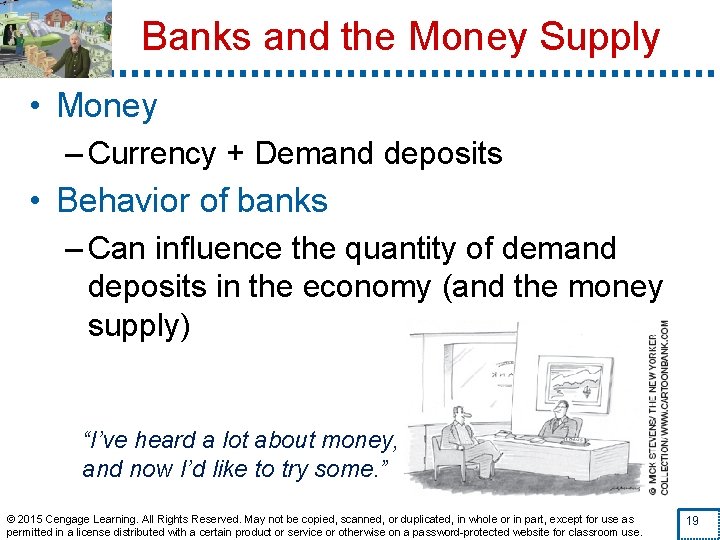
Banks and the Money Supply • Money – Currency + Demand deposits • Behavior of banks – Can influence the quantity of demand deposits in the economy (and the money supply) “I’ve heard a lot about money, and now I’d like to try some. ” © 2015 Cengage Learning. All Rights Reserved. May not be copied, scanned, or duplicated, in whole or in part, except for use as permitted in a license distributed with a certain product or service or otherwise on a password-protected website for classroom use. 19
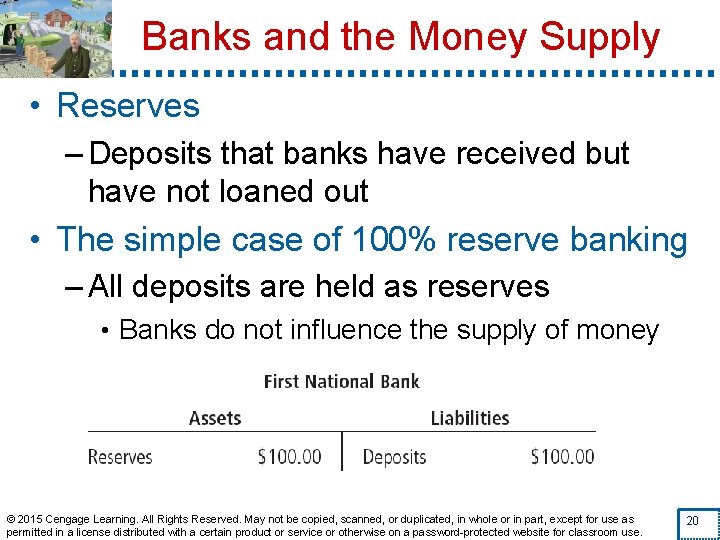
Banks and the Money Supply • Reserves – Deposits that banks have received but have not loaned out • The simple case of 100% reserve banking – All deposits are held as reserves • Banks do not influence the supply of money © 2015 Cengage Learning. All Rights Reserved. May not be copied, scanned, or duplicated, in whole or in part, except for use as permitted in a license distributed with a certain product or service or otherwise on a password-protected website for classroom use. 20
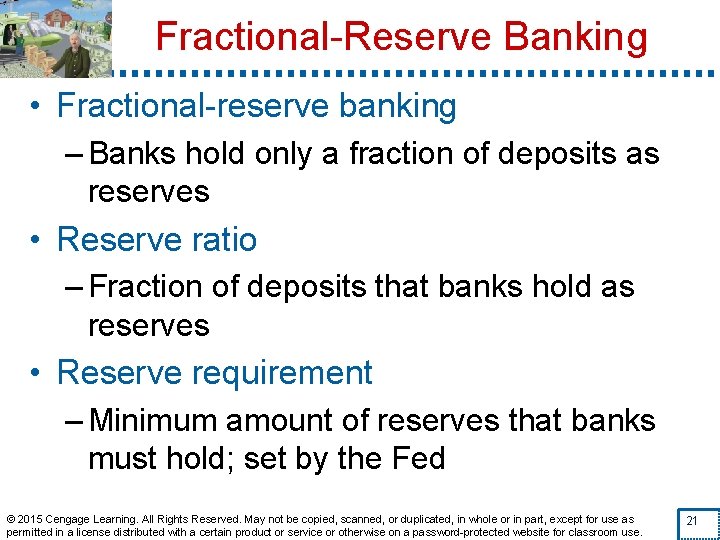
Fractional-Reserve Banking • Fractional-reserve banking – Banks hold only a fraction of deposits as reserves • Reserve ratio – Fraction of deposits that banks hold as reserves • Reserve requirement – Minimum amount of reserves that banks must hold; set by the Fed © 2015 Cengage Learning. All Rights Reserved. May not be copied, scanned, or duplicated, in whole or in part, except for use as permitted in a license distributed with a certain product or service or otherwise on a password-protected website for classroom use. 21
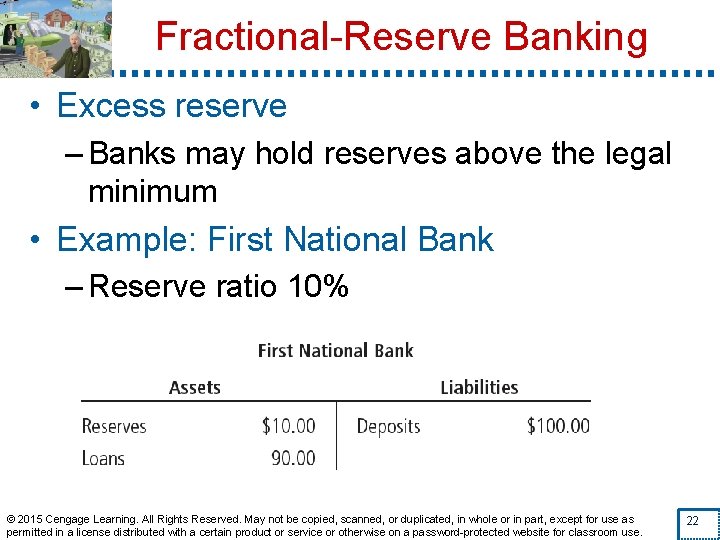
Fractional-Reserve Banking • Excess reserve – Banks may hold reserves above the legal minimum • Example: First National Bank – Reserve ratio 10% © 2015 Cengage Learning. All Rights Reserved. May not be copied, scanned, or duplicated, in whole or in part, except for use as permitted in a license distributed with a certain product or service or otherwise on a password-protected website for classroom use. 22
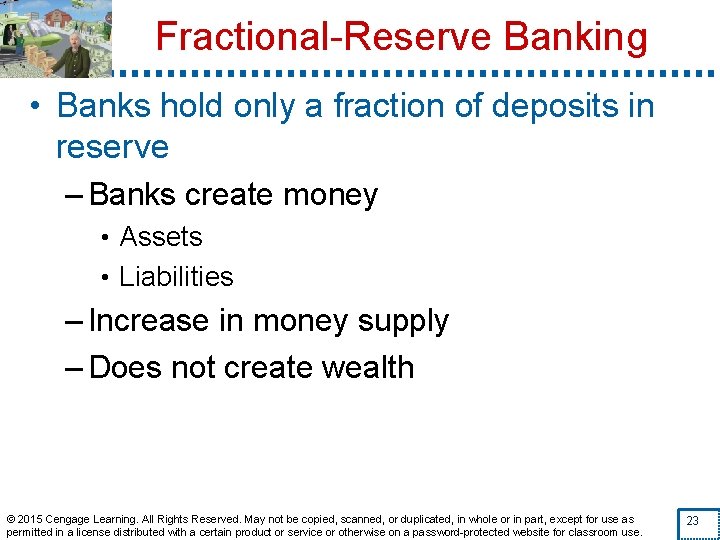
Fractional-Reserve Banking • Banks hold only a fraction of deposits in reserve – Banks create money • Assets • Liabilities – Increase in money supply – Does not create wealth © 2015 Cengage Learning. All Rights Reserved. May not be copied, scanned, or duplicated, in whole or in part, except for use as permitted in a license distributed with a certain product or service or otherwise on a password-protected website for classroom use. 23
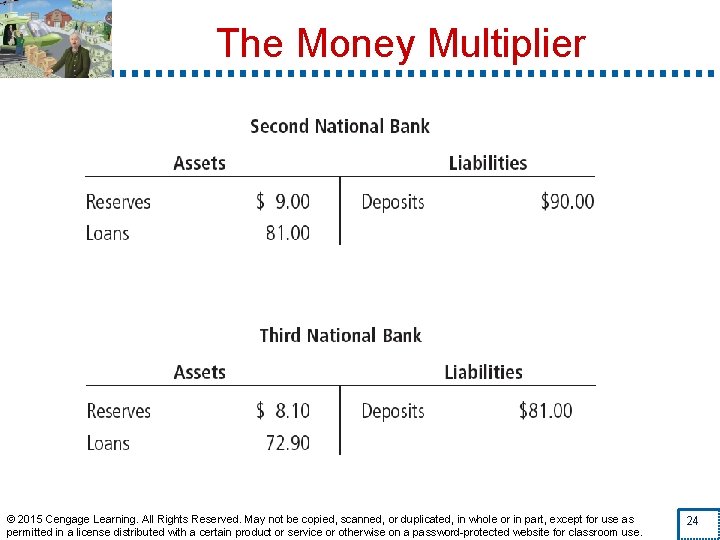
The Money Multiplier © 2015 Cengage Learning. All Rights Reserved. May not be copied, scanned, or duplicated, in whole or in part, except for use as permitted in a license distributed with a certain product or service or otherwise on a password-protected website for classroom use. 24
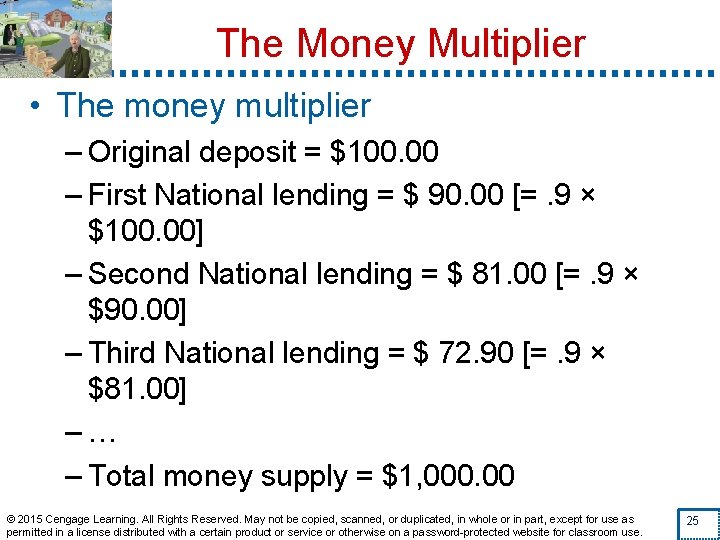
The Money Multiplier • The money multiplier – Original deposit = $100. 00 – First National lending = $ 90. 00 [=. 9 × $100. 00] – Second National lending = $ 81. 00 [=. 9 × $90. 00] – Third National lending = $ 72. 90 [=. 9 × $81. 00] –… – Total money supply = $1, 000. 00 © 2015 Cengage Learning. All Rights Reserved. May not be copied, scanned, or duplicated, in whole or in part, except for use as permitted in a license distributed with a certain product or service or otherwise on a password-protected website for classroom use. 25
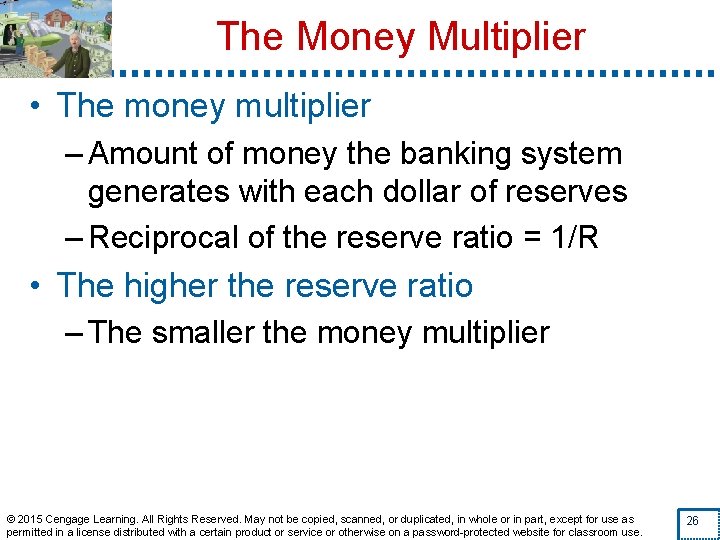
The Money Multiplier • The money multiplier – Amount of money the banking system generates with each dollar of reserves – Reciprocal of the reserve ratio = 1/R • The higher the reserve ratio – The smaller the money multiplier © 2015 Cengage Learning. All Rights Reserved. May not be copied, scanned, or duplicated, in whole or in part, except for use as permitted in a license distributed with a certain product or service or otherwise on a password-protected website for classroom use. 26
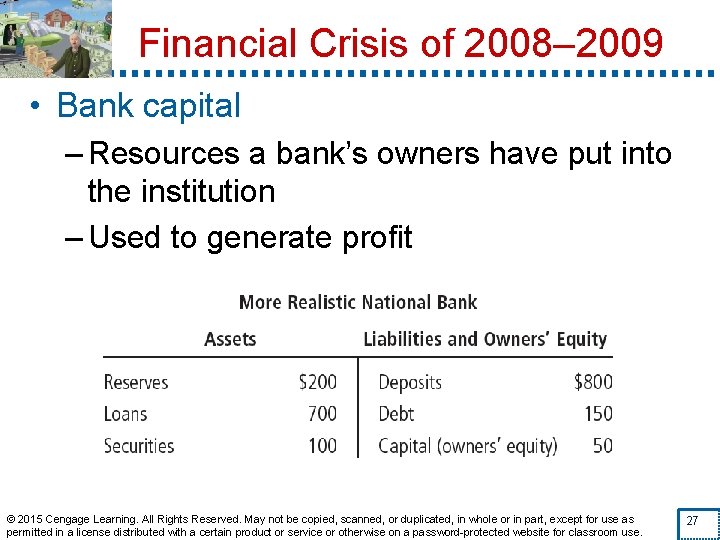
Financial Crisis of 2008– 2009 • Bank capital – Resources a bank’s owners have put into the institution – Used to generate profit © 2015 Cengage Learning. All Rights Reserved. May not be copied, scanned, or duplicated, in whole or in part, except for use as permitted in a license distributed with a certain product or service or otherwise on a password-protected website for classroom use. 27
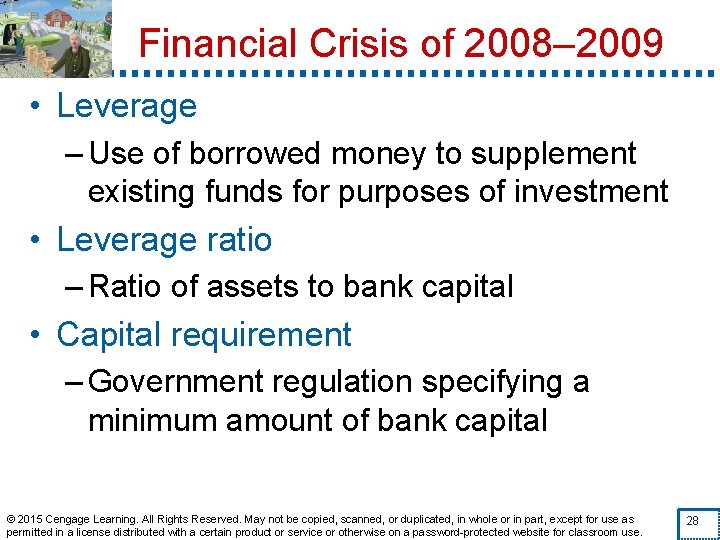
Financial Crisis of 2008– 2009 • Leverage – Use of borrowed money to supplement existing funds for purposes of investment • Leverage ratio – Ratio of assets to bank capital • Capital requirement – Government regulation specifying a minimum amount of bank capital © 2015 Cengage Learning. All Rights Reserved. May not be copied, scanned, or duplicated, in whole or in part, except for use as permitted in a license distributed with a certain product or service or otherwise on a password-protected website for classroom use. 28
Financial Crisis of 2008– 2009 • If bank’s assets rise in value by 5% – Because some of the securities the bank was holding rose in price – $1, 000 of assets would now be worth $1, 050 – Bank capital rises from $50 to $100 – So, for a leverage rate of 20 • A 5% increase in the value of assets • Increases the owners’ equity by 100% © 2015 Cengage Learning. All Rights Reserved. May not be copied, scanned, or duplicated, in whole or in part, except for use as permitted in a license distributed with a certain product or service or otherwise on a password-protected website for classroom use. 29
Financial Crisis of 2008– 2009 • If bank’s assets are reduced in value by 5% – Because some people who borrowed from the bank default on their loans – $1, 000 of assets would be worth $950 – Value of the owners’ equity falls to zero – So, for a leverage ratio of 20 • A 5% fall in the value of the bank assets • Leads to a 100% fall in bank capital © 2015 Cengage Learning. All Rights Reserved. May not be copied, scanned, or duplicated, in whole or in part, except for use as permitted in a license distributed with a certain product or service or otherwise on a password-protected website for classroom use. 30
Financial Crisis of 2008– 2009 • If bank’s assets are reduced in value by more than 5% – Because some people who borrowed from the bank default on their loans – For a leverage ratio of 20 • The bank’s assets would fall below its liabilities • The bank would be insolvent – Unable to pay off its debt holders and depositors in full © 2015 Cengage Learning. All Rights Reserved. May not be copied, scanned, or duplicated, in whole or in part, except for use as permitted in a license distributed with a certain product or service or otherwise on a password-protected website for classroom use. 31
Financial Crisis of 2008– 2009 • Many banks in 2008 and 2009 – Incurred sizable losses on some of their assets • Mortgage loans and securities backed by mortgage loans – Shortage of capital induced the banks to reduce lending • Credit crunch • Contributed to a severe downturn in economic activity © 2015 Cengage Learning. All Rights Reserved. May not be copied, scanned, or duplicated, in whole or in part, except for use as permitted in a license distributed with a certain product or service or otherwise on a password-protected website for classroom use. 32
Financial Crisis of 2008– 2009 • U. S. Treasury and the Fed – Put many billions of dollars of public funds into the banking system • To increase the amount of bank capital – Temporarily made the U. S. taxpayer a part owner of many banks – Goal: to recapitalize the banking system • So that bank lending could return to a more normal level - occurred by late 2009 © 2015 Cengage Learning. All Rights Reserved. May not be copied, scanned, or duplicated, in whole or in part, except for use as permitted in a license distributed with a certain product or service or otherwise on a password-protected website for classroom use. 33
Fed’s Tools of Monetary Control • Influences the quantity of reserves – Open-market operations – Fed lending to banks • Influences the reserve ratio – Reserve requirements – Paying interest on reserves © 2015 Cengage Learning. All Rights Reserved. May not be copied, scanned, or duplicated, in whole or in part, except for use as permitted in a license distributed with a certain product or service or otherwise on a password-protected website for classroom use. 34
Fed’s Tools of Monetary Control • Open-market operations – Purchase and sale of U. S. government bonds by the Fed – To increase the money supply • The Fed buys U. S. government bonds – To reduce the money supply • The Fed sells U. S. government bonds – Easy to conduct – Used more often © 2015 Cengage Learning. All Rights Reserved. May not be copied, scanned, or duplicated, in whole or in part, except for use as permitted in a license distributed with a certain product or service or otherwise on a password-protected website for classroom use. 35
Fed’s Tools of Monetary Control • Fed lending to banks • To increase the money supply • Discount window • At the discount rate – Term Auction Facility • To the highest bidder © 2015 Cengage Learning. All Rights Reserved. May not be copied, scanned, or duplicated, in whole or in part, except for use as permitted in a license distributed with a certain product or service or otherwise on a password-protected website for classroom use. 36
Fed’s Tools of Monetary Control • The discount rate – Interest rate on the loans that the Fed makes to banks – Higher discount rate • Reduce the money supply – Smaller discount rate • Increase the money supply © 2015 Cengage Learning. All Rights Reserved. May not be copied, scanned, or duplicated, in whole or in part, except for use as permitted in a license distributed with a certain product or service or otherwise on a password-protected website for classroom use. 37
Fed’s Tools of Monetary Control • Term Auction Facility – The Fed sets a quantity of funds it wants to lend to banks – Eligible banks bid to borrow those funds – Loans go to the highest eligible bidders • Acceptable collateral • Pay the highest interest rate © 2015 Cengage Learning. All Rights Reserved. May not be copied, scanned, or duplicated, in whole or in part, except for use as permitted in a license distributed with a certain product or service or otherwise on a password-protected website for classroom use. 38
Fed’s Tools of Monetary Control • Reserve requirements – Minimum amount of reserves that banks must hold against deposits • An increase in reserve requirement – Decrease the money supply • A decrease in reserve requirement – Increase the money supply – Used rarely – disrupt business of banking – Less effective in recent years • Many banks hold excess reserves © 2015 Cengage Learning. All Rights Reserved. May not be copied, scanned, or duplicated, in whole or in part, except for use as permitted in a license distributed with a certain product or service or otherwise on a password-protected website for classroom use. 39
Fed’s Tools of Monetary Control • Paying interest on reserves – Since October 2008 – The higher the interest rate on reserves • The more reserves banks will choose to hold – An increase in the interest rate on reserves • Increase the reserve ratio • Lower the money multiplier • Lower the money supply © 2015 Cengage Learning. All Rights Reserved. May not be copied, scanned, or duplicated, in whole or in part, except for use as permitted in a license distributed with a certain product or service or otherwise on a password-protected website for classroom use. 40
Problems • The Fed’s control of the money supply – Not precise • The Fed does not control: – The amount of money that households choose to hold as deposits in banks – The amount that bankers choose to lend © 2015 Cengage Learning. All Rights Reserved. May not be copied, scanned, or duplicated, in whole or in part, except for use as permitted in a license distributed with a certain product or service or otherwise on a password-protected website for classroom use. 41
Bank runs and the money supply • Bank runs – Depositors suspect that a bank may go bankrupt • “Run” to the bank to withdraw their deposits – Problem for banks under fractionalreserve banking • Cannot satisfy withdrawal requests from all depositors © 2015 Cengage Learning. All Rights Reserved. May not be copied, scanned, or duplicated, in whole or in part, except for use as permitted in a license distributed with a certain product or service or otherwise on a password-protected website for classroom use. 42
Bank runs and the money supply • When a bank run occurs – The bank - is forced to close its doors – Until some bank loans are repaid – Or until some lender of last resort provides it with the currency it needs to satisfy depositors – Complicate the control of the money supply © 2015 Cengage Learning. All Rights Reserved. May not be copied, scanned, or duplicated, in whole or in part, except for use as permitted in a license distributed with a certain product or service or otherwise on a password-protected website for classroom use. 43
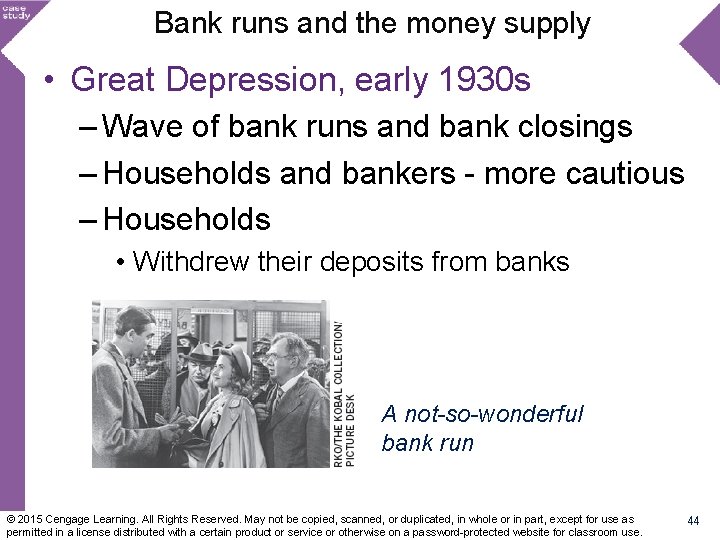
Bank runs and the money supply • Great Depression, early 1930 s – Wave of bank runs and bank closings – Households and bankers - more cautious – Households • Withdrew their deposits from banks A not-so-wonderful bank run © 2015 Cengage Learning. All Rights Reserved. May not be copied, scanned, or duplicated, in whole or in part, except for use as permitted in a license distributed with a certain product or service or otherwise on a password-protected website for classroom use. 44
Bank runs and the money supply • Great Depression, early 1930 s – Bankers - responded to falling reserves • Reducing bank loans, • Increased their reserve ratios • Smaller money multiplier • Decrease in money supply © 2015 Cengage Learning. All Rights Reserved. May not be copied, scanned, or duplicated, in whole or in part, except for use as permitted in a license distributed with a certain product or service or otherwise on a password-protected website for classroom use. 45
Bank runs and the money supply • Bank runs today – Not a major problem for the U. S. banking system • The federal government – Guarantees the safety of deposits at most banks • Federal Deposit Insurance Corporation (FDIC) © 2015 Cengage Learning. All Rights Reserved. May not be copied, scanned, or duplicated, in whole or in part, except for use as permitted in a license distributed with a certain product or service or otherwise on a password-protected website for classroom use. 46
Bank runs and the money supply • No bank runs today – Depositors are confident – FDIC will make good on the deposits • Government deposit insurance – Cost: • Bankers - little incentive to avoid bad risks – Benefit: • A more stable banking system © 2015 Cengage Learning. All Rights Reserved. May not be copied, scanned, or duplicated, in whole or in part, except for use as permitted in a license distributed with a certain product or service or otherwise on a password-protected website for classroom use. 47
The Federal Funds Rate • The federal funds rate – Interest rate at which banks make overnight loans to one another • Lender – has excess reserves • Borrower – needs reserves – A change in federal funds rate • Changes other interest rates © 2015 Cengage Learning. All Rights Reserved. May not be copied, scanned, or duplicated, in whole or in part, except for use as permitted in a license distributed with a certain product or service or otherwise on a password-protected website for classroom use. 48
The Federal Funds Rate • The Fed: target the federal funds rate – Open-market operations • The Fed buys bonds – Decrease in the federal funds rate – Increase in money supply • The Fed sells bonds – Increase in the federal funds rate – Decrease in money supply © 2015 Cengage Learning. All Rights Reserved. May not be copied, scanned, or duplicated, in whole or in part, except for use as permitted in a license distributed with a certain product or service or otherwise on a password-protected website for classroom use. 49