
29 December 2021 Respiration ATP 1 Write the
29 December 2021 Respiration - ATP 1. Write the date 2. Write the title 3. Write the today I am learning: 4. Where is ATP made in the cell? What does ATP stand for? Today I am learning what ATP is the structure of ATP how ATP is made and broken down
ENERGY - ATP
ATP • ATP is the form in which energy is transferred in cells • In eukaryotic cells ATP is made in the chemical reactions of respiration in the mitochondria • ATP is used for a variety of processes within cells that require energy such as movement, active transport or the synthesis of large organic molecules.
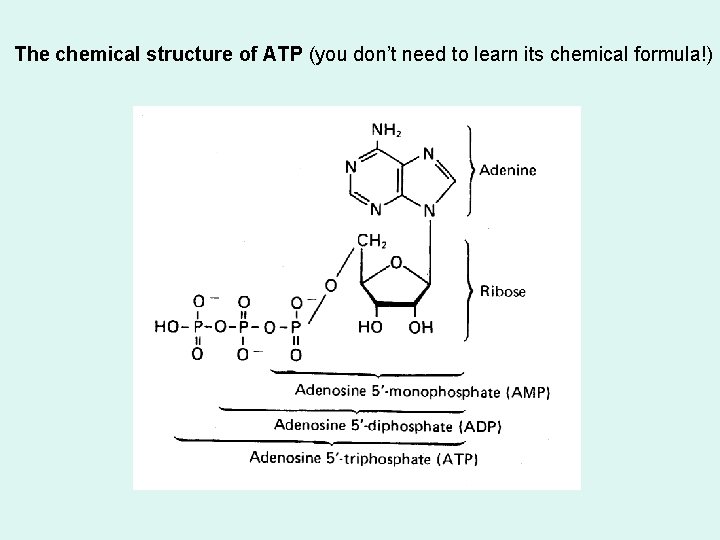
The chemical structure of ATP (you don’t need to learn its chemical formula!)
• Adenine is an organic base • Ribose is a 5 C sugar • Adenine plus ribose together are known as adenosine • Adenosine joined to one phosphate groups is known as AMP • Adenosine joined to two phosphate groups is known as ADP • Adenosine joined to three phosphate groups in known as ATP
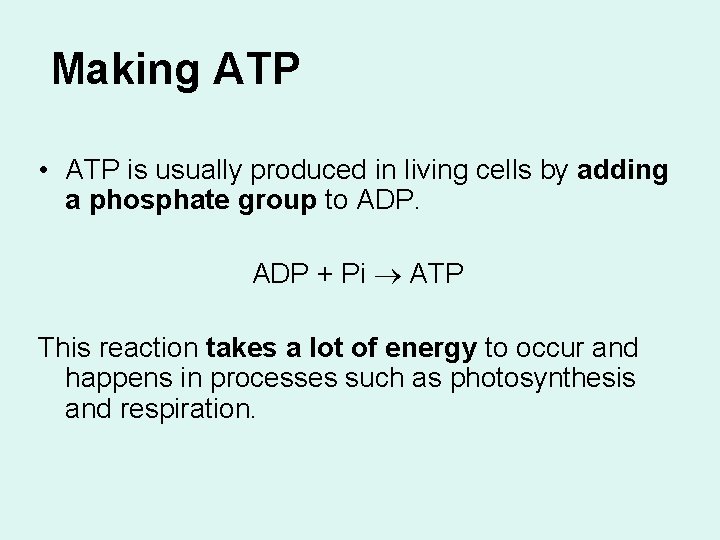
Making ATP • ATP is usually produced in living cells by adding a phosphate group to ADP + Pi ATP This reaction takes a lot of energy to occur and happens in processes such as photosynthesis and respiration.
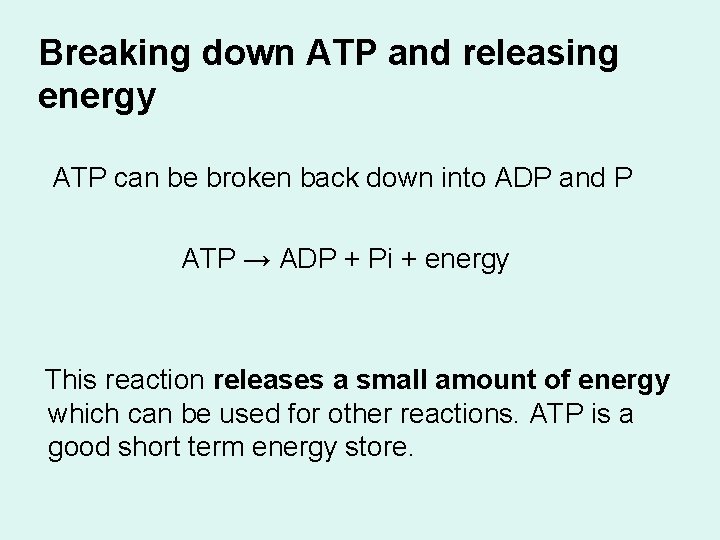
Breaking down ATP and releasing energy ATP can be broken back down into ADP and P ATP → ADP + Pi + energy This reaction releases a small amount of energy which can be used for other reactions. ATP is a good short term energy store.
Let’s think… Why do we use ATP as an energy resource rather than glucose?
ATP is more useful than glucose as a short term energy resource • This is because the break down of ATP to ADP and P is a single reaction. The break down of a glucose molecule in respiration takes a very large number of reactions.
ATP is more useful than glucose as a short term energy resource • The break down of a molecule of ATP releases a small amount of energy – enough to fuel the reactions occurring around the body. The break down of glucose would produce more energy than is needed – could produce excess heat which would denature proteins.
- Slides: 10