
28042011 Conceptual Imitation Learning Based on Functional Effects
28/04/2011 Conceptual Imitation Learning Based on Functional Effects of Action Hossein Hajimirsadeghi School of Electrical and Computer Engineering, University of Tehran, Iran © H. Hajimirsadeghi, School of ECE, University of Tehran
Outline • Introduction – – Imitation Learning Concepts Conceptual Imitation Learning Problem Statement • Hidden Markov Models – Definition & Main Problems • The Proposed Algorithm • Experiments • Conclusions © H. Hajimirsadeghi, School of ECE, University of Tehran 2
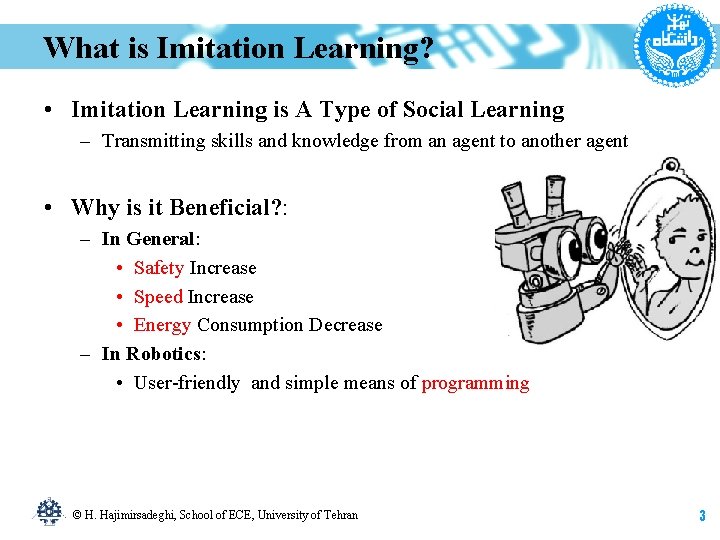
What is Imitation Learning? • Imitation Learning is A Type of Social Learning – Transmitting skills and knowledge from an agent to another agent • Why is it Beneficial? : – In General: • Safety Increase • Speed Increase • Energy Consumption Decrease – In Robotics: • User-friendly and simple means of programming © H. Hajimirsadeghi, School of ECE, University of Tehran 3
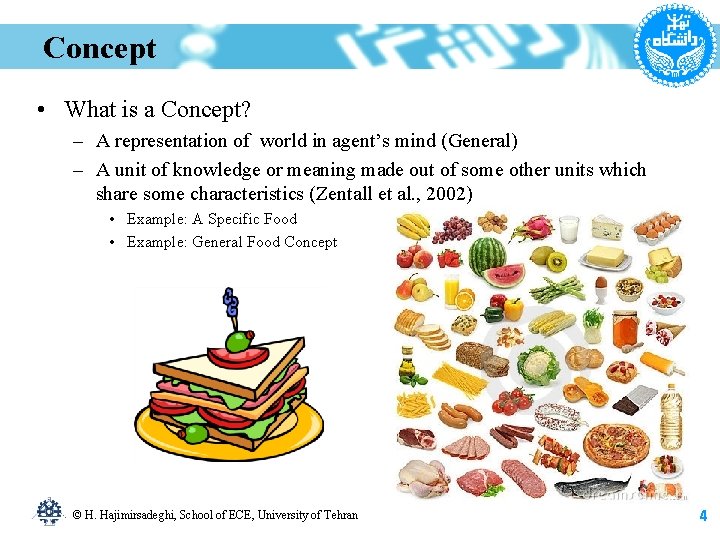
Concept • What is a Concept? – A representation of world in agent’s mind (General) – A unit of knowledge or meaning made out of some other units which share some characteristics (Zentall et al. , 2002) • Example: A Specific Food • Example: General Food Concept © H. Hajimirsadeghi, School of ECE, University of Tehran 4
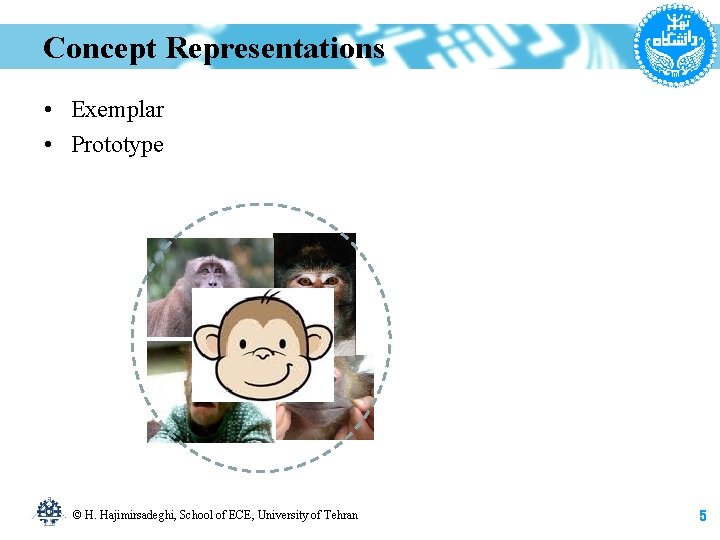
Concept Representations • Exemplar • Prototype © H. Hajimirsadeghi, School of ECE, University of Tehran 5

Types of Concepts • Perceptual Concepts • Relational Concepts • Associative Concepts Perceptual Similarity Perceptual Space Perception & Functional Similarity A Concept Needs an external information A Concept © H. Hajimirsadeghi, School of ECE, University of Tehran 6
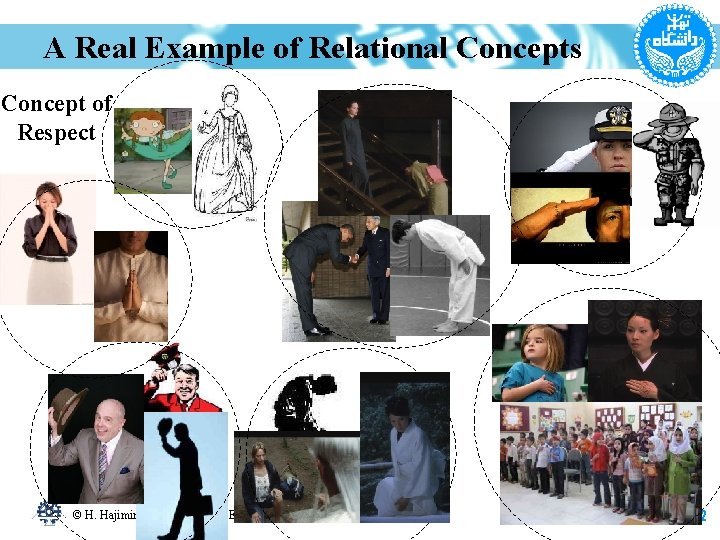
A Real Example of Relational Concepts Concept of Respect © H. Hajimirsadeghi, School of ECE, University of Tehran 2
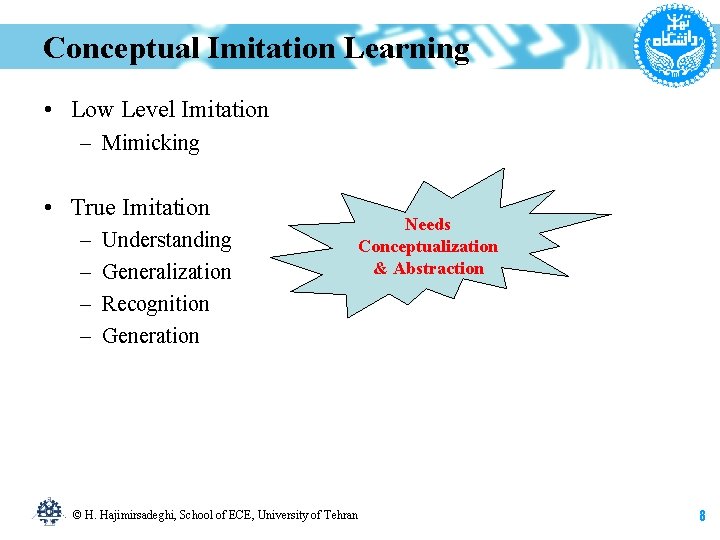
Conceptual Imitation Learning • Low Level Imitation – Mimicking • True Imitation – – Understanding Generalization Recognition Generation © H. Hajimirsadeghi, School of ECE, University of Tehran Needs Conceptualization & Abstraction 8
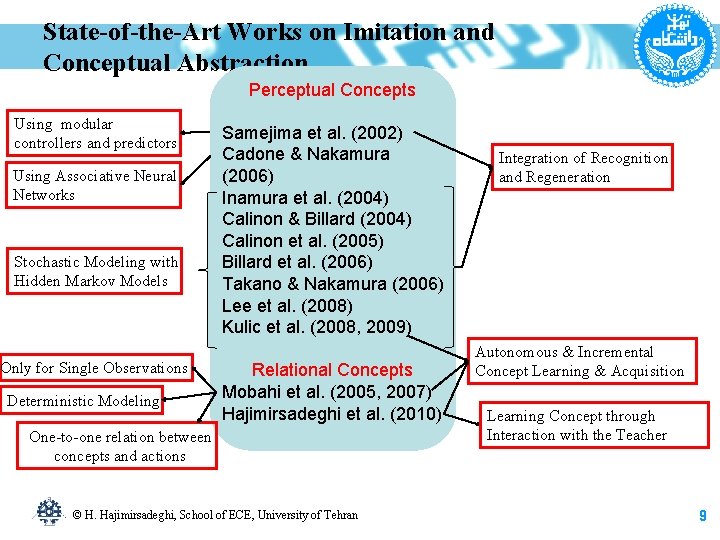
State-of-the-Art Works on Imitation and Conceptual Abstraction Perceptual Concepts Using modular controllers and predictors Using Associative Neural Networks Stochastic Modeling with Hidden Markov Models Only for Single Observations Deterministic Modeling Samejima et al. (2002) Cadone & Nakamura (2006) Inamura et al. (2004) Calinon & Billard (2004) Calinon et al. (2005) Billard et al. (2006) Takano & Nakamura (2006) Lee et al. (2008) Kulic et al. (2008, 2009) Relational Concepts Mobahi et al. (2005, 2007) Hajimirsadeghi et al. (2010) One-to-one relation between concepts and actions © H. Hajimirsadeghi, School of ECE, University of Tehran Integration of Recognition and Regeneration Autonomous & Incremental Concept Learning & Acquisition Learning Concept through Interaction with the Teacher 9

Our Proposed Model Relational Concepts Functional Similarity is Identified by the Effects Suitable for Sequence of Observations Stochastic Modeling with Hidden Markov Models Integration of Recognition and Regeneration Autonomous & Incremental Concept Learning & Acquisition Each Concept is Represented by All Perceptual Variants of an Action © H. Hajimirsadeghi, School of ECE, University of Tehran 10
Problem Statement • Proposing an Incremental and Gradual Learning Algorithm for Autonomous Acquisition, Generalization, Recognition, and Regeneration of Relational Concepts through perception of Spatio-Temporal demonstrations and Identifying their Functional Effects. • Main Ideas: – Using Prototypes (Start From Exemplar, End with Prototypes) – A Prototype Abstracts Perceptually Similar Demonstrations. – A Concept Emerges as a Set of Prototypes which Have Similar Functionalities. – Functional Similarity between Demonstrations is Understood by Recognizing their Functional Effects (External Information). © H. Hajimirsadeghi, School of ECE, University of Tehran 11
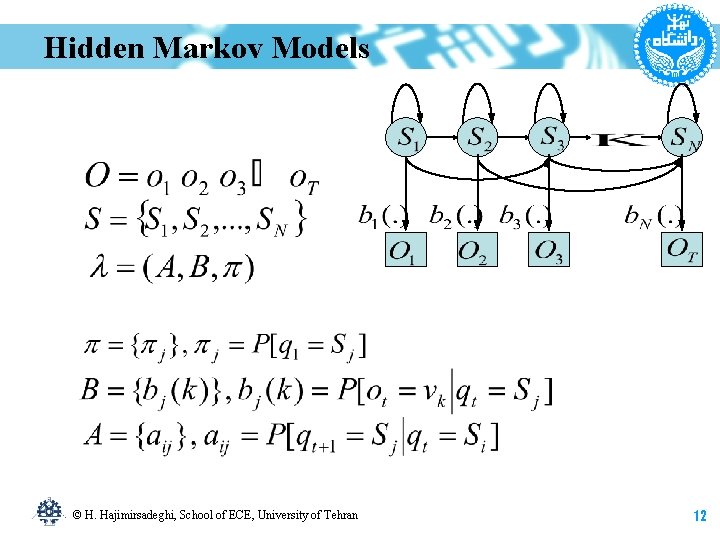
Hidden Markov Models © H. Hajimirsadeghi, School of ECE, University of Tehran 12
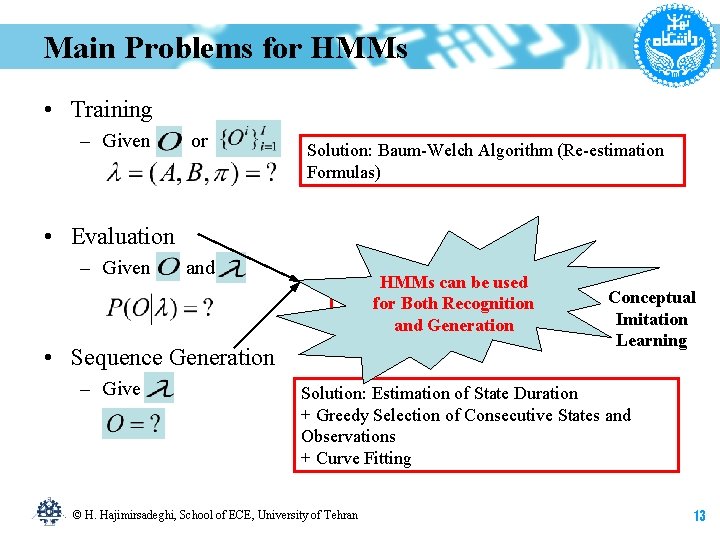
Main Problems for HMMs • Training – Given or Solution: Baum-Welch Algorithm (Re-estimation Formulas) • Evaluation – Given and HMMs can be used for Both Recognition Solution: Forward Algorithm and Generation • Sequence Generation – Give Conceptual Imitation Learning Solution: Estimation of State Duration + Greedy Selection of Consecutive States and Observations + Curve Fitting © H. Hajimirsadeghi, School of ECE, University of Tehran 13
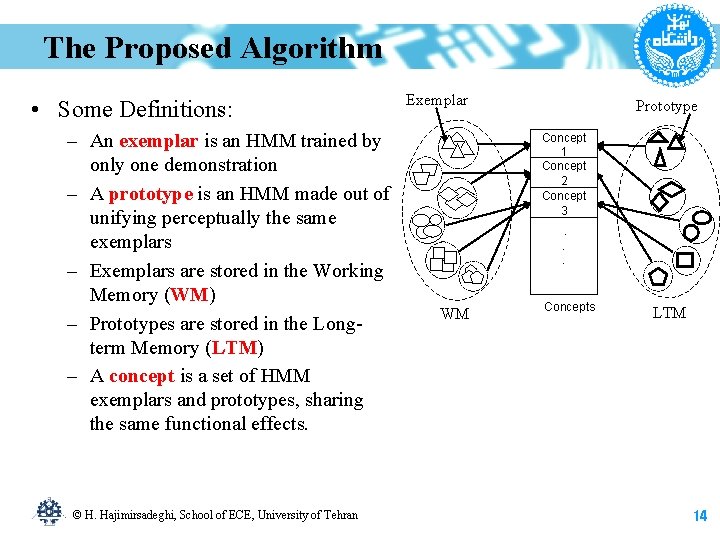
The Proposed Algorithm • Some Definitions: – An exemplar is an HMM trained by only one demonstration – A prototype is an HMM made out of unifying perceptually the same exemplars – Exemplars are stored in the Working Memory (WM) – Prototypes are stored in the Longterm Memory (LTM) – A concept is a set of HMM exemplars and prototypes, sharing the same functional effects. © H. Hajimirsadeghi, School of ECE, University of Tehran Exemplar Prototype Concept 1 Concept 2 Concept 3. . . WM Concepts LTM 14
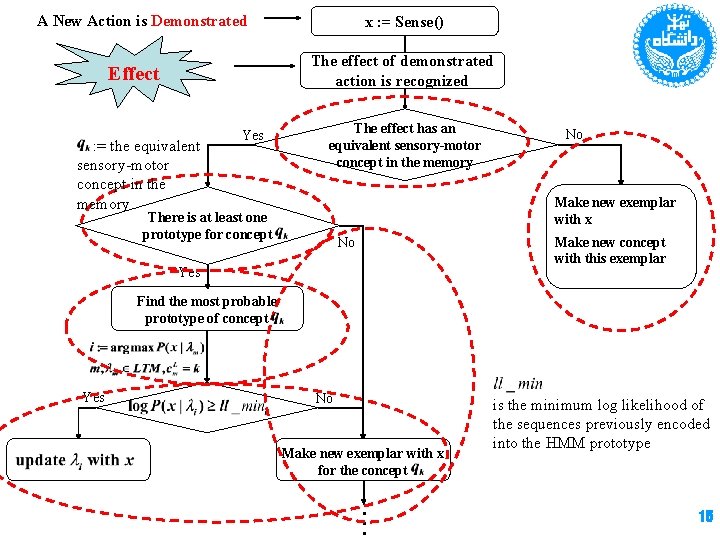
A New Action is Demonstrated x : = Sense() The effect of demonstrated action is recognized Effect : = the equivalent sensory-motor concept in the memory Yes The effect has an equivalent sensory-motor concept in the memory No Make new exemplar with x There is at least one prototype for concept Make new concept with this exemplar No Yes Find the most probable prototype of concept Yes No Make new exemplar with x for the concept is the minimum log likelihood of the sequences previously encoded into the HMM prototype … 15
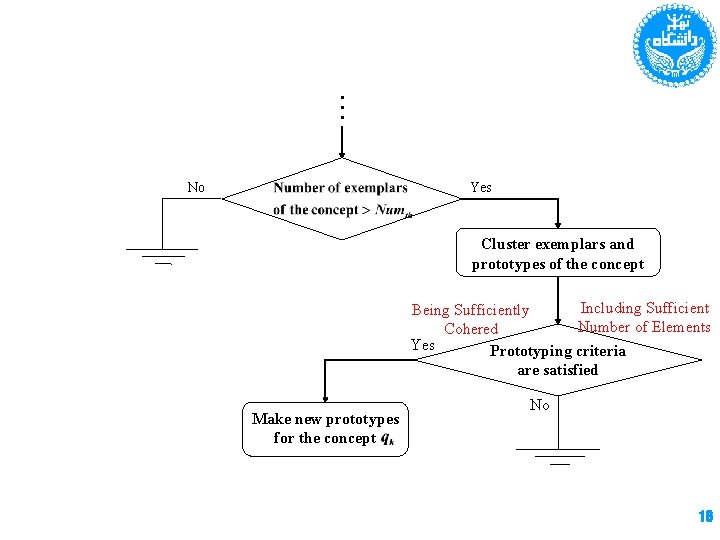
… Yes No Cluster exemplars and prototypes of the concept Including Sufficient Being Sufficiently Number of Elements Cohered Yes Prototyping criteria are satisfied Make new prototypes for the concept No 16
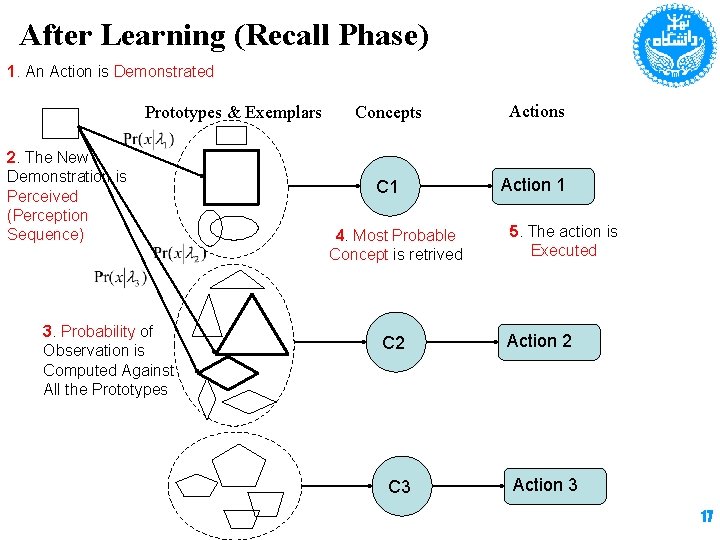
After Learning (Recall Phase) 1. An Action is Demonstrated Prototypes & Exemplars 2. The New Demonstration is Perceived (Perception Sequence) 3. Probability of Observation is Computed Against All the Prototypes Concepts Actions C 1 Action 1 4. Most Probable Concept is retrived C 2 C 3 5. The action is Executed Action 2 Action 3 17
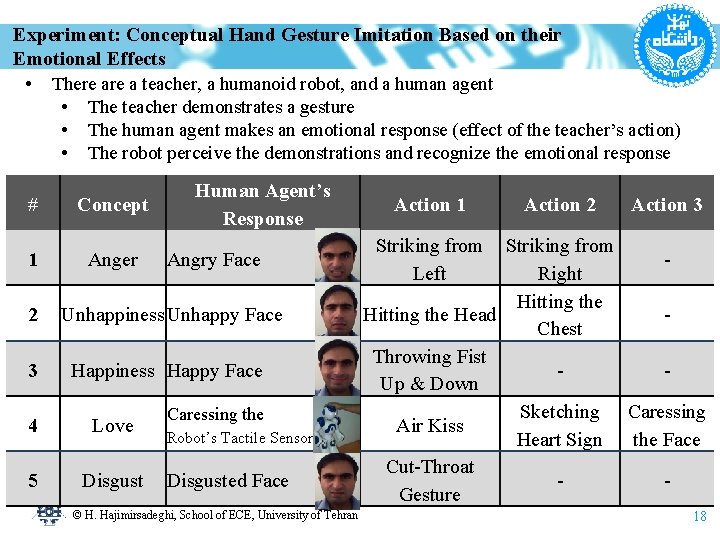
Experiment: Conceptual Hand Gesture Imitation Based on their Emotional Effects • There a teacher, a humanoid robot, and a human agent • The teacher demonstrates a gesture • The human agent makes an emotional response (effect of the teacher’s action) • The robot perceive the demonstrations and recognize the emotional response # Concept 1 Anger Human Agent’s Response Angry Face 2 Unhappiness Unhappy Face 3 Happiness Happy Face 4 Love 5 Disgust Caressing the Robot’s Tactile Sensor Disgusted Face © H. Hajimirsadeghi, School of ECE, University of Tehran Action 1 Action 2 Action 3 Striking from Left Striking from Right Hitting the Head Chest Throwing Fist Up & Down Sketching Caressing Air Kiss Heart Sign the Face Cut-Throat Gesture 18
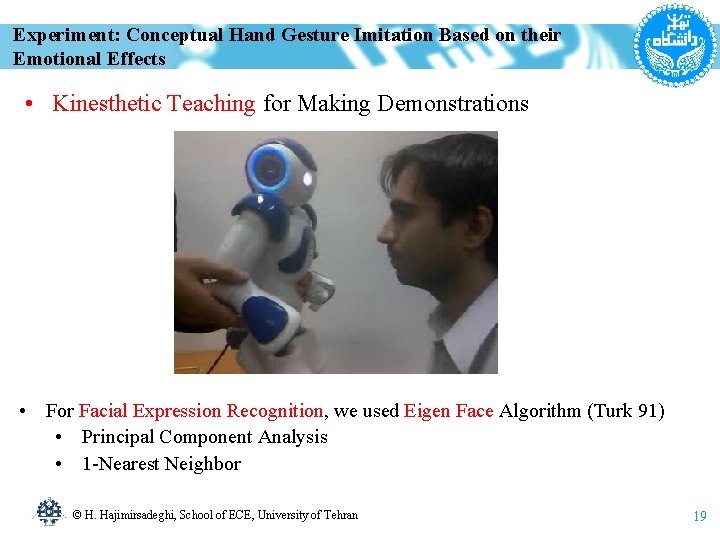
Experiment: Conceptual Hand Gesture Imitation Based on their Emotional Effects • Kinesthetic Teaching for Making Demonstrations • For Facial Expression Recognition, we used Eigen Face Algorithm (Turk 91) • Principal Component Analysis • 1 -Nearest Neighbor © H. Hajimirsadeghi, School of ECE, University of Tehran 19
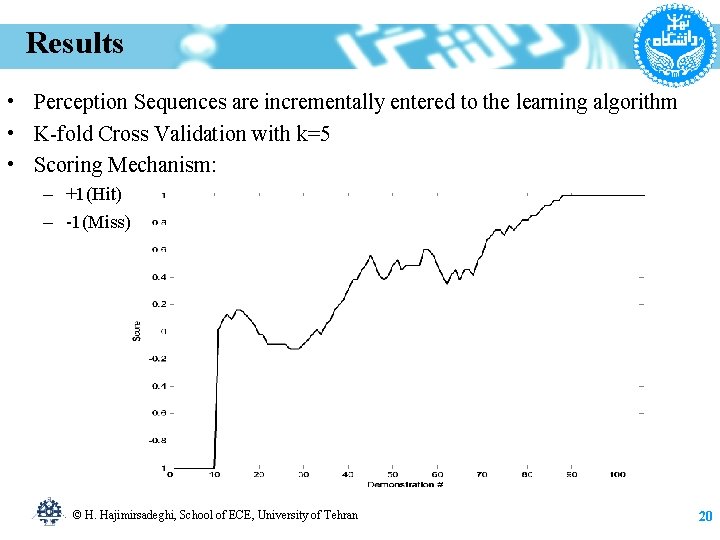
Results • Perception Sequences are incrementally entered to the learning algorithm • K-fold Cross Validation with k=5 • Scoring Mechanism: – +1(Hit) – -1(Miss) © H. Hajimirsadeghi, School of ECE, University of Tehran 20
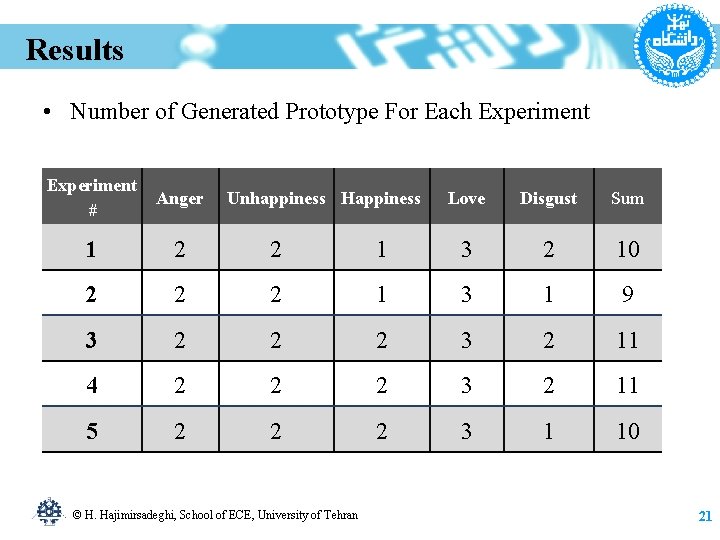
Results • Number of Generated Prototype For Each Experiment # Anger 1 2 2 3 Unhappiness Happiness Love Disgust Sum 1 3 2 10 2 1 3 1 9 2 2 2 3 2 11 4 2 2 2 3 2 11 5 2 2 2 3 1 10 © H. Hajimirsadeghi, School of ECE, University of Tehran 21
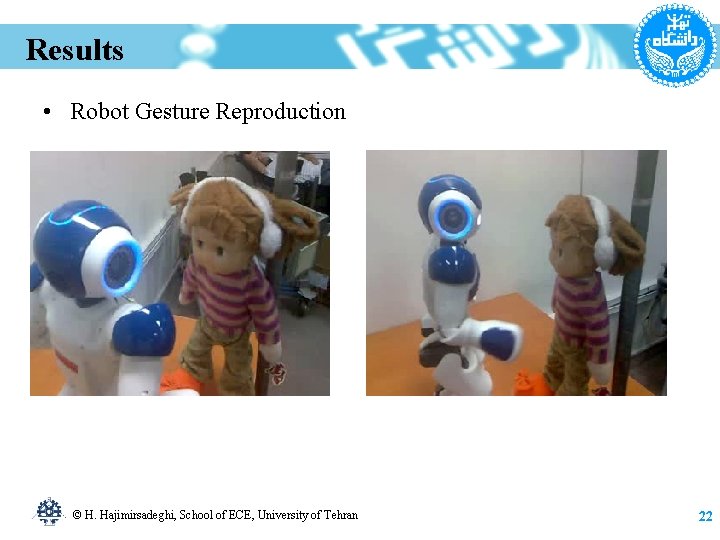
Results • Robot Gesture Reproduction © H. Hajimirsadeghi, School of ECE, University of Tehran 22
Conclusion • An Incremental and Gradual Learning Algorithm for Autonomous Acquisition, Generalization, Recognition, and Regeneration of Relational Concepts through perception of Spatio-Temporal demonstrations and their Functional Effects • Outcome: An Agent is Trained Who can make Functional Effects in the Environment © H. Hajimirsadeghi, School of ECE, University of Tehran 23
Conclusions • Consequences of Imitation Learning by Relational Concepts: – Recognition of Novel Demonstrations of the Learned Concepts – No Need of Motor Learning for Previously Learned Concepts – If Motor Programs are Learned for the Perceptual Variants of A Concept, • Flexibility of Choice between the alternatives – Less Concepts • • Smaller Representation of World Simpler Interaction with World Smaller Memory Simpler Search – Ease of Knowledge Transfer • from an Agent to Another Agent • from a Situation to Another Situation © H. Hajimirsadeghi, School of ECE, University of Tehran 24

28/04/2011 Thanks for Your Attention © H. Hajimirsadeghi, School of ECE, University of Tehran
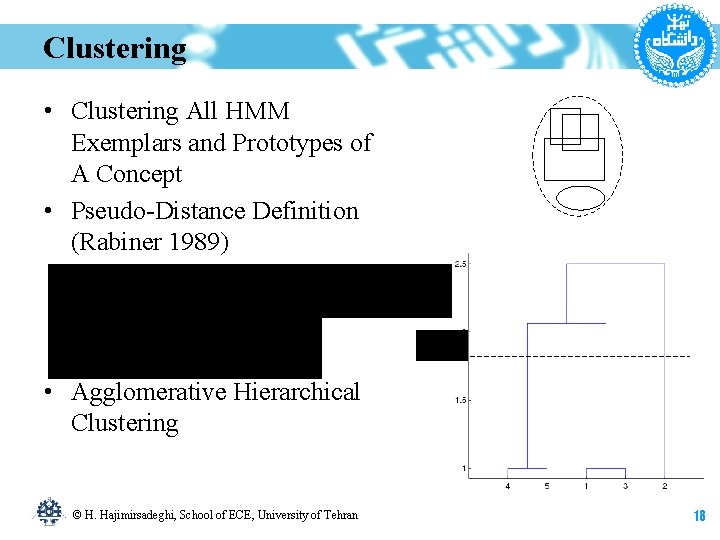
Clustering • Clustering All HMM Exemplars and Prototypes of A Concept • Pseudo-Distance Definition (Rabiner 1989) • Agglomerative Hierarchical Clustering © H. Hajimirsadeghi, School of ECE, University of Tehran 18
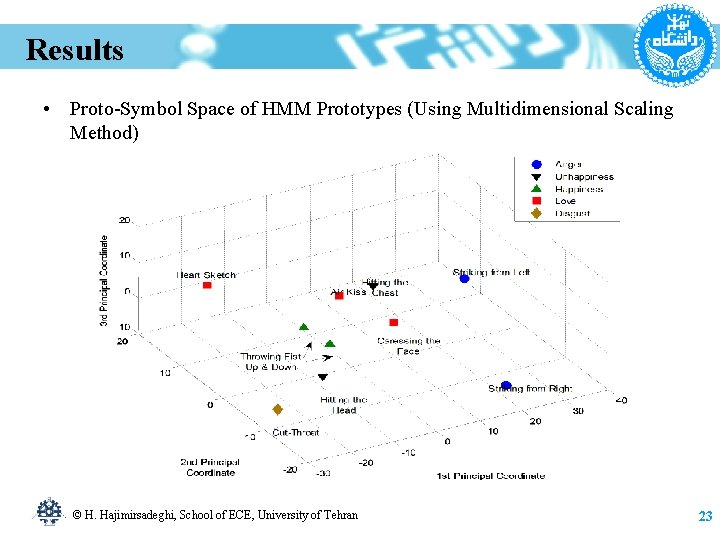
Results • Proto-Symbol Space of HMM Prototypes (Using Multidimensional Scaling Method) © H. Hajimirsadeghi, School of ECE, University of Tehran 23
What is Imitation Learning? • Imitation Learning is A Type of Social Learning – Transmitting skills and knowledge from an agent to another agent • Why is it Beneficial? : – In General: • Safety Increase • Speed Increase • Energy Consumption Decrease – In Robotics: • User-friendly means of programming • Better regeneration of human-like movements • understanding mechanisms for developmental organization of perceptionaction integration in animals. © H. Hajimirsadeghi, School of ECE, University of Tehran 3
Conceptual Imitation Learning • Low Level Imitation – Mimicking • True Imitation – – Understanding Recognition Generalization Generation Needs Conceptualization & Abstraction • Importance of Conceptual Imitation Learning – – – Recognition of Novel Demonstrations No Need of Motor Learning for Previously Learned Concepts Less Memory, Easy Search Ease of Knowledge Transfer from Agent to Agent For Concepts with Functional Abstraction: • Less Concept, Smaller Representation of World, Simpler Interaction with World • Motor Learning for Only one of the Perceptual Variants – Else: Flexibility of Choice between the alternatives • Ease of Knowledge Transfer from a Situation to Another Situation © H. Hajimirsadeghi, School of ECE, University of Tehran 8
Importance of HMMs for Conceptual Imitation Learning • Simultaneous Modeling of the Statistical Variations in – Dynamics of Observation Sequence & – Amplitude of Observations • A Unified Mathematical Model for Both – Recognition – Generation © H. Hajimirsadeghi, School of ECE, University of Tehran 14
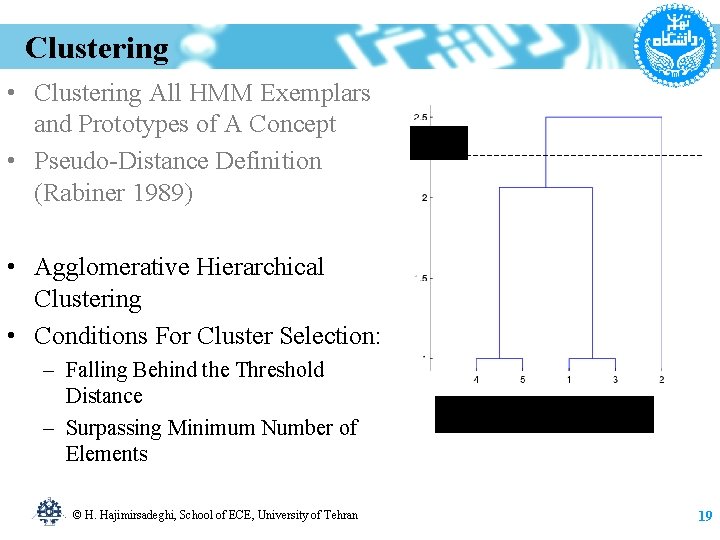
Clustering • Clustering All HMM Exemplars and Prototypes of A Concept • Pseudo-Distance Definition (Rabiner 1989) • Agglomerative Hierarchical Clustering • Conditions For Cluster Selection: – Falling Behind the Threshold Distance – Surpassing Minimum Number of Elements © H. Hajimirsadeghi, School of ECE, University of Tehran 19
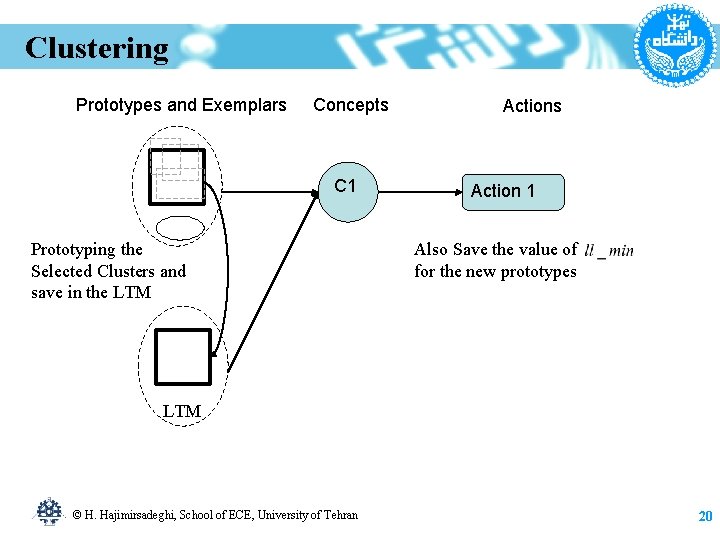
Clustering Prototypes and Exemplars Concepts C 1 Prototyping the Selected Clusters and save in the LTM Actions Action 1 Also Save the value of for the new prototypes LTM © H. Hajimirsadeghi, School of ECE, University of Tehran 20
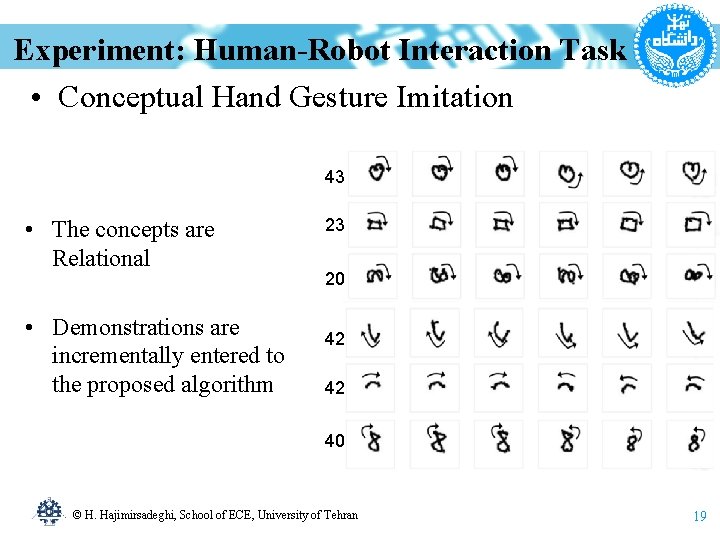
Experiment: Human-Robot Interaction Task • Conceptual Hand Gesture Imitation 43 • The concepts are Relational • Demonstrations are incrementally entered to the proposed algorithm 23 20 42 42 40 © H. Hajimirsadeghi, School of ECE, University of Tehran 19
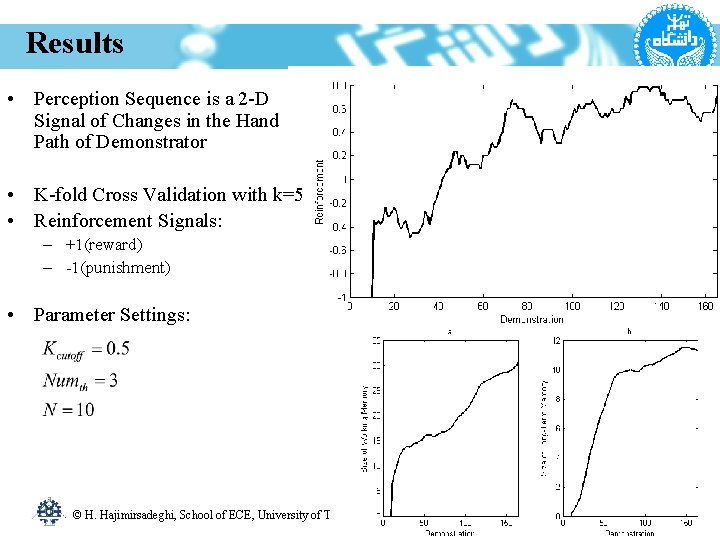
Results • Perception Sequence is a 2 -D Signal of Changes in the Hand Path of Demonstrator • K-fold Cross Validation with k=5 • Reinforcement Signals: – +1(reward) – -1(punishment) • Parameter Settings: © H. Hajimirsadeghi, School of ECE, University of Tehran 21
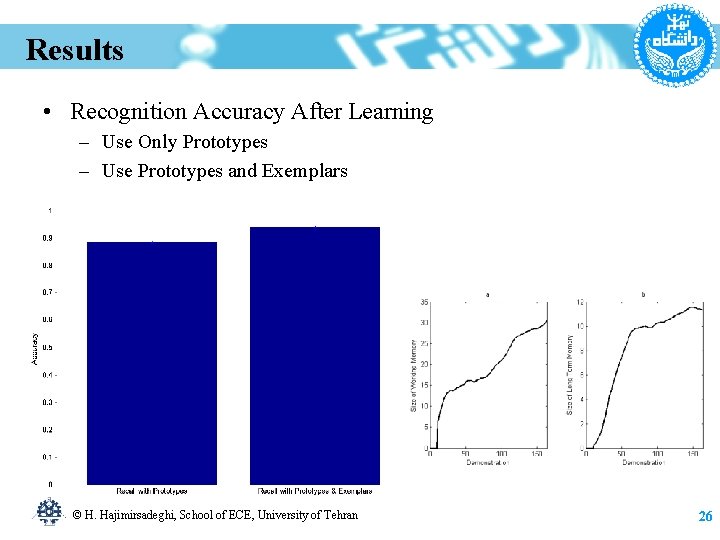
Results • Recognition Accuracy After Learning – Use Only Prototypes – Use Prototypes and Exemplars © H. Hajimirsadeghi, School of ECE, University of Tehran 26
Conclusion • An Incremental and Gradual Learning Algorithm for Autonomous Acquisition, Generalization, Recognition, and Regeneration of Relational Concepts through perception of Spatio-Temporal demonstrations of the Teacher – Using Prototypes to Represent Concepts – A Prototype Abstracts Perceptually Similar Demonstrations of a Concept – A Concept Comprises a Set of Perceptual Prototypes which Have Similar Functionalities. – Functional Similarity between Demonstrations is understood by Interaction with the Teachers (External Information). © H. Hajimirsadeghi, School of ECE, University of Tehran 28
Conclusions • Future Works: – Using HMMs for Multimodal Integration of Heterogeneous Perceptions • Representation and Recognition of Multimodal Concepts – Concept Recognition with Incomplete Observation Sequences – Conceptual Imitation Learning Based on Functional Effects of Action • E. g. , emotional effects of action – Multi-Resolution Representation of Concepts by Hierarchical Organization of Prototypes © H. Hajimirsadeghi, School of ECE, University of Tehran 30
- Slides: 37