
28 QUESTION 28 on TEST T 5 Fossils

- Slides: 50
28 QUESTION 28 on TEST !!!!@
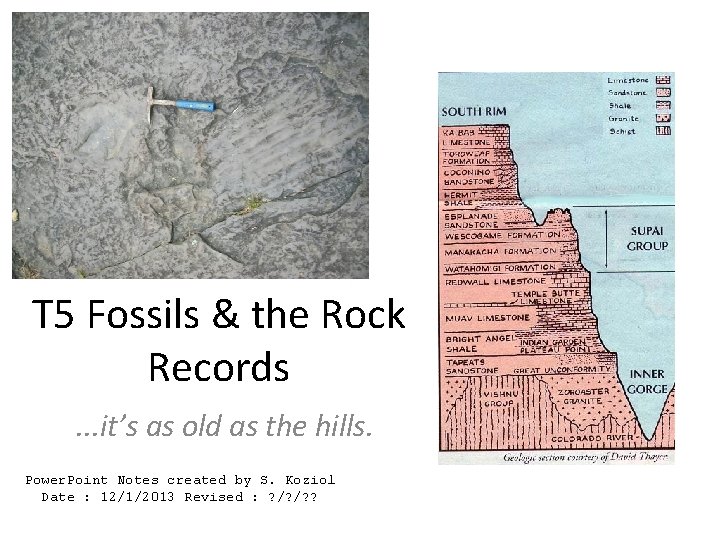
T 5 Fossils & the Rock Records. . . it’s as old as the hills. Power. Point Notes created by S. Koziol Date : 12/1/2013 Revised : ? /? /? ?
Part 1 Objectives • Describe the geological time scale • Distinguish among the following time scale divisions: eon, era, period & epoch.
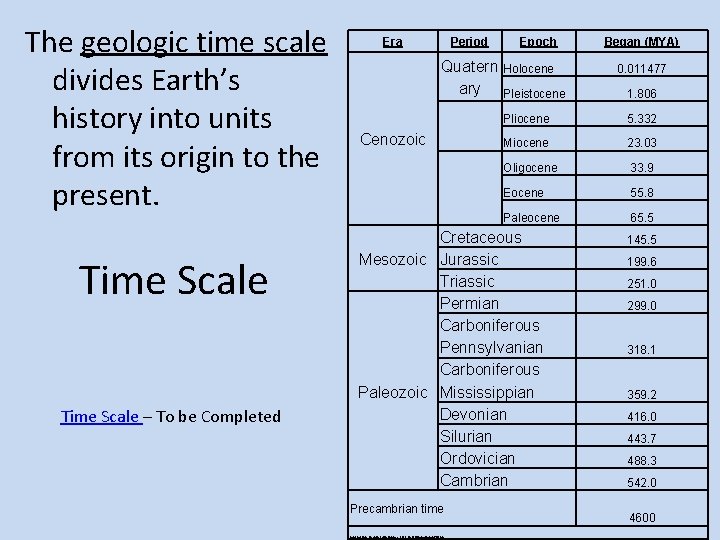
The geologic time scale divides Earth’s history into units from its origin to the present. Time Scale – To be Completed Era Period Quatern ary Cenozoic Epoch Holocene Adapted from Modern Earth Science, 2002, Holt, Rinehart and Winston 0. 011477 Pleistocene 1. 806 Pliocene 5. 332 Miocene 23. 03 Oligocene 33. 9 Eocene 55. 8 Paleocene 65. 5 Cretaceous Mesozoic Jurassic Triassic Permian Carboniferous Pennsylvanian Carboniferous Paleozoic Mississippian Devonian Silurian Ordovician Cambrian Precambrian time Began (MYA) 145. 5 199. 6 251. 0 299. 0 318. 1 359. 2 416. 0 443. 7 488. 3 542. 0 4600
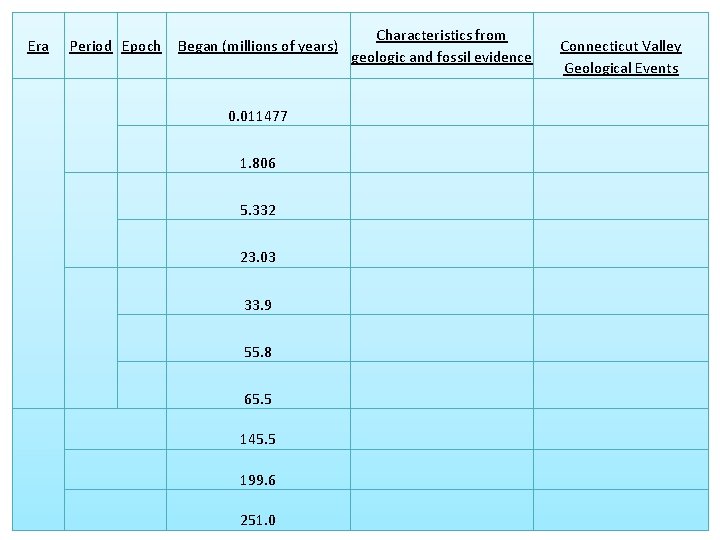
Era Period Epoch Began (millions of years) Characteristics from geologic and fossil evidence Blank Time Scale 0. 011477 1. 806 5. 332 23. 03 33. 9 55. 8 65. 5 145. 5 199. 6 251. 0 Connecticut Valley Geological Events
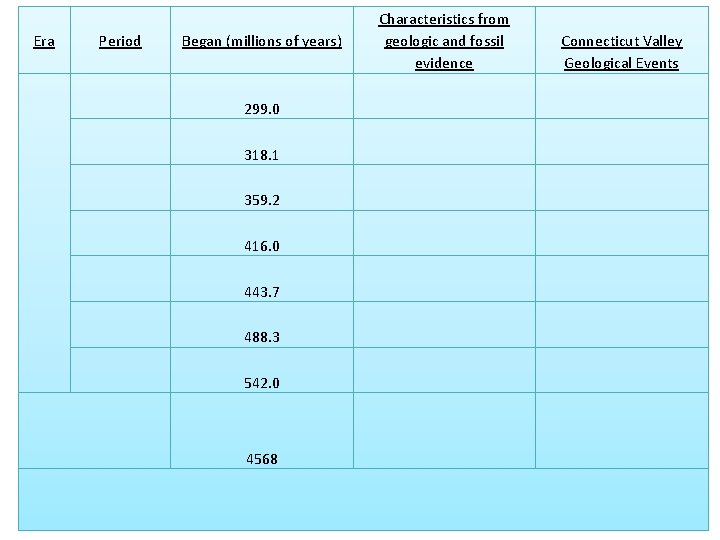
Era Period Began (millions of years) Characteristics from geologic and fossil evidence Time Scale Continued 299. 0 318. 1 359. 2 416. 0 443. 7 488. 3 542. 0 4568 Connecticut Valley Geological Events
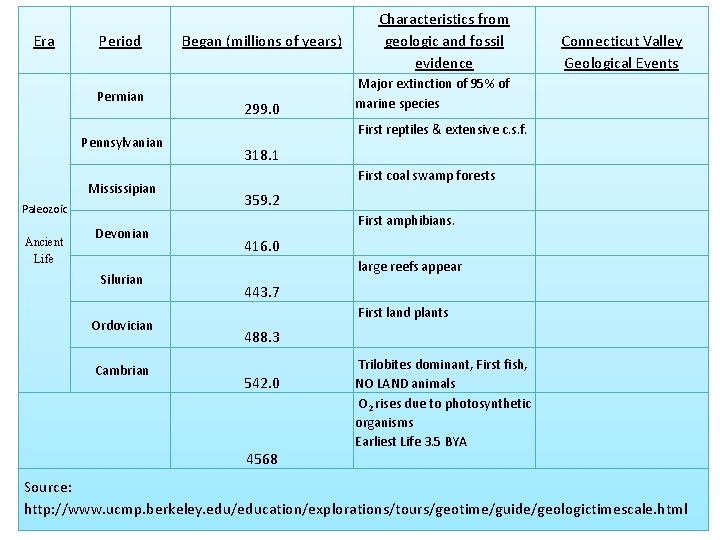
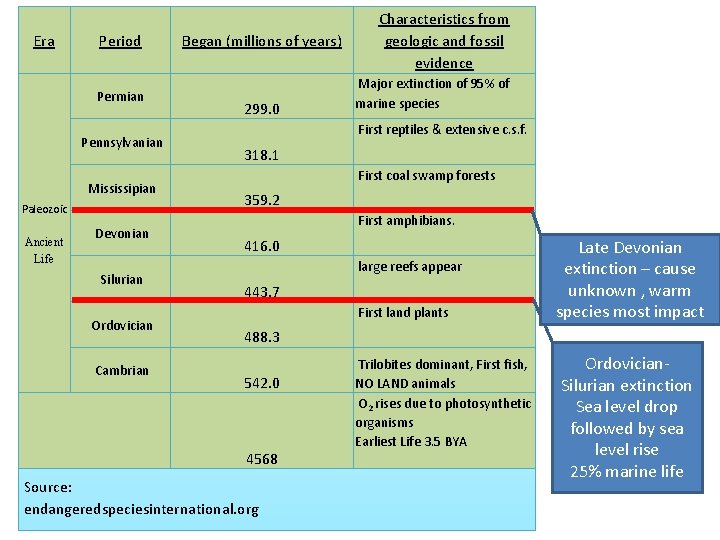
Era Period Permian Pennsylvanian Mississipian Paleozoic Ancient Life Devonian Silurian Ordovician Cambrian Began (millions of years) Characteristics from geologic and fossil evidence Time Scale Continued 299. 0 Connecticut Valley Geological Events Major extinction of 95% of marine species First reptiles & extensive c. s. f. 318. 1 First coal swamp forests 359. 2 First amphibians. 416. 0 large reefs appear 443. 7 First land plants 488. 3 542. 0 4568 Trilobites dominant, First fish, NO LAND animals O 2 rises due to photosynthetic organisms Earliest Life 3. 5 BYA Source: http: //www. ucmp. berkeley. edu/education/explorations/tours/geotime/guide/geologictimescale. html
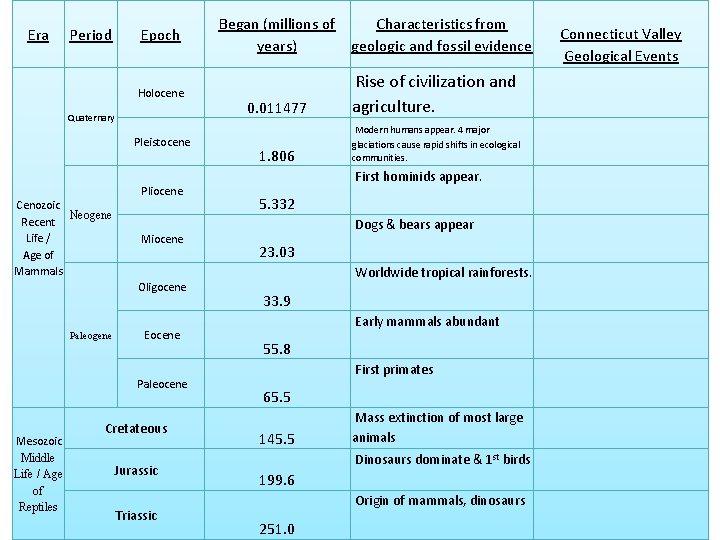
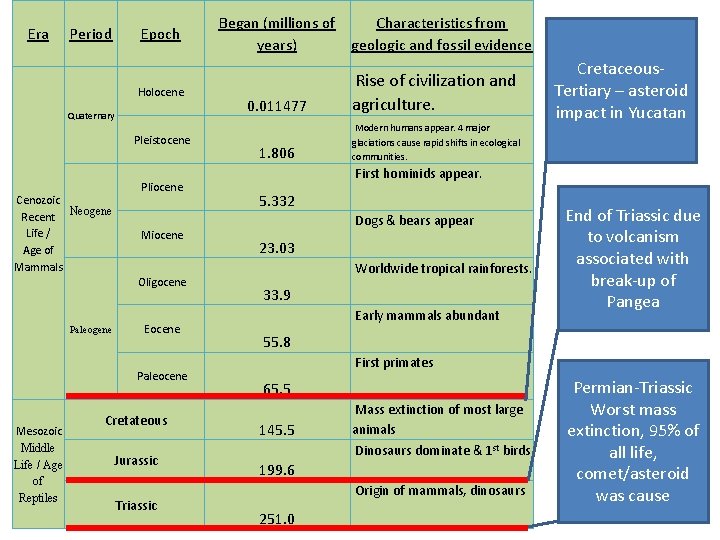
Era Period Epoch Holocene Quaternary Pleistocene Cenozoic Neogene Recent Life / Age of Mammals Pliocene Miocene Oligocene Paleogene Eocene Paleocene Mesozoic Middle Life / Age of Reptiles Cretateous Jurassic Triassic Began (millions of years) Characteristics from geologic and fossil evidence Blank Time Scaleand Rise of civilization 0. 011477 agriculture. Modern humans appear. 4 major 1. 806 glaciations cause rapid shifts in ecological communities. First hominids appear. 5. 332 Dogs & bears appear 23. 03 Worldwide tropical rainforests. 33. 9 Early mammals abundant 55. 8 First primates 65. 5 145. 5 Mass extinction of most large animals Dinosaurs dominate & 1 st birds 199. 6 Origin of mammals, dinosaurs 251. 0 Connecticut Valley Geological Events
Era Period Permian Pennsylvanian Mississipian Paleozoic Ancient Life Devonian Silurian Ordovician Cambrian Began (millions of years) Characteristics from geologic and fossil evidence Time Scale Continued 299. 0 Major extinction of 95% of marine species First reptiles & extensive c. s. f. 318. 1 First coal swamp forests 359. 2 First amphibians. 416. 0 large reefs appear 443. 7 First land plants Late Devonian extinction – cause unknown , warm species most impact 488. 3 542. 0 4568 Source: endangeredspeciesinternational. org Trilobites dominant, First fish, NO LAND animals O 2 rises due to photosynthetic organisms Earliest Life 3. 5 BYA Ordovician. Silurian extinction Sea level drop followed by sea level rise 25% marine life
Era Period Epoch Holocene Quaternary Pleistocene Cenozoic Recent Neogene Life / Age of Mammals Pliocene Miocene Oligocene Paleogene Eocene Paleocene Mesozoic Middle Life / Age of Reptiles Cretateous Jurassic Triassic Began (millions of years) Characteristics from geologic and fossil evidence Blank Time Scaleand Rise of civilization 0. 011477 agriculture. Modern humans appear. 4 major 1. 806 Cretaceous. Tertiary – asteroid impact in Yucatan glaciations cause rapid shifts in ecological communities. First hominids appear. 5. 332 Dogs & bears appear 23. 03 Worldwide tropical rainforests. 33. 9 Early mammals abundant End of Triassic due to volcanism associated with break-up of Pangea 55. 8 First primates 65. 5 145. 5 Mass extinction of most large animals Dinosaurs dominate & 1 st birds 199. 6 Origin of mammals, dinosaurs 251. 0 Permian-Triassic Worst mass extinction, 95% of all life, comet/asteroid was cause
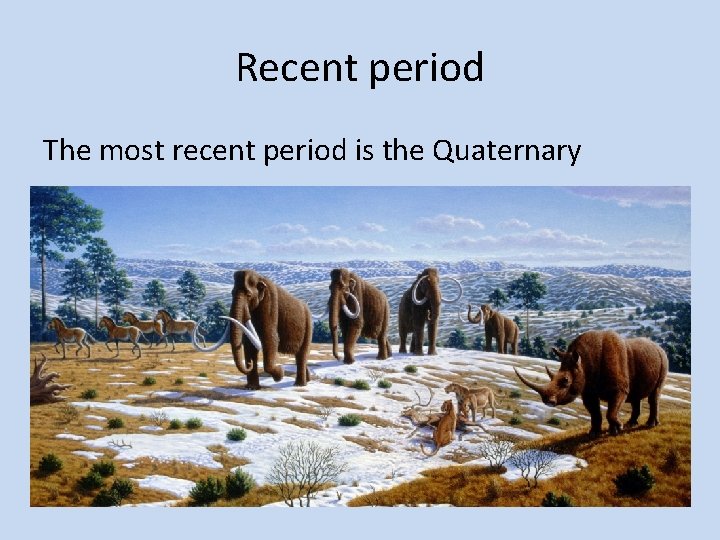
Recent period The most recent period is the Quaternary
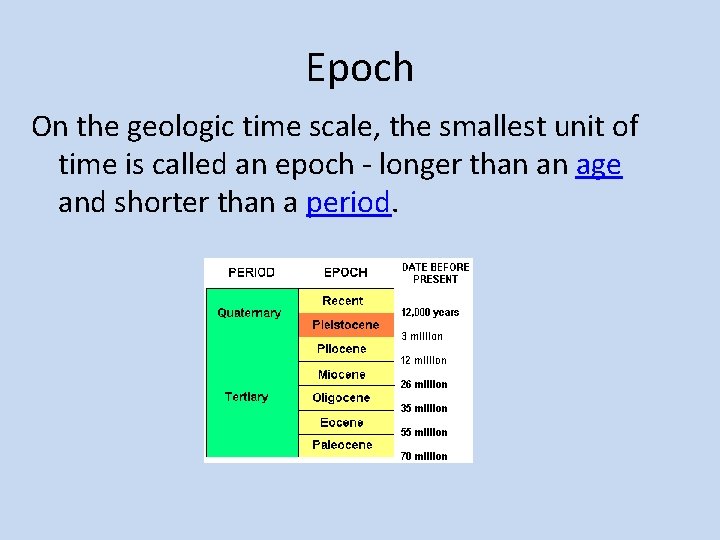
Epoch On the geologic time scale, the smallest unit of time is called an epoch - longer than an age and shorter than a period.
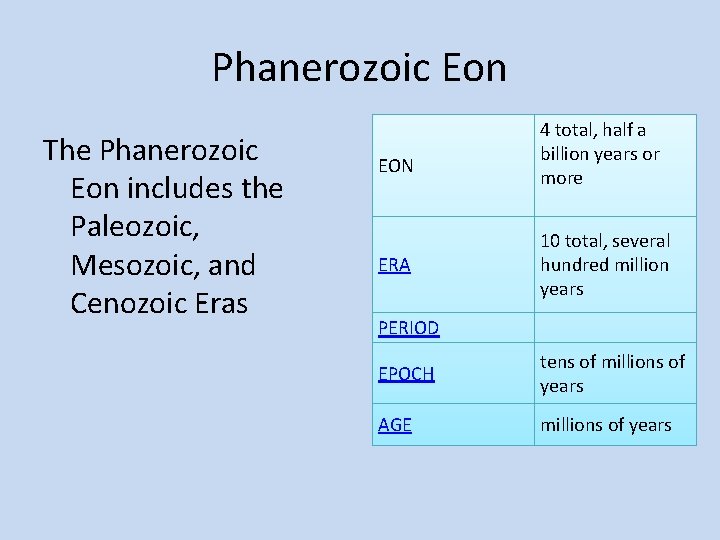
Phanerozoic Eon The Phanerozoic Eon includes the Paleozoic, Mesozoic, and Cenozoic Eras EON ERA 4 total, half a billion years or more 10 total, several hundred million years PERIOD EPOCH tens of millions of years AGE millions of years
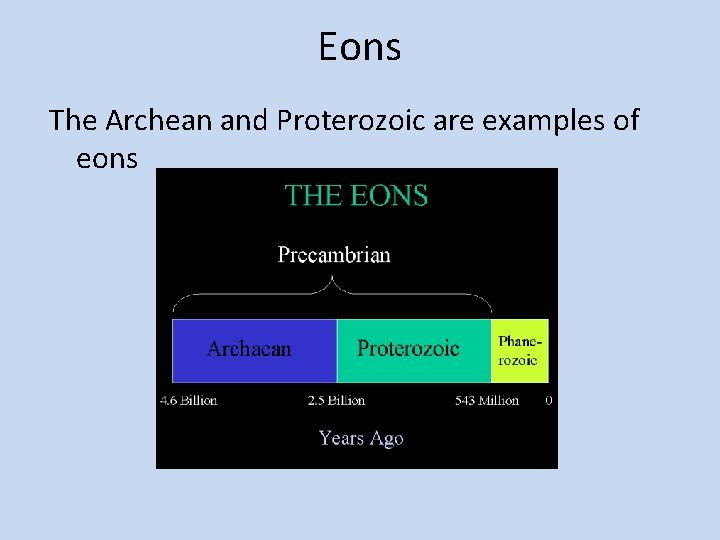
Eons The Archean and Proterozoic are examples of eons
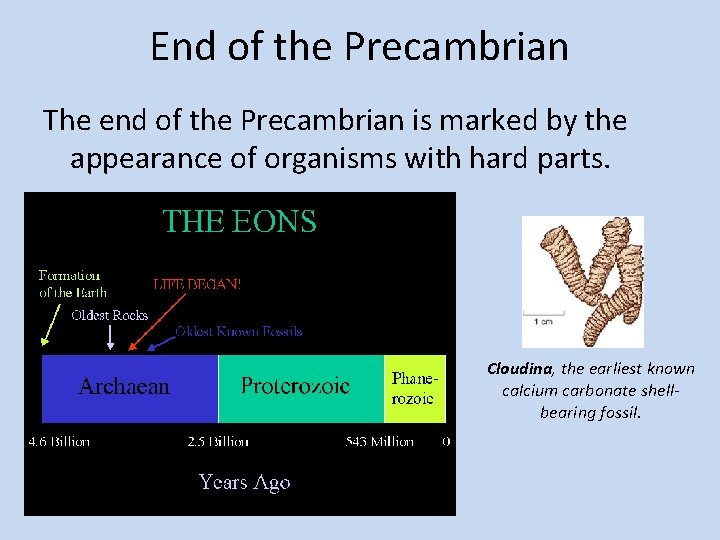
End of the Precambrian The end of the Precambrian is marked by the appearance of organisms with hard parts. Cloudina, the earliest known calcium carbonate shellbearing fossil.
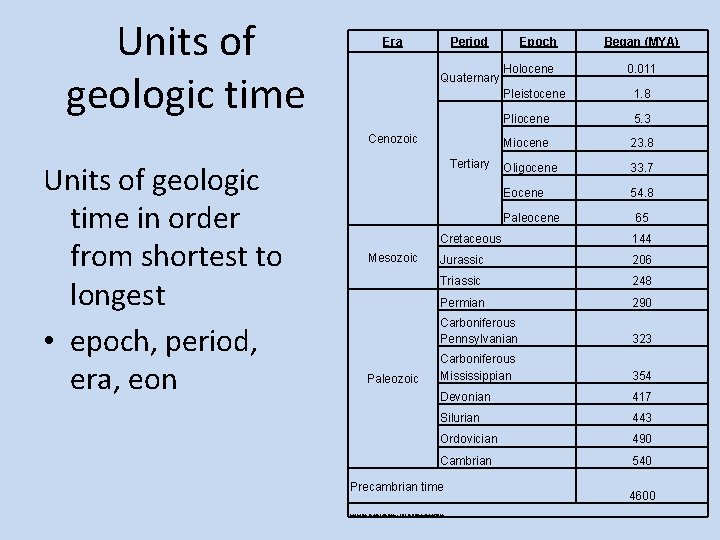
Units of geologic time Era Period Quaternary Cenozoic Units of geologic time in order from shortest to longest • epoch, period, era, eon Tertiary Epoch Holocene Paleozoic 0. 011 Pleistocene 1. 8 Pliocene 5. 3 Miocene 23. 8 Oligocene 33. 7 Eocene 54. 8 Paleocene Mesozoic Began (MYA) 65 Cretaceous 144 Jurassic 206 Triassic 248 Permian 290 Carboniferous Pennsylvanian 323 Carboniferous Mississippian 354 Devonian 417 Silurian 443 Ordovician 490 Cambrian 540 Precambrian time Adapted from Modern Earth Science, 2002, Holt, Rinehart and Winston 4600
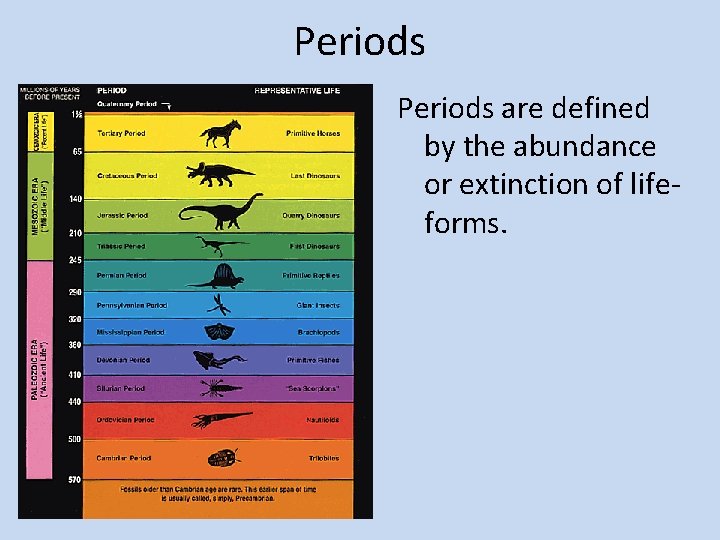
Periods are defined by the abundance or extinction of lifeforms.
Eras vs. Periods Both are units of time on the geologic time scale. Eras Periods are longer spans of time, measured in hundreds of millions to billions of years. They are defined by differences in lifeforms found in rocks. are usually measured in terms of tens of millions of years to hundreds of millions of years. They are defined by the life-forms that were abundant or became extinct during the time in which specific rocks were deposited.
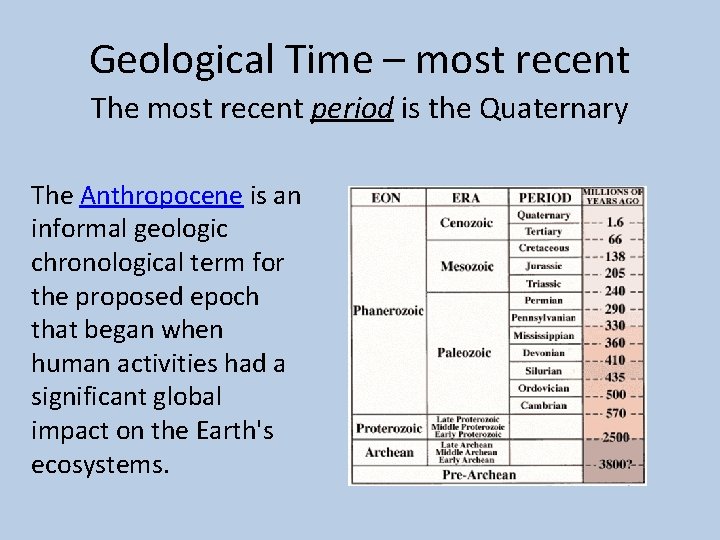
Geological Time – most recent The most recent period is the Quaternary The Anthropocene is an informal geologic chronological term for the proposed epoch that began when human activities had a significant global impact on the Earth's ecosystems.
Break + Quiz
Part 2 Objectives • Apply the principles for determining relative age to interpret rock sequences. • Describe an unconformity and how it formed within the rock record.
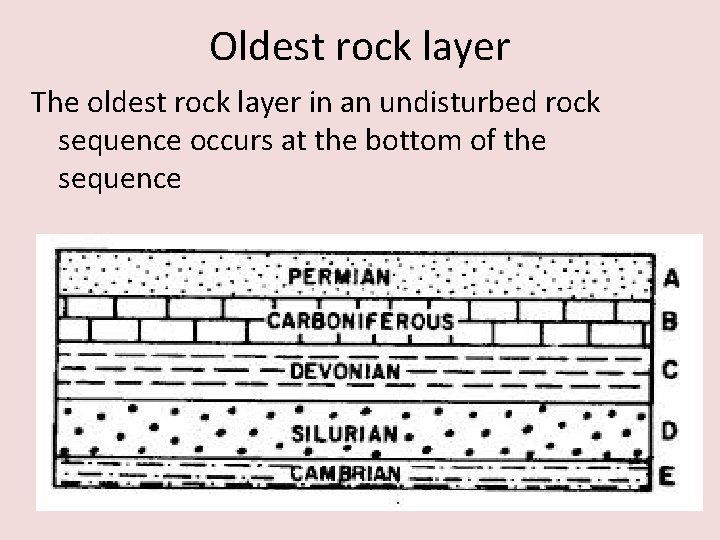
Oldest rock layer The oldest rock layer in an undisturbed rock sequence occurs at the bottom of the sequence
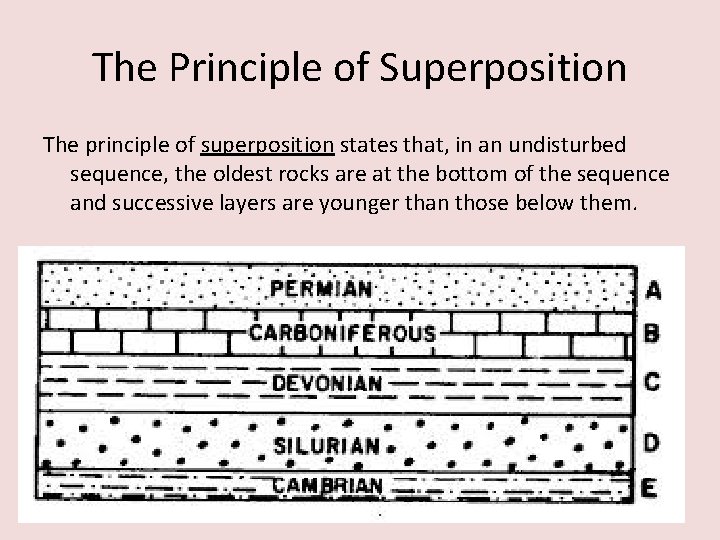
The Principle of Superposition The principle of superposition states that, in an undisturbed sequence, the oldest rocks are at the bottom of the sequence and successive layers are younger than those below them.
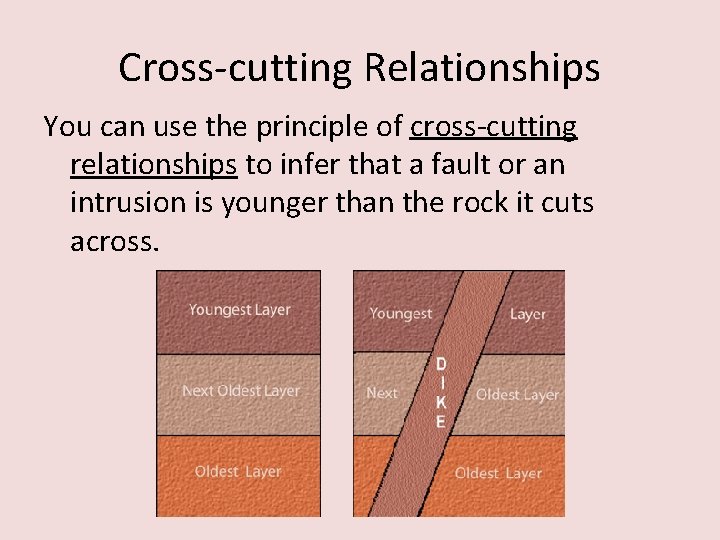
Cross-cutting Relationships You can use the principle of cross-cutting relationships to infer that a fault or an intrusion is younger than the rock it cuts across.
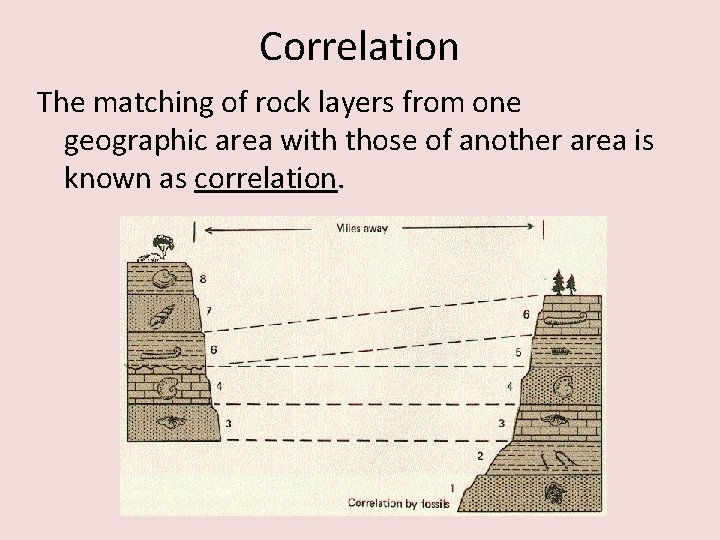
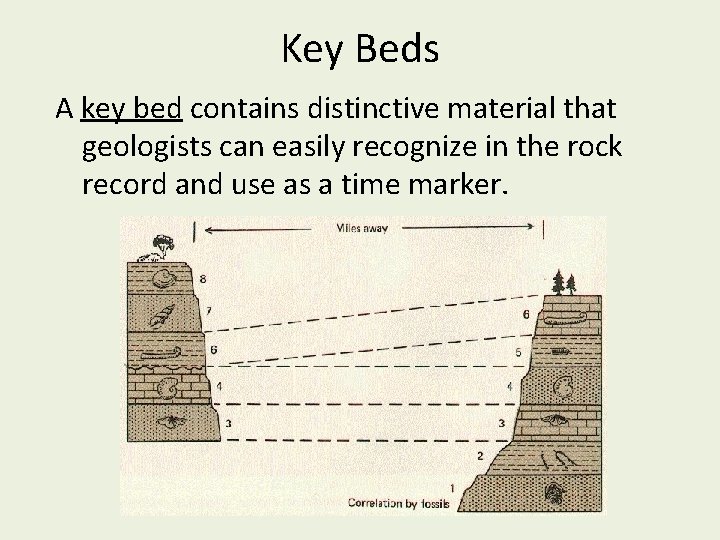
Correlation The matching of rock layers from one geographic area with those of another area is known as correlation.
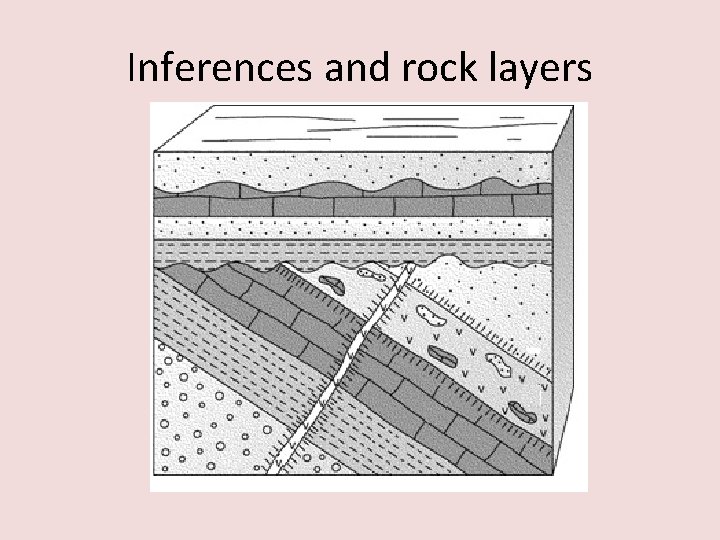
Inferences and rock layers
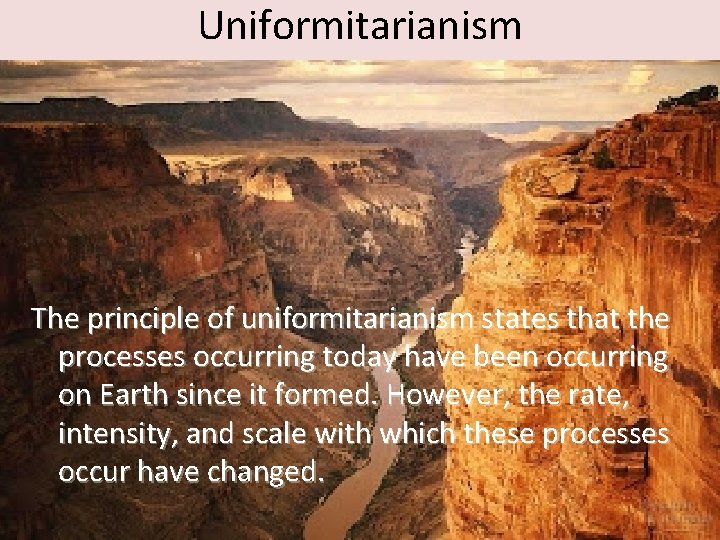
Uniformitarianism The principle of uniformitarianism states that the processes occurring today have been occurring on Earth since it formed. However, the rate, intensity, and scale with which these processes occur have changed.
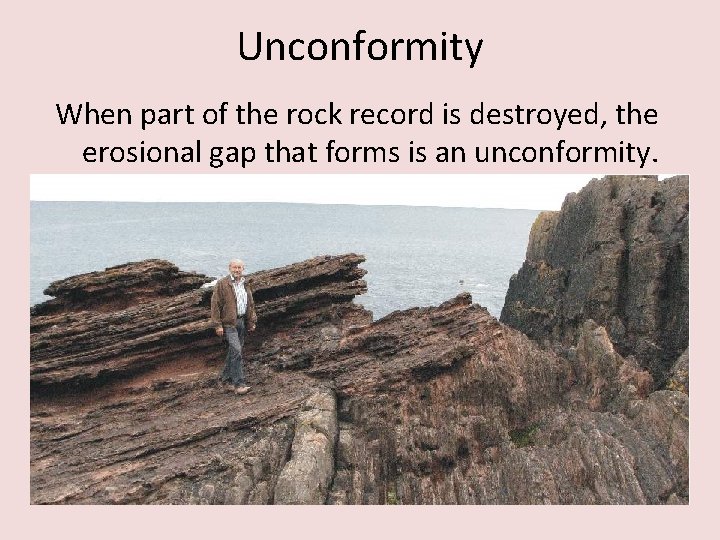
Unconformity When part of the rock record is destroyed, the erosional gap that forms is an unconformity.
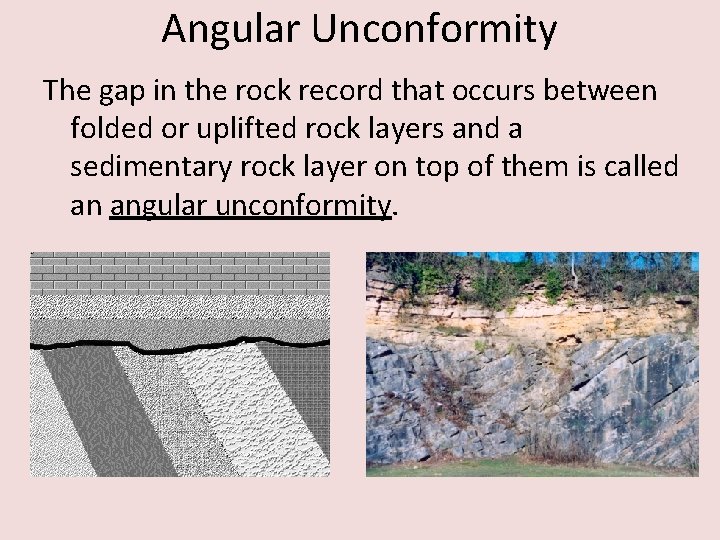
Angular Unconformity The gap in the rock record that occurs between folded or uplifted rock layers and a sedimentary rock layer on top of them is called an angular unconformity.
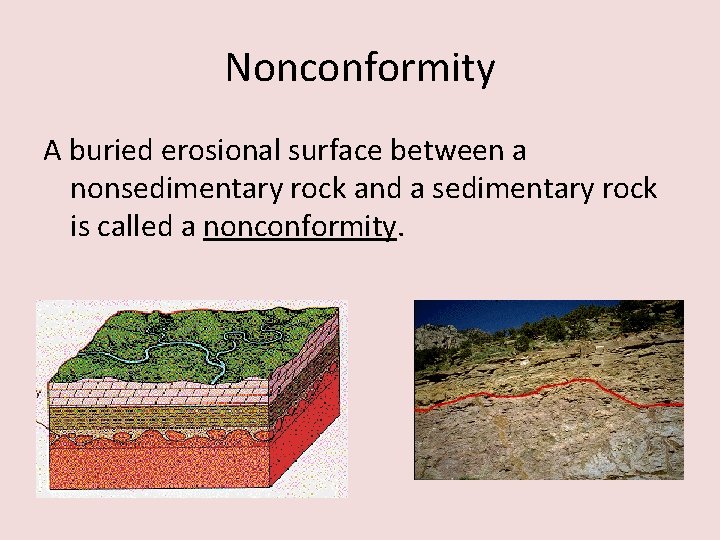
Nonconformity A buried erosional surface between a nonsedimentary rock and a sedimentary rock is called a nonconformity.
Part 3 Objectives - Dating • Explain the several different methods used by scientists to determine absolute age. • Describe how objects are dated by the use of certain radioactive elements. • Explain how annual tree rings and glacial varves are used to date geological events.
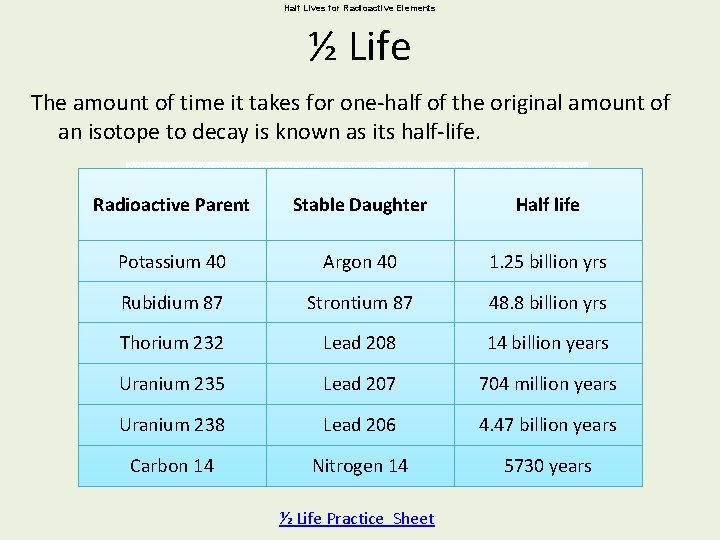
Half Lives for Radioactive Elements ½ Life The amount of time it takes for one-half of the original amount of an isotope to decay is known as its half-life. Radioactive Parent Stable Daughter Half life Potassium 40 Argon 40 1. 25 billion yrs Rubidium 87 Strontium 87 48. 8 billion yrs Thorium 232 Lead 208 14 billion years Uranium 235 Lead 207 704 million years Uranium 238 Lead 206 4. 47 billion years Carbon 14 Nitrogen 14 5730 years ½ Life Practice Sheet
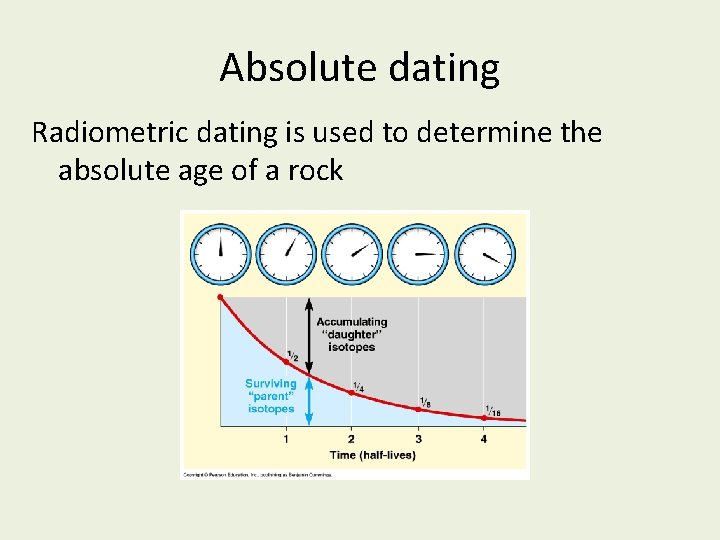
Absolute dating Radiometric dating is used to determine the absolute age of a rock
Key Beds A key bed contains distinctive material that geologists can easily recognize in the rock record and use as a time marker.
Contrast relative-age dating and absolute-age dating. Relative-age dating Absolute-age dating Relative-age dating places the ages of rocks and the events that formed them in order, without exact dates. This is done by comparing one event with another or one rock with another rock. In contrast, absolute-age dating determines the actual age of a rock, a fossil, or an object. This is done through radiometric dating, a process that determines the ratio of parent material to daughter product in a given sample of rock or fossil.
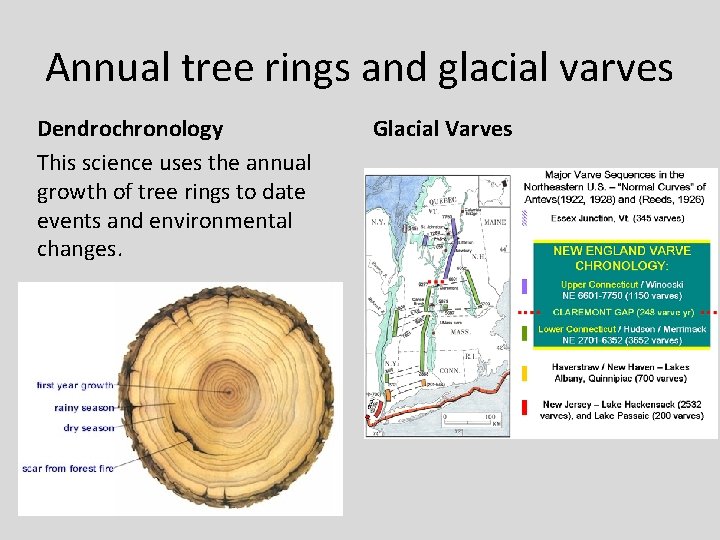
Annual tree rings and glacial varves Dendrochronology This science uses the annual growth of tree rings to date events and environmental changes. Glacial Varves
Part 4 Objectives • Define fossil. • Explain several methods by which fossils can be preserved. • Describe the characteristics of an index fossil. • Discuss how fossils can be used to interpret Earth’s past physical and environmental history.
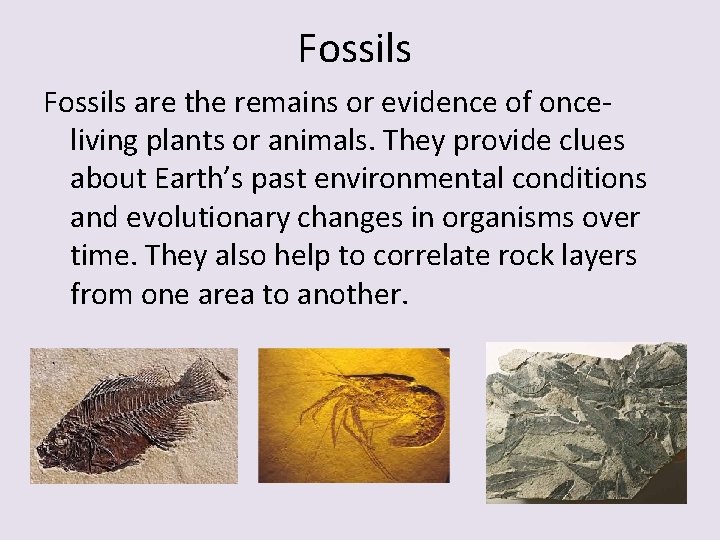
Fossils are the remains or evidence of onceliving plants or animals. They provide clues about Earth’s past environmental conditions and evolutionary changes in organisms over time. They also help to correlate rock layers from one area to another.
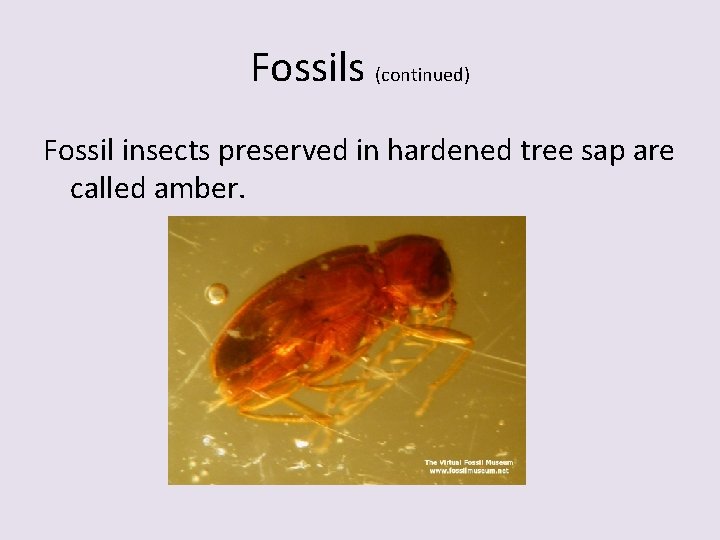
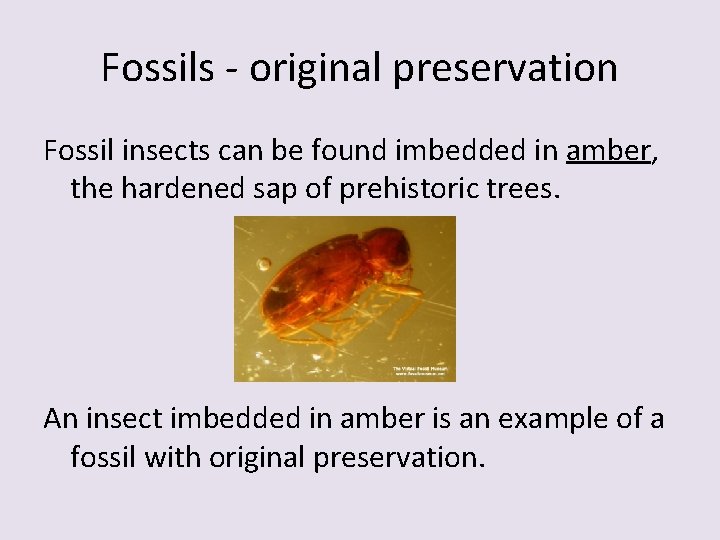
Fossils (continued) Fossil insects preserved in hardened tree sap are called amber.
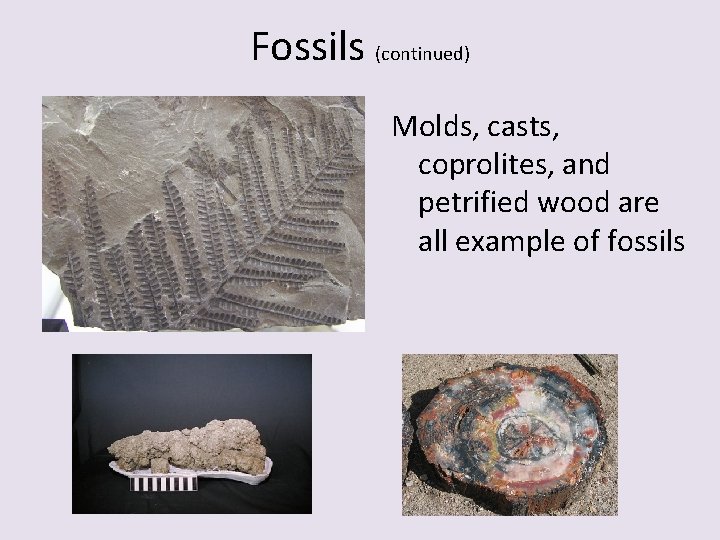
Fossils (continued) Molds, casts, coprolites, and petrified wood are all example of fossils
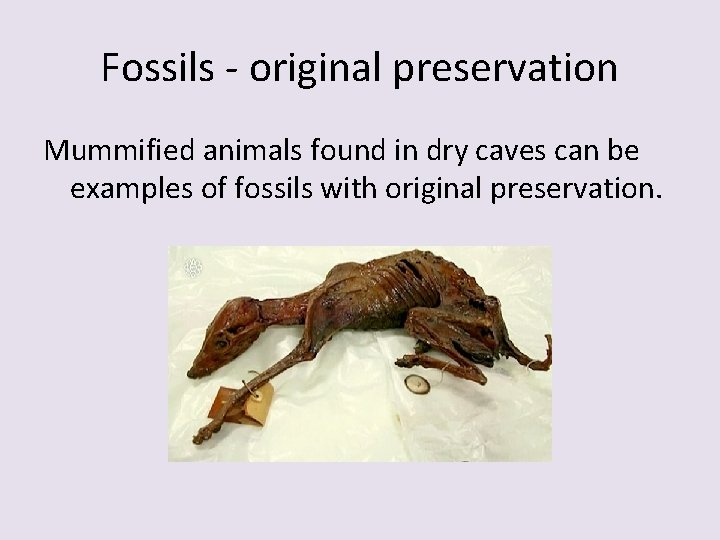
Fossils - original preservation Mummified animals found in dry caves can be examples of fossils with original preservation.
Fossils - original preservation Fossil insects can be found imbedded in amber, the hardened sap of prehistoric trees. An insect imbedded in amber is an example of a fossil with original preservation.
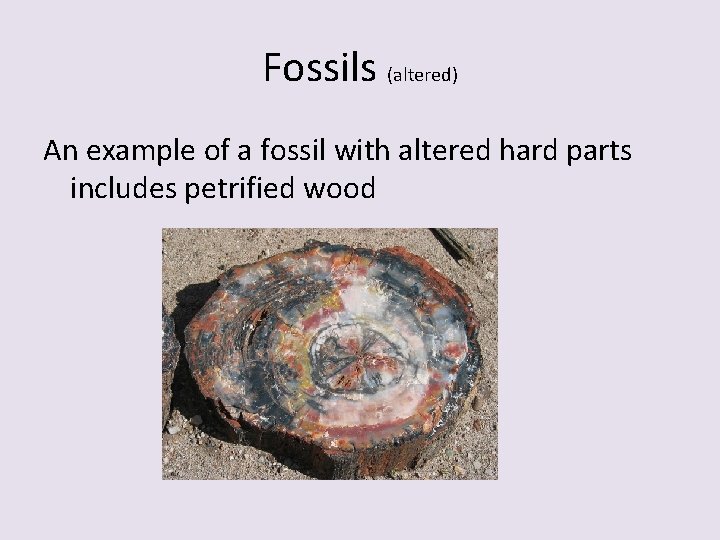
Fossils (altered) An example of a fossil with altered hard parts includes petrified wood
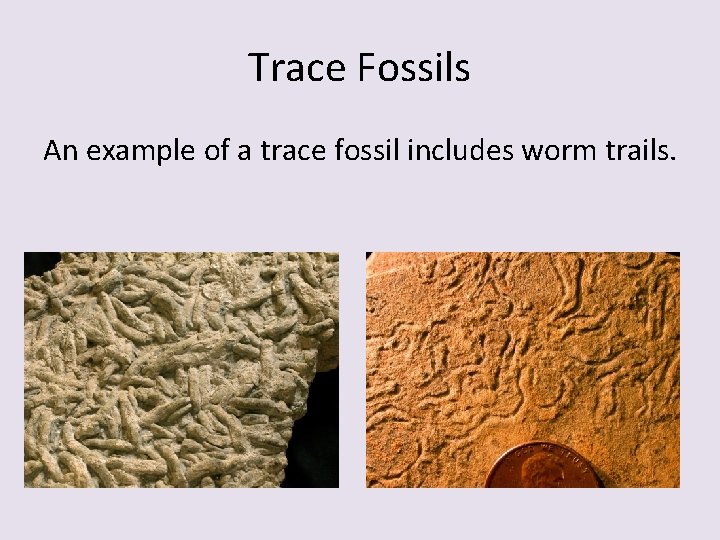
Trace Fossils An example of a trace fossil includes worm trails.
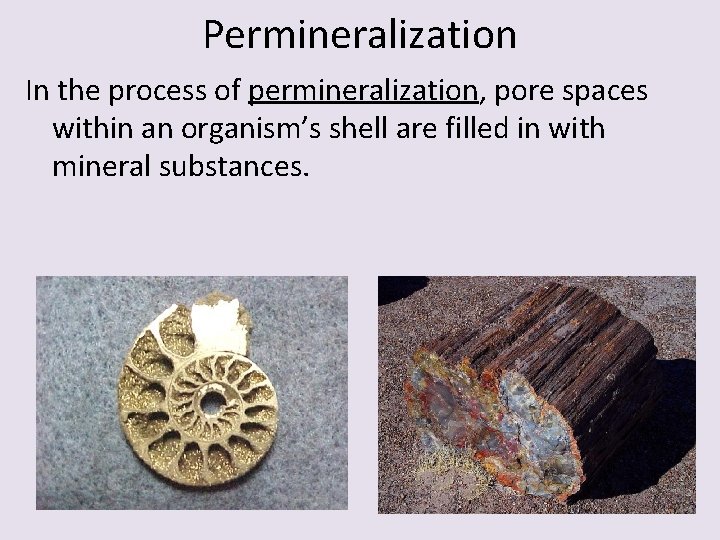
Permineralization In the process of permineralization, pore spaces within an organism’s shell are filled in with mineral substances.
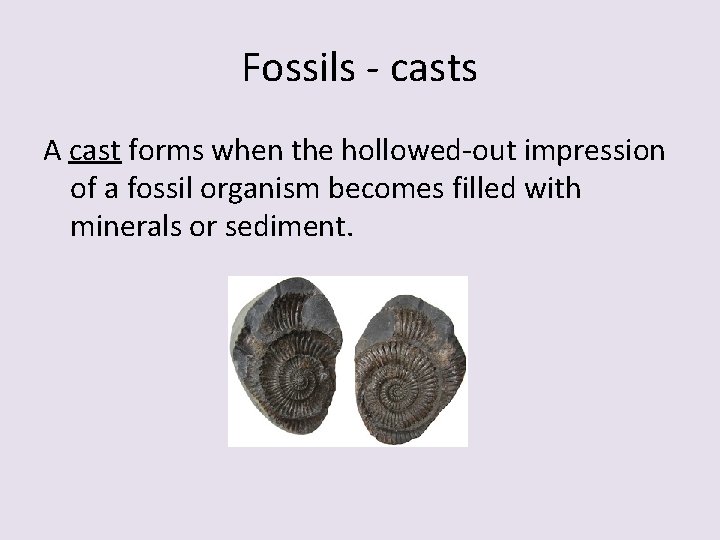
Fossils - casts A cast forms when the hollowed-out impression of a fossil organism becomes filled with minerals or sediment.
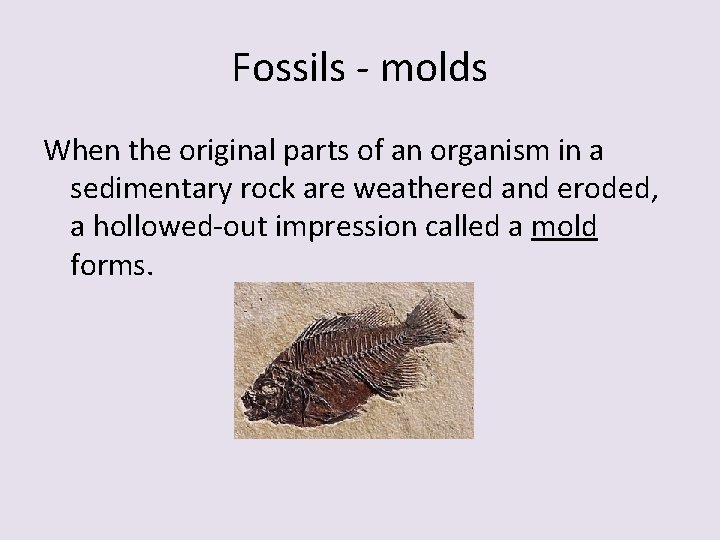
Fossils - molds When the original parts of an organism in a sedimentary rock are weathered and eroded, a hollowed-out impression called a mold forms.
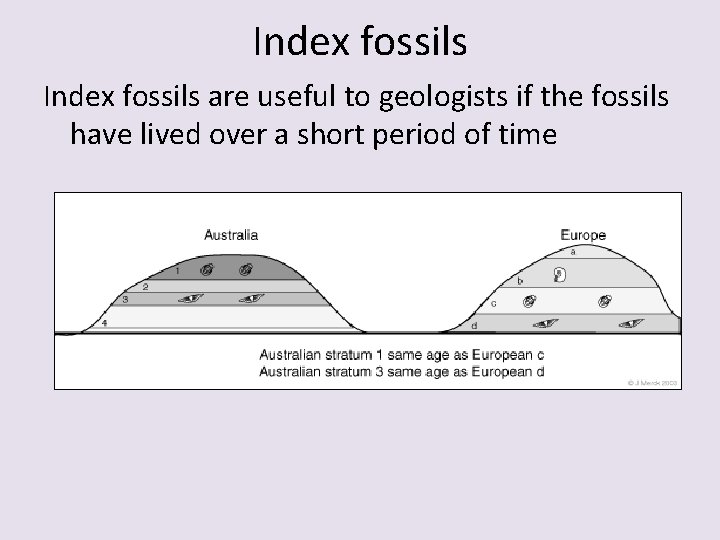
Index fossils are useful to geologists if the fossils have lived over a short period of time
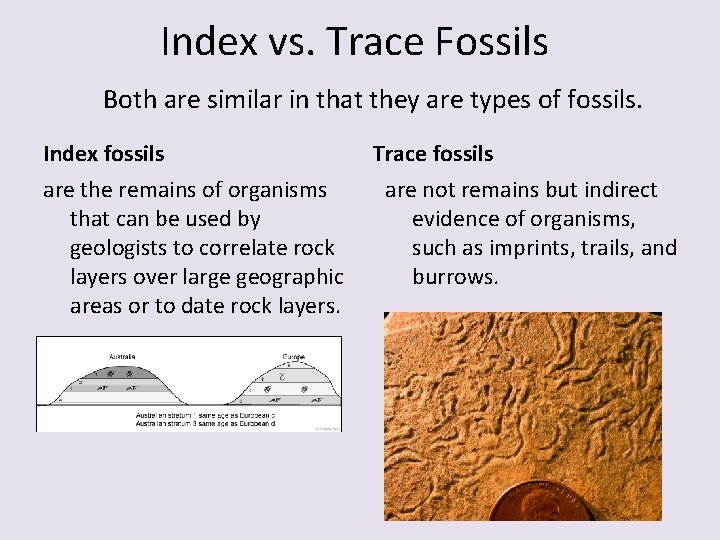
Index vs. Trace Fossils Both are similar in that they are types of fossils. Index fossils are the remains of organisms that can be used by geologists to correlate rock layers over large geographic areas or to date rock layers. Trace fossils are not remains but indirect evidence of organisms, such as imprints, trails, and burrows.
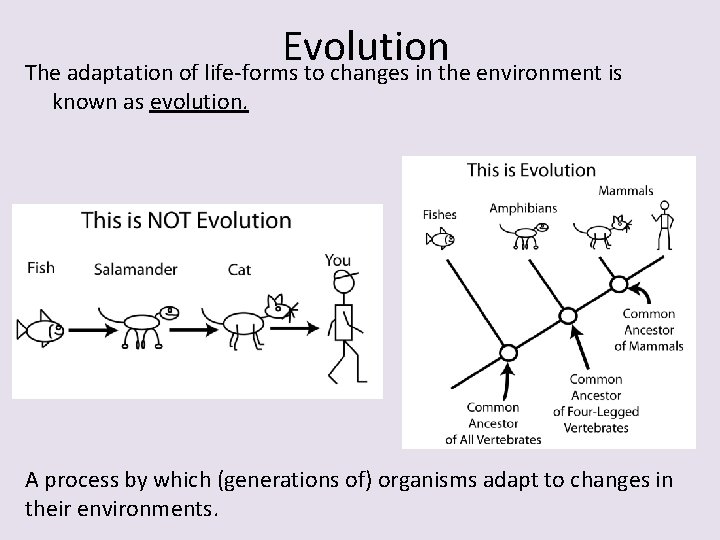
Evolution The adaptation of life-forms to changes in the environment is known as evolution. A process by which (generations of) organisms adapt to changes in their environments.