
28 December 2021 Scatter diagrams and line of
28 December 2021 Scatter diagrams and line of best fit, by eye. LO: To draw scatter diagrams and the line of best fit by eye. www. mathssupport. org
Scatter graphs and correlation Scatter graphs (scatter plots) are used to investigate the possible relationship between two variables that both relate to the same ‘event’. The relationship between two variables is called correlation. For example, Do tall people weigh more than short people? If there is more rain, will it be colder? If you revise longer, will you get better marks? Do second-hand car get cheaper with age? Is more electricity used in cold weather? www. mathssupport. org
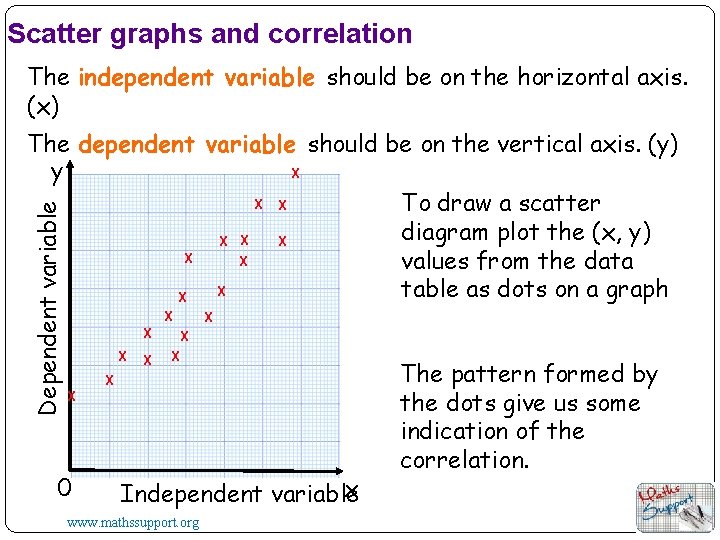
Scatter graphs and correlation The independent variable should be on the horizontal axis. (x) Dependent variable The dependent variable should be on the vertical axis. (y) X y X X To draw a scatter diagram plot the (x, y) X X X values from the data X table as dots on a graph X X X X X 0 x Independent variable www. mathssupport. org The pattern formed by the dots give us some indication of the correlation.
Correlation. Refers to the relationship or association between two variables There are several characteristics we consider when describing the correlation between two variables: Direction. Linearity. Strength www. mathssupport. org
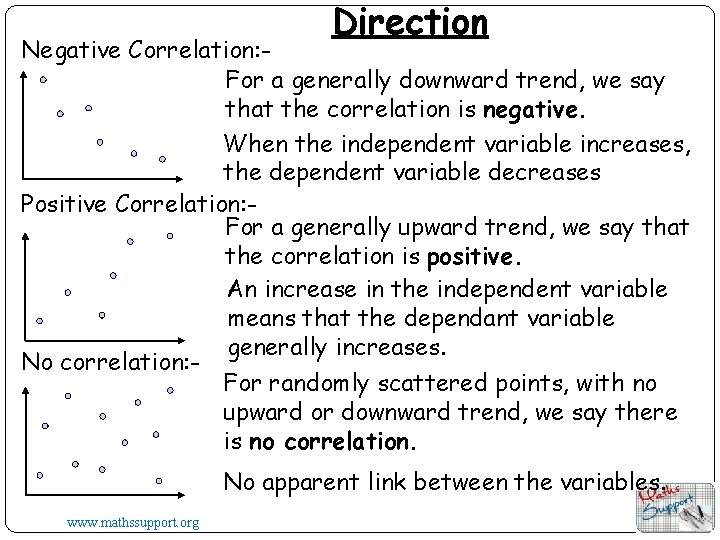
Direction Negative Correlation: For a generally downward trend, we say that the correlation is negative. When the independent variable increases, the dependent variable decreases Positive Correlation: For a generally upward trend, we say that the correlation is positive. An increase in the independent variable means that the dependant variable generally increases. No correlation: For randomly scattered points, with no upward or downward trend, we say there is no correlation. No apparent link between the variables. www. mathssupport. org
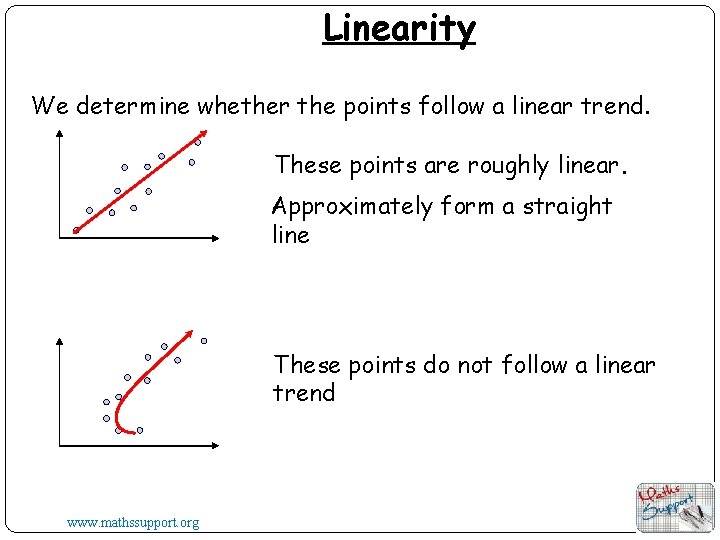
Linearity We determine whether the points follow a linear trend. These points are roughly linear. Approximately form a straight line These points do not follow a linear trend www. mathssupport. org
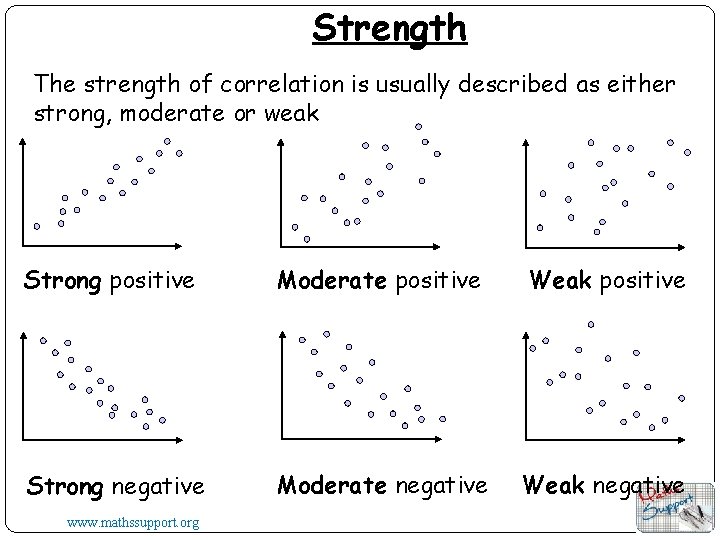
Strength The strength of correlation is usually described as either strong, moderate or weak Strong positive Moderate positive Weak positive Strong negative Moderate negative Weak negative www. mathssupport. org
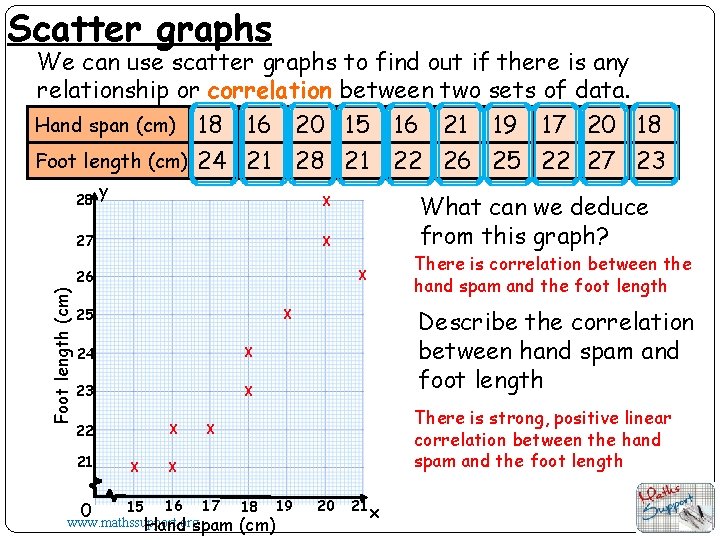
Scatter graphs We can use scatter graphs to find out if there is any relationship or correlation between two sets of data. Hand span (cm) 18 16 20 15 16 21 19 17 20 18 Foot length (cm) 28 24 21 28 21 22 26 25 22 27 23 y 27 X Foot length (cm) 26 X 25 X 23 X 22 X X There is strong, positive linear correlation between the hand spam and the foot length X X 16 17 18 19 15 www. mathssupport. org Hand spam (cm) 0 There is correlation between the hand spam and the foot length Describe the correlation between hand spam and foot length X 24 21 What can we deduce from this graph? X 20 21 x
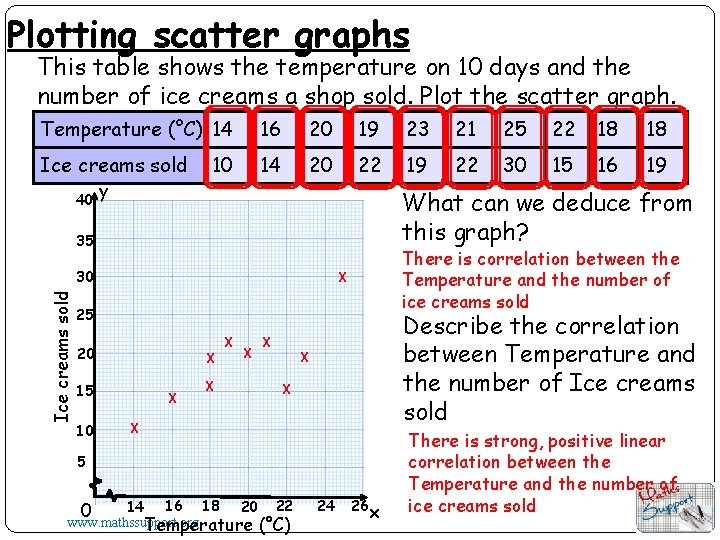
Plotting scatter graphs This table shows the temperature on 10 days and the number of ice creams a shop sold. Plot the scatter graph. Temperature (°C) 14 16 20 19 23 21 25 22 18 18 Ice creams sold 14 20 22 19 22 30 15 16 19 40 y 10 What can we deduce from this graph? 35 Ice creams sold 30 There is correlation between the Temperature and the number of ice creams sold X 25 X 20 X 15 10 X X Describe the correlation between Temperature and the number of Ice creams sold X X X 5 16 18 20 22 14 www. mathssupport. org Temperature (°C) 0 24 26 x There is strong, positive linear correlation between the Temperature and the number of ice creams sold
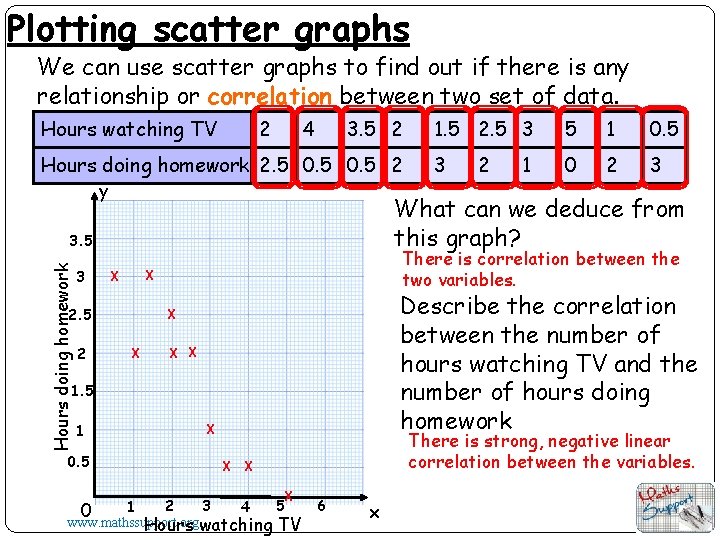
Plotting scatter graphs We can use scatter graphs to find out if there is any relationship or correlation between two set of data. Hours watching TV 2 4 3. 5 2 Hours doing homework 2. 5 0. 5 2 y Hours doing homework 0. 5 3 0 2 3 2 1 Describe the correlation between the number of hours watching TV and the number of hours doing homework X X 1. 5 1 1 There is correlation between the two variables. X X 2. 5 2 5 What can we deduce from this graph? 3. 5 3 1. 5 2. 5 3 X There is strong, negative linear correlation between the variables. X X X 2 3 5 4 1 0 www. mathssupport. org Hours watching TV 6 x
Line of best fit A line of best fit (trend line) is drawn on a scatter diagram to find the direction of an association between two variables and to show the trend. The line of best fit can then be used to make predictions. To draw the line of best fit by eye: Calculate the mean point, finding the mean of the x-values and the mean of the y-values Draw a line that will balance the number of points above the line and the number of points bellow the line The line must pass through the mean point www. mathssupport. org
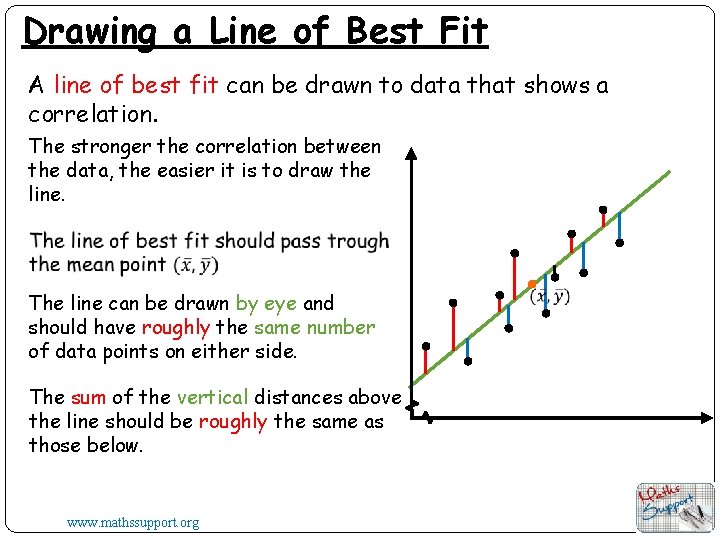
Drawing a Line of Best Fit A line of best fit can be drawn to data that shows a correlation. The stronger the correlation between the data, the easier it is to draw the line. The line can be drawn by eye and should have roughly the same number of data points on either side. The sum of the vertical distances above the line should be roughly the same as those below. www. mathssupport. org
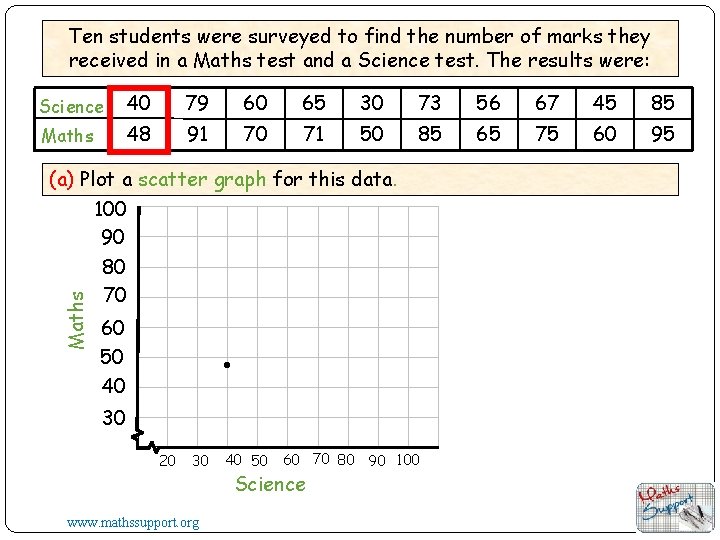
Ten students were surveyed to find the number of marks they received in a Maths test and a Science test. The results were: Science 40 79 60 65 30 73 56 67 45 85 Maths 48 91 70 71 50 85 65 75 60 95 Maths (a) Plot a scatter graph for this data. 100 90 80 70 60 50 40 30 20 30 www. mathssupport. org 40 50 60 70 80 90 100 Science
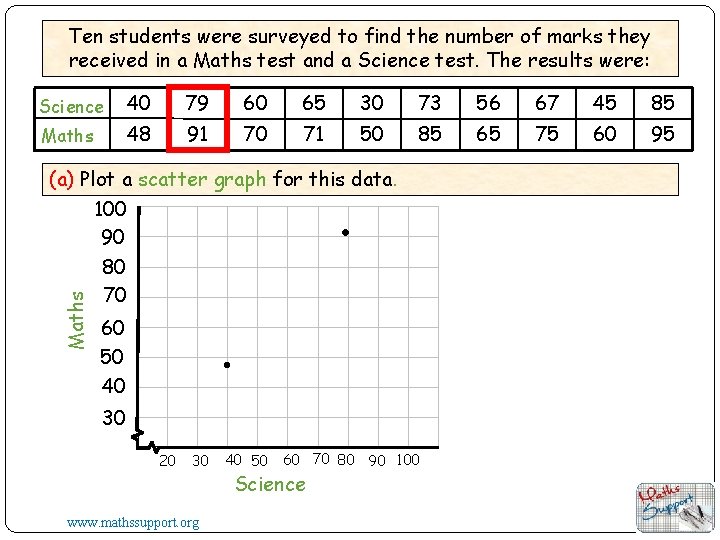
Ten students were surveyed to find the number of marks they received in a Maths test and a Science test. The results were: Science 40 79 60 65 30 73 56 67 45 85 Maths 48 91 70 71 50 85 65 75 60 95 Maths (a) Plot a scatter graph for this data. 100 90 80 70 60 50 40 30 20 30 www. mathssupport. org 40 50 60 70 80 90 100 Science
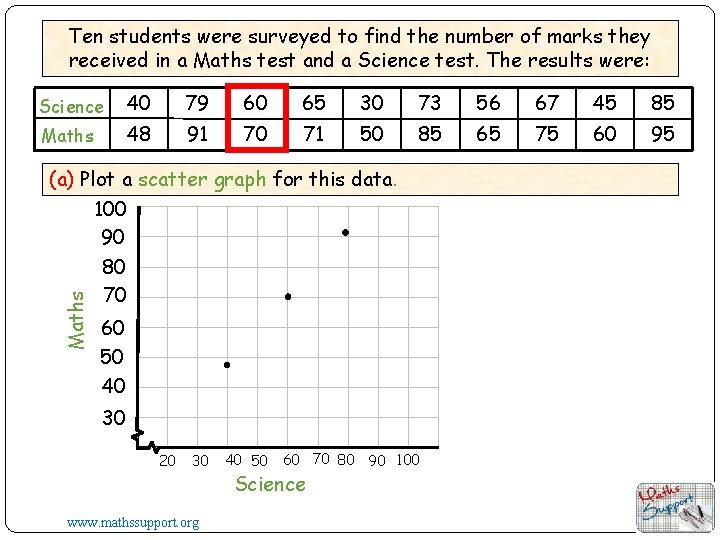
Ten students were surveyed to find the number of marks they received in a Maths test and a Science test. The results were: Science 40 79 60 65 30 73 56 67 45 85 Maths 48 91 70 71 50 85 65 75 60 95 Maths (a) Plot a scatter graph for this data. 100 90 80 70 60 50 40 30 20 30 www. mathssupport. org 40 50 60 70 80 90 100 Science
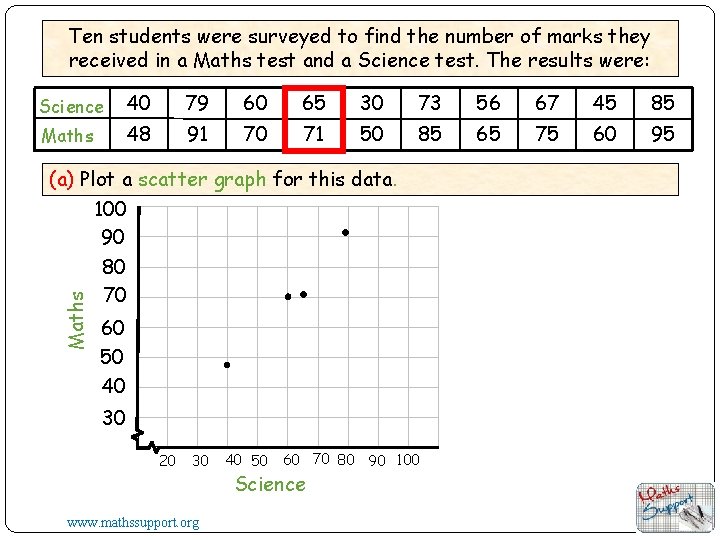
Ten students were surveyed to find the number of marks they received in a Maths test and a Science test. The results were: Science 40 79 60 65 30 73 56 67 45 85 Maths 48 91 70 71 50 85 65 75 60 95 Maths (a) Plot a scatter graph for this data. 100 90 80 70 60 50 40 30 20 30 www. mathssupport. org 40 50 60 70 80 90 100 Science
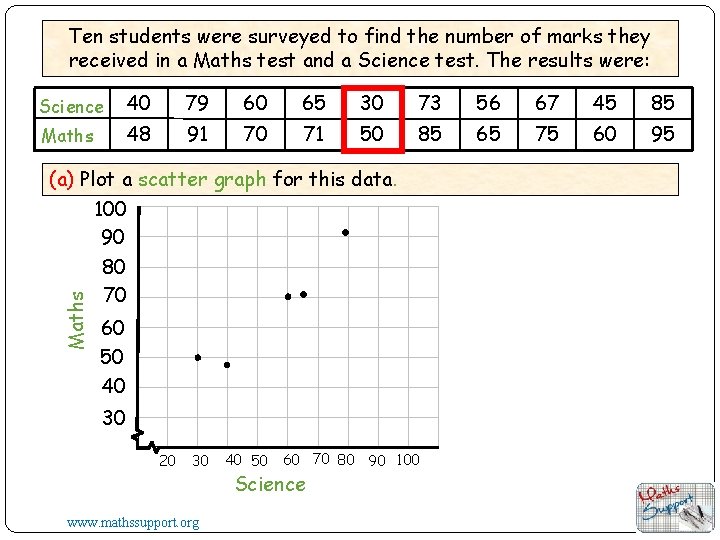
Ten students were surveyed to find the number of marks they received in a Maths test and a Science test. The results were: Science 40 79 60 65 30 73 56 67 45 85 Maths 48 91 70 71 50 85 65 75 60 95 Maths (a) Plot a scatter graph for this data. 100 90 80 70 60 50 40 30 20 30 www. mathssupport. org 40 50 60 70 80 90 100 Science
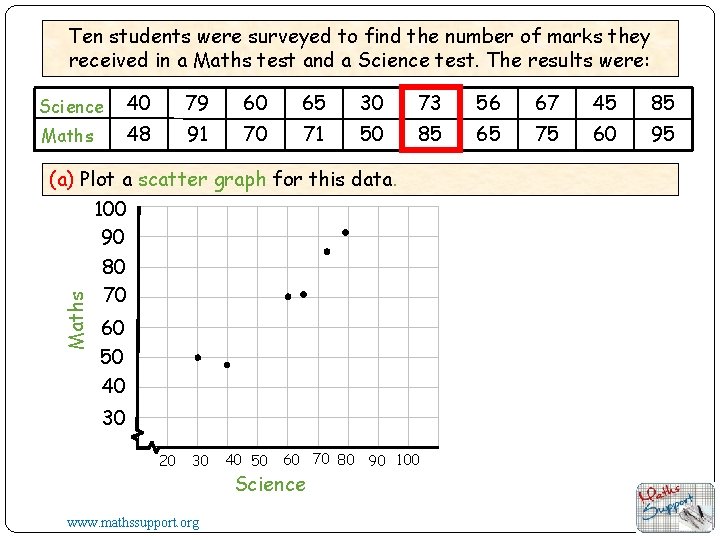
Ten students were surveyed to find the number of marks they received in a Maths test and a Science test. The results were: Science 40 79 60 65 30 73 56 67 45 85 Maths 48 91 70 71 50 85 65 75 60 95 Maths (a) Plot a scatter graph for this data. 100 90 80 70 60 50 40 30 20 30 www. mathssupport. org 40 50 60 70 80 90 100 Science
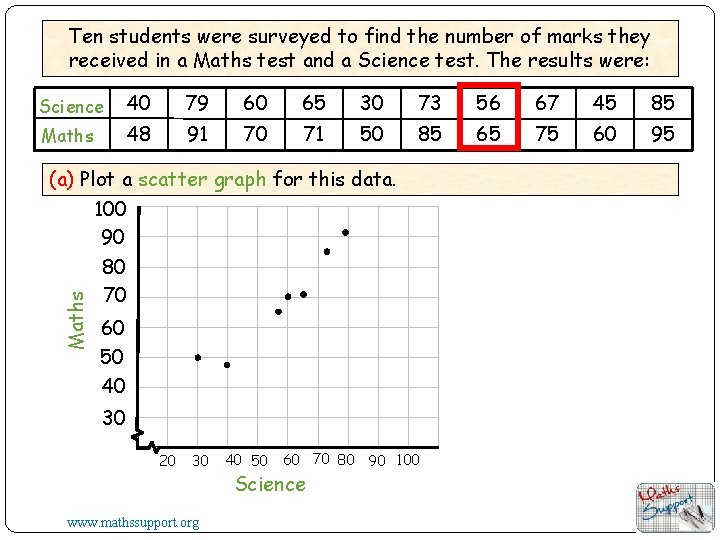
Ten students were surveyed to find the number of marks they received in a Maths test and a Science test. The results were: Science 40 79 60 65 30 73 56 67 45 85 Maths 48 91 70 71 50 85 65 75 60 95 Maths (a) Plot a scatter graph for this data. 100 90 80 70 60 50 40 30 20 30 www. mathssupport. org 40 50 60 70 80 90 100 Science
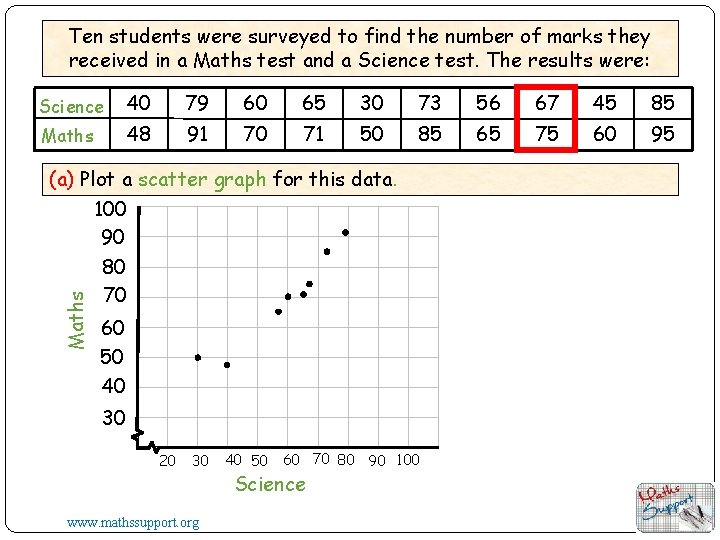
Ten students were surveyed to find the number of marks they received in a Maths test and a Science test. The results were: Science 40 79 60 65 30 73 56 67 45 85 Maths 48 91 70 71 50 85 65 75 60 95 Maths (a) Plot a scatter graph for this data. 100 90 80 70 60 50 40 30 20 30 www. mathssupport. org 40 50 60 70 80 90 100 Science
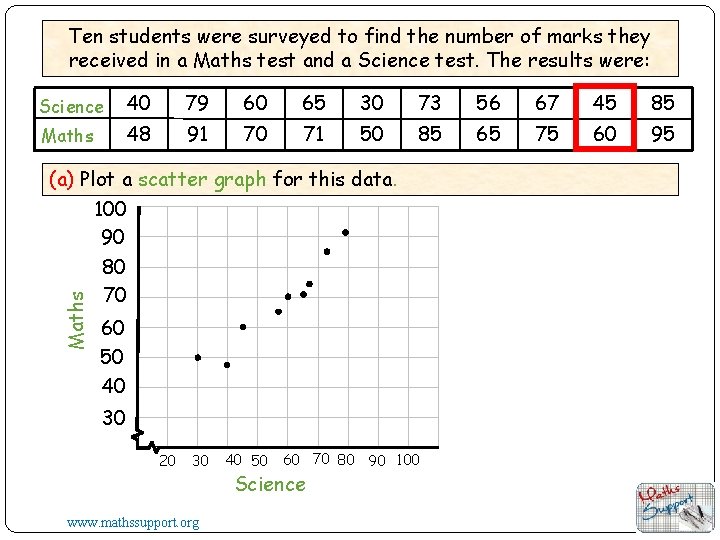
Ten students were surveyed to find the number of marks they received in a Maths test and a Science test. The results were: Science 40 79 60 65 30 73 56 67 45 85 Maths 48 91 70 71 50 85 65 75 60 95 Maths (a) Plot a scatter graph for this data. 100 90 80 70 60 50 40 30 20 30 www. mathssupport. org 40 50 60 70 80 90 100 Science
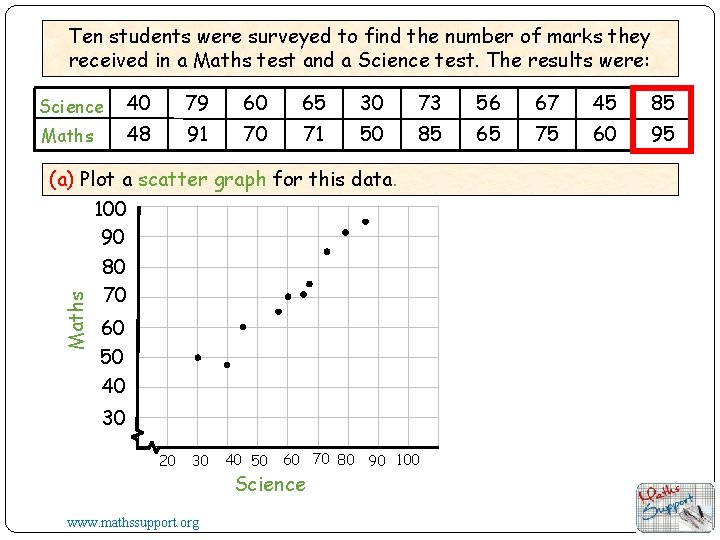
Ten students were surveyed to find the number of marks they received in a Maths test and a Science test. The results were: Science 40 79 60 65 30 73 56 67 45 85 Maths 48 91 70 71 50 85 65 75 60 95 Maths (a) Plot a scatter graph for this data. 100 90 80 70 60 50 40 30 20 30 www. mathssupport. org 40 50 60 70 80 90 100 Science
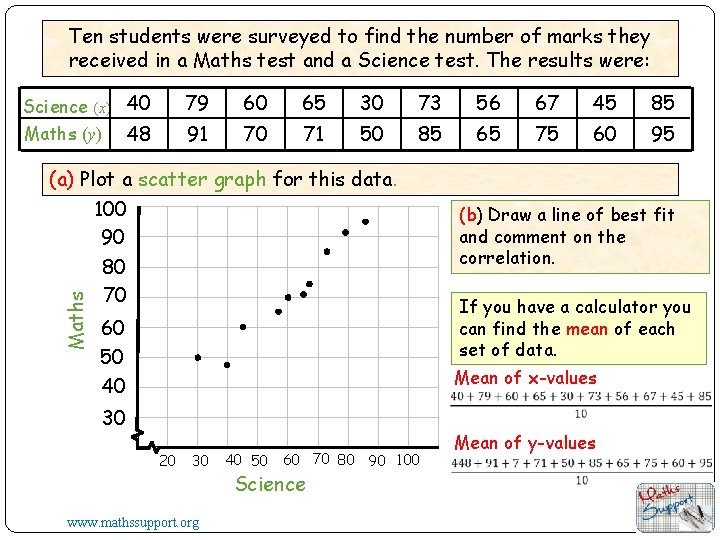
Ten students were surveyed to find the number of marks they received in a Maths test and a Science test. The results were: Science (x) 40 79 60 65 30 73 56 67 45 85 48 91 70 71 50 85 65 75 60 95 Maths (y) Maths (a) Plot a scatter graph for this data. 100 90 80 70 60 50 40 (b) Draw a line of best fit and comment on the correlation. If you have a calculator you can find the mean of each set of data. Mean of x-values 30 20 30 www. mathssupport. org 40 50 60 70 80 90 100 Science Mean of y-values
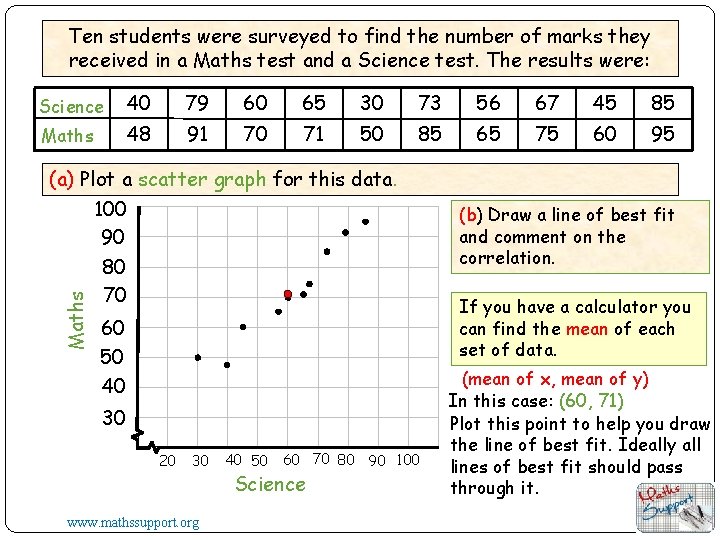
Ten students were surveyed to find the number of marks they received in a Maths test and a Science test. The results were: Science 40 79 60 65 30 73 56 67 45 85 Maths 48 91 70 71 50 85 65 75 60 95 Maths (a) Plot a scatter graph for this data. 100 90 80 70 60 50 40 30 20 30 www. mathssupport. org 40 50 60 70 80 90 100 Science (b) Draw a line of best fit and comment on the correlation. If you have a calculator you can find the mean of each set of data. (mean of x, mean of y) In this case: (60, 71) Plot this point to help you draw the line of best fit. Ideally all lines of best fit should pass through it.
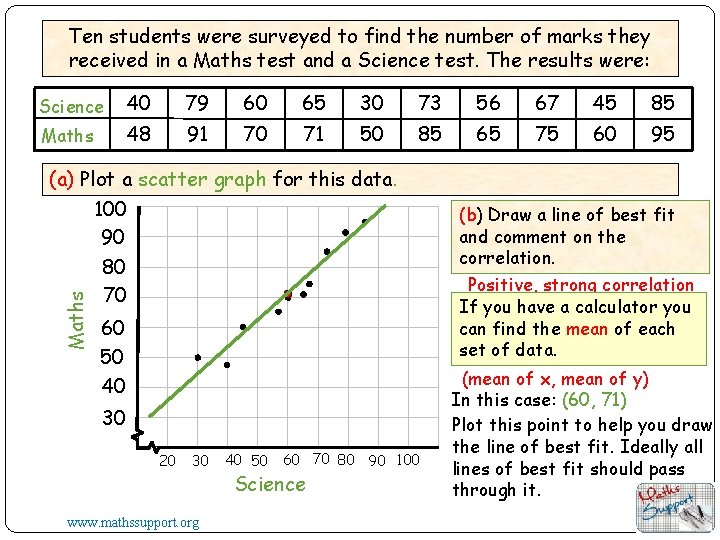
Ten students were surveyed to find the number of marks they received in a Maths test and a Science test. The results were: Science 40 79 60 65 30 73 56 67 45 85 Maths 48 91 70 71 50 85 65 75 60 95 Maths (a) Plot a scatter graph for this data. 100 90 80 70 60 50 40 30 20 30 www. mathssupport. org 40 50 60 70 80 90 100 Science (b) Draw a line of best fit and comment on the correlation. Positive, strong correlation If you have a calculator you can find the mean of each set of data. (mean of x, mean of y) In this case: (60, 71) Plot this point to help you draw the line of best fit. Ideally all lines of best fit should pass through it.
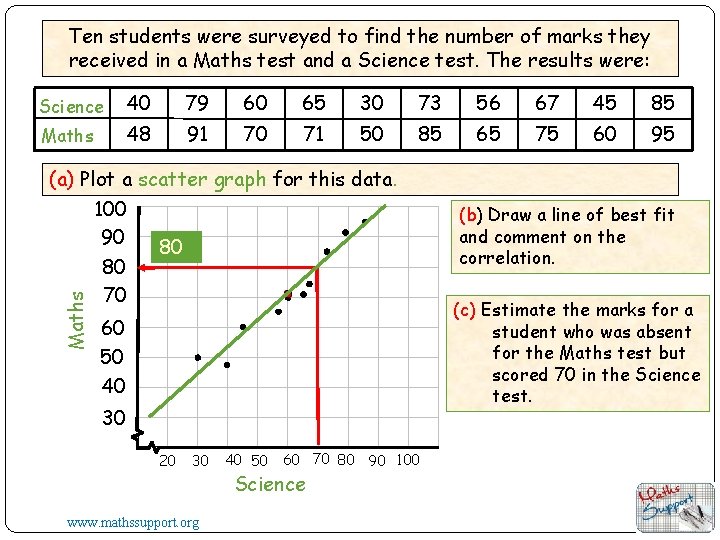
Ten students were surveyed to find the number of marks they received in a Maths test and a Science test. The results were: Science 40 79 60 65 30 73 56 67 45 85 Maths 48 91 70 71 50 85 65 75 60 95 Maths (a) Plot a scatter graph for this data. 100 90 80 80 70 60 50 40 30 20 30 www. mathssupport. org 40 50 60 70 80 90 100 Science (b) Draw a line of best fit and comment on the correlation. (c) Estimate the marks for a student who was absent for the Maths test but scored 70 in the Science test.
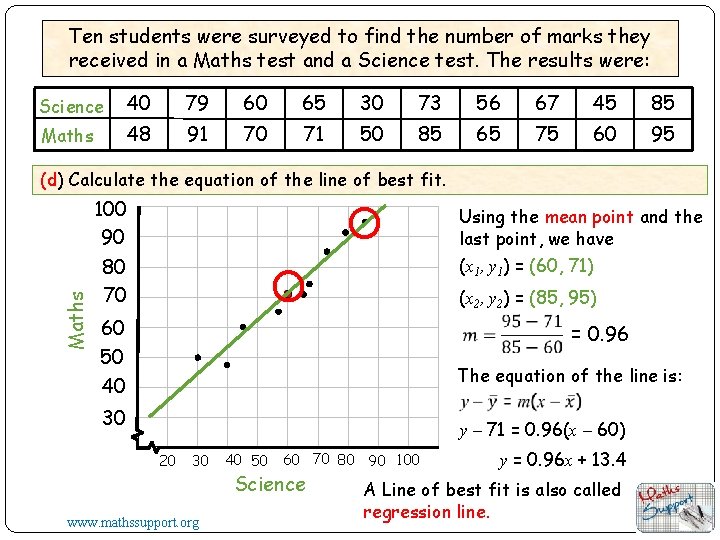
Ten students were surveyed to find the number of marks they received in a Maths test and a Science test. The results were: Science 40 79 60 65 30 73 56 67 45 85 Maths 48 91 70 71 50 85 65 75 60 95 Maths (d) Calculate the equation of the line of best fit. 100 90 80 70 Using the mean point and the last point, we have (x 1, y 1) = (60, 71) (x 2, y 2) = (85, 95) 60 50 40 = 0. 96 The equation of the line is: 30 y – 71 = 0. 96(x – 60) 20 30 www. mathssupport. org 40 50 60 70 80 90 100 Science y = 0. 96 x + 13. 4 A Line of best fit is also called regression line.
Thank you for using resources from For more resources visit our website https: //www. mathssupport. org If you have a special request, drop us an email info@mathssupport. org www. mathssupport. org
- Slides: 28