
27092017 Erik Kyhlberg Education and Admissions in Sweden

27/09/2017 Erik Kyhlberg Education and Admissions in Sweden A brief overview
Swedish education system 2
4
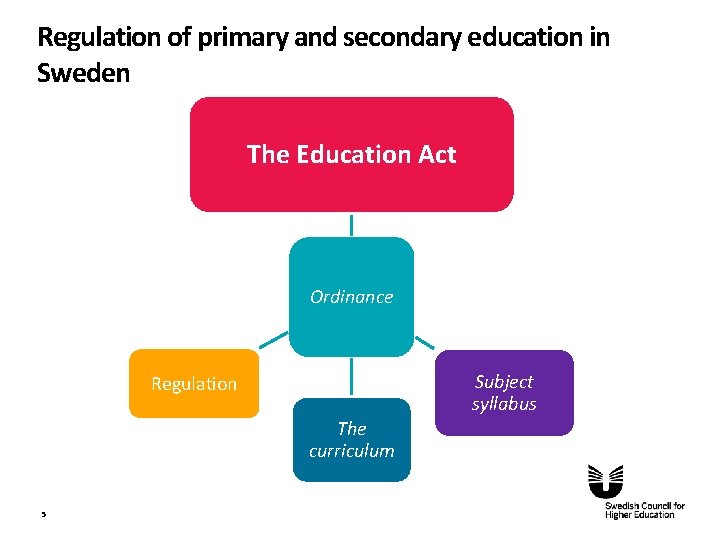
Regulation of primary and secondary education in Sweden The Education Act Ordinance Subject syllabus Regulation The curriculum 5
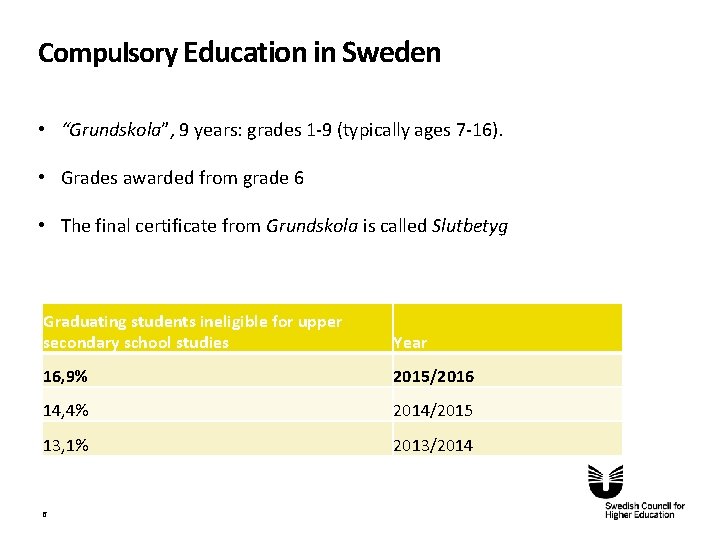
Compulsory Education in Sweden • “Grundskola”, 9 years: grades 1 -9 (typically ages 7 -16). • Grades awarded from grade 6 • The final certificate from Grundskola is called Slutbetyg Graduating students ineligible for upper secondary school studies Year 16, 9% 2015/2016 14, 4% 2014/2015 13, 1% 2013/2014 6
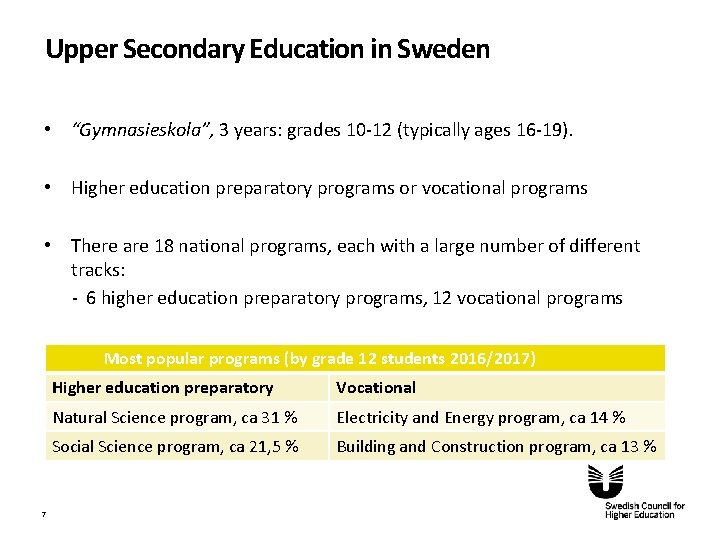
Upper Secondary Education in Sweden • “Gymnasieskola”, 3 years: grades 10 -12 (typically ages 16 -19). • Higher education preparatory programs or vocational programs • There are 18 national programs, each with a large number of different tracks: - 6 higher education preparatory programs, 12 vocational programs Most popular programs (by grade 12 students 2016/2017) 7 Higher education preparatory Vocational Natural Science program, ca 31 % Electricity and Energy program, ca 14 % Social Science program, ca 21, 5 % Building and Construction program, ca 13 %
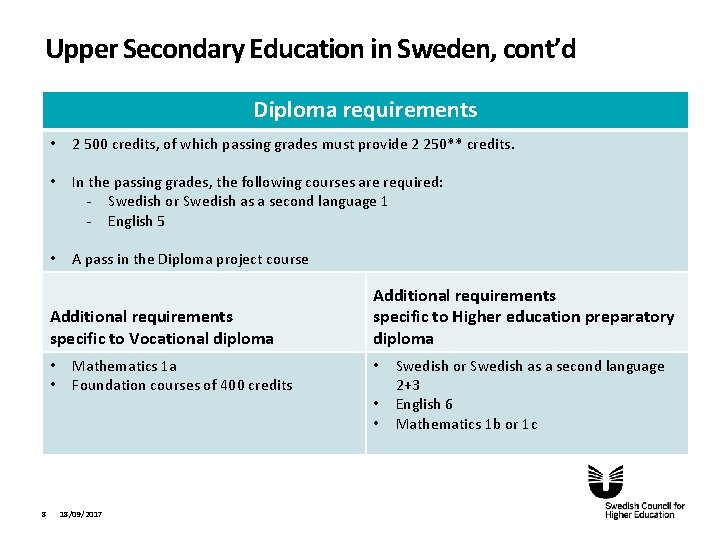
Upper Secondary Education in Sweden, cont’d Diploma requirements • 2 500 credits, of which passing grades must provide 2 250** credits. • In the passing grades, the following courses are required: - Swedish or Swedish as a second language 1 - English 5 • A pass in the Diploma project course Additional requirements specific to Vocational diploma • • 8 Mathematics 1 a Foundation courses of 400 credits 18/09/2017 Additional requirements specific to Higher education preparatory diploma • • • Swedish or Swedish as a second language 2+3 English 6 Mathematics 1 b or 1 c
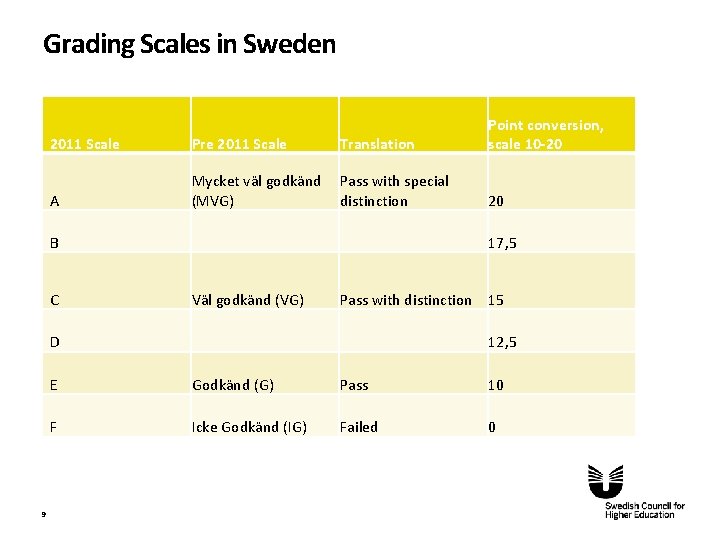
Grading Scales in Sweden 2011 Scale Pre 2011 Scale Translation Point conversion, scale 10 -20 A Mycket väl godkänd (MVG) Pass with special distinction 20 B C 17, 5 Väl godkänd (VG) Pass with distinction 15 D 9 12, 5 E Godkänd (G) Pass 10 F Icke Godkänd (IG) Failed 0
University Admissions in Sweden Applying and being admitted 10
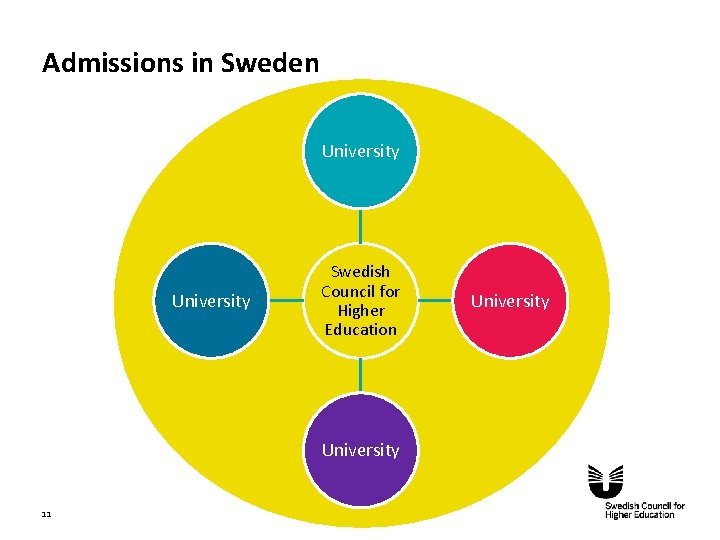
Admissions in Sweden University Swedish Council for Higher Education University 11 University
Applying for studies • The Swedish Council for Higher Education is in charge of the admissions system, and the admissions process overall. • Many applications will never need to be manually handled by an officer: - Applications are made online, most (Swedish) grades are received electronically from a separate database. - The eligibility assessment and selection is made by the admissions system. 12

Applying for studies, cont’d • To a regular admissions round you can apply to 20 courses/programmes • You can be admitted to 45 ECTS/semester (150 % full time studies) • In total you can be admitted, or placed on reserve list, for 210 ECTS 13
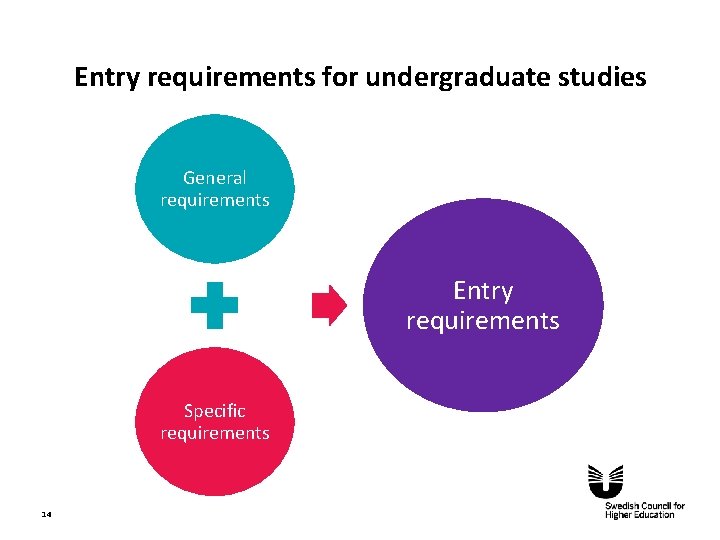
Entry requirements for undergraduate studies General requirements Entry requirements Specific requirements 14
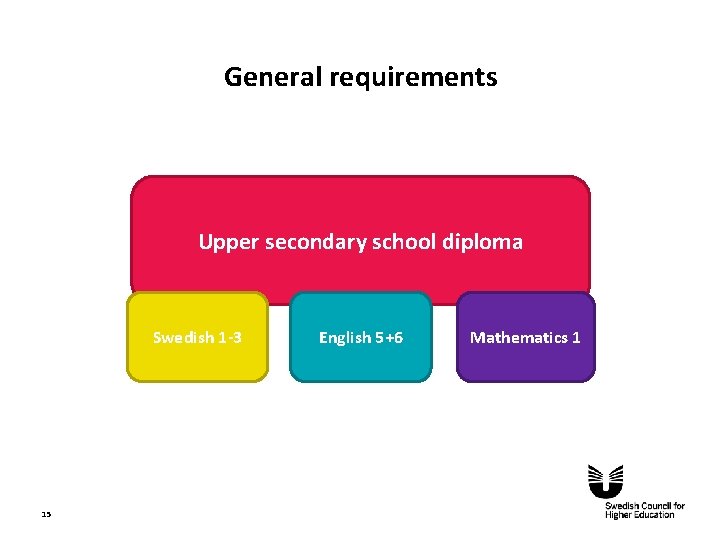
General requirements Upper secondary school diploma Swedish 1 -3 15 English 5+6 Mathematics 1
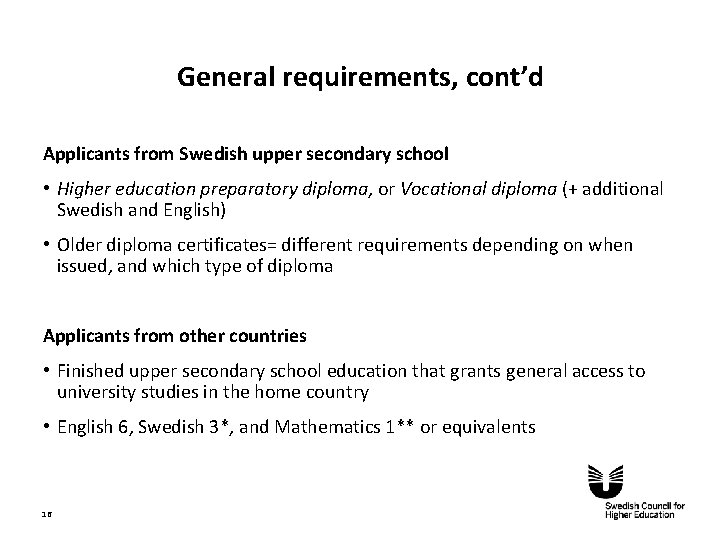
General requirements, cont’d Applicants from Swedish upper secondary school • Higher education preparatory diploma, or Vocational diploma (+ additional Swedish and English) • Older diploma certificates= different requirements depending on when issued, and which type of diploma Applicants from other countries • Finished upper secondary school education that grants general access to university studies in the home country • English 6, Swedish 3*, and Mathematics 1** or equivalents 16
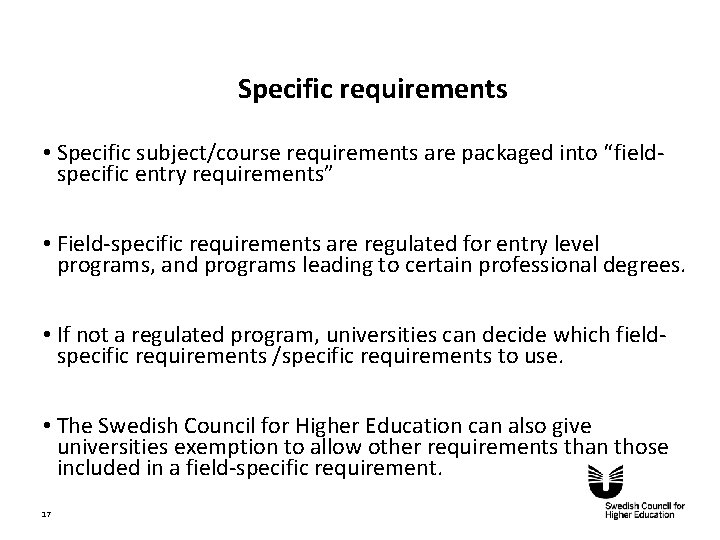
Specific requirements • Specific subject/course requirements are packaged into “fieldspecific entry requirements” • Field-specific requirements are regulated for entry level programs, and programs leading to certain professional degrees. • If not a regulated program, universities can decide which fieldspecific requirements /specific requirements to use. • The Swedish Council for Higher Education can also give universities exemption to allow other requirements than those included in a field-specific requirement. 17
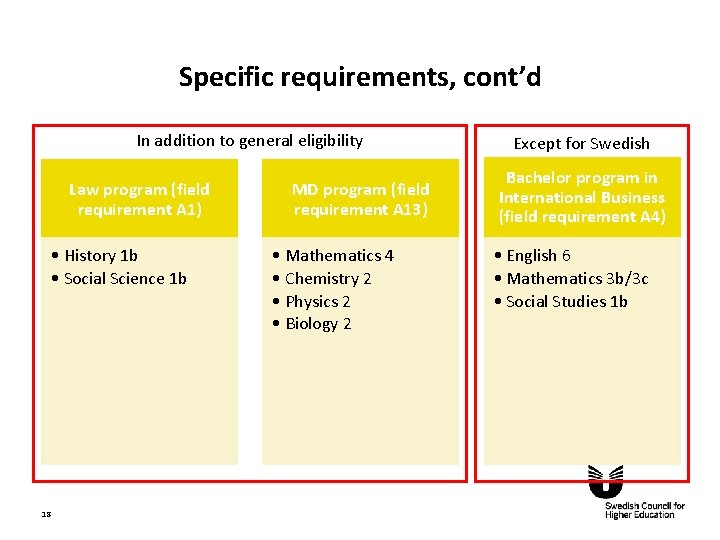
Specific requirements, cont’d In addition to general eligibility Law program (field requirement A 1) • History 1 b • Social Science 1 b 18 MD program (field requirement A 13) • Mathematics 4 • Chemistry 2 • Physics 2 • Biology 2 Except for Swedish Bachelor program in International Business (field requirement A 4) • English 6 • Mathematics 3 b/3 c • Social Studies 1 b
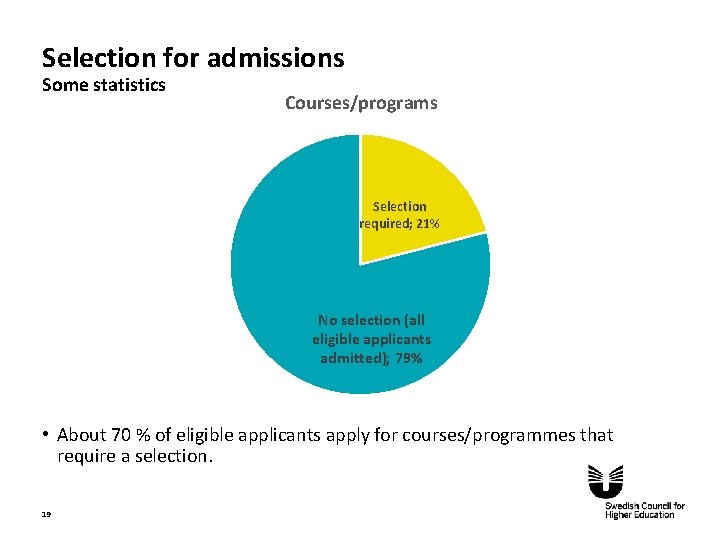
Selection for admissions Some statistics Courses/programs Selection required; 21% No selection (all eligible applicants admitted); 79% • About 70 % of eligible applicants apply for courses/programmes that require a selection. 19
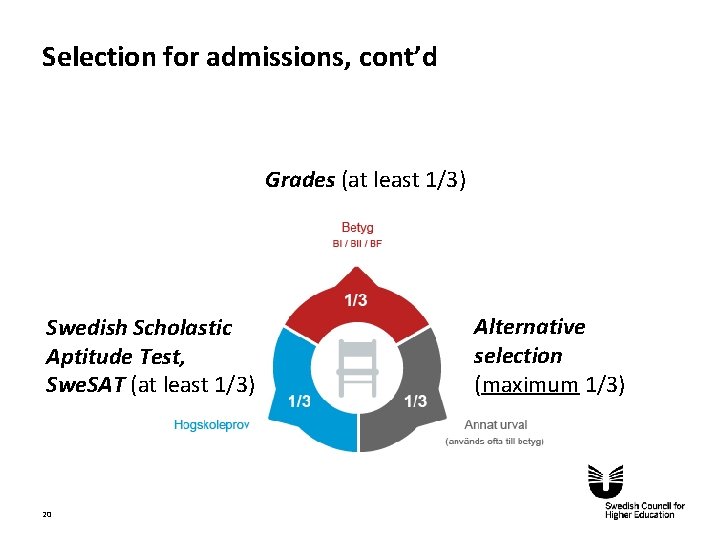
Selection for admissions, cont’d Grades (at least 1/3) Swedish Scholastic Aptitude Test, Swe. SAT (at least 1/3) 20 Alternative selection (maximum 1/3)
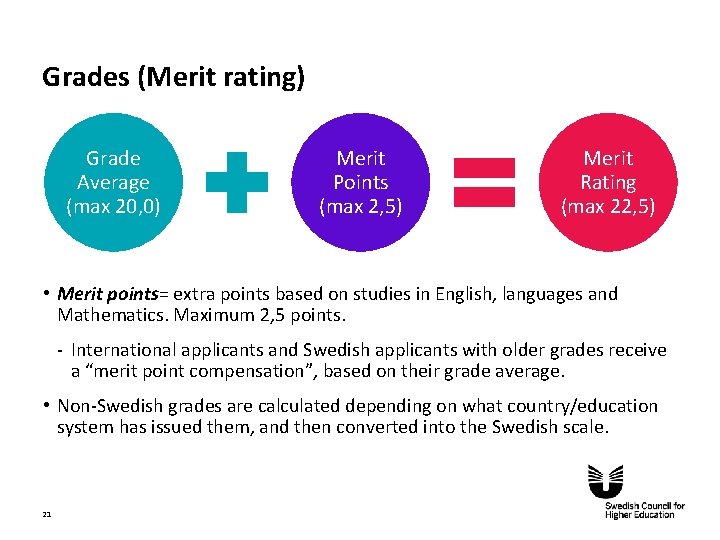
Grades (Merit rating) Grade Average (max 20, 0) Merit Points (max 2, 5) Merit Rating (max 22, 5) • Merit points= extra points based on studies in English, languages and Mathematics. Maximum 2, 5 points. - International applicants and Swedish applicants with older grades receive a “merit point compensation”, based on their grade average. • Non-Swedish grades are calculated depending on what country/education system has issued them, and then converted into the Swedish scale. 21
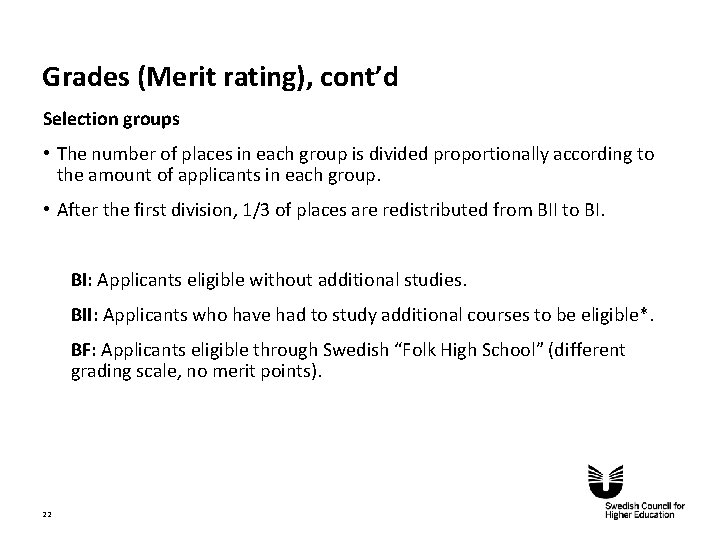
Grades (Merit rating), cont’d Selection groups • The number of places in each group is divided proportionally according to the amount of applicants in each group. • After the first division, 1/3 of places are redistributed from BII to BI. BI: Applicants eligible without additional studies. BII: Applicants who have had to study additional courses to be eligible*. BF: Applicants eligible through Swedish “Folk High School” (different grading scale, no merit points). 22
Swedish Scholastic Aptitude Test, Swe. SAT (“Högskoleprov”) • Quantitative, and verbal (Swedish and English) parts. • Solely for selection. • SAT or other international or national admissions tests are not generally applicable for undergraduate studies in Sweden 23 Alternative selection • Sometimes used for selection through interviews, practical experience, or a local entry exam. • When not used, places are redistributed to the other two groups. - for example in total 1/3 Swe. SAT and 2/3 grades, or 50/50 Swe. SAT/Grades
Sweden: Resources Questions about an individual’s documents should be directed to the issuing school in question. For questions about the school system in general, contact Skolverket (the National Agency for Education). https: //www. skolverket. se/om-skolverket/andra-sprak/in-english For questions about admissions and evaluation of Swedish grades in Sweden, please contact Universitets- och högskolerådet (Swedish Council for Higher Education). https: //www. uhr. se/en/start/ Other source documents National Agency for Education, Upper Secondary School 2011 overall commentary, diploma goals and program structures https: //www. skolverket. se/om-skolverket/publikationer/visa-enskildpublikation? _xurl_=http%3 A%2 F%2 Fwww 5. skolverket. se%2 Fwtpub%2 Fws%2 Fskolbok%2 Fwpub ext%2 Ftrycksak%2 FBlob%2 Fpdf 2801. pdf%3 Fk%3 D 2801 Swedish-English Dictionary of Higher Education https: //www. uhr. se/publikationer/svensk-engelsk-ordbok/ Common terminology for translation of upper secondary education grades https: //www. skolverket. se/polopoly_fs/1. 191540!/Common%20 terminology%20 when%20 transl ating%20 upper%20 secondary%20 school%20 grades. pdf English explanation of Swedish grades https: //www. skolverket. se/polopoly_fs/1. 259628!/swedishgrades_bilaga. pdf Translated Course Syllabuses https: //www. skolverket. se/laroplaner-amnen-ochkurser/gymnasieutbildning/gymnasieskola/oversattningar 24
- Slides: 23