
27 The Basic Tools of Finance Power Point
27 The Basic Tools of Finance Power. Point Slides prepared by: Andreea CHIRITESCU Eastern Illinois University © 2015 Cengage Learning. All Rights Reserved. May not be copied, scanned, or duplicated, in whole or in part, except for use as permitted in a license distributed with a certain product or service or otherwise on a password-protected website for classroom use. 1
Present Value • Finance – Studies how people make decisions: • Allocation of resources over time • Handling of risk • Present value – Amount of money today – That would be needed • Using prevailing interest rates • To produce a given future amount of money © 2015 Cengage Learning. All Rights Reserved. May not be copied, scanned, or duplicated, in whole or in part, except for use as permitted in a license distributed with a certain product or service or otherwise on a password-protected website for classroom use. 2
Present Value • Future value – Amount of money in the future – That an amount of money today will yield – Given prevailing interest rates • Compounding – Accumulation of a sum of money • Interest earned remains in the account • To earn additional interest in the future © 2015 Cengage Learning. All Rights Reserved. May not be copied, scanned, or duplicated, in whole or in part, except for use as permitted in a license distributed with a certain product or service or otherwise on a password-protected website for classroom use. 3
Present Value • Present value = $100 – Interest rate = r – Future value = … • (1+r) ˣ $100 after 1 year, • (1+r) ˣ $100 = (1+r)2 ˣ $100 after 2 years, • (1+r)3 ˣ $100 after 3 years, … • (1+r)N ˣ $100 after N years, © 2015 Cengage Learning. All Rights Reserved. May not be copied, scanned, or duplicated, in whole or in part, except for use as permitted in a license distributed with a certain product or service or otherwise on a password-protected website for classroom use. 4
Present Value • Future value = $200 in N years – Interest rate = r – Present value = $200/(1+r)N • Discounting – Find present value for a future sum o money © 2015 Cengage Learning. All Rights Reserved. May not be copied, scanned, or duplicated, in whole or in part, except for use as permitted in a license distributed with a certain product or service or otherwise on a password-protected website for classroom use. 5

Present Value • General formula for discounting: • r, interest rate • X, amount to be received in N years (future value) Present value = X/(1+r)N © 2015 Cengage Learning. All Rights Reserved. May not be copied, scanned, or duplicated, in whole or in part, except for use as permitted in a license distributed with a certain product or service or otherwise on a password-protected website for classroom use. 6
Managing Risk • Rational response to risk – Not necessarily to avoid it at any cost – Take it into account in your decision making • Risk aversion – Dislike of uncertainty • Utility – A person’s subjective measure of wellbeing/ satisfaction © 2015 Cengage Learning. All Rights Reserved. May not be copied, scanned, or duplicated, in whole or in part, except for use as permitted in a license distributed with a certain product or service or otherwise on a password-protected website for classroom use. 7
Managing Risk • Utility function – Every level of wealth provides a certain amount of utility – Exhibits diminishing marginal utility • The more wealth a person has • The less utility he gets from an additional dollar © 2015 Cengage Learning. All Rights Reserved. May not be copied, scanned, or duplicated, in whole or in part, except for use as permitted in a license distributed with a certain product or service or otherwise on a password-protected website for classroom use. 8
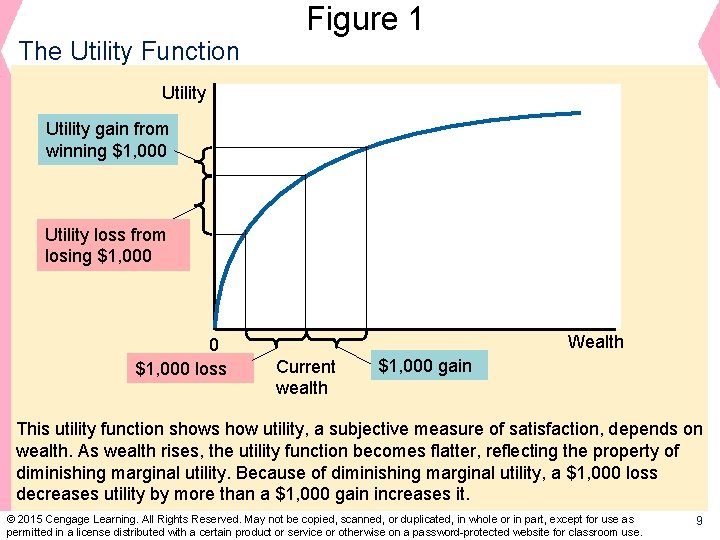
The Utility Function Figure 1 Utility gain from winning $1, 000 Utility loss from losing $1, 000 0 $1, 000 loss Wealth Current wealth $1, 000 gain This utility function shows how utility, a subjective measure of satisfaction, depends on wealth. As wealth rises, the utility function becomes flatter, reflecting the property of diminishing marginal utility. Because of diminishing marginal utility, a $1, 000 loss decreases utility by more than a $1, 000 gain increases it. © 2015 Cengage Learning. All Rights Reserved. May not be copied, scanned, or duplicated, in whole or in part, except for use as permitted in a license distributed with a certain product or service or otherwise on a password-protected website for classroom use. 9
Managing Risk • The markets for insurance – Person facing a risk • Pays a fee to insurance company – Insurance company • Accepts all or a part of risk • Insurance contract – gamble – You may not face the risk – Pay the insurance premium – Receive: peace of mind © 2015 Cengage Learning. All Rights Reserved. May not be copied, scanned, or duplicated, in whole or in part, except for use as permitted in a license distributed with a certain product or service or otherwise on a password-protected website for classroom use. 10
Managing Risk • Role of insurance – Not to eliminate the risks, but to spread the risks around more efficiently • Markets for insurance – problems: – Adverse selection • High-risk person – more likely to apply for insurance – Moral hazard • After people buy insurance - less incentive to be careful © 2015 Cengage Learning. All Rights Reserved. May not be copied, scanned, or duplicated, in whole or in part, except for use as permitted in a license distributed with a certain product or service or otherwise on a password-protected website for classroom use. 11
Managing Risk • Diversification – Reduction of risk – By replacing a single risk with a large number of smaller, unrelated risks – “Don’t put all your eggs in one basket” • Risk – Standard deviation - measures the volatility of a variable © 2015 Cengage Learning. All Rights Reserved. May not be copied, scanned, or duplicated, in whole or in part, except for use as permitted in a license distributed with a certain product or service or otherwise on a password-protected website for classroom use. 12
Managing Risk • Risk of a portfolio of stocks – Depends on number of stocks in the portfolio – The higher the standard deviation – The riskier the portfolio © 2015 Cengage Learning. All Rights Reserved. May not be copied, scanned, or duplicated, in whole or in part, except for use as permitted in a license distributed with a certain product or service or otherwise on a password-protected website for classroom use. 13
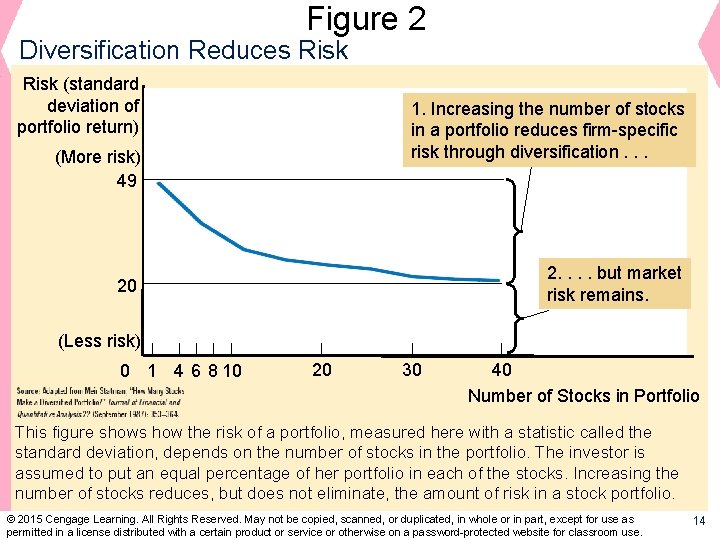
Figure 2 Diversification Reduces Risk (standard deviation of portfolio return) 1. Increasing the number of stocks in a portfolio reduces firm-specific risk through diversification. . . (More risk) 49 2. . but market risk remains. 20 (Less risk) 0 1 4 6 8 10 20 30 40 Number of Stocks in Portfolio This figure shows how the risk of a portfolio, measured here with a statistic called the standard deviation, depends on the number of stocks in the portfolio. The investor is assumed to put an equal percentage of her portfolio in each of the stocks. Increasing the number of stocks reduces, but does not eliminate, the amount of risk in a stock portfolio. © 2015 Cengage Learning. All Rights Reserved. May not be copied, scanned, or duplicated, in whole or in part, except for use as permitted in a license distributed with a certain product or service or otherwise on a password-protected website for classroom use. 14
Managing Risk • Diversification – Can eliminate firm-specific risk – Cannot eliminate market risk • Firm-specific risk – Affects only a single company • Market risk – Affects all companies in the stock market © 2015 Cengage Learning. All Rights Reserved. May not be copied, scanned, or duplicated, in whole or in part, except for use as permitted in a license distributed with a certain product or service or otherwise on a password-protected website for classroom use. 15
Managing Risk • The trade-off between risk and return – Two types of assets • Diversified group – 8% return – 20% standard deviation • Safe alternative – 3% return – 0% standard deviation – The more a person puts into stocks • The greater the risk and the return © 2015 Cengage Learning. All Rights Reserved. May not be copied, scanned, or duplicated, in whole or in part, except for use as permitted in a license distributed with a certain product or service or otherwise on a password-protected website for classroom use. 16
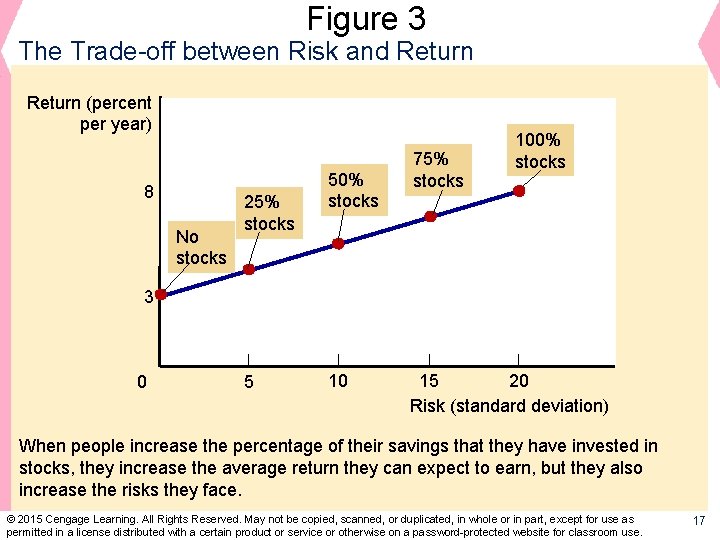
Figure 3 The Trade-off between Risk and Return (percent per year) 8 No stocks 25% stocks 50% stocks 75% stocks 100% stocks 3 0 5 10 15 20 Risk (standard deviation) When people increase the percentage of their savings that they have invested in stocks, they increase the average return they can expect to earn, but they also increase the risks they face. © 2015 Cengage Learning. All Rights Reserved. May not be copied, scanned, or duplicated, in whole or in part, except for use as permitted in a license distributed with a certain product or service or otherwise on a password-protected website for classroom use. 17
Asset Valuation • Fundamental analysis – Study of a company’s accounting statements and future prospects – To determine its value • Undervalued stock: Price < value • Overvalued stock: Price > value • Fairly valued stock: Price = value © 2015 Cengage Learning. All Rights Reserved. May not be copied, scanned, or duplicated, in whole or in part, except for use as permitted in a license distributed with a certain product or service or otherwise on a password-protected website for classroom use. 18
Asset Valuation • Use fundamental analysis to pick a stock – Do all the necessary research yourself – Rely on the advice of Wall Street analysts – Buy a mutual fund • A manager conducts fundamental analysis and makes the decision for you © 2015 Cengage Learning. All Rights Reserved. May not be copied, scanned, or duplicated, in whole or in part, except for use as permitted in a license distributed with a certain product or service or otherwise on a password-protected website for classroom use. 19
Asset Valuation • The efficient markets hypothesis – Asset prices reflect all publicly available information about the value of an asset – Each company listed on a major stock exchange is followed closely by many money managers – Equilibrium of supply and demand sets the market price © 2015 Cengage Learning. All Rights Reserved. May not be copied, scanned, or duplicated, in whole or in part, except for use as permitted in a license distributed with a certain product or service or otherwise on a password-protected website for classroom use. 20
Asset Valuation • Stock markets – Exhibit informational efficiency • Informational efficiency – Description of asset prices – Rationally reflect all available information • Implication of efficient markets hypothesis – Stock prices should follow a random walk • Changes in stock prices are impossible to predict from available information © 2015 Cengage Learning. All Rights Reserved. May not be copied, scanned, or duplicated, in whole or in part, except for use as permitted in a license distributed with a certain product or service or otherwise on a password-protected website for classroom use. 21
Random walks and index funds • The efficient markets hypothesis – Theory about how financial markets work – Probably not completely true • Evidence on stock prices – Even if not exactly a random walk, are very close to it • Index fund – Mutual fund that buys all stocks in a given stock index © 2015 Cengage Learning. All Rights Reserved. May not be copied, scanned, or duplicated, in whole or in part, except for use as permitted in a license distributed with a certain product or service or otherwise on a password-protected website for classroom use. 22
Random walks and index funds • Active funds – Actively managed mutual funds • Professional portfolio manager – Buy only the best stocks • Performance of index funds – Better than active funds © 2015 Cengage Learning. All Rights Reserved. May not be copied, scanned, or duplicated, in whole or in part, except for use as permitted in a license distributed with a certain product or service or otherwise on a password-protected website for classroom use. 23
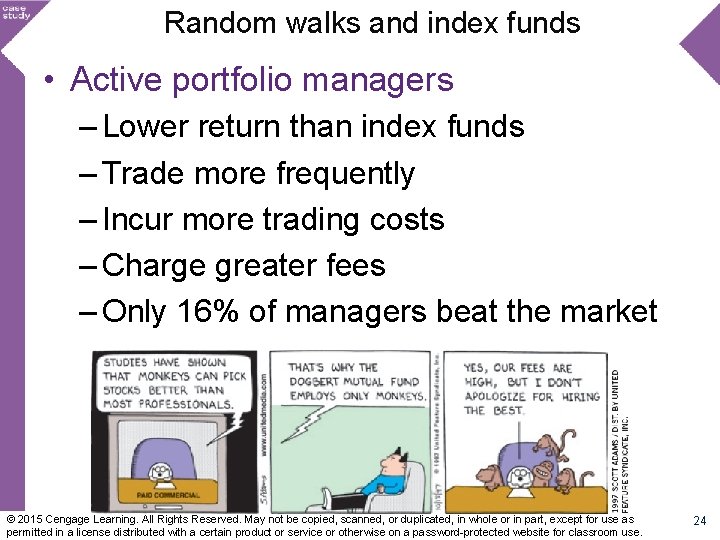
Random walks and index funds • Active portfolio managers – Lower return than index funds – Trade more frequently – Incur more trading costs – Charge greater fees – Only 16% of managers beat the market © 2015 Cengage Learning. All Rights Reserved. May not be copied, scanned, or duplicated, in whole or in part, except for use as permitted in a license distributed with a certain product or service or otherwise on a password-protected website for classroom use. 24
Asset Valuation • Efficient markets hypothesis – Assumes that people buying & selling stock are rational • Process information about stock’s underlying value • Fluctuations in stock prices – Partly psychological © 2015 Cengage Learning. All Rights Reserved. May not be copied, scanned, or duplicated, in whole or in part, except for use as permitted in a license distributed with a certain product or service or otherwise on a password-protected website for classroom use. 25
Asset Valuation • When price of an asset – Above its fundamental value – Market - experiencing a speculative bubble • Possibility of speculative bubbles – Value of the stock to a stockholder depends on: • Stream of dividend payments • Final sale price © 2015 Cengage Learning. All Rights Reserved. May not be copied, scanned, or duplicated, in whole or in part, except for use as permitted in a license distributed with a certain product or service or otherwise on a password-protected website for classroom use. 26
Asset Valuation • Debate: frequency and importance of departures from rational pricing – Market irrationality • Movement in stock market – Hard to explain - news that alter a rational valuation – Efficient markets hypothesis • Impossible to know the correct/rational valuation of a company © 2015 Cengage Learning. All Rights Reserved. May not be copied, scanned, or duplicated, in whole or in part, except for use as permitted in a license distributed with a certain product or service or otherwise on a password-protected website for classroom use. 27
- Slides: 27