
27 Managing Aggregate Demand Fiscal Policy Next let
- Slides: 35
27 Managing Aggregate Demand: Fiscal Policy Next, let us turn to the problems of our fiscal policy. Here the myths are legion and the truth hard to find. JOHN F. KENNEDY
Contents ● Income Taxes and the Consumption Schedule ● The Multiplier Revisited ● Planning Expansionary Fiscal Policy ● Planning Contractionary Fiscal Policy ● The Choice Between Spending Policy and Tax Policy Copyright © 2003 South-Western/Thomson Learning. All rights reserved.
Contents (continued) ● Some Harsh Realities ● The Idea Behind Supply-Side Tax Cuts ● Appendix: Algebraic Treatment of Fiscal Policy and Aggregate Demand Copyright © 2003 South-Western/Thomson Learning. All rights reserved.
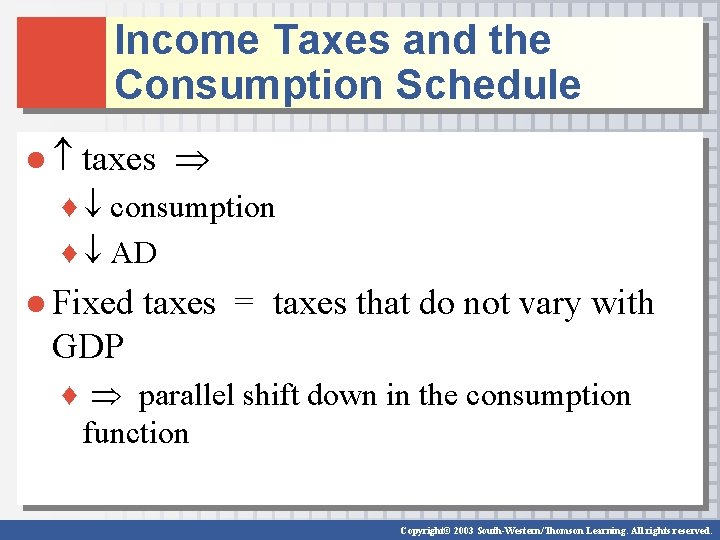
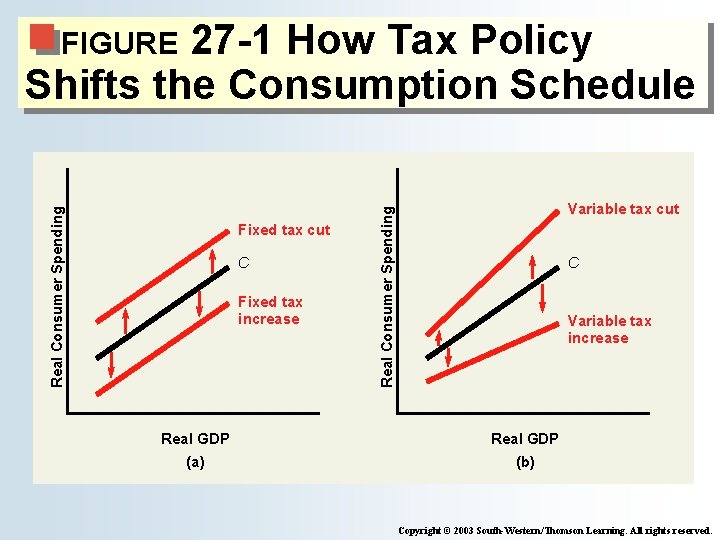
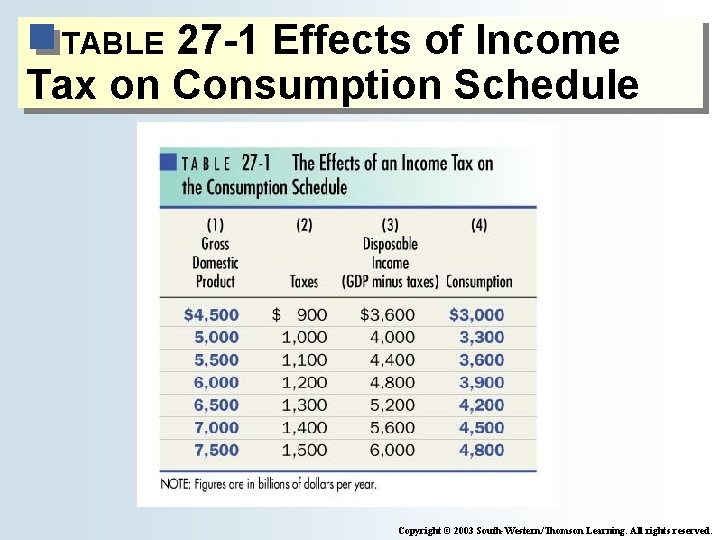
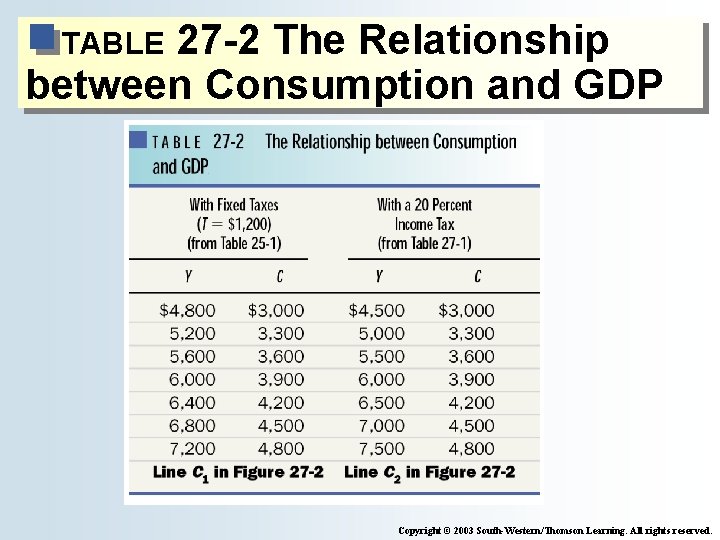
Income Taxes and the Consumption Schedule ● taxes ♦ consumption ♦ AD ● Fixed taxes = taxes that do not vary with GDP ♦ parallel shift down in the consumption function Copyright© 2003 South-Western/Thomson Learning. All rights reserved.
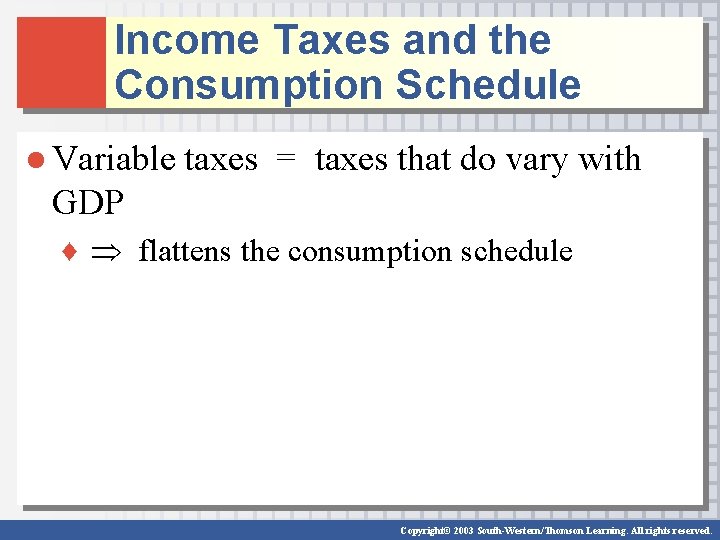
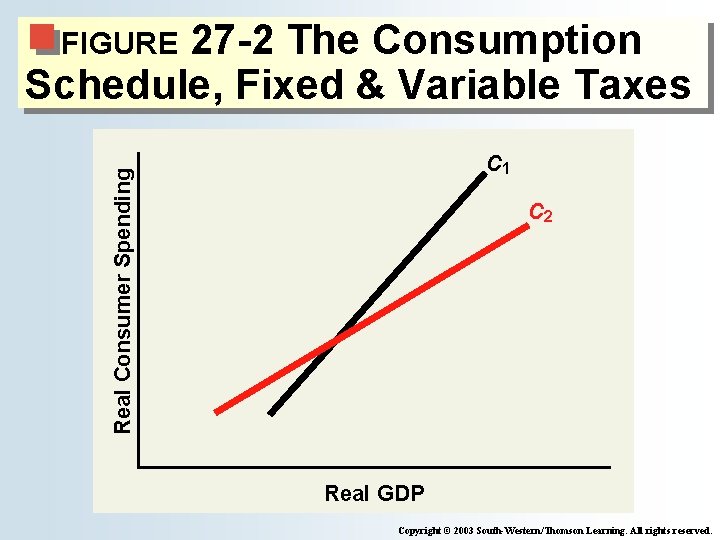
Income Taxes and the Consumption Schedule ● Variable taxes = taxes that do vary with GDP ♦ flattens the consumption schedule Copyright© 2003 South-Western/Thomson Learning. All rights reserved.
27 -1 How Tax Policy Shifts the Consumption Schedule Fixed tax cut C Fixed tax increase Variable tax cut Real Consumer Spending FIGURE C Variable tax increase Real GDP (a) (b) Copyright © 2003 South-Western/Thomson Learning. All rights reserved.
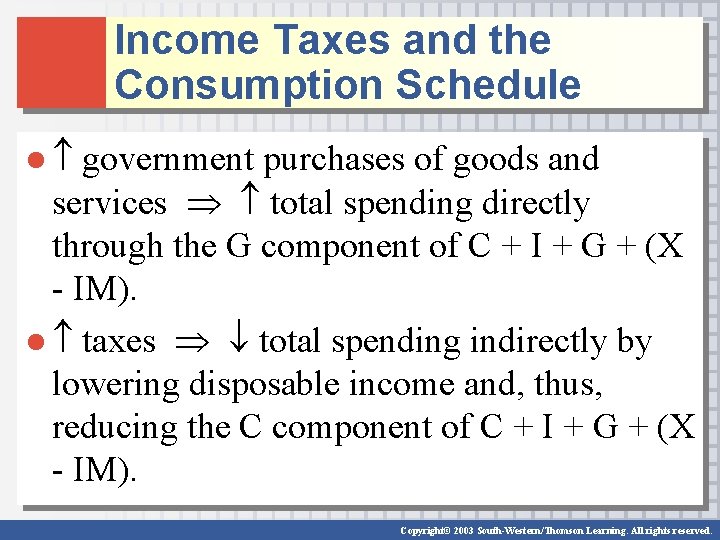
Income Taxes and the Consumption Schedule ● government purchases of goods and services total spending directly through the G component of C + I + G + (X - IM). ● taxes total spending indirectly by lowering disposable income and, thus, reducing the C component of C + I + G + (X - IM). Copyright© 2003 South-Western/Thomson Learning. All rights reserved.
27 -2 The Consumption Schedule, Fixed & Variable Taxes FIGURE Real Consumer Spending C 1 C 2 Real GDP Copyright © 2003 South-Western/Thomson Learning. All rights reserved.
27 -1 Effects of Income Tax on Consumption Schedule TABLE Copyright © 2003 South-Western/Thomson Learning. All rights reserved.
27 -2 The Relationship between Consumption and GDP TABLE Copyright © 2003 South-Western/Thomson Learning. All rights reserved.
Income Taxes and the Consumption Schedule ● On balance, the government’s actions may raise or lower equilibrium GDP, depending on how much spending and taxing it does. ● income tax multiplier Copyright© 2003 South-Western/Thomson Learning. All rights reserved.
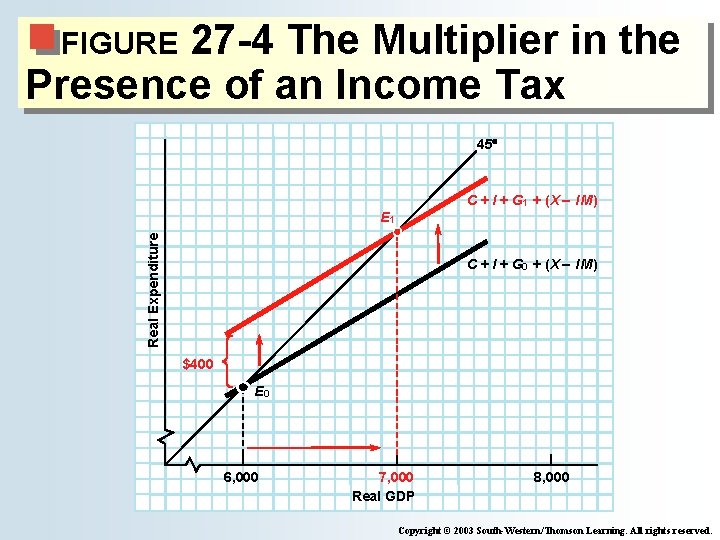
The Multiplier Revisited ● Variable tax multiplier ♦ When incomes rise, a larger amount is taken out in taxes than before, leaving a smaller increase in disposable income. Copyright© 2003 South-Western/Thomson Learning. All rights reserved.
27 -4 The Multiplier in the Presence of an Income Tax FIGURE 45° C + I + G 1 + (X – IM) Real Expenditure E 1 C + I + G 0 + (X – IM) $400 E 0 6, 000 7, 000 Real GDP 8, 000 Copyright © 2003 South-Western/Thomson Learning. All rights reserved.
The Multiplier Revisited ● Reasons why the oversimplified multiplier formula overstates the size of the multiplier: ♦ Ignores variable imports ♦ Ignores price-level changes ♦ Ignores income taxes Copyright© 2003 South-Western/Thomson Learning. All rights reserved.
The Multiplier Revisited ● Automatic stabilizers ♦ Automatic stabilizers = features of the economy that reduce its sensitivity to shocks ■Personal income tax ■Unemployment insurance Copyright© 2003 South-Western/Thomson Learning. All rights reserved.
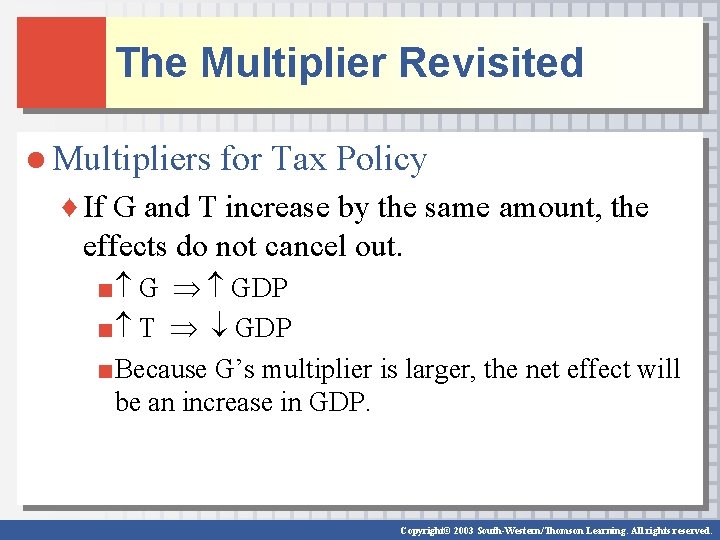
The Multiplier Revisited ● Multipliers for Tax Policy ♦ Multiplier for T < Multiplier for G ■G affects AD directly ■T changes only disposable income ■Resulting consumption < disposable income Copyright© 2003 South-Western/Thomson Learning. All rights reserved.
The Multiplier Revisited ● Multipliers for Tax Policy ♦ If G and T increase by the same amount, the effects do not cancel out. ■ G GDP ■ T GDP ■Because G’s multiplier is larger, the net effect will be an increase in GDP. Copyright© 2003 South-Western/Thomson Learning. All rights reserved.
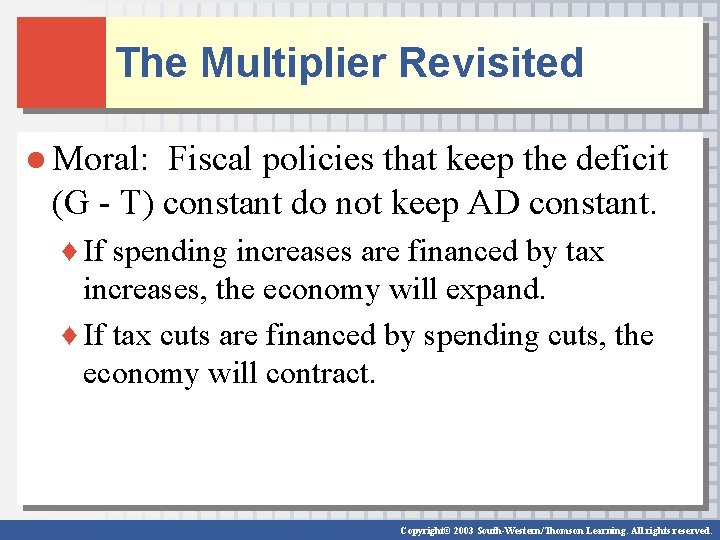
The Multiplier Revisited ● Moral: Fiscal policies that keep the deficit (G - T) constant do not keep AD constant. ♦ If spending increases are financed by tax increases, the economy will expand. ♦ If tax cuts are financed by spending cuts, the economy will contract. Copyright© 2003 South-Western/Thomson Learning. All rights reserved.
The Multiplier Revisited ● Government Transfer Payments ● Transfers = payments to individuals that do not compensate them for any direct contribution to production ● Transfers are the analytical equivalent of negative taxes. Copyright© 2003 South-Western/Thomson Learning. All rights reserved.
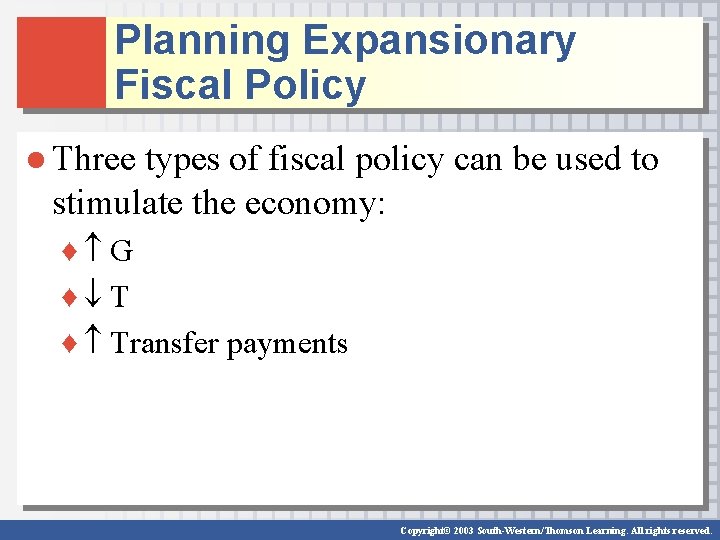
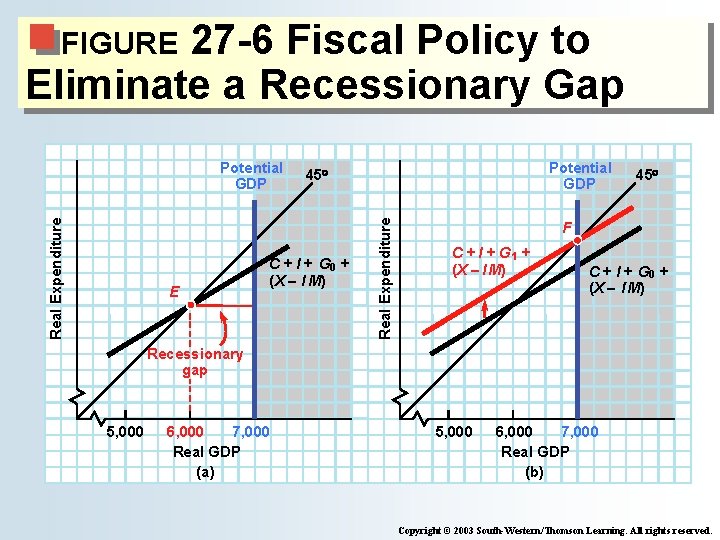
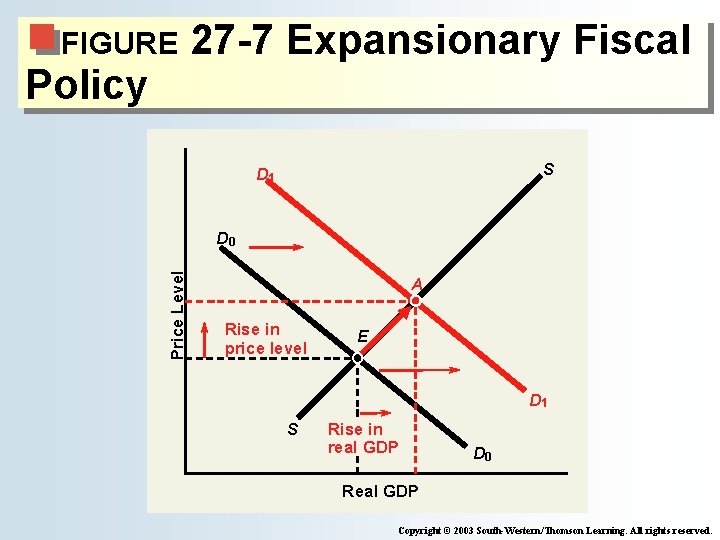
Planning Expansionary Fiscal Policy ● Three types of fiscal policy can be used to stimulate the economy: ♦ G ♦ T ♦ Transfer payments Copyright© 2003 South-Western/Thomson Learning. All rights reserved.
27 -6 Fiscal Policy to Eliminate a Recessionary Gap FIGURE E Potential GDP 45° C + I + G 0 + (X – IM) Real Expenditure Potential GDP 45° F C + I + G 1 + (X – IM) C + I + G 0 + (X – IM) Recessionary gap 5, 000 6, 000 7, 000 Real GDP (a) 5, 000 6, 000 7, 000 Real GDP (b) Copyright © 2003 South-Western/Thomson Learning. All rights reserved.
Planning Contractionary Fiscal Policy ● Three types of fiscal policy can be used to slow the economy: ♦ G ♦ T ♦ Transfer payments Copyright© 2003 South-Western/Thomson Learning. All rights reserved.
Planning Contractionary Fiscal Policy ● Note that the self-adjusting mechanism will eventually perform the same task, but at the cost of more inflation than will occur if the government succeeds in reducing AD. Copyright© 2003 South-Western/Thomson Learning. All rights reserved.
The Choice Between Spending and Tax Policy ● The choice between G and T reflects a difference in opinion about the desirable size of the government sector. ♦ Advocates of small government prefer: ■To lower T in order to stimulate output ■To lower G to control inflation ♦ Advocates of big government prefer: ■There is nothing about an activist fiscal policy that implies a preference for big government. Copyright© 2003 South-Western/Thomson Learning. All rights reserved.
FIGURE Policy 27 -7 Expansionary Fiscal S D 1 Price Level D 0 A Rise in price level E D 1 S Rise in real GDP D 0 Real GDP Copyright © 2003 South-Western/Thomson Learning. All rights reserved.
Some Harsh Realities ● A fiscal policy planner’s job is not simple. ♦ Economic variables change continuously. ♦ The “policy target” is constantly moving. ♦ Economists have only an uncertain knowledge of the value of the multiplier and the fullemployment level of GDP. ♦ Forecasts are uncertain and policies take time to work. Copyright© 2003 South-Western/Thomson Learning. All rights reserved.
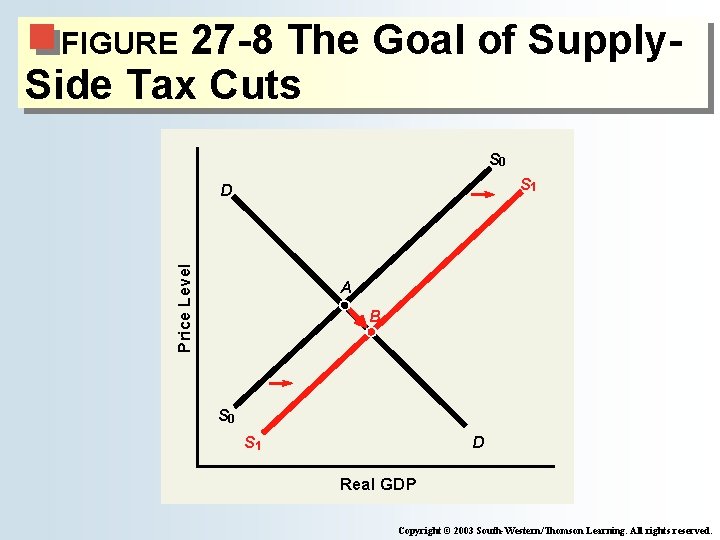
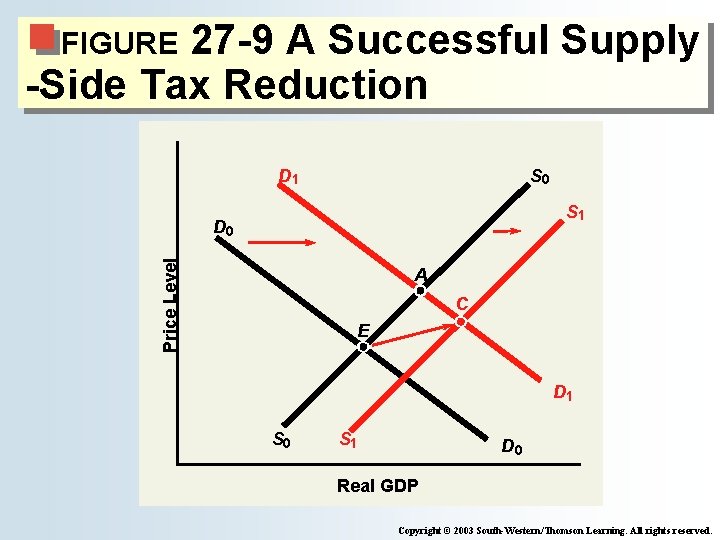
The Idea Behind Supply-Side Tax Cuts ● Supply-side economics = idea that taxes AS ♦ GDP ♦ price level Copyright© 2003 South-Western/Thomson Learning. All rights reserved.
27 -8 The Goal of Supply. Side Tax Cuts FIGURE S 0 S 1 Price Level D A B S 0 S 1 D Real GDP Copyright © 2003 South-Western/Thomson Learning. All rights reserved.
27 -9 A Successful Supply -Side Tax Reduction FIGURE D 1 S 0 S 1 Price Level D 0 A C E D 1 S 0 S 1 D 0 Real GDP Copyright © 2003 South-Western/Thomson Learning. All rights reserved.
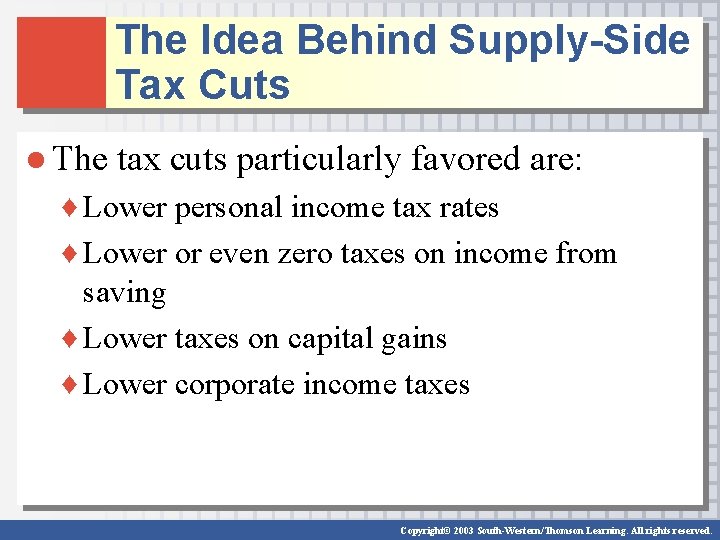
The Idea Behind Supply-Side Tax Cuts ● The tax cuts particularly favored are: ♦ Lower personal income tax rates ♦ Lower or even zero taxes on income from saving ♦ Lower taxes on capital gains ♦ Lower corporate income taxes Copyright© 2003 South-Western/Thomson Learning. All rights reserved.
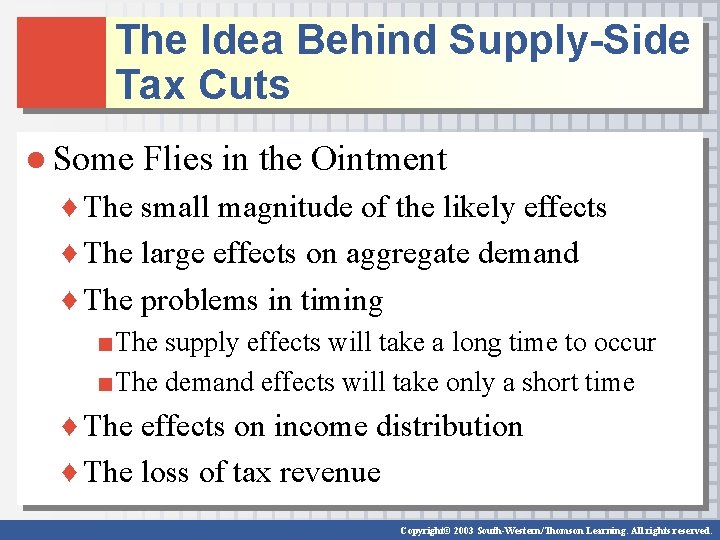
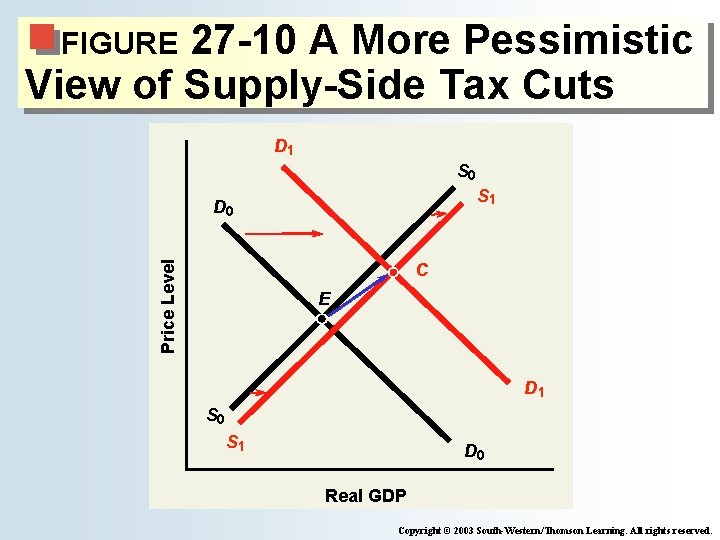
The Idea Behind Supply-Side Tax Cuts ● Some Flies in the Ointment ♦ The small magnitude of the likely effects ♦ The large effects on aggregate demand ♦ The problems in timing ■The supply effects will take a long time to occur ■The demand effects will take only a short time ♦ The effects on income distribution ♦ The loss of tax revenue Copyright© 2003 South-Western/Thomson Learning. All rights reserved.
27 -10 A More Pessimistic View of Supply-Side Tax Cuts FIGURE D 1 S 0 S 1 Price Level D 0 C E D 1 S 0 S 1 D 0 Real GDP Copyright © 2003 South-Western/Thomson Learning. All rights reserved.
Toward Assessment of Supply-Side Economics ● Supply-side tax cuts have their pros and cons. ● It is unlikely, however, that they can work as strongly or as quickly as their most ardent admirers think. Copyright© 2003 South-Western/Thomson Learning. All rights reserved.
Appendix: Algebraic Treatment of Fiscal Policy and Aggregate Demand
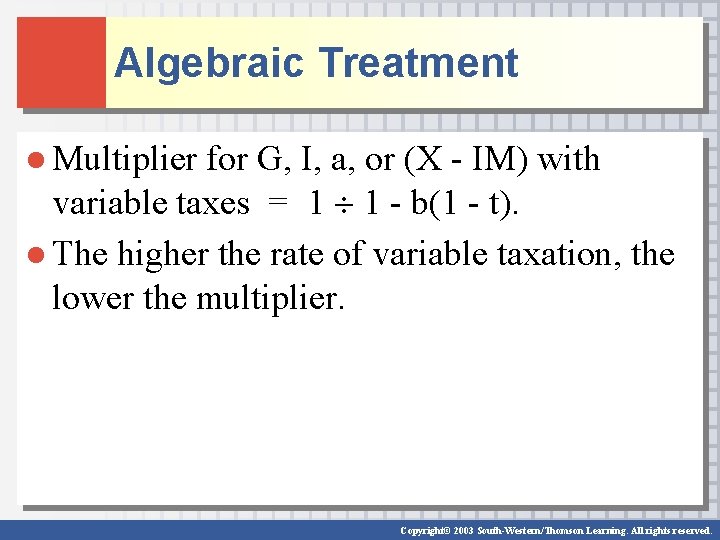
Algebraic Treatment ● Multiplier for G, I, a, or (X - IM) with variable taxes = 1 1 - b(1 - t). ● The higher the rate of variable taxation, the lower the multiplier. Copyright© 2003 South-Western/Thomson Learning. All rights reserved.