
27 4 Phylum Mollusca Mollusks Basic Body Plan
27 -4 Phylum Mollusca (Mollusks)

Basic Body Plan � Foot: � Soft muscular. Usually contains the mouth and feeding structures. Also used for movement. � Mantle: � Thin, delicate tissue layer. Covers most of the body. � Shell: � Made of calcium carbonate (Ca. CO 3) secreted by glands in the mantle � Visceral Mass: � Contains the internal organs

3 Main Classes �Gastropoda � “Stomach-foot” � Snails, slugs, abalone, sea butterflies, sea hares, and nudibranchs � Most snails have a lid-like part called an operculum on the back of the foot so they can draw their bodies into their shell and close off the opening � Shell-less varieties exhibit behaviours that protect them, and/or have ink glands, poisonous chemicals in their skin, nematocysts, and bright “danger” colours!
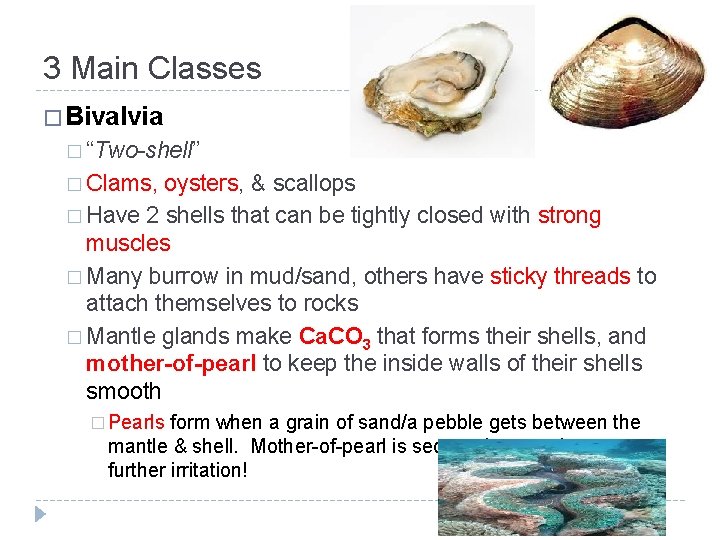
3 Main Classes � Bivalvia � “Two-shell” � Clams, oysters, & scallops � Have 2 shells that can be tightly closed with strong muscles � Many burrow in mud/sand, others have sticky threads to attach themselves to rocks � Mantle glands make Ca. CO 3 that forms their shells, and mother-of-pearl to keep the inside walls of their shells smooth � Pearls form when a grain of sand/a pebble gets between the mantle & shell. Mother-of-pearl is secreted to coat it to prevent further irritation!
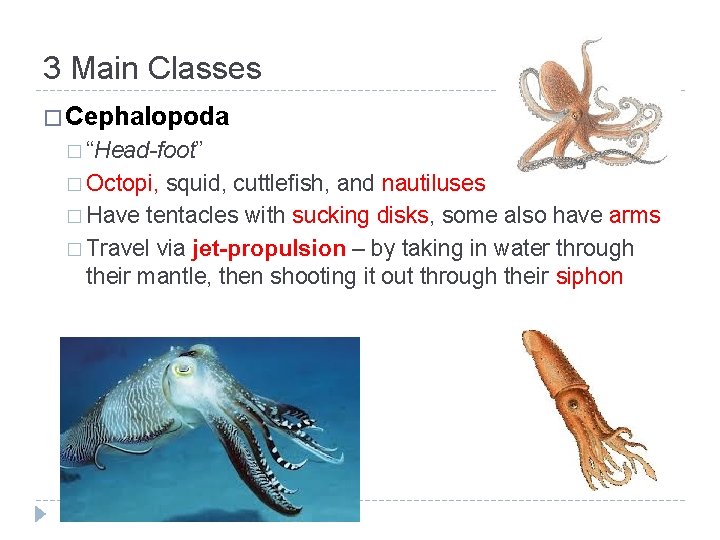
3 Main Classes � Cephalopoda � “Head-foot” � Octopi, squid, cuttlefish, and nautiluses � Have tentacles with sucking disks, some also have arms � Travel via jet-propulsion – by taking in water through their mantle, then shooting it out through their siphon
Feeding � Gastropods Use a tongue-shaped radula to scrape algae off of rocks/or eat land plant material (herbivores)/or drill holes in shells of their prey (carnivores. ) � The radula is a tooth made of flexible skin, spread over a strong supporting rod of cartilage. Feels like sandpaper! They move the outer skin layer back & forth over the cartilage rod to feed. � � Cephalopods � Tend to be carnivorous, sharp jaws – “beak”. Some also have poison/radula. Tentacles used to catch & direct prey to their mouth. � Bivalves � Filter-feeders. Use gills to sift food (ex: phytoplankton) from the water. Food is trapped in gills’ sticky mucous, then cilia direct it to their mouth.

Respiration � Marine � Use species gills (usually located inside their mantle cavity. ) � Terrestrial � Breath (land) species via diffusion through a specially adapted mantle cavity lined with many blood vessels. � The mantle is highly folded to increase surface area, and is kept moist for efficient gas exchange. (This is why they tend to live in moist/damp places!)
Circulation (Internal Transport) � Gastropods/Bivalves � Open circulatory system. Blood travels through tissues & sinuses (open spaces) which lead to/from gills & heart for O 2 and CO 2 exchange. � An open system is efficient enough for sessile & sedentary (slow-moving) species. � Cephalopods � Closed circulatory system. � Too fast-moving (predators!) to use the less efficient “open” system. Blood travels within blood vessels.
Excretion � Solid wastes � leave via anus � ie. they have a complete digestive system (one- way street!) � Liquid � leave wastes the blood via nephridia
Response (Nervous System) � Bivalves � Simple. Ganglia near their mouth, some nerve cords and simple sense organs: � Chemoreceptors, touch receptors, statocysts, ocelli � Cephalopods � Active, intelligent predators. Well-developed nervous system: � Brain (& great memory), many sense organs to sense shapes by sight and textures by touch. � Trainable, & often studied to observe how animals learn. � http: //www. youtube. com/watch? v=a. PWXOl. Ci. Egg � http: //www. youtube. com/watch? v=SCAIed. Fgd. Y 0 � http: //www. youtube. com/watch? v=urk. C 8 p. LMbh 4 � Gastropods � Show no standard trend (all very different!)
Reproduction � Separate sexes � External fertilization in most marine species � Form free-swimming trochophore larvae � Internal fertilization in cephalopods � Some gastropods are hermaphrodites � Reproduce � Certain gender! sexually in pairs bivalves (like oysters) can change their
Ecology � In their environment “clean-up” their surroundings (filter-feeders, detritus feeders, etc…) � Hosts to symbiotic algae and/or parasites � Some are parasites � Important source of food in their food web (incl. humans!) � � Relating � to human interests Bivalves are used as environmental monitors because filterfeeding can concentrate dangerous pollutants/toxic microorganisms in their tissues. This is called biomagnification. � Ex: Red Tide (eating shellfish will make you ill) Snails don’t get cancer! � Snails/slugs may damage crops/gardens � Some bivalves may damage wood (drilling) �
Identifying Characteristics of Mollusks � Have a coelom which allows for specialization of organ systems � Most are bilaterally symmetrical � All have a visceral mass, foot and mantle (see previous slide) � Possess a one way digestive system with specialized organs and have feeding mouthparts � Cephalopods have a closed circulatory system, all other classes possess open circulatory systems � Many have highly developed cephalization with sensory organs � Many have calcium carbonate external shells � Respiratory system includes the use of gills to extract O 2 and get rid of waste � Many have a radula which is a chitinous tongue used for feeding � Sexual Reproduction (have separate sexes: dioecious)
- Slides: 13