
26 Executory Contracts Union K Limbo Assumption Charles
26: Executory Contracts – Union K, Limbo, Assumption © Charles Tabb 2010
Bildisco � 2 issues: ◦ 1 st, can a DIP reject a collective bargaining agreement? �And if so – by what standard? ◦ 2 nd, is it an unfair labor practice if the DIP unilaterally modifies the CBA pending the bk ct’s rejection decision?
Bildisco �SCOTUS holdings ◦ 1 st (9 -0): �MAY reject, and �Standard is that the K is burdensome, and balancing of the equities favors rejection ◦ 2 nd (5 -4): Not commit an unfair labor practice by unilaterally modifying
1113 enacted 1984 � 1 st issue – rejection �Essentially codified Bildisco ◦ Allow rejection ◦ Detailed procedures for negotiation enacted, 1113(b), (c) ◦ Strict timetable, 1113(d) ◦ Standard: balance of equities clearly favors rejection, 1113(c)(3)
Union K – interim modifications � 2 nd issue: interim modification � 1113(e) -- Overturns Bildisco �DIP has no power to modify unilaterally ◦ Must have Bk Ct permission �“reorganization failure” standard
“Limbo” period – “do nothing” option �What is it? �Trustee or DIP WAIT to make a final decision – not assume, assign, or reject �During interim between filing of case and final deadline to make decision on K ◦ In ch 11, confirmation, 365(d)(2) ◦ Unless governed by special rule for leases on commercial real estate, 365(d)(3)-(4), or personal property, 365(d)(5)
Limbo – enforce K against Dr? enforce against estate? �NO and NO �Bildisco stated: “from the filing of a petition in bankruptcy until formal acceptance, the [contract] is not an enforceable contract. ” �Means that non-dr can’t enforce default clauses, timing deadlines, etc – i. e. , Trustee/DIP’s right to make a considered decision given precedence over non-dr
Limbo – enforce K against non. Dr? �YES �Even without assuming, estate can get order compelling non-Dr to perform under the “limbo” K
One-way street! �Bottom line is that = one-way street: estate can make non-dr perform on current basis, but not vice versa �ESTATE DR Non-
Benefits of waiting for estate �Even if want to assume, not have to cure defaults now �If assume, future breaches/liabilities under K are all admin priority – but if not assume, only have admin priority for current performance compelled �Have time to figure out what estate’s needs will be
Substantive rights Non-dr in limbo �Administrative expense for reasonable value of actual benefits conferred on the estate postpetition ◦ NOT necessarily at K rate – whatever a “reasonable” rental would be �So if market rates below K rent, DIP benefits
Example of actual benefit � 2 -year K, monthly shipment of 1000 razorback hats from Non-Dr to DR at $25 per hat �Market rate now = $20 �Dr owes Non-Dr $8 K at time bk; default �DR/DIP wants current shipment of 600 hats in ch 11, not ready to assume
Limbo enforcement? DIP can compel Non-Dr to ship just 600 of the hats, and would only have to pay $12 k (600 hats x $20 market) as admin expense rather than $25 K (1000 hats at $25 K price) And Nor not have to cure $8 k default does DIP have to give Non-dr “assurances” of future performance, even if Non-dr reasonably insecure
Lease exceptions �Unfairness to Non-Dr party explains why commercial lessors (1 st of real property in 1984, then of personal property in 1994) lobbied for statutory exceptions to the “actual benefit” rule during limbo period �In its place got “full current K rights” rule for limbo period
Procedural rights non-dr in limbo �Time limits in which DIP has to decide: ◦ Ch 11 – confirmation, 365(d)(2) ◦ Special rule (120 days, extend 90) for commercial real estate leases, 365(d)(4) �Can ask court to reduce the time, force DIP to make an earlier decision �Good luck! (i. e. , you’ll lose! ) ◦ Bk cts have VERY strong bias in favor estate ◦ Which is why Congress enacted a 210 -dayno-exception rule for commercial leases!
Whitcomb & Keller �Facts: ◦ Dr, Whitcomb & Keller, in mortgage banking business, including servicing accounts ◦ K - Data-Link: DL provide computer services ◦ WK filed ch 11, owed DL almost $13 K ◦ After few months in 11, DL stopped providing computer services, “paralyzing” WK ◦ Bk ct ordered DL to continue services, in exchange for admin priority payment ◦ DL argued = “assumption”; alternate, moved for shortened time for WK to decide ◦ WK then sought to reject, DL said fine, pay us!
Non-dr’s argument �DL argued its $13 K prepetition claim = “admin priority” b/c WL effectively had “assumed” K when bk ct ordered DL to keep performing �In essence, can’t “have your cake and eat it too” – if make non-dr perform, that = assumption
Non-dr loses � 7 th circuit ruled that the DIP’s need to take time to make a considered decision whether to assume or reject trumps the non-dr’s right to force a quicker decision �Nor is forcing current performance = “assumption, ” if pay for current expenses �Again, a “Pareto” argument – might
What about insecurity? �Outside of bankruptcy, if a party to a K (e. g. , WK) were $13 K in default, the non-dr party would have a right to suspend performance and demand adequate assurances of future performance. �So – does that same right obtain IN bankruptcy?
No right to assurances unless assuming �The non-dr’s right to demand assurances is overridden by the bk rule that says non-dr party can’t terminate or suspend K due to dr’s financial problems, 365(e) �Only exception: if estate ASSUMING, and K in default – then assurances required, 365(b)(1)(C) ◦ Negative inference that no other
Wise ct the only protector �The only safeguard the no-dr has in such a situation is wise exercise of protective discretion by bk ct, who’s supposed to look out for non-dr’s interests �Similar construct to treatment of SP in bankruptcy ◦ Analogous to “adequate protection”
Commercial real estate rules � 1984 amendments, again 2005 �Substance (365(d)(3)): “trustee shall timely perform all obligations of the debtor” that arise in limbo period, i. e. , (i) after the case begins, until (ii) lease is assumed or rejected ◦ “notwithstanding § 503(b)(1)” �So not have to show actual benefit to estate �Not have to cure prior defaults, however
Procedural rights �Change default decision date from confirmation of plan, to 120 days after filing �only a single 90 -day extension possible �After that the non-dr lessor must consent to further extensions
Example of how helps lessor �Lease: 3 floors office space, rent $10 K/mo/floor (e. g total rent = $30 k/mo) �After file ch 11, and before assume/reject: DIP uses 2 of 3 floors for 6 months, then rejects. Leaves other floor vacant �Market rental rates only $7 K/mo �Issue: what is lessor’s substantive
Before 1984 �Prior to 1984 amendment adding 365(d)(3), courts applying the “actual use and benefit” principle held that Lessor’s admin claim = $14 k/mo for 6 months, thus = $84 K �Computation: 2 floors (not the 3 in lease), at market rental of $7 k (not lease rate of $10 k) �Obviously lessor hurt, b/c not able to relet unused floor, and yet also stuck with rental below K rate
Result now? �Under 365(d)(3)’s “timely perform all obligations” arising in post-petition limbo period rule, Lessor has a right to get paid in full, immediately, at K rate: 3 floors (even though only 2 used) x $10 K ($30 K/mo) = $180 K
impact �Obvious impact of 365(d)(3) is to really hold the DIP’s feet to the fire to make a quicker decision whether to assume or reject, since has to make full K payment either way, whether using or not �ONLY are: benefits of still waiting for DIP ◦ Not have to cure pre-petition defaults ◦ Not stuck with admin liability for entire lease rental if later decide to reject
Burival �Highlights two big problems with application of special pro-lessor rule in 365(d)(3): ◦ 1 st: what if the rental falls DUE during the case, but part (or all!) of the time period to which it applies was pre-petition? ◦ 2 nd: what is the remedy if DIP does not “timely perform”? Courts are split on both
Burival facts �Drs operated a farm �Had 3 -year crop land lease with Landlord �Two payments a year – 2 nd payment of $90, 799 due December 1, 2007 ◦ December payment partially (or perhaps totally!) attributable to pre-bankruptcy period �Drs filed ch 11 on November 29, 2007 –just 2 days before December rental
1 st issue - attribution � 1 st big question – what to do about fact that the December bill of over $90 k fell due during the “limbo” period to which 365(d)(3) applies, but some portion of that bill is indisputably attributable to the time period prior to bankruptcy? ◦ Note drs argued entire amount was prebk, b/c the whole growing season came then
Statutory text �“timely perform all the obligations of the debtor … arising from and after the order for relief”
Competing approaches � 1 st: “billing” date (this court adopts) ◦ i. e. , if under K the bill falls due during limbo period, then the ENTIRE bill must be paid, now ◦ Argue that statute is clear ◦ Here, the $90 K for December 1 rent payment � 2 nd: proration, or “accrual” method ◦ Allocate rent to pre- & post-petition periods ◦ Bk ct did this –> daily accrual, ~ $50 K ◦ Not view statutory language (“arising”) as inexorable, and certainly more fair to other crs not to pay Landlord in full on pre-pet claim
Even if accrual ALL pre-bk? �The ultimate test for “billing date” courts is the case where the payment that falls due during the limbo period is indisputably attributable entirely to the pre-bk period. For example, this is often true with tax reimbursement obligations on leases. ◦ E. g. , assume tax is for calendar year 2007. Files Jan 1, 2008. Landlord is billed in January 2008; under lease, Lessee then must pay the 2007 tax bill. Does DIP have to pay the 2007 tax bill? ? But for 365(d)(3), no doubt = non-priority
Altered facts (i. e. , manipulable? ) �What if, instead of foolishly filing bk on November 29, just 2 days before the rent fell due under lease, the Drs had held off until December 2, and had filed AFTER the December 1 $90 K bill fell due? �Now, how much, if anything, must the DIP pay the Landlord?
Billing date – argue NONE! �Now, using the billing date approach, the obligation – which is dated in its entirety at the lease date of December 1 - does not “arise from and after” the bankruptcy �So DIP has no obligation to pay anything at all to the Landlord �Query whether such a monumental all-or -nothing outcome should turn on a difference in 3 days filing? ?
Accrual? – still allocate �By contrast, would not make much of a difference under the accrual (i. e. pro rata) method �Would still attribute the portion of rent to time period “from and after” the petition date, make DIP pay that amount �Seems fairer! (so must be wrong! )
2 nd issue in Burival �Even assuming that the billing date approach is correct, so the DIP was supposed to pay the Landlord $90 K on December 1, the next question is, in the event the Drs do NOT pay – what is the Landlord’s remedy?
Majority held �In Burival the majority held that 365(d)(3) automatically confers administrative priority status on the $90 K rent obligation that fell due during the limbo period �Ascribes great weight to the language in text: “notwithstanding § 503(b)(1)” �Also serves policy of better implementing DIP’s payment obligation – otherwise reward estate for disobeying “pay now” command
Dissent – no priority under 365(d)(3) �Dissent argued that the “pay now” mandate of 365(d)(3) does NOT confer administrative priority status on the obligation then due ◦ 1 st, not a priority provision! ◦ 2 nd, Landlord is not remediless – get ct to order DIP to pay, get stay relief, etc ◦ 3 rd – “notwithstanding” language actually cuts against priority, b/c it means the payment is required even if ≠ priority
What would dissent say the “priority” amount should be? �Dissent argues that priority must be assessed based on traditional principles of actual use and benefit to estate, based on reasonable rental values �In short, dissent divorces the (d)(3) payment obligation from the priority issue
Personal property lessors �Have a similar, but not identical, protection for non-dr lessors for commercial personal property leases, in 365(d)(5) �Was added in 1994
1 st difference: when start? �For real property leases, at time case commences ◦ Which has meant estate has to pay rent due even if tries to file rejection motion at start of case, b/c clock only stops when “rejected” – which requires court approval (see 365(a)) �But for personal property, not start clock until 60 -days after filing ◦ During 1 st 60 days, have traditional “actual use & benefit” approach ◦ Gives estate time to reject
2 nd difference – Ct override possible � 2 nd difference in personal property lease rule is that bk ct is given an override power –on vague standard – “based on the equities of the case”
Problem 8. 4 �Facts: ◦ 3 -year lease with Lease. Co, 30 cars for business use, rent $12 k month (e. g. , $400/car) ◦ One year into lease Dr files ch 11 ◦ Dr uses 10 (of the 30) cars for 9 months ◦ Not use other 20 cars at all ◦ Market rates off 10% (e. g. , $360/car) ◦ At 9 -month mark, Dr files plan, rejects lease what are Lease. Co’s rights?
Answer 8. 4 � 1 st, for the 1 st 60 days, apply traditional “actual use and benefit” rule �So, Lease. Co has right to admin priority of $360 (reasonable value, not K rate) per month for two months only for the 10 cars actually used = $7200 ◦ Note that the K rental for those 2 months was $24 K (so lessor out almost $17 k!)
8. 4, cont. � 2 nd, for the next 7 months (e. g. , commencing after the 60 -day mark, until the lease was rejected in the plan), Lease. Co was entitled to have the DIP “timely perform” by paying the full $12 k/month rent on a timely basis (total of $84 K) �But DIP did not pay and Lease. Co did not get ct order to make them or get stay relief
8. 4, remedy? �The fact that Lease. Co was entitled to, but did not get, timely performance of the $84 K in rent for months 3 -9 implicates the identical remedial debate that the majority and dissent in Burival had
Remedy debate, reprise �Under majority’s view, the full $84 K = admin priority, + the $7200 for 1 st 60 days, so admin claim = $91, 200 �Under dissent’s view, only have admin priority for actual use & benefit for whole 9 months, so just 9 x $3600 (the monthly reasonable rent for 10 cars used) = $32, 400, with nonpriority claim for balance
Assumption: effects �Fundamental premise: estate steps into Dr’s shoes and becomes a party to the K �This means: ◦ 1 st, estate is entitled to the benefit of the Non-dr party’s performance ◦ 2 nd, estate is liable to perform the Dr’s obligations on the K, and if does not (or later rejects), Non-dr entitled to admin priority �Whereas absent assumption. Non-dr just has
Illustration of admin priority �Chapter 11 DIP on behalf of Estate assumes commercial real estate lease, has 10 years left to run, yearly rent = $100 K �Year later, ch 11 case fails, convert to ch 7, Trustee for ch 7 Estate “rejects” the lease and tenders premises back to Landlord �Market rents have fallen to $70 K/year
Big ticket admin priority! �By assuming the lease, DIP made entire 10 -year lease an obligation of the estate �So when later “rejected” (= “breach, ” 365(g)(2), reject after assume), Landlord had an administrative expense claim for the remaining 9 years on lease, for $30 K shortfall per year (so = $270 K, reduced to present
502(b)(6) cap did not apply �Note too that (prior to 2005) the ceiling for allowance on long-term real estate leases in 502(b)(6) (the 1 -3 year rent rule), did NOT apply here, b/c that cap applied only to claims allowed under 501 – whereas an admin claim is allowed under 503! ◦ [addition of 503(b)(7) in 2005 makes 502(b)(6) applicable]
Incentive for estate �This hypo shows why estate wants to WAIT – not assume for as long as possible – b/c if assume take on liability for rest of the lease �Bk cts here would give estate endless extensions to decide, b/c of prejudice to estate if assume, turns out wrong �And that is one reason why 365(d)(4) amended 2005 to impose absolute 210 day timing rule!
503(b)(7) admin expense cap �Also in 2005, in the exact type of case in hypo, involving the post-assumption rejection of a commercial real estate lease, Congress imposed a cap on the amount of the admin expense claim � 503(b)(7): 2 -year rent rule as admin ◦ Similar motivation as 502(b)(6) cap on non -priority claims for lease rents ◦ Applies ONLY to commercial real estate lease
Assumption limits �Assumption of a K by the estate is subject to several limitations: ◦ 1 st, the K must still be in existence ◦ 2 nd, estate must cure defaults ◦ 3 rd, estate must assume the entire K, “cum onere” (e. g, with all burdens)
Limit: K in existence Hypo: �Dr in default, Non-dr party properly gives 30 -day termination notice � 45 days later, DR files chapter 11, not having cured the default The K cannot be assumed – was dead and gone once 30 -day period expired, which was prior to bankruptcy
Must be completely terminated �Note though that the “in existence” rule won’t preclude assumption if there is ANY life at all left in the K when the DR files �So in hypo, if Dr filed chapter 11 on day 29, after 30 -day notice given, K had not finally terminated as of bankruptcy, so IS assumable
How long to cure? �In hypo, question then arises – how long does the DIP have to cure once it files ch 11? Does it just have the one day left? ? �NO ◦ At minimum, estate rep (DIP) has 60 -day period in 108(b) to take acts, including curing defaults ◦ For executory Ks, better view is even 108(b) not a limit – have the time periods in 365(d), e. g. , here, until plan confirmation
Cum onere �Another limit on assumption is that estate must assume the entire K, “cum onere, ” with all burdens as well as benefits �Get the K the Dr had, nothing more, nothing less �Really just a specific iteration of Chicago Bd of Trade principle
Exceptions: Nix ipso facto, antiassignment clauses � 2 major exceptions to “cum onere” rule � 1 st, “ipso facto” or “bankruptcy” clauses are not given effect, 365(e)(1) ◦ Make bankruptcy filing an event of default, or even terminate K � 2 nd, clauses barring Dr from assigning the K w/o non-dr’s permission are not enforced, 365(f)(1)
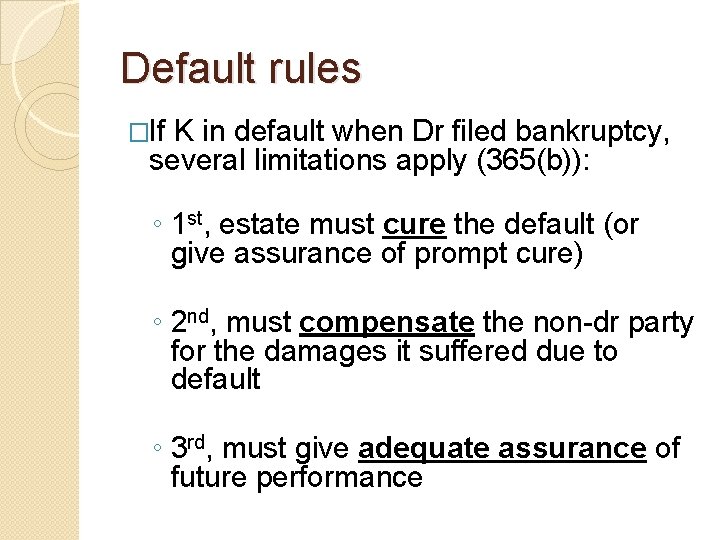
Default rules �If K in default when Dr filed bankruptcy, several limitations apply (365(b)): ◦ 1 st, estate must cure the default (or give assurance of prompt cure) ◦ 2 nd, must compensate the non-dr party for the damages it suffered due to default ◦ 3 rd, must give adequate assurance of future performance
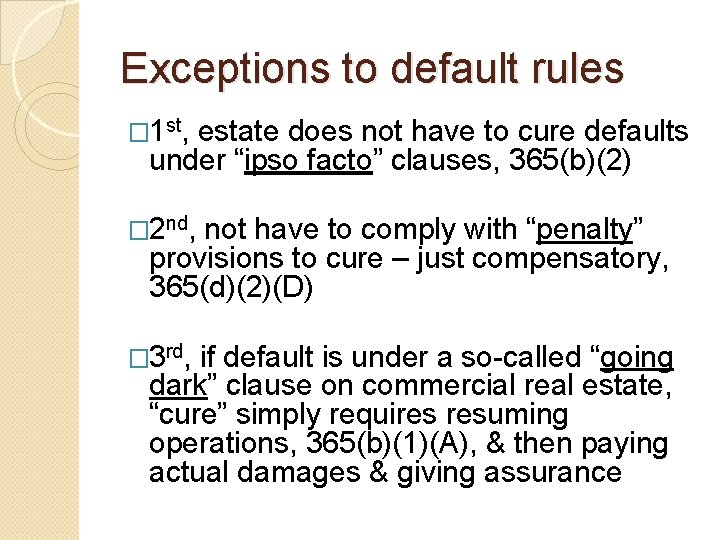
Exceptions to default rules � 1 st, estate does not have to cure defaults under “ipso facto” clauses, 365(b)(2) � 2 nd, not have to comply with “penalty” provisions to cure – just compensatory, 365(d)(2)(D) � 3 rd, if default is under a so-called “going dark” clause on commercial real estate, “cure” simply requires resuming operations, 365(b)(1)(A), & then paying actual damages & giving assurance
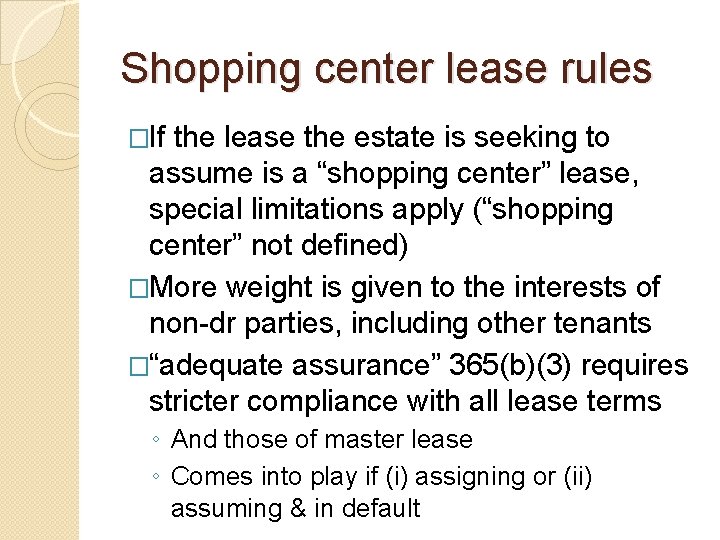
Shopping center lease rules �If the lease the estate is seeking to assume is a “shopping center” lease, special limitations apply (“shopping center” not defined) �More weight is given to the interests of non-dr parties, including other tenants �“adequate assurance” 365(b)(3) requires stricter compliance with all lease terms ◦ And those of master lease ◦ Comes into play if (i) assigning or (ii) assuming & in default
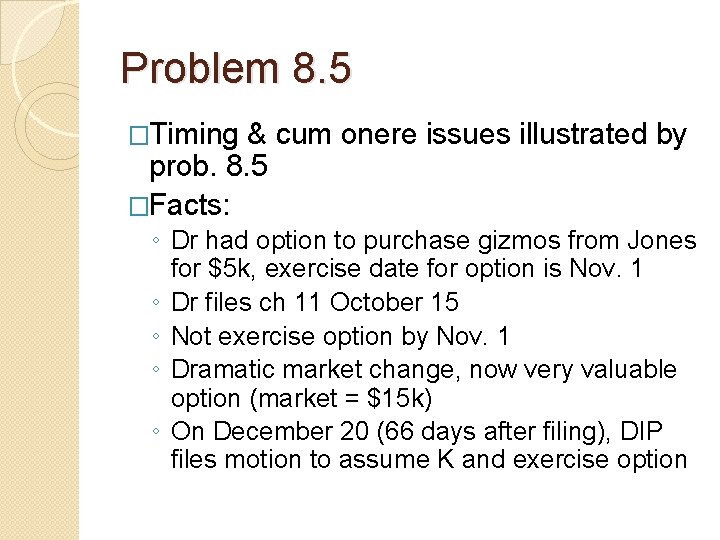
Problem 8. 5 �Timing & cum onere issues illustrated by prob. 8. 5 �Facts: ◦ Dr had option to purchase gizmos from Jones for $5 k, exercise date for option is Nov. 1 ◦ Dr files ch 11 October 15 ◦ Not exercise option by Nov. 1 ◦ Dramatic market change, now very valuable option (market = $15 k) ◦ On December 20 (66 days after filing), DIP files motion to assume K and exercise option
Option date passed? �The obvious problem, of course, is one involving the calendar, and the scope of the rights the Dr had under the K –namely, the option date has come and gone, without the option being exercised �Under Chicago Bd of Trade principles, Jones would argue that Dr’s (and now Estate’s) property right (option) was limited, requiring exercise by November 1
Do Executory K time rules trump? �DIP might argue, though, that ◦ (i) the option K is an “executory K” subject to 365 rules, which include ◦ (ii) the timing rule for chapter 11 cases, that DIP has until plan confirmation to act (365(d)(2)), and thus ◦ (iii) DIP has until plan confirmation to exercise the option
Analogize to default rules �DIP would buttress its argument by analogy to the case where Dr was in default pre-bk and non-dr gave a termination notice, but then once Dr filed bk (before termination became final), the “default” rules of 365(b) took over �And DIP has until plan confirmation to cure, etc.
Cum onere? �Jones’s response? ◦ 1 st, not a “default” simply not to exercise an option, so no “curing” to be done ◦ 2 nd, instead option exercise date is part of bundle of rights allocated in K – defines the nature of the property itself – and thus implicates “cum onere” ◦ 3 rd, under “cum onere” principle, even if DIP were to “assume” the K, what does estate get? a right to exercise an option by November 1! (which of course is now impossible)
Any other timing help for estate? �Thus, 365 itself may offer the estate no help in getting extra time �However, 108(b) might – gives trustee or DIP 60 days after filing to deal with any deadline under “an agreement” to “file any. . . demand, notice. . . or perform any similar act. ” ◦ Number of cts have applied this to options
108(b) 60 -day grace? �Thus, 108(b) might well give the estate an extra 60 days (from the bankruptcy filing) to exercise an option ◦ Could be a very valuable right! Does no good here, though, b/c DIP seeks to assume on Dec 20, which is 66 days after filing – too late!
- Slides: 70