
26 5 Summary of Renal Function Seven Steps

- Slides: 39
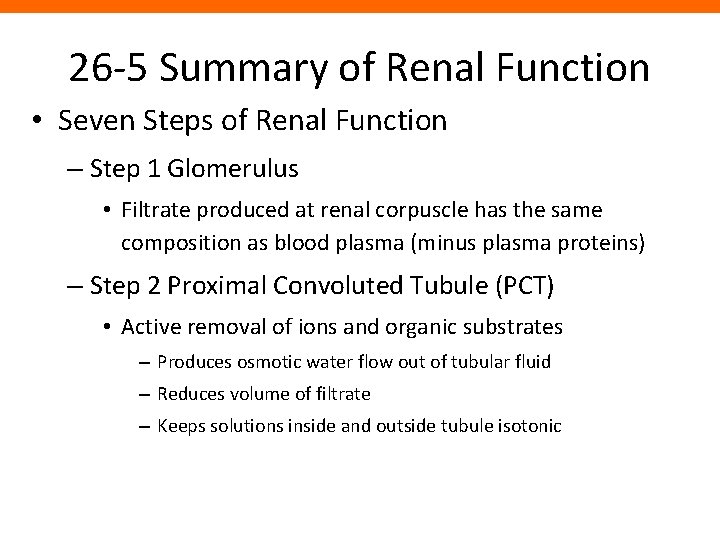
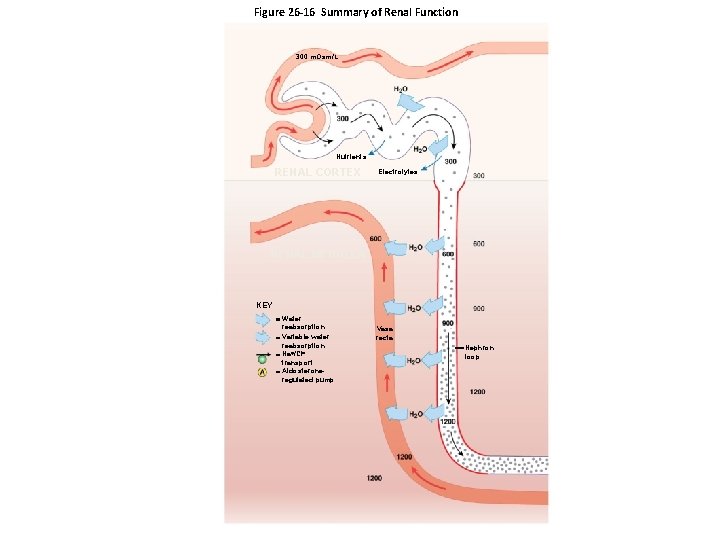
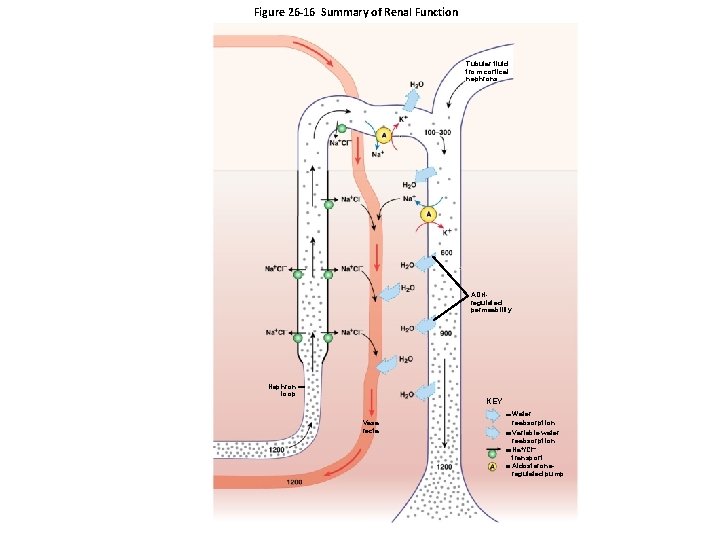
26 -5 Summary of Renal Function • Seven Steps of Renal Function – Step 1 Glomerulus • Filtrate produced at renal corpuscle has the same composition as blood plasma (minus plasma proteins) – Step 2 Proximal Convoluted Tubule (PCT) • Active removal of ions and organic substrates – Produces osmotic water flow out of tubular fluid – Reduces volume of filtrate – Keeps solutions inside and outside tubule isotonic
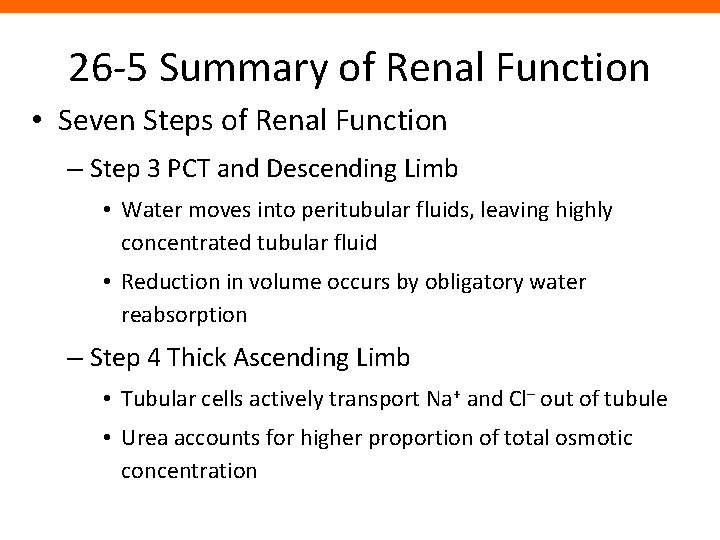
26 -5 Summary of Renal Function • Seven Steps of Renal Function – Step 3 PCT and Descending Limb • Water moves into peritubular fluids, leaving highly concentrated tubular fluid • Reduction in volume occurs by obligatory water reabsorption – Step 4 Thick Ascending Limb • Tubular cells actively transport Na+ and Cl– out of tubule • Urea accounts for higher proportion of total osmotic concentration
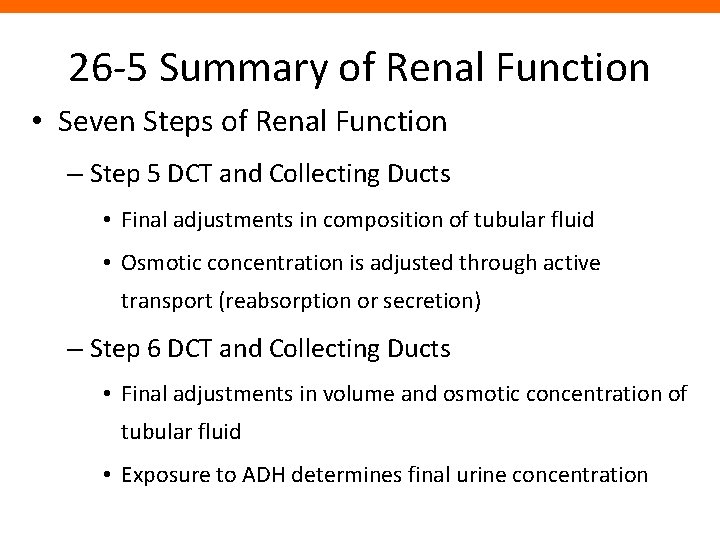
26 -5 Summary of Renal Function • Seven Steps of Renal Function – Step 5 DCT and Collecting Ducts • Final adjustments in composition of tubular fluid • Osmotic concentration is adjusted through active transport (reabsorption or secretion) – Step 6 DCT and Collecting Ducts • Final adjustments in volume and osmotic concentration of tubular fluid • Exposure to ADH determines final urine concentration
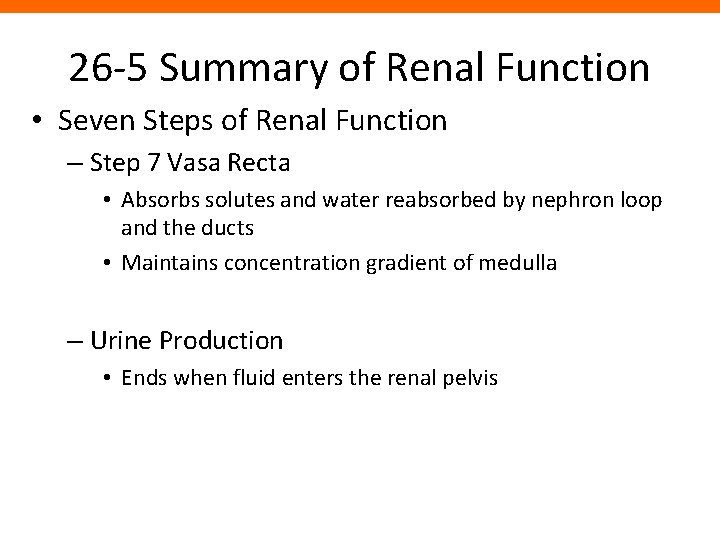
26 -5 Summary of Renal Function • Seven Steps of Renal Function – Step 7 Vasa Recta • Absorbs solutes and water reabsorbed by nephron loop and the ducts • Maintains concentration gradient of medulla – Urine Production • Ends when fluid enters the renal pelvis
Figure 26 -16 Summary of Renal Function 300 m. Osm/L Nutrients RENAL CORTEX Electrolytes RENAL MEDULLA KEY Water reabsorption Variable water reabsorption Na /Cl transport Aldosteroneregulated pump Vasa recta Nephron loop
Figure 26 -16 Summary of Renal Function Tubular fluid from cortical nephrons ADHregulated permeability Nephron loop KEY Vasa recta Water reabsorption Variable water reabsorption Na /Cl transport Aldosteroneregulated pump
26 -6 Urine Transport, Storage, and Elimination • Urine Transport, Storage, and Elimination – Take place in the urinary tract • Ureters • Urinary bladder • Urethra • Structures – Minor and major calyces, renal pelvis, ureters, urinary bladder, and proximal portion of urethra • Are lined by transitional epithelium • That undergoes cycles of distention and contraction
26 -6 Urine Transport, Storage, and Elimination • The Ureters – Are a pair of muscular tubes – Extend from kidneys to urinary bladder – Begin at renal pelvis – Pass over psoas major muscles – Are retroperitoneal, attached to posterior abdominal wall – Penetrate posterior wall of the urinary bladder – Pass through bladder wall at oblique angle – Ureteral openings are slit-like rather than rounded – Shape helps prevent backflow of urine when urinary bladder contracts
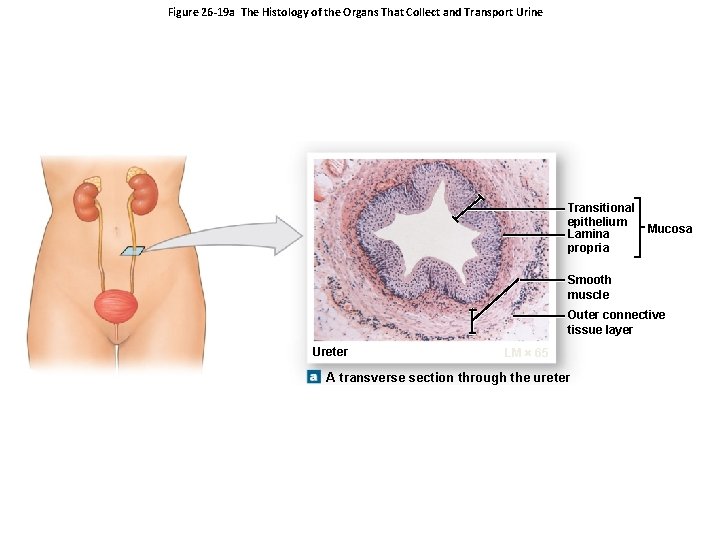
26 -6 Urine Transport, Storage, and Elimination • Histology of the Ureters – The wall of each ureter has three layers 1. Inner mucosa – Transitional epithelium and lamina propria 2. Middle muscular layer – Longitudinal and circular bands of smooth muscle 3. Outer connective tissue layer – Continuous with fibrous renal capsule and peritoneum
Figure 26 -19 a The Histology of the Organs That Collect and Transport Urine Transitional epithelium Lamina propria Mucosa Smooth muscle Outer connective tissue layer Ureter LM 65 A transverse section through the ureter
26 -6 Urine Transport, Storage, and Elimination • Peristaltic Contractions – Begin at renal pelvis – Sweep along ureter – Force urine toward urinary bladder – Every 30 seconds
26 -6 Urine Transport, Storage, and Elimination • The Urinary Bladder – Is a hollow, muscular organ – Functions as temporary reservoir for urine storage – Full bladder can contain 1 liter of urine
26 -6 Urine Transport, Storage, and Elimination • Bladder Position – Is stabilized by several peritoneal folds – Posterior, inferior, and anterior surfaces • Lie outside peritoneal cavity – Ligamentous bands • Anchor urinary bladder to pelvic and pubic bones
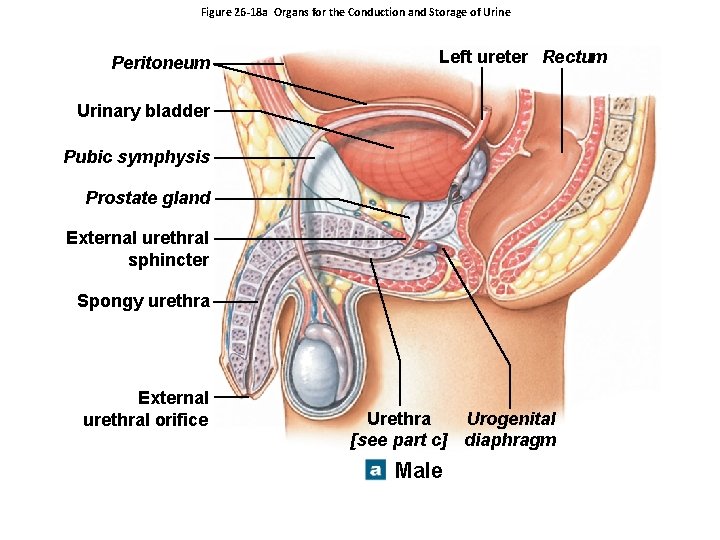
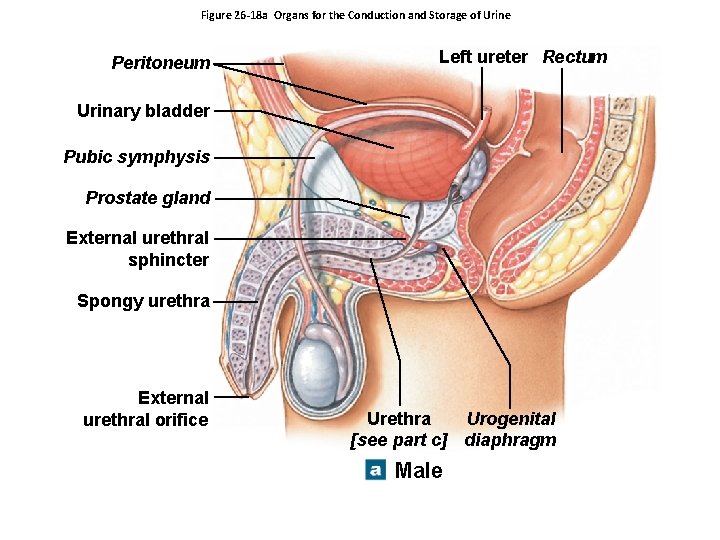
Figure 26 -18 a Organs for the Conduction and Storage of Urine Peritoneum Left ureter Rectum Urinary bladder Pubic symphysis Prostate gland External urethral sphincter Spongy urethra External urethral orifice Urethra Urogenital [see part c] diaphragm Male
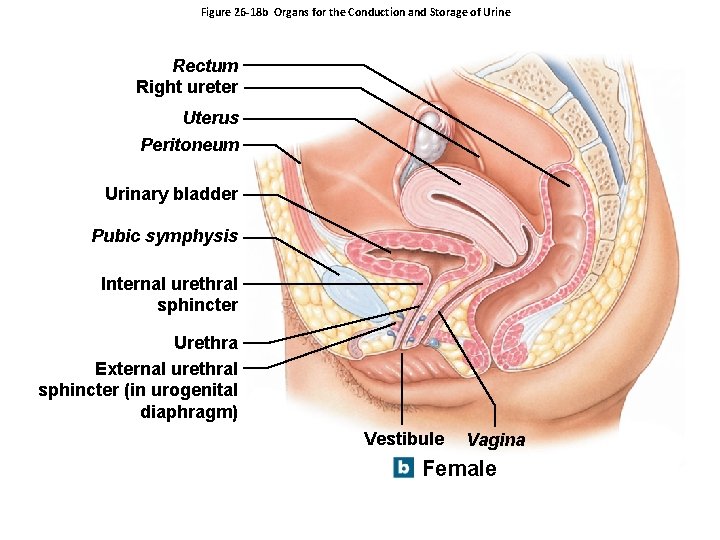
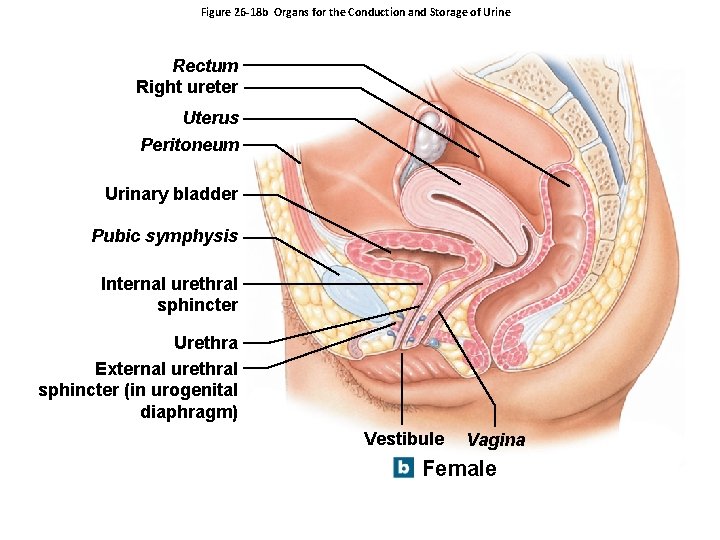
Figure 26 -18 b Organs for the Conduction and Storage of Urine Rectum Right ureter Uterus Peritoneum Urinary bladder Pubic symphysis Internal urethral sphincter Urethra External urethral sphincter (in urogenital diaphragm) Vestibule Vagina Female
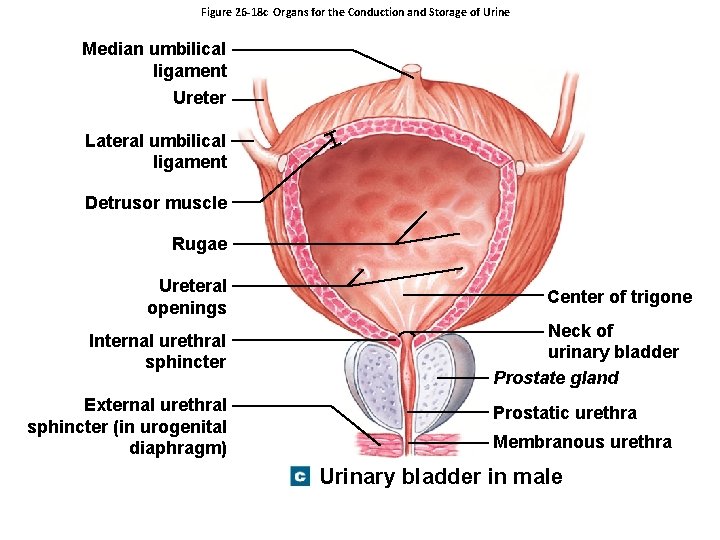
26 -6 Urine Transport, Storage, and Elimination • Umbilical Ligaments of Bladder – Median umbilical ligament extends: • From anterior, superior border • Toward umbilicus – Lateral umbilical ligaments • Pass along sides of bladder to umbilicus • Are vestiges of two umbilical arteries
Figure 26 -18 c Organs for the Conduction and Storage of Urine Median umbilical ligament Ureter Lateral umbilical ligament Detrusor muscle Rugae Ureteral openings Internal urethral sphincter External urethral sphincter (in urogenital diaphragm) Center of trigone Neck of urinary bladder Prostate gland Prostatic urethra Membranous urethra Urinary bladder in male
26 -6 Urine Transport, Storage, and Elimination • The Mucosa – Lining the urinary bladder, has folds (rugae) that disappear as bladder fills • The Trigone of the Urinary Bladder – Is a triangular area bounded by: • Openings of ureters • Entrance to urethra – Acts as a funnel • Channels urine from bladder into urethra
26 -6 Urine Transport, Storage, and Elimination • The Urethral Entrance – Lies at apex of trigone • At most inferior point in urinary bladder • The Neck of the Urinary Bladder – Is the region surrounding urethral opening – Contains a muscular internal urethral sphincter • Smooth muscle fibers of sphincter • Provides involuntary control of urine discharge
26 -6 Urine Transport, Storage, and Elimination • Urinary Bladder Innervation – Postganglionic fibers • From ganglia in hypogastric plexus – Parasympathetic fibers • From intramural ganglia controlled by pelvic nerves
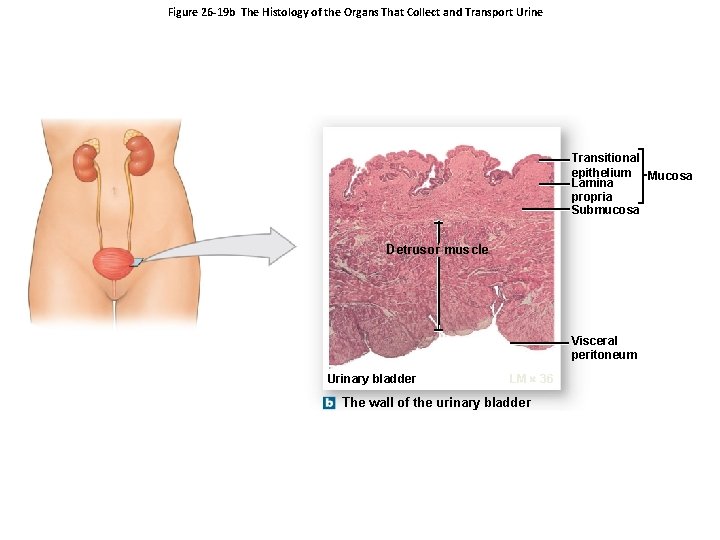
26 -6 Urine Transport, Storage, and Elimination • Histology of the Urinary Bladder – The wall of the urinary bladder contains mucosa, submucosa, and muscularis layers • The Muscularis Layer – Consists of the detrusor muscle – Inner and outer layers of longitudinal smooth muscle with a circular layer in between
Figure 26 -19 b The Histology of the Organs That Collect and Transport Urine Transitional epithelium Mucosa Lamina propria Submucosa Detrusor muscle Visceral peritoneum Urinary bladder LM 36 The wall of the urinary bladder
26 -6 Urine Transport, Storage, and Elimination • The Urethra – Extends from neck of urinary bladder – To the exterior of the body
26 -6 Urine Transport, Storage, and Elimination • The Male Urethra – Extends from neck of urinary bladder to tip of penis (18– 20 cm; 7– 8 in. ) – Prostatic urethra passes through center of prostate gland – Membranous urethra includes short segment that penetrates the urogenital diaphragm – Spongy urethra (penile urethra) extends from urogenital diaphragm to external urethral orifice
Figure 26 -18 a Organs for the Conduction and Storage of Urine Peritoneum Left ureter Rectum Urinary bladder Pubic symphysis Prostate gland External urethral sphincter Spongy urethra External urethral orifice Urethra Urogenital [see part c] diaphragm Male
26 -6 Urine Transport, Storage, and Elimination • The Female Urethra – Is very short (3– 5 cm; 1– 2 in. ) – Extends from bladder to vestibule – External urethral orifice is near anterior wall of vagina
Figure 26 -18 b Organs for the Conduction and Storage of Urine Rectum Right ureter Uterus Peritoneum Urinary bladder Pubic symphysis Internal urethral sphincter Urethra External urethral sphincter (in urogenital diaphragm) Vestibule Vagina Female
26 -6 Urine Transport, Storage, and Elimination • The External Urethral Sphincter – In both sexes • Is a circular band of skeletal muscle • Where urethra passes through urogenital diaphragm – Acts as a valve – Is under voluntary control • Via perineal branch of pudendal nerve – Has resting muscle tone – Voluntary relaxation permits micturition
26 -6 Urine Transport, Storage, and Elimination • Histology of the Urethra – Lamina propria is thick and elastic – Mucous membrane has longitudinal folds – Mucin-secreting cells lie in epithelial pockets
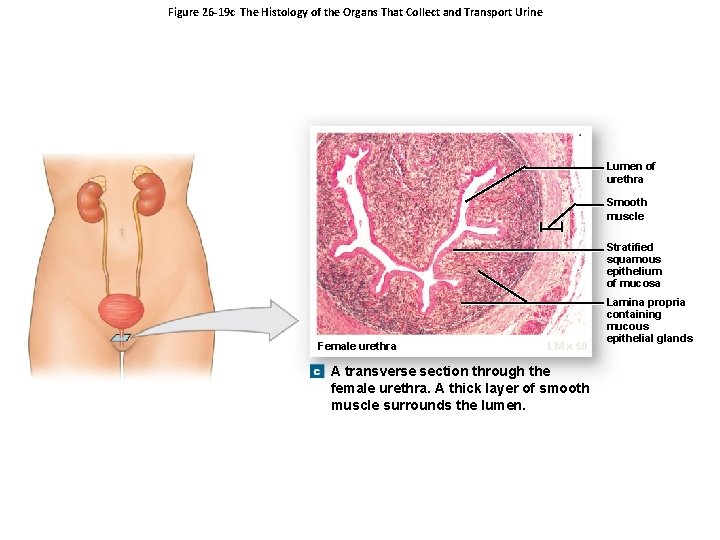
26 -6 Urine Transport, Storage, and Elimination • Male Structures of the Urethra – Epithelial mucous glands • Form tubules that extend into lamina propria – Connective tissues of lamina propria • Anchor urethra to surrounding structures • Female Structures of the Urethra – Lamina propria contains extensive network of veins – Complex is surrounded by concentric layers of smooth muscle
Figure 26 -19 c The Histology of the Organs That Collect and Transport Urine Lumen of urethra Smooth muscle Stratified squamous epithelium of mucosa Female urethra LM 50 A transverse section through the female urethra. A thick layer of smooth muscle surrounds the lumen. Lamina propria containing mucous epithelial glands
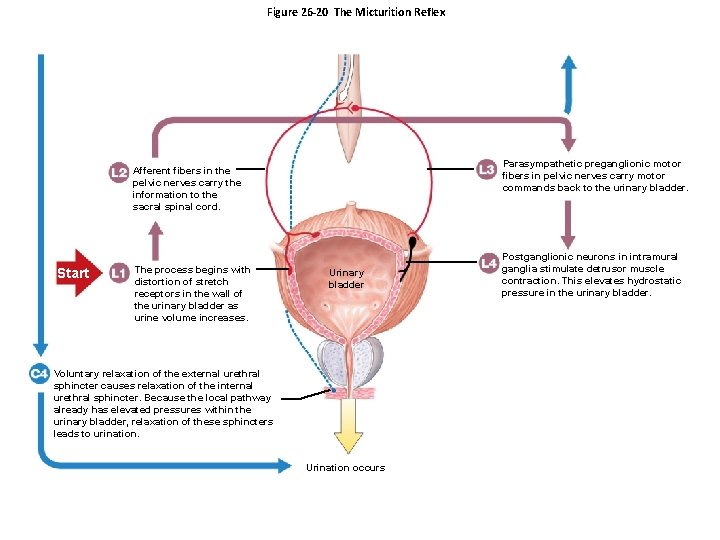
26 -6 Urine Transport, Storage, and Elimination • The Micturition Reflex and Urination – As the bladder fills with urine: • Stretch receptors in urinary bladder stimulate sensory fibers in pelvic nerve • Stimulus travels from afferent fibers in pelvic nerves to sacral spinal cord – Efferent fibers in pelvic nerves: • Stimulate ganglionic neurons in wall of bladder
26 -6 Urine Transport, Storage, and Elimination • The Micturition Reflex and Urination – Postganglionic neuron in intramural ganglion stimulates detrusor muscle contraction – Interneuron relays sensation to thalamus – Projection fibers from thalamus deliver sensation to cerebral cortex – Voluntary relaxation of external urethral sphincter causes relaxation of internal urethral sphincter
26 -6 Urine Transport, Storage, and Elimination • The Micturition Reflex and Urination – Begins when stretch receptors stimulate parasympathetic preganglionic motor neurons – Volume >500 m. L triggers micturition reflex
Figure 26 -20 The Micturition Reflex Parasympathetic preganglionic motor fibers in pelvic nerves carry motor commands back to the urinary bladder. Afferent fibers in the pelvic nerves carry the information to the sacral spinal cord. Start The process begins with distortion of stretch receptors in the wall of the urinary bladder as urine volume increases. Urinary bladder Voluntary relaxation of the external urethral sphincter causes relaxation of the internal urethral sphincter. Because the local pathway already has elevated pressures within the urinary bladder, relaxation of these sphincters leads to urination. Urination occurs Postganglionic neurons in intramural ganglia stimulate detrusor muscle contraction. This elevates hydrostatic pressure in the urinary bladder.
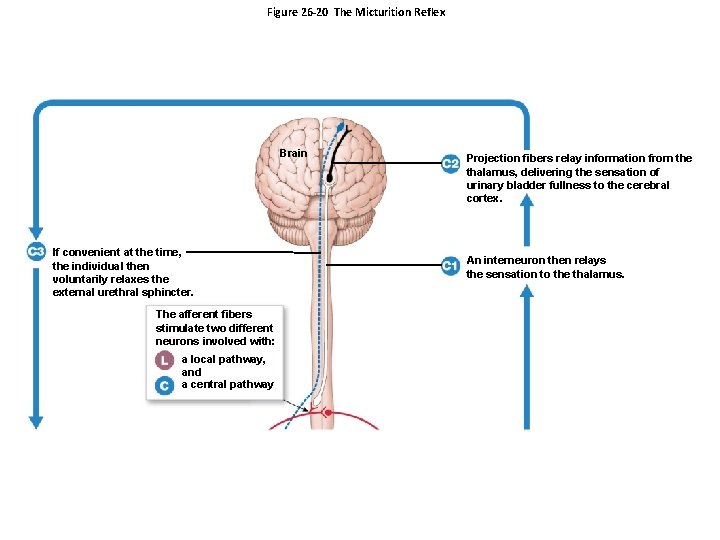
Figure 26 -20 The Micturition Reflex Brain If convenient at the time, the individual then voluntarily relaxes the external urethral sphincter. The afferent fibers stimulate two different neurons involved with: a local pathway, and a central pathway Projection fibers relay information from the thalamus, delivering the sensation of urinary bladder fullness to the cerebral cortex. An interneuron then relays the sensation to the thalamus.
26 -6 Urine Transport, Storage, and Elimination • Infants – Lack voluntary control over urination – Corticospinal connections are not established • Incontinence – Is the inability to control urination voluntarily – May be caused by trauma to internal or external urethral sphincter
26 -7 Effects of Aging on the Urinary System • Age-related Changes – Decline in number of functional nephrons – Reduction in GFR – Reduced sensitivity to ADH – Problems with micturition reflex • Sphincter muscles lose tone leading to incontinence • Control of micturition can be lost due to a stroke, Alzheimer’s disease, and other CNS problems • In males, urinary retention may develop if enlarged prostate gland compresses the urethra and restricts urine flow