
25 years of quality of service research where
- Slides: 66
25 years of quality of service research - where next? Henning Schulzrinne Columbia University (with Omer Boyaci, Andrea Forte, Kyung-Hwa Kim)
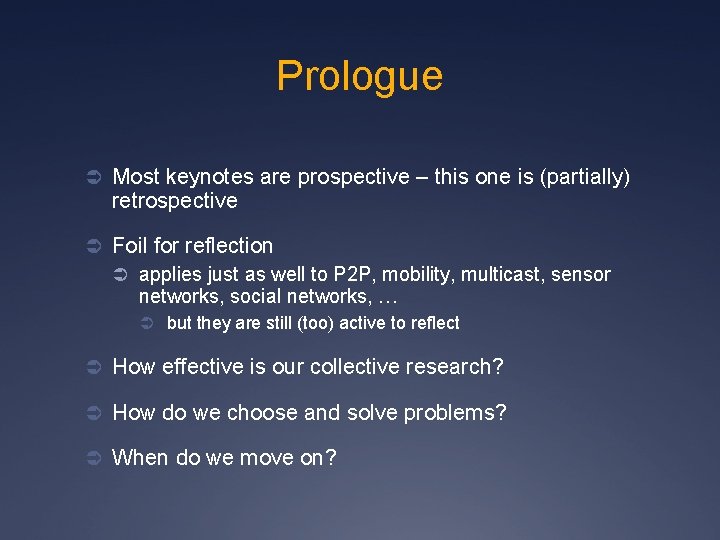
Prologue Ü Most keynotes are prospective – this one is (partially) retrospective Ü Foil for reflection Ü applies just as well to P 2 P, mobility, multicast, sensor networks, social networks, … Ü but they are still (too) active to reflect Ü How effective is our collective research? Ü How do we choose and solve problems? Ü When do we move on?
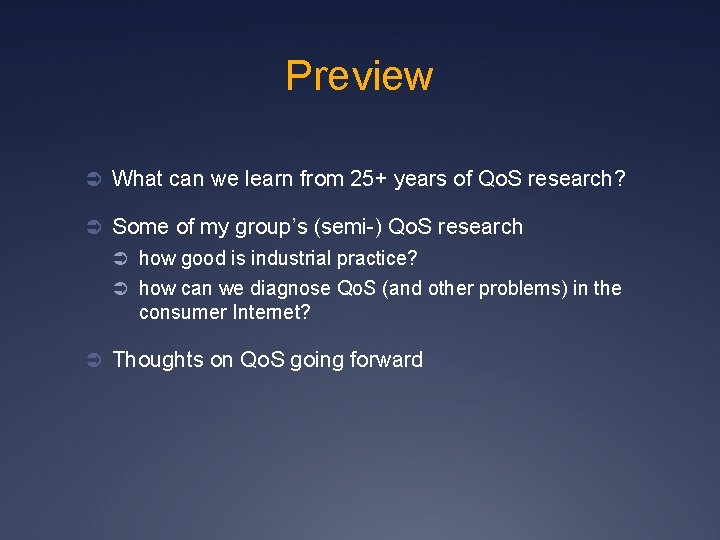
Preview Ü What can we learn from 25+ years of Qo. S research? Ü Some of my group’s (semi-) Qo. S research Ü how good is industrial practice? Ü how can we diagnose Qo. S (and other problems) in the consumer Internet? Ü Thoughts on Qo. S going forward
About (networking) research
My assumptions Ü We’re an engineering discipline Ü “Engineering is the discipline, art and profession of acquiring and applying technical, scientific, and mathematical knowledge to design and implement materials, structures, machines, devices, systems, and processes that safely realize a desired objective or invention. ” Ü Other (good) possibilities: Ü we train future engineers Ü we train future researchers
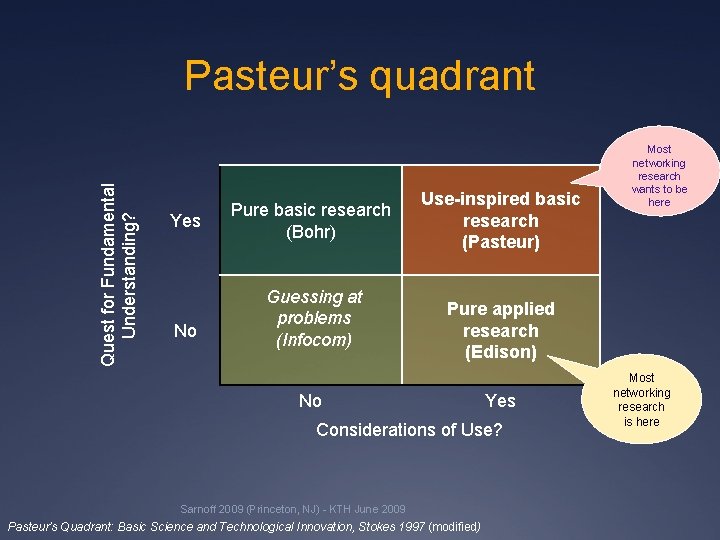
Quest for Fundamental Understanding? Pasteur’s quadrant Yes No Pure basic research (Bohr) Guessing at problems (Infocom) Use-inspired basic research (Pasteur) Most networking research wants to be here Pure applied research (Edison) No Yes Considerations of Use? Sarnoff 2009 (Princeton, NJ) - KTH June 2009 Pasteur’s Quadrant: Basic Science and Technological Innovation, Stokes 1997 (modified) Most networking research is here
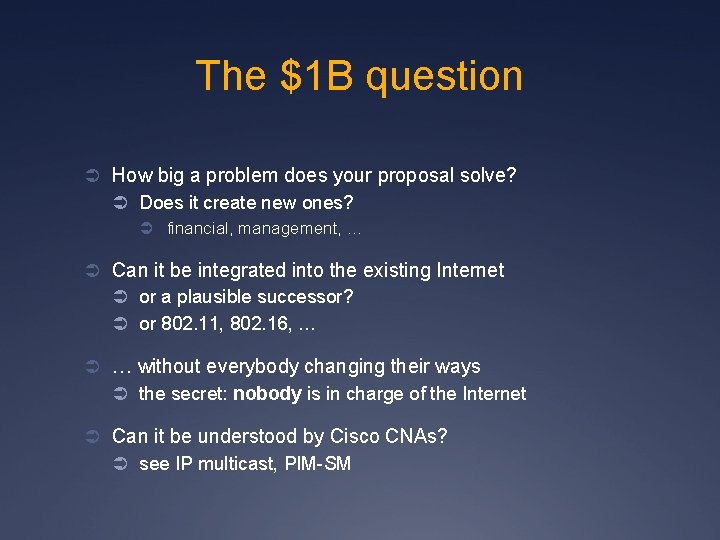
The $1 B question Ü How big a problem does your proposal solve? Ü Does it create new ones? Ü financial, management, … Ü Can it be integrated into the existing Internet Ü or a plausible successor? Ü or 802. 11, 802. 16, … Ü … without everybody changing their ways Ü the secret: nobody is in charge of the Internet Ü Can it be understood by Cisco CNAs? Ü see IP multicast, PIM-SM
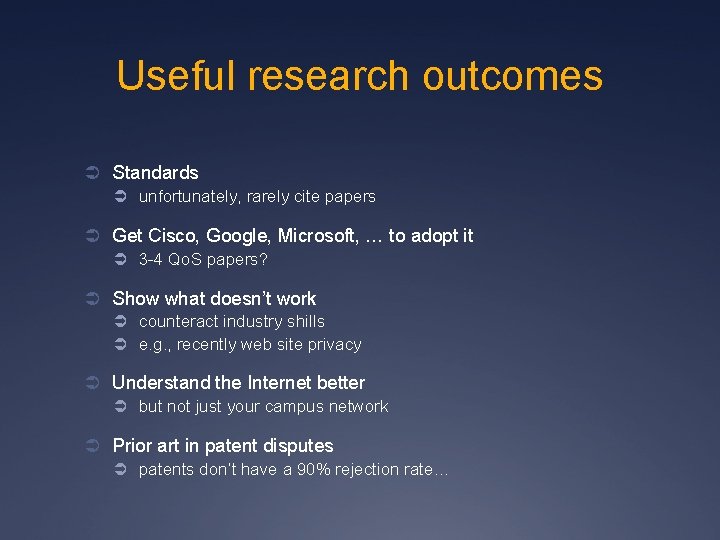
Useful research outcomes Ü Standards Ü unfortunately, rarely cite papers Ü Get Cisco, Google, Microsoft, … to adopt it Ü 3 -4 Qo. S papers? Ü Show what doesn’t work Ü counteract industry shills Ü e. g. , recently web site privacy Ü Understand the Internet better Ü but not just your campus network Ü Prior art in patent disputes Ü patents don’t have a 90% rejection rate…
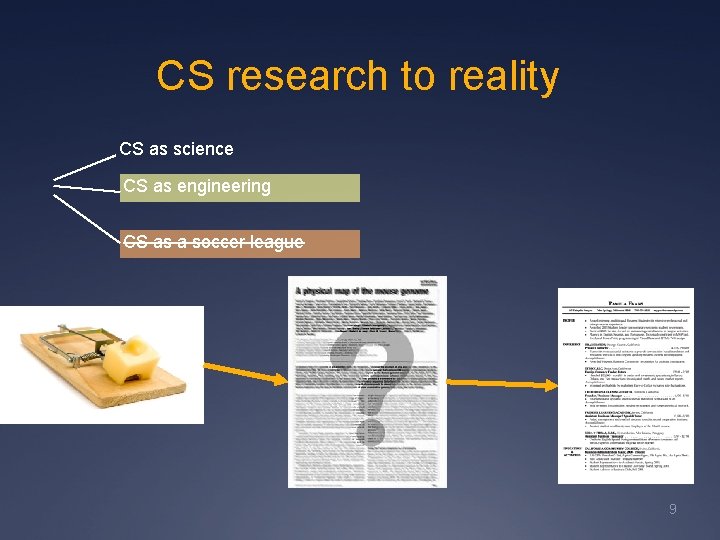
CS research to reality CS as science CS as engineering CS as a soccer league 9
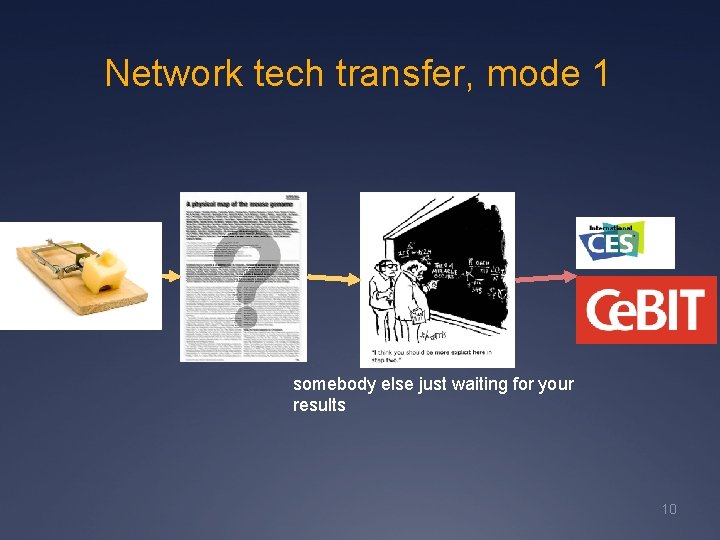
Network tech transfer, mode 1 somebody else just waiting for your results 10
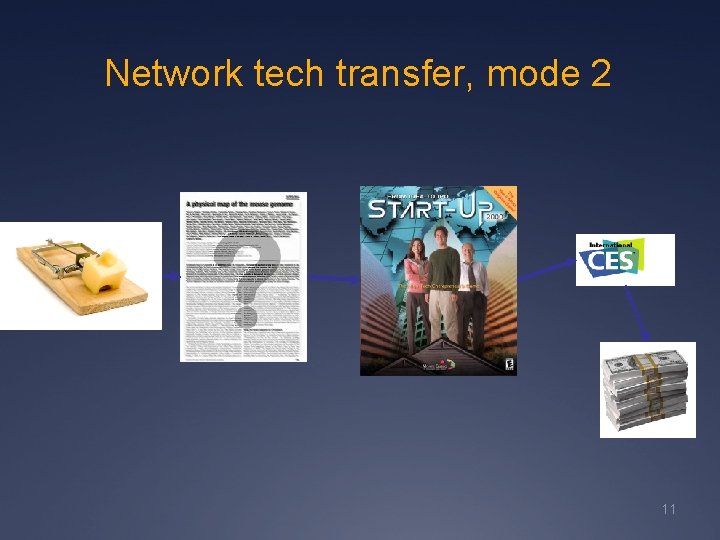
Network tech transfer, mode 2 11
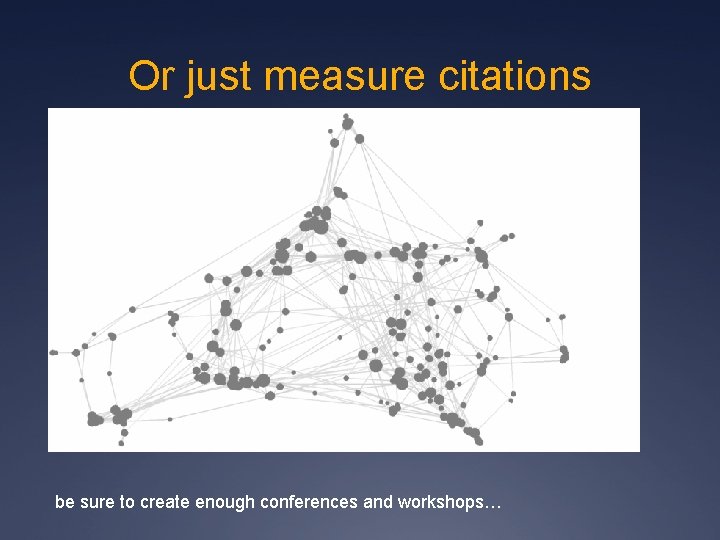
Or just measure citations be sure to create enough conferences and workshops…
Qo. S research
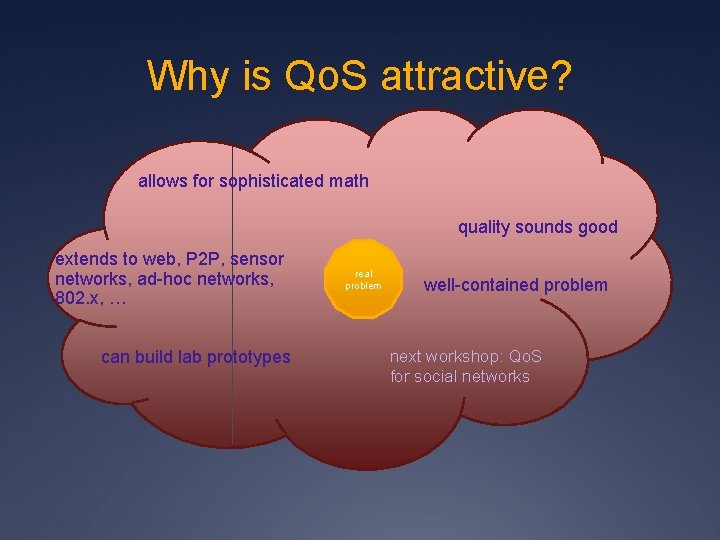
Why is Qo. S attractive? allows for sophisticated math quality sounds good extends to web, P 2 P, sensor networks, ad-hoc networks, 802. x, … can build lab prototypes real problem well-contained problem next workshop: Qo. S for social networks
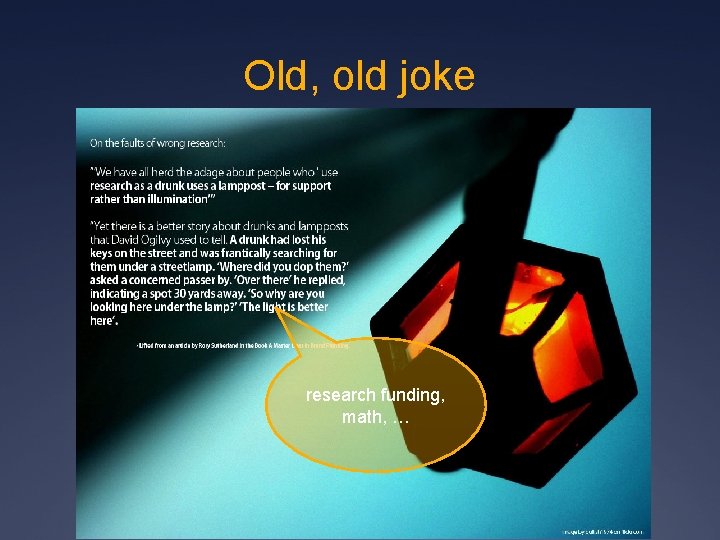
Old, old joke research funding, math, …
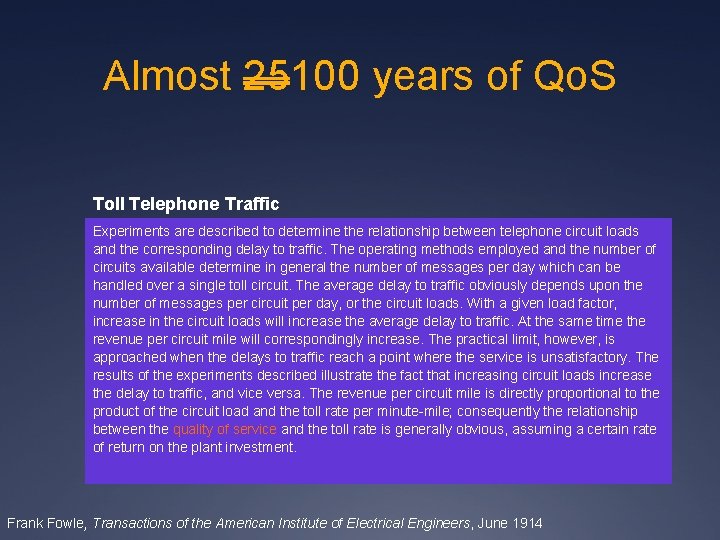
Almost 25100 years of Qo. S Toll Telephone Traffic Experiments are described to determine the relationship between telephone circuit loads and the corresponding delay to traffic. The operating methods employed and the number of circuits available determine in general the number of messages per day which can be handled over a single toll circuit. The average delay to traffic obviously depends upon the number of messages per circuit per day, or the circuit loads. With a given load factor, increase in the circuit loads will increase the average delay to traffic. At the same time the revenue per circuit mile will correspondingly increase. The practical limit, however, is approached when the delays to traffic reach a point where the service is unsatisfactory. The results of the experiments described illustrate the fact that increasing circuit loads increase the delay to traffic, and vice versa. The revenue per circuit mile is directly proportional to the product of the circuit load and the toll rate per minute-mile; consequently the relationship between the quality of service and the toll rate is generally obvious, assuming a certain rate of return on the plant investment. Frank Fowle, Transactions of the American Institute of Electrical Engineers, June 1914
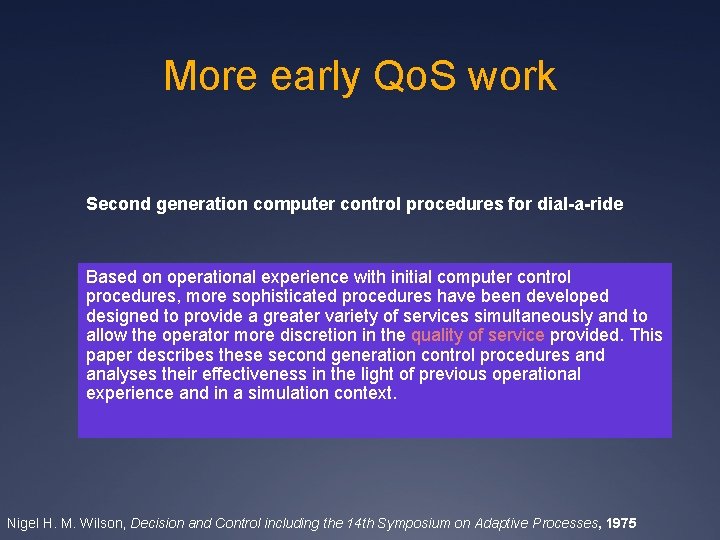
More early Qo. S work Second generation computer control procedures for dial-a-ride Based on operational experience with initial computer control procedures, more sophisticated procedures have been developed designed to provide a greater variety of services simultaneously and to allow the operator more discretion in the quality of service provided. This paper describes these second generation control procedures and analyses their effectiveness in the light of previous operational experience and in a simulation context. Nigel H. M. Wilson, Decision and Control including the 14 th Symposium on Adaptive Processes, 1975
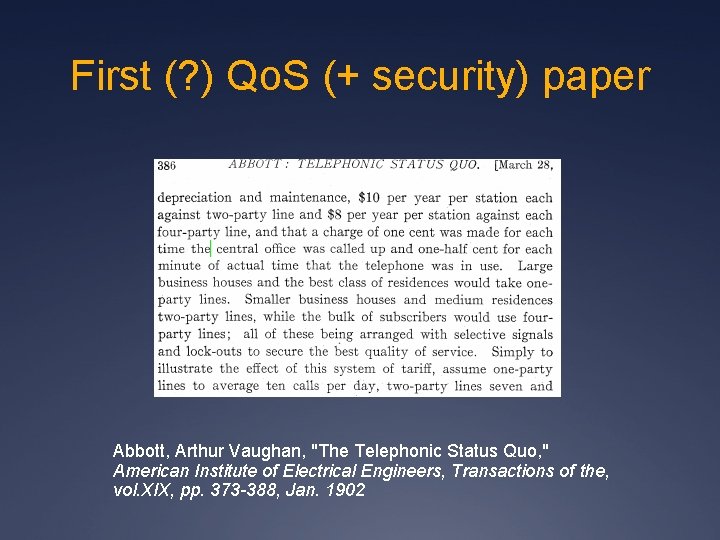
First (? ) Qo. S (+ security) paper Abbott, Arthur Vaughan, "The Telephonic Status Quo, " American Institute of Electrical Engineers, Transactions of the, vol. XIX, pp. 373 -388, Jan. 1902
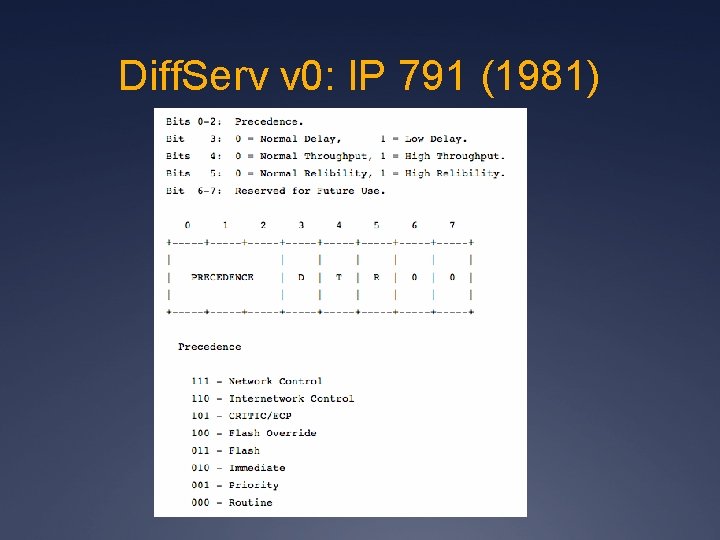
Diff. Serv v 0: IP 791 (1981)
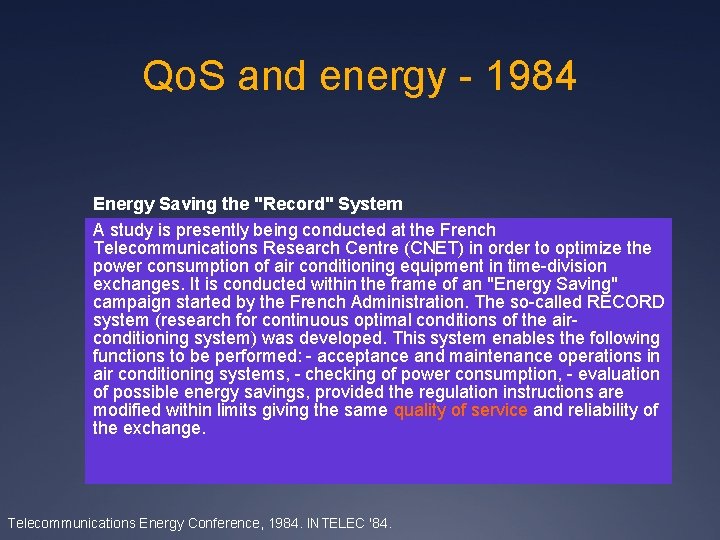
Qo. S and energy - 1984 Energy Saving the "Record" System A study is presently being conducted at the French Telecommunications Research Centre (CNET) in order to optimize the power consumption of air conditioning equipment in time-division exchanges. It is conducted within the frame of an "Energy Saving" campaign started by the French Administration. The so-called RECORD system (research for continuous optimal conditions of the airconditioning system) was developed. This system enables the following functions to be performed: - acceptance and maintenance operations in air conditioning systems, - checking of power consumption, - evaluation of possible energy savings, provided the regulation instructions are modified within limits giving the same quality of service and reliability of the exchange. Telecommunications Energy Conference, 1984. INTELEC '84.
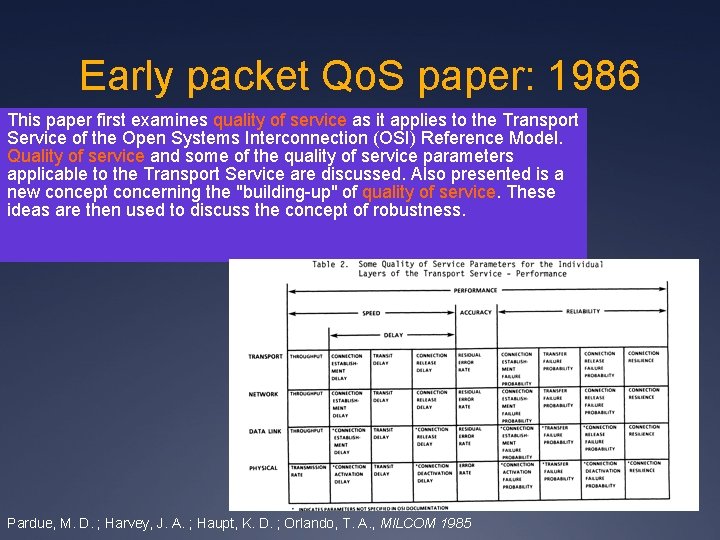
Early packet Qo. S paper: 1986 This paper first examines quality of service as it applies to the Transport Service of the Open Systems Interconnection (OSI) Reference Model. Quality of service and some of the quality of service parameters applicable to the Transport Service are discussed. Also presented is a new concept concerning the "building-up" of quality of service. These ideas are then used to discuss the concept of robustness. Pardue, M. D. ; Harvey, J. A. ; Haupt, K. D. ; Orlando, T. A. , MILCOM 1985
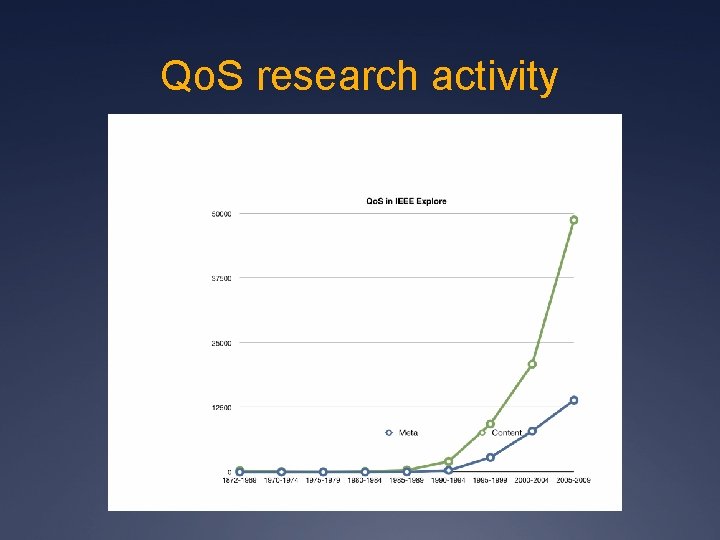
Qo. S research activity
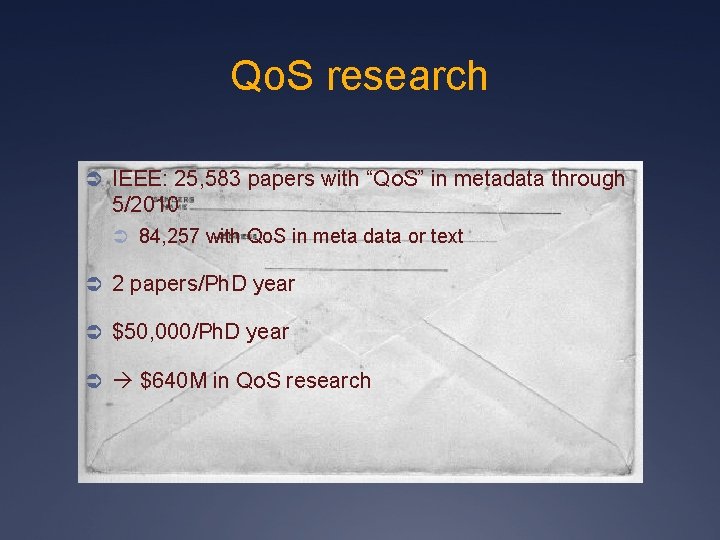
Qo. S research Ü IEEE: 25, 583 papers with “Qo. S” in metadata through 5/2010 Ü 84, 257 with Qo. S in meta data or text Ü 2 papers/Ph. D year Ü $50, 000/Ph. D year Ü $640 M in Qo. S research
What might we learn?
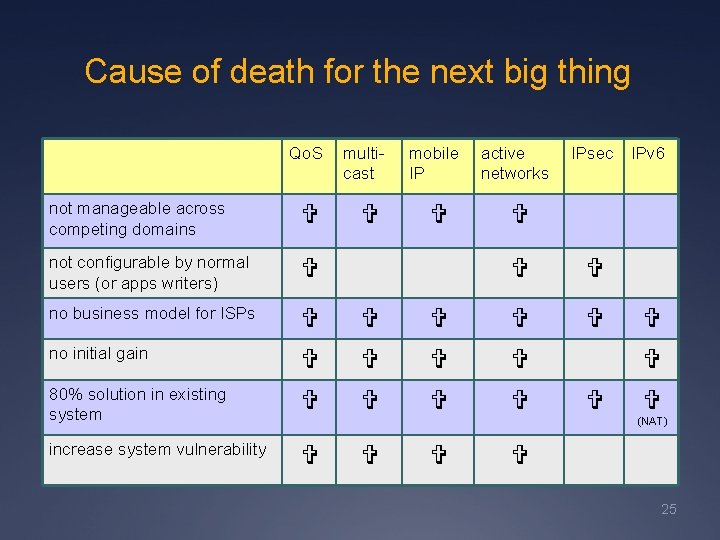
Cause of death for the next big thing Qo. S multicast not manageable across competing domains not configurable by normal users (or apps writers) no business model for ISPs no initial gain 80% solution in existing system increase system vulnerability mobile IP active networks IPsec IPv 6 (NAT) 25
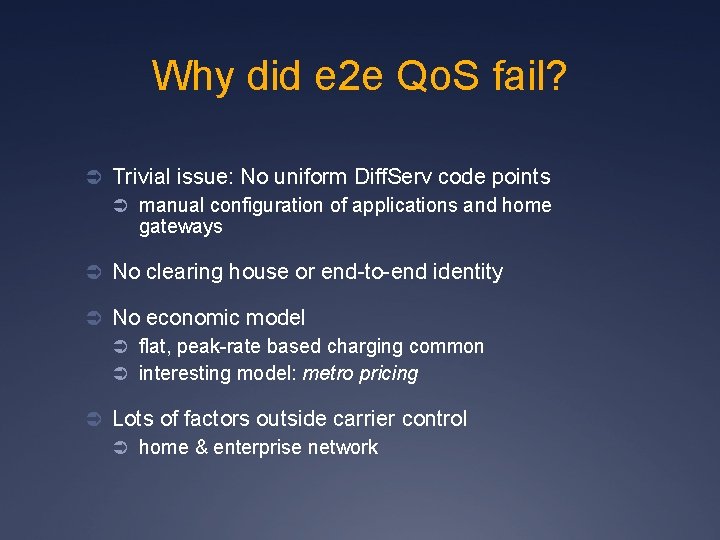
Why did e 2 e Qo. S fail? Ü Trivial issue: No uniform Diff. Serv code points Ü manual configuration of applications and home gateways Ü No clearing house or end-to-end identity Ü No economic model Ü flat, peak-rate based charging common Ü interesting model: metro pricing Ü Lots of factors outside carrier control Ü home & enterprise network
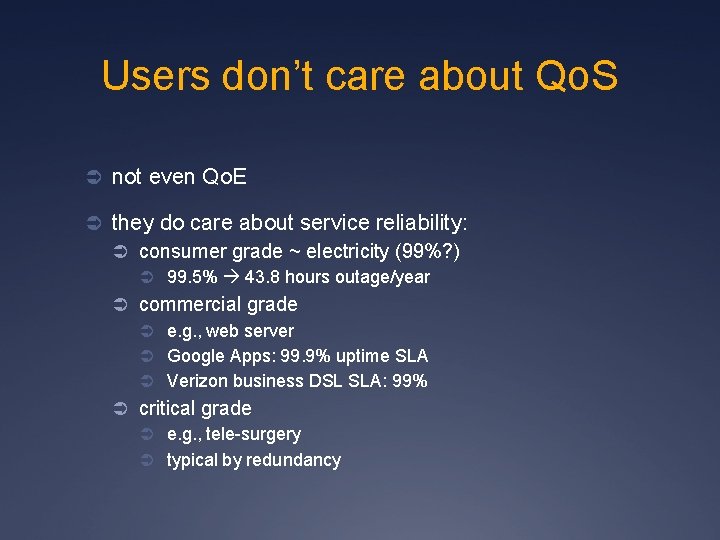
Users don’t care about Qo. S Ü not even Qo. E Ü they do care about service reliability: Ü consumer grade ~ electricity (99%? ) Ü 99. 5% 43. 8 hours outage/year Ü commercial grade Ü e. g. , web server Ü Google Apps: 99. 9% uptime SLA Ü Verizon business DSL SLA: 99% Ü critical grade Ü e. g. , tele-surgery Ü typical by redundancy
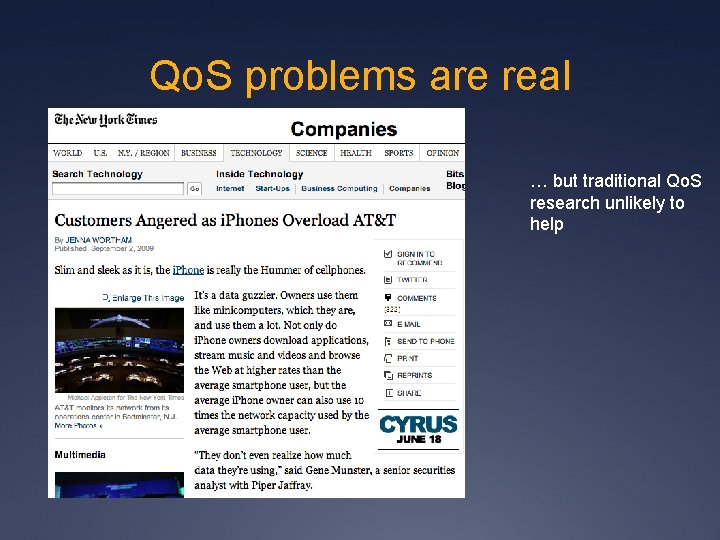
Qo. S problems are real … but traditional Qo. S research unlikely to help
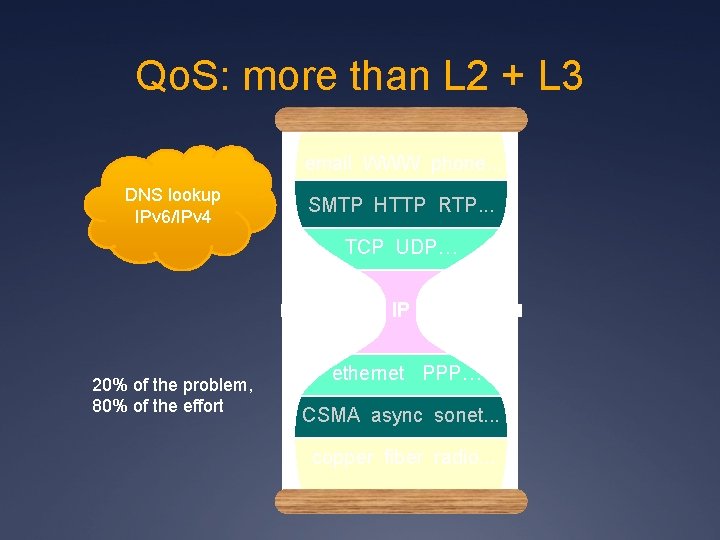
Qo. S: more than L 2 + L 3 email WWW phone. . . DNS lookup IPv 6/IPv 4 SMTP HTTP RTP. . . TCP UDP… IP 20% of the problem, 80% of the effort ethernet PPP… CSMA async sonet. . . copper fiber radio. . .
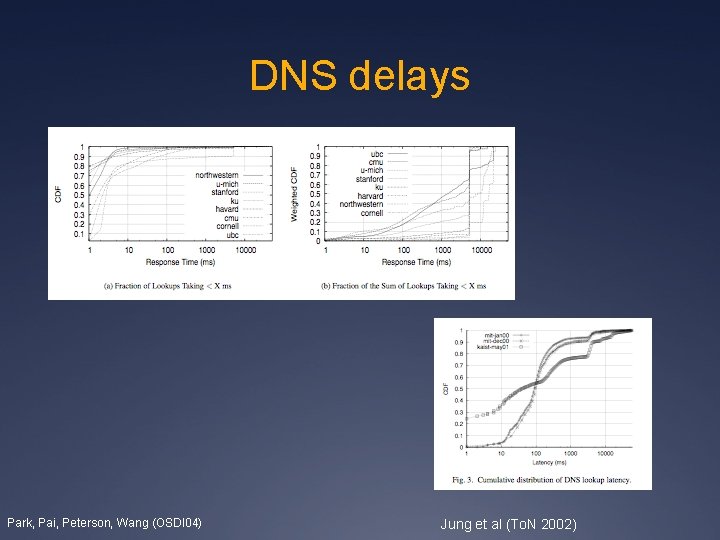
DNS delays Park, Pai, Peterson, Wang (OSDI 04) Jung et al (To. N 2002)
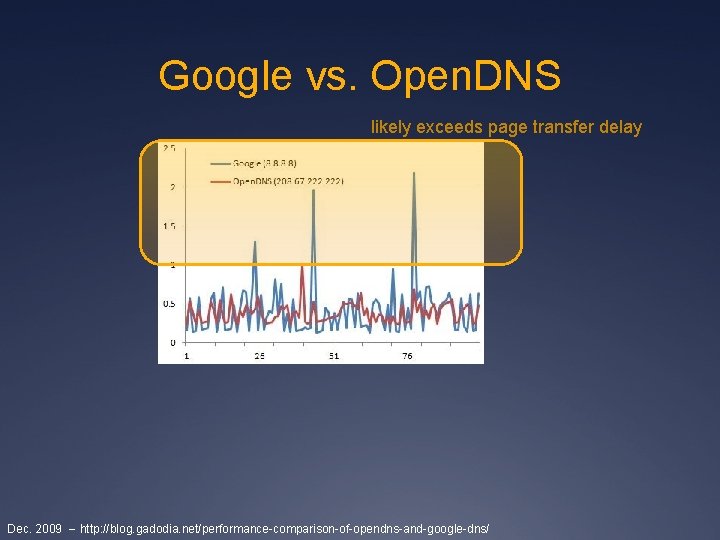
Google vs. Open. DNS likely exceeds page transfer delay Dec. 2009 -- http: //blog. gadodia. net/performance-comparison-of-opendns-and-google-dns/
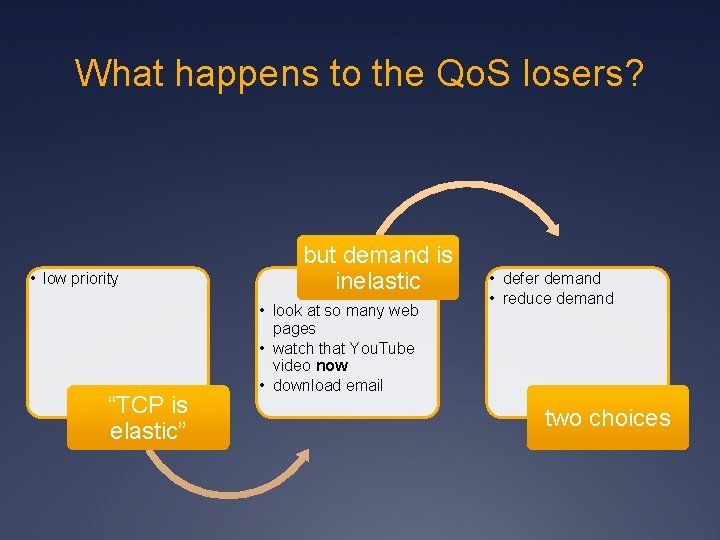
What happens to the Qo. S losers? • low priority “TCP is elastic” but demand is inelastic • look at so many web pages • watch that You. Tube video now • download email • defer demand • reduce demand two choices
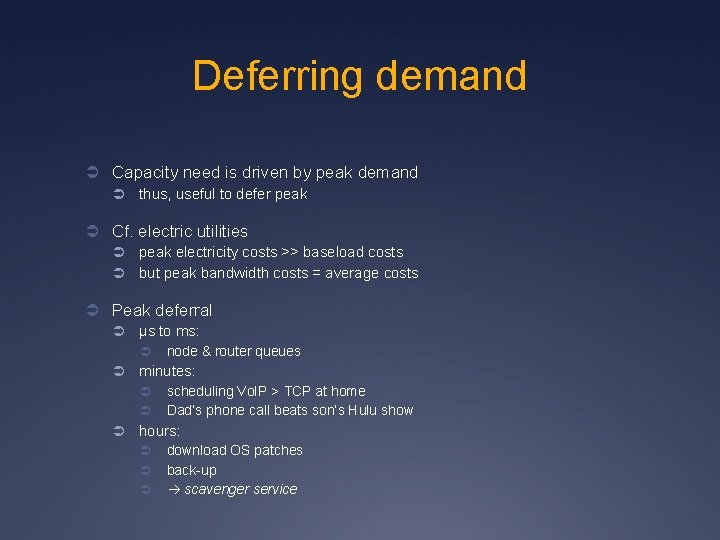
Deferring demand Ü Capacity need is driven by peak demand Ü thus, useful to defer peak Ü Cf. electric utilities Ü Ü peak electricity costs >> baseload costs but peak bandwidth costs = average costs Ü Peak deferral Ü µs to ms: Ü Ü minutes: Ü Ü Ü node & router queues scheduling Vo. IP > TCP at home Dad’s phone call beats son’s Hulu show hours: Ü Ü Ü download OS patches back-up scavenger service
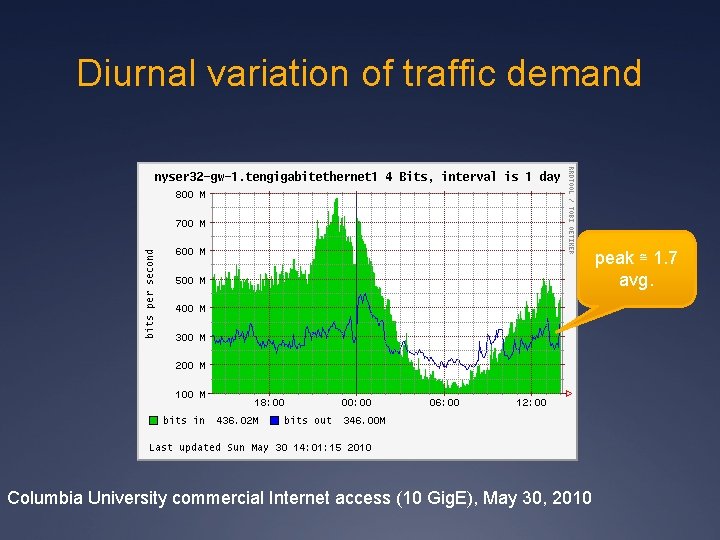
Diurnal variation of traffic demand peak ≅ 1. 7 avg. Columbia University commercial Internet access (10 Gig. E), May 30, 2010
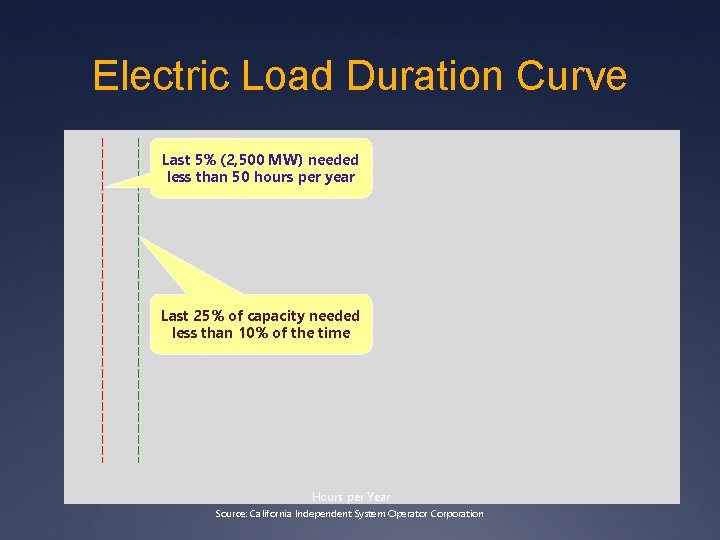
Electric Load Duration Curve Last 5% (2, 500 MW) needed less than 50 hours per year Last 25% of capacity needed less than 10% of the time Hours per Year Source: California Independent System Operator Corporation
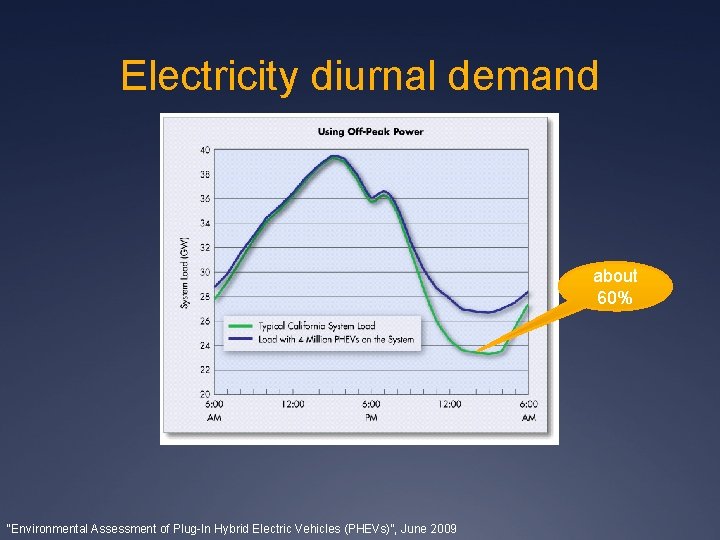
Electricity diurnal demand about 60% “Environmental Assessment of Plug-In Hybrid Electric Vehicles (PHEVs)”, June 2009
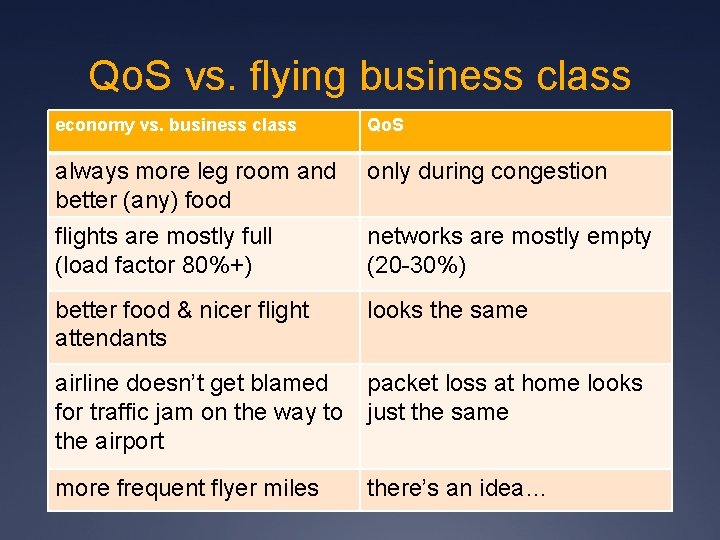
Qo. S vs. flying business class economy vs. business class Qo. S always more leg room and better (any) food only during congestion flights are mostly full (load factor 80%+) networks are mostly empty (20 -30%) better food & nicer flight attendants looks the same airline doesn’t get blamed packet loss at home looks for traffic jam on the way to just the same the airport more frequent flyer miles there’s an idea…
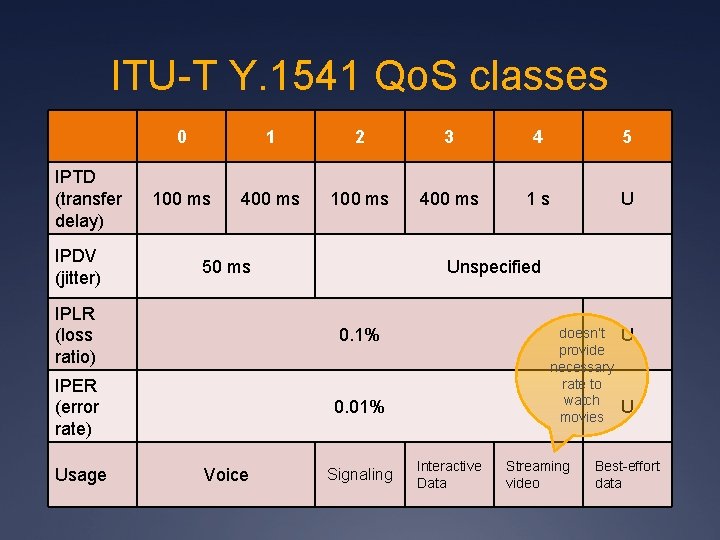
ITU-T Y. 1541 Qo. S classes IPTD (transfer delay) IPDV (jitter) 0 1 2 3 4 5 100 ms 400 ms 1 s U 50 ms Unspecified IPLR (loss ratio) 0. 1% IPER (error rate) 0. 01% Usage Voice Signaling doesn’t provide necessary rate to watch movies Interactive Data Streaming video U U Best-effort data
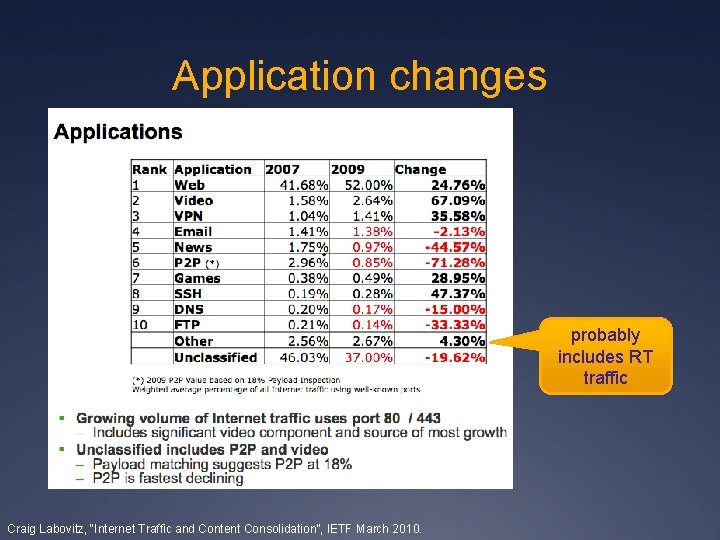
Application changes probably includes RT traffic Craig Labovitz, “Internet Traffic and Content Consolidation”, IETF March 2010.
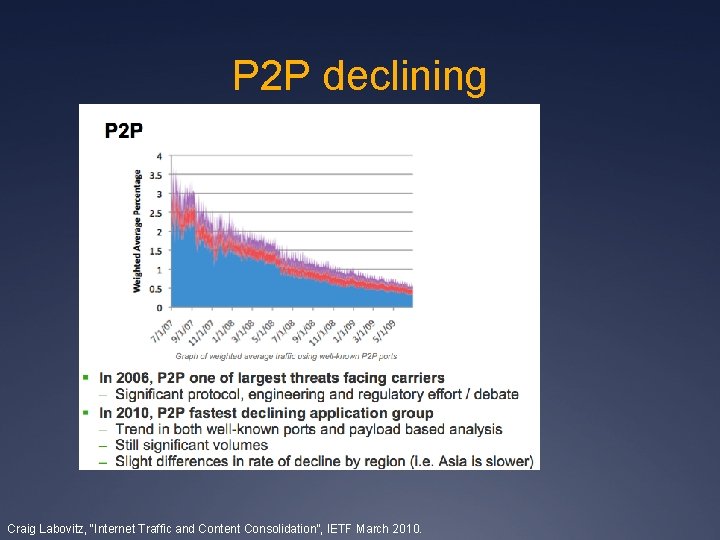
P 2 P declining Craig Labovitz, “Internet Traffic and Content Consolidation”, IETF March 2010.
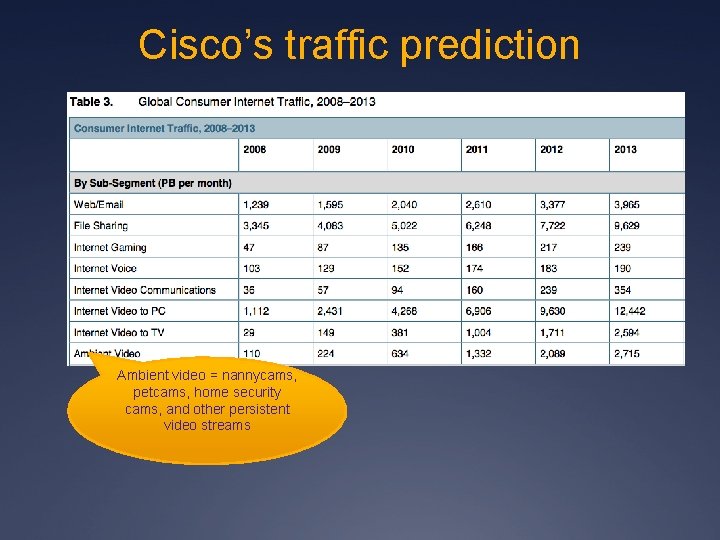
Cisco’s traffic prediction Ambient video = nannycams, petcams, home security cams, and other persistent video streams
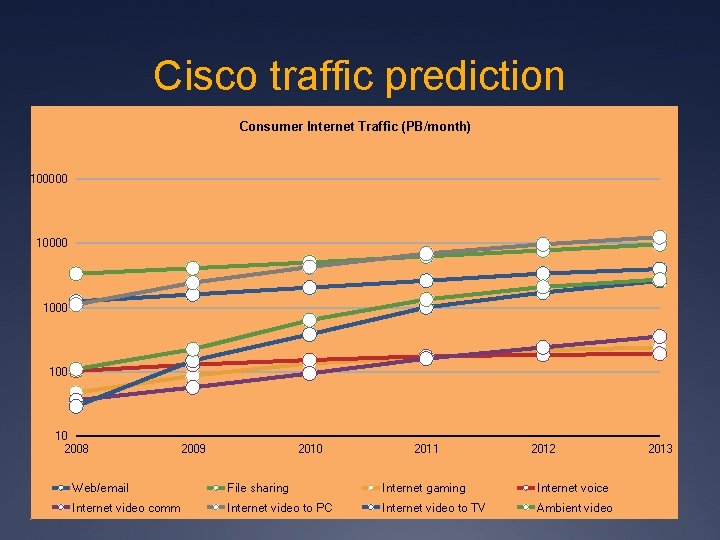
Cisco traffic prediction Consumer Internet Traffic (PB/month) 100000 1000 10 2008 2009 2010 2011 2012 Web/email File sharing Internet gaming Internet voice Internet video comm Internet video to PC Internet video to TV Ambient video 2013
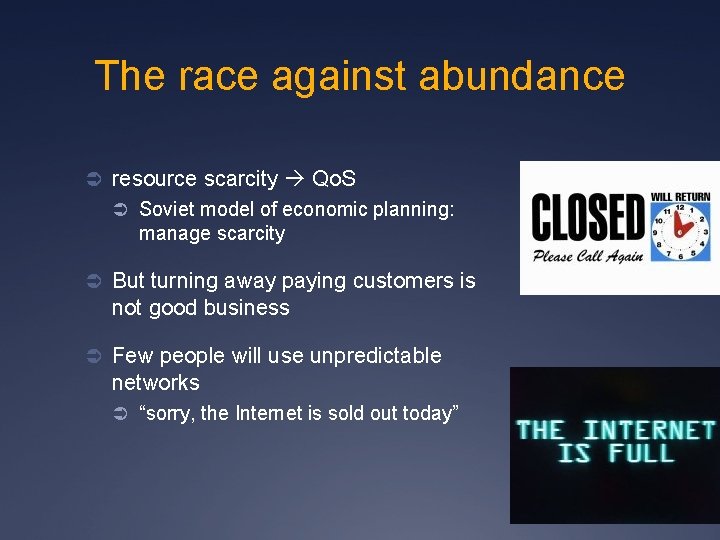
The race against abundance Ü resource scarcity Qo. S Ü Soviet model of economic planning: manage scarcity Ü But turning away paying customers is not good business Ü Few people will use unpredictable networks Ü “sorry, the Internet is sold out today”
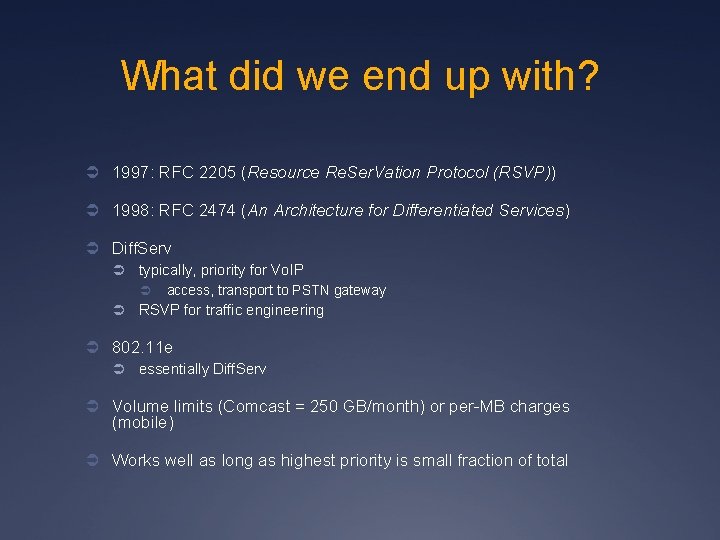
What did we end up with? Ü 1997: RFC 2205 (Resource Re. Ser. Vation Protocol (RSVP)) Ü 1998: RFC 2474 (An Architecture for Differentiated Services) Ü Diff. Serv Ü typically, priority for Vo. IP Ü Ü access, transport to PSTN gateway RSVP for traffic engineering Ü 802. 11 e Ü essentially Diff. Serv Ü Volume limits (Comcast = 250 GB/month) or per-MB charges (mobile) Ü Works well as long as highest priority is small fraction of total
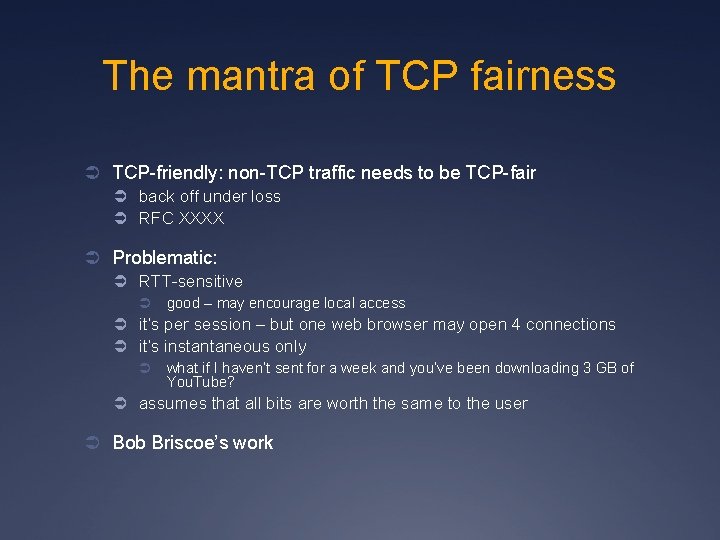
The mantra of TCP fairness Ü TCP-friendly: non-TCP traffic needs to be TCP-fair Ü back off under loss Ü RFC XXXX Ü Problematic: Ü RTT-sensitive Ü good – may encourage local access Ü it’s per session – but one web browser may open 4 connections Ü it’s instantaneous only Ü what if I haven’t sent for a week and you’ve been downloading 3 GB of You. Tube? Ü assumes that all bits are worth the same to the user Ü Bob Briscoe’s work
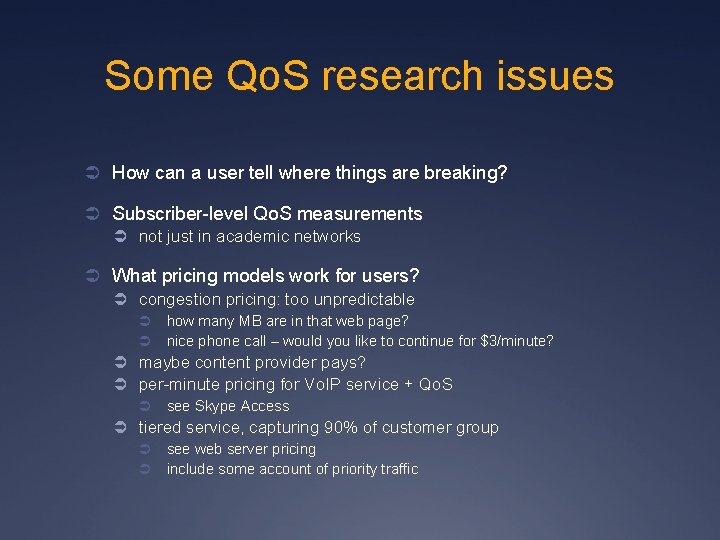
Some Qo. S research issues Ü How can a user tell where things are breaking? Ü Subscriber-level Qo. S measurements Ü not just in academic networks Ü What pricing models work for users? Ü congestion pricing: too unpredictable Ü Ü how many MB are in that web page? nice phone call – would you like to continue for $3/minute? Ü maybe content provider pays? Ü per-minute pricing for Vo. IP service + Qo. S Ü see Skype Access Ü tiered service, capturing 90% of customer group Ü Ü see web server pricing include some account of priority traffic
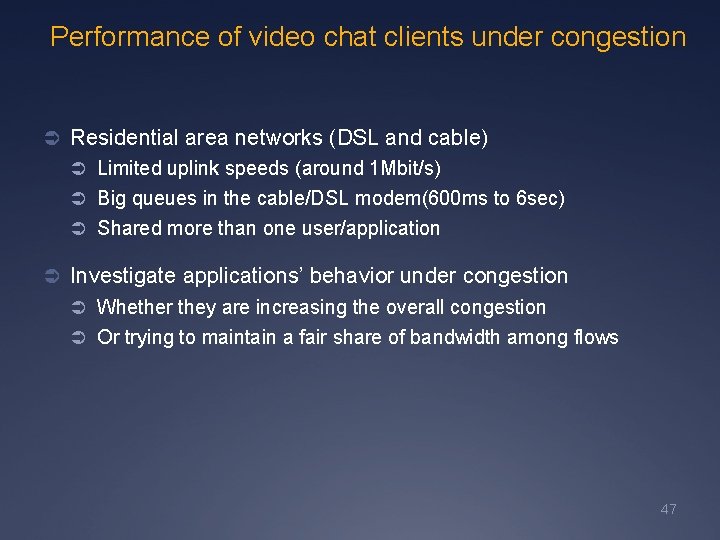
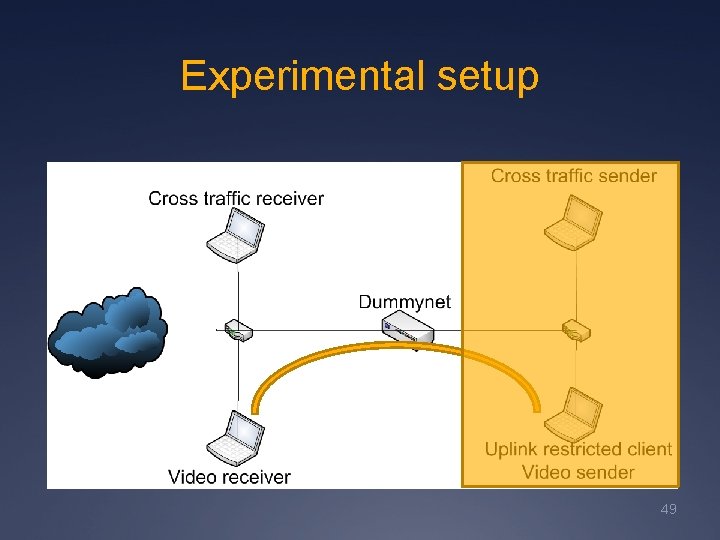
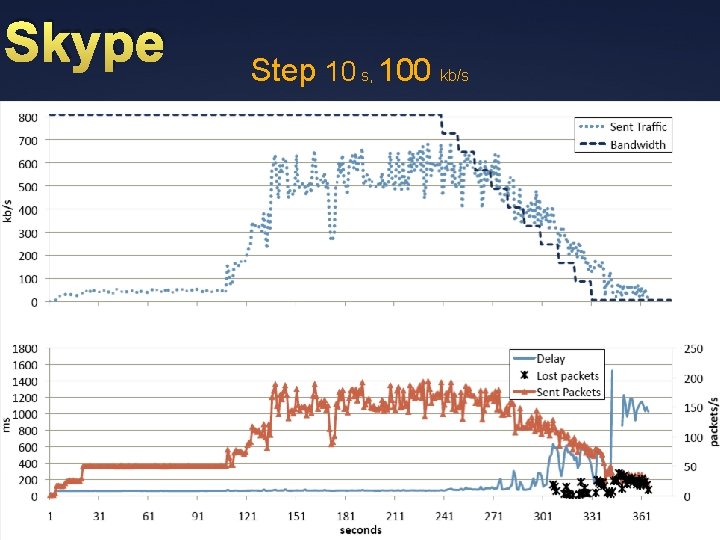
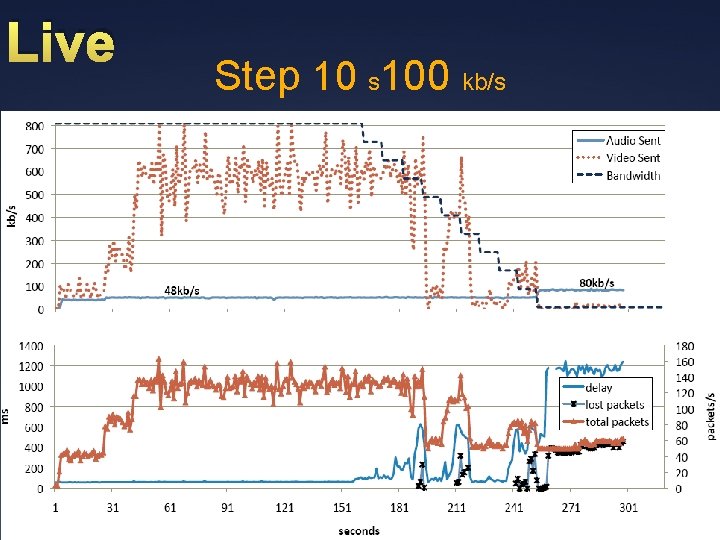
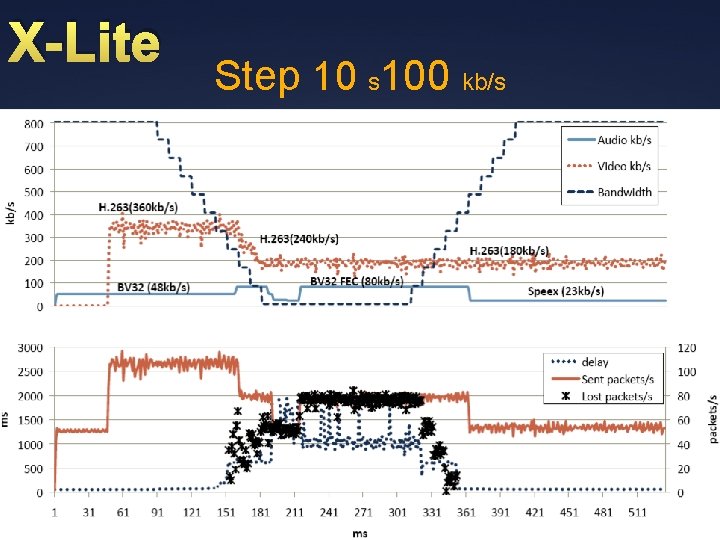
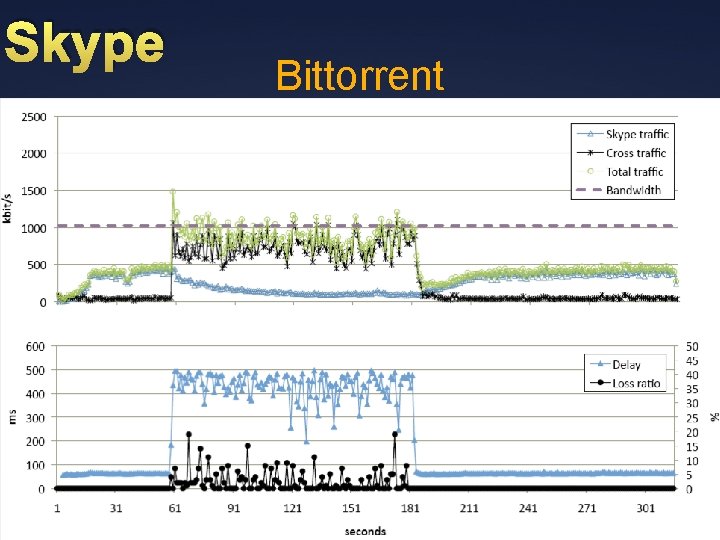
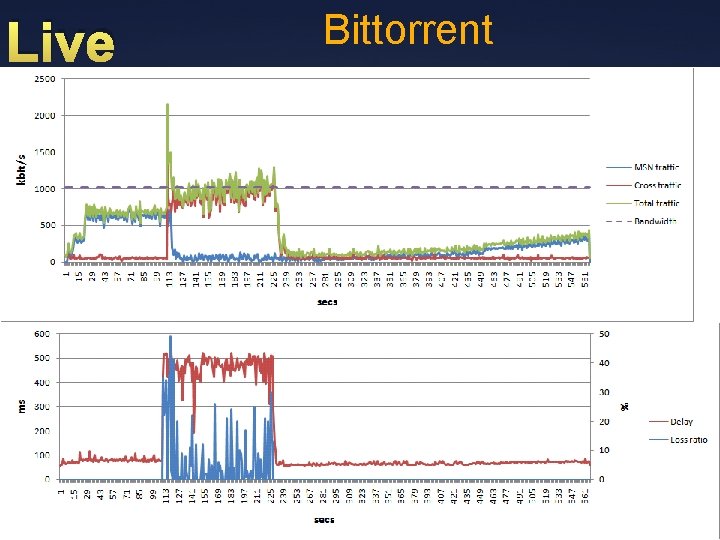
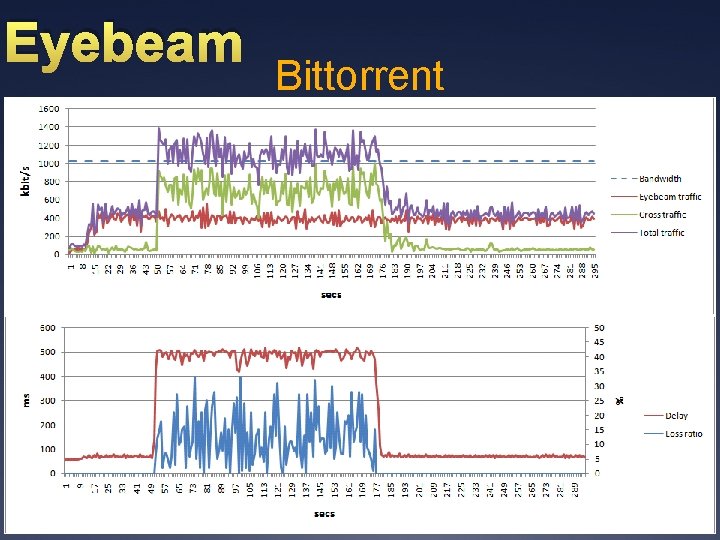
Performance of video chat clients under congestion Ü Residential area networks (DSL and cable) Ü Limited uplink speeds (around 1 Mbit/s) Ü Big queues in the cable/DSL modem(600 ms to 6 sec) Ü Shared more than one user/application Ü Investigate applications’ behavior under congestion Ü Whether they are increasing the overall congestion Ü Or trying to maintain a fair share of bandwidth among flows 47
How good is industrial practice?
Experimental setup 49
Skype Step 10 s, 100 kb/s Ü 50
Live Step 10 s 100 kb/s Ü 51
X-Lite Step 10 s 100 kb/s Ü 52
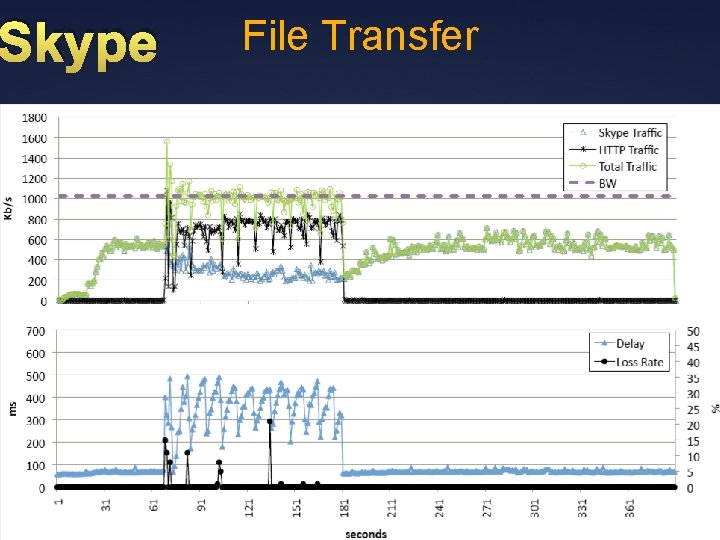
Skype File Transfer Ü 53
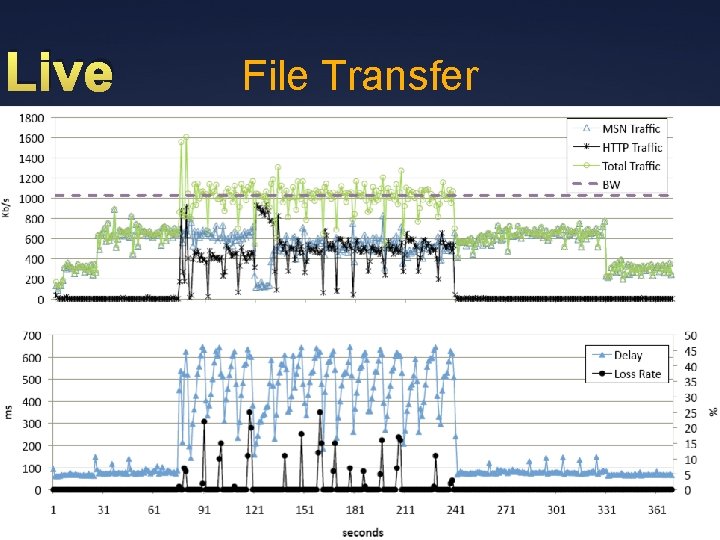
Live File Transfer Ü 54
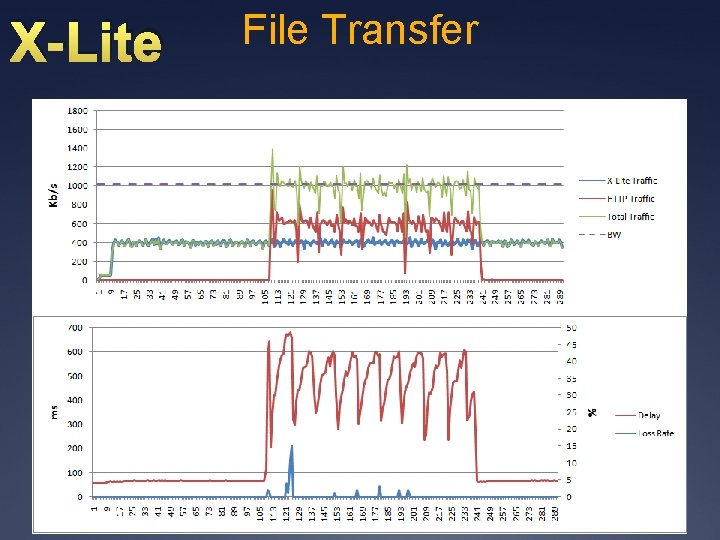
X-Lite File Transfer Ü 55
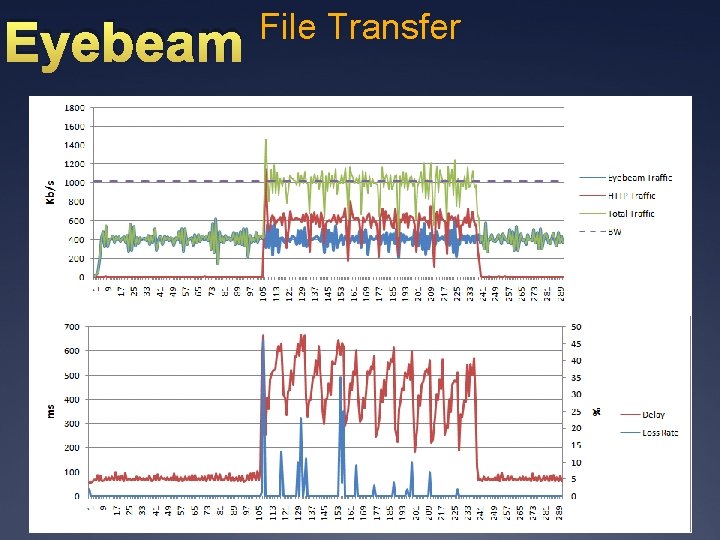
Eyebeam File Transfer Ü 56
Skype Bittorrent Ü 57
Live Bittorrent Ü 58
Eyebeam Bittorrent Ü 59
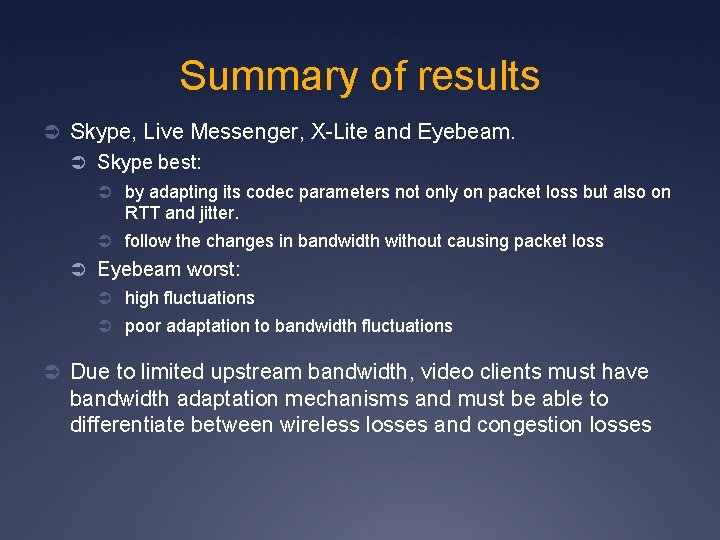
Summary of results Ü Skype, Live Messenger, X-Lite and Eyebeam. Ü Skype best: Ü by adapting its codec parameters not only on packet loss but also on RTT and jitter. Ü follow the changes in bandwidth without causing packet loss Ü Eyebeam worst: Ü high fluctuations Ü poor adaptation to bandwidth fluctuations Ü Due to limited upstream bandwidth, video clients must have bandwidth adaptation mechanisms and must be able to differentiate between wireless losses and congestion losses
Distributed diagnostics of Qo. S (and other) problems
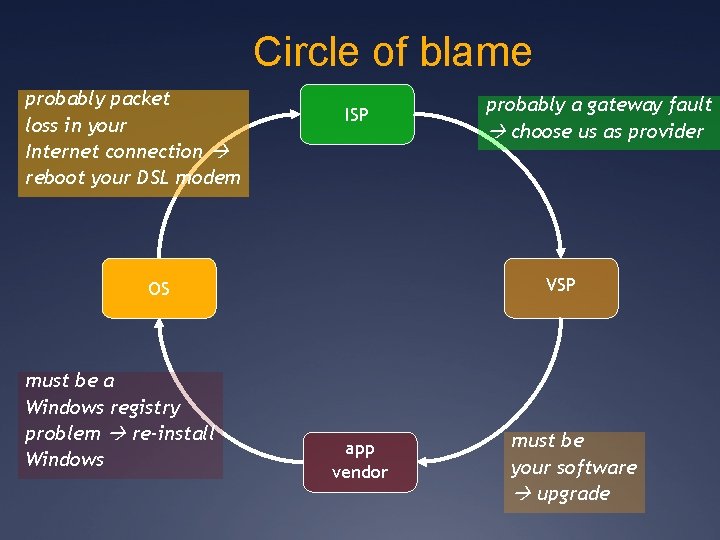
Circle of blame probably packet loss in your Internet connection reboot your DSL modem ISP VSP OS must be a Windows registry problem re-install Windows probably a gateway fault choose us as provider app vendor must be your software upgrade
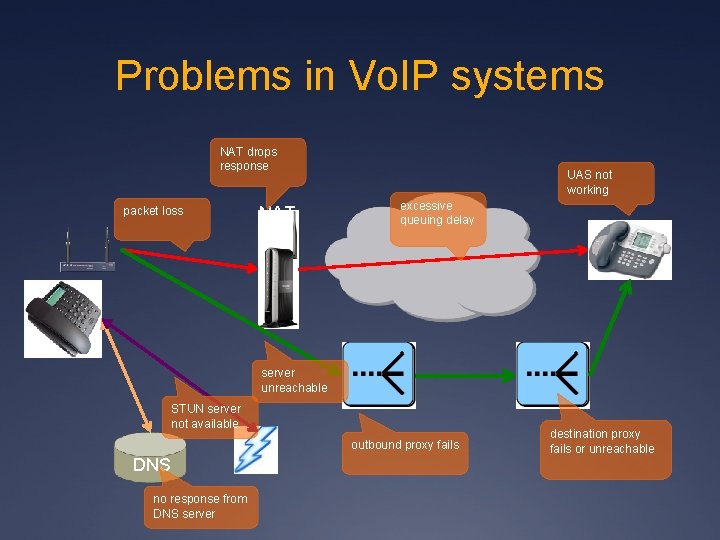
Problems in Vo. IP systems NAT drops response packet loss NAT UAS not working excessive queuing delay server unreachable STUN server not available outbound proxy fails DNS no response from DNS server destination proxy fails or unreachable
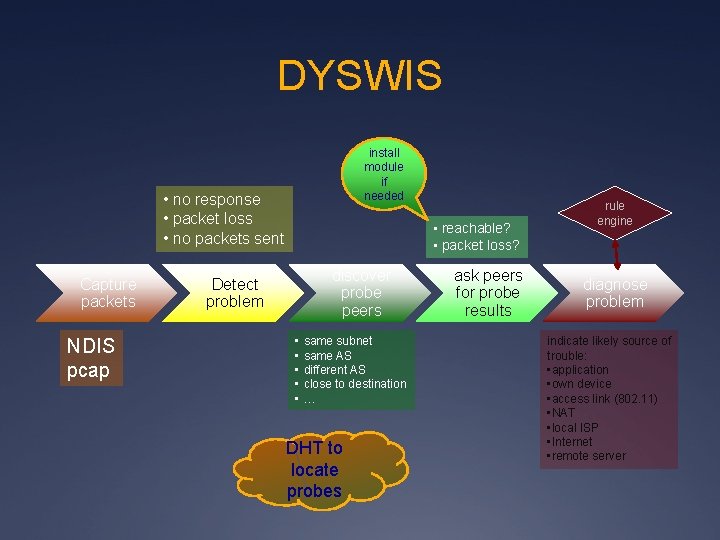
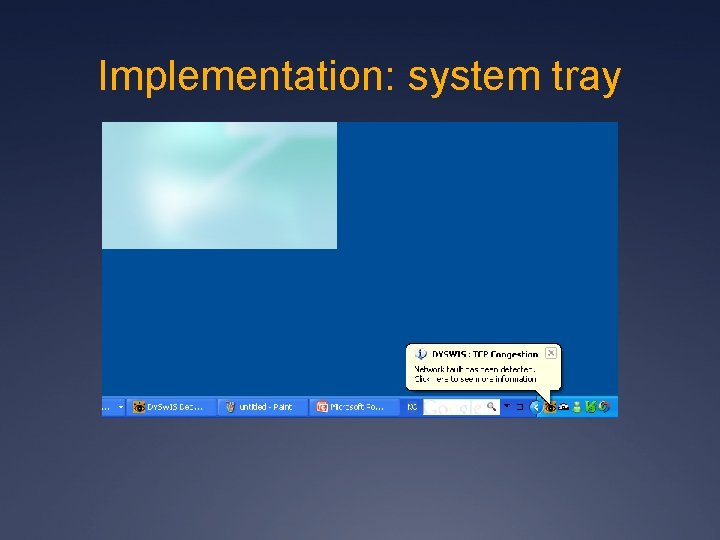
DYSWIS install module if needed • no response • packet loss • no packets sent Capture packets NDIS pcap • reachable? • packet loss? discover probe peers Detect problem • • • same subnet same AS different AS close to destination … DHT to locate probes ask peers for probe results rule engine diagnose problem indicate likely source of trouble: • application • own device • access link (802. 11) • NAT • local ISP • Internet • remote server
Implementation: system tray
Summary Ü Qo. S = our community’s longest running network research topic Ü transition of field from classical performance and queuing theory to security and Internet systems Ü Reflect on research role and outcomes Ü are we distilling results or just adding to them? Ü How can we identify topics that Ü matter to real users & operators AND Ü are amenable to research?