
25 The Reproductive System Power Point Lecture Presentations
- Slides: 51
25 The Reproductive System Power. Point® Lecture Presentations prepared by Leslie Hendon University of Alabama, Birmingham © 2014 Pearson Education, Inc.
I. The Reproductive System A. Primary sex organs – site of gamete (sex cell) formation 1. Testes - sperm 2. Ovaries - eggs B. Accessory sex organs 1. Glands 2. External genitalia © 2014 Pearson Education, Inc.
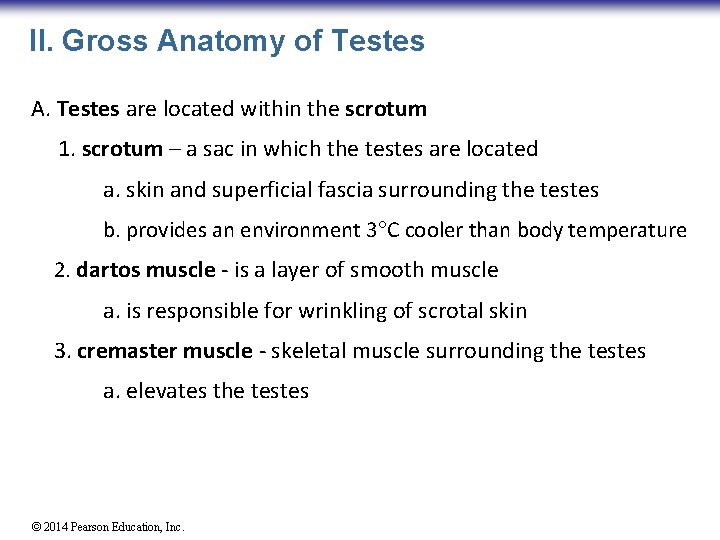
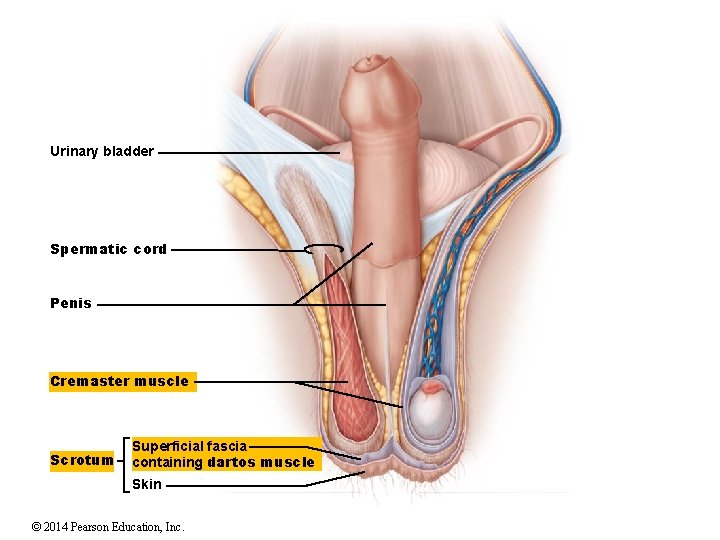
II. Gross Anatomy of Testes A. Testes are located within the scrotum 1. scrotum – a sac in which the testes are located a. skin and superficial fascia surrounding the testes b. provides an environment 3 C cooler than body temperature 2. dartos muscle - is a layer of smooth muscle a. is responsible for wrinkling of scrotal skin 3. cremaster muscle - skeletal muscle surrounding the testes a. elevates the testes © 2014 Pearson Education, Inc.
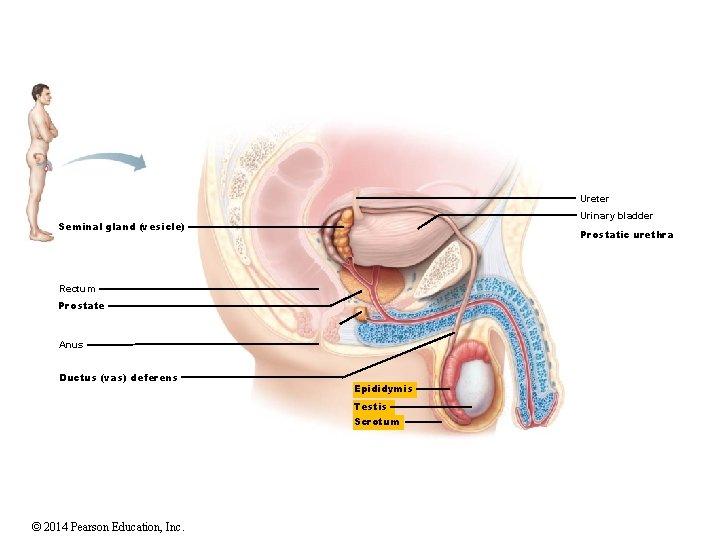
Ureter Urinary bladder Seminal gland (vesicle) Prostatic urethra Rectum Prostate Anus Ductus (vas) deferens Epididymis Testis Scrotum © 2014 Pearson Education, Inc.
Urinary bladder Spermatic cord Penis Cremaster muscle Scrotum Superficial fascia containing dartos muscle Skin © 2014 Pearson Education, Inc.
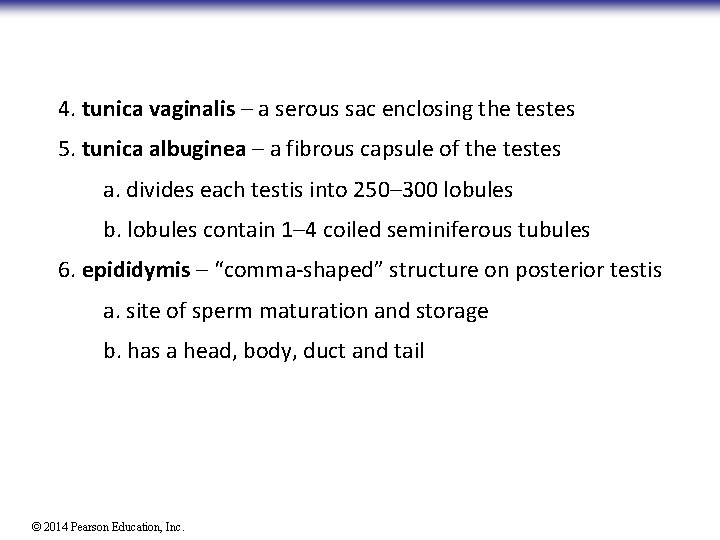
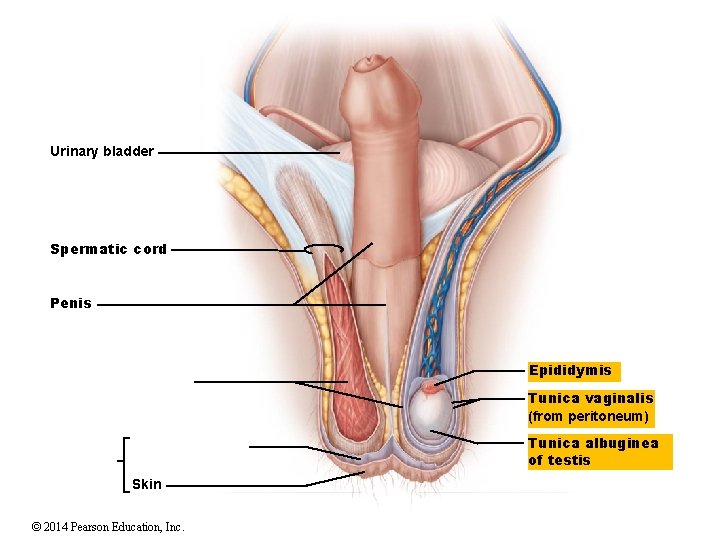
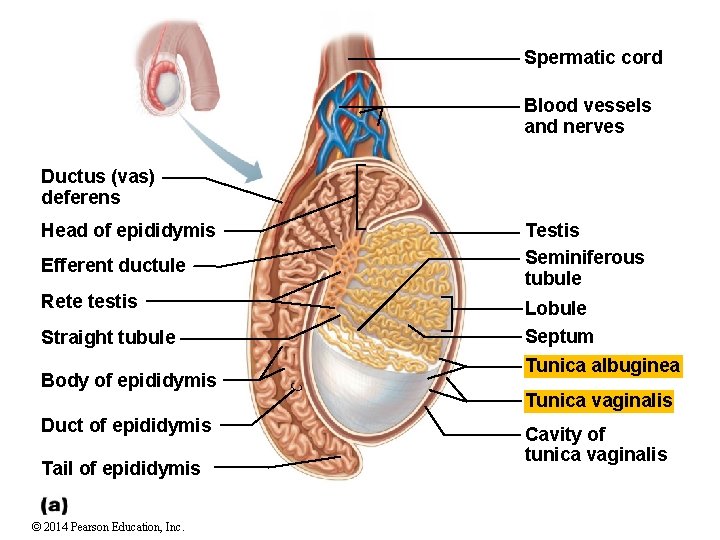
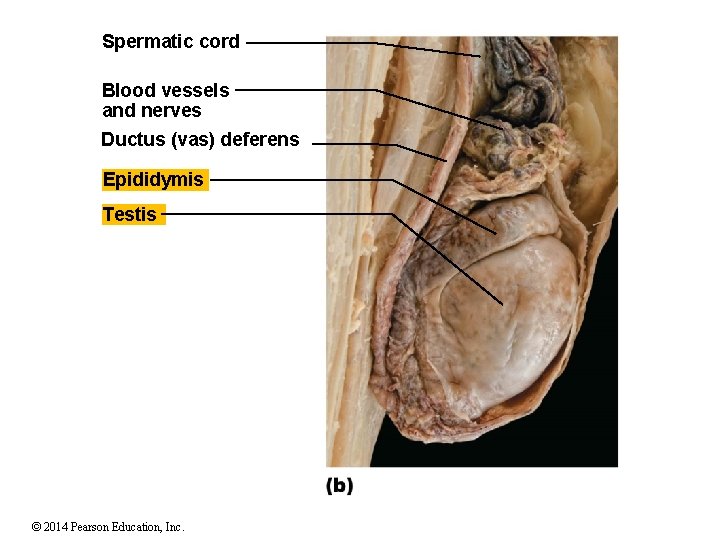
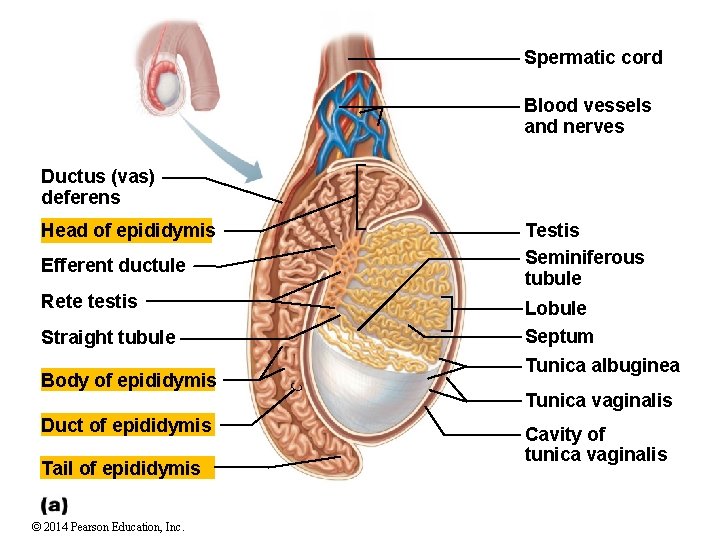
4. tunica vaginalis – a serous sac enclosing the testes 5. tunica albuginea – a fibrous capsule of the testes a. divides each testis into 250– 300 lobules b. lobules contain 1– 4 coiled seminiferous tubules 6. epididymis – “comma-shaped” structure on posterior testis a. site of sperm maturation and storage b. has a head, body, duct and tail © 2014 Pearson Education, Inc.
Urinary bladder Spermatic cord Penis Epididymis Tunica vaginalis (from peritoneum) Tunica albuginea of testis Skin © 2014 Pearson Education, Inc.
Spermatic cord Blood vessels and nerves Ductus (vas) deferens Head of epididymis Efferent ductule Rete testis Straight tubule Body of epididymis Duct of epididymis Tail of epididymis © 2014 Pearson Education, Inc. Testis Seminiferous tubule Lobule Septum Tunica albuginea Tunica vaginalis Cavity of tunica vaginalis
Spermatic cord Blood vessels and nerves Ductus (vas) deferens Epididymis Testis © 2014 Pearson Education, Inc.
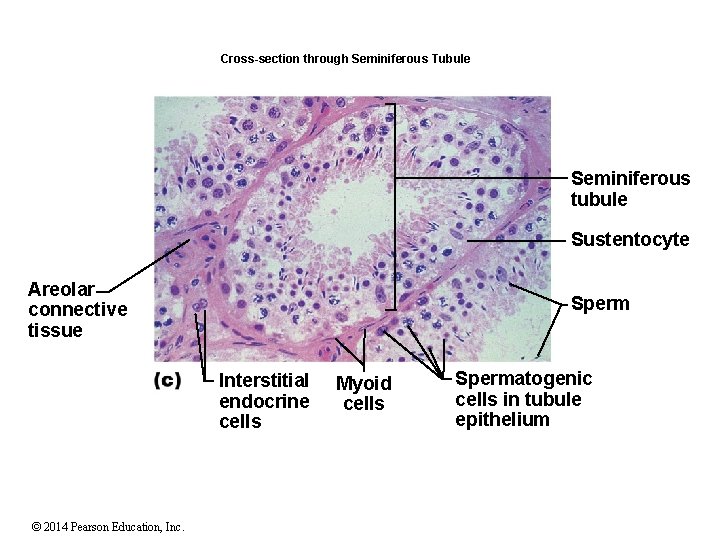
Cross-section through Seminiferous Tubule Seminiferous tubule Sustentocyte Areolar connective tissue Sperm Interstitial endocrine cells © 2014 Pearson Education, Inc. Myoid cells Spermatogenic cells in tubule epithelium
III. Microscopic Anatomy of the Testes A. Seminiferous tubules – site of spermatogenesis 1. spermatogenic cells - sperm-forming cells a. 400 million sperm produced each day b. begins at puberty – takes 75 days to produce new sperm c. cells undergo meiosis ► spermatogonia - stem cells ► primary spermatocytes ► secondary spermatocytes ► spermatids ► sperm © 2014 Pearson Education, Inc.
2. columnar sustentocytes - supporting cells a. surround spermatogenic cells b. extend from basal lamina to the lumen c. tight junctions between cells - blood testis barrier d. secrete testicular fluid androgen-binding protein 3. myoid cells—surround seminiferous tubules 4. interstitial endocrine cells - secrete testosterone © 2014 Pearson Education, Inc.
IV. The Epididymis A. Duct of the epididymis is 6 m long (when uncoiled!!!) B. Dominated by pseudostratified columnar epithelium 1. has tufts of stereocilia - immotile, long microvilli C. 20 -day journey for sperm to move through 1. gain the ability to swim and to fertilize an egg © 2014 Pearson Education, Inc.
Spermatic cord Blood vessels and nerves Ductus (vas) deferens Head of epididymis Efferent ductule Rete testis Straight tubule Body of epididymis Duct of epididymis Tail of epididymis © 2014 Pearson Education, Inc. Testis Seminiferous tubule Lobule Septum Tunica albuginea Tunica vaginalis Cavity of tunica vaginalis
V. The Ductus (Vas) Deferens A. Stores and transports sperm B. Hisotology of the ductus deferens 1. epithelium - pseudostratified columnar 2. thick muscularis layer © 2014 Pearson Education, Inc.
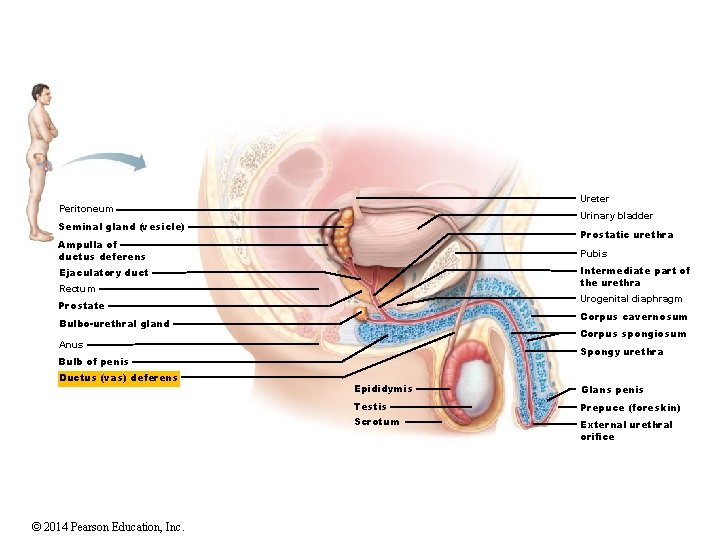
Ureter Peritoneum Urinary bladder Seminal gland (vesicle) Prostatic urethra Ampulla of ductus deferens Pubis Intermediate part of the urethra Ejaculatory duct Rectum Urogenital diaphragm Prostate Corpus cavernosum Bulbo-urethral gland Corpus spongiosum Anus Spongy urethra Bulb of penis Ductus (vas) deferens Epididymis Glans penis Testis Prepuce (foreskin) Scrotum © 2014 Pearson Education, Inc. External urethral orifice
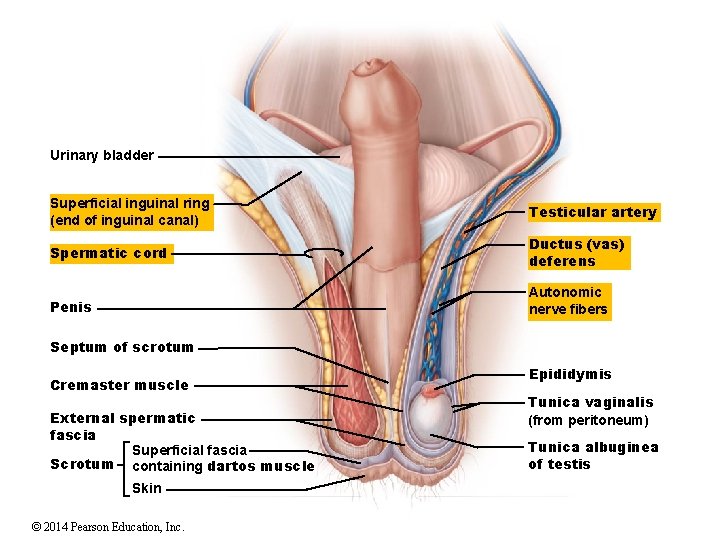
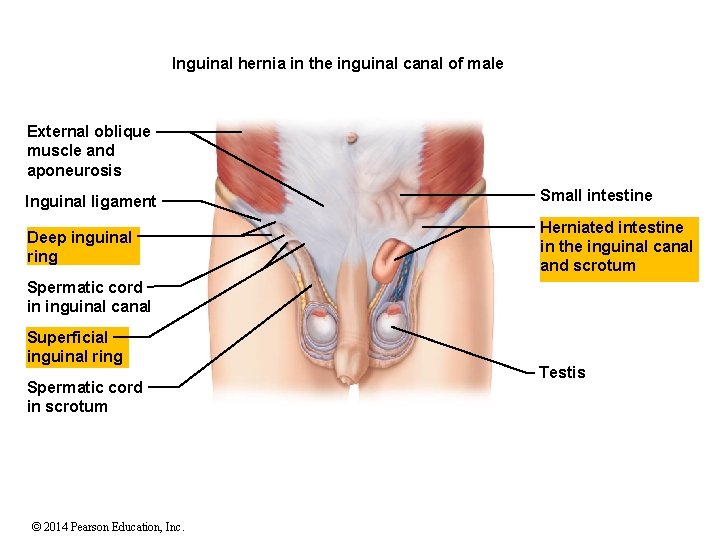
VI. The Spermatic Cord A. Contains 1. ductus deferens 2. testicular blood vessels 3. nerves B. Superior part runs through inguinal canal 1. inguinal canal is common location for hernias in males © 2014 Pearson Education, Inc.
Urinary bladder Superficial inguinal ring (end of inguinal canal) Testicular artery Spermatic cord Ductus (vas) deferens Penis Autonomic nerve fibers Septum of scrotum Cremaster muscle External spermatic fascia Superficial fascia Scrotum containing dartos muscle Skin © 2014 Pearson Education, Inc. Epididymis Tunica vaginalis (from peritoneum) Tunica albuginea of testis
Inguinal hernia in the inguinal canal of male External oblique muscle and aponeurosis Inguinal ligament Small intestine Deep inguinal ring Herniated intestine in the inguinal canal and scrotum Spermatic cord in inguinal canal Superficial inguinal ring Spermatic cord in scrotum © 2014 Pearson Education, Inc. Testis
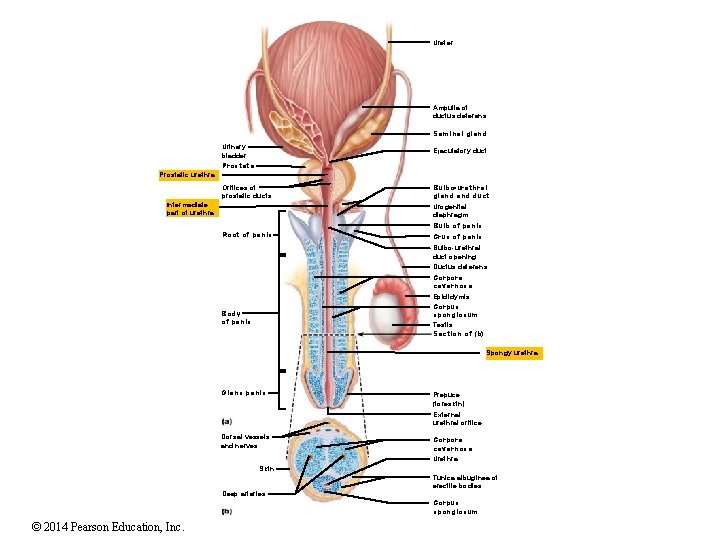
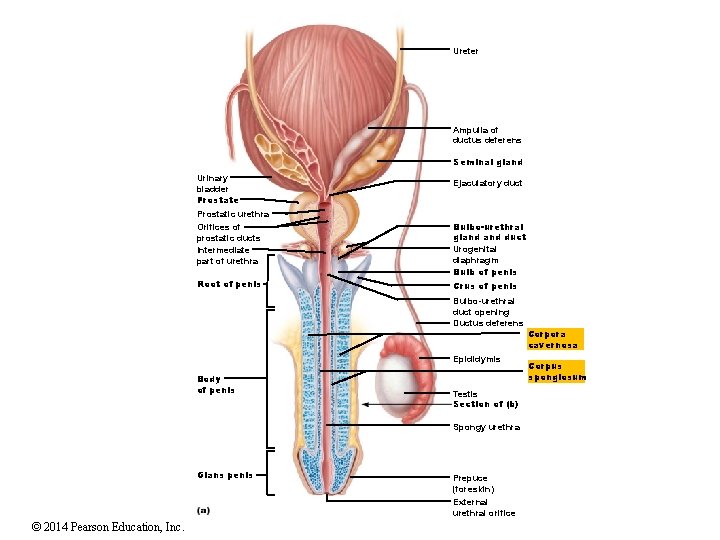
VII. The Urethra A. Carries sperm from ejaculatory ducts to “outside” B. Three parts of male urethra 1. prostatic urethra 2. intermediate part of urethra 3. spongy urethra (penis) © 2014 Pearson Education, Inc.
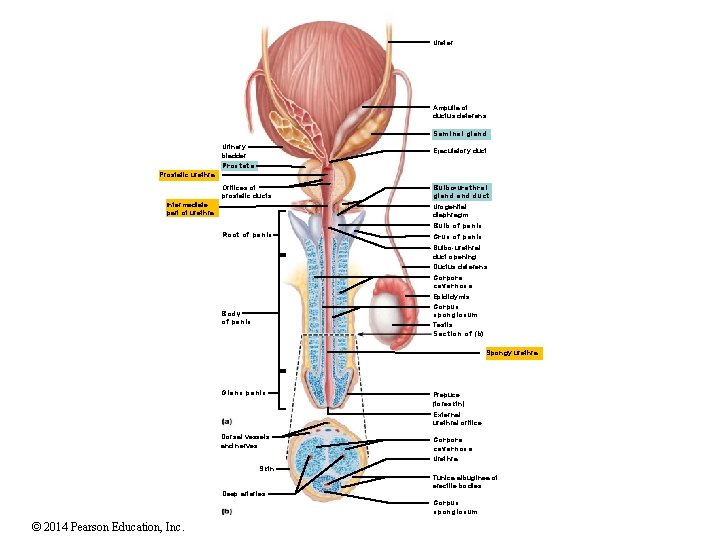
Ureter Ampulla of ductus deferens Seminal gland Urinary bladder Prostate Ejaculatory duct Orifices of prostatic ducts Bulbo-urethral gland duct Prostatic urethra Intermediate part of urethra Root of penis Urogenital diaphragm Bulb of penis Crus of penis Bulbo-urethral duct opening Ductus deferens Corpora cavernosa Epididymis Corpus spongiosum Testis Section of (b) Body of penis Spongy urethra Glans penis Prepuce (foreskin) External urethral orifice Dorsal vessels and nerves Corpora cavernosa Urethra Skin Deep arteries Tunica albuginea of erectile bodies Corpus spongiosum © 2014 Pearson Education, Inc.
VIII. Accessory Glands - Male A. seminal glands 1. lie on the posterior surface of the urinary bladder 2. secrete fluid that is 60% of the volume of semen a. fructose to nourish sperm b. substances to enhance sperm motility c. prostaglandins d. substances that suppress immune response against semen e. enzymes that clot and then liquefy semen © 2014 Pearson Education, Inc.
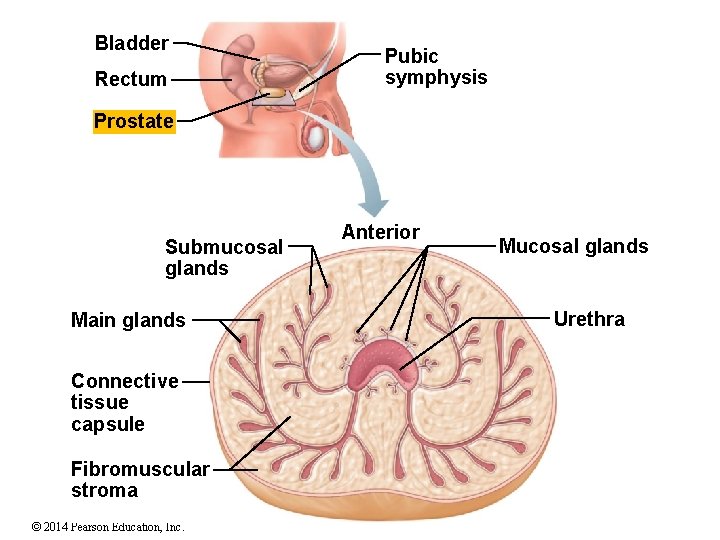
B. Prostate 1. encircles the prostatic urethra 2. consists of 20– 30 compound tubuloalveolar glands 3. secretes about 25– 30% of seminal fluid 4. common site of cancer in males 5. can be palpated (touched) through the rectum C. bulbo-urethral glands 1. pea-sized glands inferior to the prostate gland 2. produce a mucus - enters spongy urethra prior to ejaculation a. neutralizes traces of acidic urine b. lubricates urethra © 2014 Pearson Education, Inc.
Ureter Ampulla of ductus deferens Seminal gland Urinary bladder Prostate Ejaculatory duct Orifices of prostatic ducts Bulbo-urethral gland duct Prostatic urethra Intermediate part of urethra Root of penis Urogenital diaphragm Bulb of penis Crus of penis Bulbo-urethral duct opening Ductus deferens Corpora cavernosa Epididymis Corpus spongiosum Testis Section of (b) Body of penis Spongy urethra Glans penis Prepuce (foreskin) External urethral orifice Dorsal vessels and nerves Corpora cavernosa Urethra Skin Deep arteries Tunica albuginea of erectile bodies Corpus spongiosum © 2014 Pearson Education, Inc.
Bladder Rectum Pubic symphysis Prostate Submucosal glands Main glands Connective tissue capsule Fibromuscular stroma © 2014 Pearson Education, Inc. Anterior Mucosal glands Urethra
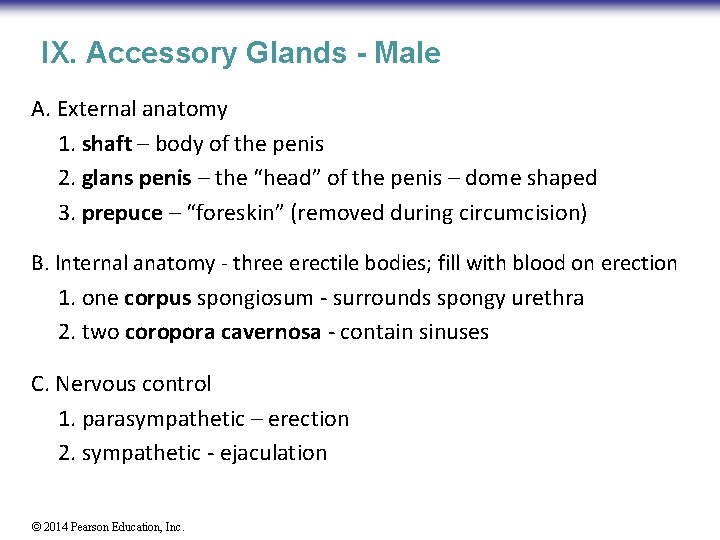
IX. Accessory Glands - Male A. External anatomy 1. shaft – body of the penis 2. glans penis – the “head” of the penis – dome shaped 3. prepuce – “foreskin” (removed during circumcision) B. Internal anatomy - three erectile bodies; fill with blood on erection 1. one corpus spongiosum - surrounds spongy urethra 2. two coropora cavernosa - contain sinuses C. Nervous control 1. parasympathetic – erection 2. sympathetic - ejaculation © 2014 Pearson Education, Inc.
Ureter Ampulla of ductus deferens Seminal gland Urinary bladder Prostate Prostatic urethra Orifices of prostatic ducts Intermediate part of urethra Root of penis Ejaculatory duct Bulbo-urethral gland duct Urogenital diaphragm Bulb of penis Crus of penis Bulbo-urethral duct opening Ductus deferens Epididymis Body of penis Testis Section of (b) Spongy urethra Glans penis © 2014 Pearson Education, Inc. Prepuce (foreskin) External urethral orifice Corpora cavernosa Corpus spongiosum
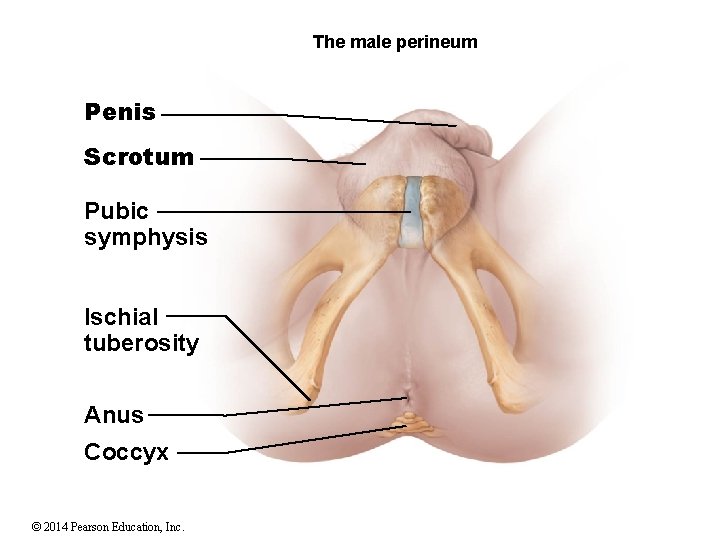
The male perineum Penis Scrotum Pubic symphysis Ischial tuberosity Anus Coccyx © 2014 Pearson Education, Inc.
X. Accessory Glands - Female A. Produces gametes (ova) B. Prepares to support a developing embryo C. Undergoes changes according to the menstrual cycle 1. menstrual cycle - affects all female reproductive organs D. Organs: ovaries, uterine (Fallopian) tubes, uterus and vagina © 2014 Pearson Education, Inc.
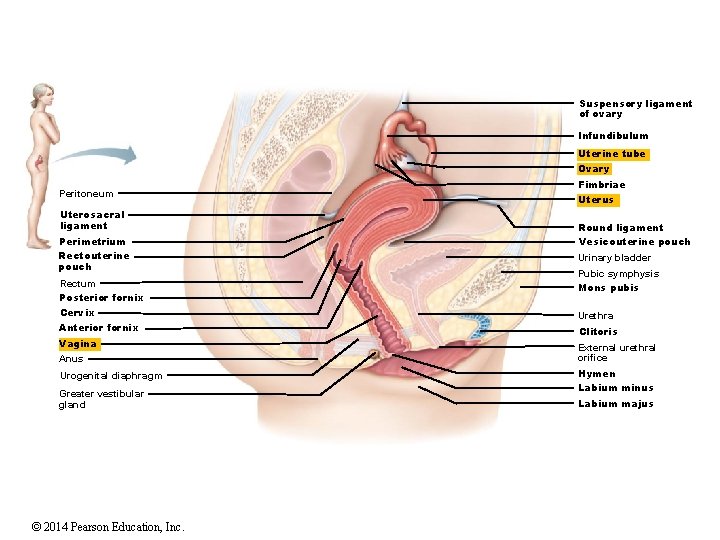
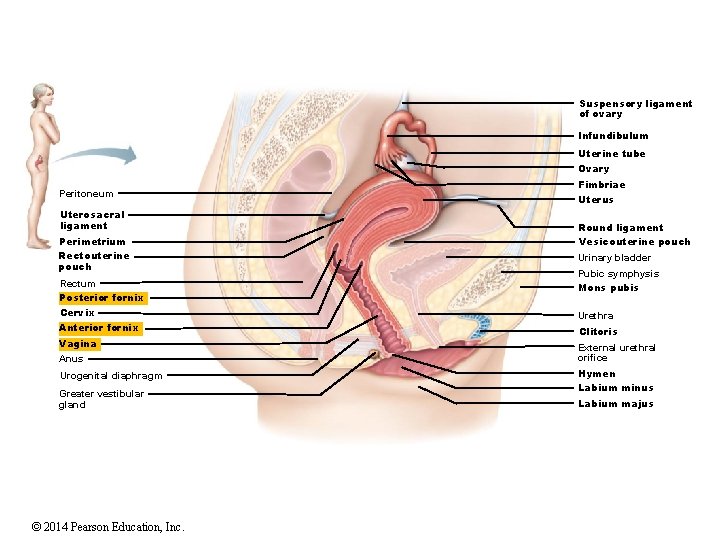
Suspensory ligament of ovary Infundibulum Uterine tube Ovary Peritoneum Uterosacral ligament Perimetrium Rectouterine pouch Rectum Posterior fornix Cervix Anterior fornix Vagina Anus Urogenital diaphragm Greater vestibular gland © 2014 Pearson Education, Inc. Fimbriae Uterus Round ligament Vesicouterine pouch Urinary bladder Pubic symphysis Mons pubis Urethra Clitoris External urethral orifice Hymen Labium minus Labium majus
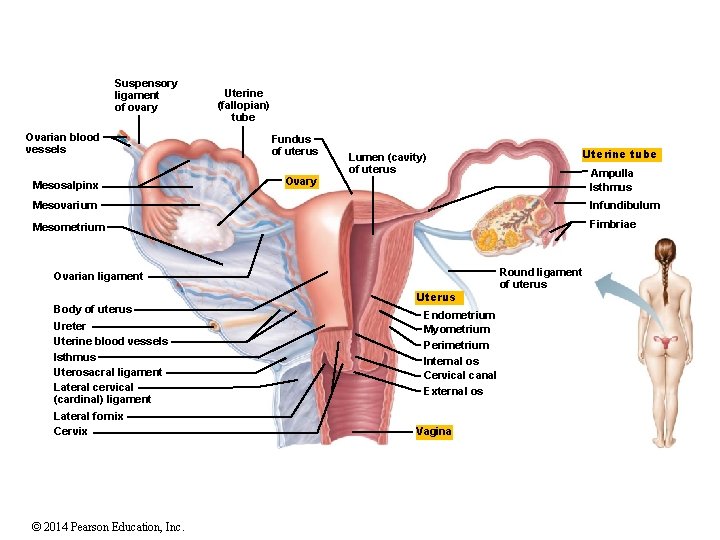
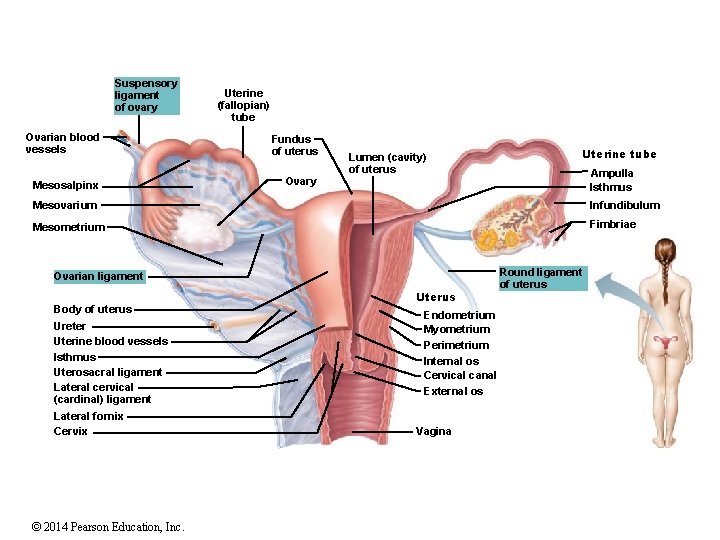
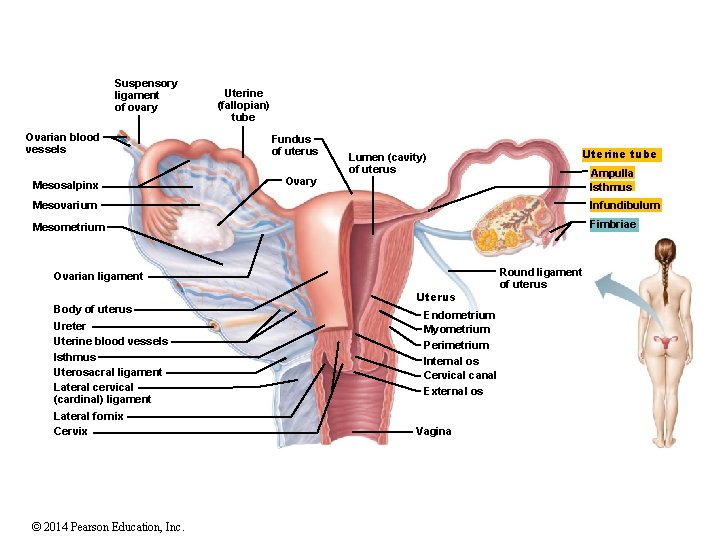
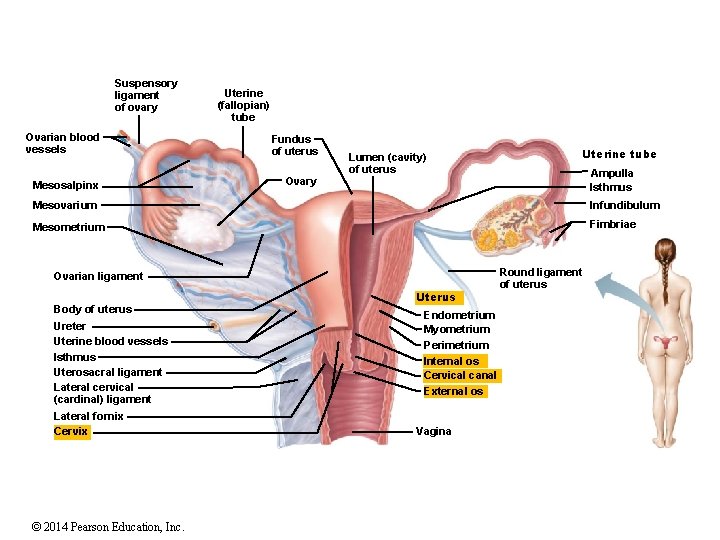
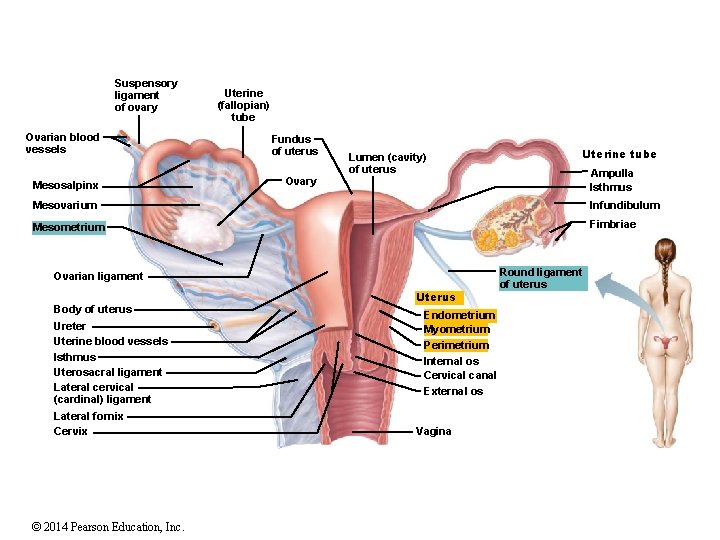
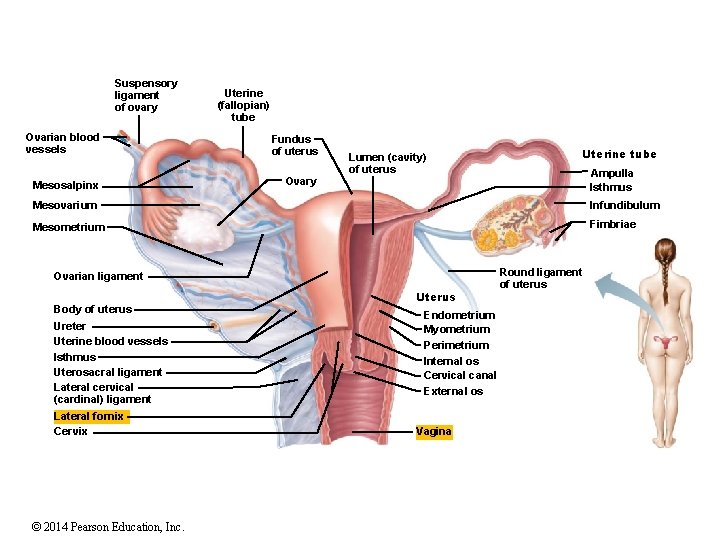
Suspensory ligament of ovary Uterine (fallopian) tube Ovarian blood vessels Fundus of uterus Mesosalpinx Ovary Lumen (cavity) of uterus Uterine tube Ampulla Isthmus Mesovarium Infundibulum Mesometrium Fimbriae Ovarian ligament Body of uterus Ureter Uterine blood vessels Isthmus Uterosacral ligament Lateral cervical (cardinal) ligament Lateral fornix Cervix © 2014 Pearson Education, Inc. Uterus Endometrium Myometrium Perimetrium Internal os Cervical canal External os Vagina Round ligament of uterus
XI. Ovaries A. Small, almond-shaped organs - produce ova through oogenesis B. Held in place by ligaments and mesenteries 1. broad ligament 2. suspensory ligament 3. ovarian ligament C. Ovarian arteries - arterial supply D. Innervated by both divisions of the ANS © 2014 Pearson Education, Inc.
Suspensory ligament of ovary Uterine (fallopian) tube Ovarian blood vessels Fundus of uterus Mesosalpinx Ovary Lumen (cavity) of uterus Uterine tube Ampulla Isthmus Mesovarium Infundibulum Mesometrium Fimbriae Ovarian ligament Body of uterus Ureter Uterine blood vessels Isthmus Uterosacral ligament Lateral cervical (cardinal) ligament Lateral fornix Cervix © 2014 Pearson Education, Inc. Uterus Endometrium Myometrium Perimetrium Internal os Cervical canal External os Vagina Round ligament of uterus
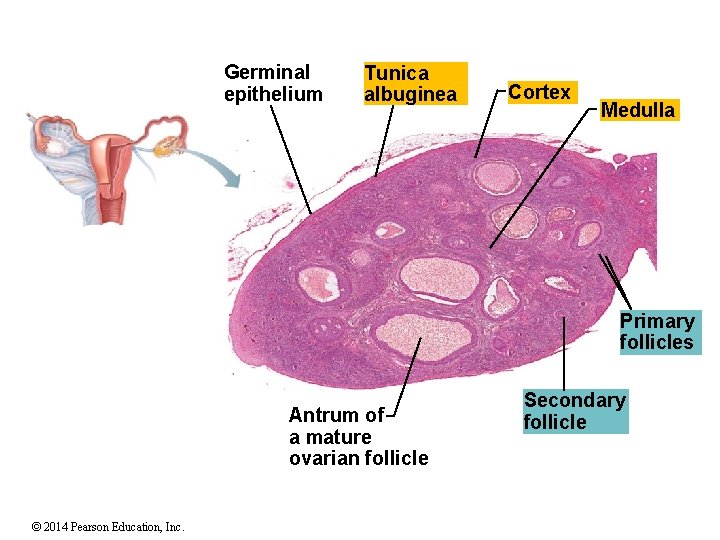
XII. Internal Structure - Ovaries A. Tunica albuginea 1. fibrous capsule of the ovary 2. covered in simple columnar epithelium B. Ovarian cortex – site of developing oocytes C. Follicles - multicellular sacs housing oocytes D. Ovarian medulla - loose connective tissue 1. contains blood vessels, lymph vessels and nerves © 2014 Pearson Education, Inc.
Germinal epithelium Tunica albuginea Cortex Medulla Primary follicles Antrum of a mature ovarian follicle © 2014 Pearson Education, Inc. Secondary follicle
XIII. Uterine (Fallopian) Tubes A. Receive oocyte during ovulation B. Parts of the uterine tube 1. infundibulum - distal end of uterine tube a. urrounded by fimbriae 2. ampulla - middle third of uterine tube a. usual site of fertilization 3. isthmus - medial third of uterine tube © 2014 Pearson Education, Inc.
Suspensory ligament of ovary Uterine (fallopian) tube Ovarian blood vessels Fundus of uterus Mesosalpinx Ovary Lumen (cavity) of uterus Uterine tube Ampulla Isthmus Mesovarium Infundibulum Mesometrium Fimbriae Ovarian ligament Body of uterus Ureter Uterine blood vessels Isthmus Uterosacral ligament Lateral cervical (cardinal) ligament Lateral fornix Cervix © 2014 Pearson Education, Inc. Uterus Endometrium Myometrium Perimetrium Internal os Cervical canal External os Vagina Round ligament of uterus
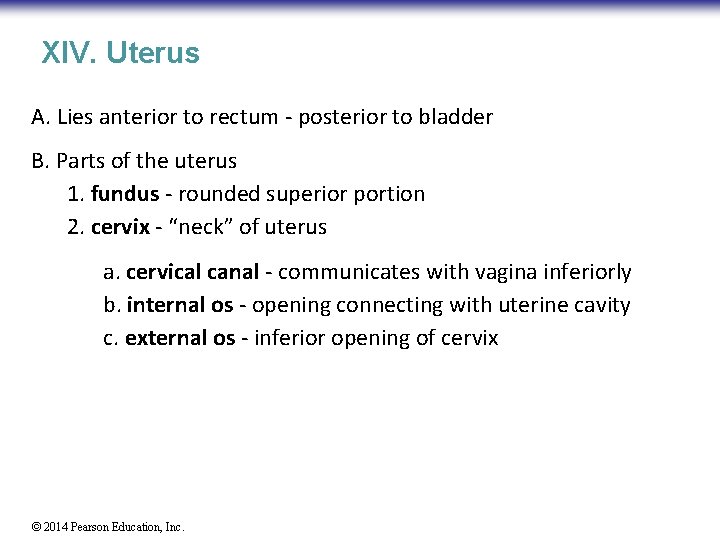
XIV. Uterus A. Lies anterior to rectum - posterior to bladder B. Parts of the uterus 1. fundus - rounded superior portion 2. cervix - “neck” of uterus a. cervical canal - communicates with vagina inferiorly b. internal os - opening connecting with uterine cavity c. external os - inferior opening of cervix © 2014 Pearson Education, Inc.
Suspensory ligament of ovary Uterine (fallopian) tube Ovarian blood vessels Fundus of uterus Mesosalpinx Ovary Lumen (cavity) of uterus Uterine tube Ampulla Isthmus Mesovarium Infundibulum Mesometrium Fimbriae Ovarian ligament Body of uterus Ureter Uterine blood vessels Isthmus Uterosacral ligament Lateral cervical (cardinal) ligament Lateral fornix Cervix © 2014 Pearson Education, Inc. Uterus Endometrium Myometrium Perimetrium Internal os Cervical canal External os Vagina Round ligament of uterus
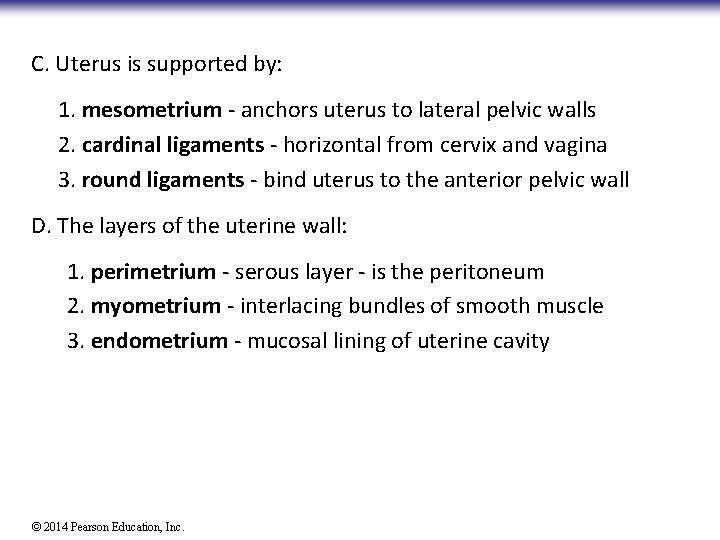
C. Uterus is supported by: 1. mesometrium - anchors uterus to lateral pelvic walls 2. cardinal ligaments - horizontal from cervix and vagina 3. round ligaments - bind uterus to the anterior pelvic wall D. The layers of the uterine wall: 1. perimetrium - serous layer - is the peritoneum 2. myometrium - interlacing bundles of smooth muscle 3. endometrium - mucosal lining of uterine cavity © 2014 Pearson Education, Inc.
Suspensory ligament of ovary Uterine (fallopian) tube Ovarian blood vessels Fundus of uterus Mesosalpinx Ovary Lumen (cavity) of uterus Uterine tube Ampulla Isthmus Mesovarium Infundibulum Mesometrium Fimbriae Ovarian ligament Body of uterus Ureter Uterine blood vessels Isthmus Uterosacral ligament Lateral cervical (cardinal) ligament Lateral fornix Cervix © 2014 Pearson Education, Inc. Uterus Endometrium Myometrium Perimetrium Internal os Cervical canal External os Vagina Round ligament of uterus
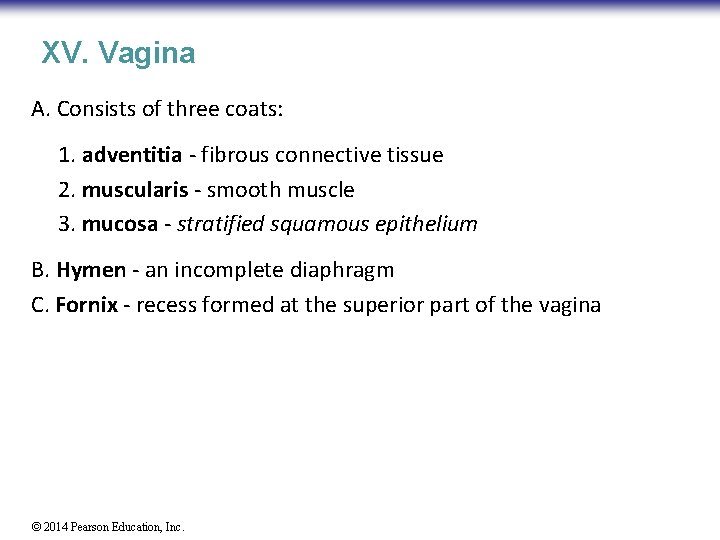
XV. Vagina A. Consists of three coats: 1. adventitia - fibrous connective tissue 2. muscularis - smooth muscle 3. mucosa - stratified squamous epithelium B. Hymen - an incomplete diaphragm C. Fornix - recess formed at the superior part of the vagina © 2014 Pearson Education, Inc.
Suspensory ligament of ovary Infundibulum Uterine tube Ovary Peritoneum Uterosacral ligament Perimetrium Rectouterine pouch Rectum Posterior fornix Cervix Anterior fornix Vagina Anus Urogenital diaphragm Greater vestibular gland © 2014 Pearson Education, Inc. Fimbriae Uterus Round ligament Vesicouterine pouch Urinary bladder Pubic symphysis Mons pubis Urethra Clitoris External urethral orifice Hymen Labium minus Labium majus
Suspensory ligament of ovary Uterine (fallopian) tube Ovarian blood vessels Fundus of uterus Mesosalpinx Ovary Lumen (cavity) of uterus Uterine tube Ampulla Isthmus Mesovarium Infundibulum Mesometrium Fimbriae Ovarian ligament Body of uterus Ureter Uterine blood vessels Isthmus Uterosacral ligament Lateral cervical (cardinal) ligament Lateral fornix Cervix © 2014 Pearson Education, Inc. Uterus Endometrium Myometrium Perimetrium Internal os Cervical canal External os Vagina Round ligament of uterus
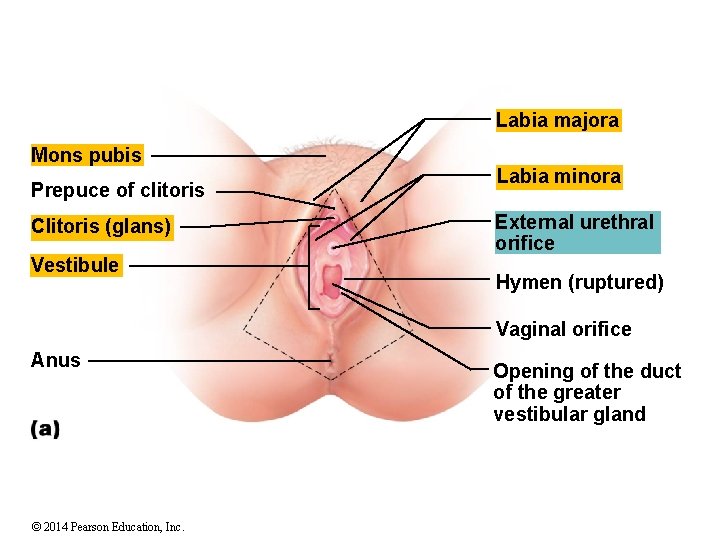
XVI. External Genitalia A. Mons pubis 1. overlies the pubic symphysis 2. pubic hair covers after puberty B. Labia majora 1. homologue of the male scrotum in embryology 2. encloses the labia minora C. Vestibule 1. space between the labia minora 2. houses opening to urethra and vagina © 2014 Pearson Education, Inc.
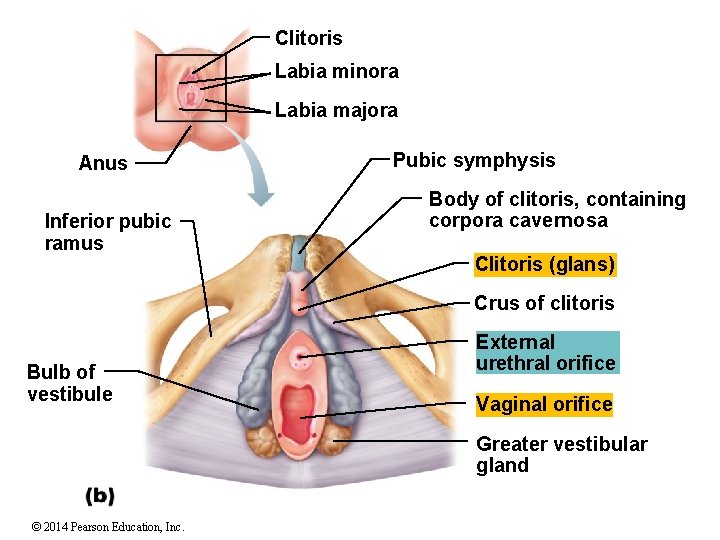
D. Clitoris 1. Anterior to vestibule 2. Is erectile tissue 3. Homologous to the penis E. Female perineum 1. anterior boundary - pubic arch 2. posterior boundary - coccyx 3. lateral boundaries - ischial tuberosities © 2014 Pearson Education, Inc.
Labia majora Mons pubis Prepuce of clitoris Clitoris (glans) Vestibule Labia minora External urethral orifice Hymen (ruptured) Vaginal orifice Anus © 2014 Pearson Education, Inc. Opening of the duct of the greater vestibular gland
Clitoris Labia minora Labia majora Anus Inferior pubic ramus Pubic symphysis Body of clitoris, containing corpora cavernosa Clitoris (glans) Crus of clitoris Bulb of vestibule External urethral orifice Vaginal orifice Greater vestibular gland © 2014 Pearson Education, Inc.
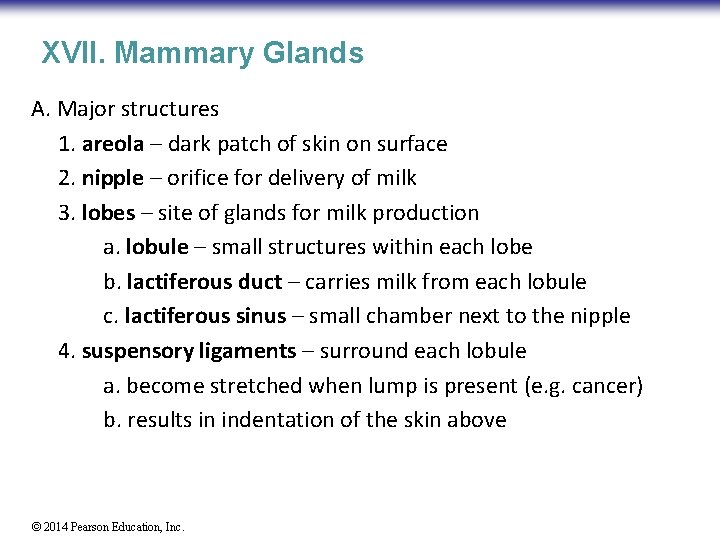
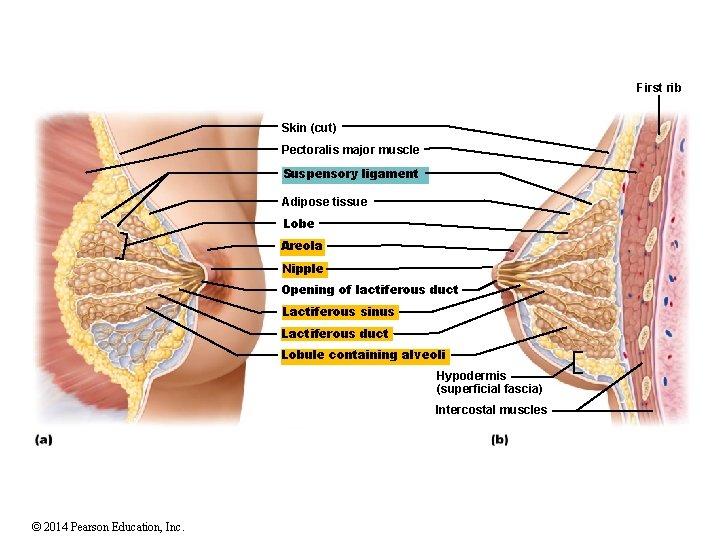
XVII. Mammary Glands A. Major structures 1. areola – dark patch of skin on surface 2. nipple – orifice for delivery of milk 3. lobes – site of glands for milk production a. lobule – small structures within each lobe b. lactiferous duct – carries milk from each lobule c. lactiferous sinus – small chamber next to the nipple 4. suspensory ligaments – surround each lobule a. become stretched when lump is present (e. g. cancer) b. results in indentation of the skin above © 2014 Pearson Education, Inc.
First rib Skin (cut) Pectoralis major muscle Suspensory ligament Adipose tissue Lobe Areola Nipple Opening of lactiferous duct Lactiferous sinus Lactiferous duct Lobule containing alveoli Hypodermis (superficial fascia) Intercostal muscles © 2014 Pearson Education, Inc.
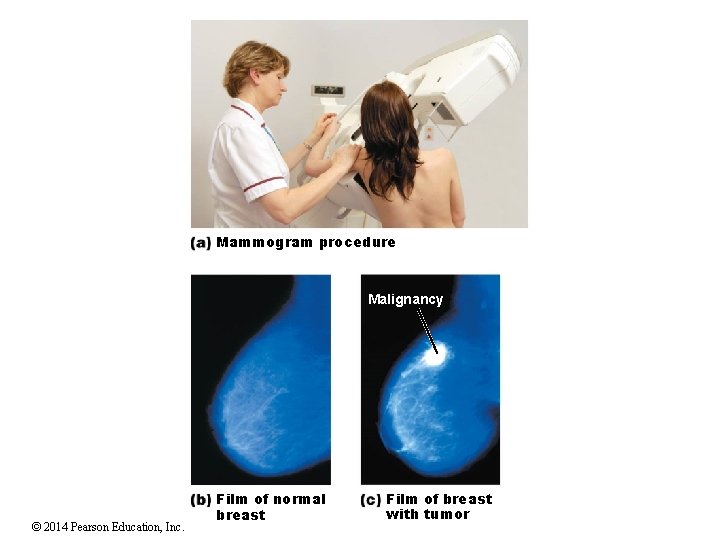
Mammogram procedure Malignancy © 2014 Pearson Education, Inc. Film of normal breast Film of breast with tumor