
25 Optical Instruments human eye microscopes telescopes diffraction
- Slides: 13
25 Optical Instruments • human eye • microscopes & telescopes • diffraction & resolution • Homework: • 6, 11, 13 1
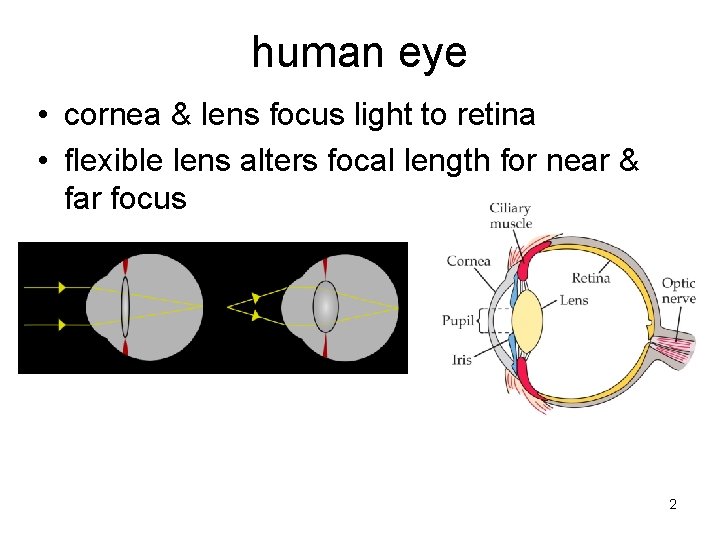
human eye • cornea & lens focus light to retina • flexible lens alters focal length for near & far focus 2
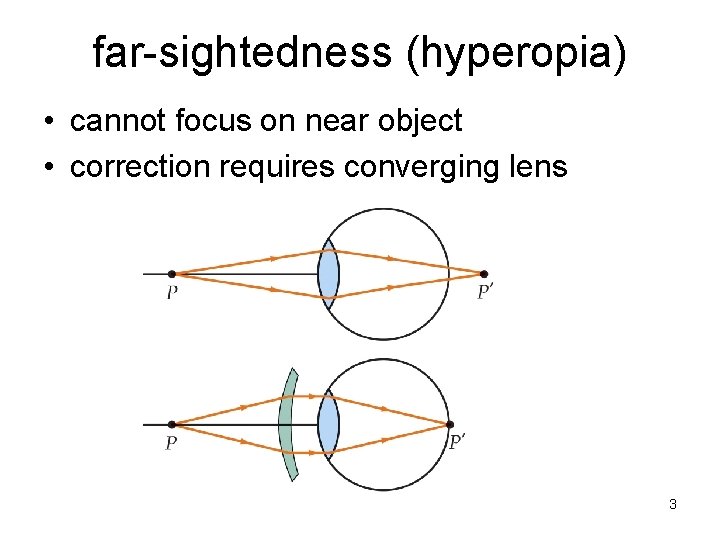
far-sightedness (hyperopia) • cannot focus on near object • correction requires converging lens 3
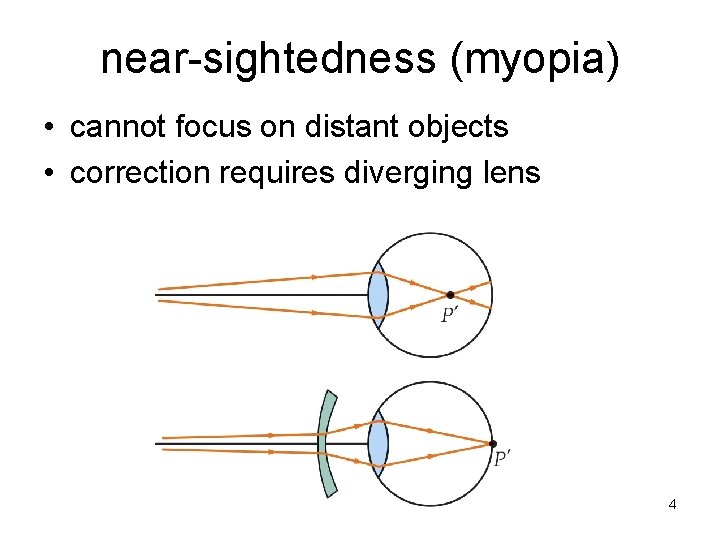
near-sightedness (myopia) • cannot focus on distant objects • correction requires diverging lens 4
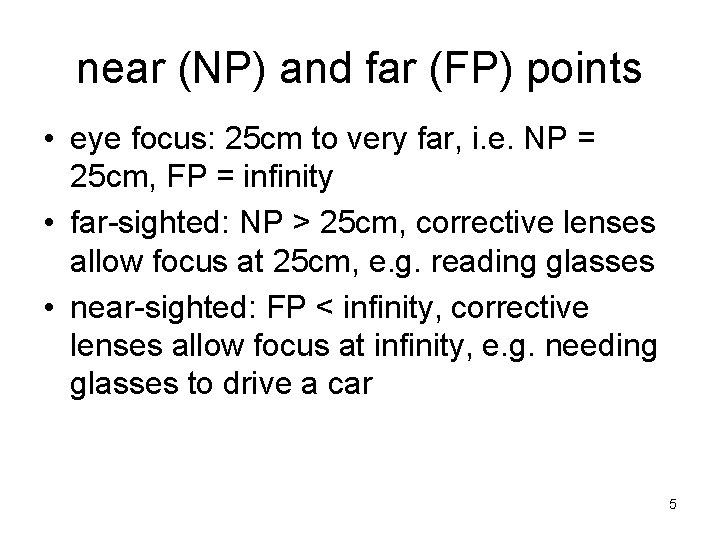
near (NP) and far (FP) points • eye focus: 25 cm to very far, i. e. NP = 25 cm, FP = infinity • far-sighted: NP > 25 cm, corrective lenses allow focus at 25 cm, e. g. reading glasses • near-sighted: FP < infinity, corrective lenses allow focus at infinity, e. g. needing glasses to drive a car 5
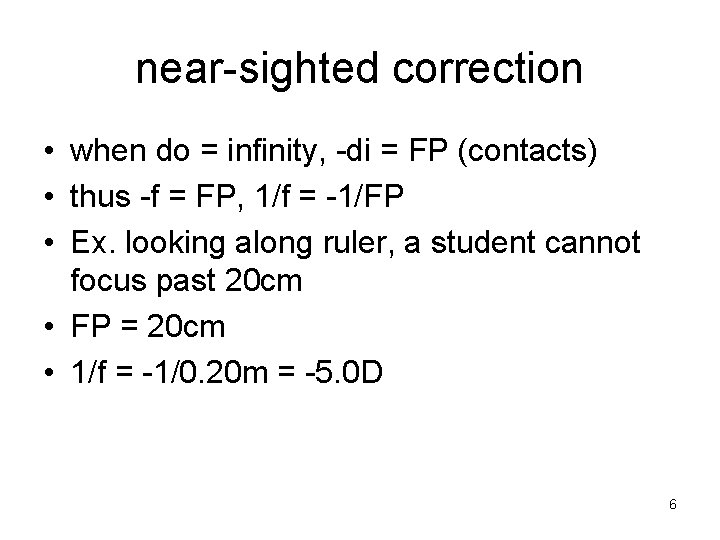
near-sighted correction • when do = infinity, -di = FP (contacts) • thus -f = FP, 1/f = -1/FP • Ex. looking along ruler, a student cannot focus past 20 cm • FP = 20 cm • 1/f = -1/0. 20 m = -5. 0 D 6
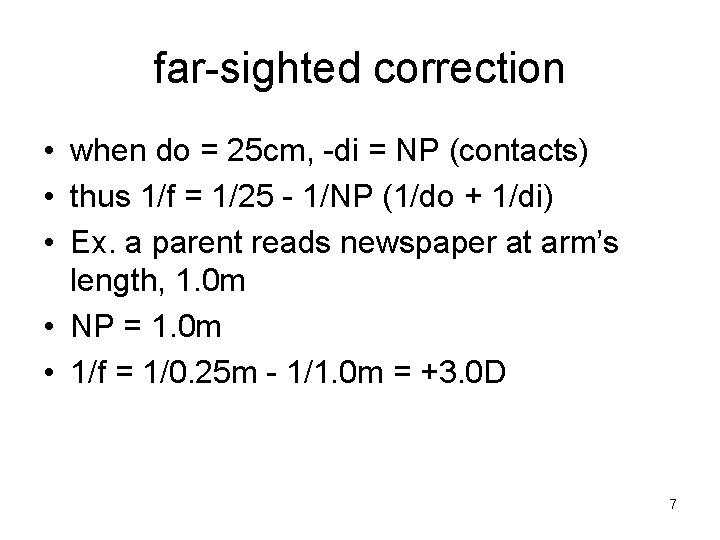
far-sighted correction • when do = 25 cm, -di = NP (contacts) • thus 1/f = 1/25 - 1/NP (1/do + 1/di) • Ex. a parent reads newspaper at arm’s length, 1. 0 m • NP = 1. 0 m • 1/f = 1/0. 25 m - 1/1. 0 m = +3. 0 D 7
summary • • • eye/instrument parameters eye defects & corrective lenses magnifying glass compound microscope refracting telescope diffraction limit of resolution 8
magnifying glass • allows close-focus • object at focal point - eye focuses parallel rays which emerge • angular magnification (AM) = 25 cm/f • AM = angular-width ratio: with lens vs. when 25 cm from eye 9
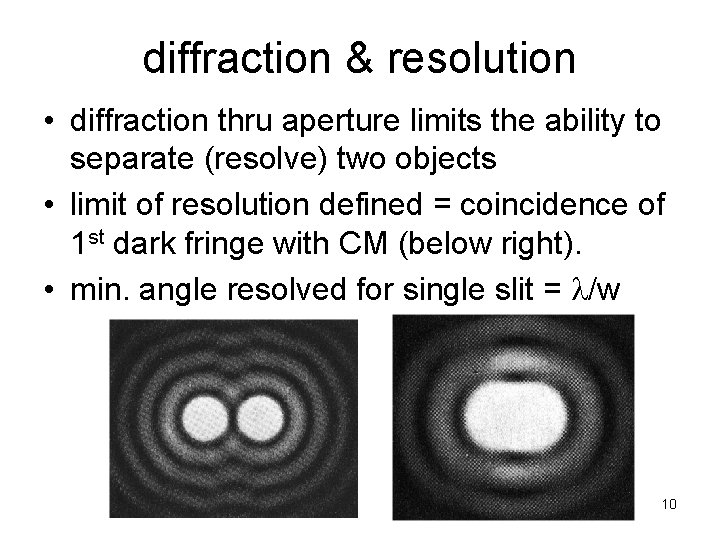
diffraction & resolution • diffraction thru aperture limits the ability to separate (resolve) two objects • limit of resolution defined = coincidence of 1 st dark fringe with CM (below right). • min. angle resolved for single slit = l/w 10
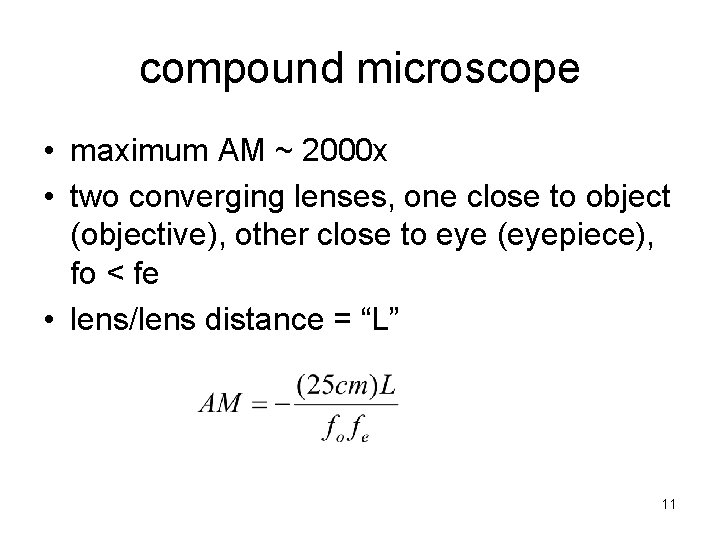
compound microscope • maximum AM ~ 2000 x • two converging lenses, one close to object (objective), other close to eye (eyepiece), fo < fe • lens/lens distance = “L” 11
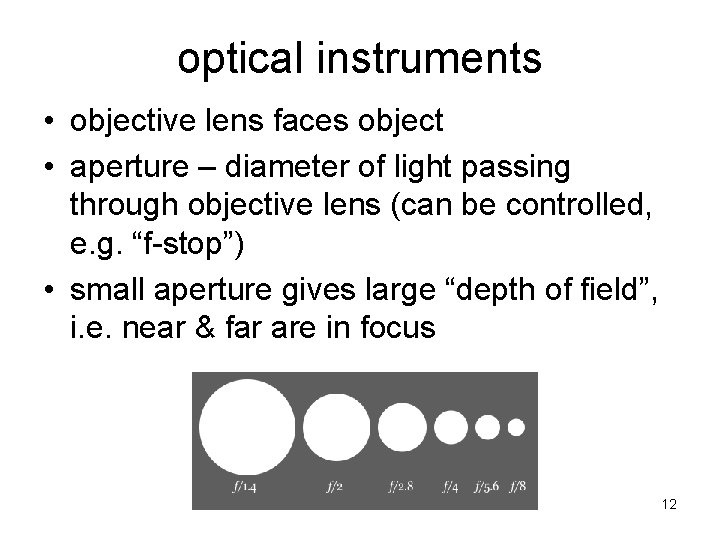
optical instruments • objective lens faces object • aperture – diameter of light passing through objective lens (can be controlled, e. g. “f-stop”) • small aperture gives large “depth of field”, i. e. near & far are in focus 12
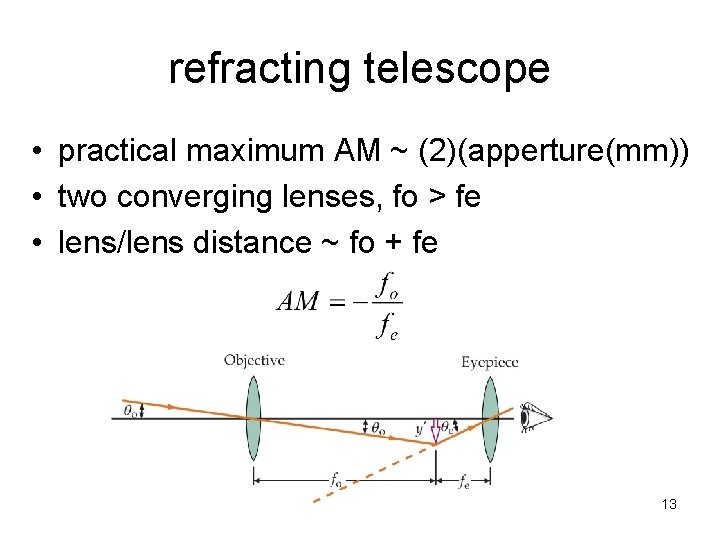
refracting telescope • practical maximum AM ~ (2)(apperture(mm)) • two converging lenses, fo > fe • lens/lens distance ~ fo + fe 13