
25 January 2022 Division of polynomials LO Use
- Slides: 9
25 January 2022 Division of polynomials LO: Use long division or equating coefficients to divide polynomials.
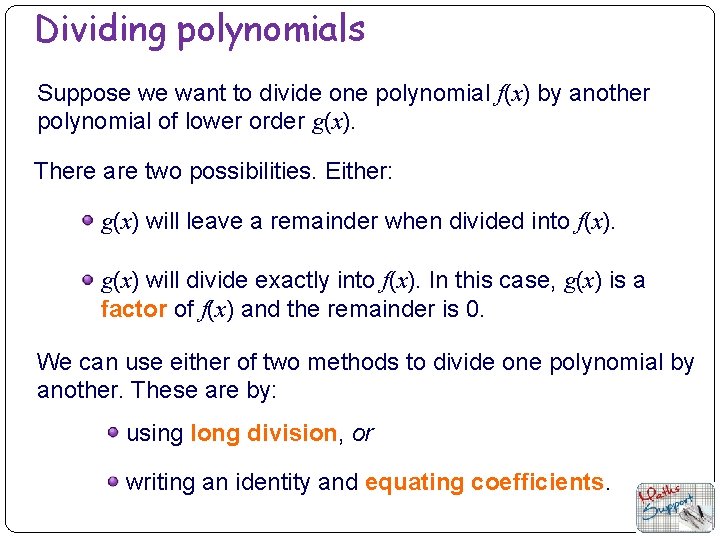
Dividing polynomials Suppose we want to divide one polynomial f(x) by another polynomial of lower order g(x). There are two possibilities. Either: g(x) will leave a remainder when divided into f(x). g(x) will divide exactly into f(x). In this case, g(x) is a factor of f(x) and the remainder is 0. We can use either of two methods to divide one polynomial by another. These are by: using long division, or writing an identity and equating coefficients.
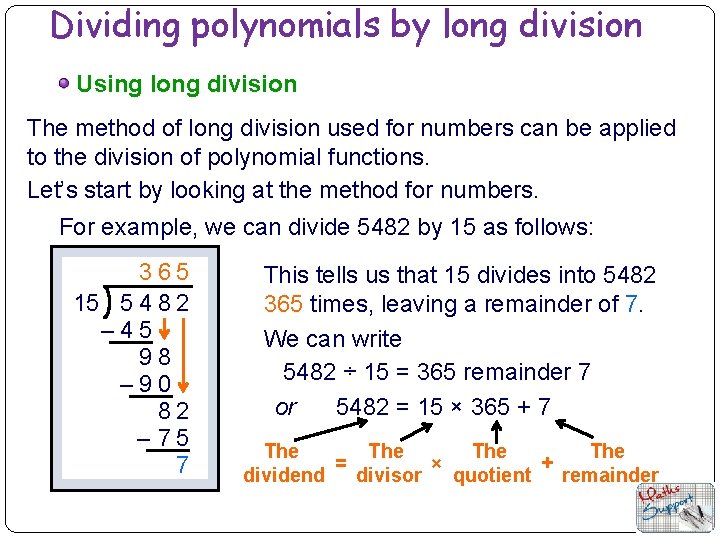
Dividing polynomials by long division Using long division The method of long division used for numbers can be applied to the division of polynomial functions. Let’s start by looking at the method for numbers. For example, we can divide 5482 by 15 as follows: 365 15 5 4 8 2 – 45 98 – 90 82 – 75 7 This tells us that 15 divides into 5482 365 times, leaving a remainder of 7. We can write 5482 ÷ 15 = 365 remainder 7 or 5482 = 15 × 365 + 7 The The × + = dividend divisor quotient remainder
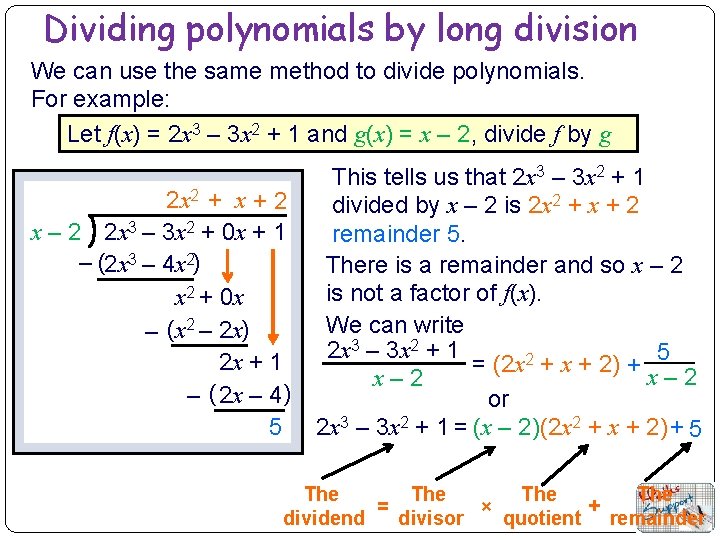
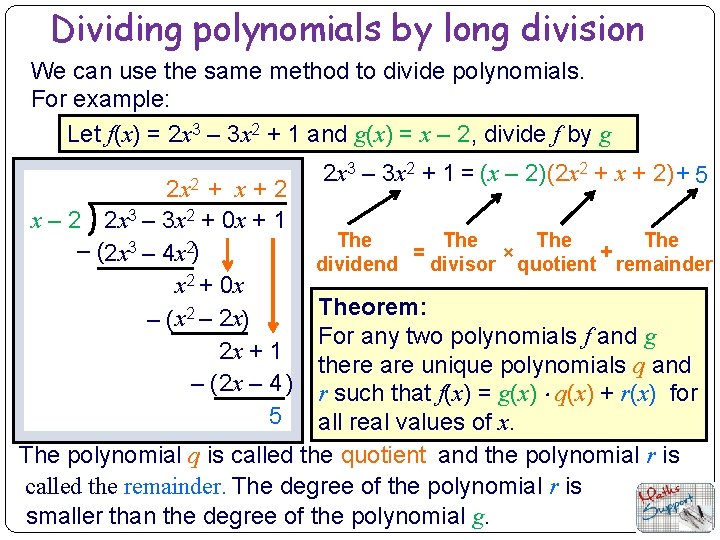
Dividing polynomials by long division We can use the same method to divide polynomials. For example: Let f(x) = 2 x 3 – 3 x 2 + 1 and g(x) = x – 2, divide f by g 2 x 2 + x + 2 x – 2 2 x 3 – 3 x 2 + 0 x + 1 – (2 x 3 – 4 x 2) x 2 + 0 x – (x 2 – 2 x) 2 x + 1 – ( 2 x – 4 ) 5 This tells us that 2 x 3 – 3 x 2 + 1 divided by x – 2 is 2 x 2 + x + 2 remainder 5. There is a remainder and so x – 2 is not a factor of f(x). We can write 2 x 3 – 3 x 2 + 1 5 2 = (2 x + 2) + x– 2 or 2 x 3 – 3 x 2 + 1 = (x – 2)(2 x 2 + x + 2) + 5 The The = × + divisor quotient remainder dividend
Dividing polynomials by long division We can use the same method to divide polynomials. For example: Let f(x) = 2 x 3 – 3 x 2 + 1 and g(x) = x – 2, divide f by g 2 x 3 – 3 x 2 + 1 = (x – 2)(2 x 2 + x + 2) + 5 2 x 2 + x + 2 x – 2 2 x 3 – 3 x 2 + 0 x + 1 The The – (2 x 3 – 4 x 2) = × + divisor quotient remainder dividend x 2 + 0 x Theorem: – ( x 2 – 2 x) For any two polynomials f and g 2 x + 1 there are unique polynomials q and – ( 2 x – 4 ) r such that f(x) = g(x) q(x) + r(x) for 5 all real values of x. The polynomial q is called the quotient and the polynomial r is called the remainder. The degree of the polynomial r is smaller than the degree of the polynomial g.
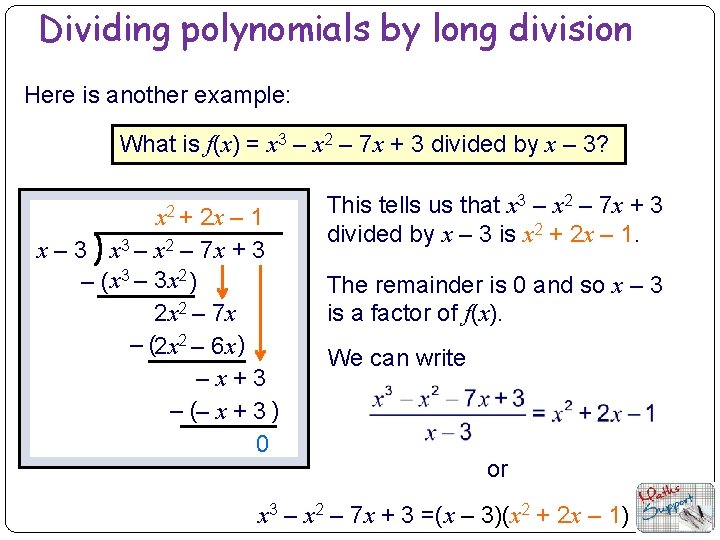
Dividing polynomials by long division Here is another example: What is f(x) = x 3 – x 2 – 7 x + 3 divided by x – 3? x 2 + 2 x – 1 x – 3 x 3 – x 2 – 7 x + 3 – ( x 3 – 3 x 2 ) 2 x 2 – 7 x – (2 x 2 – 6 x ) –x+3 – (– x + 3 ) 0 This tells us that x 3 – x 2 – 7 x + 3 divided by x – 3 is x 2 + 2 x – 1. The remainder is 0 and so x – 3 is a factor of f(x). We can write or x 3 – x 2 – 7 x + 3 =(x – 3)(x 2 + 2 x – 1)
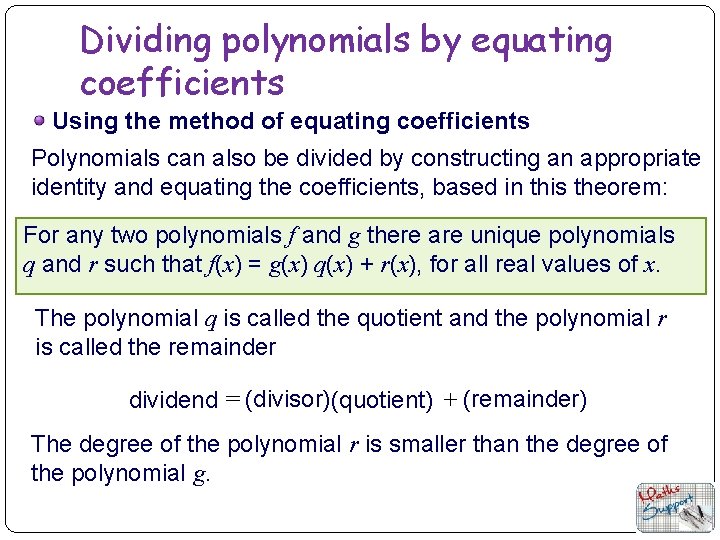
Dividing polynomials by equating coefficients Using the method of equating coefficients Polynomials can also be divided by constructing an appropriate identity and equating the coefficients, based in this theorem: For any two polynomials f and g there are unique polynomials q and r such that f(x) = g(x) q(x) + r(x), for all real values of x. The polynomial q is called the quotient and the polynomial r is called the remainder dividend = (divisor) (quotient) + (remainder) The degree of the polynomial r is smaller than the degree of the polynomial g.
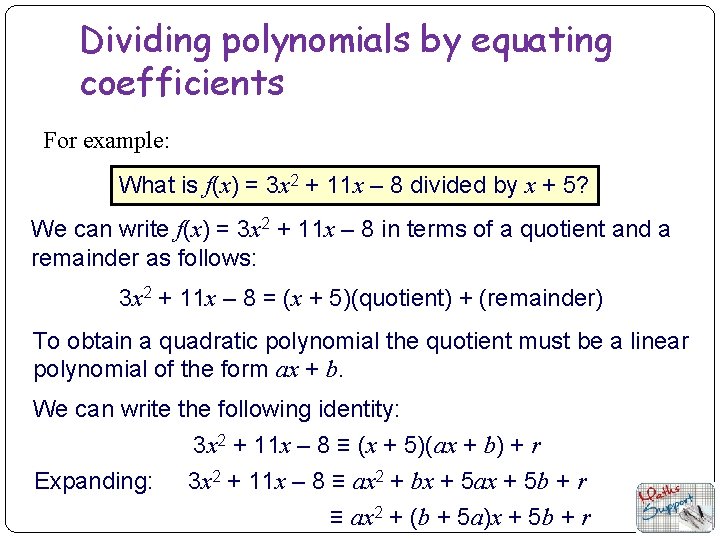
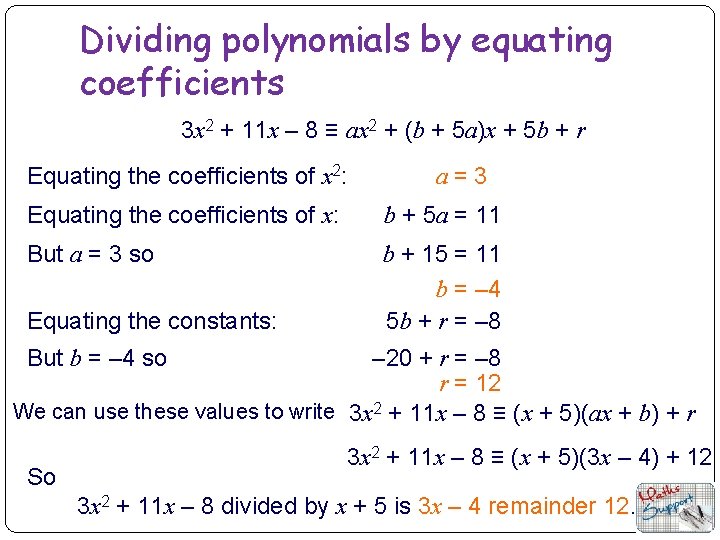
Dividing polynomials by equating coefficients For example: What is f(x) = 3 x 2 + 11 x – 8 divided by x + 5? We can write f(x) = 3 x 2 + 11 x – 8 in terms of a quotient and a remainder as follows: 3 x 2 + 11 x – 8 = (x + 5)(quotient) + (remainder) To obtain a quadratic polynomial the quotient must be a linear polynomial of the form ax + b. We can write the following identity: 3 x 2 + 11 x – 8 ≡ (x + 5)(ax + b) + r Expanding: 3 x 2 + 11 x – 8 ≡ ax 2 + bx + 5 ax + 5 b + r ≡ ax 2 + (b + 5 a)x + 5 b + r
Dividing polynomials by equating coefficients 3 x 2 + 11 x – 8 ≡ ax 2 + (b + 5 a)x + 5 b + r Equating the coefficients of x 2: a=3 Equating the coefficients of x: b + 5 a = 11 But a = 3 so b + 15 = 11 b = – 4 5 b + r = – 8 Equating the constants: But b = – 4 so – 20 + r = – 8 r = 12 We can use these values to write 3 x 2 + 11 x – 8 ≡ (x + 5)(ax + b) + r So 3 x 2 + 11 x – 8 ≡ (x + 5)(3 x – 4) + 12 3 x 2 + 11 x – 8 divided by x + 5 is 3 x – 4 remainder 12.