
25 Development of Fetal membranes and placenta Prof
25 Development of Fetal membranes and placenta Prof. Abdulameer Al-Nuaimi E-mail: a. al-nuaimi@sheffield. ac. uk E. mail: abdulameerh@yahoo. com
Placenta The placenta, begins to form in the first week 4 of pregnancy, it continues to develop over the next couple of months, with smaller capillaries turning into blood vessels and delivering nutrients and oxygen to the growing baby. Placenta will develop enough by week 12 (three months) of pregnancy to work in place of the corpus luteum through the rest of pregnancy. Placenta weighs about a pound by the time of 40 weeks of pregnancy.
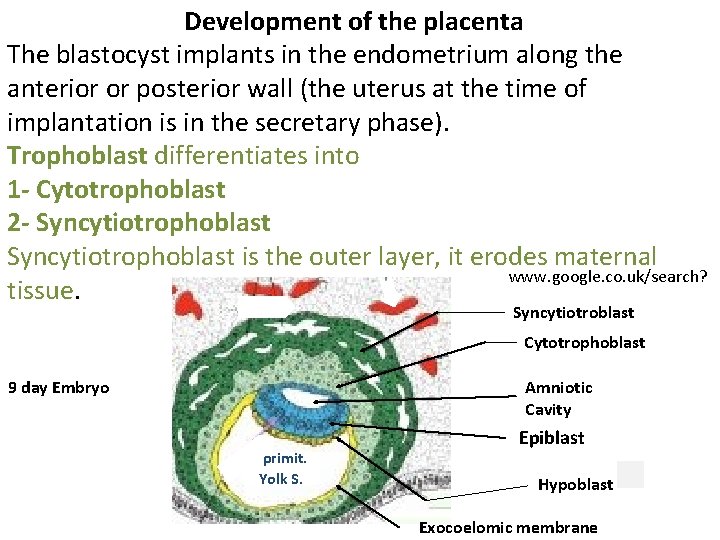
Development of the placenta The blastocyst implants in the endometrium along the anterior or posterior wall (the uterus at the time of implantation is in the secretary phase). Trophoblast differentiates into 1 - Cytotrophoblast 2 - Syncytiotrophoblast is the outer layer, it erodes maternal www. google. co. uk/search? tissue. Syncytiotroblast Cytotrophoblast 9 day Embryo Amniotic Cavity Pprimit. Yolk S. Epiblast Hypoblast Exocoelomic membrane
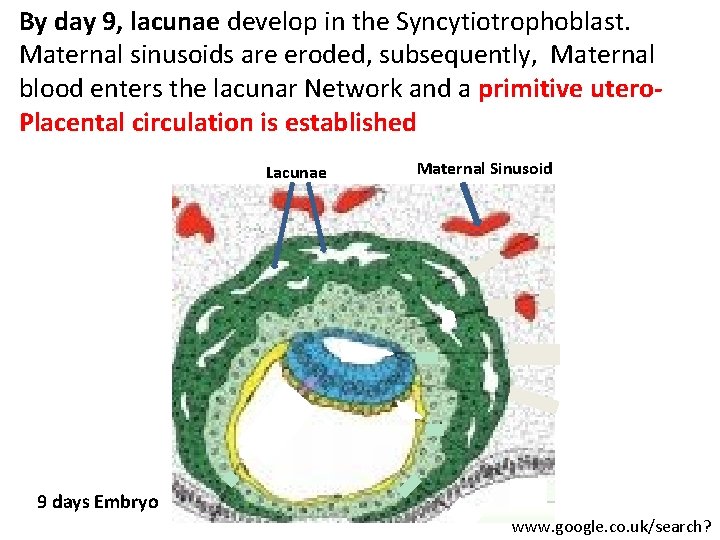
By day 9, lacunae develop in the Syncytiotrophoblast. Maternal sinusoids are eroded, subsequently, Maternal blood enters the lacunar Network and a primitive utero- Placental circulation is established Lacunae Maternal Sinusoid 9 days Embryo www. google. co. uk/search?

Extraembryonic mesoderm (chorionic plate) fills all of the space between the Cytotrophoblast and Exocoelomic membrane. Large cavities develop in the Extraembryonic mesoderm, these cavities become confluent, they form a new space called the Extraembryonic cavity , or Chorionic cavity. The Extraembryonic mesoderm = (chorionic plate) forms two layers, Splanchnopleuric (splanchnic or visceral) and Somatopleuric (somatic or parietal) layers. extra-embryonic mesoderm is responsible for the formation of the blood vessels that will connect the embryo to the placenta. This extra-embryonic mesoderm looks and acts just like embryonic mesoderm, but it is found outside of the developing embryo.

Trophoblastic Lacunae Cytotrophoblast Extraembryonic Splanchnopleuric Mesodermr (Visceral)m Extraembryonic Somatopleuric Mesoderm (Somatic) 13 day human Syncytiotroph oblast Exocoelomic membrane Epiblast A. C hypoblast Primary Yolk sac Site of penetration Extraembryonic (Chorionic) cavity Endometrium blastocyst Formation of Extraembryonic mesoderm www. google. co. uk/search?
Further development of the trophoblast connecting stalk appears, it contains capillaries which are connected to the chorionic plate (Extraembryonic Somatopleuric mesoderm) and the embryo. chorion Is a membrane that exist during pregnancy between the developing fetus and mother. It is formed by extraembryonic mesoderm and the two layers of trophoblast, it surrounds the embryo and other membranes. Chorionic villi emerge from the chorion, invade the endometrium, and allow transfer of nutrients from maternal blood to fetal blood. This commences the formation of placenta. In this way, the embryo starts getting its nutrients and oxygen through this stalk.
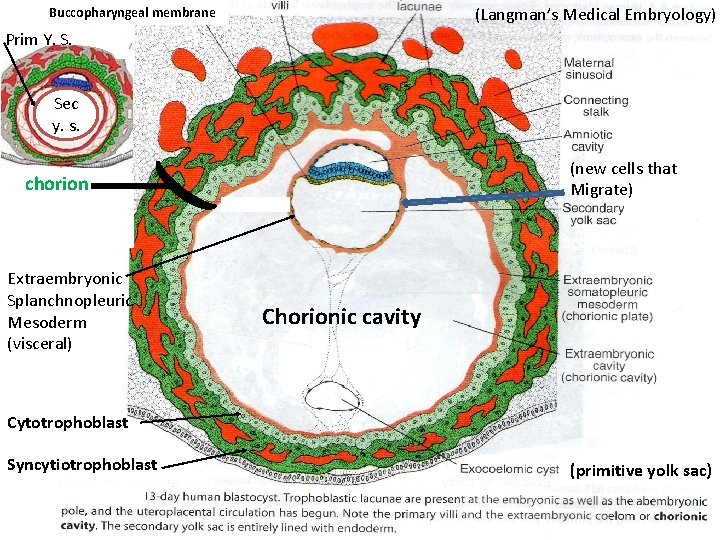
(Langman’s Medical Embryology) Buccopharyngeal membrane Prim Y. S. Sec y. s. (new cells that Migrate) chorion Extraembryonic Splanchnopleuric Mesoderm (visceral) Chorionic cavity Cytotrophoblast Syncytiotrophoblast (primitive yolk sac)
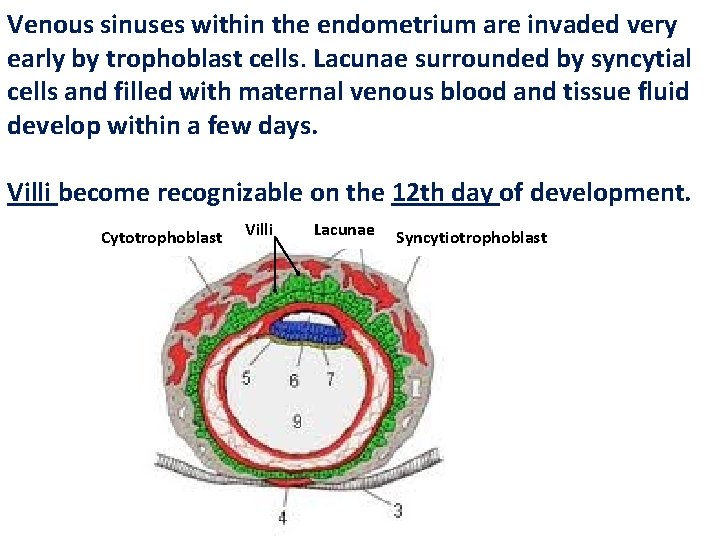
Venous sinuses within the endometrium are invaded very early by trophoblast cells. Lacunae surrounded by syncytial cells and filled with maternal venous blood and tissue fluid develop within a few days. Villi become recognizable on the 12 th day of development. Cytotrophoblast Villi Lacunae Syncytiotrophoblast
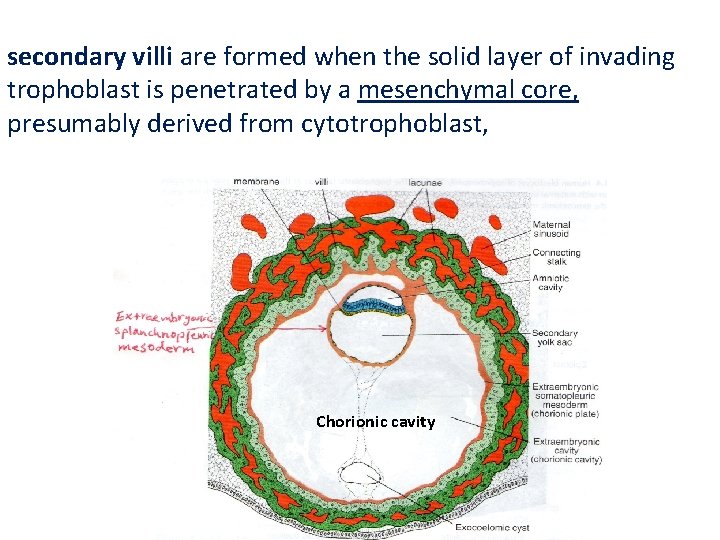
secondary villi are formed when the solid layer of invading trophoblast is penetrated by a mesenchymal core, presumably derived from cytotrophoblast, Chorionic cavity
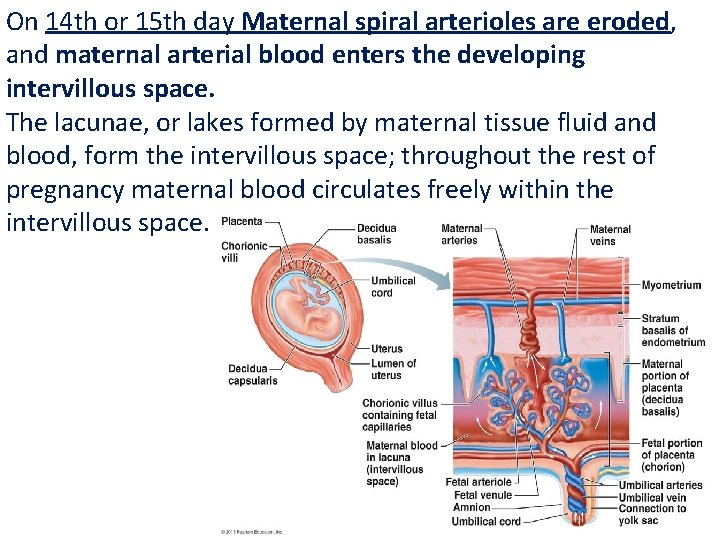
On 14 th or 15 th day Maternal spiral arterioles are eroded, and maternal arterial blood enters the developing intervillous space. The lacunae, or lakes formed by maternal tissue fluid and blood, form the intervillous space; throughout the rest of pregnancy maternal blood circulates freely within the intervillous space.
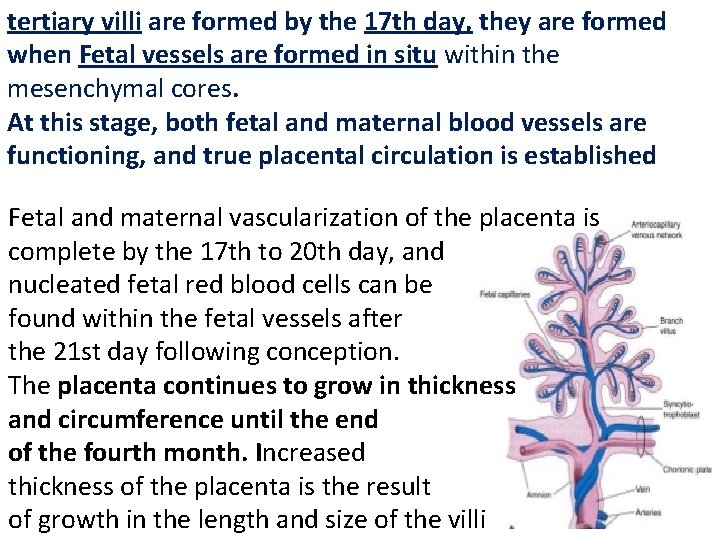
tertiary villi are formed by the 17 th day, they are formed when Fetal vessels are formed in situ within the mesenchymal cores. At this stage, both fetal and maternal blood vessels are functioning, and true placental circulation is established Fetal and maternal vascularization of the placenta is complete by the 17 th to 20 th day, and nucleated fetal red blood cells can be found within the fetal vessels after the 21 st day following conception. The placenta continues to grow in thickness and circumference until the end of the fourth month. Increased thickness of the placenta is the result of growth in the length and size of the villi
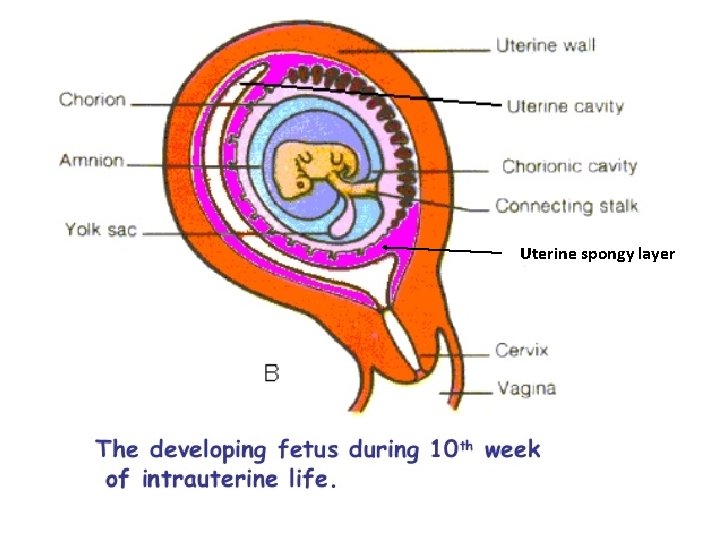
Meanwhile, the endometrium, under the influence of estrogen and progesterone, has undergone striking changes in preparation for implantation. Stromal cells have become enlarged and pale staining and are surrounded by oedema fluid; gland cells are filled with glycogen. This endometrium is called decidua because it sheds at the end of the pregnancy, it is arranged into three layers: 1 - Compact layer: surface layer with few glands. 2 - Spongy layer: middle layer with many glands and vessels. 3 - basal layer: lying deep under the implanted embryo The blastocyst invades and develops within the spongy layer.

Layers of uterine wall Compact layer Spongy layer (basal layer) Layers of the endometrium (decidua)
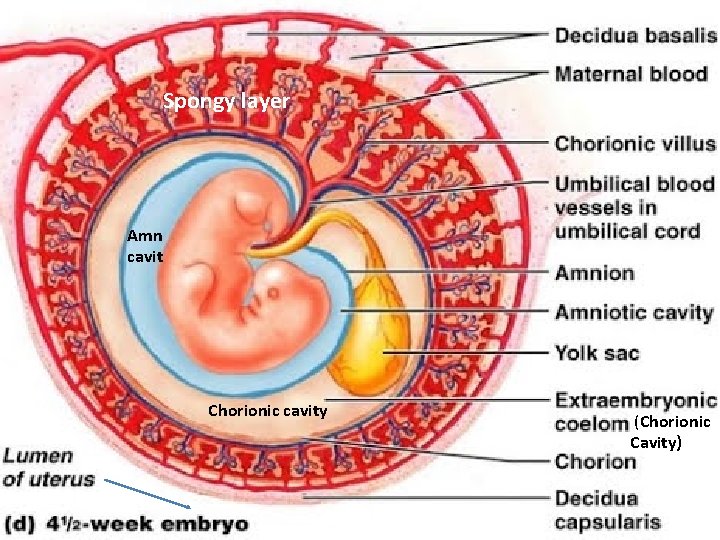
Spongy layer Amn cavit Chorionic cavity (Chorionic Cavity)
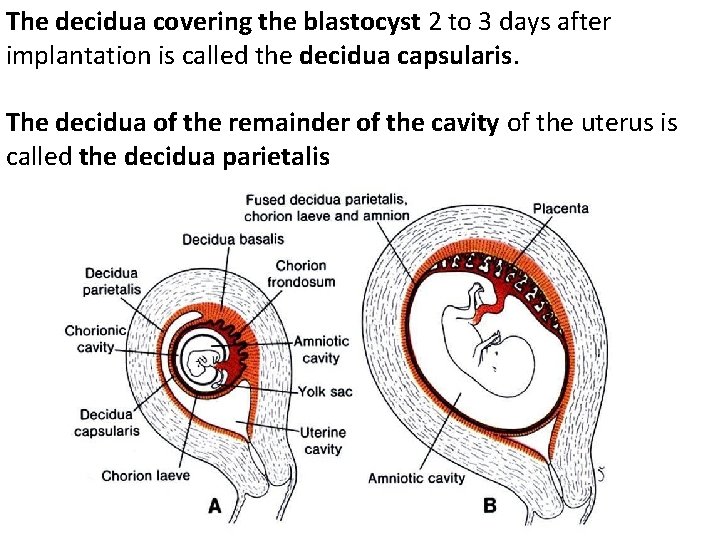
The decidua covering the blastocyst 2 to 3 days after implantation is called the decidua capsularis. The decidua of the remainder of the cavity of the uterus is called the decidua parietalis
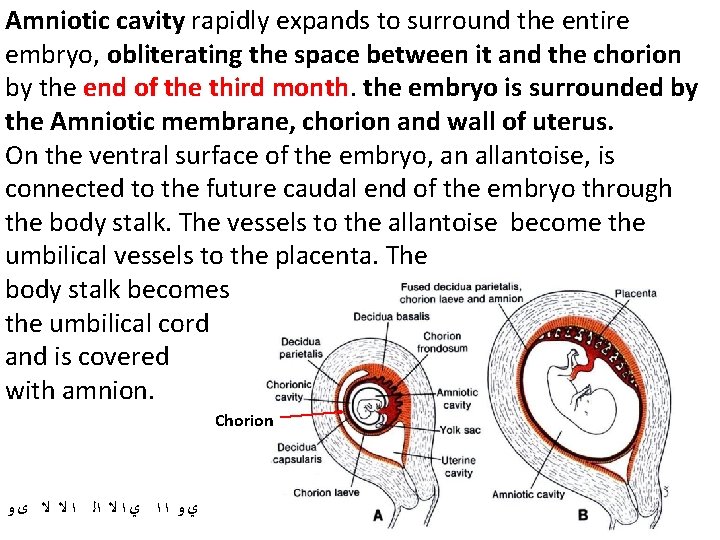
Amniotic cavity rapidly expands to surround the entire embryo, obliterating the space between it and the chorion by the end of the third month. the embryo is surrounded by the Amniotic membrane, chorion and wall of uterus. On the ventral surface of the embryo, an allantoise, is connected to the future caudal end of the embryo through the body stalk. The vessels to the allantoise become the umbilical vessels to the placenta. The body stalk becomes the umbilical cord and is covered with amnion. Chorion ﻱ ﻭ ﺍ ﺍ ﻱ ﺍ ﻻ ﺍﻟ ﺍ ﻻ ﻻ ﻯ ﻭ
Uterine spongy layer
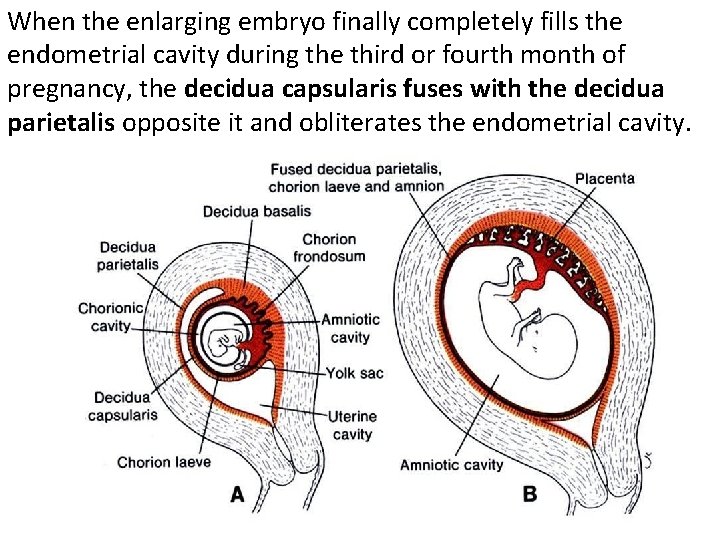
When the enlarging embryo finally completely fills the endometrial cavity during the third or fourth month of pregnancy, the decidua capsularis fuses with the decidua parietalis opposite it and obliterates the endometrial cavity.
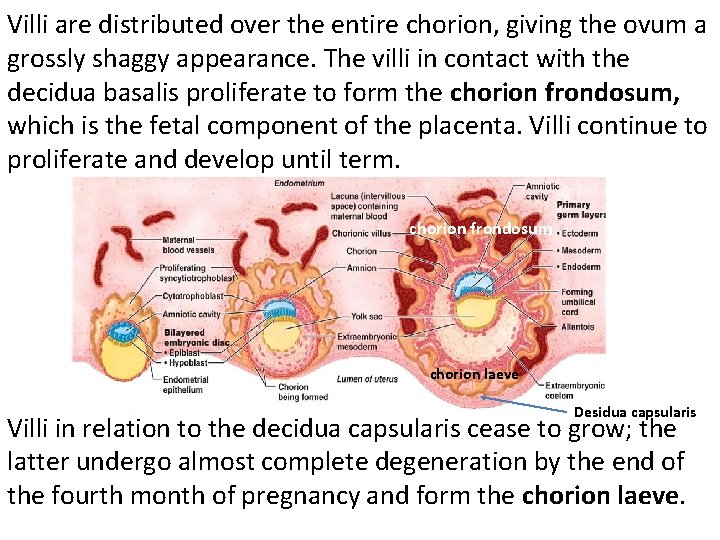
Villi are distributed over the entire chorion, giving the ovum a grossly shaggy appearance. The villi in contact with the decidua basalis proliferate to form the chorion frondosum, which is the fetal component of the placenta. Villi continue to proliferate and develop until term. chorion frondosum chorion laeve Desidua capsularis Villi in relation to the decidua capsularis cease to grow; the latter undergo almost complete degeneration by the end of the fourth month of pregnancy and form the chorion laeve.
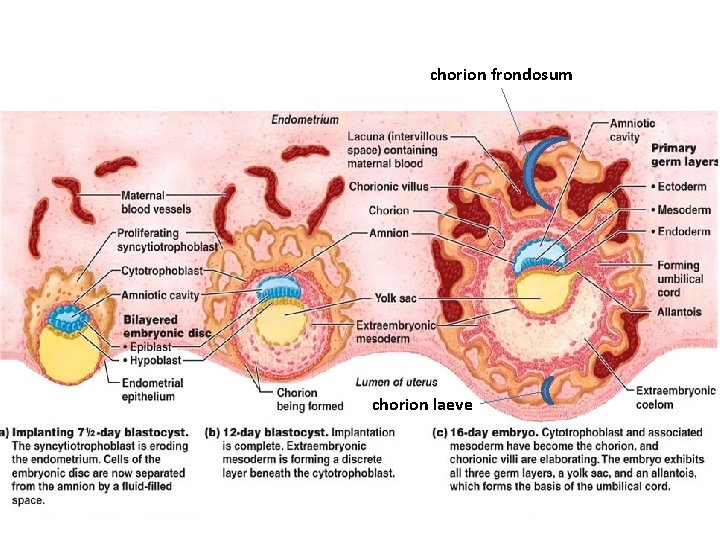
chorion frondosum chorion laeve

Chorion
After the fourth month there is no appreciable increase in thickness of the placenta, but growth in circumference continues through most of pregnancy, it is due to the continuous expansion of the intervillous space.
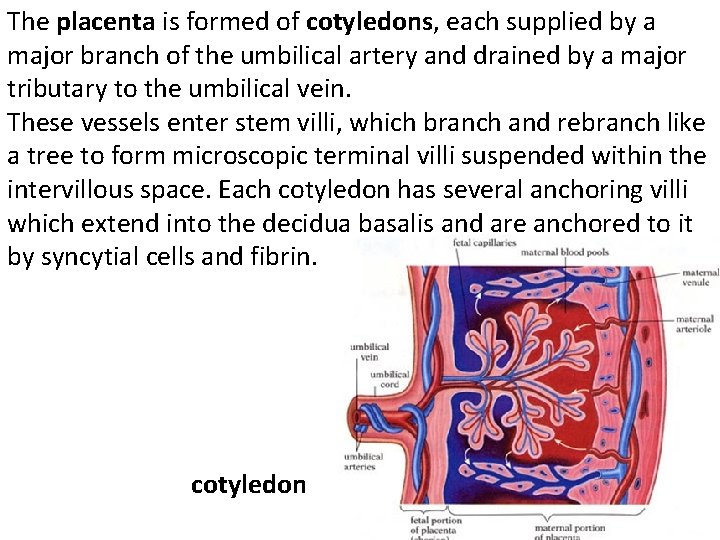
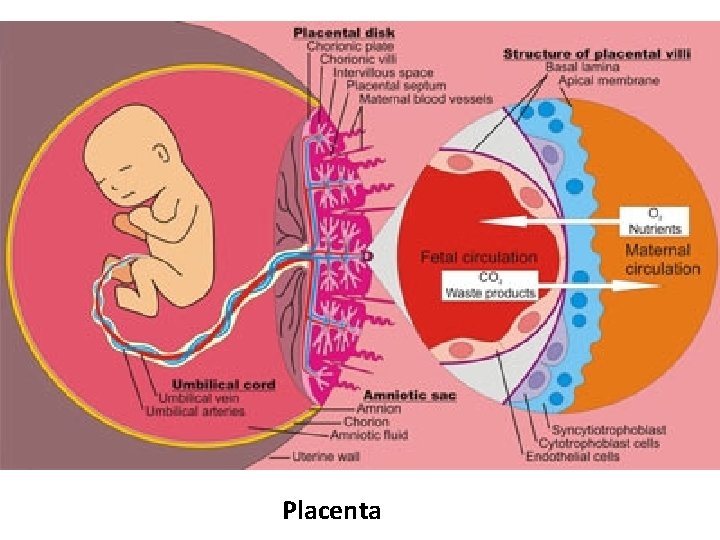
The placenta is formed of cotyledons, each supplied by a major branch of the umbilical artery and drained by a major tributary to the umbilical vein. These vessels enter stem villi, which branch and rebranch like a tree to form microscopic terminal villi suspended within the intervillous space. Each cotyledon has several anchoring villi which extend into the decidua basalis and are anchored to it by syncytial cells and fibrin. cotyledon
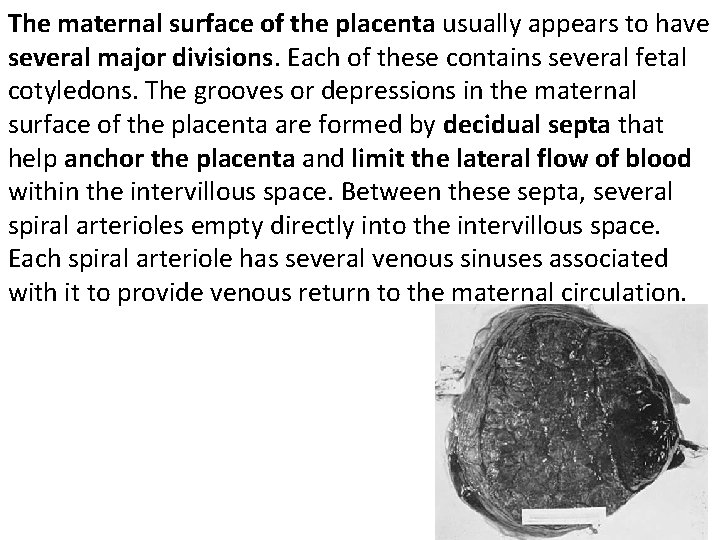
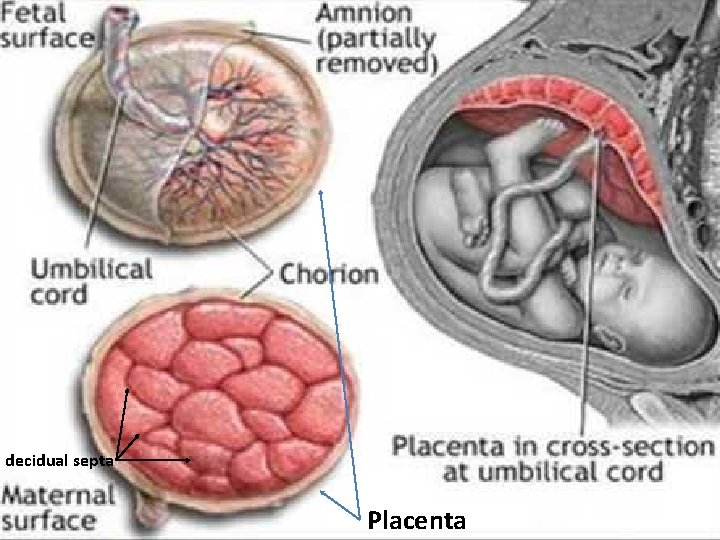
The maternal surface of the placenta usually appears to have several major divisions. Each of these contains several fetal cotyledons. The grooves or depressions in the maternal surface of the placenta are formed by decidual septa that help anchor the placenta and limit the lateral flow of blood within the intervillous space. Between these septa, several spiral arterioles empty directly into the intervillous space. Each spiral arteriole has several venous sinuses associated with it to provide venous return to the maternal circulation.
decidual septa Placenta
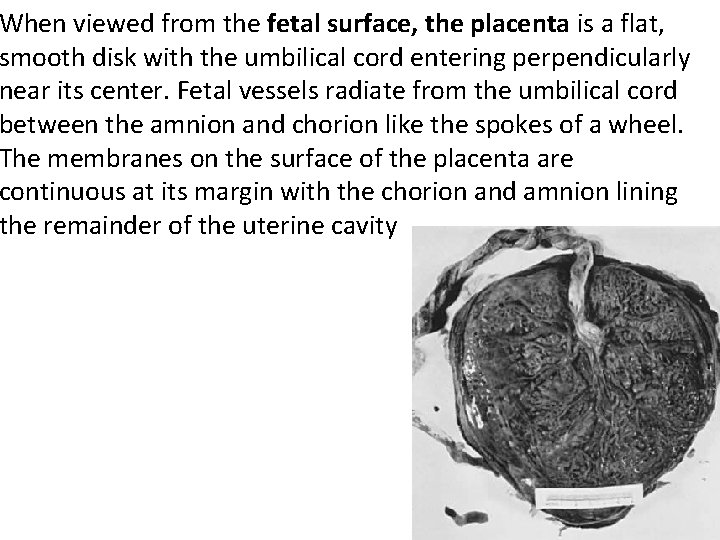
When viewed from the fetal surface, the placenta is a flat, smooth disk with the umbilical cord entering perpendicularly near its center. Fetal vessels radiate from the umbilical cord between the amnion and chorion like the spokes of a wheel. The membranes on the surface of the placenta are continuous at its margin with the chorion and amnion lining the remainder of the uterine cavity
Placenta

Thank you
- Slides: 29