
25 1 Properties of Stars Part I Do

- Slides: 13
25. 1 – Properties of Stars – Part I
Do Now What does a star's color tell us about a star?
Do Now What does a star's color tell us about a star? The color tells us the star’s temperature.
Key Word Parallax
Vocab Words Constellations Binary Star Light-year
Constellations As early as 5000 years ago, people became fascinated with the star-studded skies and began to name the patterns they saw; called constellations. Although the stars that make up a constellation all appear to be the same distance from Earth, some are many times farther away than others. Today 88 constellations are recognized. They are used to divide the sky into units, just as state boundaries divide the U. S.
Characteristics of Stars Color is a clue to a star’s temperature. Very hot stars with surface temperatures above 30, 000 K emit most of their energy in short wavelengths and appear blue. Red stars are much cooler, and have longer wavelengths. Yellow stars, like the sun have temperatures from about 5, 000 and 6, 000 K.
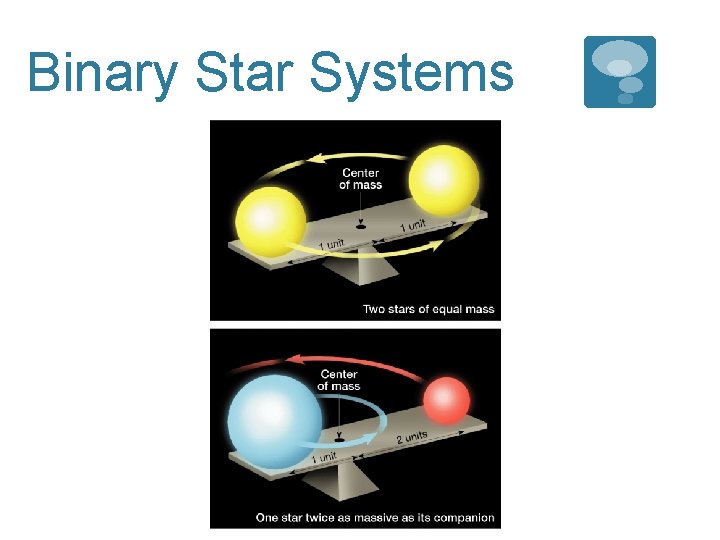
Binary Stars and Stellar Mass Binary stars are pairs of stars, pulled toward each other by gravity. More than 50% of the stars in the universe may occur in pairs or multiples. They are used to determine the star property most difficult to calculate – the mass. It’s calculated by looking at where the center of mass is in a binary system. If one star is more massive than it’s partner the center of mass is closer to that said star.
Binary Star Systems
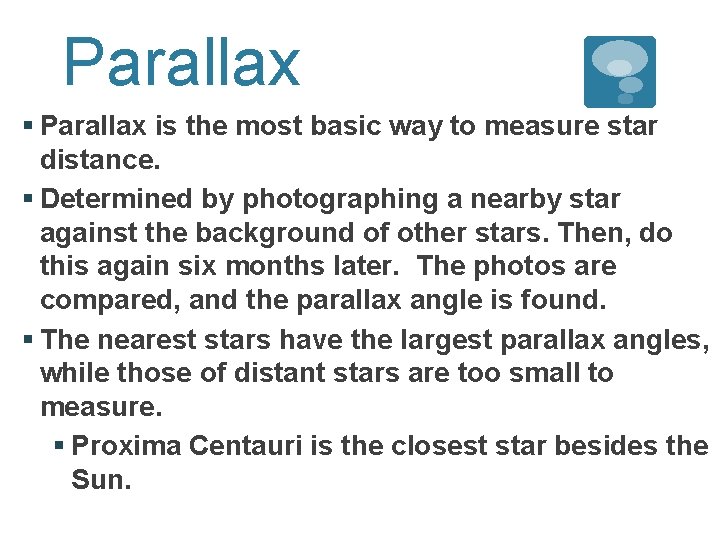
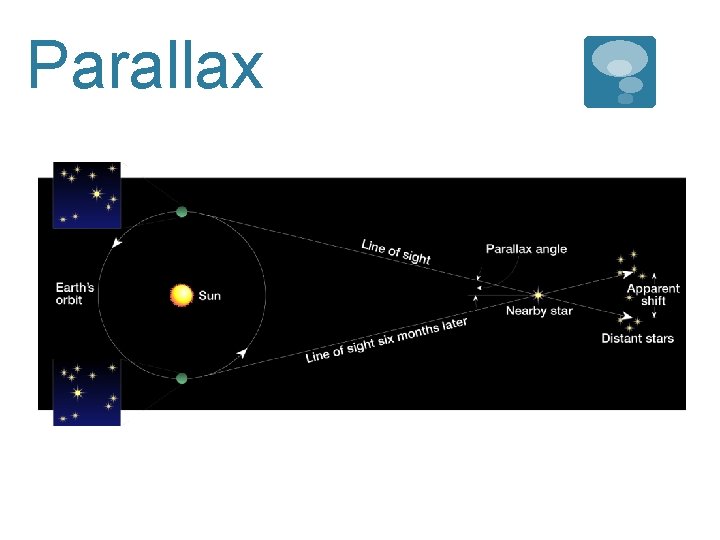
Parallax is the most basic way to measure star distance. Determined by photographing a nearby star against the background of other stars. Then, do this again six months later. The photos are compared, and the parallax angle is found. The nearest stars have the largest parallax angles, while those of distant stars are too small to measure. Proxima Centauri is the closest star besides the Sun.
Parallax Original Photo taken 6 months later
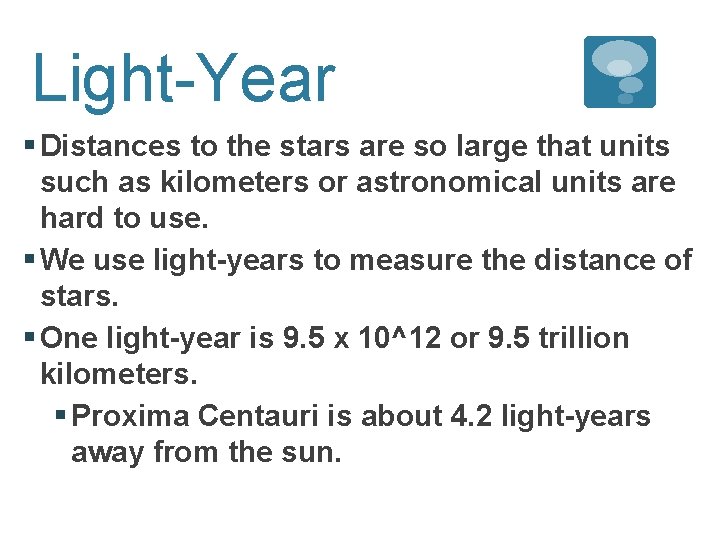
Light-Year Distances to the stars are so large that units such as kilometers or astronomical units are hard to use. We use light-years to measure the distance of stars. One light-year is 9. 5 x 10^12 or 9. 5 trillion kilometers. Proxima Centauri is about 4. 2 light-years away from the sun.
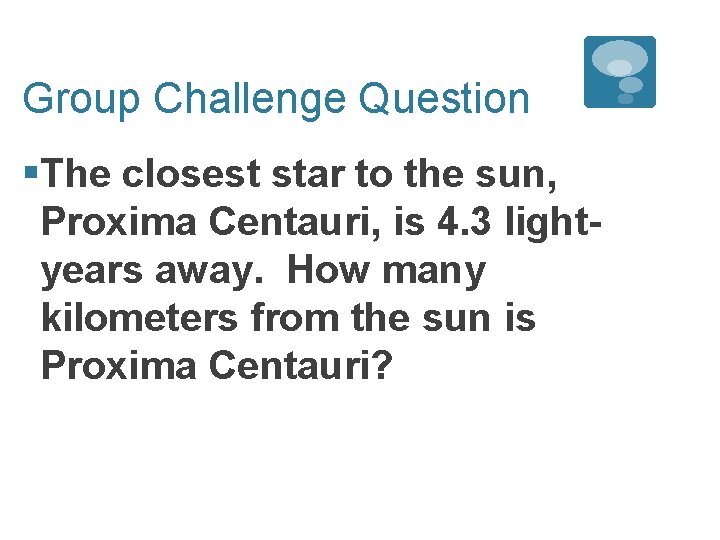
Group Challenge Question The closest star to the sun, Proxima Centauri, is 4. 3 lightyears away. How many kilometers from the sun is Proxima Centauri?