
24 6 Degradation of Proteins and Amino Acids

- Slides: 11
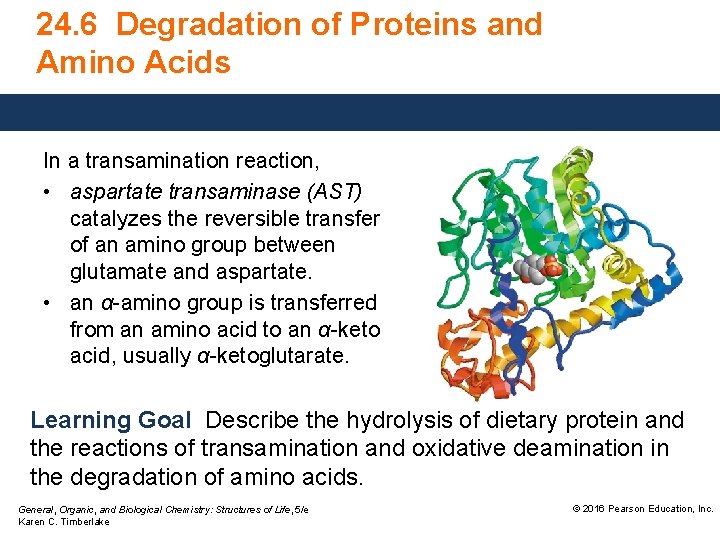
24. 6 Degradation of Proteins and Amino Acids In a transamination reaction, • aspartate transaminase (AST) catalyzes the reversible transfer of an amino group between glutamate and aspartate. • an α-amino group is transferred from an amino acid to an α-keto acid, usually α-ketoglutarate. Learning Goal Describe the hydrolysis of dietary protein and the reactions of transamination and oxidative deamination in the degradation of amino acids. General, Organic, and Biological Chemistry: Structures of Life, 5/e Karen C. Timberlake © 2016 Pearson Education, Inc.
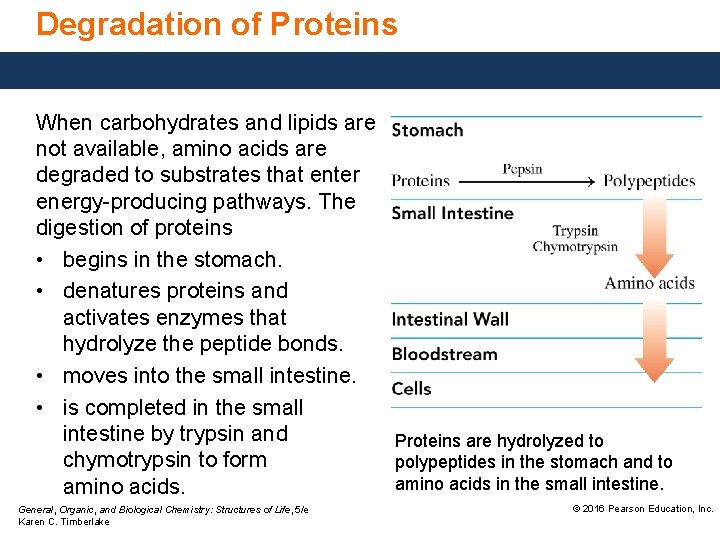
Degradation of Proteins When carbohydrates and lipids are not available, amino acids are degraded to substrates that enter energy-producing pathways. The digestion of proteins • begins in the stomach. • denatures proteins and activates enzymes that hydrolyze the peptide bonds. • moves into the small intestine. • is completed in the small intestine by trypsin and Proteins are hydrolyzed to chymotrypsin to form polypeptides in the stomach and to amino acids in the small intestine. amino acids. General, Organic, and Biological Chemistry: Structures of Life, 5/e Karen C. Timberlake © 2016 Pearson Education, Inc.
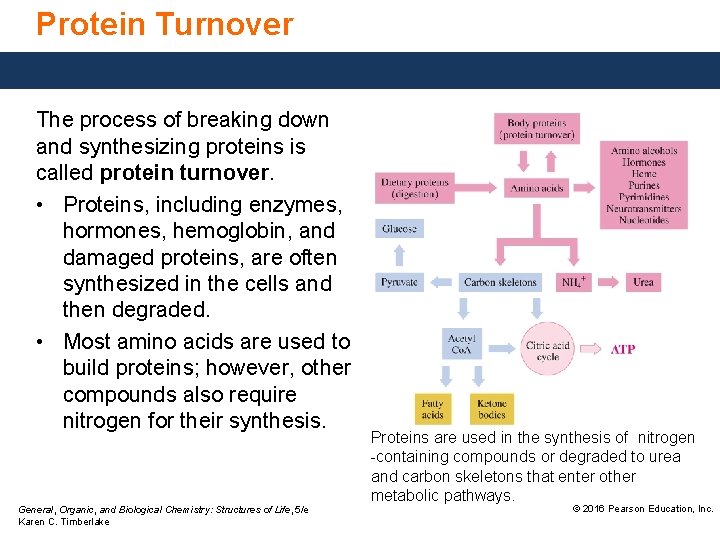
Protein Turnover The process of breaking down and synthesizing proteins is called protein turnover. • Proteins, including enzymes, hormones, hemoglobin, and damaged proteins, are often synthesized in the cells and then degraded. • Most amino acids are used to build proteins; however, other compounds also require nitrogen for their synthesis. General, Organic, and Biological Chemistry: Structures of Life, 5/e Karen C. Timberlake Proteins are used in the synthesis of nitrogen -containing compounds or degraded to urea and carbon skeletons that enter other metabolic pathways. © 2016 Pearson Education, Inc.
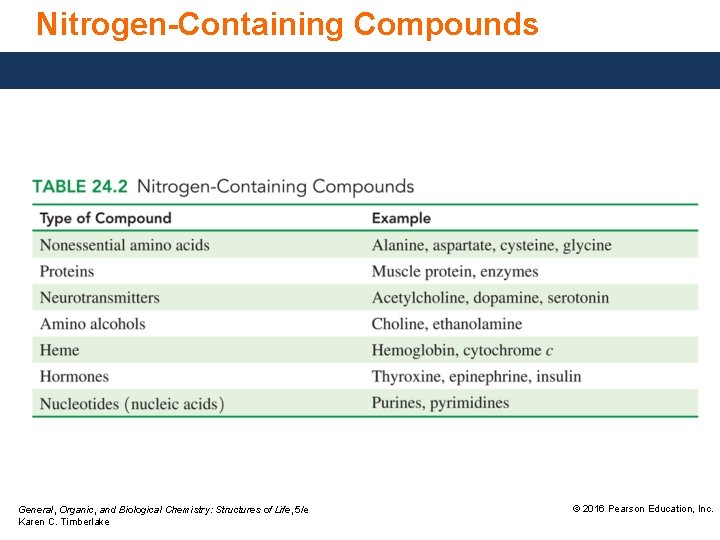
Nitrogen-Containing Compounds General, Organic, and Biological Chemistry: Structures of Life, 5/e Karen C. Timberlake © 2016 Pearson Education, Inc.
Nitrogen-Containing Compounds Our bodies maintain a nitrogen balance in the cells so that the amount of protein we break down is equal to the amount that is reused. • Diets high in protein, however, have a positive nitrogen balance because a high-protein diet supplies more nitrogen than we need. • The body cannot store nitrogen, so the excess is excreted as urea, putting an extra demand on the liver and kidneys. • Diets that do not provide sufficient protein have a negative nitrogen balance, a condition that occurs during starvation and fasting. General, Organic, and Biological Chemistry: Structures of Life, 5/e Karen C. Timberlake © 2016 Pearson Education, Inc.
Energy from Amino Acids Energy is extracted from amino acids in conditions such as fasting or starvation. • If amino acids remain the only source of energy for a long period of time, the breakdown of body proteins eventually leads to a destruction of essential body tissues. • In anorexia, the loss of protein decreases muscle mass and may severely weaken the heart muscle and impair heart function. General, Organic, and Biological Chemistry: Structures of Life, 5/e Karen C. Timberlake © 2016 Pearson Education, Inc.
Degradation of Amino Acids When dietary protein exceeds the nitrogen needed for protein synthesis, excess amino acids are degraded. • The α amino group is removed to yield an α-keto acid, which can be converted to an intermediate for other metabolic pathways. • Carbon atoms from amino acids are used in the citric acid cycle as well as for the synthesis of fatty acids, ketone bodies, and glucose. • Most of the amino acids are converted to urea. General, Organic, and Biological Chemistry: Structures of Life, 5/e Karen C. Timberlake © 2016 Pearson Education, Inc.
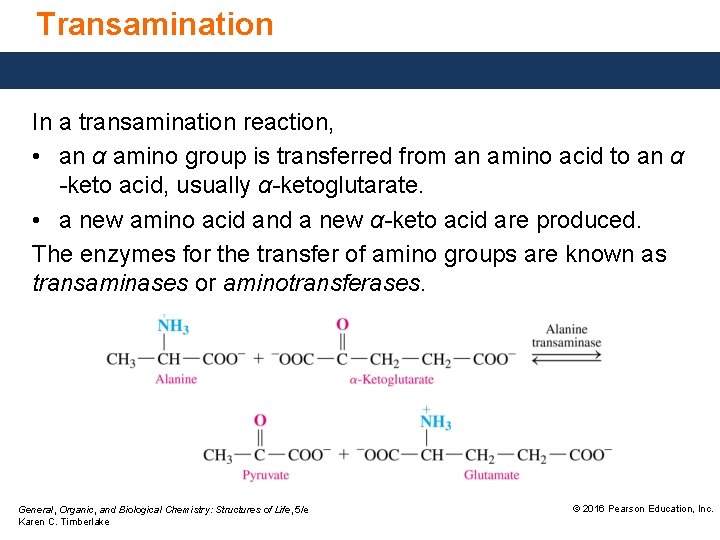
Transamination In a transamination reaction, • an α amino group is transferred from an amino acid to an α -keto acid, usually α-ketoglutarate. • a new amino acid and a new α-keto acid are produced. The enzymes for the transfer of amino groups are known as transaminases or aminotransferases. General, Organic, and Biological Chemistry: Structures of Life, 5/e Karen C. Timberlake © 2016 Pearson Education, Inc.
Oxidative Deamination In oxidative deamination, • the amino group —NH 3+ in glutamate is removed as an ammonium ion, NH 4+. • α-ketoglutarate, which can enter transamination with an amino acid, is produced. • glutamate dehydrogenase, the enzyme, uses NAD+ as a coenzyme. General, Organic, and Biological Chemistry: Structures of Life, 5/e Karen C. Timberlake © 2016 Pearson Education, Inc.
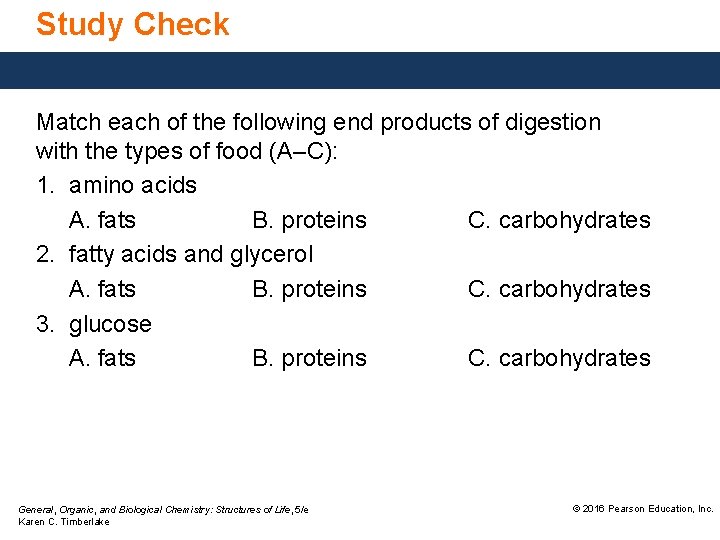
Study Check Match each of the following end products of digestion with the types of food (A–C): 1. amino acids A. fats B. proteins C. carbohydrates 2. fatty acids and glycerol A. fats B. proteins C. carbohydrates 3. glucose A. fats B. proteins C. carbohydrates General, Organic, and Biological Chemistry: Structures of Life, 5/e Karen C. Timberlake © 2016 Pearson Education, Inc.
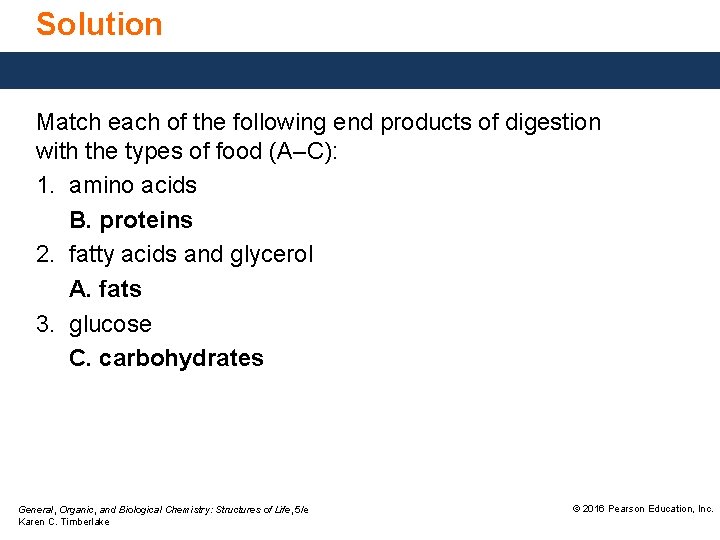
Solution Match each of the following end products of digestion with the types of food (A–C): 1. amino acids B. proteins 2. fatty acids and glycerol A. fats 3. glucose C. carbohydrates General, Organic, and Biological Chemistry: Structures of Life, 5/e Karen C. Timberlake © 2016 Pearson Education, Inc.