
23 September Chapter 4 Arithmetic and its implementation
23 September • Chapter 4 – Arithmetic and its implementation • Assignments 5, 6 and 7 posted to the class web page 9/23/2004 Comp 120 Fall 2004 1
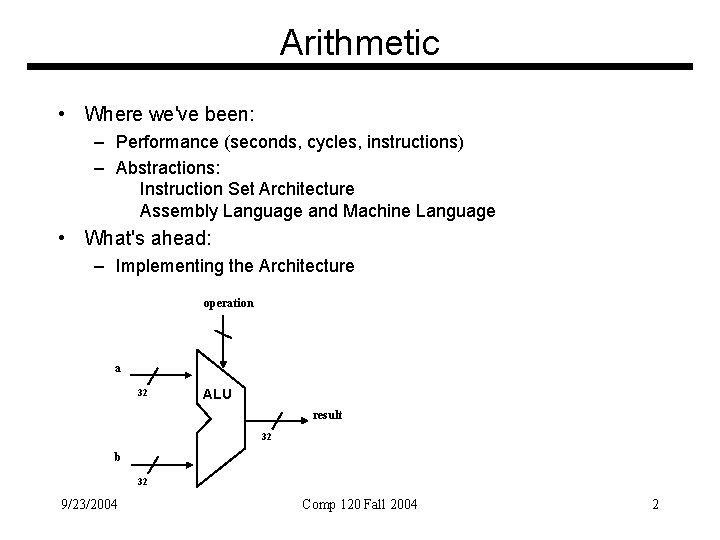
Arithmetic • Where we've been: – Performance (seconds, cycles, instructions) – Abstractions: Instruction Set Architecture Assembly Language and Machine Language • What's ahead: – Implementing the Architecture operation a 32 ALU result 32 b 32 9/23/2004 Comp 120 Fall 2004 2
Numbers • Bits are just bits (no inherent meaning) — conventions define relationship between bits and numbers • Binary numbers (base 2) 0000 0001 0010 0011 0100 0101 0110 0111 1000 1001. . . decimal: 0. . . 2 n-1 • Of course it gets more complicated: numbers are finite (overflow) fractions and real numbers negative numbers e. g. , no MIPS subi; addi can add a negative number) • How do we represent negative numbers? i. e. , which bit patterns will represent which numbers? 9/23/2004 Comp 120 Fall 2004 3
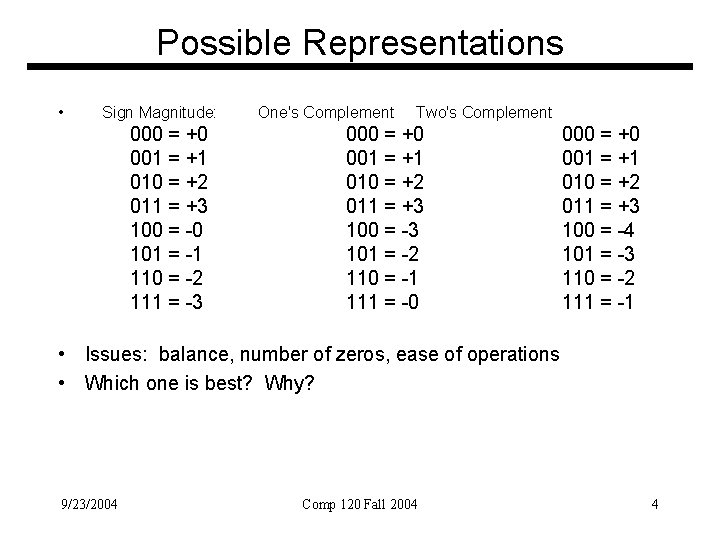
Possible Representations • Sign Magnitude: 000 = +0 001 = +1 010 = +2 011 = +3 100 = -0 101 = -1 110 = -2 111 = -3 One's Complement Two's Complement 000 = +0 001 = +1 010 = +2 011 = +3 100 = -3 101 = -2 110 = -1 111 = -0 000 = +0 001 = +1 010 = +2 011 = +3 100 = -4 101 = -3 110 = -2 111 = -1 • Issues: balance, number of zeros, ease of operations • Which one is best? Why? 9/23/2004 Comp 120 Fall 2004 4
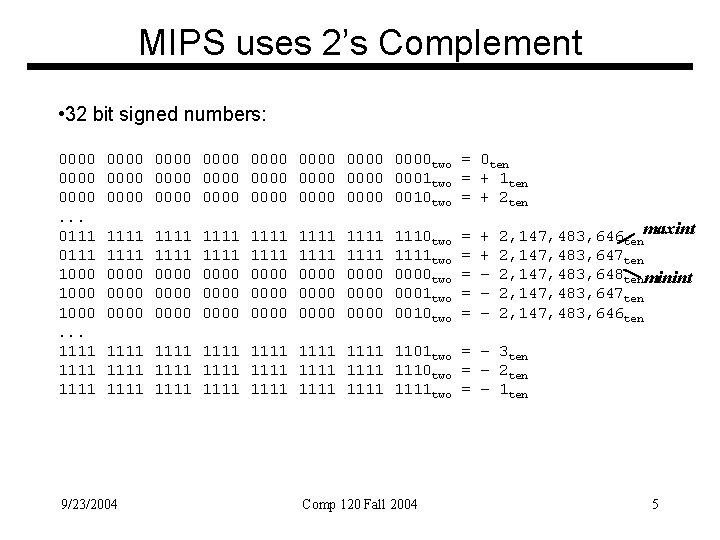
MIPS uses 2’s Complement • 32 bit signed numbers: 0000. . . 0111 1000. . . 1111 0000 0000 two = 0 ten 0000 0000 0001 two = + 1 ten 0000 0000 0010 two = + 2 ten 1111 1111 0000 0000 0000 1111 0000 0000 1110 two 1111 two 0000 two 0001 two 0010 two = = = + + – – – 2, 147, 483, 646 tenmaxint 2, 147, 483, 647 ten 2, 147, 483, 648 tenminint 2, 147, 483, 647 ten 2, 147, 483, 646 ten 1111 1111 1101 two = – 3 ten 1111 1111 1110 two = – 2 ten 1111 1111 two = – 1 ten 9/23/2004 Comp 120 Fall 2004 5
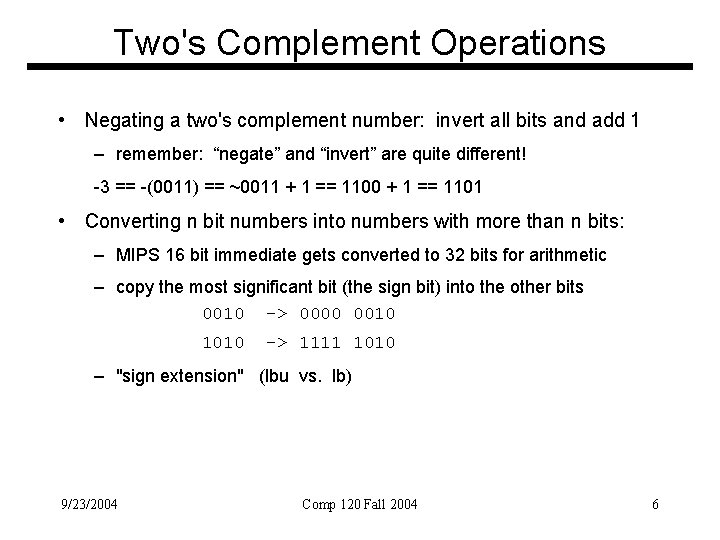
Two's Complement Operations • Negating a two's complement number: invert all bits and add 1 – remember: “negate” and “invert” are quite different! -3 == -(0011) == ~0011 + 1 == 1100 + 1 == 1101 • Converting n bit numbers into numbers with more than n bits: – MIPS 16 bit immediate gets converted to 32 bits for arithmetic – copy the most significant bit (the sign bit) into the other bits 0010 -> 0000 0010 1010 -> 1111 1010 – "sign extension" (lbu vs. lb) 9/23/2004 Comp 120 Fall 2004 6
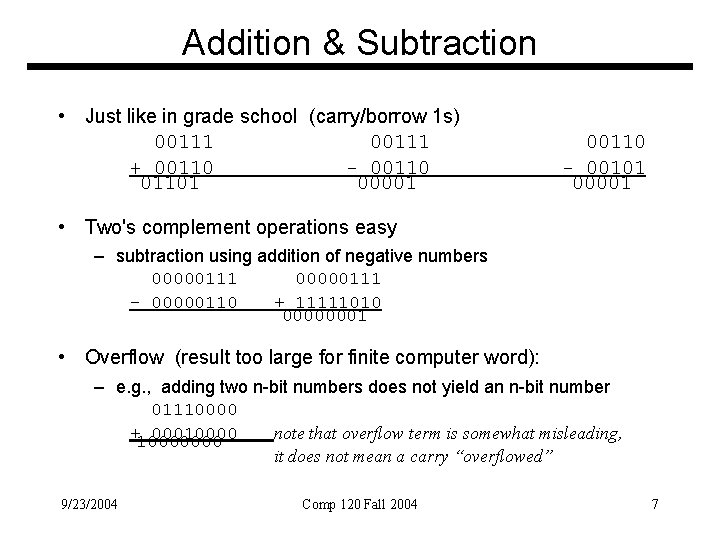
Addition & Subtraction • Just like in grade school (carry/borrow 1 s) 00111 + 00110 - 001101 00001 00110 - 00101 00001 • Two's complement operations easy – subtraction using addition of negative numbers 00000111 - 00000110 + 11111010 00000001 • Overflow (result too large for finite computer word): – e. g. , adding two n-bit numbers does not yield an n-bit number 01110000 +10000000 00010000 note that overflow term is somewhat misleading, it does not mean a carry “overflowed” 9/23/2004 Comp 120 Fall 2004 7
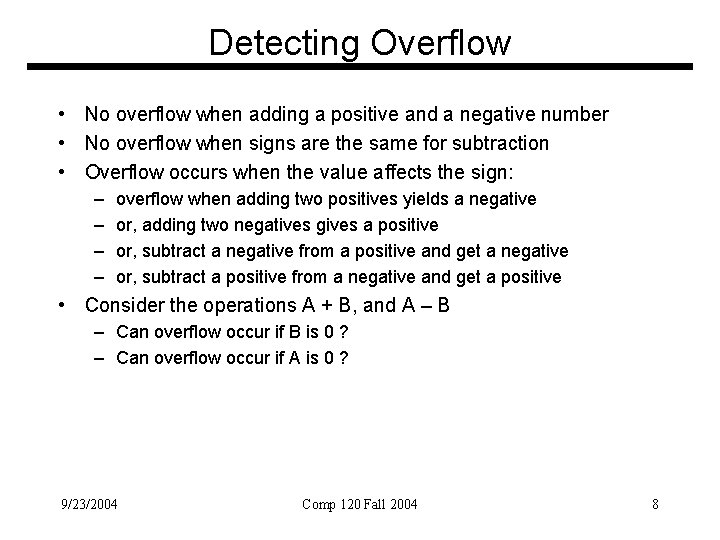
Detecting Overflow • No overflow when adding a positive and a negative number • No overflow when signs are the same for subtraction • Overflow occurs when the value affects the sign: – – overflow when adding two positives yields a negative or, adding two negatives gives a positive or, subtract a negative from a positive and get a negative or, subtract a positive from a negative and get a positive • Consider the operations A + B, and A – B – Can overflow occur if B is 0 ? – Can overflow occur if A is 0 ? 9/23/2004 Comp 120 Fall 2004 8
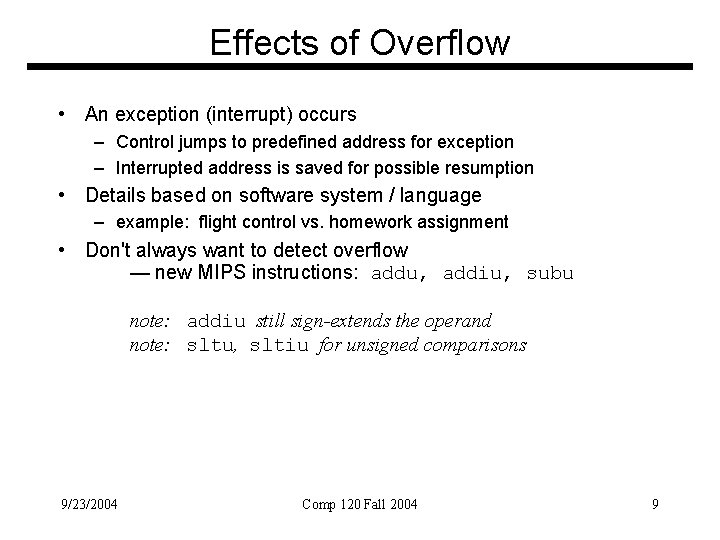
Effects of Overflow • An exception (interrupt) occurs – Control jumps to predefined address for exception – Interrupted address is saved for possible resumption • Details based on software system / language – example: flight control vs. homework assignment • Don't always want to detect overflow — new MIPS instructions: addu, addiu, subu note: addiu still sign-extends the operand note: sltu, sltiu for unsigned comparisons 9/23/2004 Comp 120 Fall 2004 9
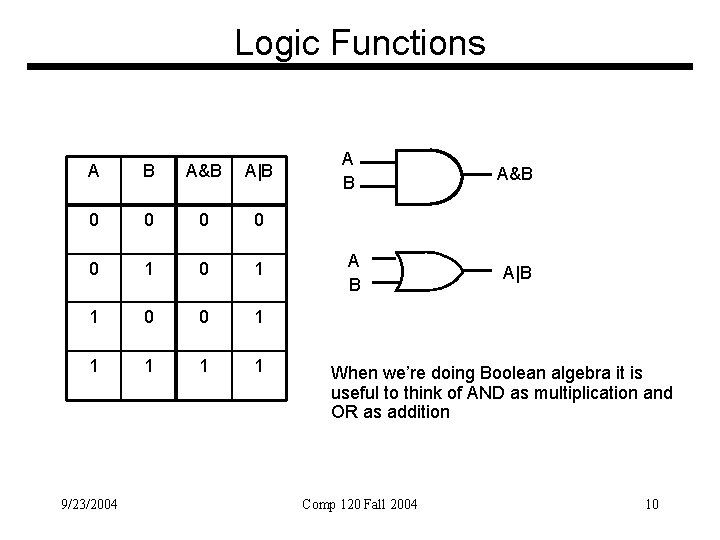
Logic Functions A B A&B A|B 0 0 0 1 1 1 9/23/2004 A B A&B A|B When we’re doing Boolean algebra it is useful to think of AND as multiplication and OR as addition Comp 120 Fall 2004 10
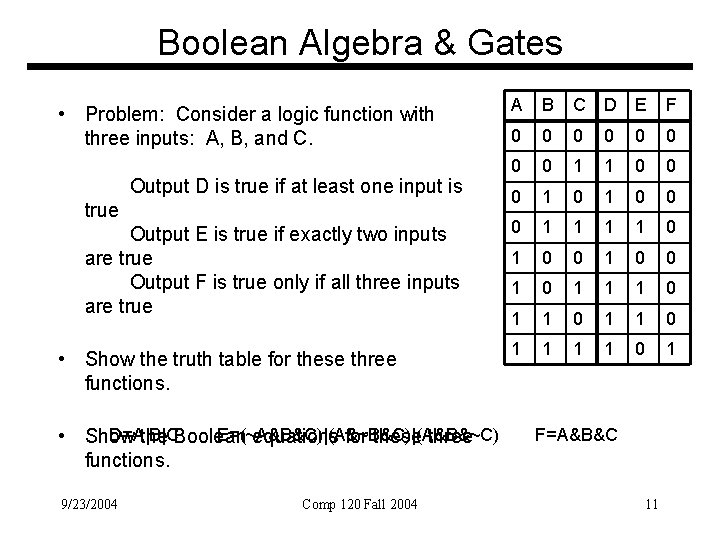
Boolean Algebra & Gates • Problem: Consider a logic function with three inputs: A, B, and C. Output D is true if at least one input is true Output E is true if exactly two inputs are true Output F is true only if all three inputs are true • Show the truth table for these three functions. D=A|B|C E=(~A&B&C)|(A&~B&C)|(A&B&~C) • Show the Boolean equations for these three functions. 9/23/2004 Comp 120 Fall 2004 A B C D E F 0 0 0 0 1 1 0 0 0 1 1 0 1 0 0 1 1 1 0 1 1 0 1 F=A&B&C 11
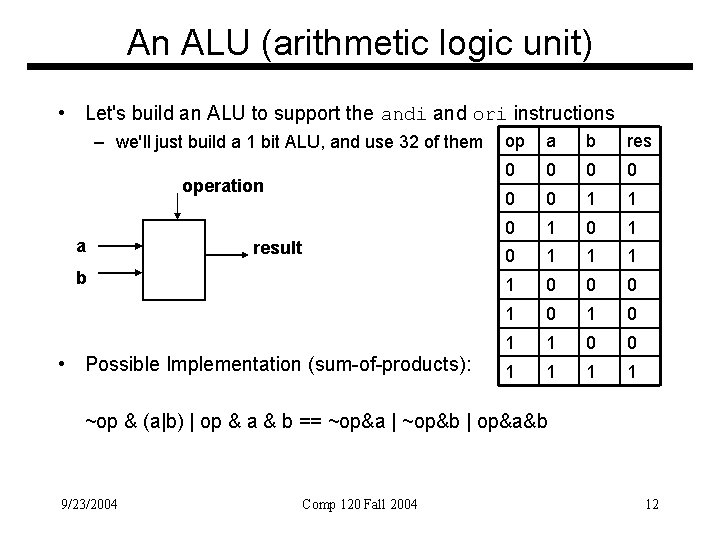
An ALU (arithmetic logic unit) • Let's build an ALU to support the andi and ori instructions – we'll just build a 1 bit ALU, and use 32 of them operation a result b • Possible Implementation (sum-of-products): op a b res 0 0 0 1 1 0 1 0 1 1 0 0 1 1 ~op & (a|b) | op & a & b == ~op&a | ~op&b | op&a&b 9/23/2004 Comp 120 Fall 2004 12
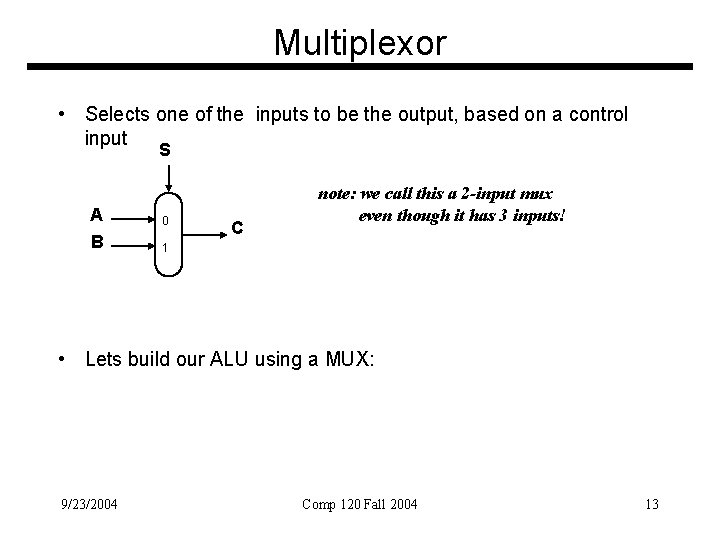
Multiplexor • Selects one of the inputs to be the output, based on a control input S A 0 B 1 C note: we call this a 2 -input mux even though it has 3 inputs! • Lets build our ALU using a MUX: 9/23/2004 Comp 120 Fall 2004 13
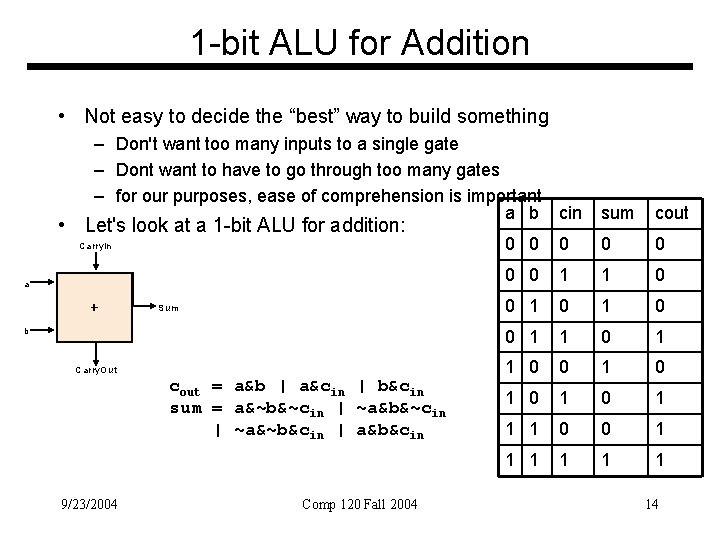
1 -bit ALU for Addition • Not easy to decide the “best” way to build something – Don't want too many inputs to a single gate – Dont want to have to go through too many gates – for our purposes, ease of comprehension is important a b cin • Let's look at a 1 -bit ALU for addition: Carry. In a Sum b Carry. Out cout = a&b | a&cin | b&cin sum = a&~b&~cin | ~a&~b&cin | a&b&cin 9/23/2004 Comp 120 Fall 2004 sum cout 0 0 0 0 1 1 0 0 1 0 1 1 1 0 0 1 1 1 14
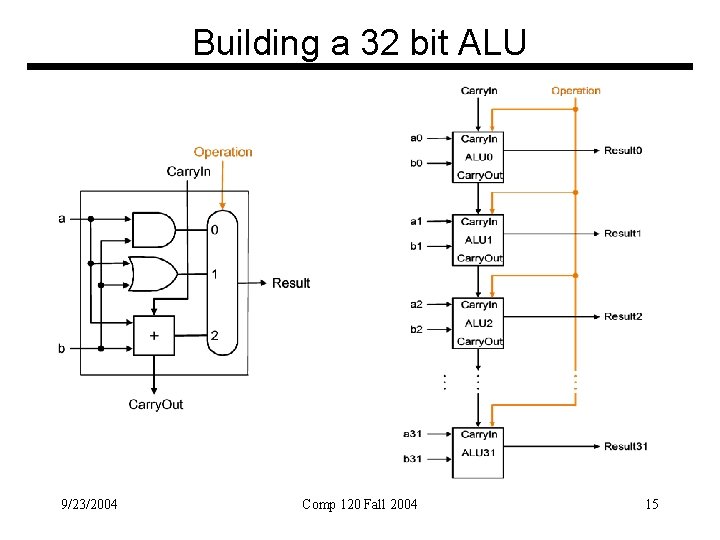
Building a 32 bit ALU 9/23/2004 Comp 120 Fall 2004 15
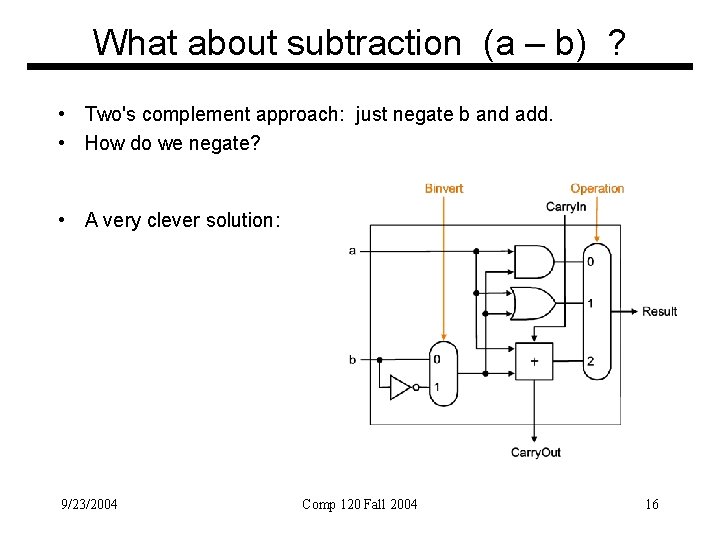
What about subtraction (a – b) ? • Two's complement approach: just negate b and add. • How do we negate? • A very clever solution: 9/23/2004 Comp 120 Fall 2004 16
Tailoring the ALU to the MIPS • Need to support the set-on-less-than instruction (slt) – remember: slt is an arithmetic instruction – produces a 1 if rs < rt and 0 otherwise – use subtraction: (a-b) < 0 implies a < b • Need to support test for equality (beq $t 5, $t 6, $t 7) – use subtraction: (a-b) = 0 implies a = b 9/23/2004 Comp 120 Fall 2004 17
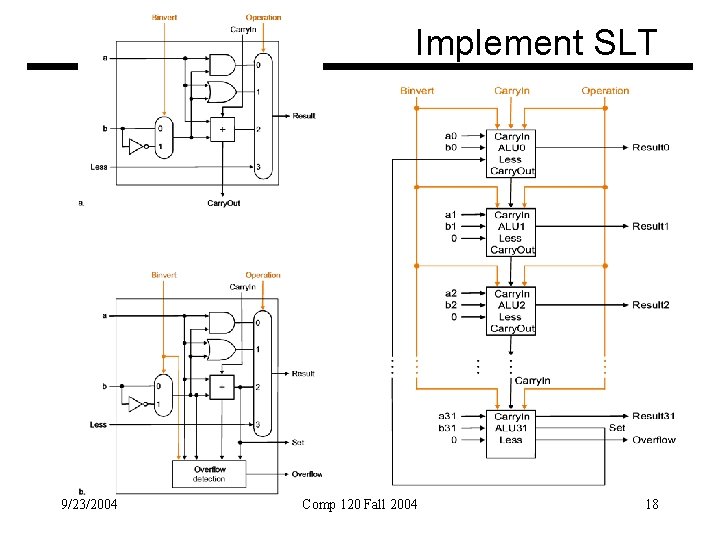
Implement SLT 9/23/2004 Comp 120 Fall 2004 18
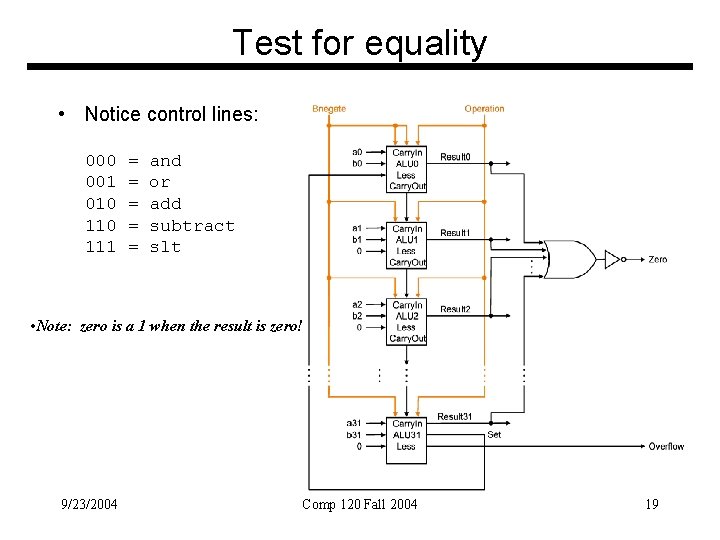
Test for equality • Notice control lines: 000 001 010 111 = = = and or add subtract slt • Note: zero is a 1 when the result is zero! 9/23/2004 Comp 120 Fall 2004 19
Conclusion • We can build an ALU to support the MIPS instruction set – key idea: use multiplexor to select the output we want – we can efficiently perform subtraction using two’s complement – we can replicate a 1 -bit ALU to produce a 32 -bit ALU • Important points about hardware – all of the gates are always working – the speed of a gate is affected by the number of inputs to the gate – the speed of a circuit is affected by the number of gates in series (on the “critical path” or the “deepest level of logic”) • Our primary focus: comprehension, however, – Clever changes to organization can improve performance (similar to using better algorithms in software) 9/23/2004 Comp 120 Fall 2004 20
- Slides: 20