
23 7 Kinetics of photochemical reactions Primary photochemical
- Slides: 16
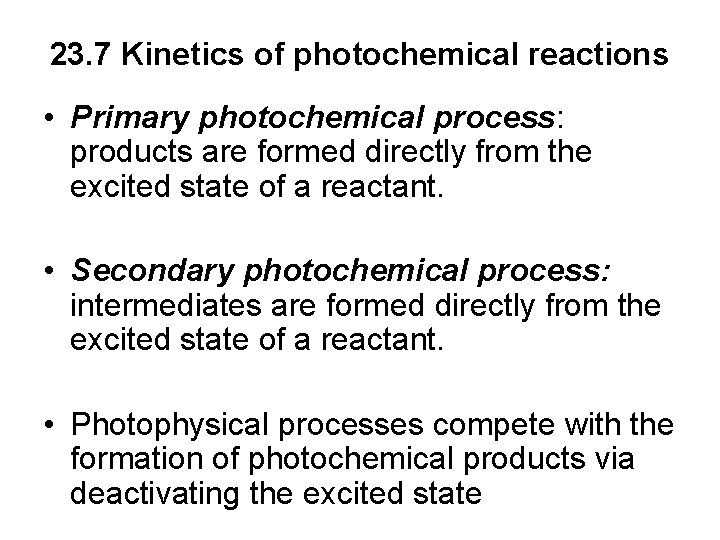
23. 7 Kinetics of photochemical reactions • Primary photochemical process: products are formed directly from the excited state of a reactant. • Secondary photochemical process: intermediates are formed directly from the excited state of a reactant. • Photophysical processes compete with the formation of photochemical products via deactivating the excited state
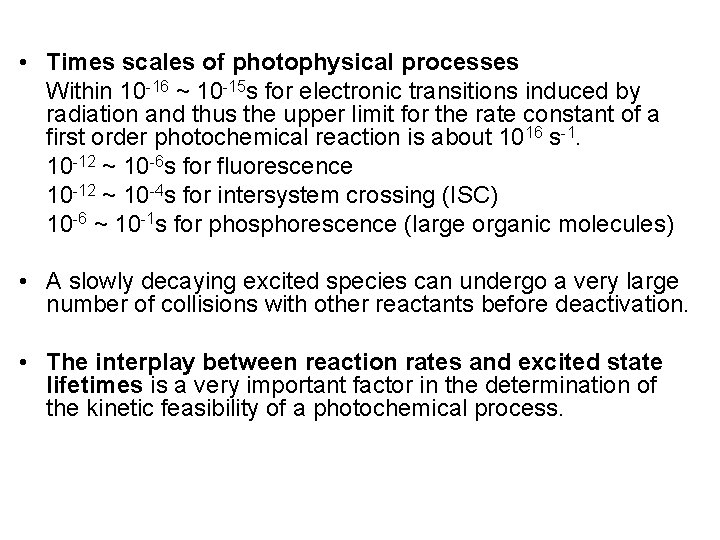
• Times scales of photophysical processes Within 10 -16 ~ 10 -15 s for electronic transitions induced by radiation and thus the upper limit for the rate constant of a first order photochemical reaction is about 1016 s-1. 10 -12 ~ 10 -6 s for fluorescence 10 -12 ~ 10 -4 s for intersystem crossing (ISC) 10 -6 ~ 10 -1 s for phosphorescence (large organic molecules) • A slowly decaying excited species can undergo a very large number of collisions with other reactants before deactivation. • The interplay between reaction rates and excited state lifetimes is a very important factor in the determination of the kinetic feasibility of a photochemical process.
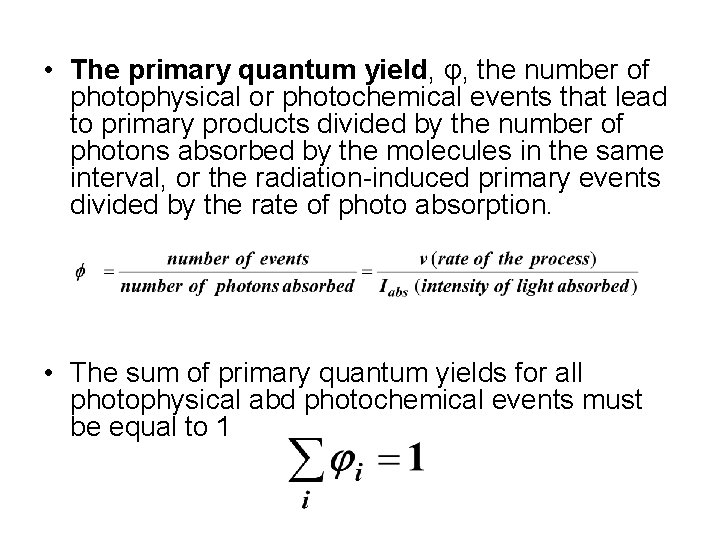
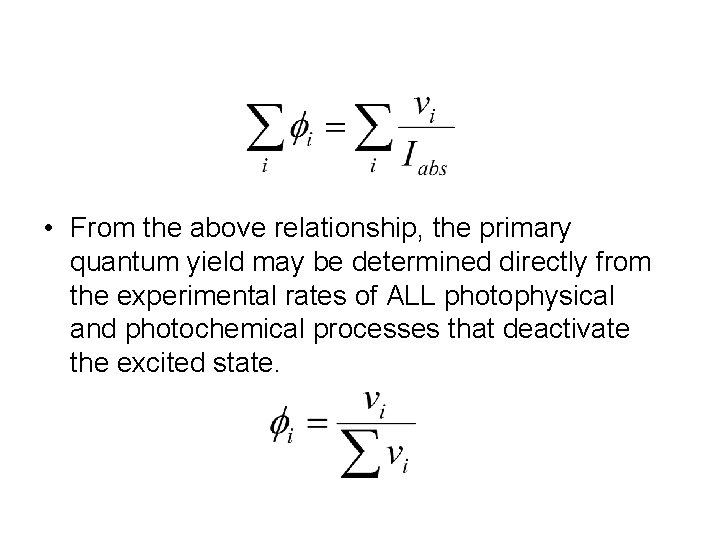
• The primary quantum yield, φ, the number of photophysical or photochemical events that lead to primary products divided by the number of photons absorbed by the molecules in the same interval, or the radiation-induced primary events divided by the rate of photo absorption. • The sum of primary quantum yields for all photophysical abd photochemical events must be equal to 1
• From the above relationship, the primary quantum yield may be determined directly from the experimental rates of ALL photophysical and photochemical processes that deactivate the excited state.
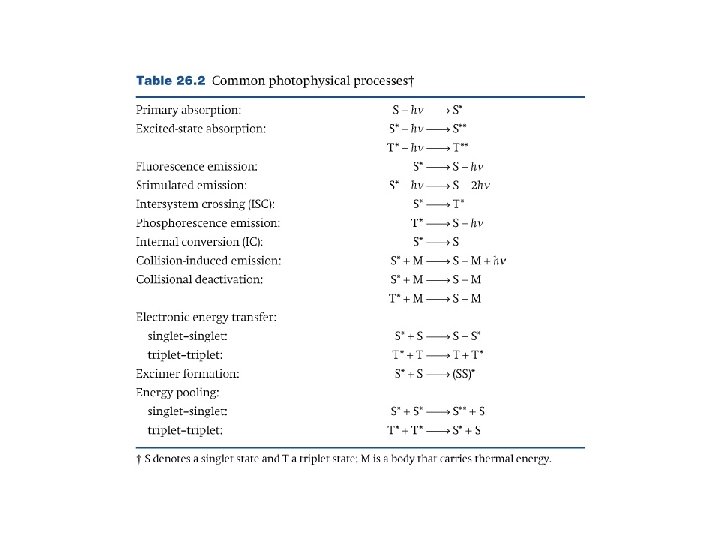
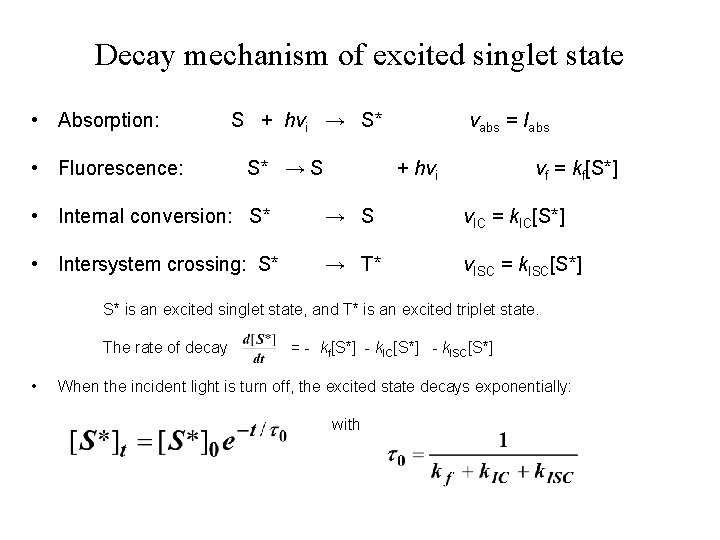
Decay mechanism of excited singlet state • Absorption: • Fluorescence: S + hvi → S* S* → S vabs = Iabs + hvi vf = kf[S*] • Internal conversion: S* → S v. IC = k. IC[S*] • Intersystem crossing: S* → T* v. ISC = k. ISC[S*] S* is an excited singlet state, and T* is an excited triplet state. The rate of decay • = - kf[S*] - k. IC[S*] - k. ISC[S*] When the incident light is turn off, the excited state decays exponentially: with
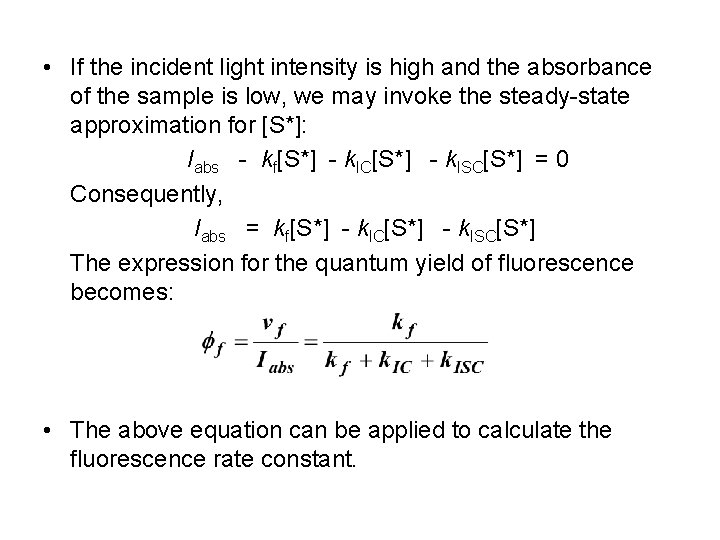
• If the incident light intensity is high and the absorbance of the sample is low, we may invoke the steady-state approximation for [S*]: Iabs - kf[S*] - k. IC[S*] - k. ISC[S*] = 0 Consequently, Iabs = kf[S*] - k. IC[S*] - k. ISC[S*] The expression for the quantum yield of fluorescence becomes: • The above equation can be applied to calculate the fluorescence rate constant.
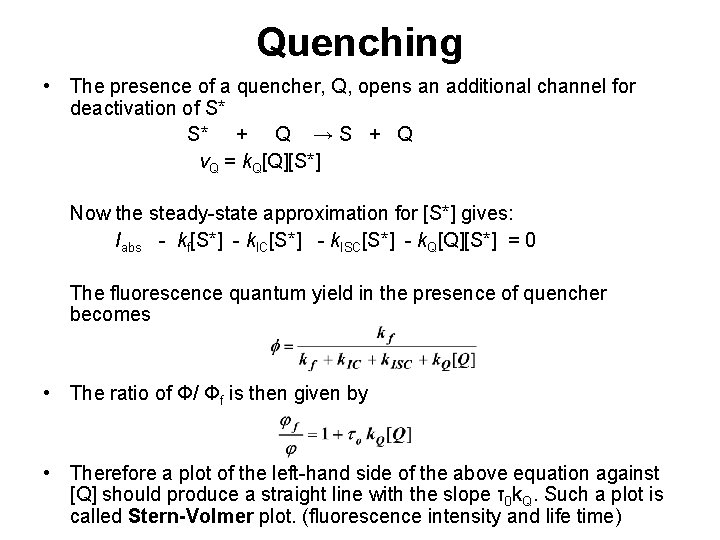
Quenching • The presence of a quencher, Q, opens an additional channel for deactivation of S* S* + Q → S + Q v. Q = k. Q[Q][S*] Now the steady-state approximation for [S*] gives: Iabs - kf[S*] - k. IC[S*] - k. ISC[S*] - k. Q[Q][S*] = 0 The fluorescence quantum yield in the presence of quencher becomes • The ratio of Φ/ Φf is then given by • Therefore a plot of the left-hand side of the above equation against [Q] should produce a straight line with the slope τ0 k. Q. Such a plot is called Stern-Volmer plot. (fluorescence intensity and life time)
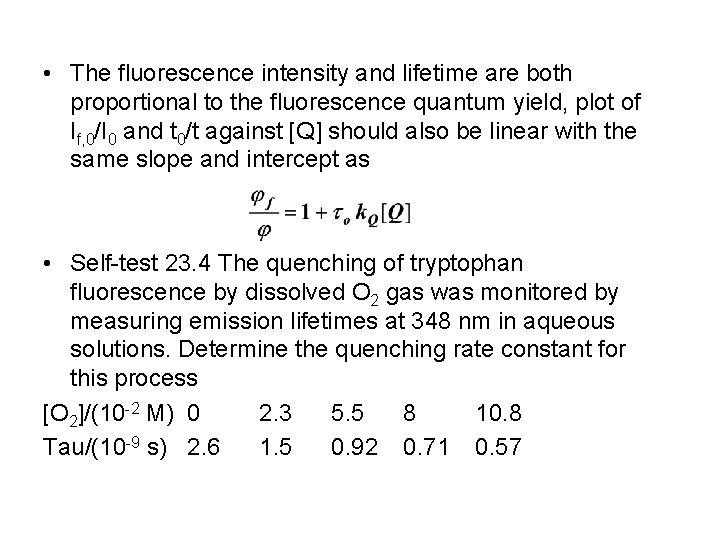
• The fluorescence intensity and lifetime are both proportional to the fluorescence quantum yield, plot of If, 0/I 0 and t 0/t against [Q] should also be linear with the same slope and intercept as • Self-test 23. 4 The quenching of tryptophan fluorescence by dissolved O 2 gas was monitored by measuring emission lifetimes at 348 nm in aqueous solutions. Determine the quenching rate constant for this process [O 2]/(10 -2 M) 0 2. 3 5. 5 8 10. 8 Tau/(10 -9 s) 2. 6 1. 5 0. 92 0. 71 0. 57
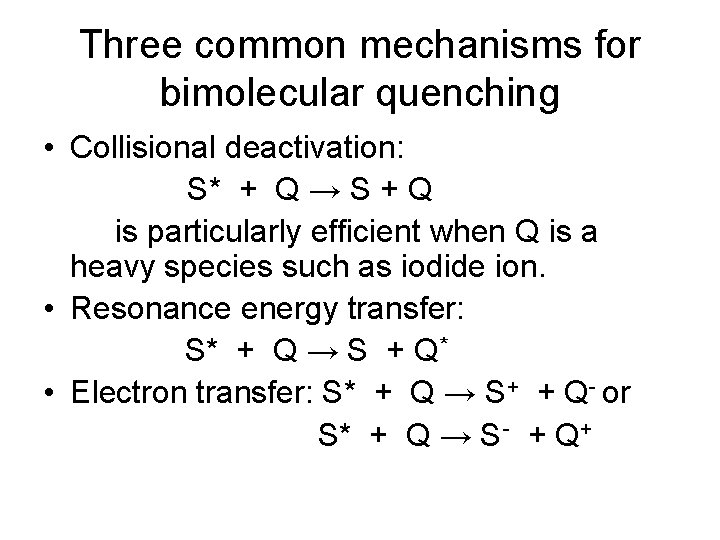
Three common mechanisms for bimolecular quenching • Collisional deactivation: S* + Q → S + Q is particularly efficient when Q is a heavy species such as iodide ion. • Resonance energy transfer: S* + Q → S + Q* • Electron transfer: S* + Q → S+ + Q- or S* + Q → S - + Q+
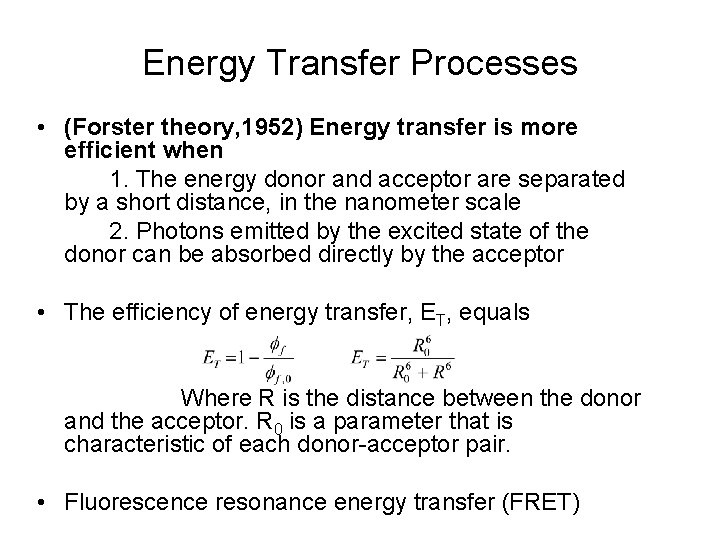
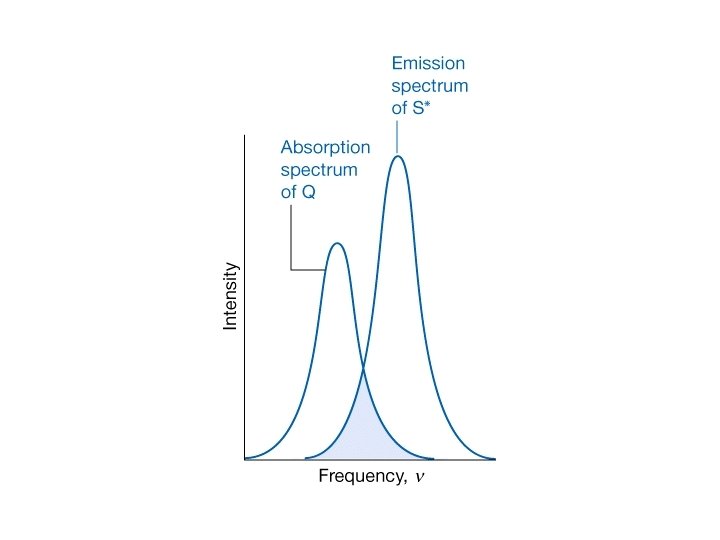
Energy Transfer Processes • (Forster theory, 1952) Energy transfer is more efficient when 1. The energy donor and acceptor are separated by a short distance, in the nanometer scale 2. Photons emitted by the excited state of the donor can be absorbed directly by the acceptor • The efficiency of energy transfer, ET, equals Where R is the distance between the donor and the acceptor. R 0 is a parameter that is characteristic of each donor-acceptor pair. • Fluorescence resonance energy transfer (FRET)
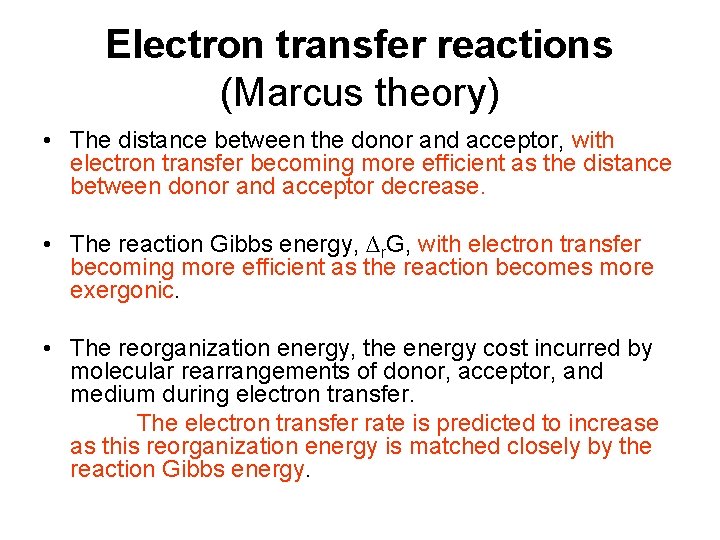
Electron transfer reactions (Marcus theory) • The distance between the donor and acceptor, with electron transfer becoming more efficient as the distance between donor and acceptor decrease. • The reaction Gibbs energy, ∆r. G, with electron transfer becoming more efficient as the reaction becomes more exergonic. • The reorganization energy, the energy cost incurred by molecular rearrangements of donor, acceptor, and medium during electron transfer. The electron transfer rate is predicted to increase as this reorganization energy is matched closely by the reaction Gibbs energy.
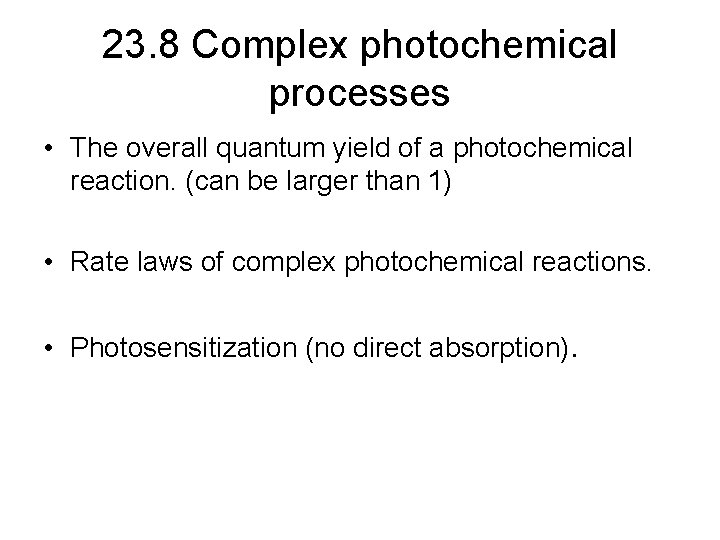
23. 8 Complex photochemical processes • The overall quantum yield of a photochemical reaction. (can be larger than 1) • Rate laws of complex photochemical reactions. • Photosensitization (no direct absorption).
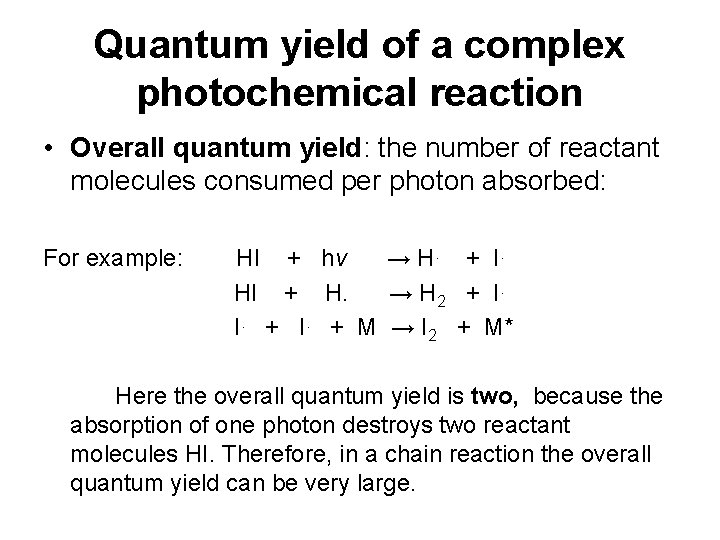
Quantum yield of a complex photochemical reaction • Overall quantum yield: the number of reactant molecules consumed per photon absorbed: For example: HI + hv → H. + I. HI + H. → H 2 + I. I. + M → I 2 + M* Here the overall quantum yield is two, because the absorption of one photon destroys two reactant molecules HI. Therefore, in a chain reaction the overall quantum yield can be very large.
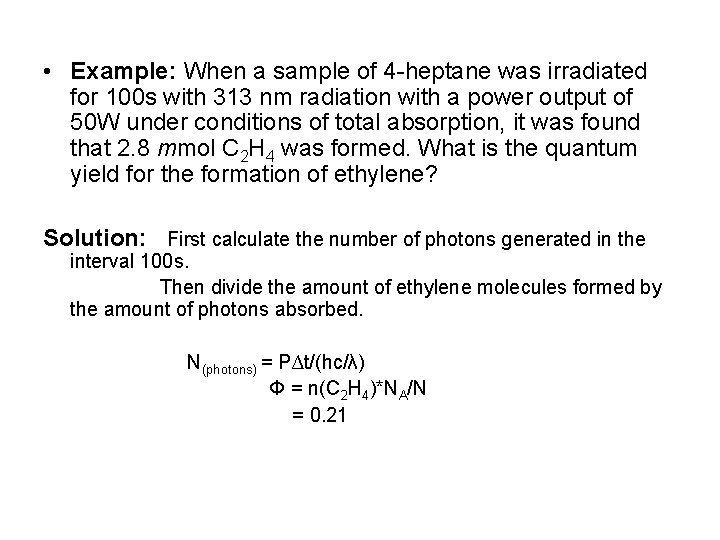
• Example: When a sample of 4 -heptane was irradiated for 100 s with 313 nm radiation with a power output of 50 W under conditions of total absorption, it was found that 2. 8 mmol C 2 H 4 was formed. What is the quantum yield for the formation of ethylene? Solution: First calculate the number of photons generated in the interval 100 s. Then divide the amount of ethylene molecules formed by the amount of photons absorbed. N(photons) = P∆t/(hc/λ) Ф = n(C 2 H 4)*NA/N = 0. 21