
23 24 Marzo 2018 Tuberculosis Fact sheet Reviewed

23 -24 Marzo 2018
Tuberculosis Fact sheet Reviewed January 2018 Key facts Tuberculosis (TB) is one of the top 10 causes of death worldwide. In 2016, 10. 4 million people fell ill with TB, and 1. 7 million died from the disease (including 0. 4 million among people with HIV). In 2016, an estimated 1 million children became ill with TB and 250 000 children died of TB (including children with HIV associated TB). TB is a leading killer of HIV-positive people: in 2016, 40% of HIV deaths were due to TB. WHO estimates that there were 600 000 new cases with resistance to rifampicin – the most effective first-line drug, of which 490 000 had MDR-TB. Globally, TB incidence is falling at about 2% per year. This needs to accelerate to a 4– 5% annual decline to reach the 2020 milestones of the End TB Strategy.
In 2016, 58 994 cases of TB were reported in 30 EU/EEA countries: 70. 4% were newly diagnosed and 71. 0% were laboratory confirmed thirty-three per cent of all TB cases were of foreign origin, mostly residing in lowincidence countries children under 15 years of age accounted for 4. 1% of all TB cases multidrug-resistant (MDR) TB was reported for 3. 7% of 36 071 cases with drug susceptibility testing (DST) results and continues to be highest (more than 10%) in the three Baltic countries (XDR) TB was reported for 20. 1% of 984 MDR TB cases tested for secondline drug susceptibility
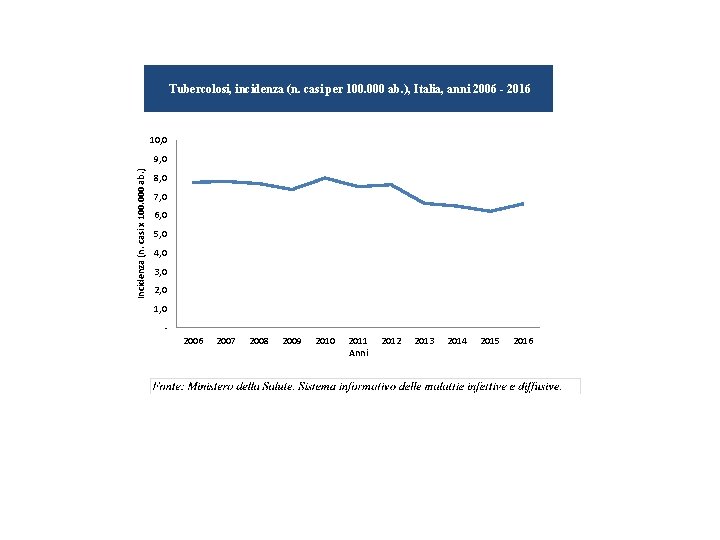
Tubercolosi, incidenza (n. casi per 100. 000 ab. ), Italia, anni 2006 - 2016 10, 0 Incidenza (n. casi x 100. 000 ab. ) 9, 0 8, 0 7, 0 6, 0 5, 0 4, 0 3, 0 2, 0 1, 0 2006 2007 2008 2009 2010 2011 Anni 2012 2013 2014 2015 2016
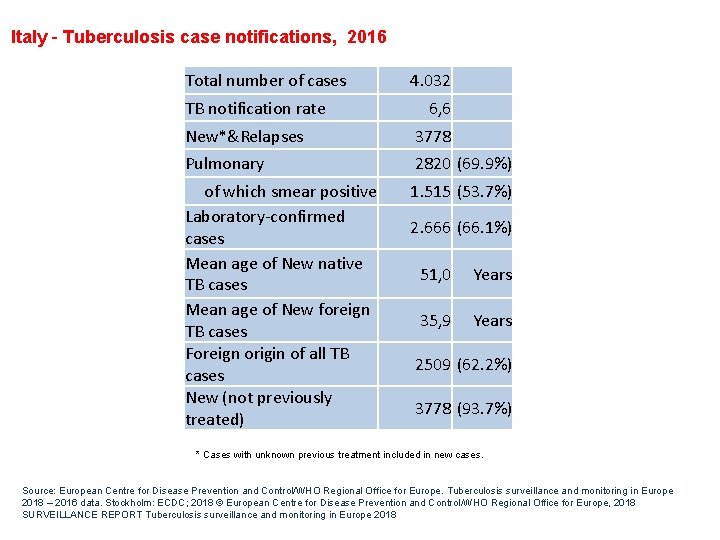
Italy - Tuberculosis case notifications, 2016 Total number of cases TB notification rate 4. 032 6, 6 New*&Relapses 3778 Pulmonary 2820 (69. 9%) of which smear positive Laboratory-confirmed cases Mean age of New native TB cases Mean age of New foreign TB cases Foreign origin of all TB cases New (not previously treated) 1. 515 (53. 7%) 2. 666 (66. 1%) 51, 0 Years 35, 9 Years 2509 (62. 2%) 3778 (93. 7%) * Cases with unknown previous treatment included in new cases. Source: European Centre for Disease Prevention and Control/WHO Regional Office for Europe. Tuberculosis surveillance and monitoring in Europe 2018 – 2016 data. Stockholm: ECDC; 2018 © European Centre for Disease Prevention and Control/WHO Regional Office for Europe, 2018 SURVEILLANCE REPORT Tuberculosis surveillance and monitoring in Europe 2018
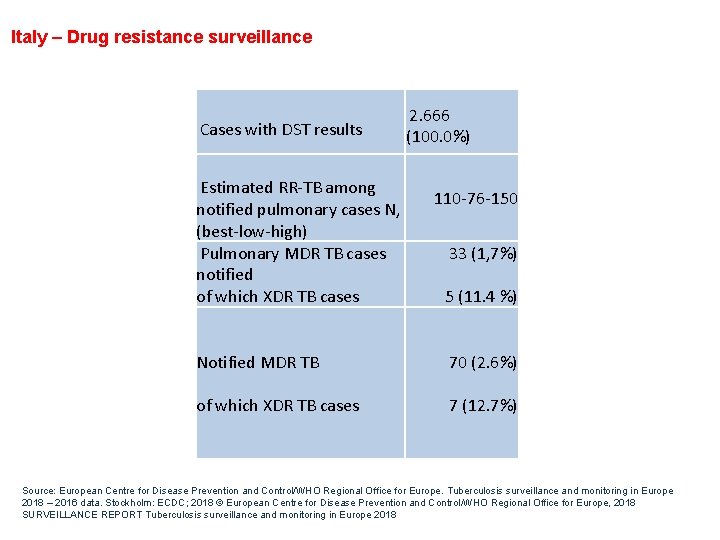
Italy – Drug resistance surveillance Cases with DST results Estimated RR-TB among notified pulmonary cases N, (best-low-high) Pulmonary MDR TB cases notified of which XDR TB cases 2. 666 (100. 0%) 110 -76 -150 33 (1, 7%) 5 (11. 4 %) Notified MDR TB 70 (2. 6%) of which XDR TB cases 7 (12. 7%) Source: European Centre for Disease Prevention and Control/WHO Regional Office for Europe. Tuberculosis surveillance and monitoring in Europe 2018 – 2016 data. Stockholm: ECDC; 2018 © European Centre for Disease Prevention and Control/WHO Regional Office for Europe, 2018 SURVEILLANCE REPORT Tuberculosis surveillance and monitoring in Europe 2018
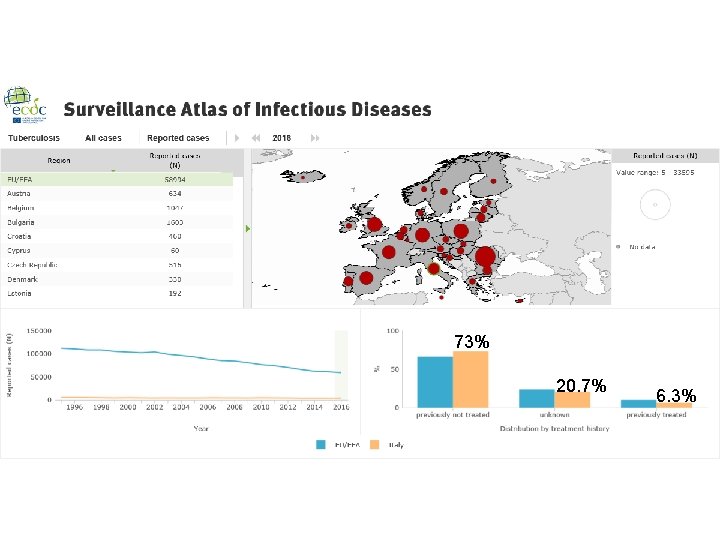
73% 20. 7% 6. 3%
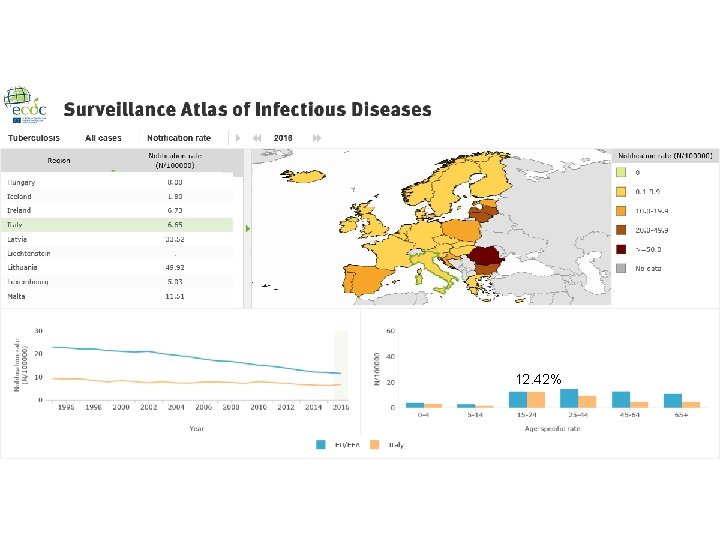
GN PH PE SO CI BD IN GM NG SN PK MA PG RO 39 41 45 48 51 53 57 81 86 97 104 146 325 366 1 40 5 53 2 55 12 12 13 12 6 93 98 110 116 152 23 389 12. 42%
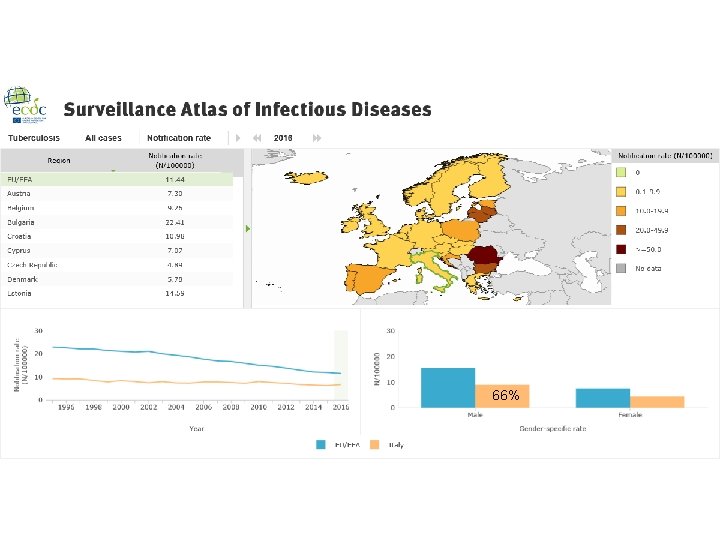
66%
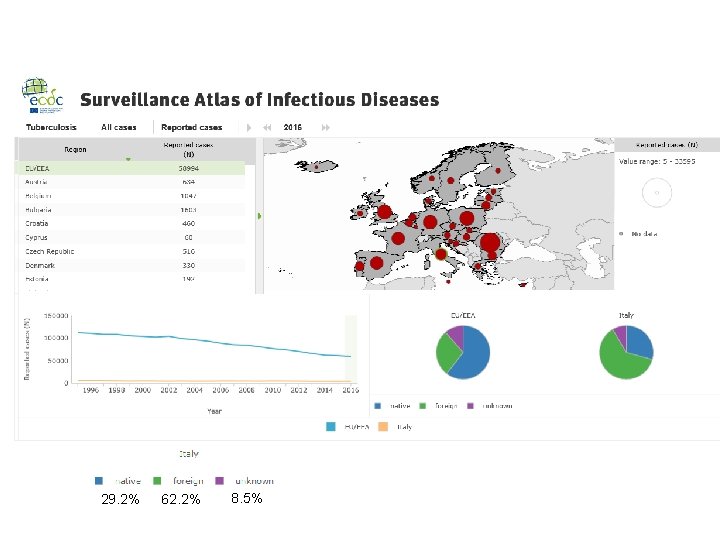
29. 2% 62. 2% 8. 5%
La Regione europea ha sviluppato un suo specifico piano di azione per gli anni 2016 -2020 Gli obiettivi specifici per il 2020 sono: § ridurre del 35% i decessi per TB § ridurre l’incidenza della TB del 25% § raggiungere un tasso di successo del trattamento del 75% tra la coorte di casi di TB multiresistenti (Mdr-TB). Le attività da mettere in atto sono relative a tre aree di intervento: § assistenza (prevenzione e cura) integrata e centrata sul paziente § politiche e sistemi di supporto § intensificazione della ricerca e dell’innovazione.
Conclusioni • Notifica da parte dei laboratori delle persone con un esame batteriologico (diretto, coltura, ecc. ) positivo per tubercolosi su campioni respiratori; • Monitoraggio dell’esito del trattamento almeno per tutti i casi polmonari; • Rilevazione di dati sulla farmacoresistenza; • Integrazione dei dati provenienti da queste fonti informative con la notifica; • Rilevazione di dati sulla resa dei programmi di screening, con particolare riguardo ai contatti di caso.
- Slides: 12