
23 2 Electron Transport and ATP The enzymes

- Slides: 19
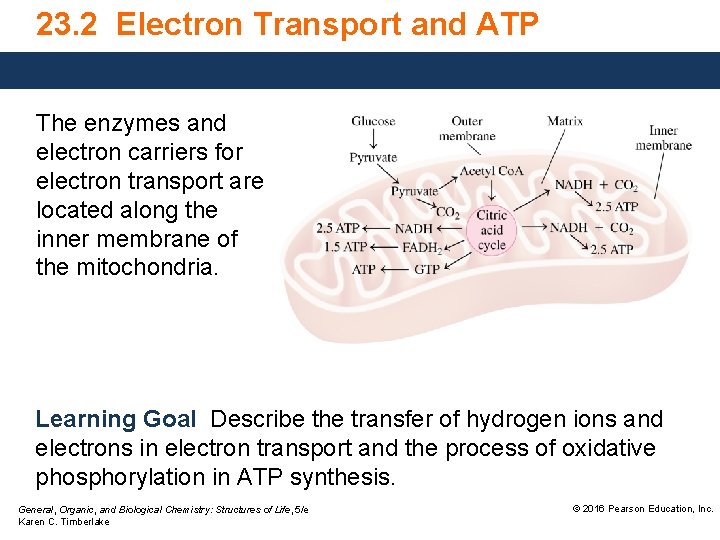
23. 2 Electron Transport and ATP The enzymes and electron carriers for electron transport are located along the inner membrane of the mitochondria. Learning Goal Describe the transfer of hydrogen ions and electrons in electron transport and the process of oxidative phosphorylation in ATP synthesis. General, Organic, and Biological Chemistry: Structures of Life, 5/e Karen C. Timberlake © 2016 Pearson Education, Inc.
Electron Transport The reduced coenzymes NADH and FADH 2 produced from glycolysis, oxidation of pyruvate, and the citric acid cycle are oxidized to provide the energy for the synthesis of ATP. In electron transport or the respiratory chain, • hydrogen ions and electrons from NADH and FADH 2 are passed from one electron acceptor or carrier to the next until they combine with oxygen to form H 2 O. • energy released during electron transport is used to synthesize ATP from ADP and Pi during oxidative phosphorylation. General, Organic, and Biological Chemistry: Structures of Life, 5/e Karen C. Timberlake © 2016 Pearson Education, Inc.
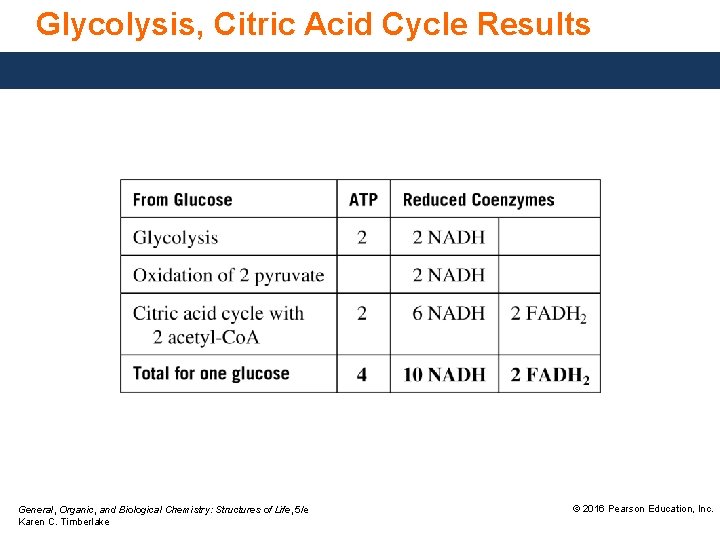
Glycolysis, Citric Acid Cycle Results General, Organic, and Biological Chemistry: Structures of Life, 5/e Karen C. Timberlake © 2016 Pearson Education, Inc.
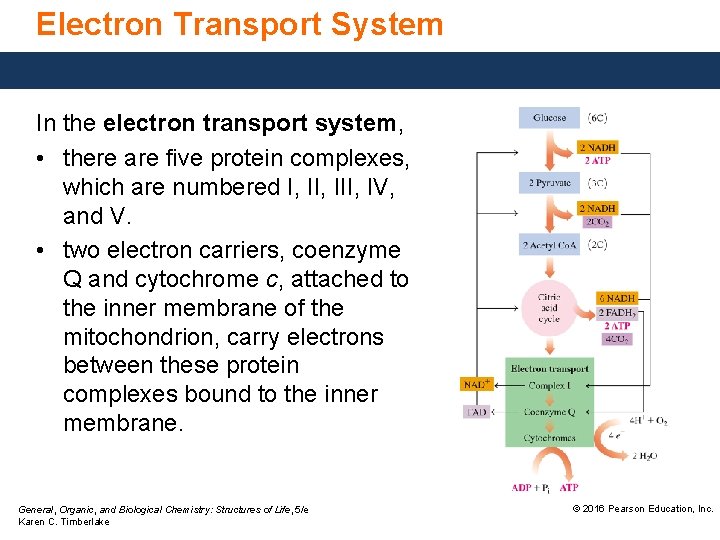
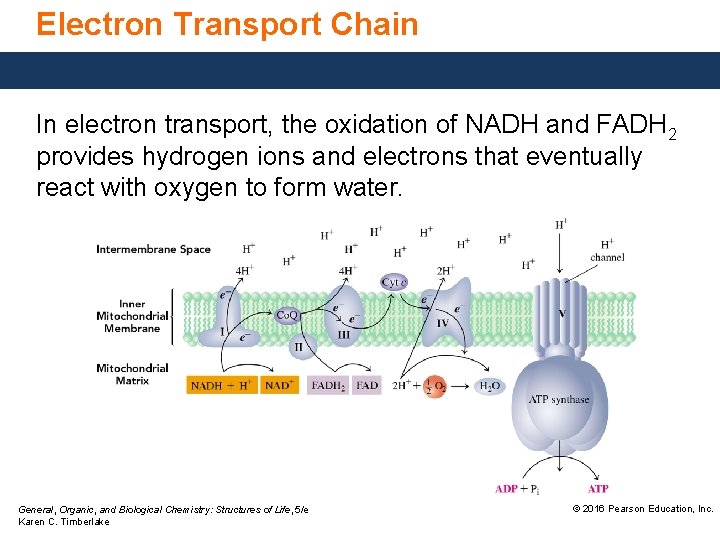
Electron Transport System In the electron transport system, • there are five protein complexes, which are numbered I, III, IV, and V. • two electron carriers, coenzyme Q and cytochrome c, attached to the inner membrane of the mitochondrion, carry electrons between these protein complexes bound to the inner membrane. General, Organic, and Biological Chemistry: Structures of Life, 5/e Karen C. Timberlake © 2016 Pearson Education, Inc.
Electron Transport Chain In electron transport, the oxidation of NADH and FADH 2 provides hydrogen ions and electrons that eventually react with oxygen to form water. General, Organic, and Biological Chemistry: Structures of Life, 5/e Karen C. Timberlake © 2016 Pearson Education, Inc.
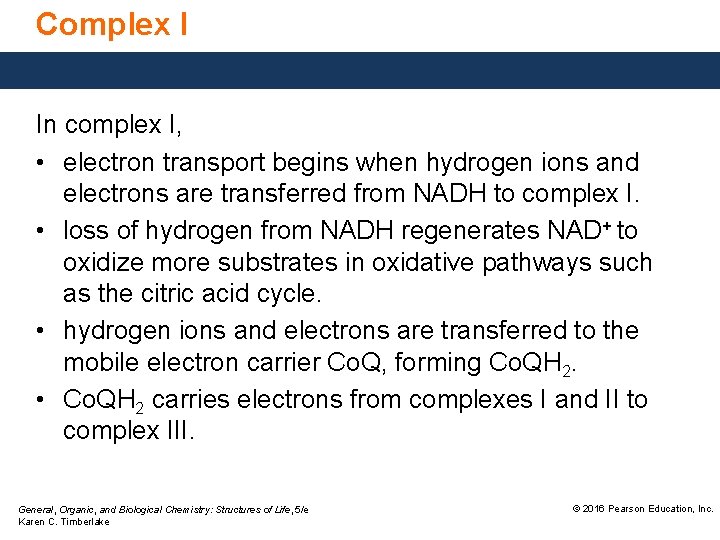
Complex I In complex I, • electron transport begins when hydrogen ions and electrons are transferred from NADH to complex I. • loss of hydrogen from NADH regenerates NAD+ to oxidize more substrates in oxidative pathways such as the citric acid cycle. • hydrogen ions and electrons are transferred to the mobile electron carrier Co. Q, forming Co. QH 2. • Co. QH 2 carries electrons from complexes I and II to complex III. General, Organic, and Biological Chemistry: Structures of Life, 5/e Karen C. Timberlake © 2016 Pearson Education, Inc.
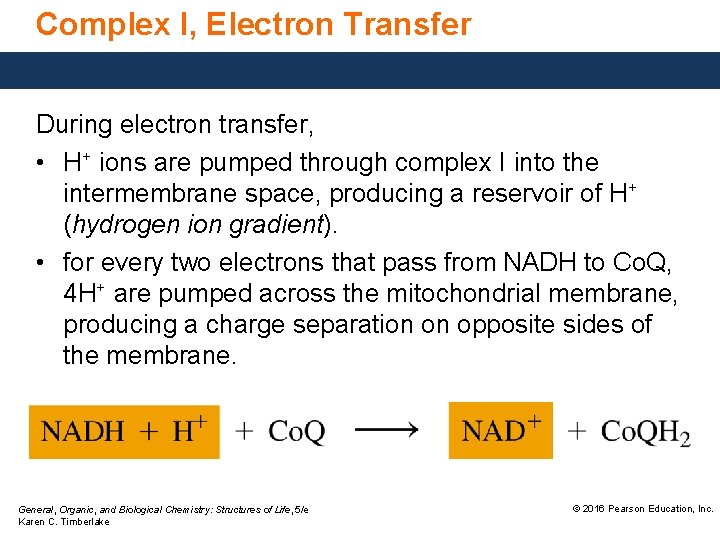
Complex I, Electron Transfer During electron transfer, • H+ ions are pumped through complex I into the intermembrane space, producing a reservoir of H+ (hydrogen ion gradient). • for every two electrons that pass from NADH to Co. Q, 4 H+ are pumped across the mitochondrial membrane, producing a charge separation on opposite sides of the membrane. General, Organic, and Biological Chemistry: Structures of Life, 5/e Karen C. Timberlake © 2016 Pearson Education, Inc.
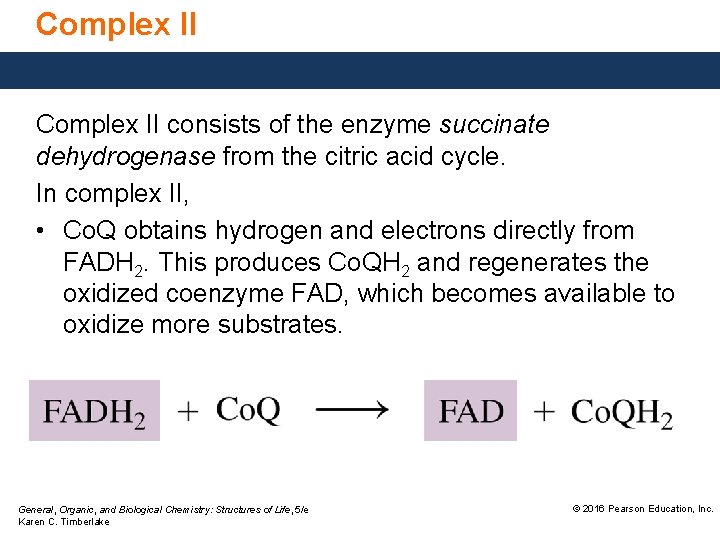
Complex II consists of the enzyme succinate dehydrogenase from the citric acid cycle. In complex II, • Co. Q obtains hydrogen and electrons directly from FADH 2. This produces Co. QH 2 and regenerates the oxidized coenzyme FAD, which becomes available to oxidize more substrates. General, Organic, and Biological Chemistry: Structures of Life, 5/e Karen C. Timberlake © 2016 Pearson Education, Inc.
Complex III Complex II consists of the enzyme succinate dehydrogenase from the citric acid cycle. In complex II, • Co. Q obtains hydrogen and electrons directly from FADH 2 and becomes Co. QH 2. • two electrons are transferred from the mobile carrier Co. QH 2 to a series of iron-containing proteins called cytochromes. • electrons are then transferred to two cytochrome c, which can move between complexes III and IV. General, Organic, and Biological Chemistry: Structures of Life, 5/e Karen C. Timberlake © 2016 Pearson Education, Inc.
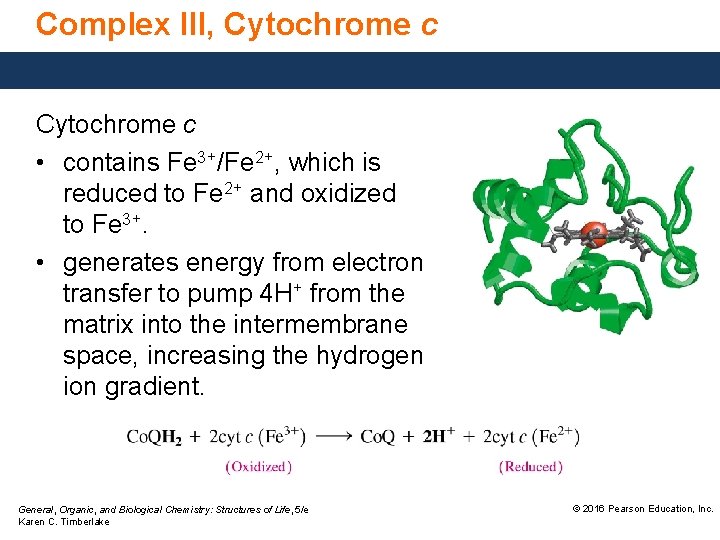
Complex III, Cytochrome c • contains Fe 3+/Fe 2+, which is reduced to Fe 2+ and oxidized to Fe 3+. • generates energy from electron transfer to pump 4 H+ from the matrix into the intermembrane space, increasing the hydrogen ion gradient. General, Organic, and Biological Chemistry: Structures of Life, 5/e Karen C. Timberlake © 2016 Pearson Education, Inc.
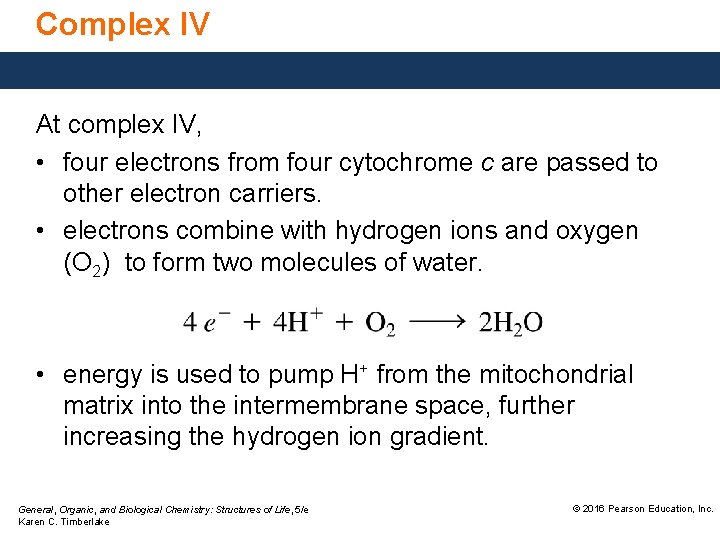
Complex IV At complex IV, • four electrons from four cytochrome c are passed to other electron carriers. • electrons combine with hydrogen ions and oxygen (O 2) to form two molecules of water. • energy is used to pump H+ from the mitochondrial matrix into the intermembrane space, further increasing the hydrogen ion gradient. General, Organic, and Biological Chemistry: Structures of Life, 5/e Karen C. Timberlake © 2016 Pearson Education, Inc.
Oxidative Phosphorylation Energy is coupled with the production of ATP in a process called oxidative phosphorylation. In 1978, Peter Mitchell theorized about a chemiosmotic model, which • links the energy from electron transport to a hydrogen ion gradient that drives the synthesis of ATP. • allows complexes I, III, and IV to act as hydrogen ion pumps, producing a hydrogen ion gradient. • equalizes p. H and electrical charge between the matrix and intermembrane space that occurs when H+ must return to the matrix. General, Organic, and Biological Chemistry: Structures of Life, 5/e Karen C. Timberlake © 2016 Pearson Education, Inc.
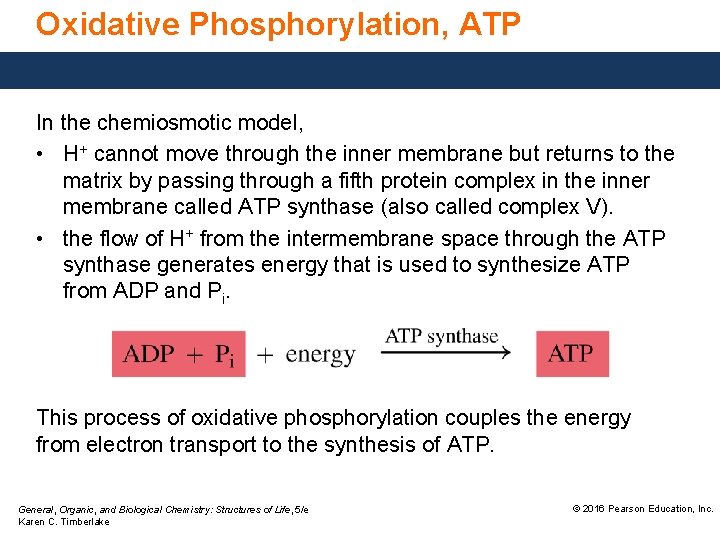
Oxidative Phosphorylation, ATP In the chemiosmotic model, • H+ cannot move through the inner membrane but returns to the matrix by passing through a fifth protein complex in the inner membrane called ATP synthase (also called complex V). • the flow of H+ from the intermembrane space through the ATP synthase generates energy that is used to synthesize ATP from ADP and Pi. This process of oxidative phosphorylation couples the energy from electron transport to the synthesis of ATP. General, Organic, and Biological Chemistry: Structures of Life, 5/e Karen C. Timberlake © 2016 Pearson Education, Inc.
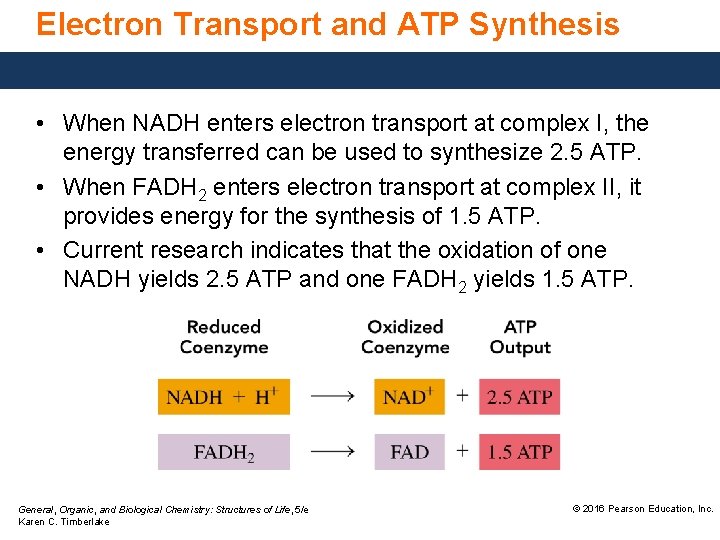
Electron Transport and ATP Synthesis • When NADH enters electron transport at complex I, the energy transferred can be used to synthesize 2. 5 ATP. • When FADH 2 enters electron transport at complex II, it provides energy for the synthesis of 1. 5 ATP. • Current research indicates that the oxidation of one NADH yields 2. 5 ATP and one FADH 2 yields 1. 5 ATP. General, Organic, and Biological Chemistry: Structures of Life, 5/e Karen C. Timberlake © 2016 Pearson Education, Inc.
Regulation of Electron Transport and Oxidative Phosphorylation Electron transport • is regulated by the availability of ADP, Pi, oxygen (O 2), and NADH. • decreases with low levels of any of these compounds and decreases the formation of ATP. When a cell is active and ATP is consumed rapidly, the elevated levels of ADP will activate the synthesis of ATP. The activity of electron transport is strongly dependent on the availability of ADP for ATP synthesis. General, Organic, and Biological Chemistry: Structures of Life, 5/e Karen C. Timberlake © 2016 Pearson Education, Inc.
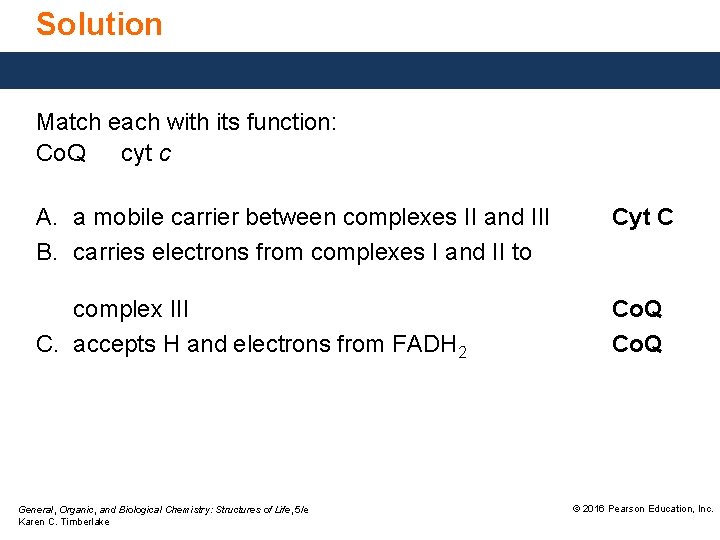
Study Check Match each with its function: Co. Q cyt c A. a mobile carrier between complexes II and III B. carries electrons from complexes I and II to complex III C. accepts H and electrons from FADH 2 General, Organic, and Biological Chemistry: Structures of Life, 5/e Karen C. Timberlake © 2016 Pearson Education, Inc.
Solution Match each with its function: Co. Q cyt c A. a mobile carrier between complexes II and III B. carries electrons from complexes I and II to Cyt C complex III C. accepts H and electrons from FADH 2 Co. Q General, Organic, and Biological Chemistry: Structures of Life, 5/e Karen C. Timberlake © 2016 Pearson Education, Inc.
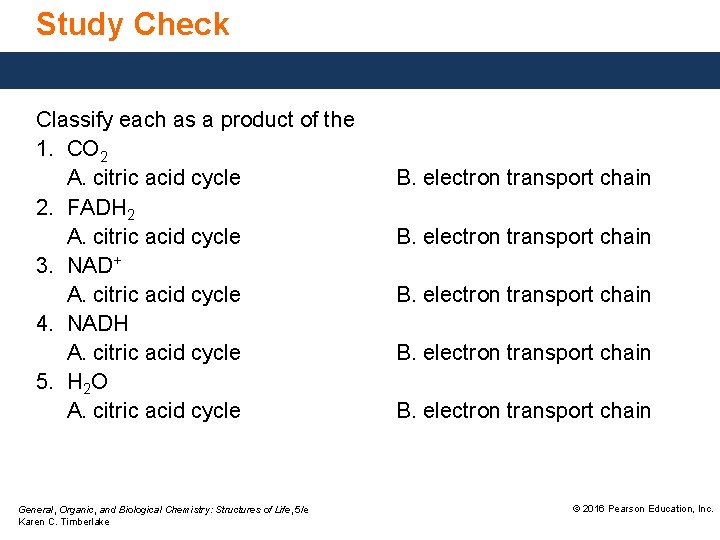
Study Check Classify each as a product of the 1. CO 2 A. citric acid cycle 2. FADH 2 A. citric acid cycle 3. NAD+ A. citric acid cycle 4. NADH A. citric acid cycle 5. H 2 O A. citric acid cycle General, Organic, and Biological Chemistry: Structures of Life, 5/e Karen C. Timberlake B. electron transport chain © 2016 Pearson Education, Inc.
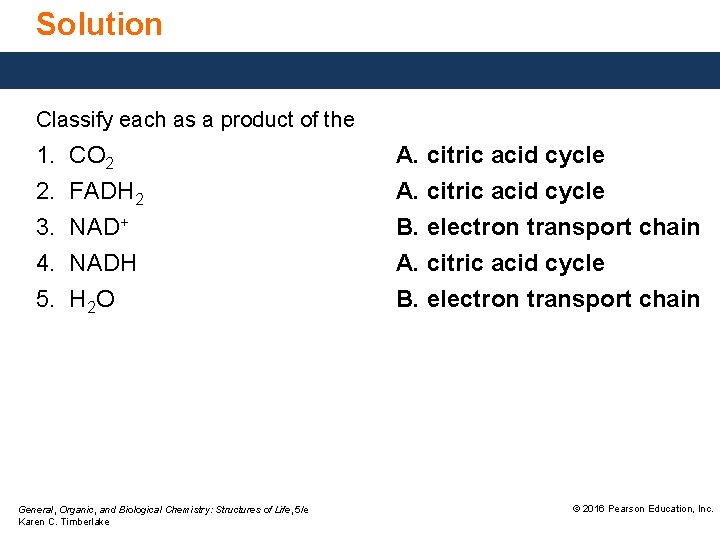
Solution Classify each as a product of the 1. 2. 3. 4. 5. CO 2 FADH 2 NAD+ NADH H 2 O General, Organic, and Biological Chemistry: Structures of Life, 5/e Karen C. Timberlake A. citric acid cycle B. electron transport chain © 2016 Pearson Education, Inc.