
225 Section Chapter Section 1 Objectives Analyze why
225 Section Chapter Section 1 Objectives • Analyze why industrialization took root in the northern part of the United States. • Describe the impact of industrialization on northern life. • Analyze the reasons that agriculture and slavery became entrenched in the South. Sectional Differences The Cold War Begins
225 Section Chapter Section 1 Terms and People • Tariff of 1816 – a tax on imports designed to protect American industry • capital – money used to invest in factories or other productive assets • labor union – a group of workers who unite to seek better pay and working conditions • nativist – person opposed to immigrants and immigration • cotton gin – machine invented by Eli Whitney in 1793 to quickly separate seeds from cotton fibers Sectional Differences The Cold War Begins
225 Section Chapter Section 1 Terms and People (continued) • Adams-Onís Treaty – treaty negotiated by John Quincy Adams to purchase Florida from Spain • Monroe Doctrine – policy warning European monarchies not to interfere with Latin American republics in return for U. S. non-interference • Missouri Compromise – 1820 compromise balancing the admission of Missouri as a slave state with the admission of Maine as a free state and setting a line across the continent dividing future free and slave states Sectional Differences The Cold War Begins
225 Section Chapter Section 1 Terms and People • Andrew Jackson – popular war hero elected president as a Democrat in 1828 • spoils system – practice of giving government jobs to loyal party supporters • Indian Removal Act – 1830 Act forcing the relocation of the Five Civilized Tribes from the southeast to present day Oklahoma • Trail of Tears – forced march to Oklahoma in the winter of 1838, during which 4, 000 Cherokees died Sectional Differences The Cold War Begins
225 Section Chapter Section 1 How did the North and the South differ during the first half of the 1800 s? Industrialization occurred mainly in the Northeast while cotton production deepened the South’s dependence on slavery. These two geographical regions developed in different ways, creating a complicated political environment. Sectional Differences The Cold War Begins
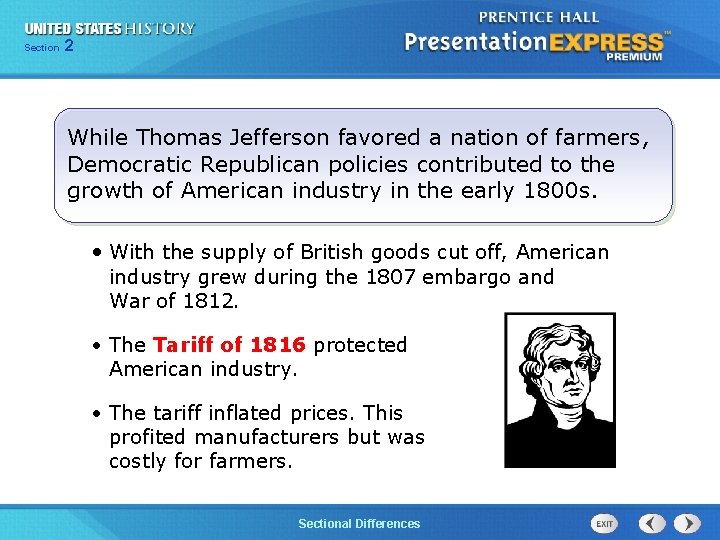
225 Section Chapter Section 1 While Thomas Jefferson favored a nation of farmers, Democratic Republican policies contributed to the growth of American industry in the early 1800 s. • With the supply of British goods cut off, American industry grew during the 1807 embargo and War of 1812. • The Tariff of 1816 protected American industry. • The tariff inflated prices. This profited manufacturers but was costly for farmers. Sectional Differences The Cold War Begins
225 Section Chapter Section 1 In the early 19 th century, the North embraced industry. • Factory owners had access to money for investment called capital. • Immigrants provided inexpensive labor. • Swiftly flowing rivers provided cheap power. Sectional Differences The Cold War Begins
225 Section Chapter Section 1 Immigration changed America’s urban population beginning in the 1840 s. Most immigrants came to Northern cities. Few went to the South. Immigration grew from 600, 000 per year in the 1830 s to 2, 800, 000 per year in the 1850 s. Prior to 1840, most immigrants were English or Scottish. After 1840, a larger percentage were Irish or German. The Irish arrived following a potato famine. The Germans came due to a failed revolution, famine, and depression. Sectional Differences The Cold War Begins
225 Section Chapter Section 1 Most immigrants became urban laborers, though some set up businesses or moved to the Midwest. • The rapid influx of people caused social, economic and political strains in cities. • Various immigrant groups and free Africans competed for jobs and housing in shabby neighborhoods. • This competition led to riots in Philadelphia in 1844 and in Baltimore in 1854. Sectional Differences The Cold War Begins
225 Section Chapter Section 1 The Founding Fathers had hoped that slavery would gradually fade away. Slavery continued. Three developments caused cotton production to surge, making slavery profitable in the Deep South: Sectional Differences The Cold War Begins • The invention of the cotton gin • The expansion of cotton production westward • A huge demand for cotton due to industrialization
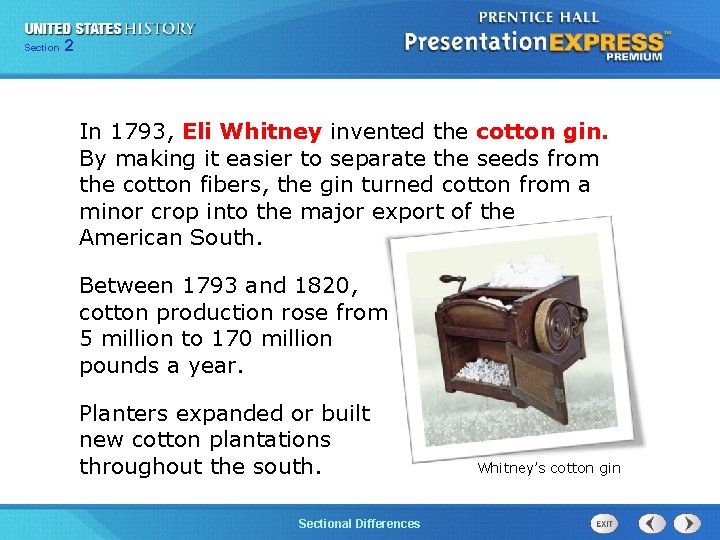
225 Section Chapter Section 1 In 1793, Eli Whitney invented the cotton gin. By making it easier to separate the seeds from the cotton fibers, the gin turned cotton from a minor crop into the major export of the American South. Between 1793 and 1820, cotton production rose from 5 million to 170 million pounds a year. Planters expanded or built new cotton plantations throughout the south. Sectional Differences The Cold War Begins Whitney’s cotton gin
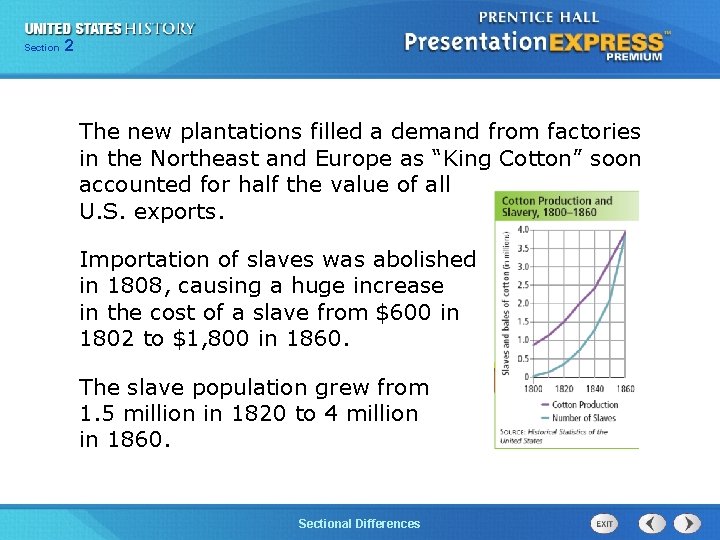
225 Section Chapter Section 1 The new plantations filled a demand from factories in the Northeast and Europe as “King Cotton” soon accounted for half the value of all U. S. exports. Importation of slaves was abolished in 1808, causing a huge increase in the cost of a slave from $600 in 1802 to $1, 800 in 1860. The slave population grew from 1. 5 million in 1820 to 4 million in 1860. Sectional Differences The Cold War Begins
225 Section Chapter Section 1 • Most aspired to acquire slaves If so few and a plantation. benefited from slavery, why did • Southern whites shared a Southerners sense of racial superiority and defend the pride in their independence. slave system? • Most believed that slaves were better off than poor northern factory workers. • Most feared that freed blacks would seek a bloody revenge. Sectional Differences The Cold War Begins
225 Section Chapter Section 1 How did domestic and foreign policies reflect the nationalism of the times? After the War of 1812, nationalism affected economic and foreign policy and began to create a sense of national identity. Supreme Court rulings supported nationalism by favoring federal power. Sectional Differences The Cold War Begins
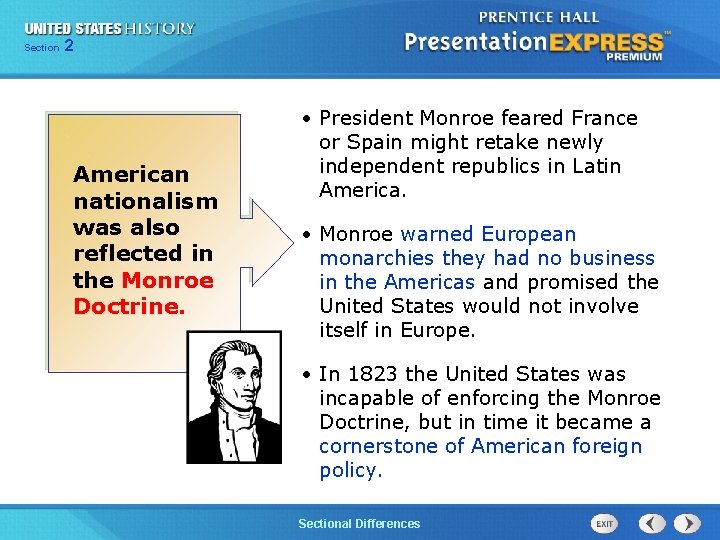
225 Section Chapter Section 1 American nationalism was also reflected in the Monroe Doctrine. • President Monroe feared France or Spain might retake newly independent republics in Latin America. • Monroe warned European monarchies they had no business in the Americas and promised the United States would not involve itself in Europe. • In 1823 the United States was incapable of enforcing the Monroe Doctrine, but in time it became a cornerstone of American foreign policy. Sectional Differences The Cold War Begins
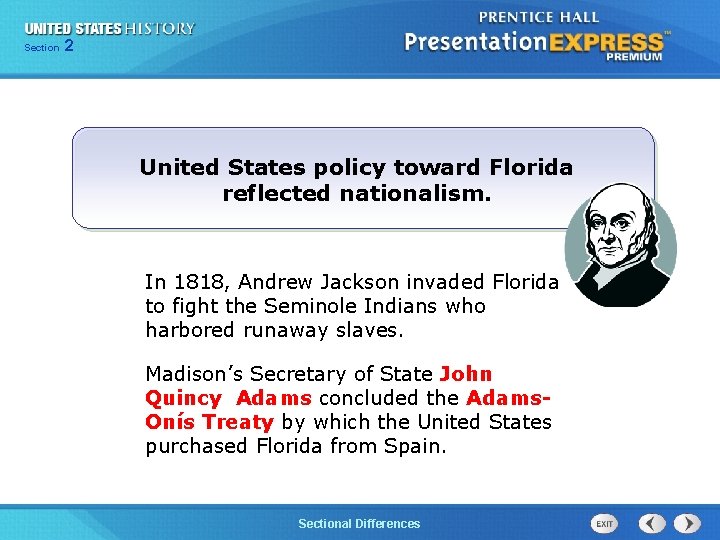
225 Section Chapter Section 1 United States policy toward Florida reflected nationalism. In 1818, Andrew Jackson invaded Florida to fight the Seminole Indians who harbored runaway slaves. Madison’s Secretary of State John Quincy Adams concluded the Adams. Onís Treaty by which the United States purchased Florida from Spain. Sectional Differences The Cold War Begins
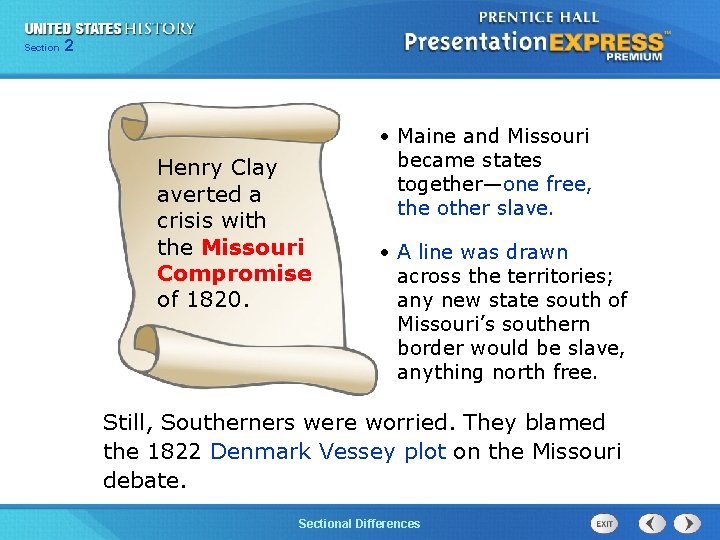
225 Section Chapter Section 1 Henry Clay averted a crisis with the Missouri Compromise of 1820. • Maine and Missouri became states together—one free, the other slave. • A line was drawn across the territories; any new state south of Missouri’s southern border would be slave, anything north free. Still, Southerners were worried. They blamed the 1822 Denmark Vessey plot on the Missouri debate. Sectional Differences The Cold War Begins
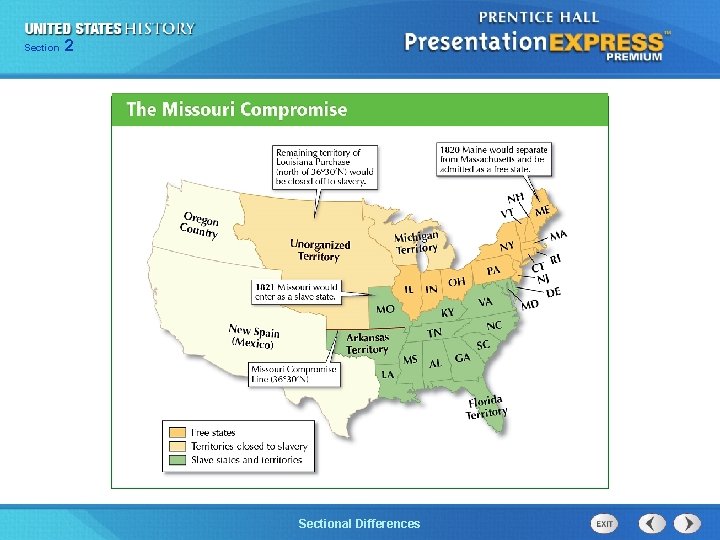
225 Section Chapter Section 1 Sectional Differences The Cold War Begins
225 Section Chapter Section 1 Objectives • Analyze the movement toward greater democracy and its impact. • Describe the personal and political qualities of Andrew Jackson. • Summarize the causes and effects of the removal of Native Americans in the early 1800 s. Sectional Differences The Cold War Begins
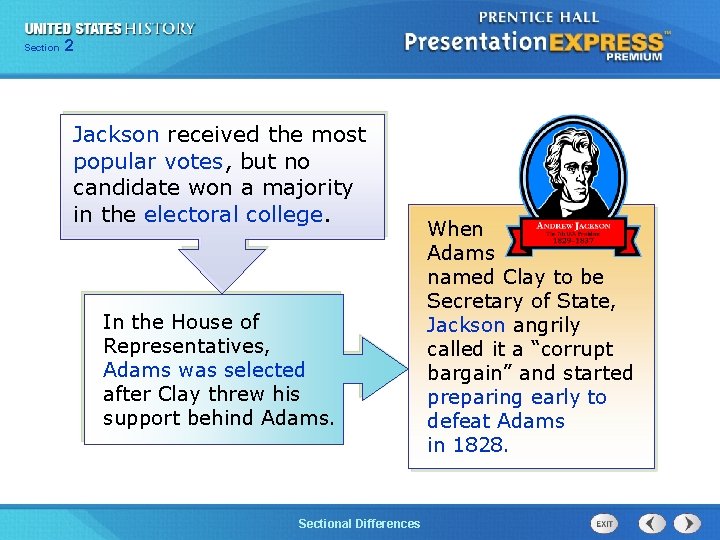
225 Section Chapter Section 1 Jackson received the most popular votes, but no candidate won a majority in the electoral college. In the House of Representatives, Adams was selected after Clay threw his support behind Adams. Sectional Differences The Cold War Begins When Adams named Clay to be Secretary of State, Jackson angrily called it a “corrupt bargain” and started preparing early to defeat Adams in 1828.
225 Section Chapter Section 1 Andrew Jackson won the Presidency in 1828. Jackson symbolized the rise of new democratic ideals uniting city workers, western settlers, and southern farmers against privileged “aristocrats. ” This combination came to be known as “Jacksonian Democracy. ” Sectional Differences The Cold War Begins
225 Section Chapter Section 1 Jackson’s followers called themselves “Democrats. ” • Under Martin Van Buren his campaign was the first to be run in a disciplined and professional fashion. • Opponents were replaced in government jobs by supporters, using what critics called “the spoils system. ” • Jackson promised a weak federal government but was ruthless against anyone who challenged his decisions. Sectional Differences The Cold War Begins
225 Section Chapter Section 1 Conflict arose between Native Americans and whites In the Southeast, the “five civilized tribes” adopted White American culture. They ran newspapers, schools and churches and elected officials under republican constitutions. Settlers wanted Native land. Many believed Indians to be inferior. Sectional Differences The Cold War Begins
225 Section Chapter Section 1 Jackson supported Southerners and Westerners over Native Americans. • With Jackson’s urging, Congress passed the Indian Removal Act of 1830. • In 1832, Chief Justice Marshall ruled that the seizure of native lands was unconstitutional. • Jackson defied the ruling. “Justice Marshall has made his decision, now let him enforce it. ” Sectional Differences The Cold War Begins
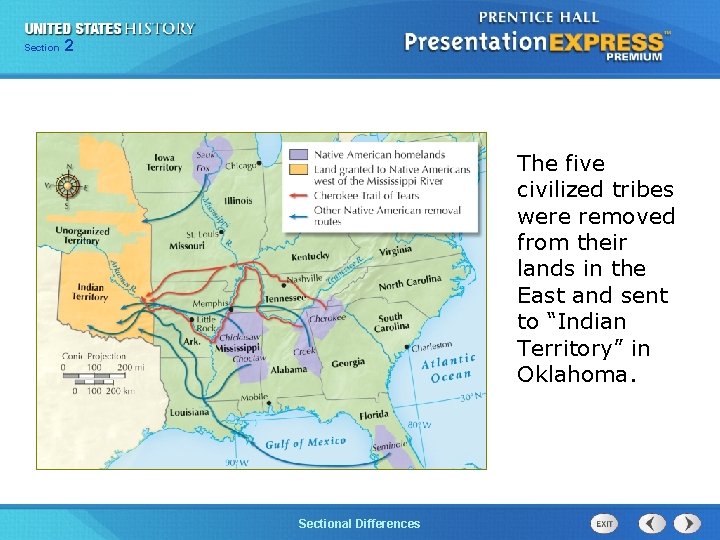
225 Section Chapter Section 1 The five civilized tribes were removed from their lands in the East and sent to “Indian Territory” in Oklahoma. Sectional Differences The Cold War Begins
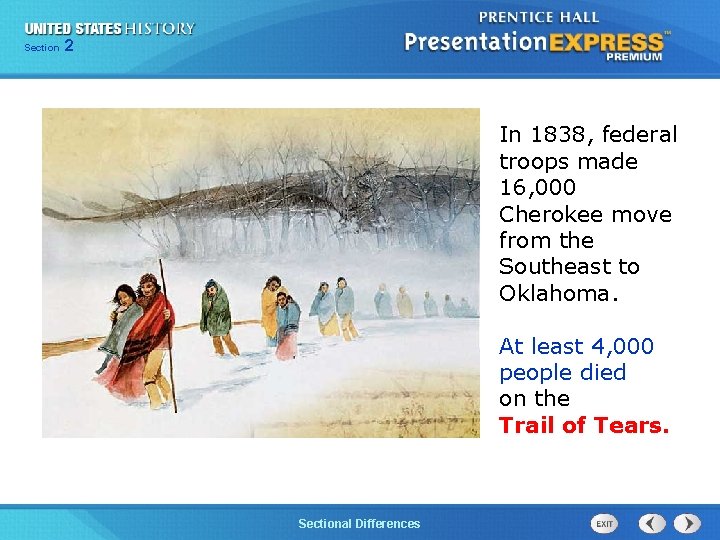
225 Section Chapter Section 1 In 1838, federal troops made 16, 000 Cherokee move from the Southeast to Oklahoma. At least 4, 000 people died on the Trail of Tears. Sectional Differences The Cold War Begins
- Slides: 26