
2232014 ANDRAGOGY VS PEDAGOGY TEACHING THE ADULT LEARNER
- Slides: 19
2/23/2014 ANDRAGOGY VS PEDAGOGY: TEACHING THE ADULT LEARNER IN AN ONLINE ENVIRONMENT Tonina Aragona Adjunct Lecturer/Education Department Hostos Community College Bronx Ed. Tech Showcase 2014
QUESTIONS 1. Do adults and children learn differently? � What is pedagogy? � What is andragogy? 2. What are the implications for the use of pedagogy and/or andragogy in online learning? 3. Does the online instructor maintain the same role as the face-to-face instructor? 4. What is the role of the adult learner? 2/23/2014
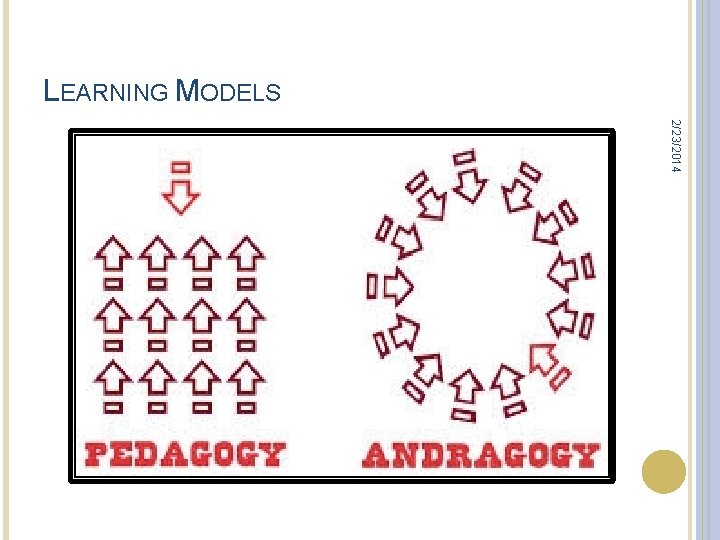
LEARNING MODELS 2/23/2014
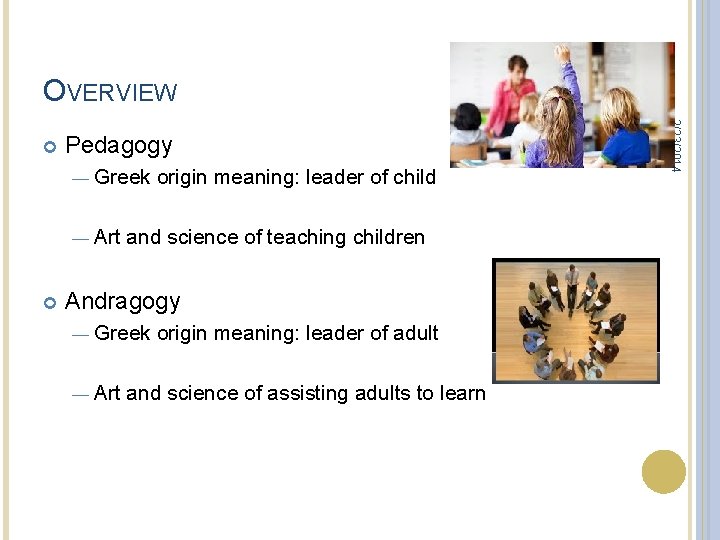
OVERVIEW Pedagogy — Greek — Art origin meaning: leader of child and science of teaching children Andragogy — Greek — Art origin meaning: leader of adult and science of assisting adults to learn 2/23/2014
THE THEORY OF ANDRAGOGY Malcolm Knowles introduced theory of andragogy to the U. S. circa 1970. Six main adult learning principles: � Learner’s need to know � Self-concept of the learner � Prior experience of the learner � Readiness to learn � Orientation to learning � Motivation to learn • (Knowles, Holton, & Swanson, 2012, p. 3) 2/23/2014
ASSUMPTIONS OF THE PEDAGOGICAL MODEL Teacher is main decision maker: What will be learned — How it will be learned — When it will be learned — Learner assumptions: — — — Know only what teacher teaches Dependent on teacher for learning needs Few prior experiences Ready to learn only what the teacher decides Motivated by external reasons Grades, parental pressures, etc. — (Knowles et al. , 2012, pp. 60 -62) 2/23/2014
THE ROLE OF THE TEACHER IN PEDAGOGY Provides learners with learning objectives. Instructs by telling, describing, or demonstrating. Provides lots of student practice with feedback. Assesses learners to determine if objectives are met. Allocates time for learners to do independent practice. (Chaplin, 2013, p. 65) 2/23/2014
THE ROLE OF THE FACILITATOR IN ANDRAGOGY Process Manager and Designer Assist in relationship building Assess needs Involve students in planning Link learners to resources Encourage student initiatives (Knowles et al. , 2012 p. 260) 2/23/2014
THE ROLE OF THE LEARNER IN PEDAGOGY 2/23/2014 Obedient Follows directions Submissive Listens to lectures Takes notes Asks teacher questions Expects teacher to answer questions Memorizes information Takes tests to prove comprehension of new information (Chapin, 2013)
THE ROLE OF LEARNER IN ANDRAGOGY 2/23/2014 Self-directs the learning process Sets own learning objective and goals Collaborates with facilitator and group members Works independently Creates own questions Engages in research to answer own questions Relies on prior experiences for the acquisition of new information Demands relevance in the learning process Expects to apply newly acquired information
ONLINE LEARNING Why do learners choose online learning? — Access — Convenience — Flexibility — (Harris & Martin, 2012) 2/23/2014
ANDRAGOGY AND ONLINE LEARNING Both: — Decrease learner’s dependency on the educator — Assist learner to access resources — Assist learner to increase responsibility — Encourage learner to define learning objectives — Use experience as the foundation and motivator for learning — Encourage collaboration among other learners — Offer a self-reflexive, self-directed, and non-authoritarian environment — Facilitate problem posing and problem solving — (Samaroo et al. , 2013, pp. 83 -84) 2/23/2014
Tips for Teaching Online Create an e-learning culture. Plan stimulating activities. Encourage participation and group interaction. Maintain online presence. Provide timely feedback. Assure relevance in course work. Promote problem-solving skills.
Preparing the Adult Learner Re-learning to Learn Responsibility Awareness Share in the Planning Identify the Adult Learner Role � Self-directed � Independent � Proactive � Logical � Problem-solver � Inquirer � (Knowles et al. , 2012)
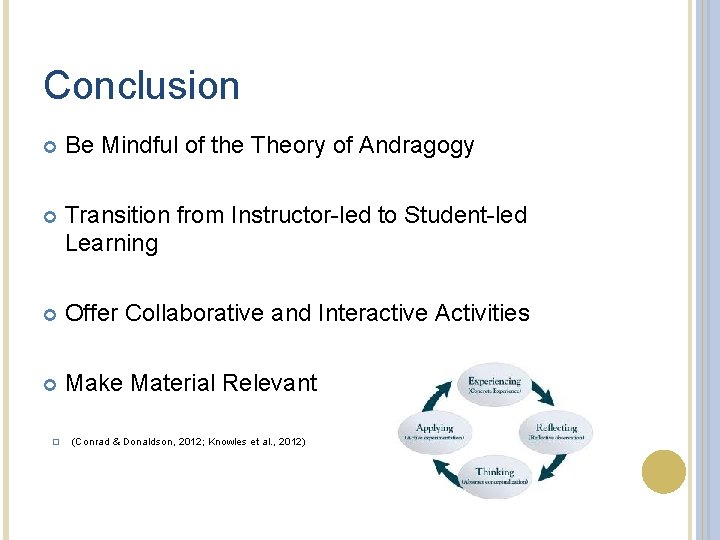
Conclusion Be Mindful of the Theory of Andragogy Transition from Instructor-led to Student-led Learning Offer Collaborative and Interactive Activities Make Material Relevant � (Conrad & Donaldson, 2012; Knowles et al. , 2012)
Discussion What changes can you make in your role of online instructor? What type of online activities can help learners become more self-directed and independent? How will you prepare your adult learners for the online experience? 2/23/2014
Thank You! Thank you for your attention!!! Your feedback is very important…please feel free to email me. Tonina Aragona �taragona@hostos. cuny. edu 2/23/2014
REFERENCES Chapin, J. R. (2013). Elementary social studies: A practical guide. Boston, MA: Pearson. Conrad, R. & Donaldson, J. A. (2012). Continuing to engage the online learner. San Francisco, CA: Jossey-Bass. Harris, H. S. , & Martin, E. W. (2012). Student motivations for choosing online classes. International Journal for the Scholarship of Teaching & Learning, 6(2), 1 -8. 2/23/2014
REFERENCES Knowles, M. S. , Holton, E. F. , Swanson, R. A. (2012). The adult learner: The definite classic in adult education and human resource development. Burlington, MA: Elsevier, Inc. Samaroo, S. , Cooper, E. , & Green, T. (2013). Pedandragogy: A way forward to self-engaged learning. New Horizons in Adult Education & Human Resource Development, 25(3), 76 -90. Yoshimoto, K. , Inenaga, Y. , & Yamada, H. (2007). Pedagogy andragogy in higher education: A comparison between Germany, the UK and Japan. European Journal of Education, 42(1), 75 -98. 2/23/2014