
22 6 Glycogen Synthesis and Degradation Glycogen storage
- Slides: 15
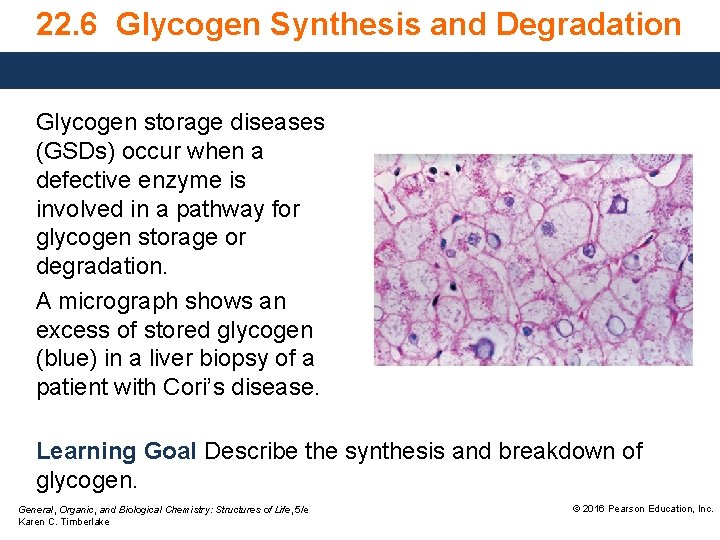
22. 6 Glycogen Synthesis and Degradation Glycogen storage diseases (GSDs) occur when a defective enzyme is involved in a pathway for glycogen storage or degradation. A micrograph shows an excess of stored glycogen (blue) in a liver biopsy of a patient with Cori’s disease. Learning Goal Describe the synthesis and breakdown of glycogen. General, Organic, and Biological Chemistry: Structures of Life, 5/e Karen C. Timberlake © 2016 Pearson Education, Inc.
Glycogen: Energy Storage Excess glucose is used to replenish energy reserves by synthesizing glycogen, which is stored in your muscles and liver. Glycogen • is a polymer of glucose with α(1 4)-glycosidic bonds and multiple branches attached by α(1 6)-glycosidic bonds. • is formed when high levels of glucose-6 -phosphate are formed in the first reaction of glycolysis. • is not formed when energy stores (glycogen) are full, which means that additional glucose is converted to triacylglycerols and stored as body fat. General, Organic, and Biological Chemistry: Structures of Life, 5/e Karen C. Timberlake © 2016 Pearson Education, Inc.
Glycogen: Energy Storage Glycogenesis • is the metabolic process of converting glucose molecules into glycogen. • produces glucose-6 -phosphate in reaction 1 of glycolysis. Core Chemistry Skill Identifying the Compounds and Enzymes in Glycogenesis and Glycogenolysis General, Organic, and Biological Chemistry: Structures of Life, 5/e Karen C. Timberlake © 2016 Pearson Education, Inc.
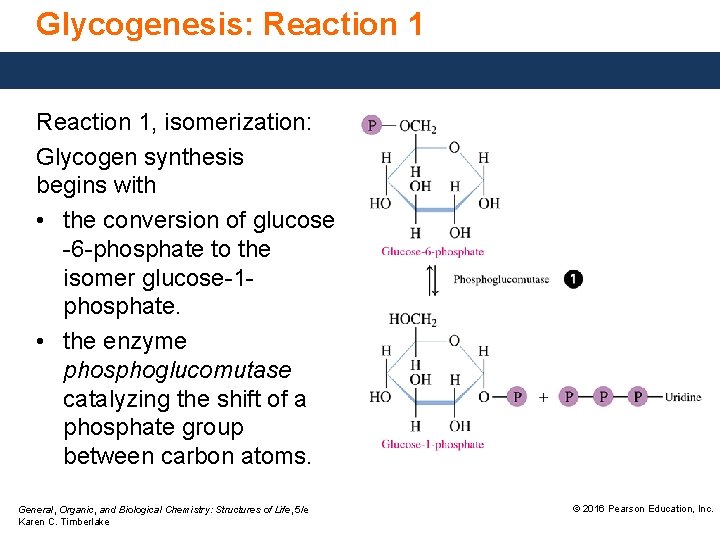
Glycogenesis: Reaction 1, isomerization: Glycogen synthesis begins with • the conversion of glucose -6 -phosphate to the isomer glucose-1 phosphate. • the enzyme phosphoglucomutase catalyzing the shift of a phosphate group between carbon atoms. General, Organic, and Biological Chemistry: Structures of Life, 5/e Karen C. Timberlake © 2016 Pearson Education, Inc.
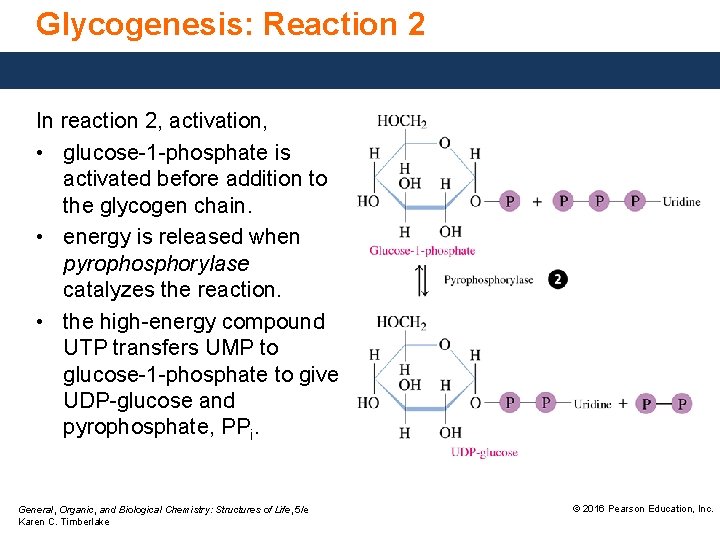
Glycogenesis: Reaction 2 In reaction 2, activation, • glucose-1 -phosphate is activated before addition to the glycogen chain. • energy is released when pyrophosphorylase catalyzes the reaction. • the high-energy compound UTP transfers UMP to glucose-1 -phosphate to give UDP-glucose and pyrophosphate, PPi. General, Organic, and Biological Chemistry: Structures of Life, 5/e Karen C. Timberlake © 2016 Pearson Education, Inc.
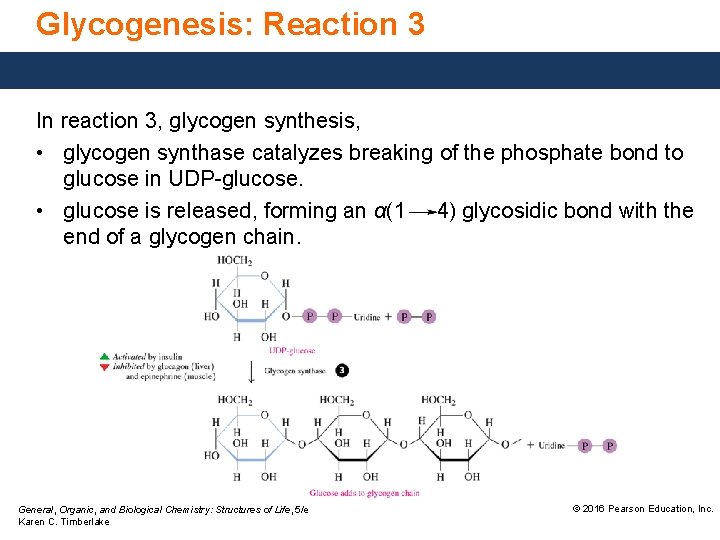
Glycogenesis: Reaction 3 In reaction 3, glycogen synthesis, • glycogen synthase catalyzes breaking of the phosphate bond to glucose in UDP-glucose. • glucose is released, forming an α(1 4) glycosidic bond with the end of a glycogen chain. General, Organic, and Biological Chemistry: Structures of Life, 5/e Karen C. Timberlake © 2016 Pearson Education, Inc.
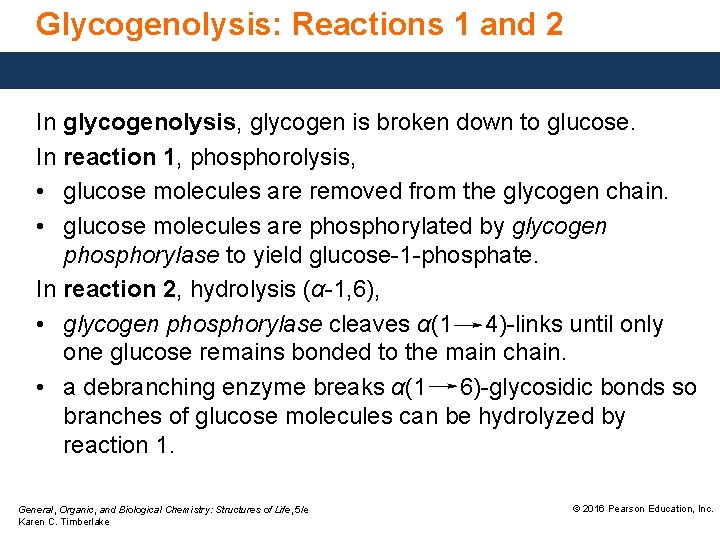
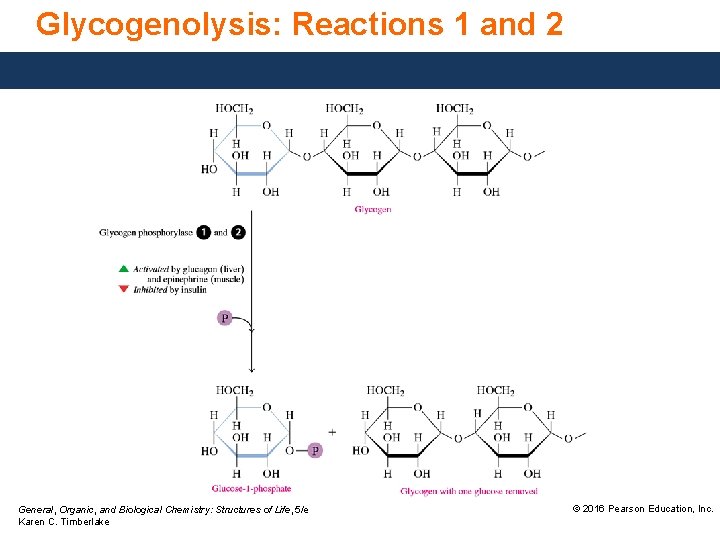
Glycogenolysis: Reactions 1 and 2 In glycogenolysis, glycogen is broken down to glucose. In reaction 1, phosphorolysis, • glucose molecules are removed from the glycogen chain. • glucose molecules are phosphorylated by glycogen phosphorylase to yield glucose-1 -phosphate. In reaction 2, hydrolysis (α-1, 6), • glycogen phosphorylase cleaves α(1 4)-links until only one glucose remains bonded to the main chain. • a debranching enzyme breaks α(1 6)-glycosidic bonds so branches of glucose molecules can be hydrolyzed by reaction 1. General, Organic, and Biological Chemistry: Structures of Life, 5/e Karen C. Timberlake © 2016 Pearson Education, Inc.
Glycogenolysis: Reactions 1 and 2 General, Organic, and Biological Chemistry: Structures of Life, 5/e Karen C. Timberlake © 2016 Pearson Education, Inc.
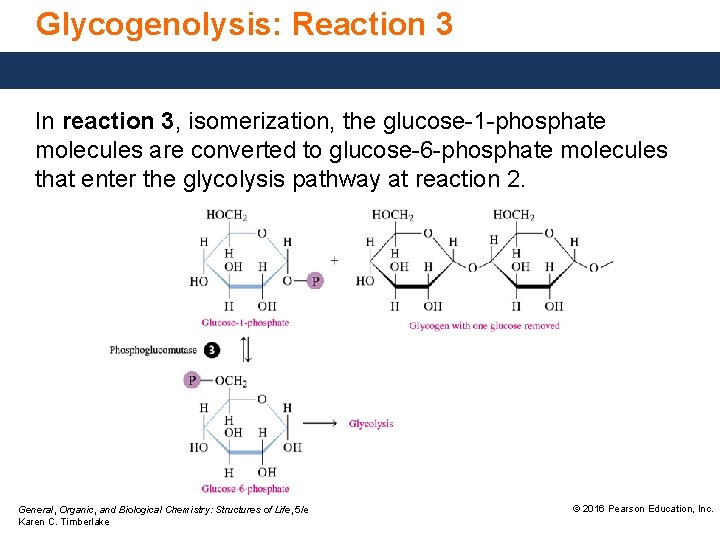
Glycogenolysis: Reaction 3 In reaction 3, isomerization, the glucose-1 -phosphate molecules are converted to glucose-6 -phosphate molecules that enter the glycolysis pathway at reaction 2. General, Organic, and Biological Chemistry: Structures of Life, 5/e Karen C. Timberlake © 2016 Pearson Education, Inc.
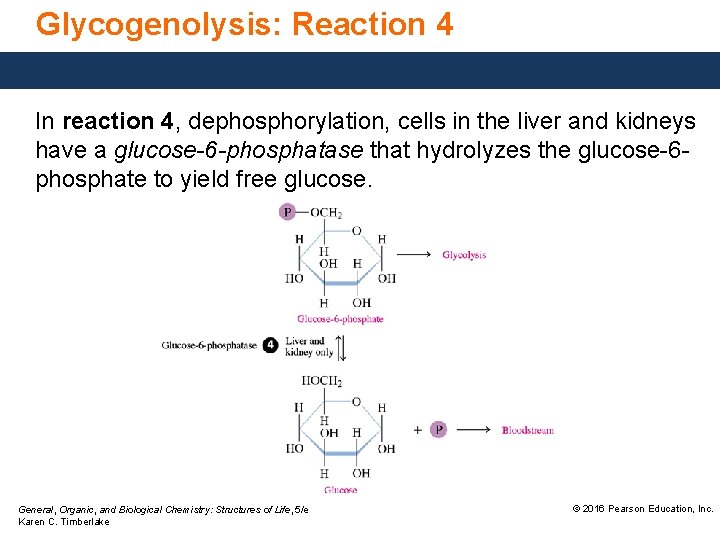
Glycogenolysis: Reaction 4 In reaction 4, dephosphorylation, cells in the liver and kidneys have a glucose-6 -phosphatase that hydrolyzes the glucose-6 phosphate to yield free glucose. General, Organic, and Biological Chemistry: Structures of Life, 5/e Karen C. Timberlake © 2016 Pearson Education, Inc.
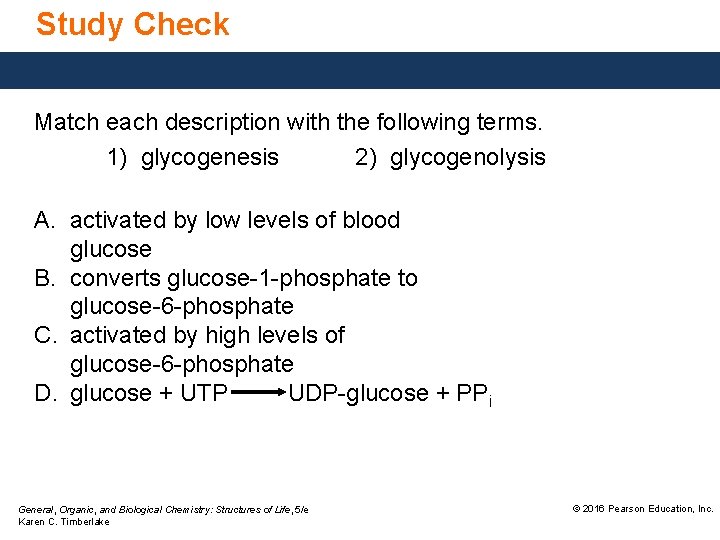
Study Check Match each description with the following terms. 1) glycogenesis 2) glycogenolysis A. activated by low levels of blood glucose B. converts glucose-1 -phosphate to glucose-6 -phosphate C. activated by high levels of glucose-6 -phosphate D. glucose + UTP UDP-glucose + PPi General, Organic, and Biological Chemistry: Structures of Life, 5/e Karen C. Timberlake © 2016 Pearson Education, Inc.
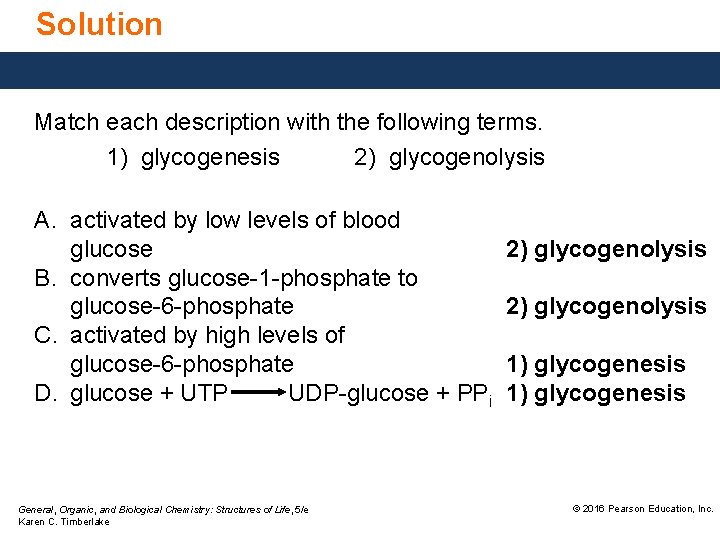
Solution Match each description with the following terms. 1) glycogenesis 2) glycogenolysis A. activated by low levels of blood glucose B. converts glucose-1 -phosphate to glucose-6 -phosphate C. activated by high levels of glucose-6 -phosphate D. glucose + UTP UDP-glucose + PPi General, Organic, and Biological Chemistry: Structures of Life, 5/e Karen C. Timberlake 2) glycogenolysis 1) glycogenesis © 2016 Pearson Education, Inc.
Regulation of Glycogen Metabolism The brain, skeletal muscles, and red blood cells require large amounts of glucose to function properly. To protect the brain, hormones with opposing actions control blood glucose levels such as • glucagon. • insulin. • epinephrine. General, Organic, and Biological Chemistry: Structures of Life, 5/e Karen C. Timberlake © 2016 Pearson Education, Inc.
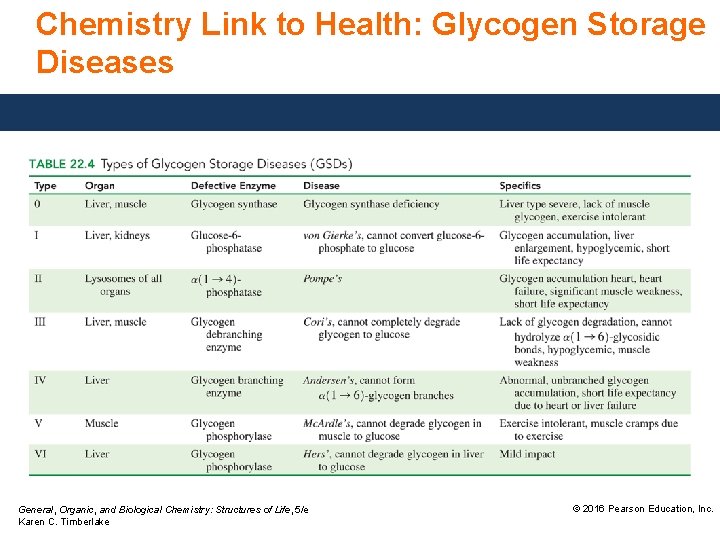
Chemistry Link to Health: Glycogen Storage Diseases Glycogen storage diseases (GSDs) occur when a defective enzyme is involved in a pathway for glycogen storage or degradation. • Severe GSDs are detected in infancy, and life expectancy is usually short. • Less severe types are detected in adulthood. General, Organic, and Biological Chemistry: Structures of Life, 5/e Karen C. Timberlake © 2016 Pearson Education, Inc.
Chemistry Link to Health: Glycogen Storage Diseases General, Organic, and Biological Chemistry: Structures of Life, 5/e Karen C. Timberlake © 2016 Pearson Education, Inc.