
2170715 Data Mining Business Intelligence UNIT 3 Introduction
2170715 - Data Mining & Business Intelligence UNIT - 3 Introduction to Data Mining (DM) Prof. Naimish R. Vadodariya naimish. vadodariya@darshan. ac. in +91 -8866215253 Computer Engineering Darshan Institute of Engineering & Technology
Outline § Motivation: Why data mining? § What is data mining? § Data mining functionalities § Classification of Data mining systems § Data Mining: On what kind of data? § Data Mining Architecture § KDD Process § Data mining issues Unit: 3 – Introduction to Data Mining (DM) 2 Darshan Institute of Engineering & Technology
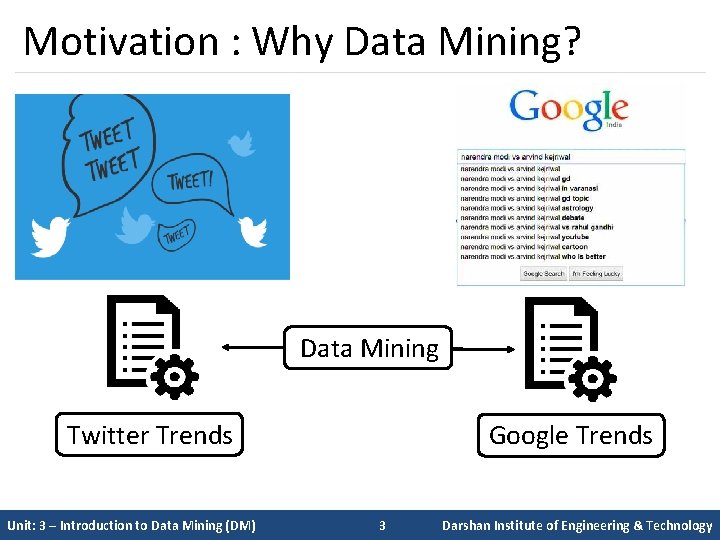
Motivation : Why Data Mining? Data Mining Google Trends Twitter Trends Unit: 3 – Introduction to Data Mining (DM) 3 Darshan Institute of Engineering & Technology
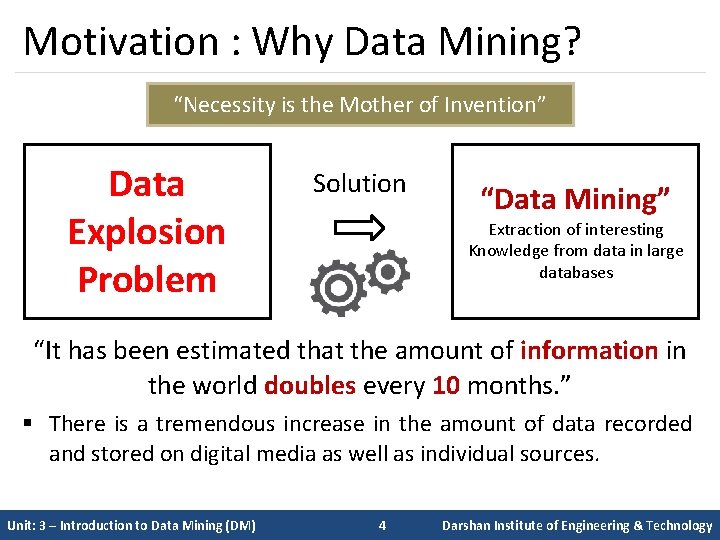
Motivation : Why Data Mining? “Necessity is the Mother of Invention” Data Explosion Problem Solution “Data Mining” Extraction of interesting Knowledge from data in large databases “It has been estimated that the amount of information in the world doubles every 10 months. ” § There is a tremendous increase in the amount of data recorded and stored on digital media as well as individual sources. Unit: 3 – Introduction to Data Mining (DM) 4 Darshan Institute of Engineering & Technology
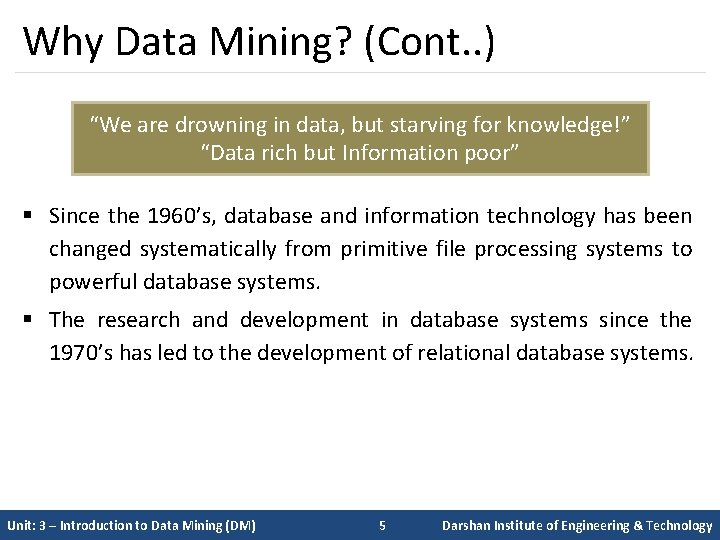
Why Data Mining? (Cont. . ) “We are drowning in data, but starving for knowledge!” “Data rich but Information poor” § Since the 1960’s, database and information technology has been changed systematically from primitive file processing systems to powerful database systems. § The research and development in database systems since the 1970’s has led to the development of relational database systems. Unit: 3 – Introduction to Data Mining (DM) 5 Darshan Institute of Engineering & Technology
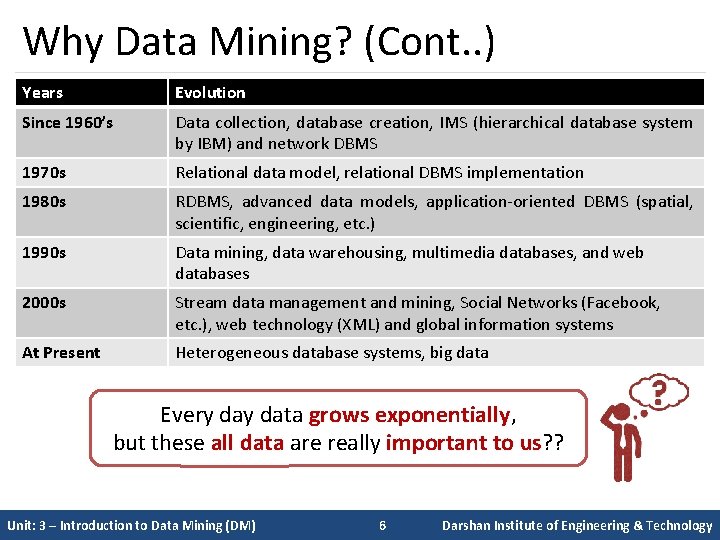
Why Data Mining? (Cont. . ) Years Evolution Since 1960’s Data collection, database creation, IMS (hierarchical database system by IBM) and network DBMS 1970 s Relational data model, relational DBMS implementation 1980 s RDBMS, advanced data models, application-oriented DBMS (spatial, scientific, engineering, etc. ) 1990 s Data mining, data warehousing, multimedia databases, and web databases 2000 s Stream data management and mining, Social Networks (Facebook, etc. ), web technology (XML) and global information systems At Present Heterogeneous database systems, big data Every data grows exponentially, but these all data are really important to us? ? Unit: 3 – Introduction to Data Mining (DM) 6 Darshan Institute of Engineering & Technology
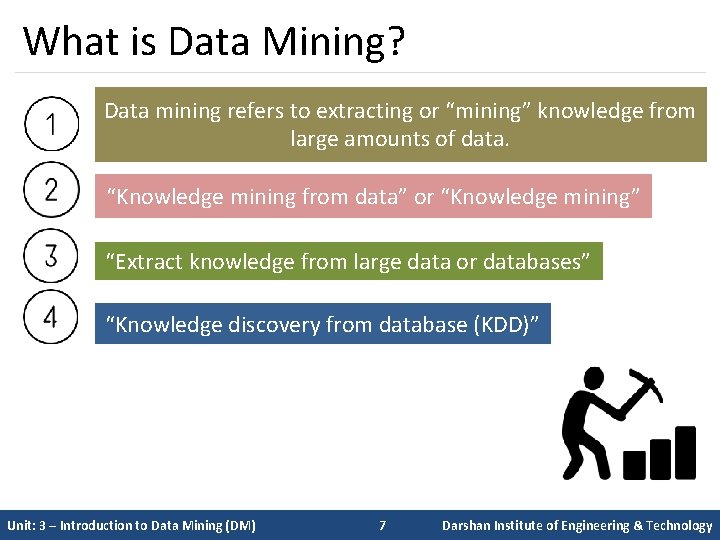
What is Data Mining? Data mining refers to extracting or “mining” knowledge from large amounts of data. “Knowledge mining from data” or “Knowledge mining” “Extract knowledge from large data or databases” “Knowledge discovery from database (KDD)” Unit: 3 – Introduction to Data Mining (DM) 7 Darshan Institute of Engineering & Technology
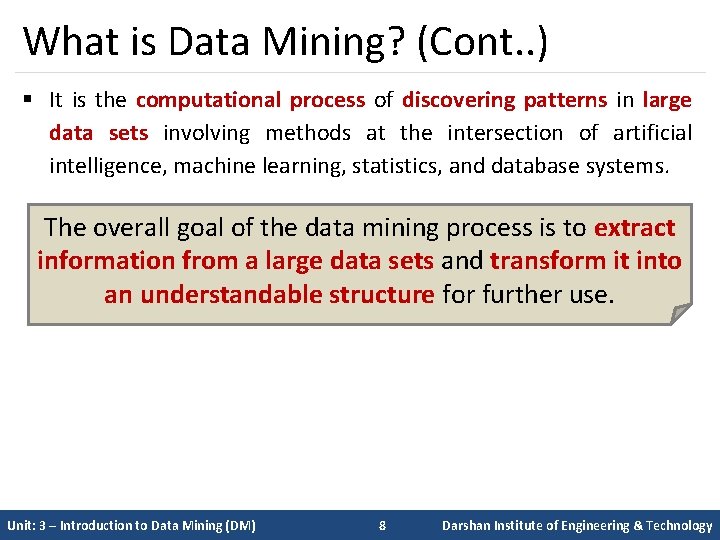
What is Data Mining? (Cont. . ) § It is the computational process of discovering patterns in large data sets involving methods at the intersection of artificial intelligence, machine learning, statistics, and database systems. The overall goal of the data mining process is to extract information from a large data sets and transform it into an understandable structure for further use. Unit: 3 – Introduction to Data Mining (DM) 8 Darshan Institute of Engineering & Technology
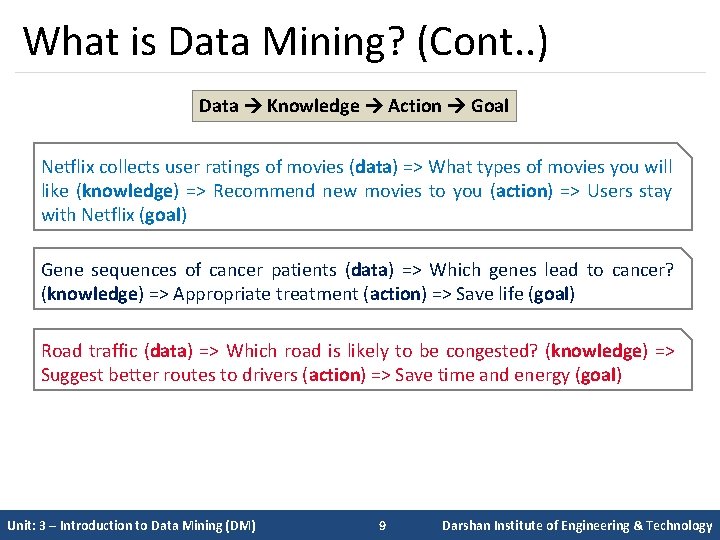
What is Data Mining? (Cont. . ) Data Knowledge Action Goal Netflix collects user ratings of movies (data) => What types of movies you will like (knowledge) => Recommend new movies to you (action) => Users stay with Netflix (goal) Gene sequences of cancer patients (data) => Which genes lead to cancer? (knowledge) => Appropriate treatment (action) => Save life (goal) Road traffic (data) => Which road is likely to be congested? (knowledge) => Suggest better routes to drivers (action) => Save time and energy (goal) Unit: 3 – Introduction to Data Mining (DM) 9 Darshan Institute of Engineering & Technology
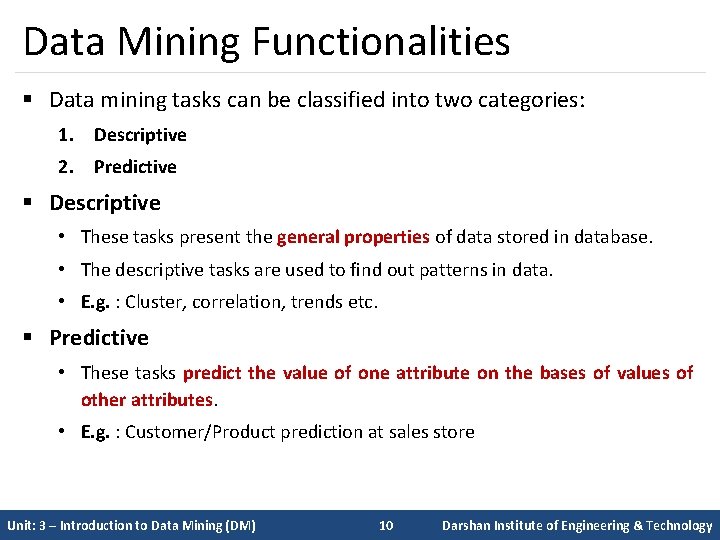
Data Mining Functionalities § Data mining tasks can be classified into two categories: 1. Descriptive 2. Predictive § Descriptive • These tasks present the general properties of data stored in database. • The descriptive tasks are used to find out patterns in data. • E. g. : Cluster, correlation, trends etc. § Predictive • These tasks predict the value of one attribute on the bases of values of other attributes. • E. g. : Customer/Product prediction at sales store Unit: 3 – Introduction to Data Mining (DM) 10 Darshan Institute of Engineering & Technology
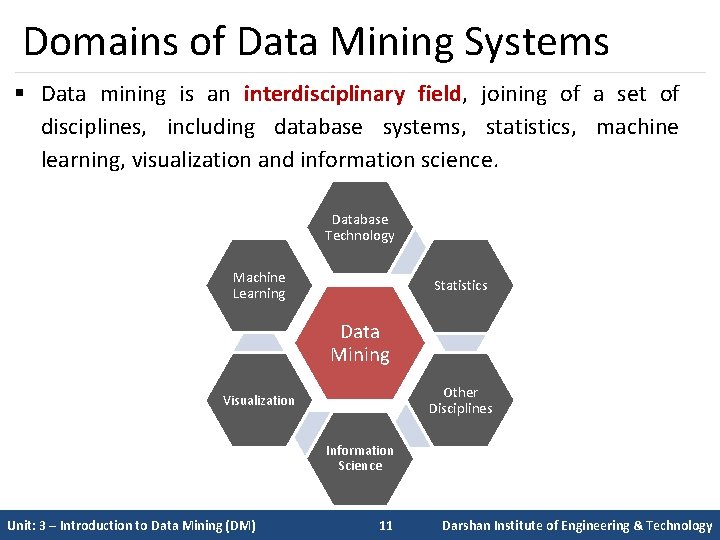
Domains of Data Mining Systems § Data mining is an interdisciplinary field, joining of a set of disciplines, including database systems, statistics, machine learning, visualization and information science. Database Technology Machine Learning Statistics Data Mining Other Disciplines Visualization Information Science Unit: 3 – Introduction to Data Mining (DM) 11 Darshan Institute of Engineering & Technology
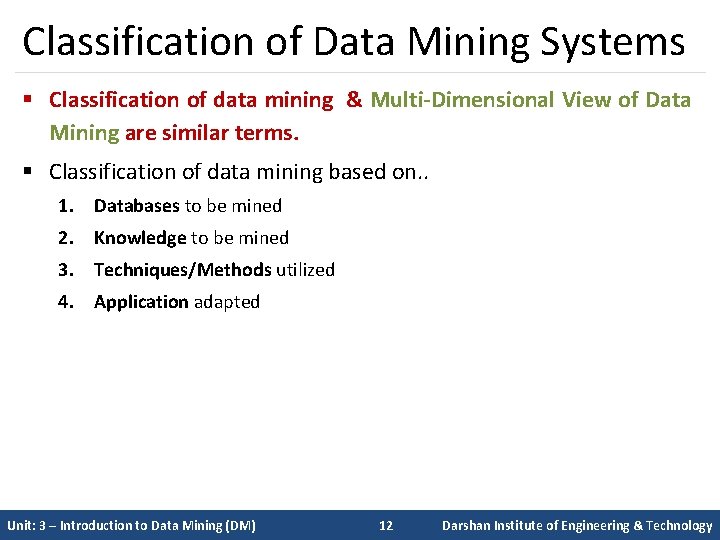
Classification of Data Mining Systems § Classification of data mining & Multi-Dimensional View of Data Mining are similar terms. § Classification of data mining based on. . 1. Databases to be mined 2. Knowledge to be mined 3. Techniques/Methods utilized 4. Application adapted Unit: 3 – Introduction to Data Mining (DM) 12 Darshan Institute of Engineering & Technology
Classification of Data Mining Systems 1. Classification according to the kinds of databases mined: • Classified according to different criteria (such as data models, or the types of data or applications involved), each of which may require its own data mining technique. • For instance, if classifying according to data models, we may have a relational, transactional, object-oriented, object-relational, or data warehouse mining system. • If classifying according to the special data types, we may have a spatial, time-series, text or multimedia data mining system or a world-wide web mining system. • Other system types include heterogeneous data mining systems and legacy data mining systems. Unit: 3 – Introduction to Data Mining (DM) 13 Darshan Institute of Engineering & Technology
Classification of Data Mining Systems (Cont. . ) 2. Classification according to the kinds of knowledge mined: • Based on data mining functionalities, • Characterization • Discrimination • Association • Correlation analysis • Classification & prediction • Clustering • Outlier analysis Unit: 3 – Introduction to Data Mining (DM) 14 Darshan Institute of Engineering & Technology
Classification of Data Mining Systems (Cont. . ) 3. Classification according to the kinds of techniques utilized: • These techniques can be described according to the degree of user interaction involved (e. g. , autonomous systems, query-driven systems). • The methods of data analysis employed (e. g. , database-oriented or data warehouse–oriented techniques, machine learning, statistics, visualization, pattern recognition, neural networks etc. ) • A sophisticated data mining system will often adopt multiple data mining techniques for work out an effective, integrated technique which combines the merits of a few individual approaches. • E. g. Data-intensive, data warehouse (OLAP), machine learning, statistics, pattern recognition, visualization, high-performance, etc. Unit: 3 – Introduction to Data Mining (DM) 15 Darshan Institute of Engineering & Technology
Classification of Data Mining Systems (Cont. . ) 4. Classification according to the Applications adapted: • Retail • Telecommunication • Banking • Fraud analysis • Stock market analysis • Text mining • Web mining etc. Unit: 3 – Introduction to Data Mining (DM) 16 Darshan Institute of Engineering & Technology
Data Mining—On what kind of data? § Relational Databases: • A database system, also called a database management system (DBMS), consists of a collection of interrelated data, known as a database, and a set of software programs to manage and access the data. • E. g. : SQL Server, Oracle etc. § Data Warehouses: • A data warehouse is a repository of information collected from multiple sources. • Data warehouses are constructed via a process of data cleaning, data integration, data transformation, data loading, and periodic data refreshing. • E. g. : Stock Market, D-Mart, Big Bazar etc. Unit: 3 – Introduction to Data Mining (DM) 17 Darshan Institute of Engineering & Technology
Data Mining—On what kind of data? (Cont. . ) § Transactional Databases: • Transactional database consists of a file where each record represents a transaction. • A transaction typically includes a unique transaction identity number (TID) and a list of the items making up the transaction (such as items purchased in a store). • E. g. : Online shopping like Flipkart, Amazon etc. § Other Data • Spatial data (Maps or Location) • Engineering design data (Design of Buildings, Offices Structures) • Hypertext and multimedia data (Including text, image, video, and audio data), the World Wide Web (a huge, widely distributed information repository made available on the Internet). Unit: 3 – Introduction to Data Mining (DM) 18 Darshan Institute of Engineering & Technology
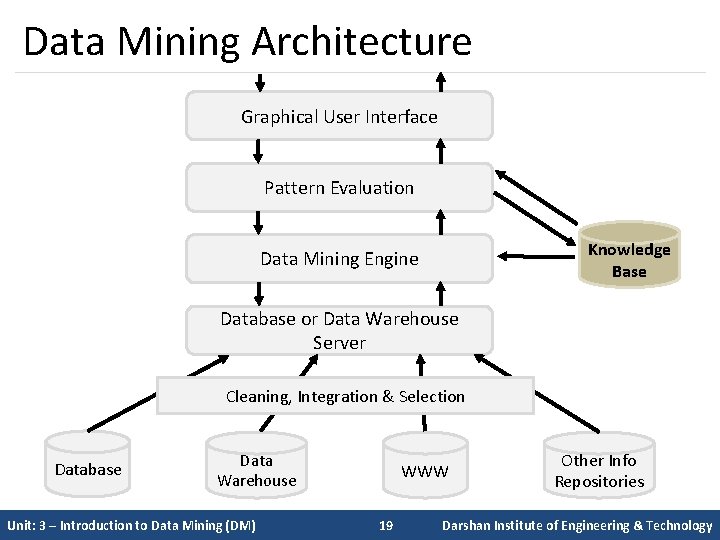
Data Mining Architecture Graphical User Interface Pattern Evaluation Knowledge Base Data Mining Engine Database or Data Warehouse Server Cleaning, Integration & Selection Database Data Warehouse Unit: 3 – Introduction to Data Mining (DM) WWW 19 Other Info Repositories Darshan Institute of Engineering & Technology
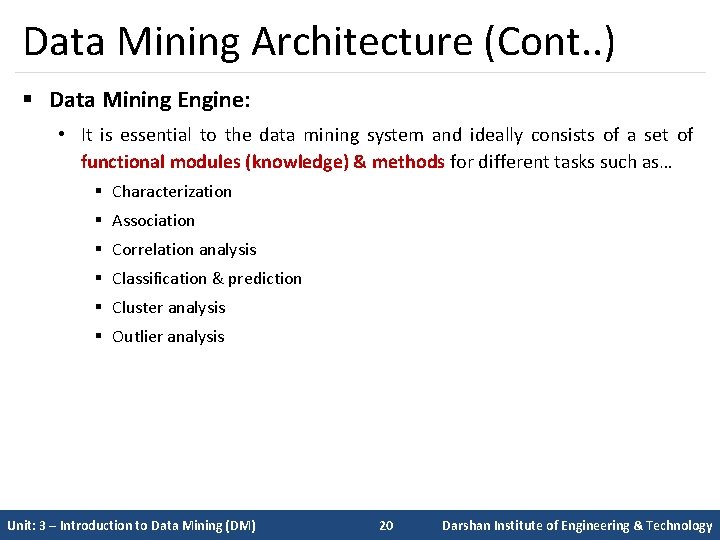
Data Mining Architecture (Cont. . ) § Data Mining Engine: • It is essential to the data mining system and ideally consists of a set of functional modules (knowledge) & methods for different tasks such as… § Characterization § Association § Correlation analysis § Classification & prediction § Cluster analysis § Outlier analysis Unit: 3 – Introduction to Data Mining (DM) 20 Darshan Institute of Engineering & Technology
Data Mining Architecture (Cont. . ) § Pattern Evaluation Module: • This component typically employs interestingness measures and interacts with the data mining modules so it is focus in the search towards interesting patterns. • The pattern evaluation module integrated with the mining module, depending on the implementation of the data mining method used. Unit: 3 – Introduction to Data Mining (DM) 21 Darshan Institute of Engineering & Technology
Data Mining Architecture (Cont. . ) § Knowledge base: • Knowledge base is the domain knowledge that is used to guide the search or evaluate the interestingness of resulting patterns. • Such knowledge can include concept hierarchies, used to organize attributes or attribute values into different levels of abstraction. • Knowledge is such as user beliefs, which can be used to assess a pattern’s interestingness based on its unexpectedness, may also be included. Unit: 3 – Introduction to Data Mining (DM) 22 Darshan Institute of Engineering & Technology
KDD (Knowledge Discovery in Databases) Process § Knowledge discovery in databases is a process of an iterative sequence of the following steps: 1. Selection 2. Preprocessing 3. Transformation 4. Data Mining 5. Pattern Evaluation 6. User Interface (Visualization of Pattern or Knowledge) Unit: 3 – Introduction to Data Mining (DM) 23 Darshan Institute of Engineering & Technology
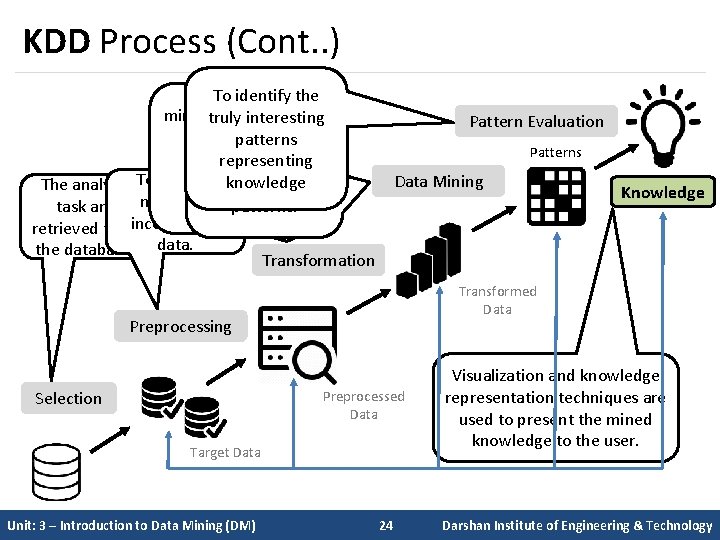
KDD Process (Cont. . ) Appropriate forthe To identify miningtruly by. Intelligent performing interesting summary orare patterns methods aggregation representing applied in order operations, The analysis To remove toknowledge extractfor data task are noise andinstance. patterns. retrieved frominconsistent the database. data. Transformation Pattern Evaluation Patterns Data Mining Transformed Data Preprocessing Preprocessed Data Selection Target Data Unit: 3 – Introduction to Data Mining (DM) Knowledge 24 Visualization and knowledge representation techniques are used to present the mined knowledge to the user. Darshan Institute of Engineering & Technology
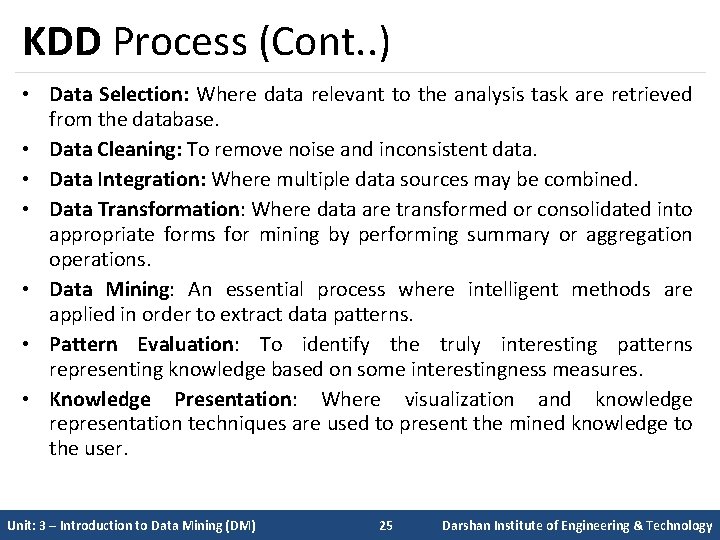
KDD Process (Cont. . ) • Data Selection: Where data relevant to the analysis task are retrieved from the database. • Data Cleaning: To remove noise and inconsistent data. • Data Integration: Where multiple data sources may be combined. • Data Transformation: Where data are transformed or consolidated into appropriate forms for mining by performing summary or aggregation operations. • Data Mining: An essential process where intelligent methods are applied in order to extract data patterns. • Pattern Evaluation: To identify the truly interesting patterns representing knowledge based on some interestingness measures. • Knowledge Presentation: Where visualization and knowledge representation techniques are used to present the mined knowledge to the user. Unit: 3 – Introduction to Data Mining (DM) 25 Darshan Institute of Engineering & Technology
Data Mining Issues § Data mining issues can be classified into five categories: 1. Mining Methodology 2. User Interaction 3. Efficiency and Scalability 4. Diversity of Database Types 5. Data Mining and Society Unit: 3 – Introduction to Data Mining (DM) 26 Darshan Institute of Engineering & Technology
1) Mining Methodology § Mining various and new kinds of knowledge • Data mining covers a wide spectrum of data analysis and knowledge discovery tasks, so these tasks may use the same database in different ways and require the development of numerous data mining techniques. § Mining knowledge in multidimensional space • When searching for knowledge in large data sets, we can explore the data in multidimensional space. • That is, we can search for interesting patterns among combinations of dimensions (attributes) at varying levels of abstraction. Such mining is known as (exploratory) multidimensional data mining. Unit: 3 – Introduction to Data Mining (DM) 27 Darshan Institute of Engineering & Technology
1) Mining Methodology (Cont. . ) § Data mining—an interdisciplinary effort • The power of data mining can be substantially enhanced by integrating new methods from multiple disciplines. • For example, to mine data with natural language text, it makes sense to fuse data mining methods of information retrieval and natural language processing. § Handling uncertainty, noise, or incompleteness of data • Data often contain noise, errors, exceptions, uncertainty or incomplete. • Errors and noise may confuse the data mining process, leading to the derivation of erroneous patterns. Unit: 3 – Introduction to Data Mining (DM) 28 Darshan Institute of Engineering & Technology
2) User Interaction § Interactive mining • The data mining process should be highly interactive. Thus, it is important to build flexible user interfaces and an exploratory mining environment, facilitating the user’s interaction with the system. § Incorporation of background knowledge • Background knowledge, constraints, rules, and other information regarding the domain under study should be incorporated into the knowledge discovery process. § Presentation and visualization of data mining results • How any system can present data mining results, vividly(clear image in mind) and flexibly ? , so that the discovered knowledge can be easily understood and directly usable by humans. Unit: 3 – Introduction to Data Mining (DM) 29 Darshan Institute of Engineering & Technology
3) Efficiency and Scalability § Efficiency and scalability of data mining algorithms • Data mining algorithms must be efficient and scalable in order to effectively extract information from huge amounts of data lies in many data repositories or in dynamic data streams. • In other words, the running time of a data mining algorithm must be predictable, short, and acceptable by applications. • Efficiency, scalability, performance, optimization, and the ability to execute in real time are key criteria for new mining algorithms. § Parallel, distributed, and incremental mining algorithms • The giant size of many data sets, the wide distribution of data, and the computational complexity of some data mining methods are factors that motivate the development of parallel and distributed data-intensive mining algorithms. Unit: 3 – Introduction to Data Mining (DM) 30 Darshan Institute of Engineering & Technology
4) Diversity of Database Types § Handling complex types of data • Data mining is how to uncover knowledge from stream, time-series, sequence, graph, social network, and multirelational data. • In mining various types of attributes are available and also different types of data in database or dataset. § Mining dynamic, networked, and global data repositories • Data from multiple sources are connected by the Internet and various kinds of networks like distributed and heterogeneous global information systems. • The discovery of knowledge from different sources of structured, semistructured, or unstructured challengeable. • Web Mining, multisource data mining and information network mining have become challenging and fast-evolving data mining fields. Unit: 3 – Introduction to Data Mining (DM) 31 Darshan Institute of Engineering & Technology
5) Data Mining and Society § Social impacts of data mining • With data mining penetrating our everyday lives, it is important to study the impact of data mining on society, How can we used at a mining technology to benefit our society? How can we guard against its misuse? § Privacy-preserving data mining • Data mining will help in scientific discovery, business management, economy recovery, and security protection (e. g. , the real-time discovery of intruders and cyber attacks). • However, it poses the risk of disclosing an individual’s personal information. § Invisible data mining • We cannot expect everyone in society to learn and master in data mining techniques. • For example, when purchasing items online, users may be unaware that the store is likely collecting data on the buying patterns of its customers, which may be used to recommend other items for purchase in the future. Unit: 3 – Introduction to Data Mining (DM) 32 Darshan Institute of Engineering & Technology

- Slides: 33