
213 User Interface Design and Development History of
![“[W]e use the same methods, we study the same things, but we do it](https://slidetodoc.com/presentation_image_h/35fb8cf2632caa1b62414200418140e1/image-36.jpg "“[W]e use the same methods, we study the same things, but we do it")
- Slides: 45
213: User Interface Design and Development History of HCI Adapted from a talk by Jonathan Grudin (jgrudin@microsoft. com) Lecture #13 - April 21 st, 2009
Is HCI a Discipline? Dedicated conferences, journals and associations emerged in 70 s and 80 s Hasn’t coalesced as a coherent discipline Includes researchers from CS, ISchools, Human Factors and Ergonomics, Information Systems, Cognitive Science, Psychology, Sociology, Industrial Engineering, Design, Art, etc.
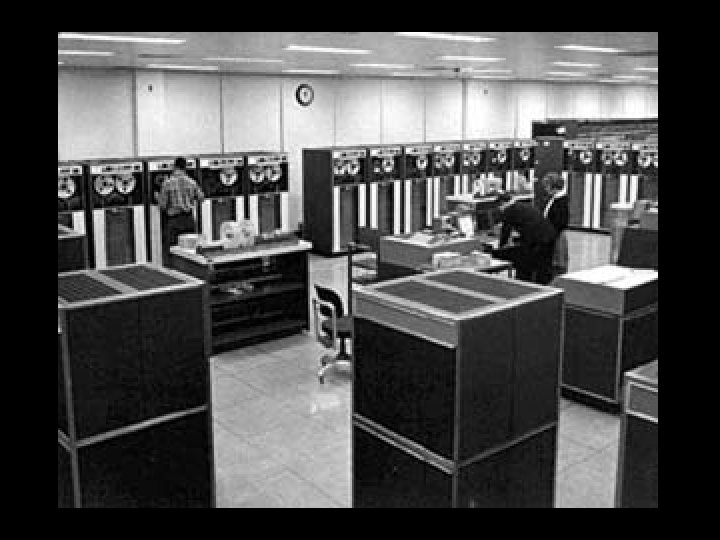
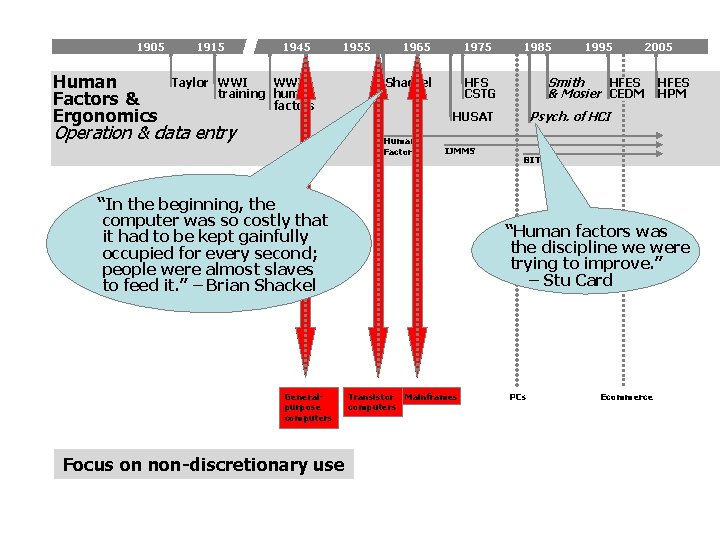
“In the beginning the computer was so costly that it had to be kept gainfully occupied for every second; people were almost slaves to feed it. ” -- Brian Shackel
Early Computing Jobs 1) Operation 2) Management 3) Programming
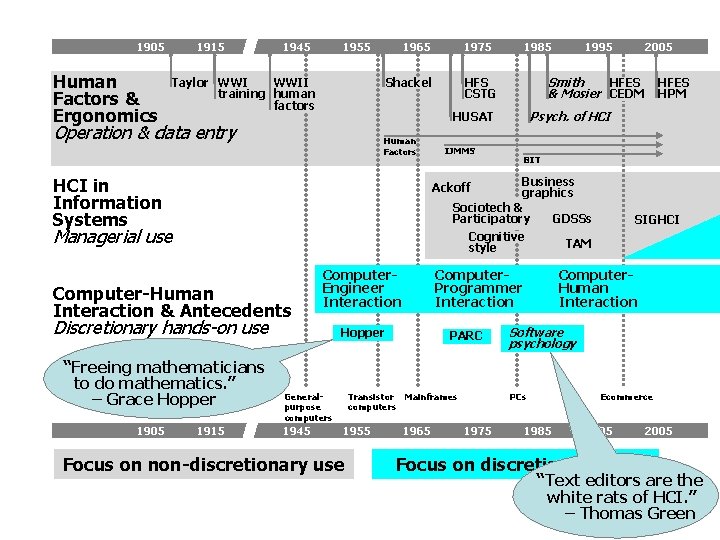
Human Factors & Ergonomics HF&E originated after WWI / WWII, for studying performance of fighter pilots Operators were first hands-on users Research was on reducing training time, improving efficiency, and reducing the number of errors – Improving the design of console buttons, switches, displays, …
“The computer industry will be forced to become increasingly concerned with the usage of people, rather then with the computer’s intestines. ” -- James Martin Design of Man-Computer Dialogues (1973)
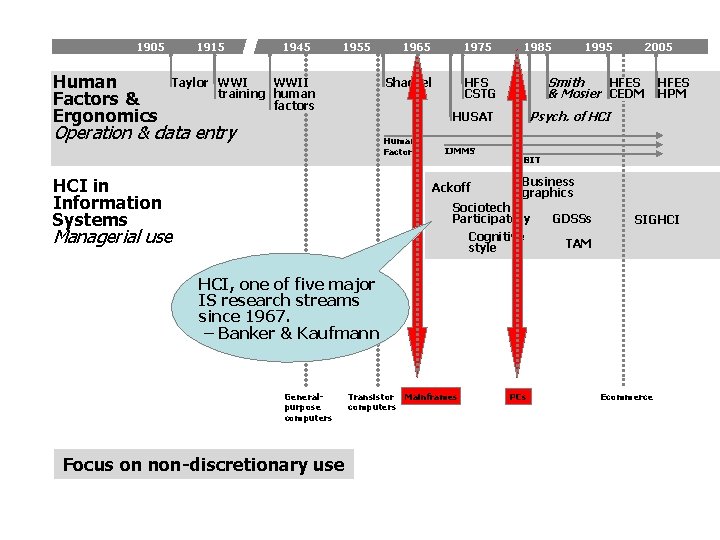
Information Systems Increased affordability of mainframes (and later mini/micro-computers), led to business use of computers Emergence of Information Systems, within schools of Management, focused on improving management decision-making HCI was one of early research themes
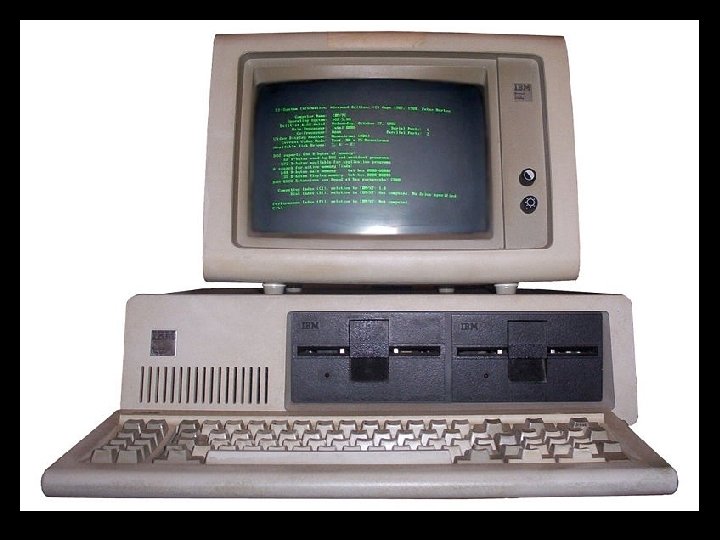
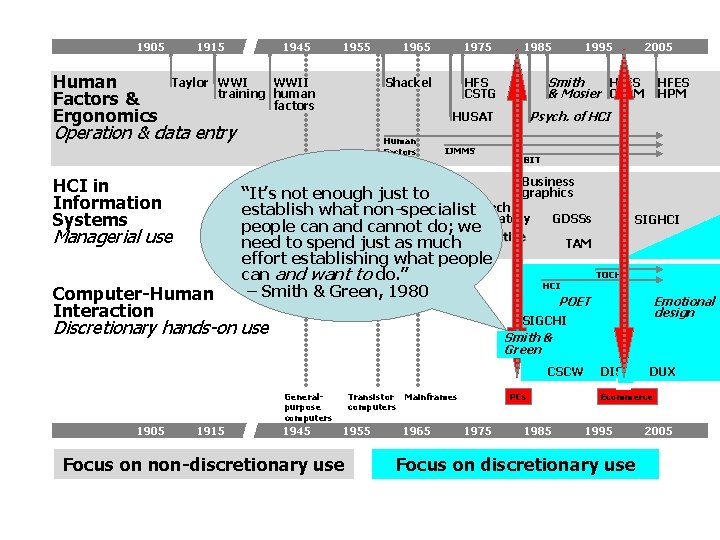
Computer-Human Interaction With the emergence of IBM PC in the early 1980 s, computers began to be used by ordinary people, and not as part of their jobs Many initial users were programmers Early researchers had a background in Cognitive Psychology (including Card, Moran, Newell, Norman and others)
“It’s not enough just to establish what people can and cannot do; we need to spend just as much effort establishing what people can and want to do” -- Smith & Green Human Interaction with Computers (1980)
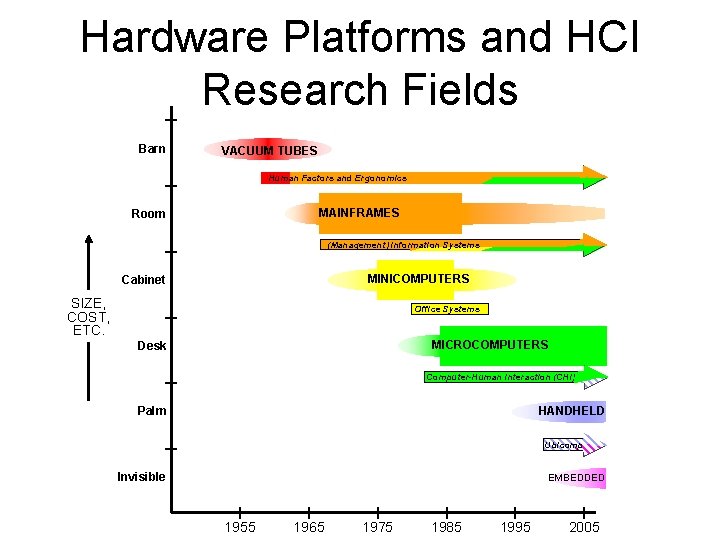
Hardware Platforms and HCI Research Fields Barn VACUUM TUBES Human Factors and Ergonomics MAINFRAMES Room (Management) Information Systems MINICOMPUTERS Cabinet SIZE, COST, ETC. Office Systems MICROCOMPUTERS Desk Computer-Human Interaction (CHI) Palm HANDHELD Ubicomp Invisible EMBEDDED 1955 1965 1975 1985 1995 2005
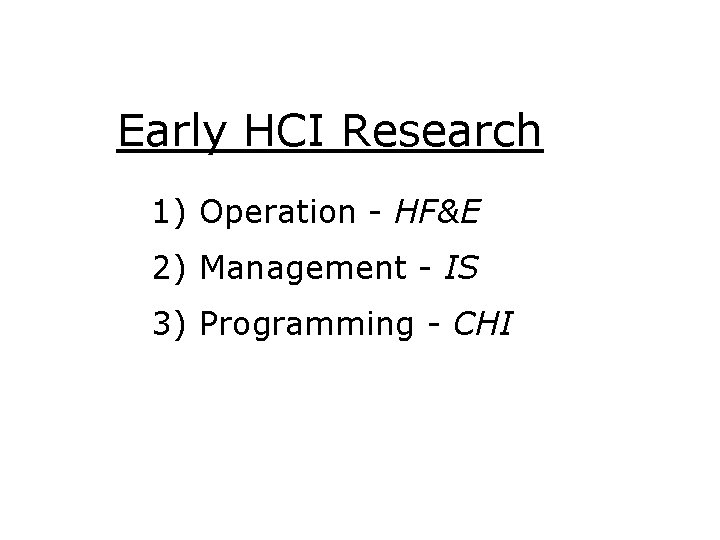
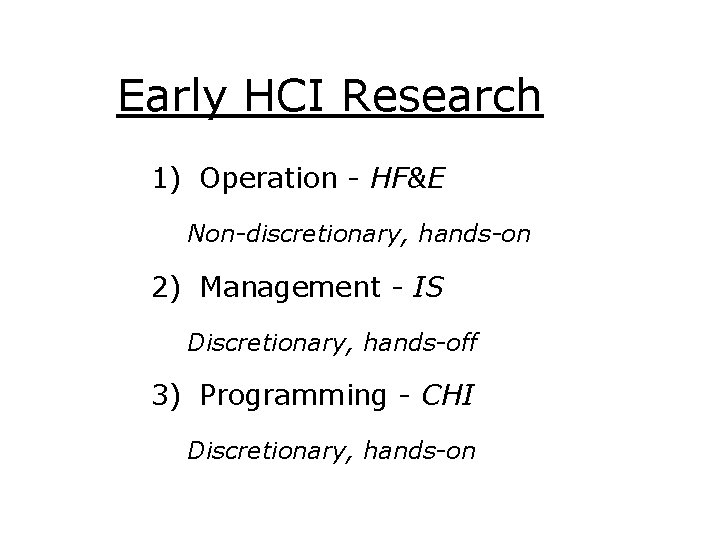
Early HCI Research 1) Operation - HF&E 2) Management - IS 3) Programming - CHI
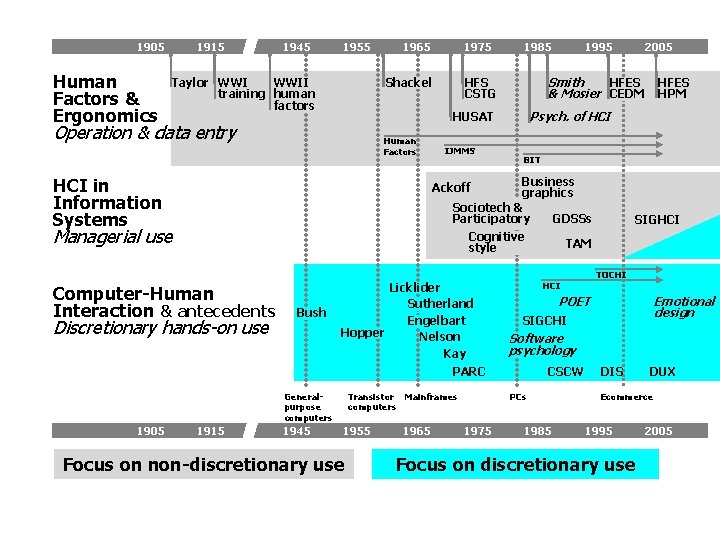
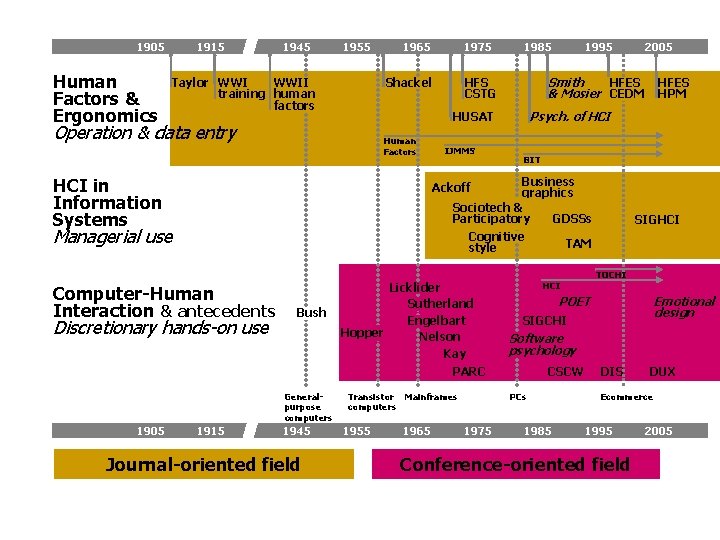
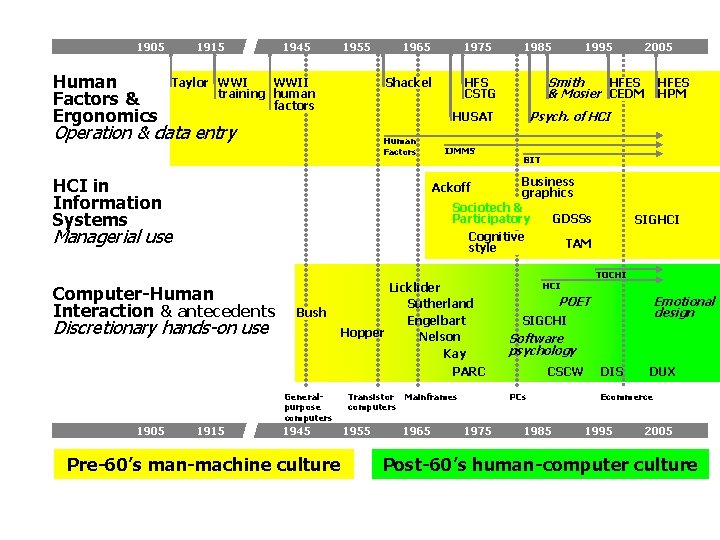
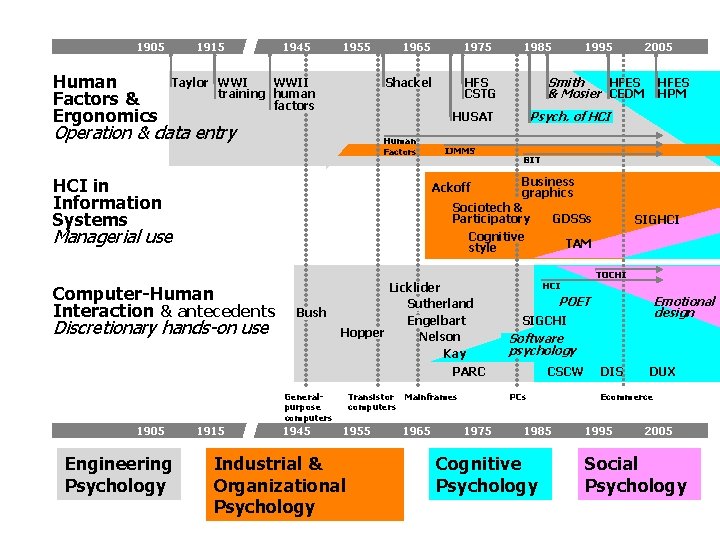
1905 Human Factors & Ergonomics 1915 1945 1955 Taylor WWII training human factors Operation & data entry 1965 1975 Shackel IJMMS “In the beginning, the computer was so costly that it had to be kept gainfully occupied for every second; people were almost slaves to feed it. ” – Brian Shackel Focus on non-discretionary use 1995 2005 Smith HFES & Mosier CEDM HFS CSTG HFES HPM Psych. of HCI HUSAT Human Factors Generalpurpose computers 1985 BIT “Human factors was the discipline we were trying to improve. ” – Stu Card Transistor Mainframes computers PCs Ecommerce
1905 Human Factors & Ergonomics 1915 1945 1955 Taylor WWII training human factors 1965 1975 Shackel 1985 Human Factors IJMMS HFES HPM Psych. of HCI BIT Business graphics Sociotech & GDSSs Participatory Cognitive TAM style HCI in Information Systems 2005 Smith HFES & Mosier CEDM HFS CSTG HUSAT Operation & data entry 1995 Ackoff Managerial use SIGHCI HCI, one of five major IS research streams since 1967. – Banker & Kaufmann Generalpurpose computers Focus on non-discretionary use Transistor Mainframes computers PCs Ecommerce
1905 Human Factors & Ergonomics 1915 1945 1955 Taylor WWII training human factors 1965 1975 Shackel 1985 Human Factors IJMMS HFES HPM Psych. of HCI BIT Business HCI in Information Systems Managerial use Computer-Human Interaction graphics “It’s not enough just to Ackoff Sociotech & establish what non-specialist GDSSs Participatory people can and cannot do; we need to spend just as much TAM effort establishing what people TOCHI can and want to do. ” HCI – Smith & Green, 1980 Emotional design SIGCHI Smith & Green CSCW Generalpurpose computers 1915 SIGHCI POET Discretionary hands-on use 1905 2005 Smith HFES & Mosier CEDM HFS CSTG HUSAT Operation & data entry 1995 1945 Transistor Mainframes computers 1955 Focus on non-discretionary use 1965 PCs 1975 1985 DIS DUX Ecommerce 1995 Focus on discretionary use 2005
1905 Human Factors & Ergonomics 1915 1945 1965 1955 Taylor WWII training human factors Shackel Human Factors 1995 HFES HPM Psych. of HCI IJMMS BIT Business graphics Sociotech & GDSSs Participatory Cognitive TAM style HCI in Information Systems 2005 Smith HFES & Mosier CEDM HFS CSTG HUSAT Operation & data entry Ackoff Managerial use Computer-Human Interaction & Antecedents Computer. Engineer Interaction Discretionary hands-on use “Freeing mathematicians to do mathematics. ” – Grace Hopper 1905 1985 1975 1915 Computer. Programmer Interaction Hopper Generalpurpose computers 1945 PARC Transistor Mainframes computers 1955 Focus on non-discretionary use 1965 Computer. Human Interaction Software psychology PCs 1975 SIGHCI Ecommerce 1985 1995 Focus on discretionary use 2005 “Text editors are the white rats of HCI. ” – Thomas Green
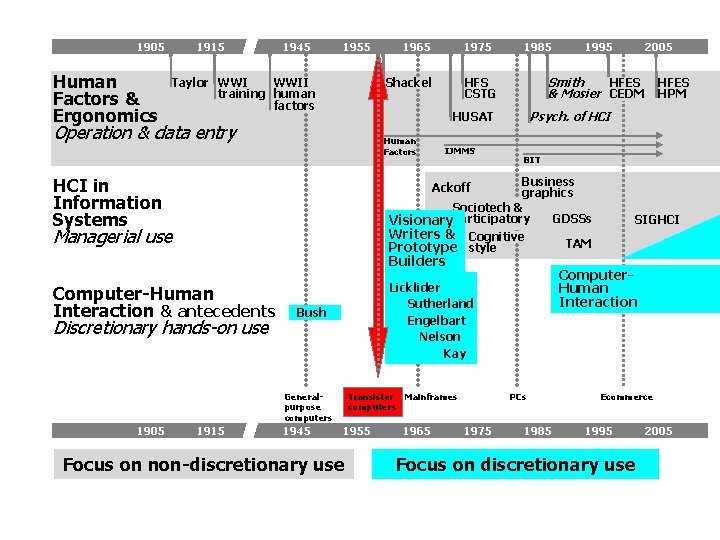
1905 Human Factors & Ergonomics 1915 1945 1955 Taylor WWII training human factors 1965 1975 Shackel 1985 Human Factors IJMMS BIT Ackoff Managerial use Builders Computer-Human Interaction & antecedents Discretionary hands-on use Bush 1915 1945 Transistor Mainframes computers 1955 Focus on non-discretionary use 1965 PCs 1975 SIGHCI Computer. Human Interaction Licklider Sutherland Engelbart Nelson Kay Generalpurpose computers 1905 HFES HPM Psych. of HCI Business graphics Sociotech & GDSSs Visionary. Participatory Writers & Cognitive TAM Prototype style HCI in Information Systems 2005 Smith HFES & Mosier CEDM HFS CSTG HUSAT Operation & data entry 1995 1985 Ecommerce 1995 Focus on discretionary use 2005
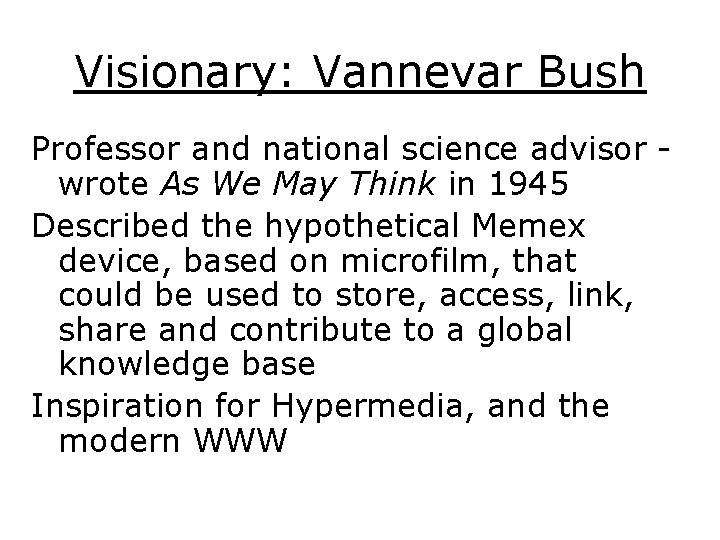
Visionary: Vannevar Bush Professor and national science advisor wrote As We May Think in 1945 Described the hypothetical Memex device, based on microfilm, that could be used to store, access, link, share and contribute to a global knowledge base Inspiration for Hypermedia, and the modern WWW
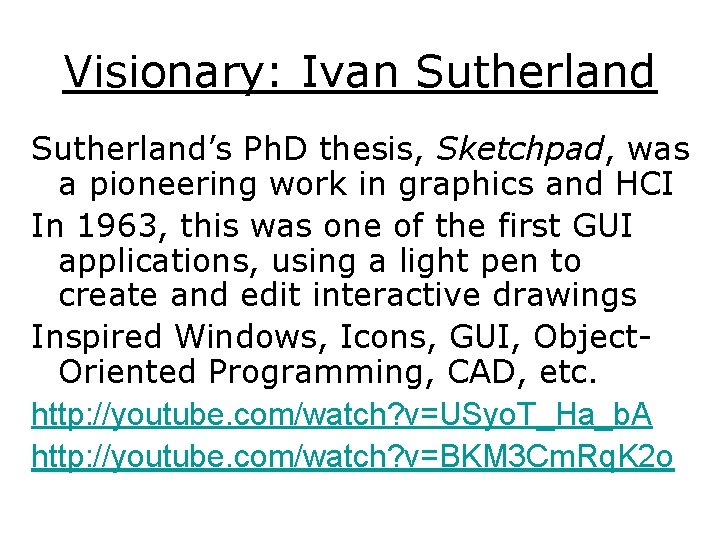
Visionary: Ivan Sutherland’s Ph. D thesis, Sketchpad, was a pioneering work in graphics and HCI In 1963, this was one of the first GUI applications, using a light pen to create and edit interactive drawings Inspired Windows, Icons, GUI, Object. Oriented Programming, CAD, etc. http: //youtube. com/watch? v=USyo. T_Ha_b. A http: //youtube. com/watch? v=BKM 3 Cm. Rq. K 2 o
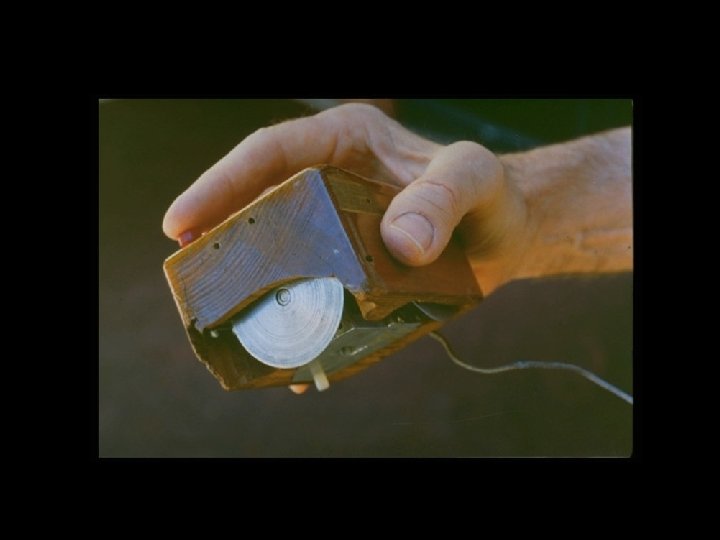
Visionary: Douglas Engelbart’s revolutionary 1968 demo (the mother of all demos) demonstrated the computer mouse, integrated text, graphics and video; real-time video conferencing, windowing, and the ancestors of email and word processing http: //www. youtube. com/view_play_list? p=341 5 B 231 F 8 D 760 C 2
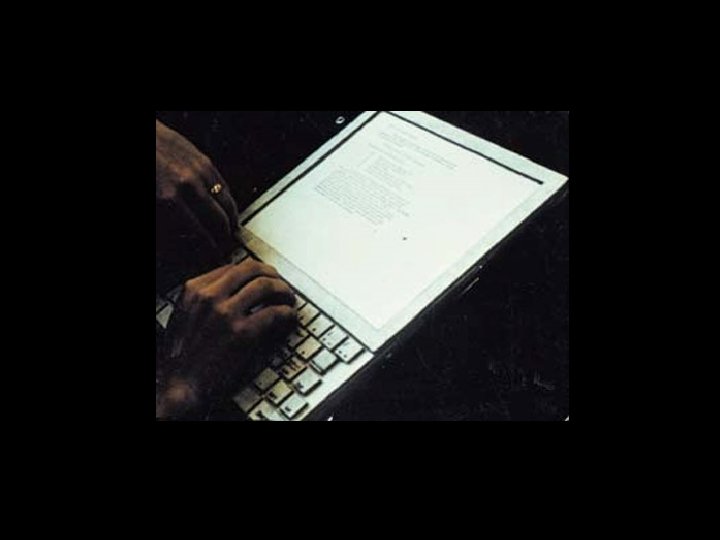
Visionary: Alan Kay Advised by Sutherland at the University of Utah, and later working at Xerox PARC, Alan Kay worked on the first GUI with overlapping windows, and developed the Smalltalk objectoriented programming language His vision for the Dynabook (1968) presaged modern laptop and tablet computers
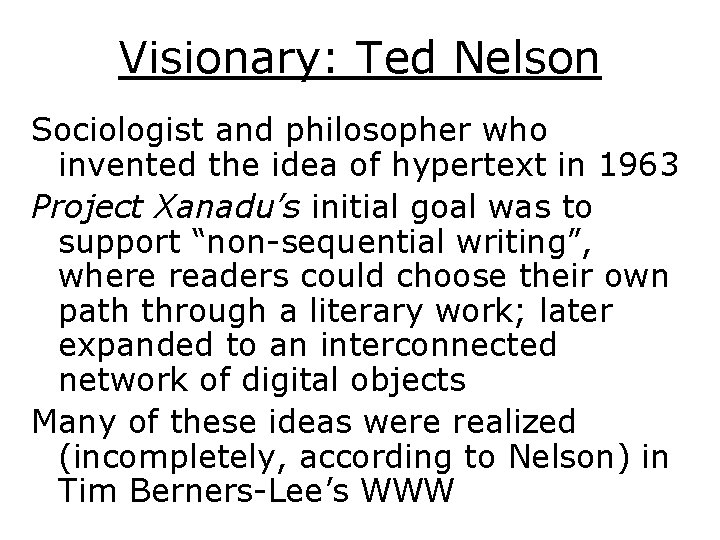
Visionary: Ted Nelson Sociologist and philosopher who invented the idea of hypertext in 1963 Project Xanadu’s initial goal was to support “non-sequential writing”, where readers could choose their own path through a literary work; later expanded to an interconnected network of digital objects Many of these ideas were realized (incompletely, according to Nelson) in Tim Berners-Lee’s WWW
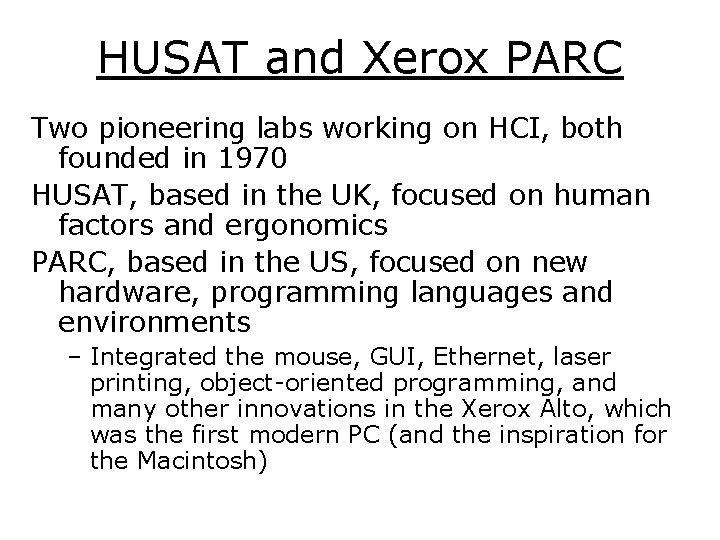
HUSAT and Xerox PARC Two pioneering labs working on HCI, both founded in 1970 HUSAT, based in the UK, focused on human factors and ergonomics PARC, based in the US, focused on new hardware, programming languages and environments – Integrated the mouse, GUI, Ethernet, laser printing, object-oriented programming, and many other innovations in the Xerox Alto, which was the first modern PC (and the inspiration for the Macintosh)
1905 Human Factors & Ergonomics 1915 1945 1955 Taylor WWII training human factors 1965 1975 Shackel 1985 Human Factors IJMMS HFES HPM Psych. of HCI BIT Business graphics Sociotech & GDSSs Participatory Cognitive TAM style HCI in Information Systems 2005 Smith HFES & Mosier CEDM HFS CSTG HUSAT Operation & data entry 1995 Ackoff Managerial use SIGHCI TOCHI Computer-Human Interaction & antecedents Discretionary hands-on use Bush Licklider Sutherland Engelbart Hopper Nelson Kay PARC Generalpurpose computers 1905 1915 1945 Transistor Mainframes computers 1955 Focus on non-discretionary use 1965 HCI POET SIGCHI Software psychology CSCW PCs 1975 Emotional design 1985 DIS DUX Ecommerce 1995 Focus on discretionary use 2005
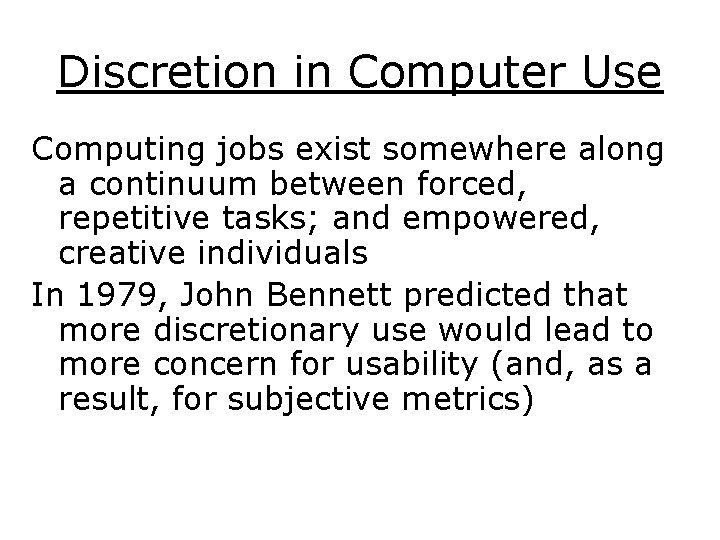
Discretion in Computer Use Computing jobs exist somewhere along a continuum between forced, repetitive tasks; and empowered, creative individuals In 1979, John Bennett predicted that more discretionary use would lead to more concern for usability (and, as a result, for subjective metrics)
Early HCI Research 1) Operation - HF&E Non-discretionary, hands-on 2) Management - IS Discretionary, hands-off 3) Programming - CHI Discretionary, hands-on
1905 Human Factors & Ergonomics 1915 1945 1955 Taylor WWII training human factors 1965 1975 Shackel 1985 Human Factors IJMMS HFES HPM Psych. of HCI BIT Business graphics Sociotech & GDSSs Participatory Cognitive TAM style HCI in Information Systems 2005 Smith HFES & Mosier CEDM HFS CSTG HUSAT Operation & data entry 1995 Ackoff Managerial use SIGHCI TOCHI Computer-Human Interaction & antecedents Discretionary hands-on use Bush Generalpurpose computers 1905 1915 1945 Journal-oriented field Licklider Sutherland Engelbart Hopper Nelson Kay PARC Transistor Mainframes computers 1955 1965 HCI POET SIGCHI Software psychology CSCW PCs 1975 Emotional design 1985 DIS DUX Ecommerce 1995 Conference-oriented field 2005
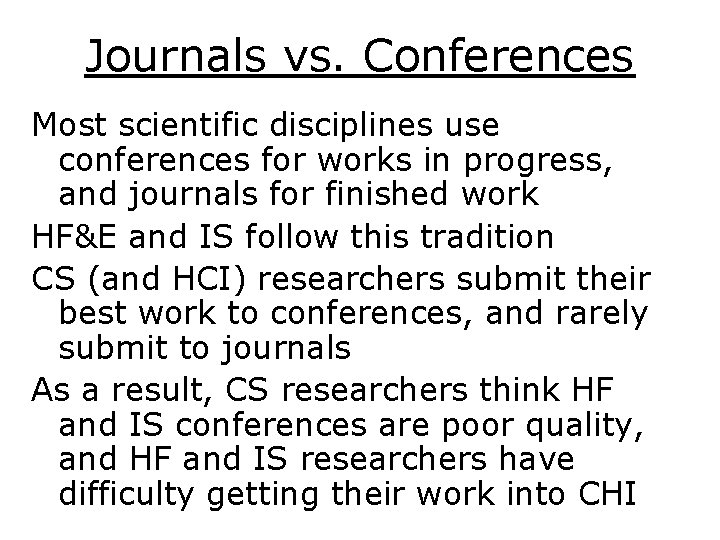
Journals vs. Conferences Most scientific disciplines use conferences for works in progress, and journals for finished work HF&E and IS follow this tradition CS (and HCI) researchers submit their best work to conferences, and rarely submit to journals As a result, CS researchers think HF and IS conferences are poor quality, and HF and IS researchers have difficulty getting their work into CHI
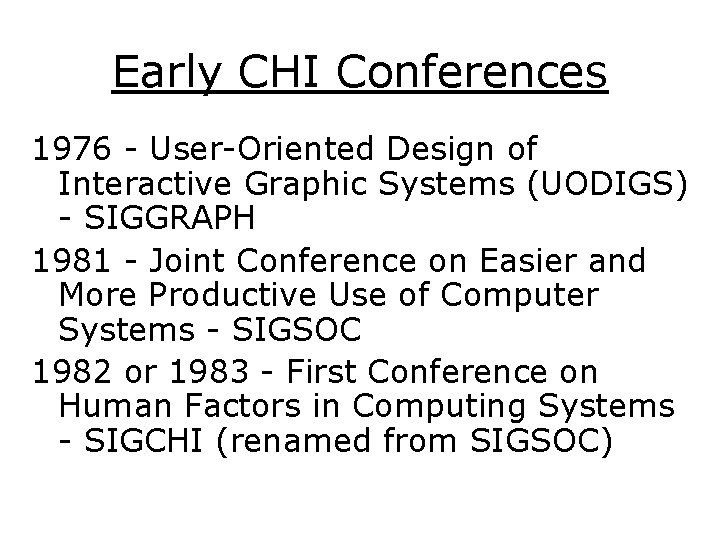
Early CHI Conferences 1976 - User-Oriented Design of Interactive Graphic Systems (UODIGS) - SIGGRAPH 1981 - Joint Conference on Easier and More Productive Use of Computer Systems - SIGSOC 1982 or 1983 - First Conference on Human Factors in Computing Systems - SIGCHI (renamed from SIGSOC)
1905 Human Factors & Ergonomics 1915 1945 1955 Taylor WWII training human factors 1965 1975 Shackel 1985 Human Factors IJMMS HFES HPM Psych. of HCI BIT Business graphics Sociotech & GDSSs Participatory Cognitive TAM style HCI in Information Systems 2005 Smith HFES & Mosier CEDM HFS CSTG HUSAT Operation & data entry 1995 Ackoff Managerial use SIGHCI TOCHI Computer-Human Interaction & antecedents Discretionary hands-on use Bush Generalpurpose computers 1905 1915 1945 Pre-60’s man-machine culture Licklider Sutherland Engelbart Hopper Nelson Kay PARC Transistor Mainframes computers 1955 1965 HCI POET SIGCHI Software psychology CSCW PCs 1975 Emotional design 1985 DIS DUX Ecommerce 1995 2005 Post-60’s human-computer culture
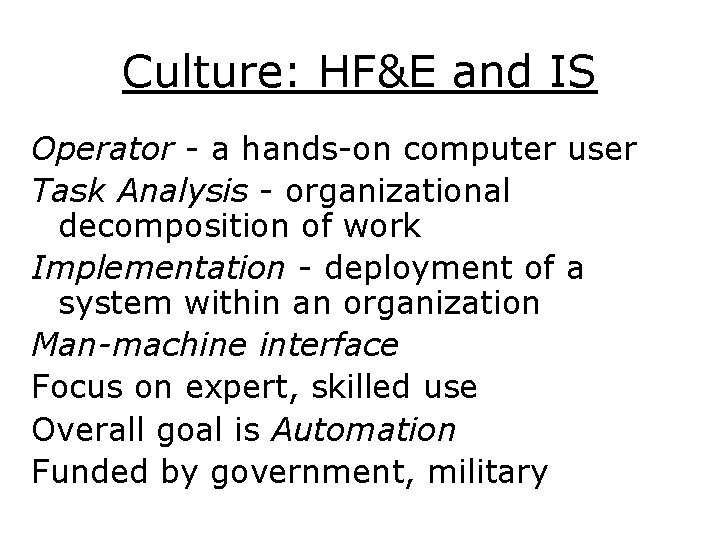
Culture: HF&E and IS Operator - a hands-on computer user Task Analysis - organizational decomposition of work Implementation - deployment of a system within an organization Man-machine interface Focus on expert, skilled use Overall goal is Automation Funded by government, military
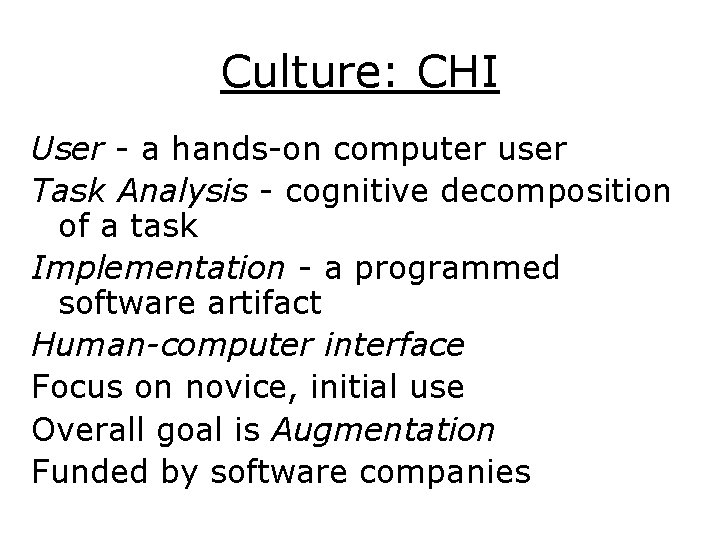
Culture: CHI User - a hands-on computer user Task Analysis - cognitive decomposition of a task Implementation - a programmed software artifact Human-computer interface Focus on novice, initial use Overall goal is Augmentation Funded by software companies
“[W]e use the same methods, we study the same things, but we do it to get new ideas, and they do it to improve what already exists. ” -- Edie Adams speaking from the CHI perspective
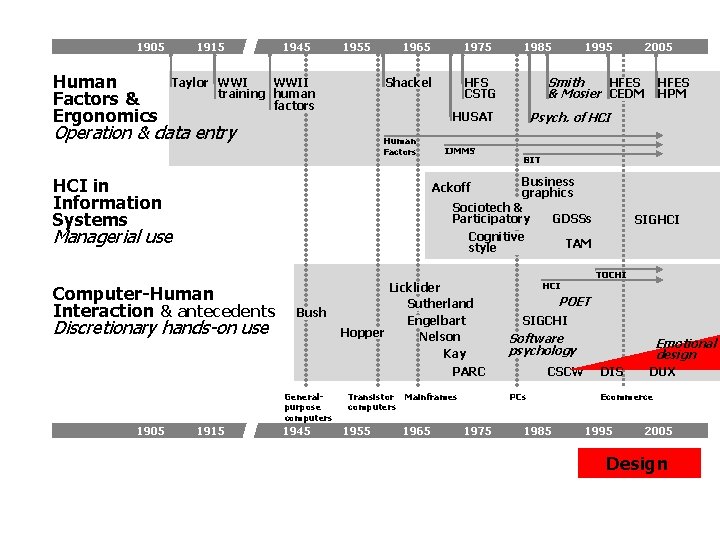
1905 Human Factors & Ergonomics 1915 1945 1955 Taylor WWII training human factors 1965 1975 Shackel 1985 Human Factors IJMMS HFES HPM Psych. of HCI BIT Business graphics Sociotech & GDSSs Participatory Cognitive TAM style HCI in Information Systems 2005 Smith HFES & Mosier CEDM HFS CSTG HUSAT Operation & data entry 1995 Ackoff Managerial use SIGHCI TOCHI Computer-Human Interaction & antecedents Discretionary hands-on use Bush Generalpurpose computers 1905 1915 1945 Licklider Sutherland Engelbart Hopper Nelson Kay PARC Transistor Mainframes computers 1955 1965 HCI POET SIGCHI Software psychology CSCW PCs 1975 1985 Emotional design DIS DUX Ecommerce 1995 2005 Design
CS and HCI Post-Mac, CHI began focusing on GUIs – Needed programmers (CS researchers) to explore the design space – More emphasis on quick-and-dirty lab studies, and qualitative methods – Assimilated history of CS visionaries Cognitive approaches (KLM, GOMS, etc. ), focused on expert use, eventually merged back with HF&E CHI became user-centered, iterative, prototype-based design (Gould and Lewis, 1983)
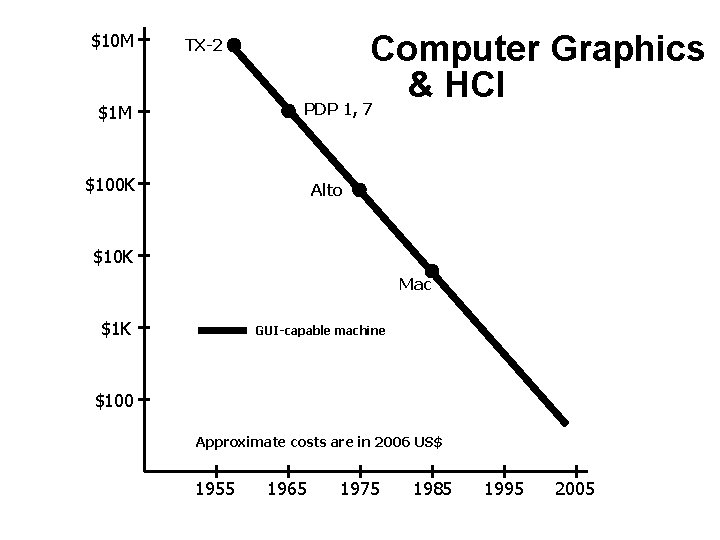
$10 M Computer Graphics & HCI TX-2 PDP 1, 7 $1 M $100 K Alto $10 K Mac $1 K GUI-capable machine $100 Approximate costs are in 2006 US$ 1955 1965 1975 1985 1995 2005
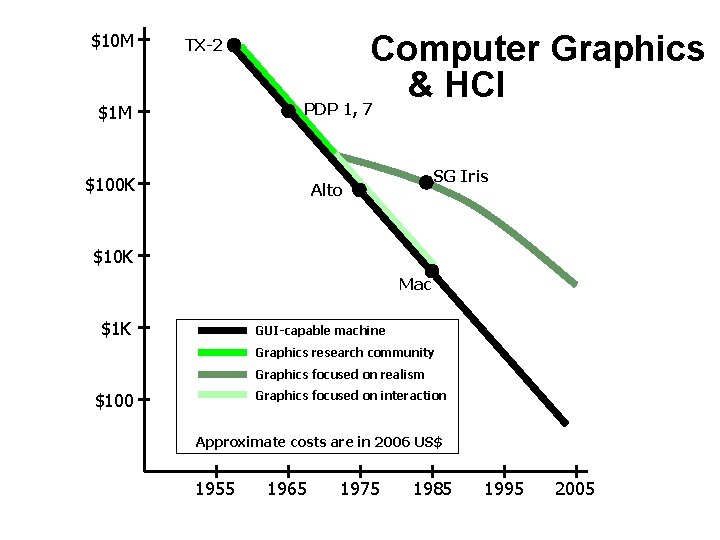
$10 M Computer Graphics & HCI TX-2 PDP 1, 7 $1 M $100 K SG Iris Alto $10 K Mac $1 K GUI-capable machine Graphics research community Graphics focused on realism Graphics focused on interaction $100 Approximate costs are in 2006 US$ 1955 1965 1975 1985 1995 2005
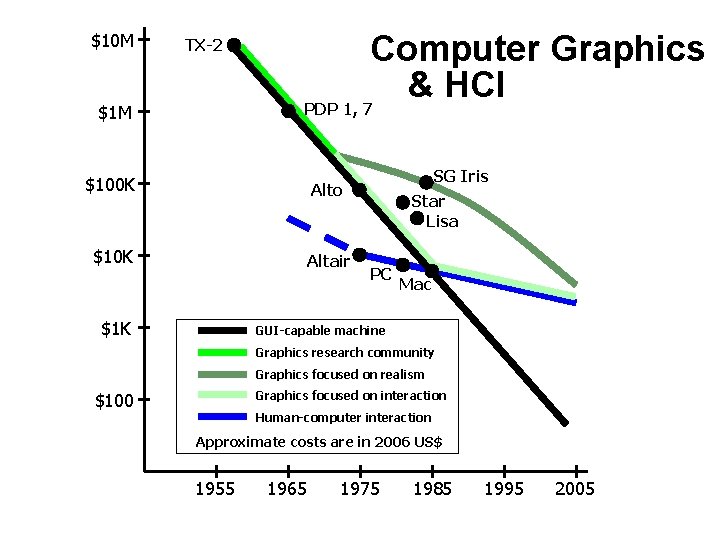
$10 M Computer Graphics & HCI TX-2 PDP 1, 7 $1 M $100 K Alto $10 K Altair $1 K SG Iris Star Lisa PC Mac GUI-capable machine Graphics research community Graphics focused on realism Graphics focused on interaction $100 Human-computer interaction Approximate costs are in 2006 US$ 1955 1965 1975 1985 1995 2005
1905 Human Factors & Ergonomics 1915 1945 1955 Taylor WWII training human factors 1965 1975 Shackel 1985 Human Factors IJMMS HFES HPM Psych. of HCI BIT Business graphics Sociotech & GDSSs Participatory Cognitive TAM style HCI in Information Systems 2005 Smith HFES & Mosier CEDM HFS CSTG HUSAT Operation & data entry 1995 Ackoff Managerial use SIGHCI TOCHI Computer-Human Interaction & antecedents Discretionary hands-on use Bush Licklider Sutherland Engelbart Hopper Nelson Kay PARC Generalpurpose computers 1905 Engineering Psychology 1915 1945 Transistor Mainframes computers 1955 Industrial & Organizational Psychology 1965 HCI POET SIGCHI Software psychology CSCW PCs 1975 Emotional design 1985 Cognitive Psychology DIS DUX Ecommerce 1995 2005 Social Psychology
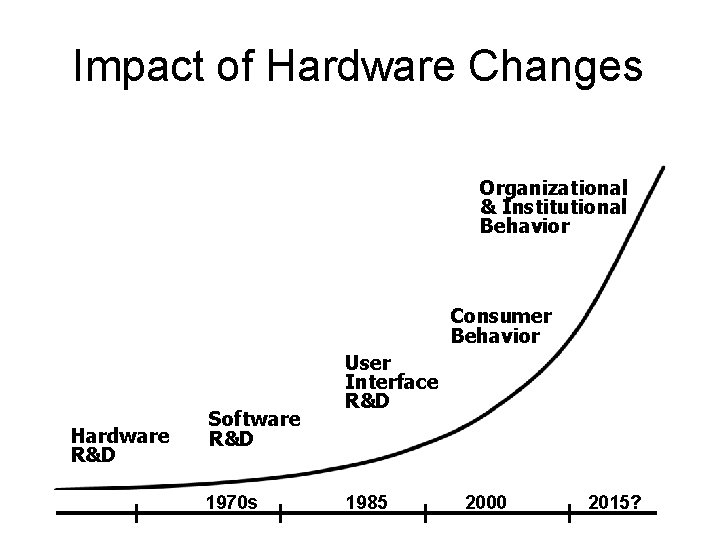
Impact of Hardware Changes Organizational & Institutional Behavior Consumer Behavior Hardware R&D Software R&D 1970 s User Interface R&D 1985 2000 2015?
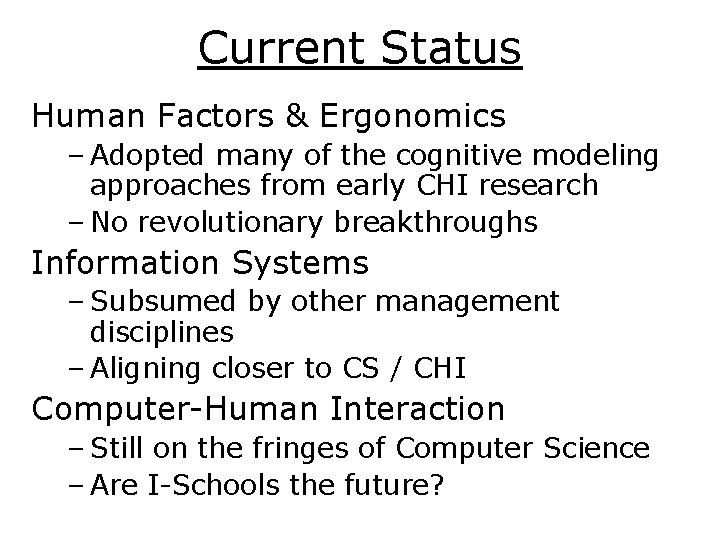
Current Status Human Factors & Ergonomics – Adopted many of the cognitive modeling approaches from early CHI research – No revolutionary breakthroughs Information Systems – Subsumed by other management disciplines – Aligning closer to CS / CHI Computer-Human Interaction – Still on the fringes of Computer Science – Are I-Schools the future?
For Next Time Guest lecture by Google team! Come prepared with questions… Continue working on the Final Project!