
21012022 A is for ATOM Evidence for nuclear
- Slides: 29
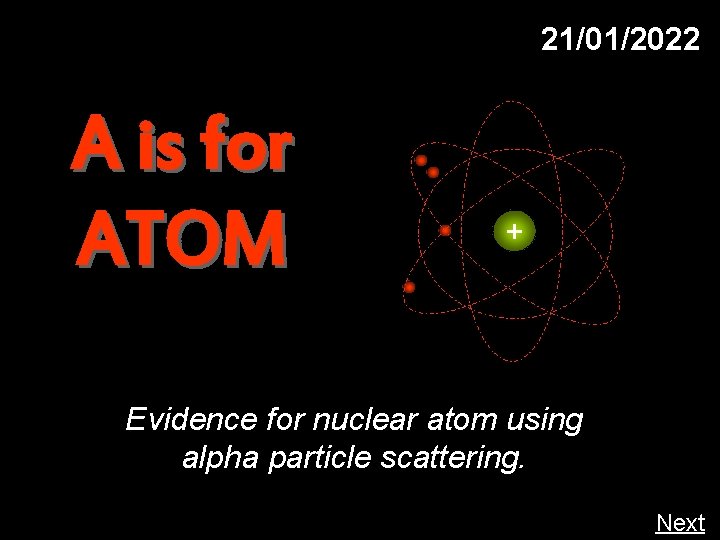
21/01/2022 A is for ATOM + Evidence for nuclear atom using alpha particle scattering. Next
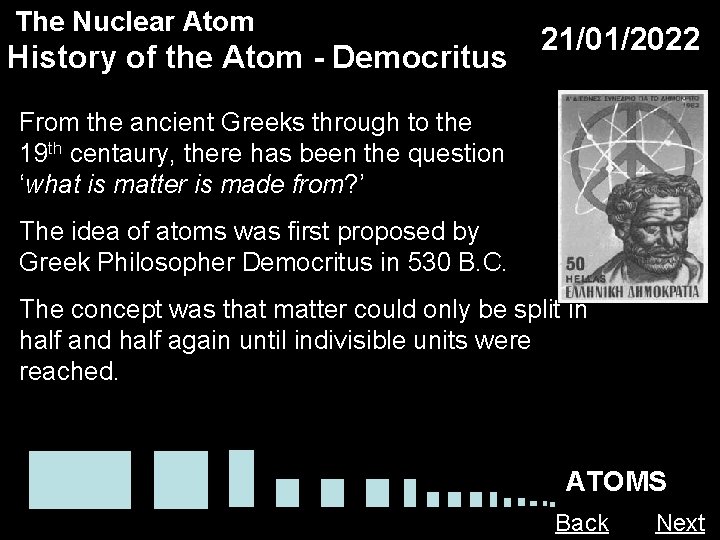
The Nuclear Atom History of the Atom - Democritus 21/01/2022 From the ancient Greeks through to the 19 th centaury, there has been the question ‘what is matter is made from? ’ The idea of atoms was first proposed by Greek Philosopher Democritus in 530 B. C. The concept was that matter could only be split in half and half again until indivisible units were reached. ATOMS Back Next
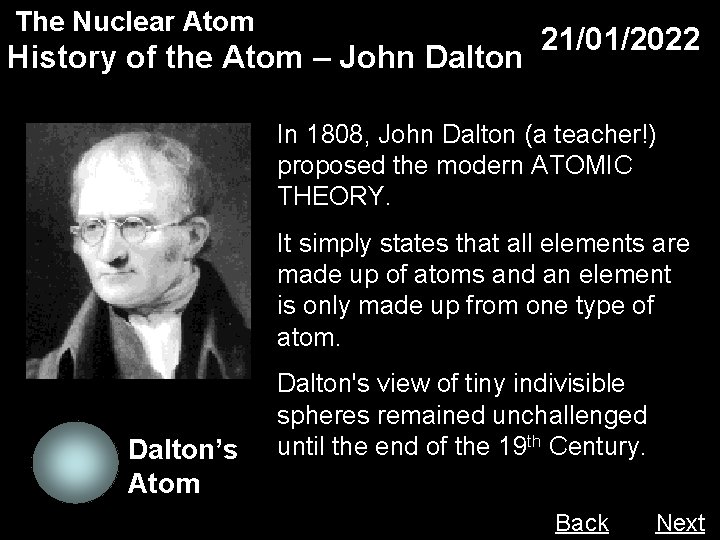
The Nuclear Atom History of the Atom – John Dalton 21/01/2022 In 1808, John Dalton (a teacher!) proposed the modern ATOMIC THEORY. It simply states that all elements are made up of atoms and an element is only made up from one type of atom. Dalton’s Atom Dalton's view of tiny indivisible spheres remained unchallenged until the end of the 19 th Century. Back Next
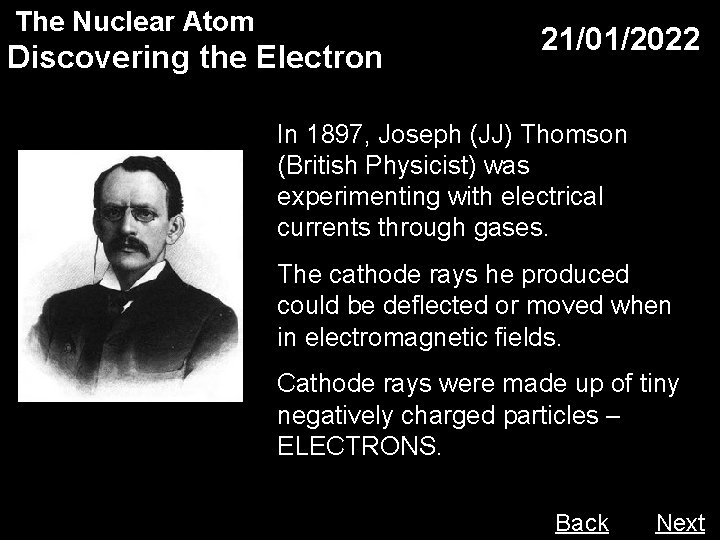
The Nuclear Atom Discovering the Electron 21/01/2022 In 1897, Joseph (JJ) Thomson (British Physicist) was experimenting with electrical currents through gases. The cathode rays he produced could be deflected or moved when in electromagnetic fields. Cathode rays were made up of tiny negatively charged particles – ELECTRONS. Back Next
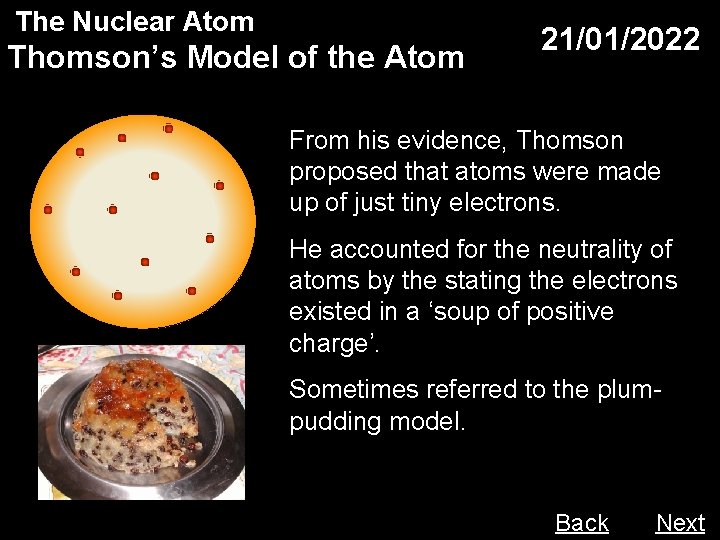
The Nuclear Atom Thomson’s Model of the Atom 21/01/2022 From his evidence, Thomson proposed that atoms were made up of just tiny electrons. He accounted for the neutrality of atoms by the stating the electrons existed in a ‘soup of positive charge’. Sometimes referred to the plumpudding model. Back Next
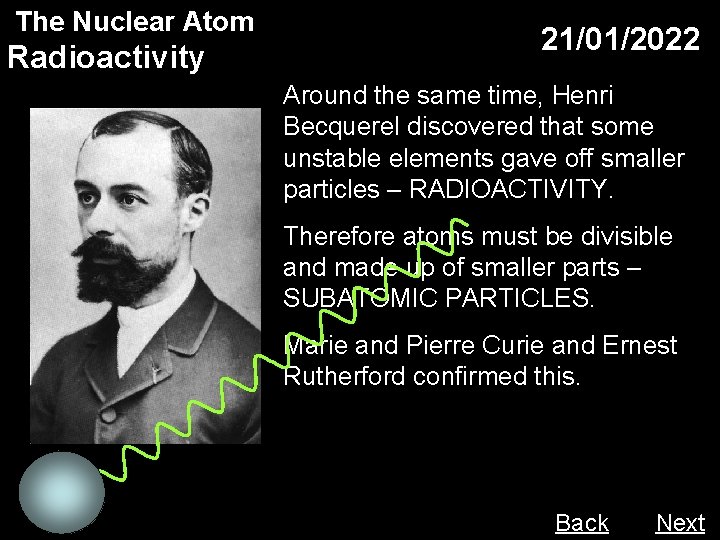
The Nuclear Atom Radioactivity 21/01/2022 Around the same time, Henri Becquerel discovered that some unstable elements gave off smaller particles – RADIOACTIVITY. Therefore atoms must be divisible and made up of smaller parts – SUBATOMIC PARTICLES. Marie and Pierre Curie and Ernest Rutherford confirmed this. Back Next
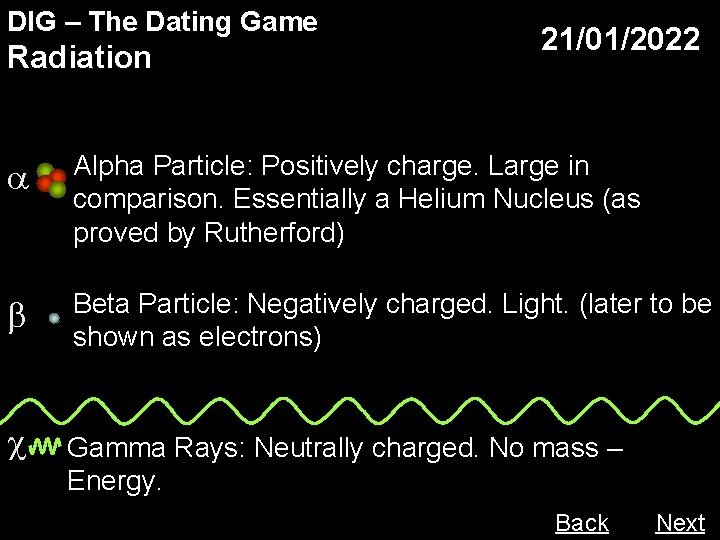
DIG – The Dating Game Radiation 21/01/2022 Alpha Particle: Positively charge. Large in comparison. Essentially a Helium Nucleus (as proved by Rutherford) Beta Particle: Negatively charged. Light. (later to be shown as electrons) Gamma Rays: Neutrally charged. No mass – Energy. Back Next
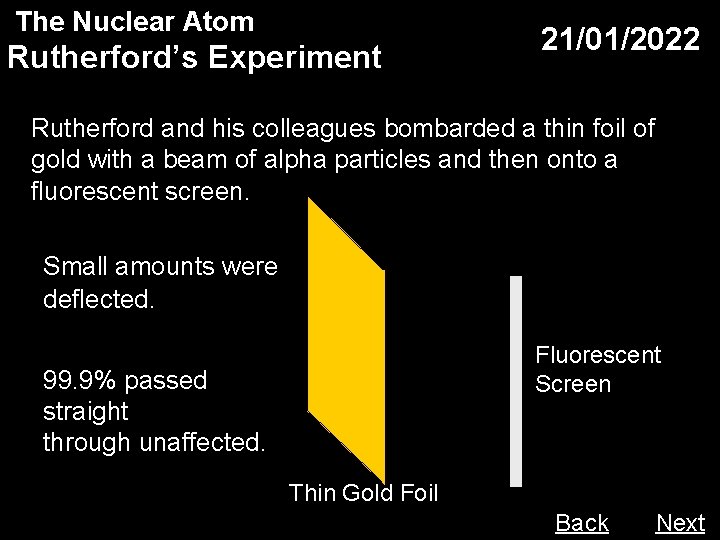
The Nuclear Atom Rutherford’s Experiment 21/01/2022 Rutherford and his colleagues bombarded a thin foil of gold with a beam of alpha particles and then onto a fluorescent screen. Small amounts were deflected. Fluorescent Screen 99. 9% passed straight through unaffected. Thin Gold Foil Back Next
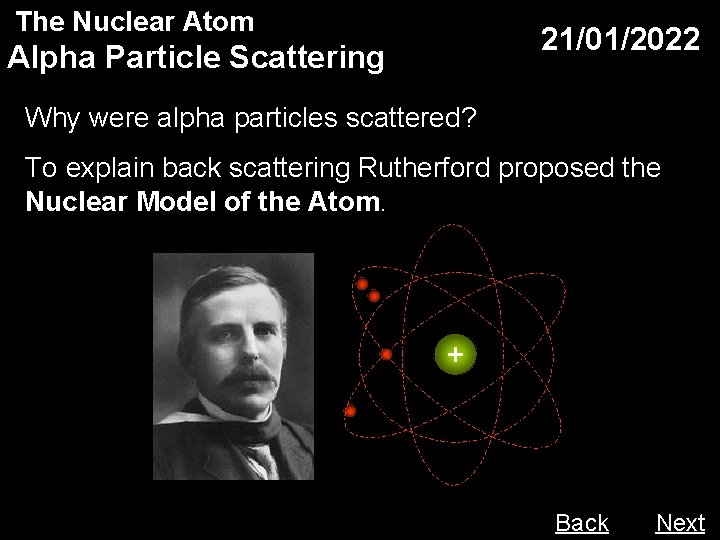
The Nuclear Atom 21/01/2022 Alpha Particle Scattering Why were alpha particles scattered? To explain back scattering Rutherford proposed the Nuclear Model of the Atom. + Back Next
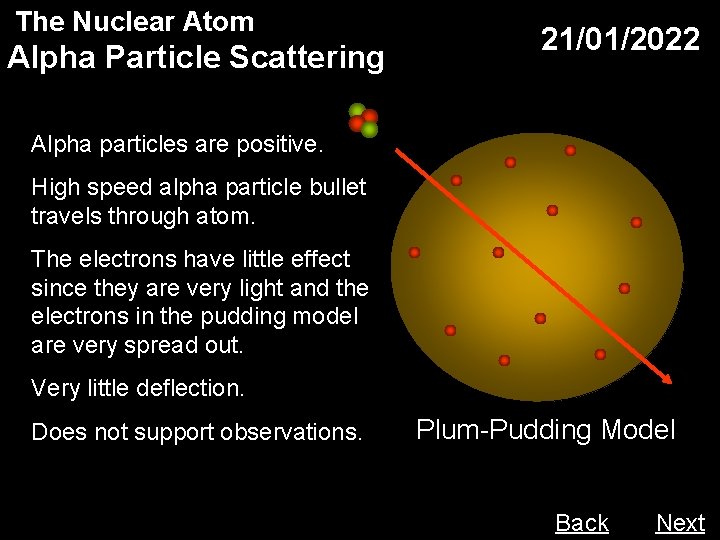
The Nuclear Atom Alpha Particle Scattering 21/01/2022 Alpha particles are positive. High speed alpha particle bullet travels through atom. The electrons have little effect since they are very light and the electrons in the pudding model are very spread out. Very little deflection. Does not support observations. Plum-Pudding Model Back Next
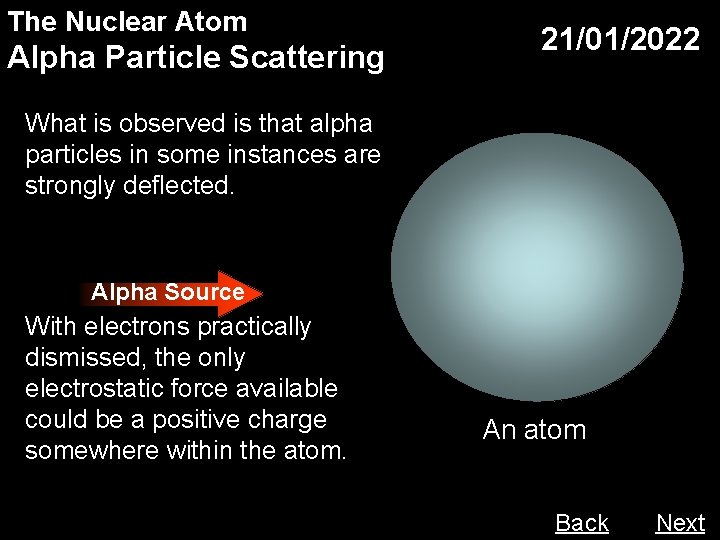
The Nuclear Atom Alpha Particle Scattering 21/01/2022 What is observed is that alpha particles in some instances are strongly deflected. Alpha Source With electrons practically dismissed, the only electrostatic force available could be a positive charge somewhere within the atom. An atom Back Next
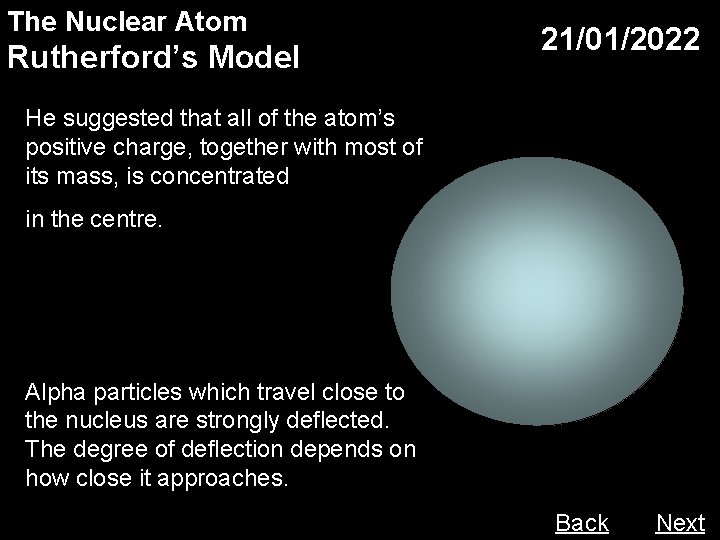
The Nuclear Atom Rutherford’s Model 21/01/2022 He suggested that all of the atom’s positive charge, together with most of its mass, is concentrated in the centre. + Alpha particles which travel close to the nucleus are strongly deflected. The degree of deflection depends on how close it approaches. Back Next
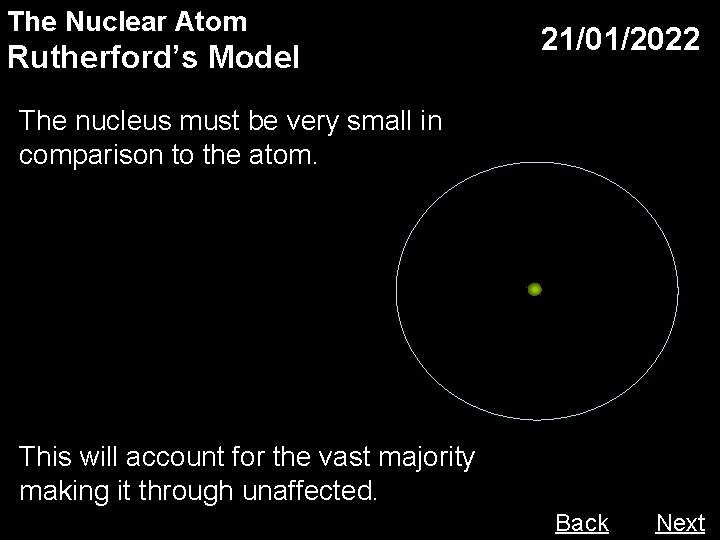
The Nuclear Atom Rutherford’s Model 21/01/2022 The nucleus must be very small in comparison to the atom. This will account for the vast majority making it through unaffected. Back Next
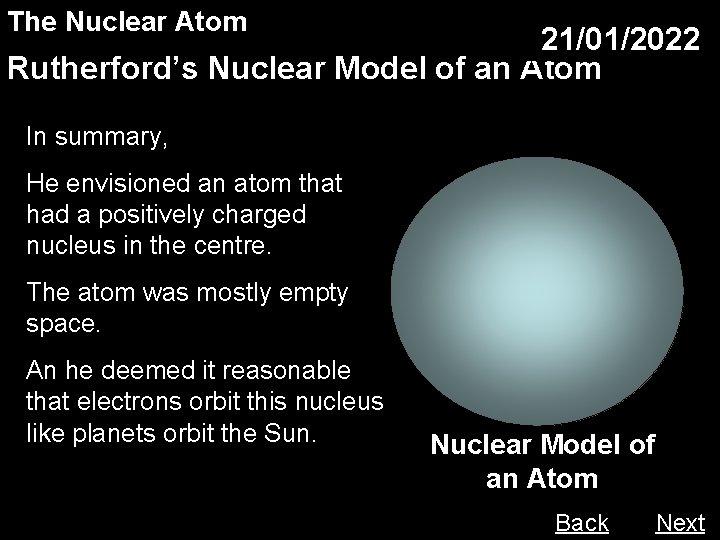
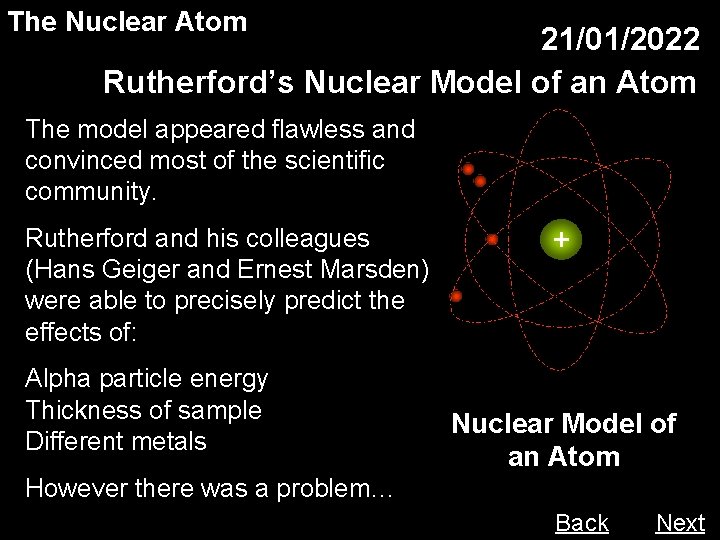
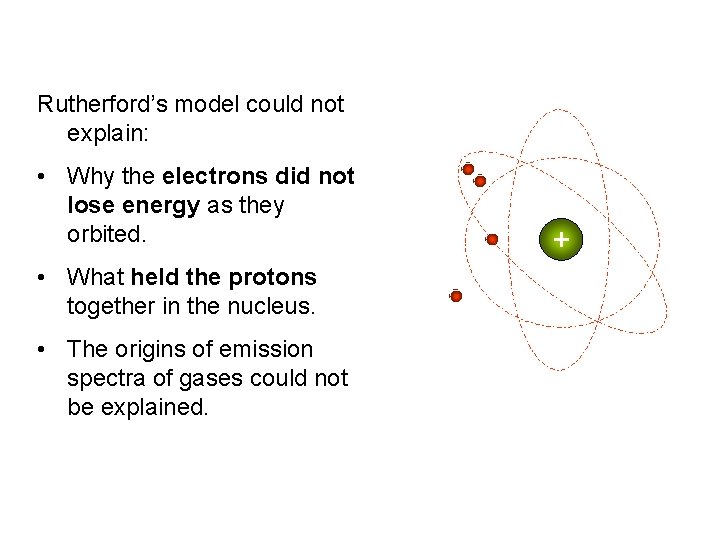
The Nuclear Atom 21/01/2022 Rutherford’s Nuclear Model of an Atom In summary, He envisioned an atom that had a positively charged nucleus in the centre. The atom was mostly empty space. An he deemed it reasonable that electrons orbit this nucleus like planets orbit the Sun. + Nuclear Model of an Atom Back Next
The Nuclear Atom 21/01/2022 Rutherford’s Nuclear Model of an Atom The model appeared flawless and convinced most of the scientific community. Rutherford and his colleagues (Hans Geiger and Ernest Marsden) were able to precisely predict the effects of: Alpha particle energy Thickness of sample Different metals + Nuclear Model of an Atom However there was a problem… Back Next
The Nuclear Atom The Problem… 21/01/2022 As the electrons move in circles, they would lose energy. Losing energy would slow them down. Therefore they would be pulled into the positively charged nucleus. It has been calculated that a Rutherford atom would only exist for about 1 billionth of a second! The answer lies within QUANTUM MECHANICS – when things get really small!! Back Next
Rutherford’s model could not explain: • Why the electrons did not lose energy as they orbited. • What held the protons together in the nucleus. • The origins of emission spectra of gases could not be explained. +
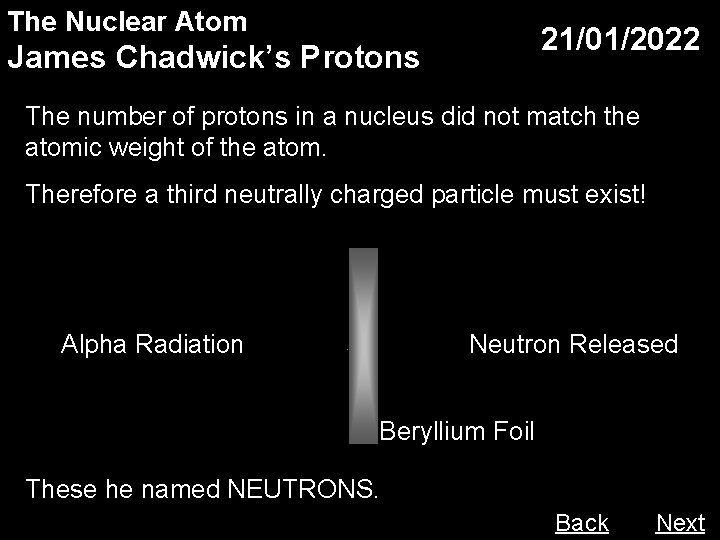
The Nuclear Atom 21/01/2022 James Chadwick’s Protons The number of protons in a nucleus did not match the atomic weight of the atom. Therefore a third neutrally charged particle must exist! Alpha Radiation Neutron Released Beryllium Foil These he named NEUTRONS. Back Next
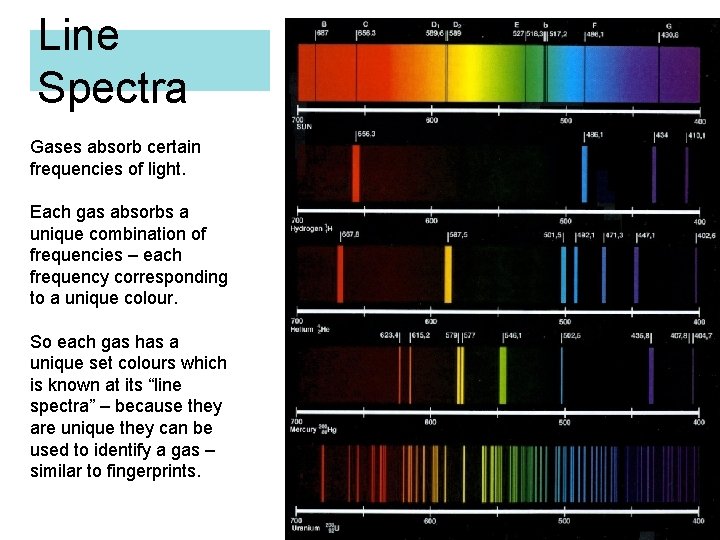
Line Spectra Gases absorb certain frequencies of light. Each gas absorbs a unique combination of frequencies – each frequency corresponding to a unique colour. So each gas has a unique set colours which is known at its “line spectra” – because they are unique they can be used to identify a gas – similar to fingerprints.
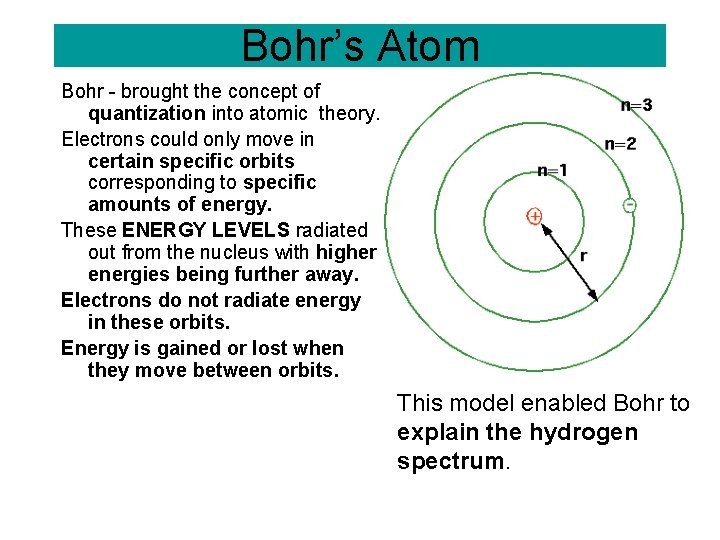
Bohr’s Atom Bohr - brought the concept of quantization into atomic theory. Electrons could only move in certain specific orbits corresponding to specific amounts of energy. These ENERGY LEVELS radiated out from the nucleus with higher energies being further away. Electrons do not radiate energy in these orbits. Energy is gained or lost when they move between orbits. This model enabled Bohr to explain the hydrogen spectrum.
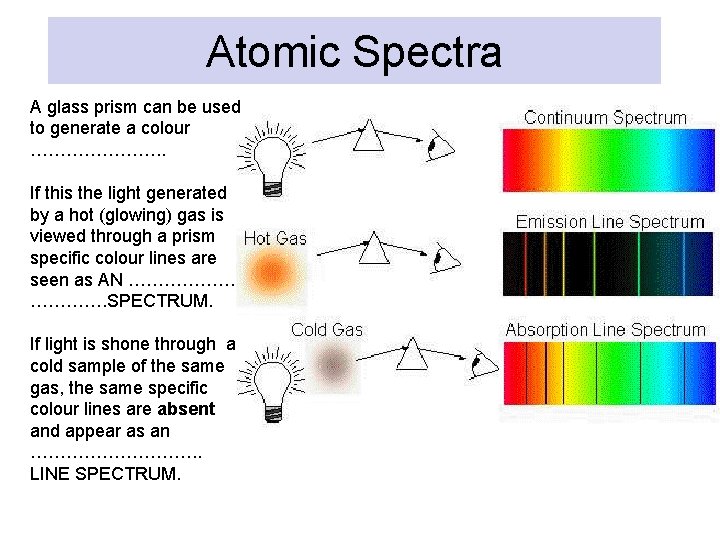
Atomic Spectra A glass prism can be used to generate a colour …………………. . If this the light generated by a hot (glowing) gas is viewed through a prism specific colour lines are seen as AN ………………. SPECTRUM. If light is shone through a cold sample of the same gas, the same specific colour lines are absent and appear as an ……………. . LINE SPECTRUM.
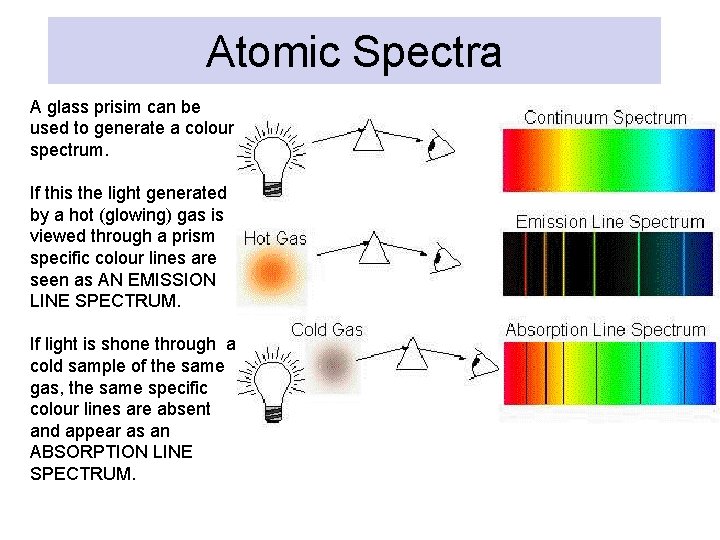
Atomic Spectra A glass prisim can be used to generate a colour spectrum. If this the light generated by a hot (glowing) gas is viewed through a prism specific colour lines are seen as AN EMISSION LINE SPECTRUM. If light is shone through a cold sample of the same gas, the same specific colour lines are absent and appear as an ABSORPTION LINE SPECTRUM.
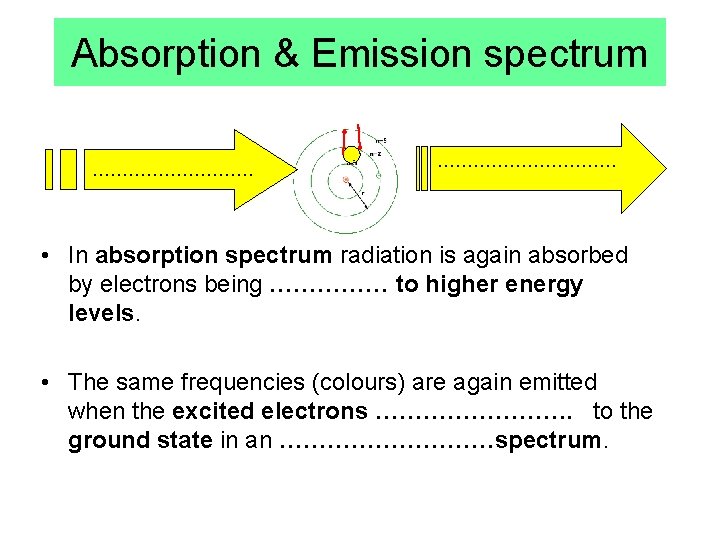
Absorption & Emission spectrum …………… - …………… • In absorption spectrum radiation is again absorbed by electrons being …………… to higher energy levels. • The same frequencies (colours) are again emitted when the excited electrons …………. to the ground state in an ……………spectrum.
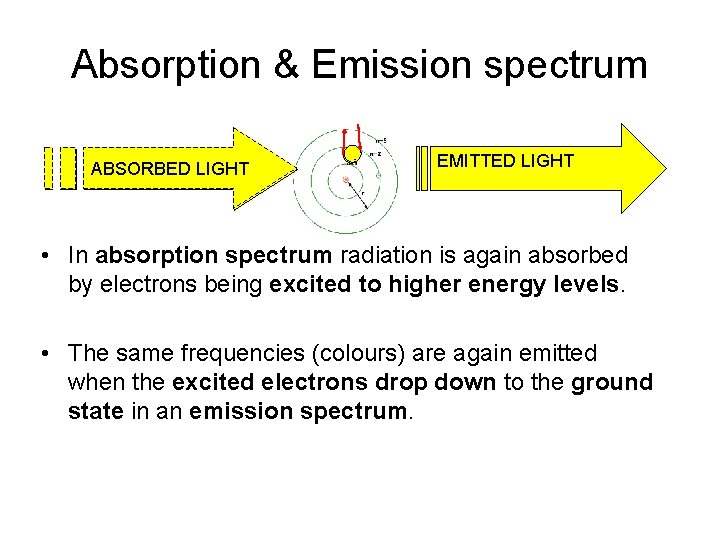
Absorption & Emission spectrum ABSORBED LIGHT - EMITTED LIGHT • In absorption spectrum radiation is again absorbed by electrons being excited to higher energy levels. • The same frequencies (colours) are again emitted when the excited electrons drop down to the ground state in an emission spectrum.
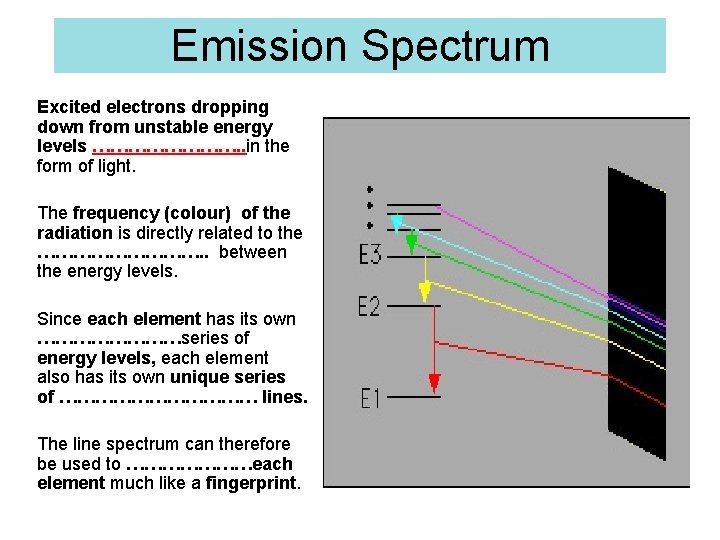
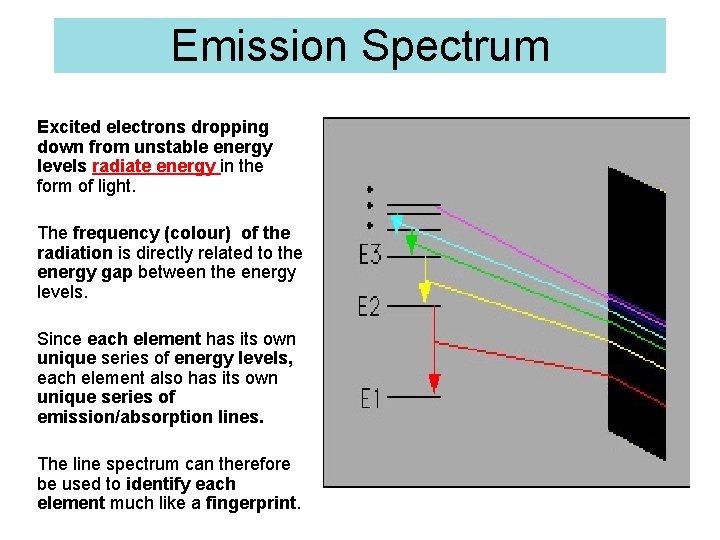
Emission Spectrum Excited electrons dropping down from unstable energy levels …………. . in the form of light. The frequency (colour) of the radiation is directly related to the ……………. . between the energy levels. Since each element has its own …………series of energy levels, each element also has its own unique series of ……………… lines. The line spectrum can therefore be used to …………………each element much like a fingerprint.
Emission Spectrum Excited electrons dropping down from unstable energy levels radiate energy in the form of light. The frequency (colour) of the radiation is directly related to the energy gap between the energy levels. Since each element has its own unique series of energy levels, each element also has its own unique series of emission/absorption lines. The line spectrum can therefore be used to identify each element much like a fingerprint.
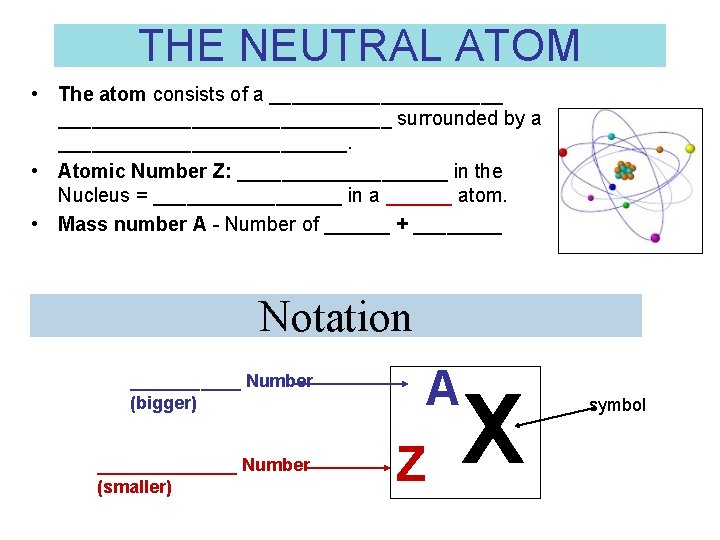
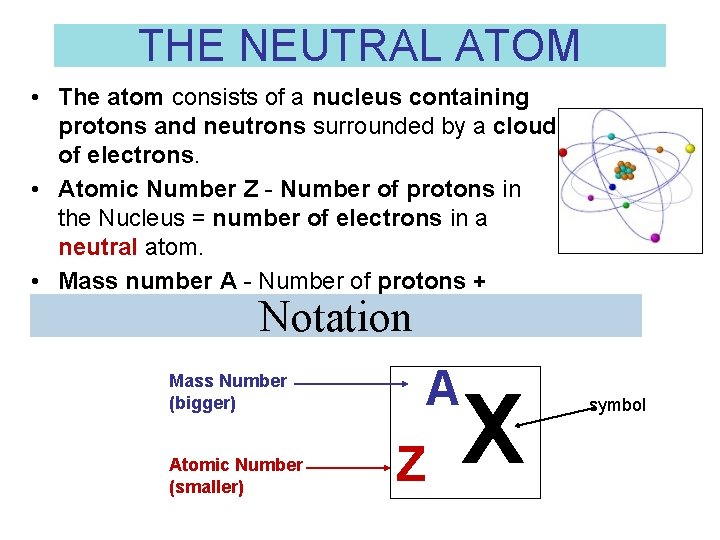
THE NEUTRAL ATOM • The atom consists of a __________________________ surrounded by a _____________. • Atomic Number Z: __________ in the Nucleus = _________ in a ______ atom. • Mass number A - Number of ______ + ____ Notation A ______ Number (bigger) _______ Number (smaller) Z X symbol
THE NEUTRAL ATOM • The atom consists of a nucleus containing protons and neutrons surrounded by a cloud of electrons. • Atomic Number Z - Number of protons in the Nucleus = number of electrons in a neutral atom. • Mass number A - Number of protons + neutrons. Notation A Mass Number (bigger) Atomic Number (smaller) Z X symbol
References • Simon Ball • Nelson 12 • Mcgraw-Hill Ryerson