
21 ST CENTURY SKILLS 2020 CREATIVE PROBLEM SOLVING
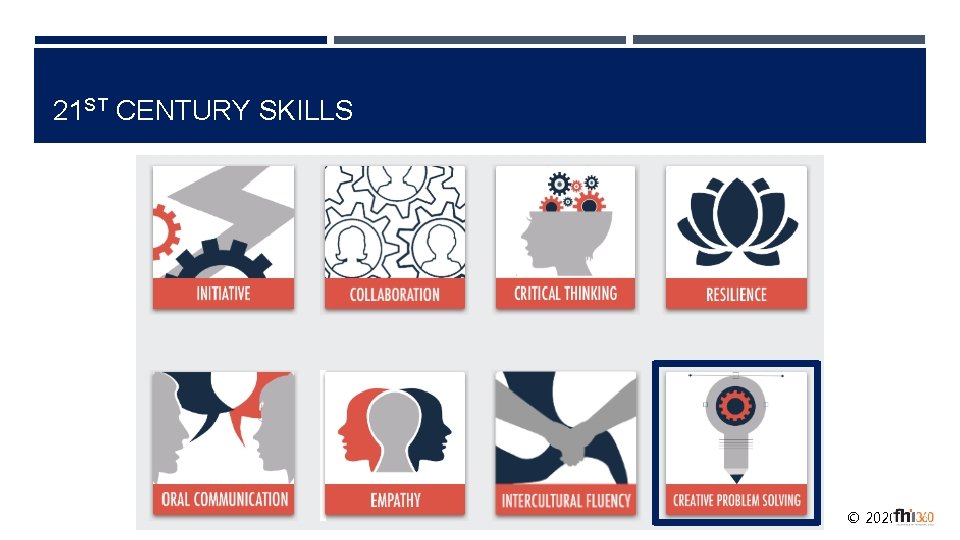
21 ST CENTURY SKILLS © 2020
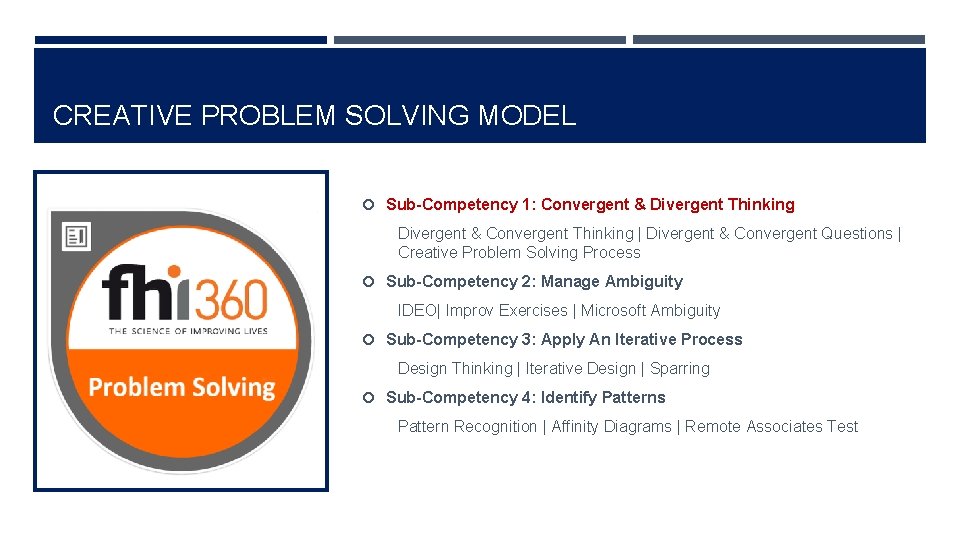
CREATIVE PROBLEM SOLVING MODEL Sub-Competency 1: Convergent & Divergent Thinking Divergent & Convergent Thinking | Divergent & Convergent Questions | Creative Problem Solving Process Sub-Competency 2: Manage Ambiguity IDEO| Improv Exercises | Microsoft Ambiguity Sub-Competency 3: Apply An Iterative Process Design Thinking | Iterative Design | Sparring Sub-Competency 4: Identify Patterns Pattern Recognition | Affinity Diagrams | Remote Associates Test
DIVERGENT & CONVERGENT THINKING Sub-Competency I: Convergent & Divergent Thinking
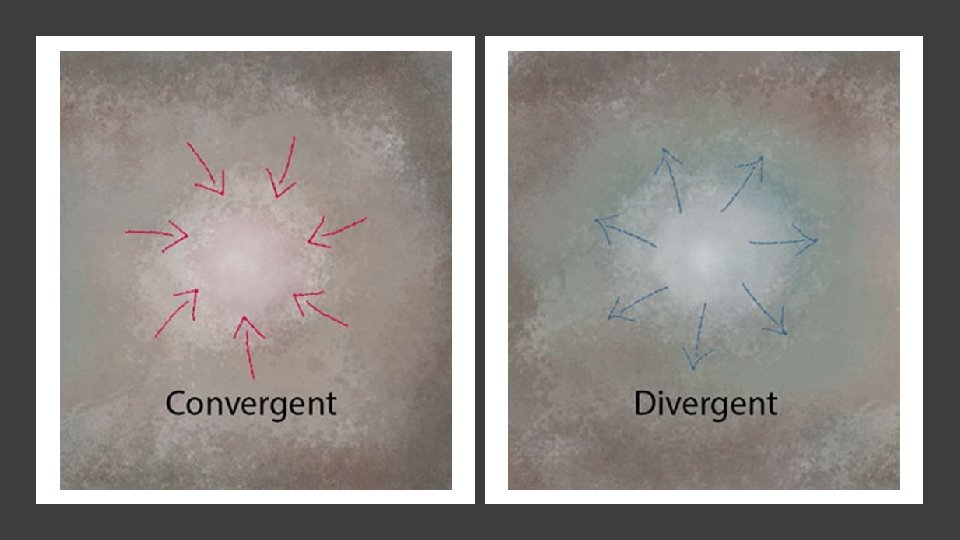
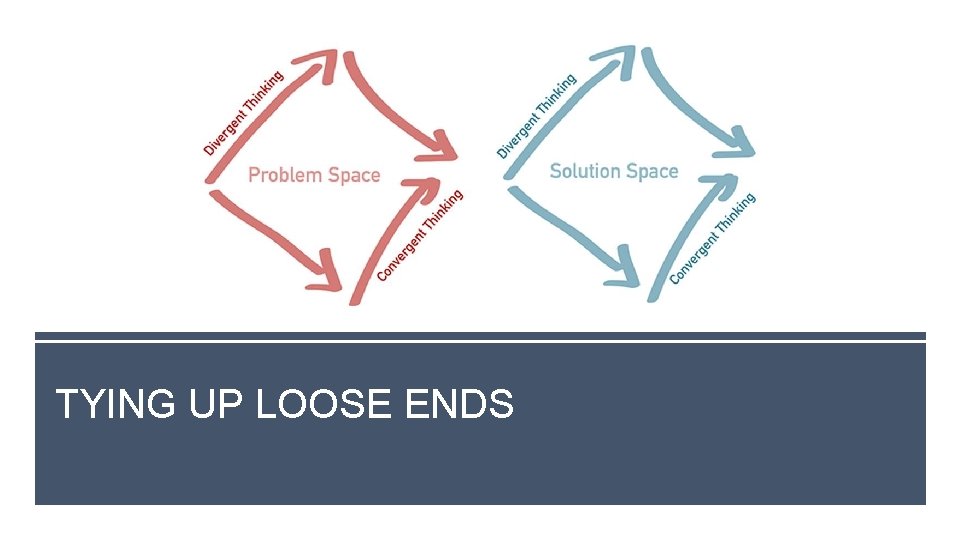
WHAT’S THE DIFFERENCE? CONVERGENT THINKING The process of figuring out a concrete solution to a problem Straight forward process that focuses on figuring out the most effective answer to a problem Perspective that the world is black and white Characteristics: Speed Accuracy Logic DIVERGENT THINKING The process of thinking that explores multiple possible solutions in order to generate creative ideas Opening the mind in various directions and trying out multiple solutions for a problem Perspective that the world isn’t always black and white Characteristics: Spontaneous Free-flowing Non-linear
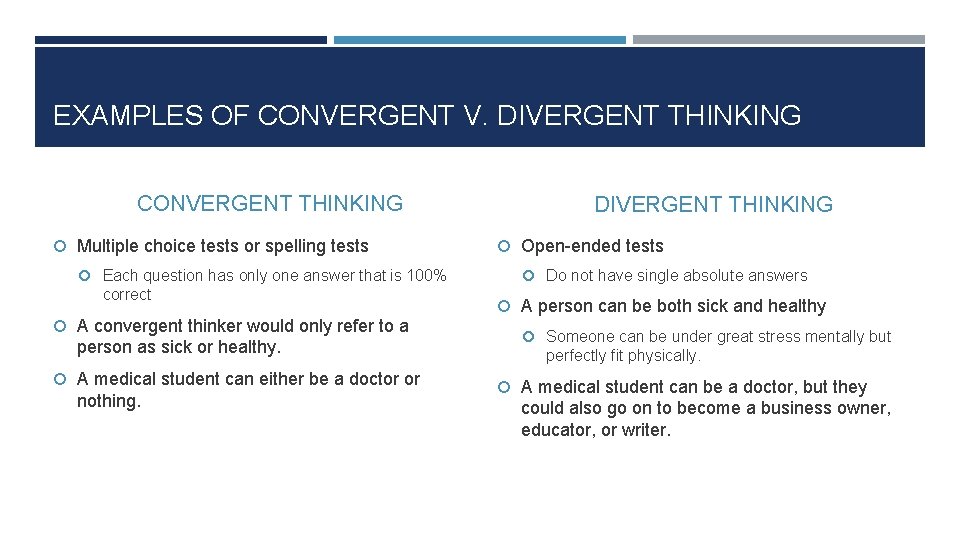
EXAMPLES OF CONVERGENT V. DIVERGENT THINKING CONVERGENT THINKING Multiple choice tests or spelling tests Each question has only one answer that is 100% correct A convergent thinker would only refer to a person as sick or healthy. A medical student can either be a doctor or nothing. DIVERGENT THINKING Open-ended tests Do not have single absolute answers A person can be both sick and healthy Someone can be under great stress mentally but perfectly fit physically. A medical student can be a doctor, but they could also go on to become a business owner, educator, or writer.
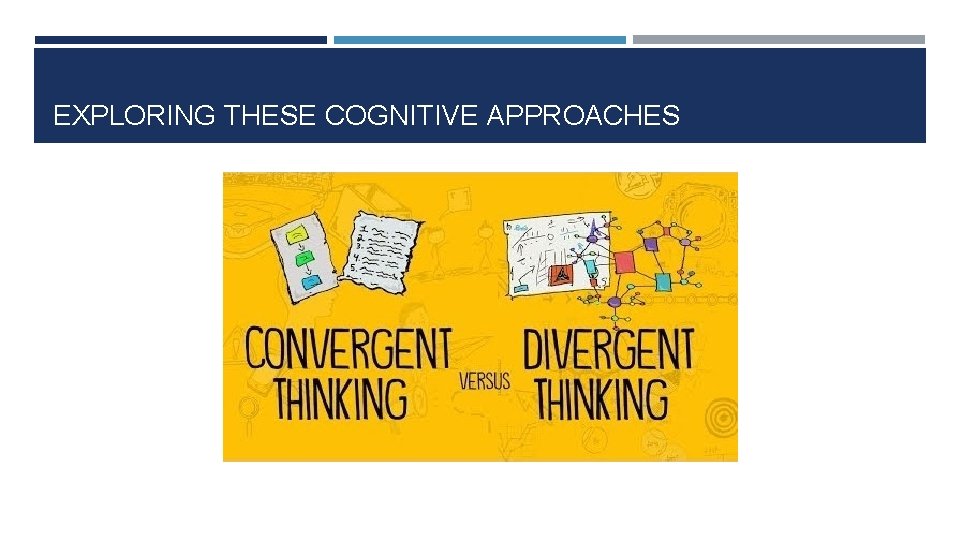
EXPLORING THESE COGNITIVE APPROACHES
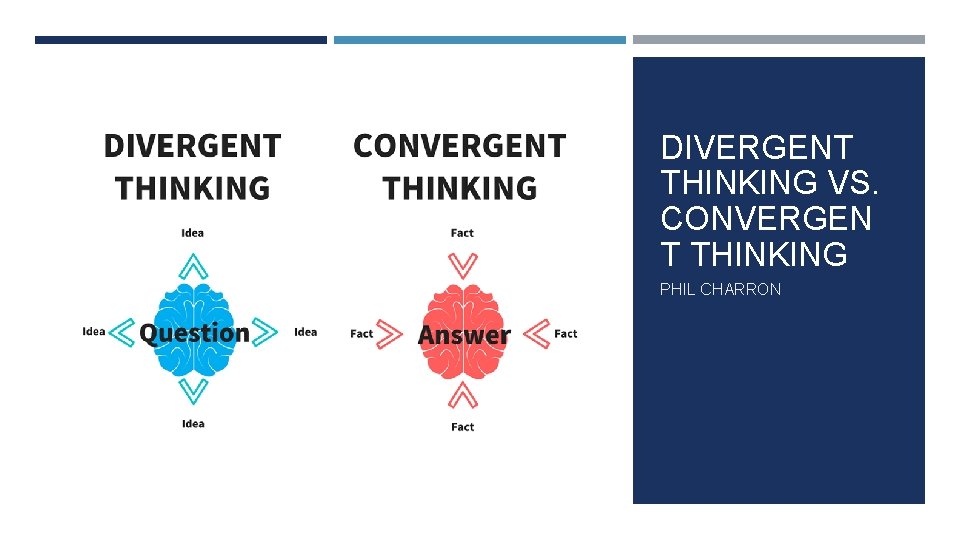
DIVERGENT THINKING VS. CONVERGEN T THINKING PHIL CHARRON

DIVERGENT & CONVERGENT QUESTIONS Sub-Competency I: Convergent & Divergent Thinking
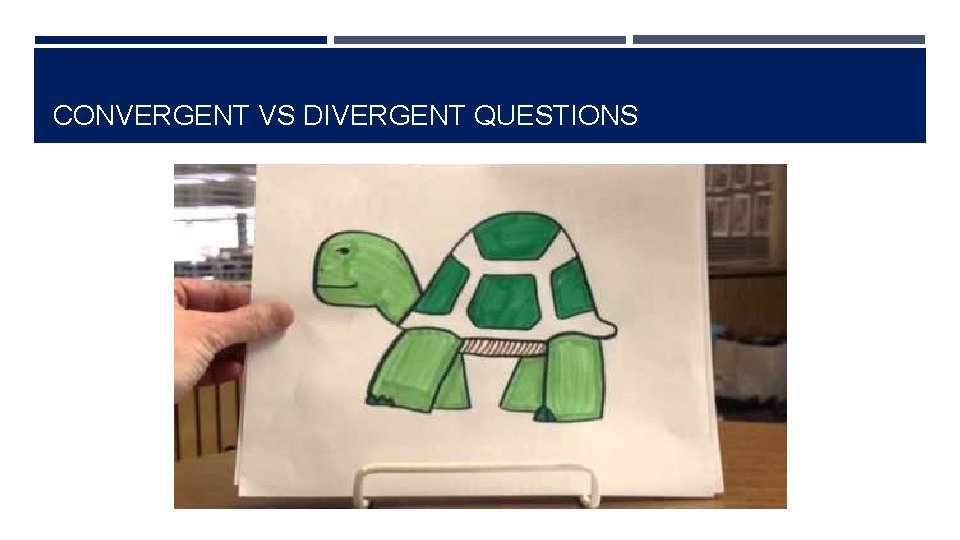
CONVERGENT VS DIVERGENT QUESTIONS
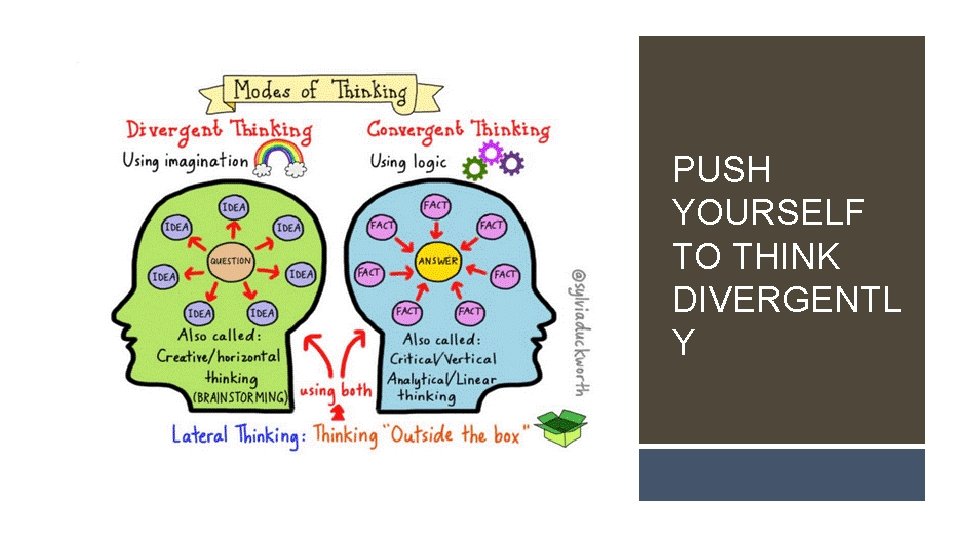
PUSH YOURSELF TO THINK DIVERGENTL Y
CREATIVE PROBLEM SOLVING Sub-Competency I: Convergent & Divergent Thinking

THE CREATIVE PROBLEM SOLVING PROCESS: CPS LEARNER’S MODEL Based on the Osborn-Parnes process, the CPS Model uses plain language and recent research. The basic structure is comprised of four stages with a total of six explicit process steps. Each step uses divergent and convergent thinking.
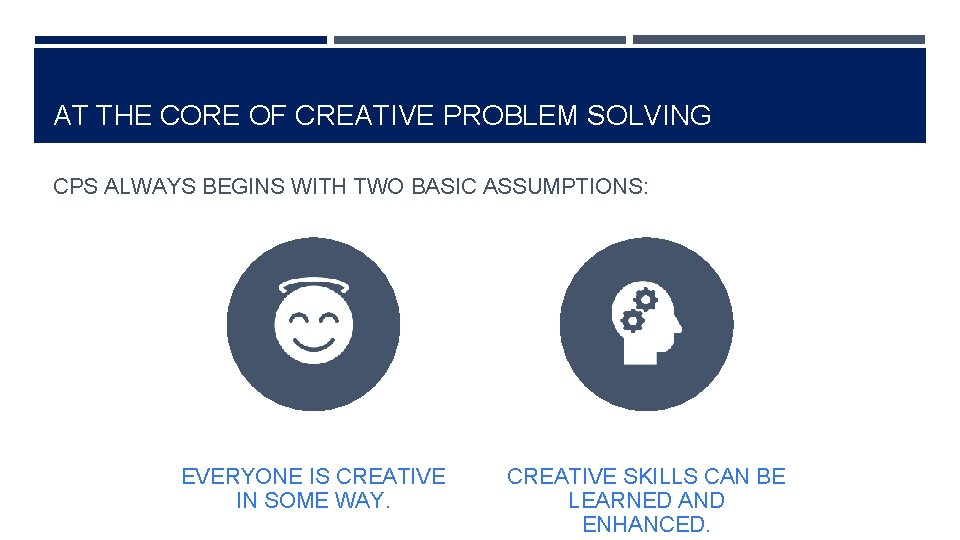
AT THE CORE OF CREATIVE PROBLEM SOLVING CPS ALWAYS BEGINS WITH TWO BASIC ASSUMPTIONS: EVERYONE IS CREATIVE IN SOME WAY. CREATIVE SKILLS CAN BE LEARNED AND ENHANCED.
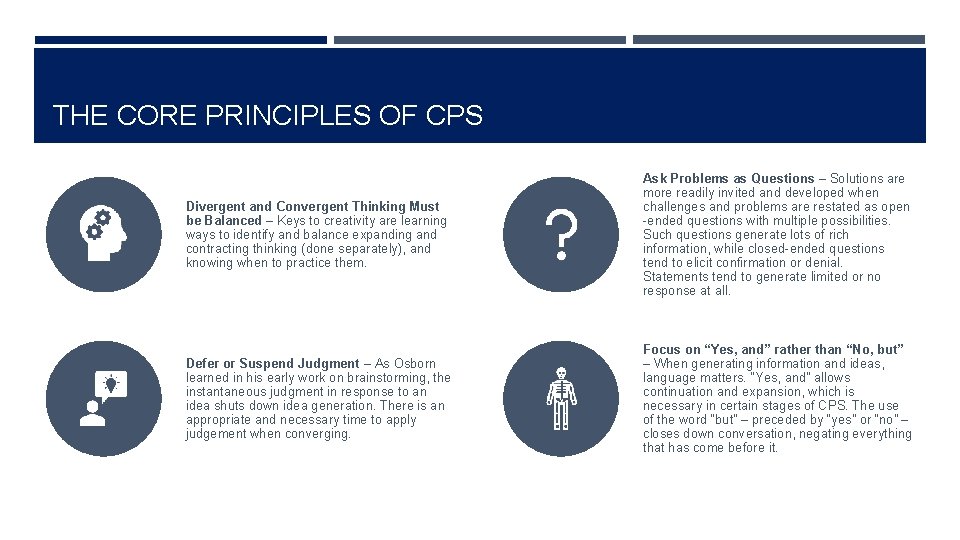
THE CORE PRINCIPLES OF CPS Divergent and Convergent Thinking Must be Balanced – Keys to creativity are learning ways to identify and balance expanding and contracting thinking (done separately), and knowing when to practice them. Ask Problems as Questions – Solutions are more readily invited and developed when challenges and problems are restated as open -ended questions with multiple possibilities. Such questions generate lots of rich information, while closed-ended questions tend to elicit confirmation or denial. Statements tend to generate limited or no response at all. Defer or Suspend Judgment – As Osborn learned in his early work on brainstorming, the instantaneous judgment in response to an idea shuts down idea generation. There is an appropriate and necessary time to apply judgement when converging. Focus on “Yes, and” rather than “No, but” – When generating information and ideas, language matters. “Yes, and” allows continuation and expansion, which is necessary in certain stages of CPS. The use of the word “but” – preceded by “yes” or “no” – closes down conversation, negating everything that has come before it.
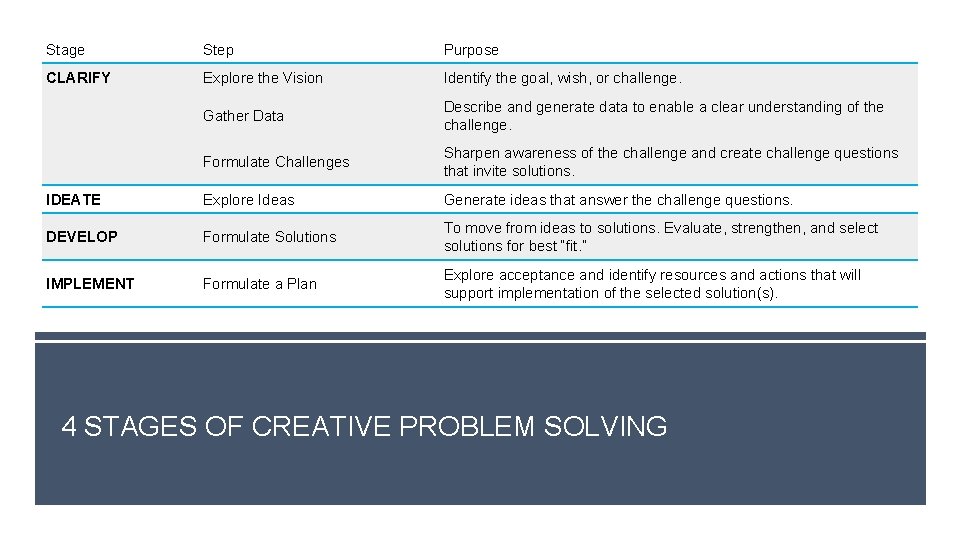
Stage Step Purpose CLARIFY Explore the Vision Identify the goal, wish, or challenge. Gather Data Describe and generate data to enable a clear understanding of the challenge. Formulate Challenges Sharpen awareness of the challenge and create challenge questions that invite solutions. IDEATE Explore Ideas Generate ideas that answer the challenge questions. DEVELOP Formulate Solutions To move from ideas to solutions. Evaluate, strengthen, and select solutions for best “fit. ” IMPLEMENT Formulate a Plan Explore acceptance and identify resources and actions that will support implementation of the selected solution(s). 4 STAGES OF CREATIVE PROBLEM SOLVING
TYING UP LOOSE ENDS
THOUGHTS AND REFLECTIONS?
- Slides: 18