
21 st Century Lessons Shapes of Distributions Unit
21 st Century Lessons Shapes of Distributions Unit 3 – Introduction of Concepts 1
Warm Up OBJECTIVE: SWBAT understand the concept of a statistical question, and develop a method to collect data to answer a statistical question. 1) How many letters are in your middle name? 2) Ask 5 class mates how many letters are in their middle names, and write them down. 3) Based on the results from question 2, try to guess how many letters the next person has in their middle name. Explain why you guessed this! Agenda 2
Launch A Vocabulary What is the definition of a statistical question? A statistical question is a question where the answer can change depending on who it is asked to, and when it is asked. This kind of change is called variability. Agenda 3
Launch B (Wait time: 30 seconds for each question) Can you determine whether the following questions are statistical question or not? 1. What did everyone in the class eat for breakfast today? Statistical Question! …Why? 2. What did YOU eat for breakfast today? Not a statistical Question… Why? 3. How many people in the class ate breakfast today? Not a statistical Question…Why? 4. Who was the first president of the U. S. A. ? Not a statistical Question… Why? 5. How many points does Lebron James have in each game? Statistical Question! … Why? Agenda 4
Launch B (Wait time: 30 seconds) Can you come up with your own statistical question? • Remember to explain why it is a statistical question! Agenda 5
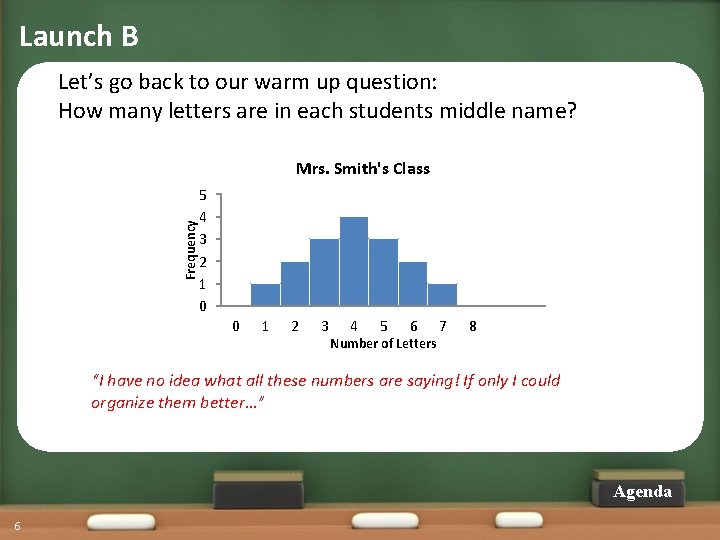
Launch B Let’s go back to our warm up question: How many letters are in each students middle name? Answers: Frequency Mrs. Smith's Class 5 4 3 2 1 0 0 1 2 3 4 5 6 Number of Letters 7 8 “I have no idea what all these numbers are saying! If only I could organize them better…” Agenda 6
Launch C The answers for our statistical questions have a special name. They are called our data. Data: The counts, measurements, or opinions that are collected to answer a statistical question. Notice how some of the numbers in our data show up more than once. This has a special name as well: Frequency: The number of times an answer shows up in the data. Agenda 7
Explore Click on the timer! Part 1 - (10 Min) Work with your PARTNER to find an efficient and neat method of displaying the data we’ve collected. You will get a piece of graph paper and a ruler. You can: 1 -Partners 2 -Share Out 3 -Worksheet - Organize however you’d like - Develop and answer your own questions - Be Creative! In 10 minutes you will be asked to stop and think about it! Data 8 Agenda
Explore – Student Share Out Part 2 - (3 Min) Students share out work. Classwork Questions Agenda 9
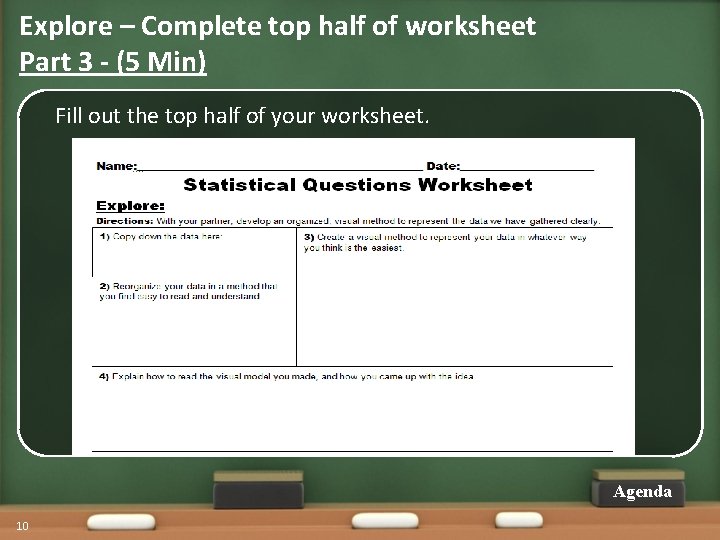
Explore – Complete top half of worksheet Part 3 - (5 Min) Fill out the top half of your worksheet. Agenda 10
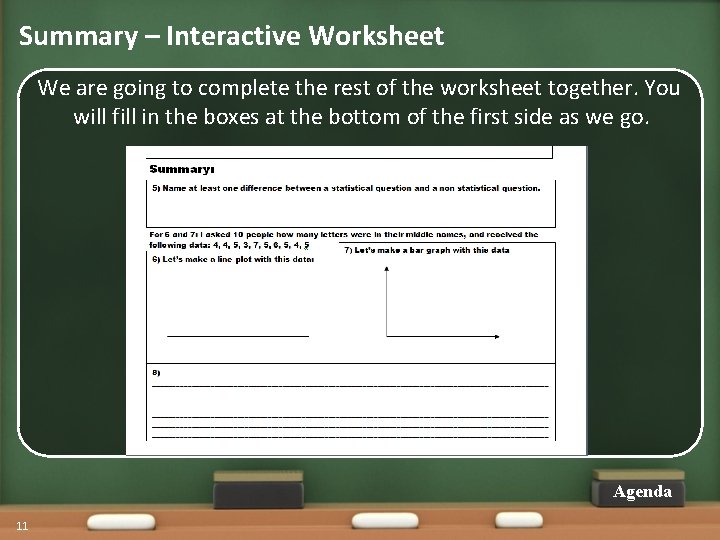
Summary – Interactive Worksheet We are going to complete the rest of the worksheet together. You will fill in the boxes at the bottom of the first side as we go. Agenda 11
Summary What are some differences between statistical questions and non statistical questions? 1) Statistical questions have more than one answer. . 2) Statistical questions vary according to who answers, where it is answered, and when it is answered. 3) The answer to statistical questions is in the form of data. 4) …and many more! Agenda 12
Summary – How to Make a Line Plot A jogger wrote down how many miles he ran on ten different days. These were his results: 2, 3, 5, 2, 4, 4, 2, 7, 2, 3: We are going to create a visual representation of this data called a Line Plot. Copy this down in the space for problem 6. Agenda 13
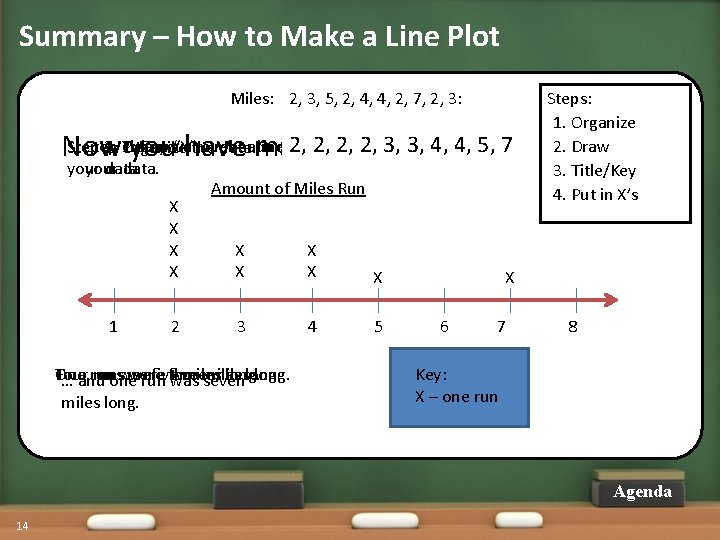
Summary – How to Make a Line Plot Miles: 2, 3, 5, 2, 4, 4, 2, 7, 2, 3: 2, 2, a 3, 4, 4, 5, in 7 in Step 3. Put 4. Title 2: you Draw an your “X” ahave number over each line, linenumber that and 2, contains create represent key. all 3, the an numbers item Step 1: Organize the data. Now made a 2, to Line Plot! your data. X X 1 2 Amount of Miles Run X X X 3 4 5 One Four Two runs was were five three four two miles long. … and one run was seven miles long. Steps: 1. Organize 2. Draw 3. Title/Key 4. Put in X’s X 6 7 8 Key: X – one run Agenda 14
Summary – How to Make a Bar Graph Pizza hut surveyed 10 people to find out what kind of pizza they liked. Here were the results: Cheese, Pepperoni, Cheese, Mushroom, Pineapple, Cheese, Pepperoni, Chicken, Pepperoni Let’s Make a Bar Graph to organize this to interpret this data better. Copy this down in the space for problem 7. Agenda 15
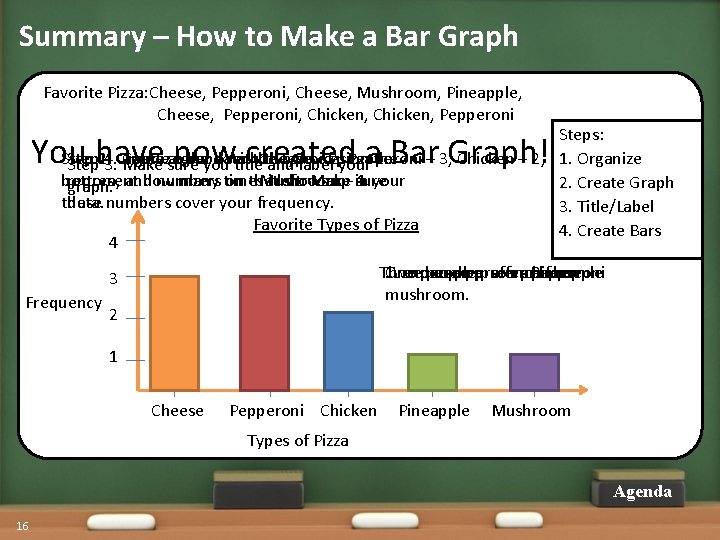
Summary – How to Make a Bar Graph Favorite Pizza: Cheese, Pepperoni, Cheese, Mushroom, Pineapple, Cheese, Pepperoni, Chicken, Pepperoni Steps: Step 2. 4. Create aagraph the baryou data. over with the Cheese the type choices –of 2, pizza Pepperoni on the to – 3, Chicken – 2, Pineapple 1. Organize – 1, Step 1. 3. Organize Make sure title and label your bottom, represent how numbers many times on the Mushroom itleft. shows Make up– in sure 1 your 2. Create Graph graph. and these data. numbers cover your frequency. 3. Title/Label Favorite Types of Pizza 4. Create Bars 4 You have now created a Bar Graph! Three Two One … and person people one person prefers preferprefers chicken Pepperoni Cheese pineapple mushroom. 3 Frequency 2 1 Cheese Pepperoni Chicken Pineapple Mushroom Types of Pizza Agenda 16
(2 minutes) Summary #8) Your little cousin keeps bugging you about what you do in sixth grade all day! Explain what you did in math class to get him to leave you alone. Hey big cuz!!! • In the space for #12, write him/her a note explaining what you learned so far today. • Use complete sentences. Scaffolding 17 Agenda
(2 minutes) Summary #8) Your little cousin keeps bugging you about what you do in sixth grade all day! Explain what you did in math class to get him to leave you alone. • In the space for #8, write him/her a note explaining what you learned so far today. 18 Hey big cuz!!! Sentence Starter • Use complete sentences. “Even though you are too young to understand this as well as I have learned it, I’m going to explain it to you as carefully as possible…” Scaffolding Agenda
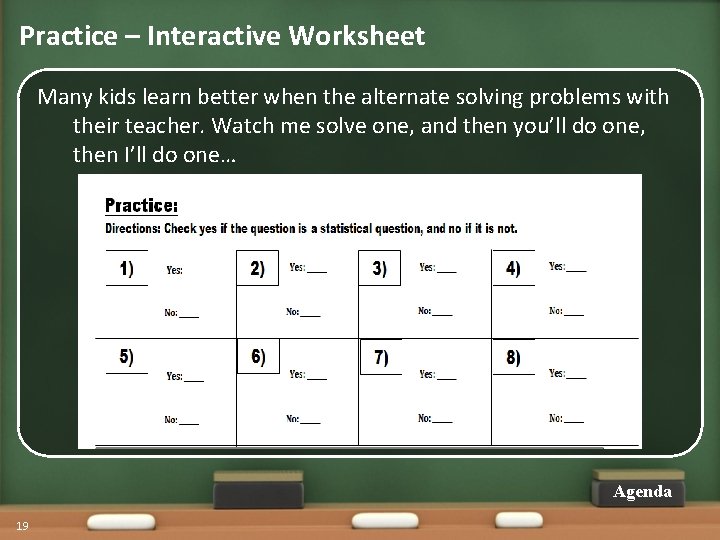
Practice – Interactive Worksheet Many kids learn better when the alternate solving problems with their teacher. Watch me solve one, and then you’ll do one, then I’ll do one… Agenda 19
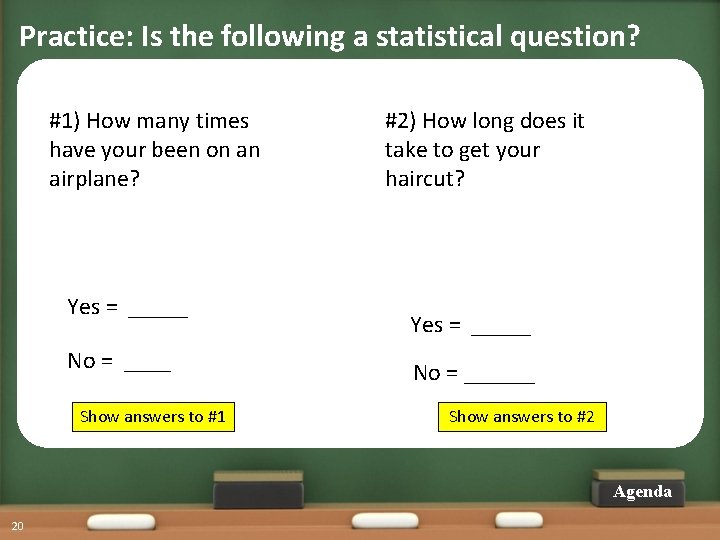
Practice: Is the following a statistical question? #1) How many times have your been on an airplane? Yes = _____ No = ____ Show answers to #1 #2) How long does it take to get your haircut? Yes = _____ No = ______ Show answers to #2 Agenda 20
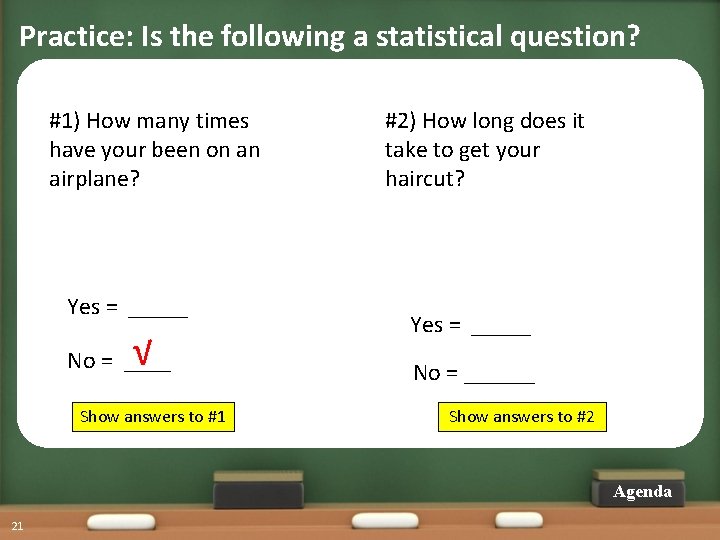
Practice: Is the following a statistical question? #1) How many times have your been on an airplane? Yes = _____ √ No = ____ Show answers to #1 #2) How long does it take to get your haircut? Yes = _____ No = ______ Show answers to #2 Agenda 21
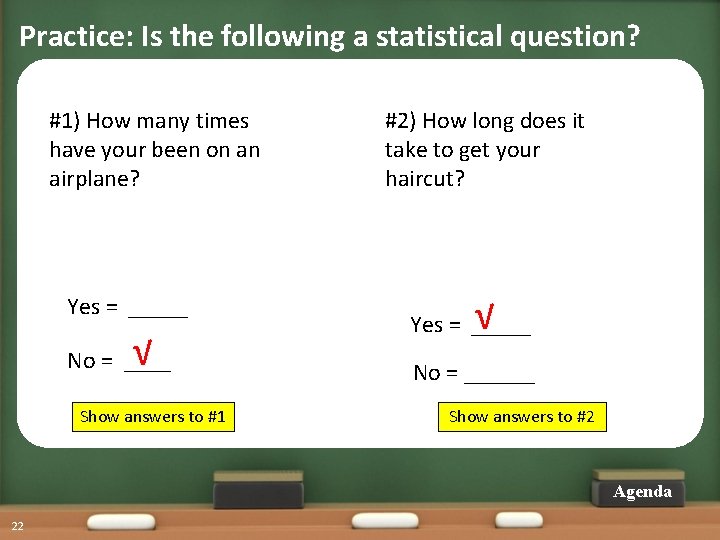
Practice: Is the following a statistical question? #1) How many times have your been on an airplane? Yes = _____ √ No = ____ Show answers to #1 #2) How long does it take to get your haircut? √ Yes = _____ No = ______ Show answers to #2 Agenda 22
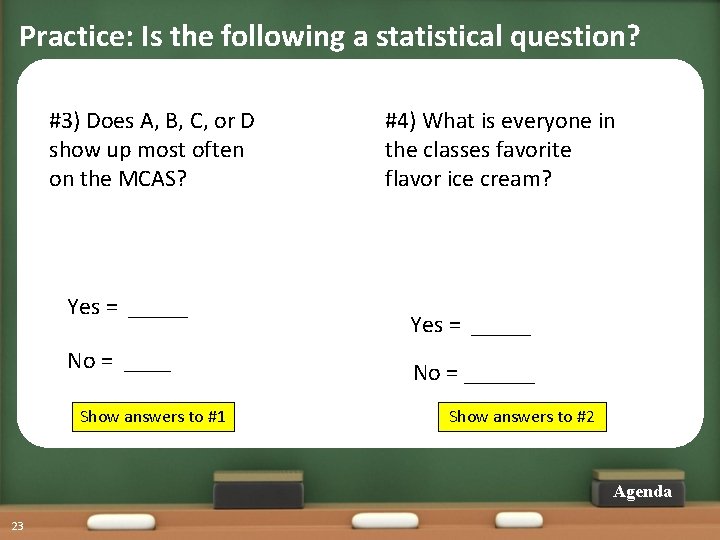
Practice: Is the following a statistical question? #3) Does A, B, C, or D show up most often on the MCAS? Yes = _____ No = ____ Show answers to #1 #4) What is everyone in the classes favorite flavor ice cream? Yes = _____ No = ______ Show answers to #2 Agenda 23
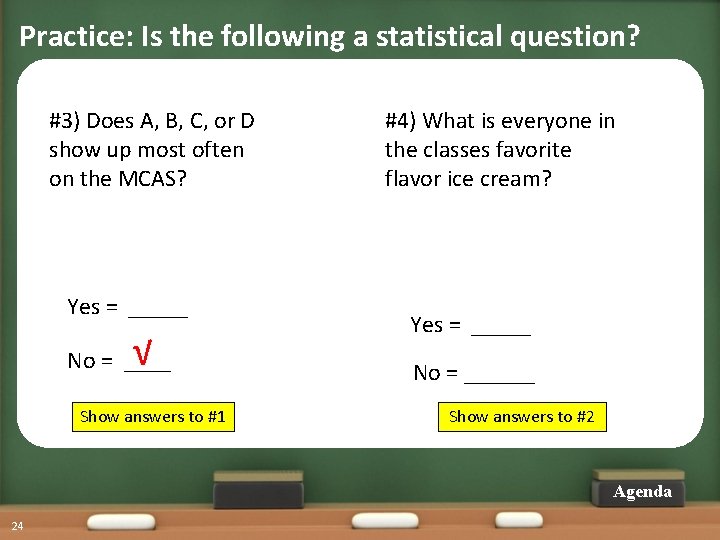
Practice: Is the following a statistical question? #3) Does A, B, C, or D show up most often on the MCAS? Yes = _____ √ No = ____ Show answers to #1 #4) What is everyone in the classes favorite flavor ice cream? Yes = _____ No = ______ Show answers to #2 Agenda 24
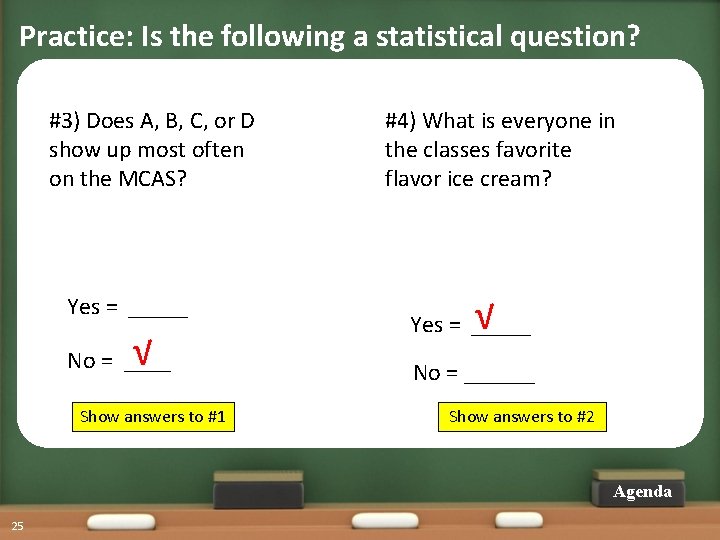
Practice: Is the following a statistical question? #3) Does A, B, C, or D show up most often on the MCAS? Yes = _____ √ No = ____ Show answers to #1 #4) What is everyone in the classes favorite flavor ice cream? √ Yes = _____ No = ______ Show answers to #2 Agenda 25
Practice: Is the following a statistical question? #5) What is the best way to study for a math test? Yes = _____ No = ____ Show answers to #1 #6) How many hours of sleep do you get at night? Yes = _____ No = ______ Show answers to #2 Agenda 26
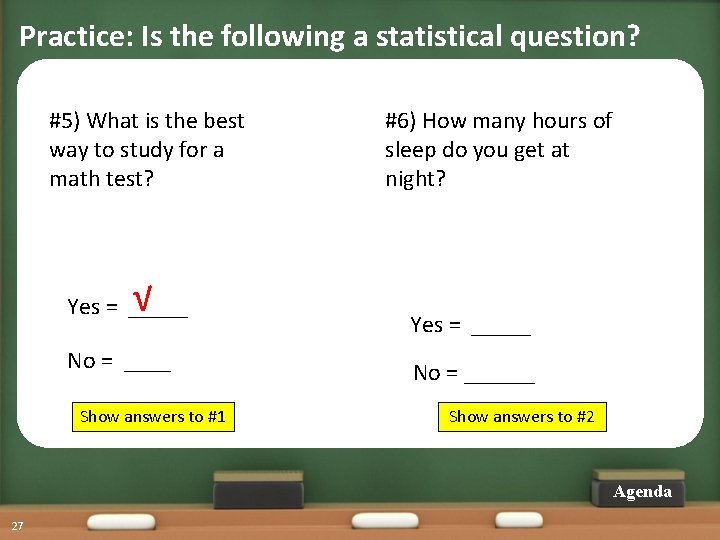
Practice: Is the following a statistical question? #5) What is the best way to study for a math test? √ Yes = _____ No = ____ Show answers to #1 #6) How many hours of sleep do you get at night? Yes = _____ No = ______ Show answers to #2 Agenda 27
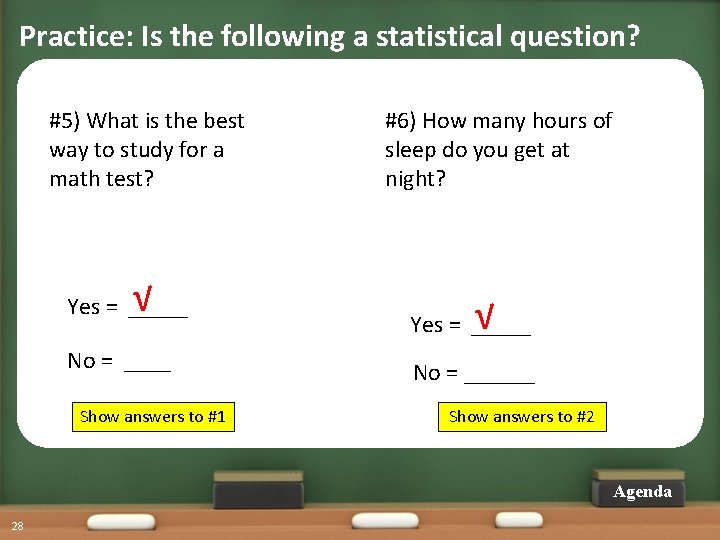
Practice: Is the following a statistical question? #5) What is the best way to study for a math test? √ Yes = _____ No = ____ Show answers to #1 #6) How many hours of sleep do you get at night? √ Yes = _____ No = ______ Show answers to #2 Agenda 28
Practice: Is the following a statistical question? #7) What is the best song ever? Yes = _____ No = ____ Show answers to #1 #8) What is the formula for the area of a parallelogram? Yes = _____ No = ______ Show answers to #2 Agenda 29
Practice: Is the following a statistical question? #7) What is the best song ever? √ Yes = _____ No = ____ Show answers to #1 #8) What is the formula for the area of a parallelogram? Yes = _____ No = ______ Show answers to #2 Agenda 30
Practice: Is the following a statistical question? #7) What is the best song ever? √ Yes = _____ No = ____ Show answers to #1 #8) What is the formula for the area of a parallelogram? Yes = _____ √ No = ______ Show answers to #2 Agenda 31
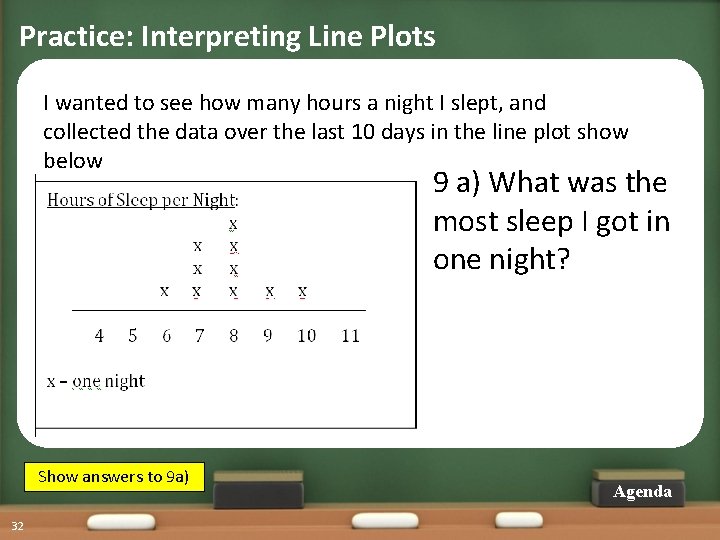
Practice: Interpreting Line Plots I wanted to see how many hours a night I slept, and collected the data over the last 10 days in the line plot show below 9 a) What was the most sleep I got in one night? Show answers to 9 a) 32 Agenda
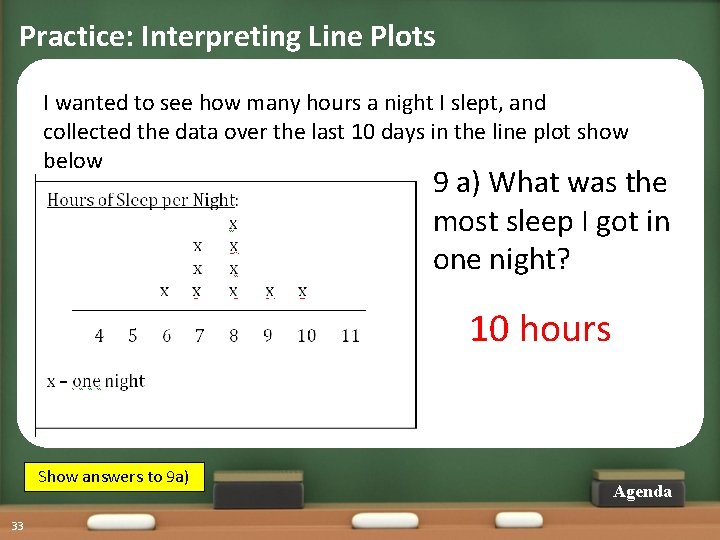
Practice: Interpreting Line Plots I wanted to see how many hours a night I slept, and collected the data over the last 10 days in the line plot show below 9 a) What was the most sleep I got in one night? 10 hours Show answers to 9 a) 33 Agenda
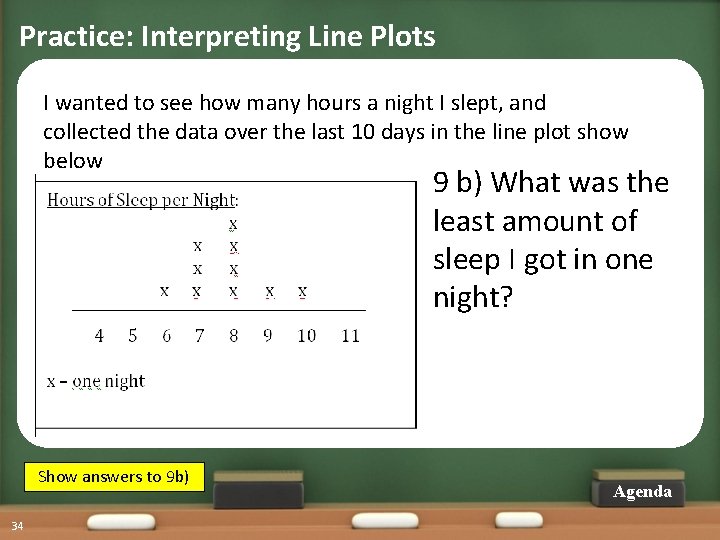
Practice: Interpreting Line Plots I wanted to see how many hours a night I slept, and collected the data over the last 10 days in the line plot show below 9 b) What was the least amount of sleep I got in one night? Show answers to 9 b) 34 Agenda
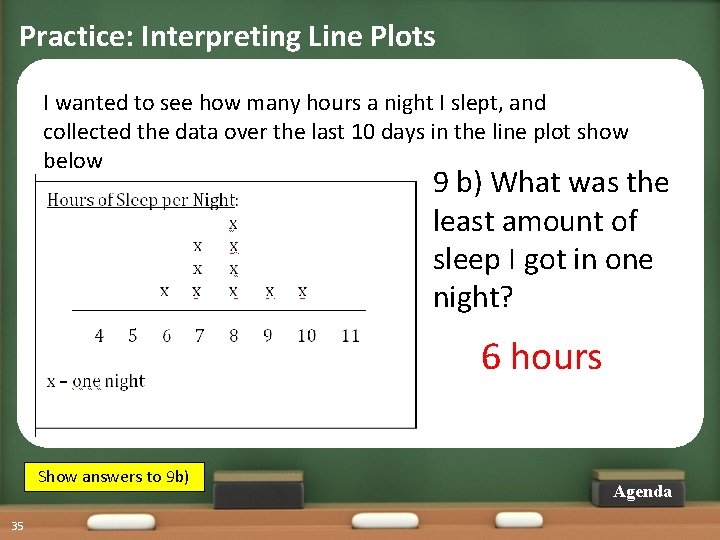
Practice: Interpreting Line Plots I wanted to see how many hours a night I slept, and collected the data over the last 10 days in the line plot show below 9 b) What was the least amount of sleep I got in one night? 6 hours Show answers to 9 b) 35 Agenda
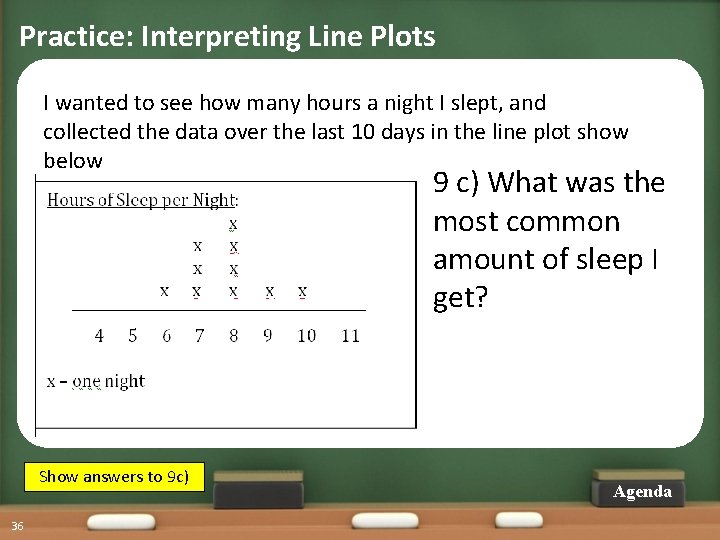
Practice: Interpreting Line Plots I wanted to see how many hours a night I slept, and collected the data over the last 10 days in the line plot show below 9 c) What was the most common amount of sleep I get? Show answers to 9 c) 36 Agenda
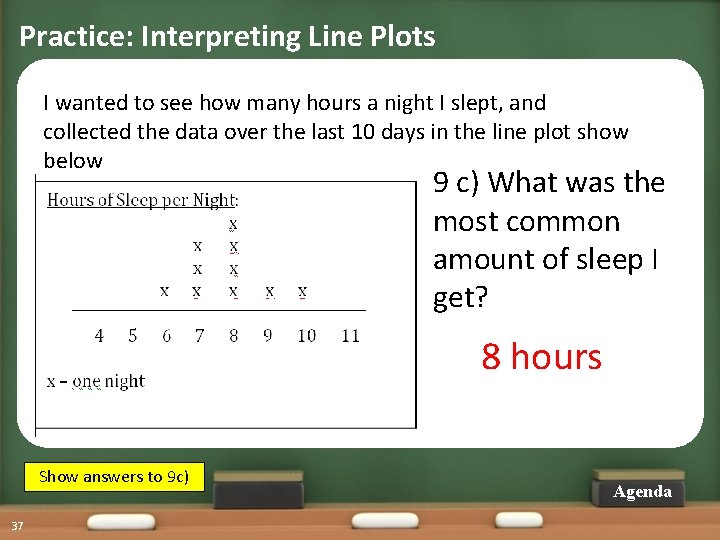
Practice: Interpreting Line Plots I wanted to see how many hours a night I slept, and collected the data over the last 10 days in the line plot show below 9 c) What was the most common amount of sleep I get? 8 hours Show answers to 9 c) 37 Agenda
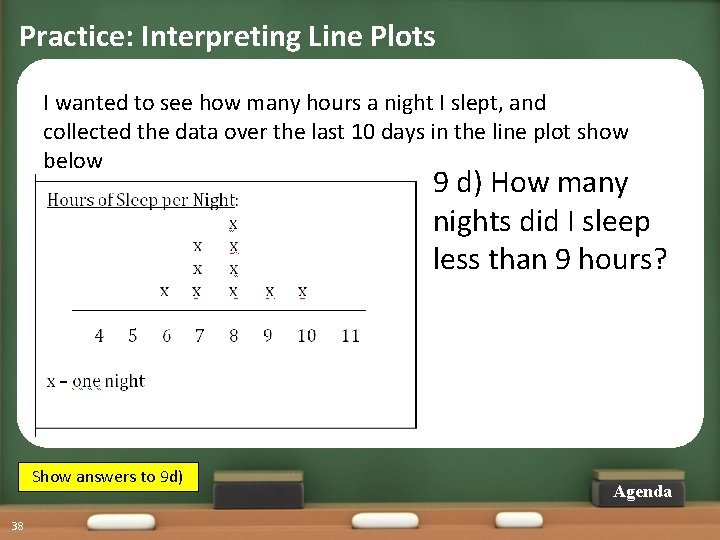
Practice: Interpreting Line Plots I wanted to see how many hours a night I slept, and collected the data over the last 10 days in the line plot show below 9 d) How many nights did I sleep less than 9 hours? Show answers to 9 d) 38 Agenda
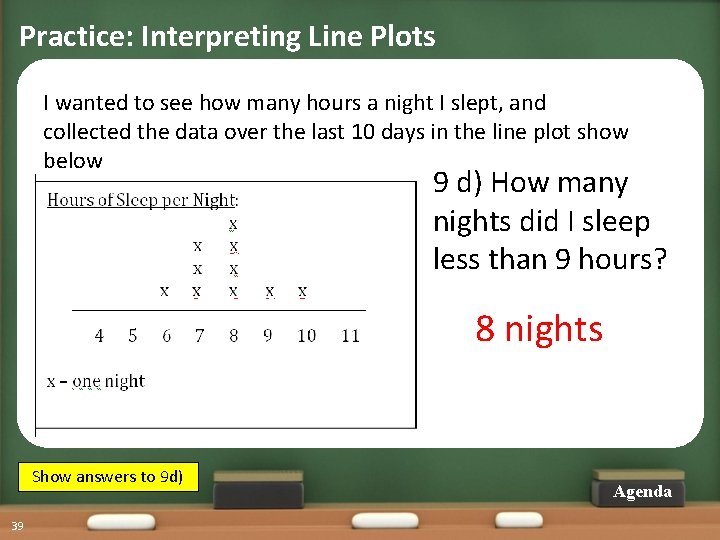
Practice: Interpreting Line Plots I wanted to see how many hours a night I slept, and collected the data over the last 10 days in the line plot show below 9 d) How many nights did I sleep less than 9 hours? 8 nights Show answers to 9 d) 39 Agenda
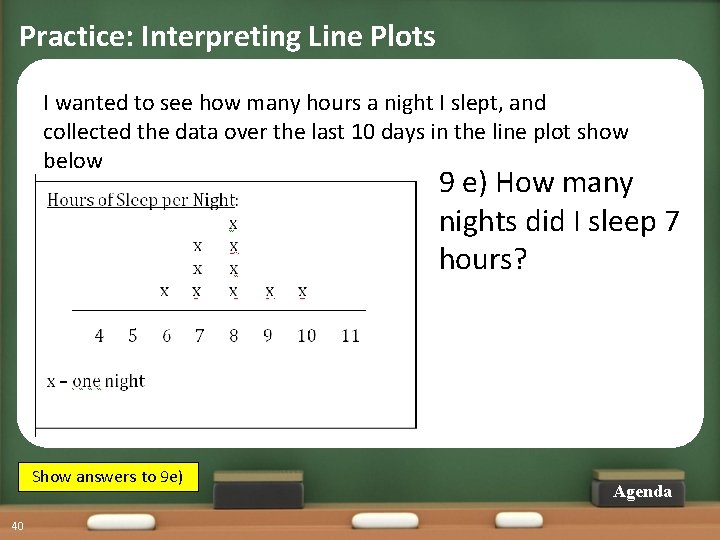
Practice: Interpreting Line Plots I wanted to see how many hours a night I slept, and collected the data over the last 10 days in the line plot show below 9 e) How many nights did I sleep 7 hours? Show answers to 9 e) 40 Agenda
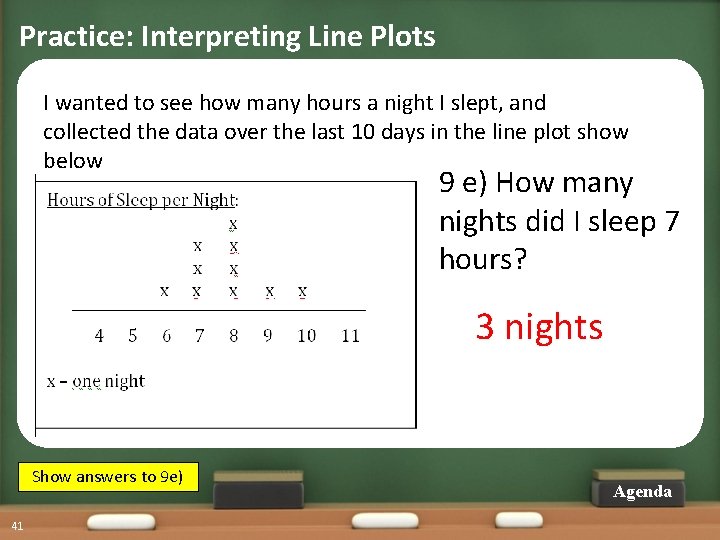
Practice: Interpreting Line Plots I wanted to see how many hours a night I slept, and collected the data over the last 10 days in the line plot show below 9 e) How many nights did I sleep 7 hours? 3 nights Show answers to 9 e) 41 Agenda
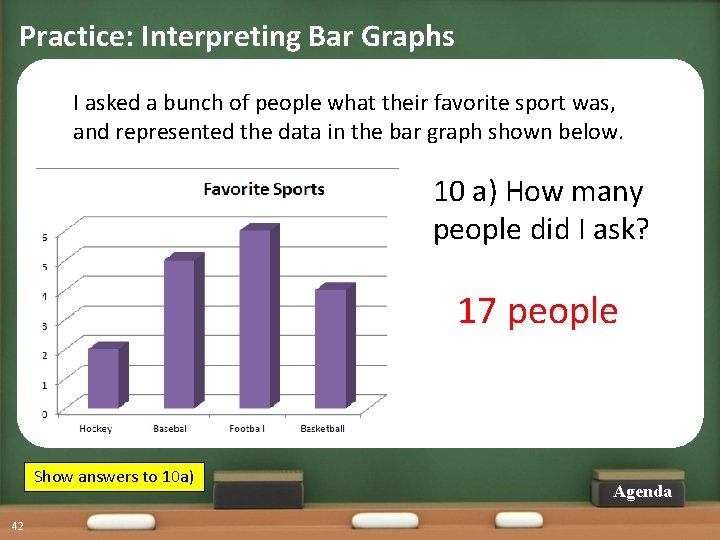
Practice: Interpreting Bar Graphs I asked a bunch of people what their favorite sport was, and represented the data in the bar graph shown below. 10 a) How many people did I ask? 17 people Show answers to 10 a) 42 Agenda
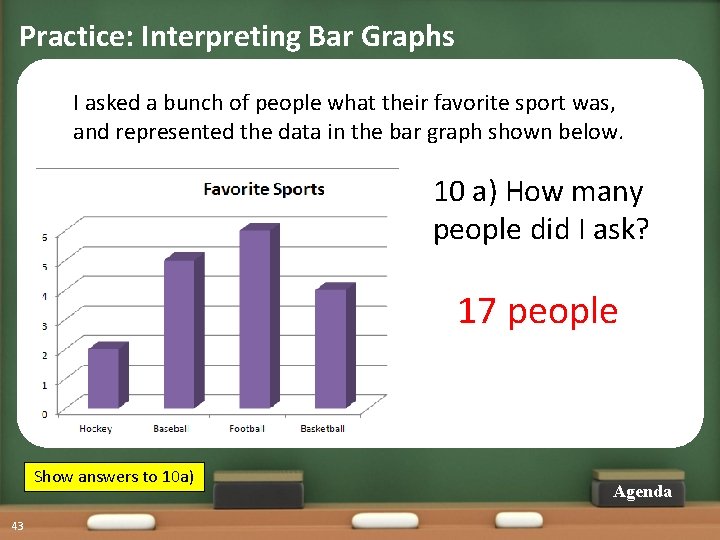
Practice: Interpreting Bar Graphs I asked a bunch of people what their favorite sport was, and represented the data in the bar graph shown below. 10 a) How many people did I ask? 17 people Show answers to 10 a) 43 Agenda
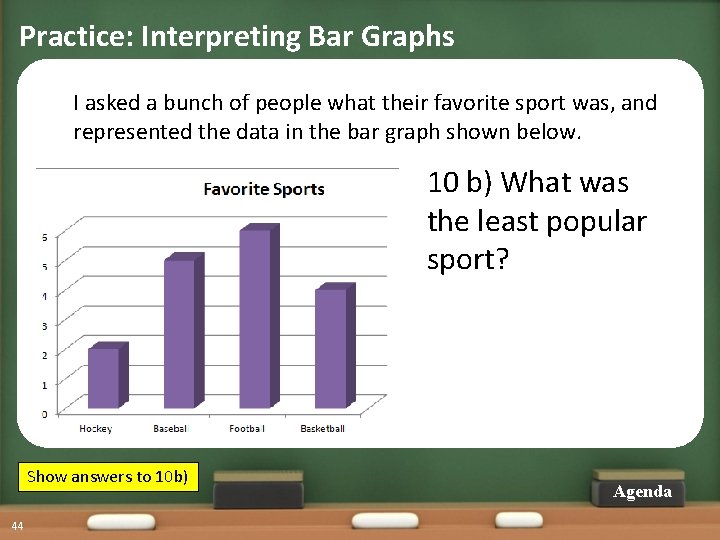
Practice: Interpreting Bar Graphs I asked a bunch of people what their favorite sport was, and represented the data in the bar graph shown below. 10 b) What was the least popular sport? Show answers to 10 b) 44 Agenda
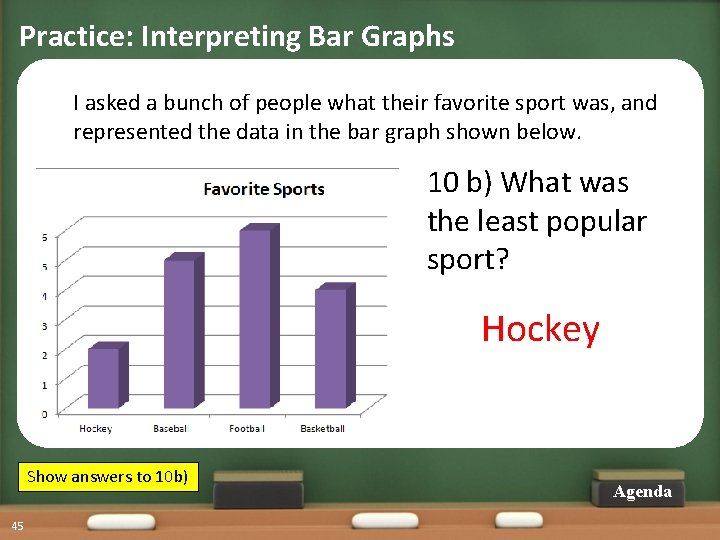
Practice: Interpreting Bar Graphs I asked a bunch of people what their favorite sport was, and represented the data in the bar graph shown below. 10 b) What was the least popular sport? Hockey Show answers to 10 b) 45 Agenda
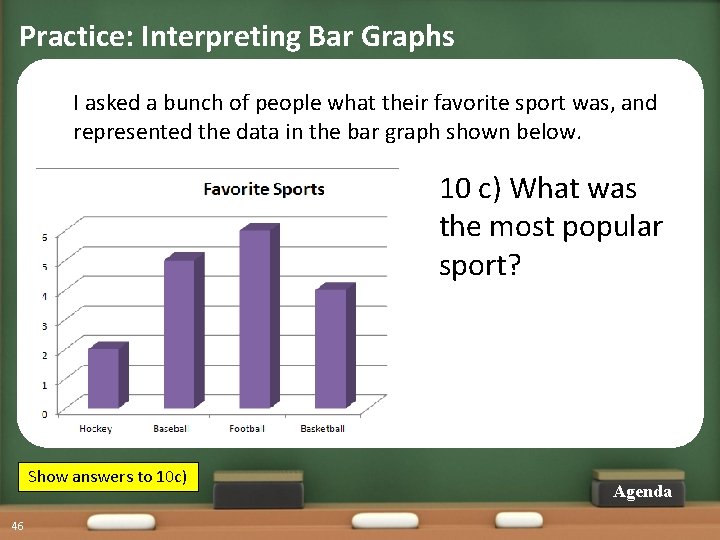
Practice: Interpreting Bar Graphs I asked a bunch of people what their favorite sport was, and represented the data in the bar graph shown below. 10 c) What was the most popular sport? Show answers to 10 c) 46 Agenda
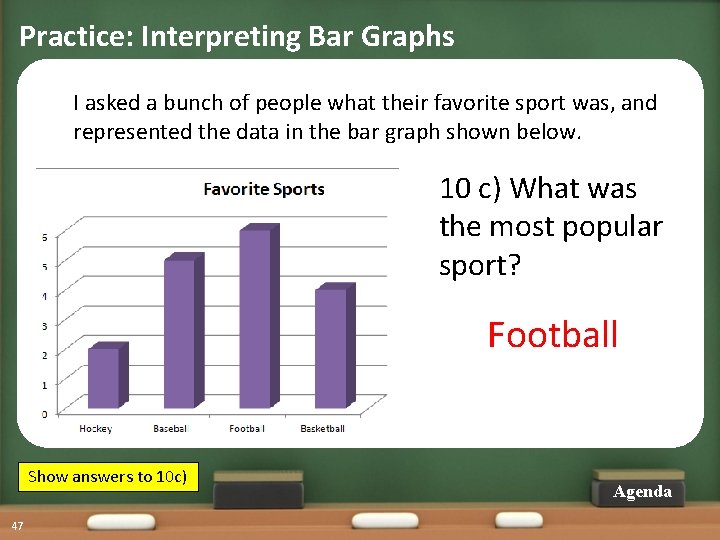
Practice: Interpreting Bar Graphs I asked a bunch of people what their favorite sport was, and represented the data in the bar graph shown below. 10 c) What was the most popular sport? Football Show answers to 10 c) 47 Agenda
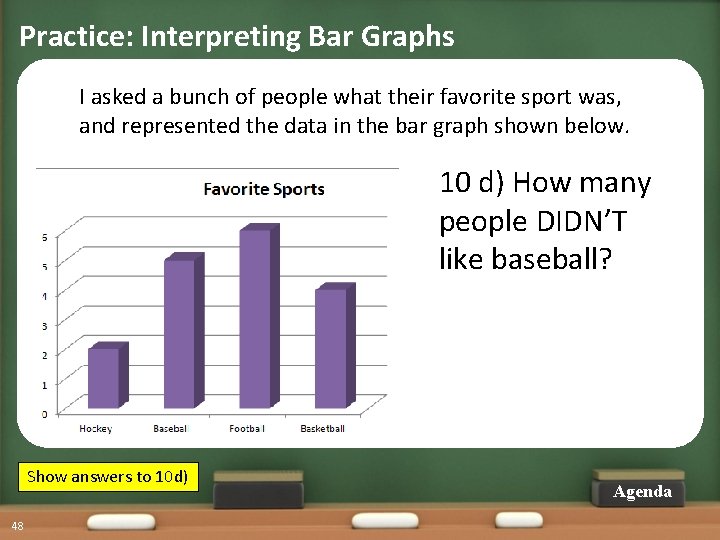
Practice: Interpreting Bar Graphs I asked a bunch of people what their favorite sport was, and represented the data in the bar graph shown below. 10 d) How many people DIDN’T like baseball? Show answers to 10 d) 48 Agenda
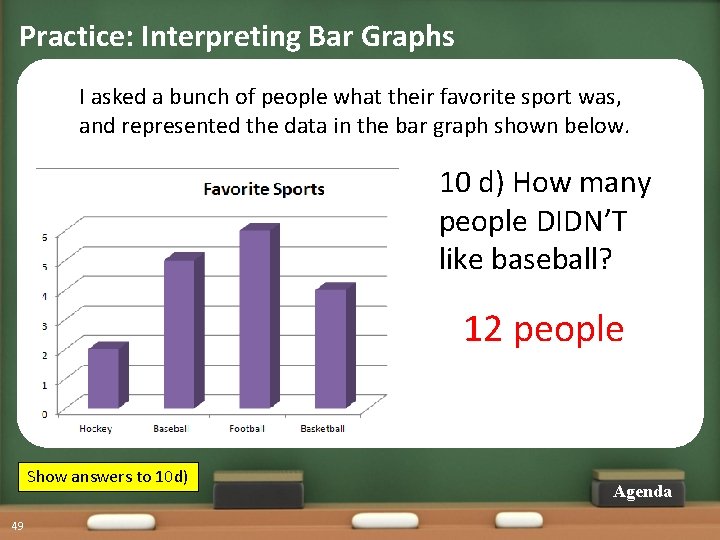
Practice: Interpreting Bar Graphs I asked a bunch of people what their favorite sport was, and represented the data in the bar graph shown below. 10 d) How many people DIDN’T like baseball? 12 people Show answers to 10 d) 49 Agenda
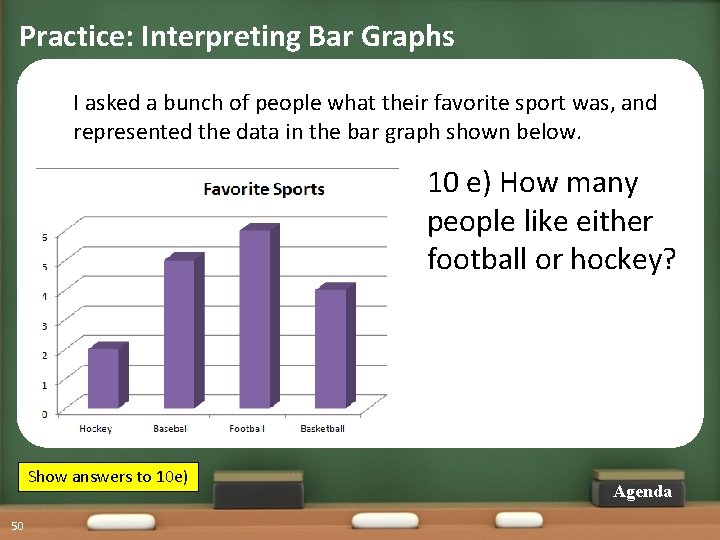
Practice: Interpreting Bar Graphs I asked a bunch of people what their favorite sport was, and represented the data in the bar graph shown below. 10 e) How many people like either football or hockey? Show answers to 10 e) 50 Agenda
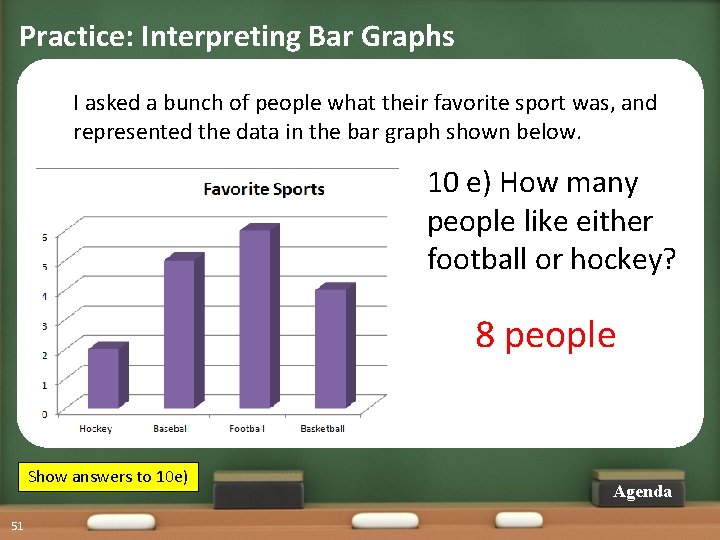
Practice: Interpreting Bar Graphs I asked a bunch of people what their favorite sport was, and represented the data in the bar graph shown below. 10 e) How many people like either football or hockey? 8 people Show answers to 10 e) 51 Agenda
Assessment – Exit Ticket! Complete and hand in the Exit Ticket before you leave! Agenda 52
- Slides: 52