
21 st Century Lessons Circumference of a Circle

- Slides: 29
21 st Century Lessons Circumference of a Circle Lesson Day 2 (of 2) Primary Lesson Designers: Meghan Mc. Goldrick Tracy Young 1
This project is funded by the American Federation of Teachers. 2
21 st Century Lessons – Teacher Preparation Please do the following as you prepare to deliver this lesson: • Spend AT LEAST 30 minutes studying the Lesson Overview, Teacher Notes on each slide, and accompanying worksheets. • Set up your projector and test this Power. Point file to make sure all animations, media, etc. work properly. • Feel free to customize this file to match the language and routines in your classroom. *1 st Time Users of 21 st Century Lesson: Click HERE for a detailed description of our project. 3
Lesson Overview (1 of 4) Lesson Objective SWBAT calculate the circumference of any circle, given the diameter or radius, using pi. Lesson Description This is the second of two lessons on circumference. The focus of this lesson is on the introduction and application of the formulas for circumference. Additionally, students are introduced to π and its role in the circumference formulas. Students will review yesterday’s lesson, engage in a pi mini lesson and introduction to formulas, and create their own definitions of circumference. They will create a “Four Corners” for their notes and participate in a “Turn and Talk” with their partners in addition to practicing through interleaving as they embed their understanding of circumference in real world situations with real life circles. 4
Lesson Overview (2 of 4) Lesson Vocabulary Materials Online Resources for Absent Students 5 Students should already be familiar with the term perimeter. Students will have the chance to review and discuss the words: Radius, Center, Diameter, Circumference, Radius Square -Class set of calculators -Copies of “Four Corner” or “Modified Four Corners” handout -Copies of “Circumference Lesson 2 Classwork” and/or “Circumference -Lesson 2 Modified Classwork” and/or “Circumference Lesson 2 Classwork Extension” handout. -Copies of “Circumference Lesson 2 Homework” handout -Online weblink available within the lesson. Learn Alberta: Circumference Digital Manipulative A video from Khan Academy shows how to find circumference of a circle. Khan Academy Find Circumference Video An applet from NCTM Diameter and Circumference Applet
Lesson Overview (3 of 4) 6 Scaffolding Lesson Modifications: The scaffolding provided in this lesson includes optional references to prior work with formulas (area and perimeter of polygons) and to the discoveries made during Circumference Lesson # 1. There also optional cloze equations to help students refine their substitution skills and a second modified classwork handout for students who will benefit from more straightforward numbers and fewer questions. Additional modifications are noted below. ELL Strategies: Best practices for ELL students are embedded in the lesson. They include, but are not limited to, “Four Corners”, “Turn and Talk”, “Think Pair Share”, real world circle images, visual representation of formulas, and class summary. NOTE: Since today’s objective is not focusing on multiplying decimals, students are able to use a calculator at the teacher’s discretion or whenever the calculator image appears in the upper right corner. Enrichment A worksheet titled Resource Class Handout Extension is available as an extension to the lesson.
Lesson Overview (4 of 4) Common Core State Standard 6. G. MA 1 a: Use the relationships among radius, diameter, and center of a circle to find its circumference and area. Before and After Before this lesson, students are familiar with perimeter and have had one exploratory lesson to discover that about 3 diameters fit around the circumference of any sized circle. After this lesson, students will go on to discover and practice how to find the area of a circle and the surface area of a rectangular prism. Topic Background Information – For background information, see Lesson 7 Research-Based Strategies - This lesson includes an opportunity for students to communicate in partners about math vocabulary, teaches students using interleaving , and includes an assessment (exit slip) at the end of the lesson. 7
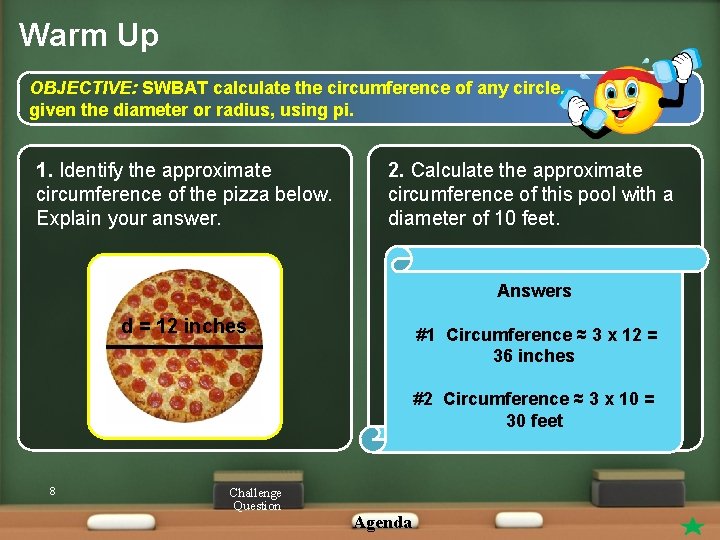
Warm Up OBJECTIVE: SWBAT calculate the circumference of any circle, given the diameter or radius, using pi. 1. Identify the approximate circumference of the pizza below. Explain your answer. 2. Calculate the approximate circumference of this pool with a diameter of 10 feet. Answers d = 12 inches #1 Circumference ≈ 3 x 12 = 36 inches #2 Circumference ≈ 3 x 10 = 30 feet 8 Challenge Question Agenda
Agenda: OBJECTIVE: SWBAT calculate the circumference of any circle, given the diameter or radius, using pi. 1) Warm Up 2) Getting Ready – Review yesterday’s lab 3) Launch – Challenge Problem 4) Mini-Lesson, History of Pi, Circumference Formulas 5) Using the Formulas 6) Four Corners – Generating Definitions 7) Turn and Talk – Sharing Four Corners 8) Interleaving Practice 9) Exit Slip 10 Agenda
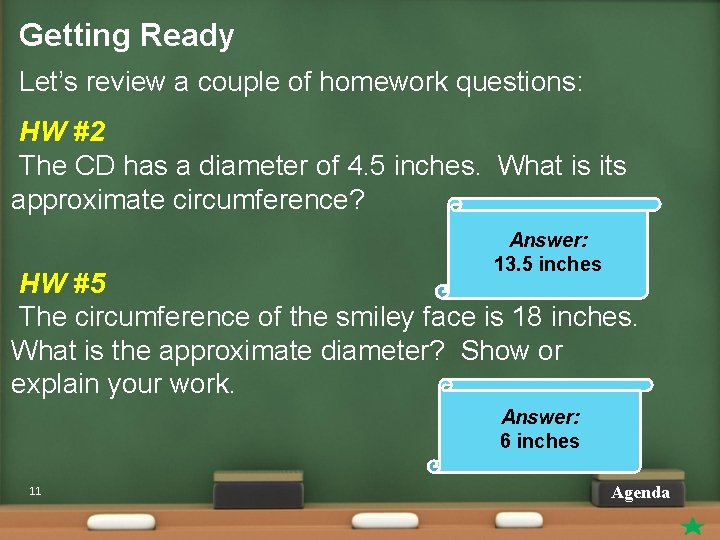
Getting Ready Let’s review a couple of homework questions: HW #2 The CD has a diameter of 4. 5 inches. What is its approximate circumference? Answer: 13. 5 inches HW #5 The circumference of the smiley face is 18 inches. What is the approximate diameter? Show or explain your work. Answer: 6 inches 11 Agenda
Launch How can you prove that the circumference of a circle is a little more than three diameter lengths? Try This! 12 Scaffolding Agenda
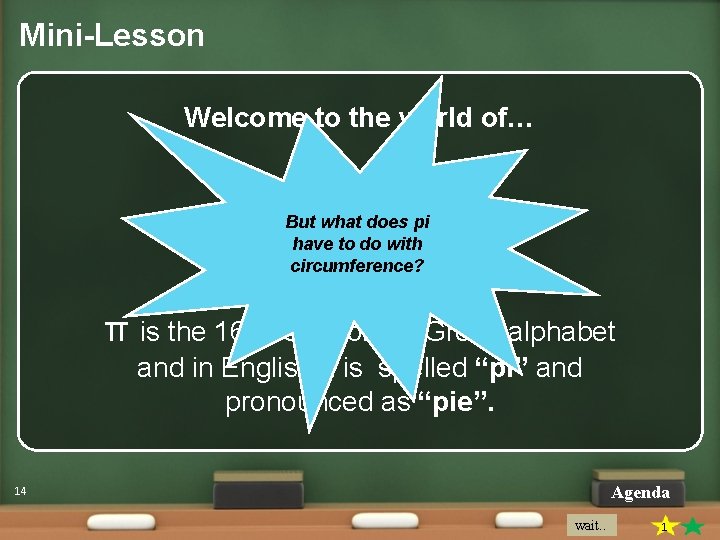
Mini-Lesson Welcome to the world of… π But what does pi have to do with circumference? π is the 16 th letter of the Greek alphabet and in English it is spelled “pi” and pronounced as “pie”. Agenda 14 wait. . 1
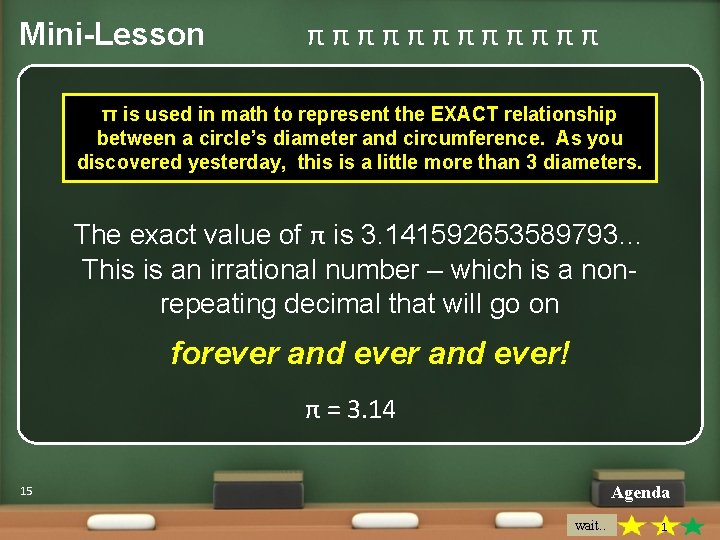
Mini-Lesson ππππππ π is used in math to represent the EXACT relationship between a circle’s diameter and circumference. As you discovered yesterday, this is a little more than 3 diameters. The exact value of π is 3. 141592653589793… This is an irrational number – which is a nonrepeating decimal that will go on forever and ever! π = 3. 14 Agenda 15 wait. . 1
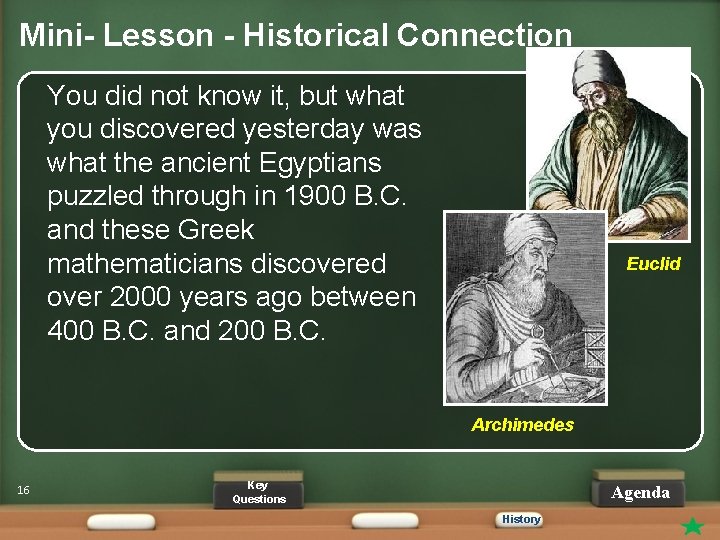
Mini- Lesson - Historical Connection You did not know it, but what you discovered yesterday was what the ancient Egyptians puzzled through in 1900 B. C. and these Greek mathematicians discovered over 2000 years ago between 400 B. C. and 200 B. C. Euclid Archimedes 16 Key Questions Agenda History
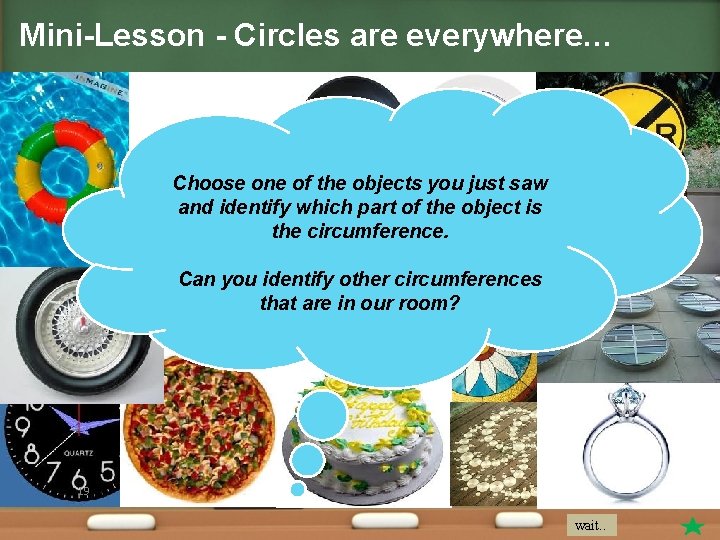
Mini-Lesson - Circles are everywhere… Choose one of the objects you just saw and identify which part of the object is the circumference. Can you identify other circumferences that are in our room? 19 wait. .
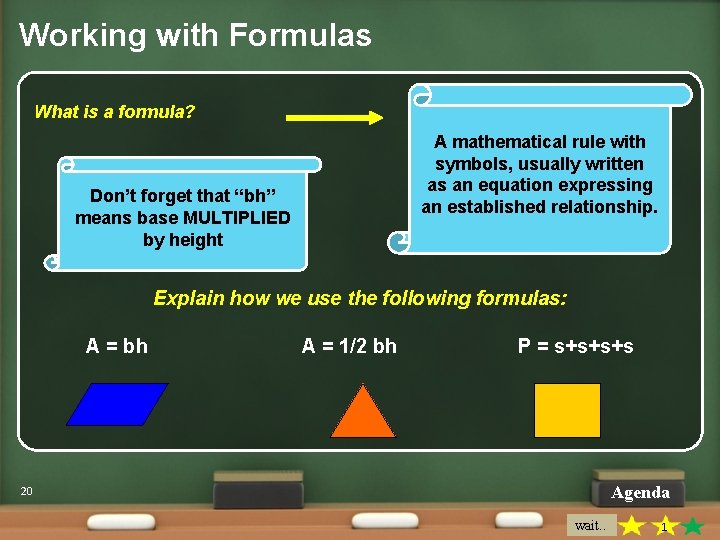
Working with Formulas What is a formula? A mathematical rule with symbols, usually written as an equation expressing an established relationship. Don’t forget that “bh” means base MULTIPLIED by height Explain how we use the following formulas: A = bh A = 1/2 bh P = s+s+s+s Agenda 20 wait. . 1
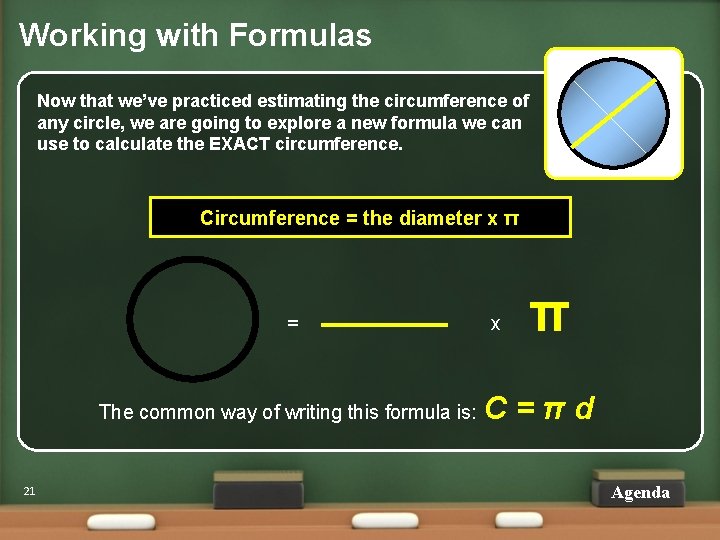
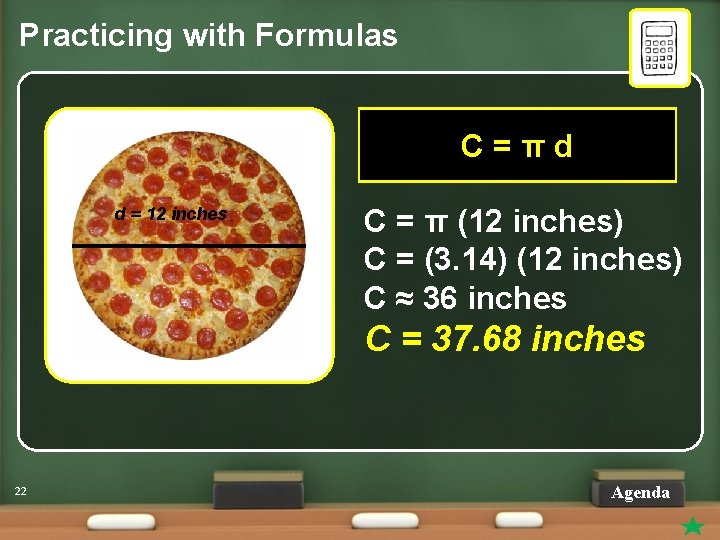
Working with Formulas Now that we’ve practiced estimating the circumference of any circle, we are going to explore a new formula we can use to calculate the EXACT circumference. Circumference = the diameter x π = The common way of writing this formula is: 21 x π C=πd Agenda
Practicing with Formulas C=πd d = 12 inches C = π (12 inches) C = (3. 14) (12 inches) C ≈ 36 inches C = 37. 68 inches 22 Agenda
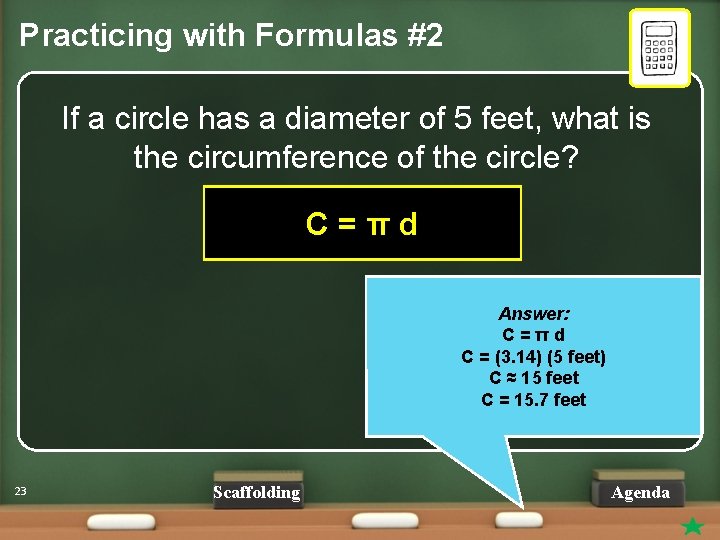
Practicing with Formulas #2 If a circle has a diameter of 5 feet, what is the circumference of the circle? C=πd Answer: C=πd C = (3. 14) (5 feet) C ≈ 15 feet C = 15. 7 feet 23 Scaffolding Agenda
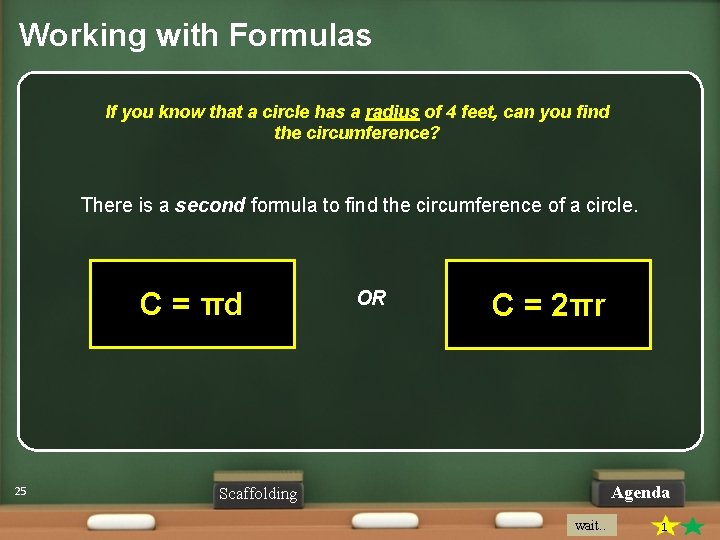
Working with Formulas If you know that a circle has a radius of 4 feet, can you find the circumference? There is a second formula to find the circumference of a circle. C = πd 25 OR C = 2πr Agenda Scaffolding wait. . 1
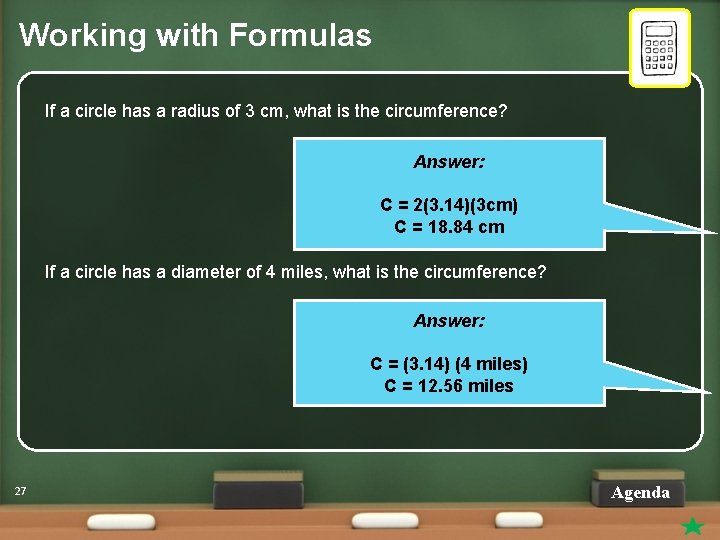
Working with Formulas If a circle has a radius of 3 cm, what is the circumference? Answer: C = 2(3. 14)(3 cm) C = 18. 84 cm If a circle has a diameter of 4 miles, what is the circumference? Answer: C = (3. 14) (4 miles) C = 12. 56 miles 27 Agenda
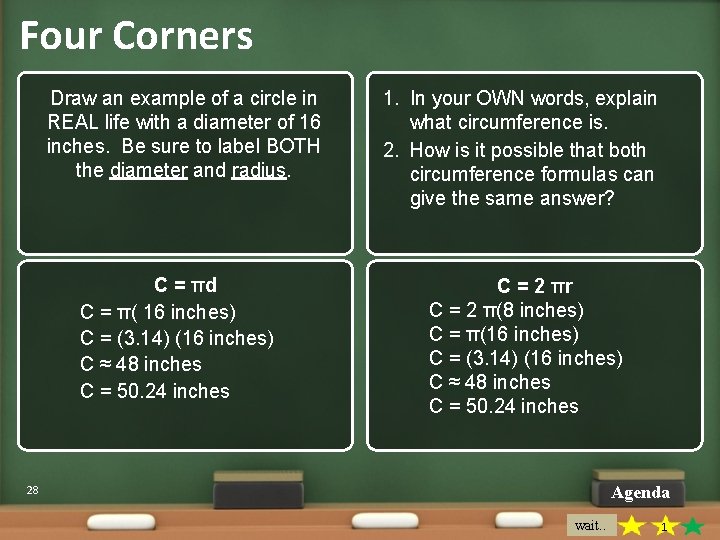
Four Corners Draw an example of a circle in REAL life with a diameter of 16 inches. Be sure to label BOTH the diameter and radius. C = πd C = π( 16 inches) C = (3. 14) (16 inches) C ≈ 48 inches C = 50. 24 inches 1. In your OWN words, explain what circumference is. 2. How is it possible that both circumference formulas can give the same answer? C = 2 πr C = 2 π(8 inches) C = π(16 inches) C = (3. 14) (16 inches) C ≈ 48 inches C = 50. 24 inches Agenda 28 wait. . 1
Turn and Talk Share your real life circle and Four Corners definition with your partner. If your partner gives you a good idea, be sure to add those details to your own Four Corners Sheet. 29 Agenda
Let’s Practice Now it’s your turn to practice! Using today’s notes, work independently through these few questions. You will have an opportunity to check in and compare answers with your partner before we go over these as a class. 30 Agenda
Let’s Practice (Optional) Now that you have mastered circumference, there a few challenge questions for you to tackle. 31 Agenda
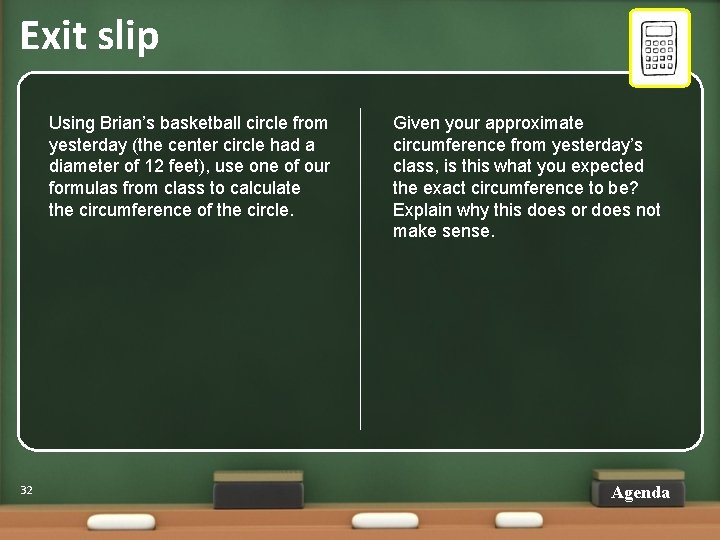
Exit slip Using Brian’s basketball circle from yesterday (the center circle had a diameter of 12 feet), use one of our formulas from class to calculate the circumference of the circle. 32 Given your approximate circumference from yesterday’s class, is this what you expected the exact circumference to be? Explain why this does or does not make sense. Agenda
Homework Any Questions? 33 Agenda
21 st Century Lessons The goal… The goal of 21 st Century Lessons is simple: We want to assist teachers, particularly in urban and turnaround schools, by bringing together teams of exemplary educators to develop units of high-quality, model lessons. These lessons are intended to: • Support an increase in student achievement; • Engage teachers and students; • Align to the Common Core State Standards and the Massachusetts curriculum frameworks; • Embed best teaching practices, such as differentiated instruction; • Incorporate high-quality multi-media and design (e. g. , Power. Point); • Be delivered by exemplary teachers for videotaping to be used for professional development and other teacher training activities; • Be available, along with videos and supporting materials, to teachers free of charge via the Internet. • Serve as the basis of high-quality, teacher-led professional development, including mentoring between experienced and novice teachers. 41
21 st Century Lessons The people… Directors: Kathy Aldred - Co-Chair of the Boston Teachers Union Professional Issues Committee Ted Chambers - Co-director of 21 st Century Lessons Tracy Young - Staffing Director of 21 st Century Lessons Leslie Ryan Miller - Director of the Boston Public Schools Office of Teacher Development and Advancement Kevin Qazilbash - Co-director of 21 st Century Lessons Lesson Designers: Stephanie Conklin Meghan Mc. Goldrick Lisa Schad Sarita Thomas Shane Ulrich Project Specialist: Kimberly Anderson Meideros 42