
21 st Century Employability Skills Communication Lesson 2
21 st Century Employability Skills Communication: Lesson 2 Communication Styles
4 Primary Attributes of Communication Lesson Focus: 1 & 4 1. Speaks in a professional manner, uses appropriate content, and says things in a way that others will understand. 2. Can communicate using technology tools like email, Linked. In, or Power. Point slide shows. Knows how to use social media appropriately in work settings. 3. Knows how to choose words wisely and use non-verbal communication to make meaning clear. When writing uses correct spelling and grammar to make meaning clear. 4. Is an attentive listener and asks questions or repeats back what was heard to make sure everything was understood correctly.
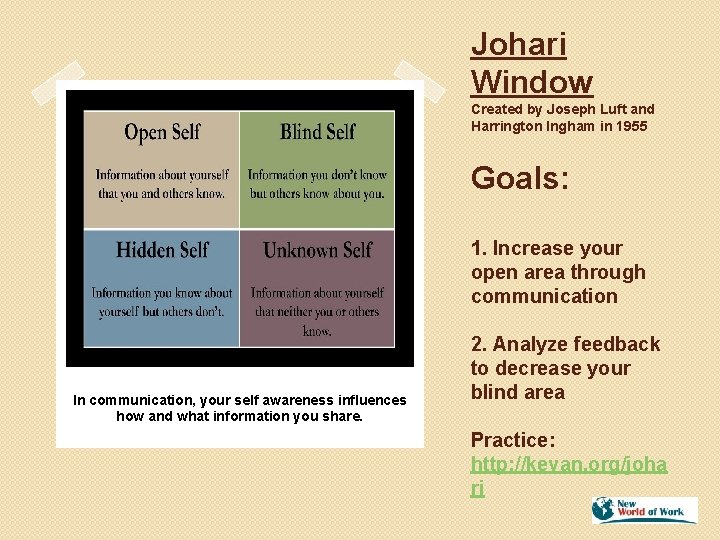
Johari Window Created by Joseph Luft and Harrington Ingham in 1955 Goals: 1. Increase your open area through communication In communication, your self awareness influences how and what information you share. 2. Analyze feedback to decrease your blind area Practice: http: //kevan. org/joha ri
Action Steps to Improve Communication �Self assess your communication style(s) �Make �Learn �Find to identify the style(s) of others adjustments based on who you are communicating with common ground

Communication Styles �Supporter/Relater communicator �Analyzer/Thinker communicator (O/I): Process focused (G/I): Idea focused �Promoter/Socializer (O/D): People focused communicator �Controller/Director communicator (G/D): Action focused
Active/ Attentive Listening �Be observant of visual clues �Pay attention to information and the way it is delivered �Ask questions and check that you understand what the speaker means �Try to determine the speaker’s communication style so you can adapt your own to find common ground
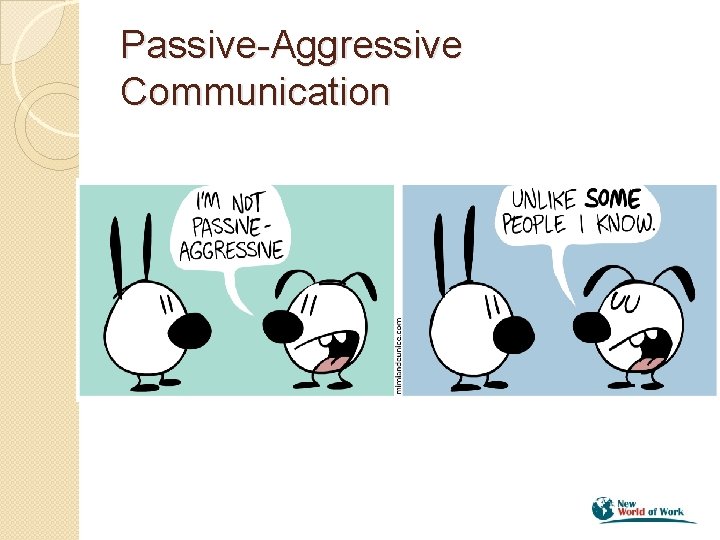
Passive-Aggressive Communication
Definition: � Passive aggressive communication is used to express: anger, frustration, stress, or unsettled feelings � This � is done INDIRECTLY The speaker does not take responsibility for those feelings but can deflect them on others � Pay attention to tone and non verbal communication to help identify passive aggressive behavior
Major Types of P-A Communication: �Denial �Guilting �Blaming �Sarcasm �Revenge Seeking �Back �Controlling Stabbing
COMMON P-A PHRASES Pay attention to tone and how it relates to the meaning behind words. Can you come up with other examples? � "I'm not mad. ” � "Fine. " "Whatever. ” � "Sure, I'd be happy to. ” � "I was only joking!” � "Why are you getting so upset? ” � "You just want everything to be perfect. "
Action Steps to Confront P-A Communication � Don’t take it personally: the speaker is projecting his/her frustrations onto you � Moderate your response: stay calm, use a neutral voice, avoid escalating the situation � Check for understanding: “it seems you are frustrated by…” or “am I understanding correctly that you think/feel…” � Be direct: “When you communicate in this way it comes across to me as passiveaggressive…” or “what you said made me feel…”
NWo. W Playlist: www. youtube. com/playlist ? list=PLWCjcr. Qp. Qi. FZn 9 k Wv. XIKTnd-DOsc. OEs 6 A Communication Assessment Video
NEXT STEPS: PRACTICE! Courses: Communication Communicating with Confidence Communicating Across Cultures Communicating with Empathy Grammar Fundamentals Linked. In and New World of Effective Listening Work have partnered to provide suggested next Videos: st steps after each of the 21 Simplify communication with Century Skills lessons. templates and tools Using email as a Go to: www. linkedin. com/learning communication tool Tips on These videos will help you nonverbal communication Refining your verbal communication continue to explore Communication. You can Practicing the grammar rules earn certificates of completion to post on your Becoming a better listener Linked. In profiles along with any of your digital badges and skills verifications.
- Slides: 13