
21 LOGICAL FALLACIES English III What is a
- Slides: 27
21 LOGICAL FALLACIES English III
What is a logical fallacy? Error in reasoning that undermines the logic of an argument Can be illegitimate arguments or irrelevant points Usually lack evidence to support claims
1. Ad Hominem Literally means “against the man” Attacks the person creating the argument Diverts from the actual validity of an argument Ex. Bob’s idea is wrong because he does not like cats. People who hate cats are horrible.
2. Ambiguity As a feature of language, ambiguity occurs when a word or phrase has more than one meaning. Example: The warrant officer sent city police out at 11: 38 a. m. to kick kids off the roof of a downtown furniture store.
3. Appeal to Ignorance A proposition is true simply on the basis that it has not been proven false or that it is false simply because it has not been proven true. Example: Since the class has no questions concerning the topics discussed in class, the class is ready for a test.
4. Appeal to Pity When a person substitutes a claim intended to create pity for evidence in an argument. Example: Haley: "He'd be a terrible coach for the team. " Shayna: "He had his heart set on the job, and it would break if he didn't get it. " Haley: "I guess he'll do an adequate job. "
5. Bandwagon Bases argument around what the majority believe The majority’s opinion must be correct; thus, a person should believe in the majority Ex. Ninety percent of people prefer Apple computers to IBMs; thus Apple computers are better than IBM computers.
6. Begging the Question Using the conclusion as a premise to prove the conclusion. (redundancy) Example: I was late because I didn't get there in time. Example You want to know why I failed the test? I failed the test because I didn't pass it.
7. Circular argumentation Also known as “begging the question” Assumes what it tries to prove Writer or speaker uses no actual proof to support their claims Ex. Bill Clinton is a good orator because he speaks effectively.
8. Either/or Fallacy Writer or speaker implies there are only two choices Creates a simple outcome to a complex problem Usually uses very strong generalizations Either you can stay in here or go outside and freeze to death.
9. Faulty Authority When a person in question is not a legitimate authority on the subject. Example: I’m not a doctor, but I play one on TV.
10. Genetic Fallacy Idea, person, or product is untrustworthy due to racial, geographic, or ethnic origin. Ex 1. That car must have failing brakes because it was made in Japan! Ex 2. All of these Chinese products cannot be any good. They were probably made using cheap Chinese labor.
11. Guilt by Association A fallacy in which a person rejects a claim simply because it is pointed out that people she dislikes accept the claim. Example: Social security is a state funded old-age pension. Nazis supported state funded old-age pensions. Therefore, social security is bad.
12. Hasty Generalization Known as “Dicto Simpliciter” Uses faulty inductive reasoning Bases reasoning on insufficient or biased evidence Usually not an accurate statement Ex. Fifty percent of women trying to get their license failed. Thus women are bad at driving. But, this sample was taken from two women.
13. Moral Equivalence Compares harmless actions with atrocious behavior Unfair and inaccurate comparison Ex. That parking attendant who gave me a ticket is as bad as Hitler.
14. Non Sequitur Literally means “It does not follow” Any argument that does not follow from previous statements Speaker may leave out a step in her argument Conclusion may be completely unrelated Ex. Ralph Wiggum: Martin Luther King had a dream. Dreams are where Elmo and Toy Story had a party and I was invited. Yay! My turn is over! Principal Skinner: One of your best, Ralphie. ("The Color Yellow, " The Simpsons)
15. Oversimplification Ignoring the complicated issues behind an argument. Very often only one possible cause for a current situation is addressed rather than addressing the multiple causes that often gives rise to the problem. Example: If Joe would just stop smoking, he could avoid a heart attack.
16. Post Hoc Writer or speaker assumes a false relationship between two events simply because one event happened before another. No actual correlation between the two events is established Ex. A black cat crossed my path. Later, I took Mr. Boesch’s lit term quiz and failed. The cat must have caused me to fail.
17. Red Herring Attempts to change the subject Use to divert argument from the real issues Usually changes the subject to something completely irrelevant Ex. We admit healthcare important, but the issue at hand here is childhood obesity.
18. Scare Tactic Creating fear in people, which does not constitute evidence for a claim. Example: Because of the possibility of a terrorist hijacking or a mechanical failure, flying on a plane is too dangerous and should be avoided altogether.
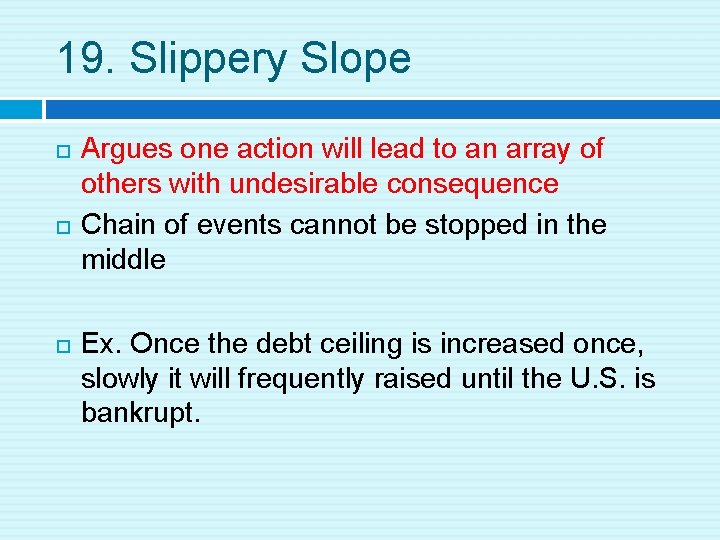
19. Slippery Slope Argues one action will lead to an array of others with undesirable consequence Chain of events cannot be stopped in the middle Ex. Once the debt ceiling is increased once, slowly it will frequently raised until the U. S. is bankrupt.
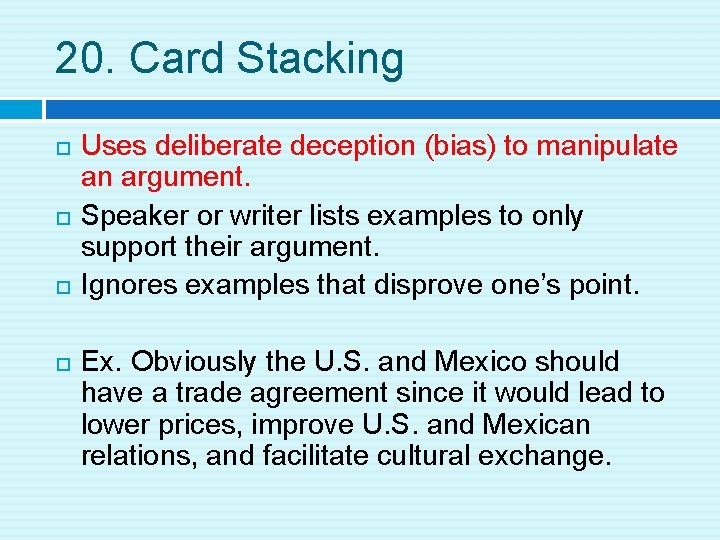
20. Card Stacking Uses deliberate deception (bias) to manipulate an argument. Speaker or writer lists examples to only support their argument. Ignores examples that disprove one’s point. Ex. Obviously the U. S. and Mexico should have a trade agreement since it would lead to lower prices, improve U. S. and Mexican relations, and facilitate cultural exchange.
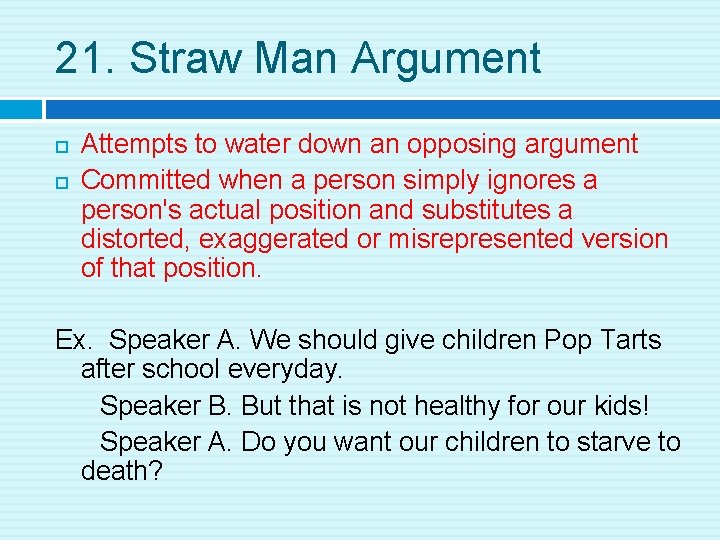
21. Straw Man Argument Attempts to water down an opposing argument Committed when a person simply ignores a person's actual position and substitutes a distorted, exaggerated or misrepresented version of that position. Ex. Speaker A. We should give children Pop Tarts after school everyday. Speaker B. But that is not healthy for our kids! Speaker A. Do you want our children to starve to death?
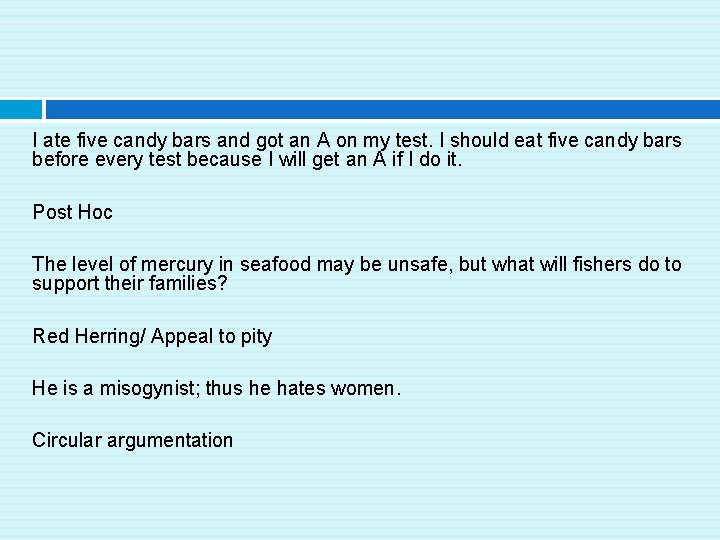
I ate five candy bars and got an A on my test. I should eat five candy bars before every test because I will get an A if I do it. Post Hoc The level of mercury in seafood may be unsafe, but what will fishers do to support their families? Red Herring/ Appeal to pity He is a misogynist; thus he hates women. Circular argumentation
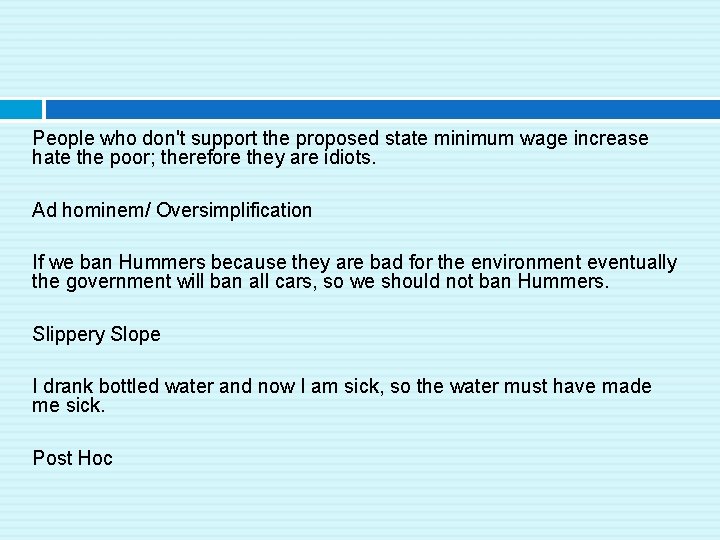
People who don't support the proposed state minimum wage increase hate the poor; therefore they are idiots. Ad hominem/ Oversimplification If we ban Hummers because they are bad for the environment eventually the government will ban all cars, so we should not ban Hummers. Slippery Slope I drank bottled water and now I am sick, so the water must have made me sick. Post Hoc
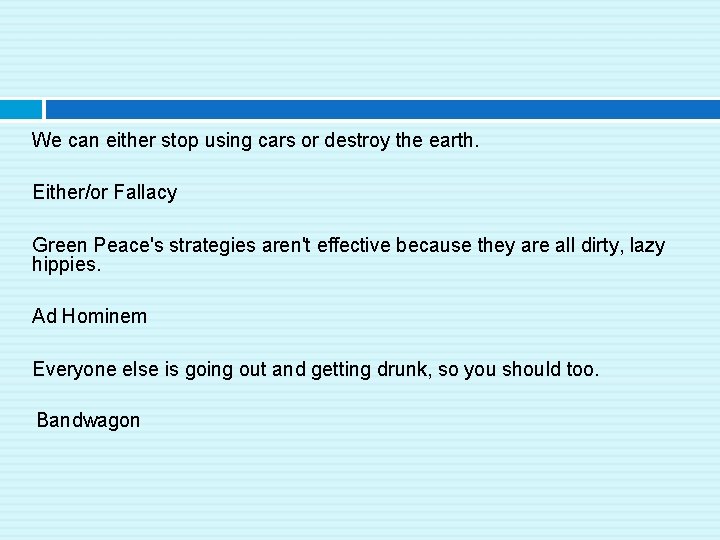
We can either stop using cars or destroy the earth. Either/or Fallacy Green Peace's strategies aren't effective because they are all dirty, lazy hippies. Ad Hominem Everyone else is going out and getting drunk, so you should too. Bandwagon
Works Cited "Logical Fallacies. " http: //owl. english. purdue. edu. N. p. , n. d. Web. 07 Nov. 2012. Wheeler, L. Kip. "Logical Fallacies Handlist. " Web. cn. edu. N. p. , n. d. Web. 7 Nov. 2012