
21 January 2022 Applications of exponential and logarithmic
- Slides: 11
21 January 2022 Applications of exponential and logarithmic functions Lesson objective: Solve problems involving exponential or logarithmic functions in real life situations.
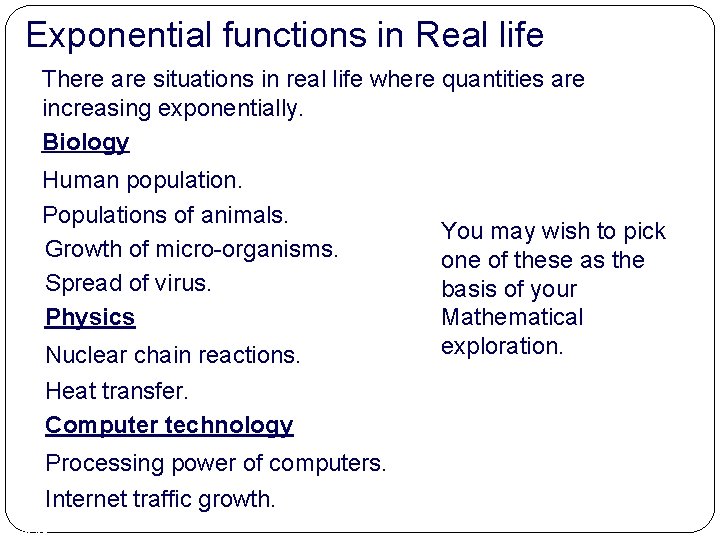
Exponential functions in Real life There are situations in real life where quantities are increasing exponentially. Biology Human population. Populations of animals. Growth of micro-organisms. Spread of virus. Physics Nuclear chain reactions. Heat transfer. Computer technology Processing power of computers. Internet traffic growth. 2 of 48 You may wish to pick one of these as the basis of your Mathematical exploration.
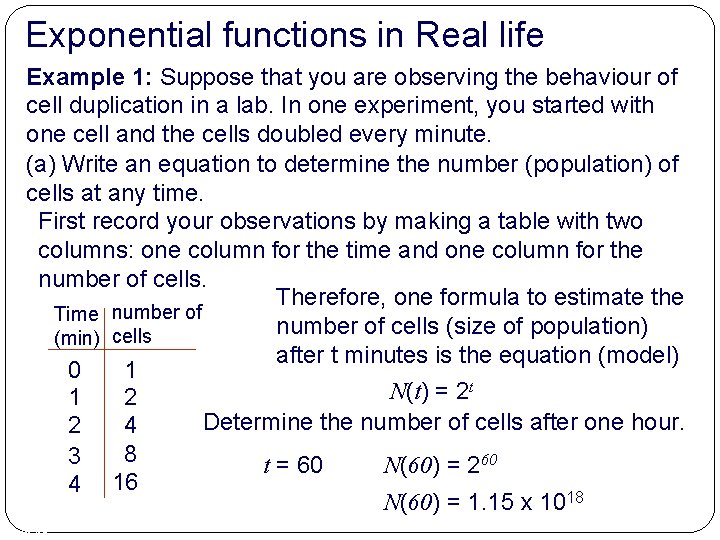
Exponential functions in Real life Example 1: Suppose that you are observing the behaviour of cell duplication in a lab. In one experiment, you started with one cell and the cells doubled every minute. (a) Write an equation to determine the number (population) of cells at any time. First record your observations by making a table with two columns: one column for the time and one column for the number of cells. Therefore, one formula to estimate the number of Time number of cells (size of population) (min) cells after t minutes is the equation (model) 0 1 N(t) = 2 t 1 2 Determine the number of cells after one hour. 2 4 8 3 N(60) = 260 t = 60 4 16 N(60) = 1. 15 x 1018 3 of 48
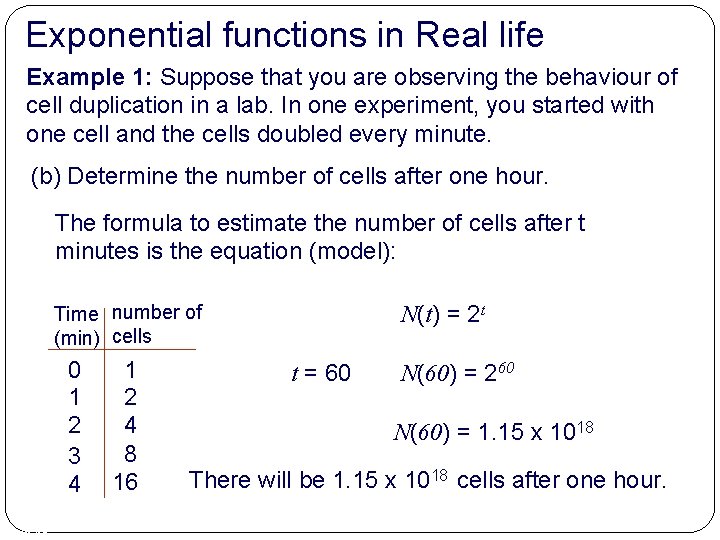
Exponential functions in Real life Example 1: Suppose that you are observing the behaviour of cell duplication in a lab. In one experiment, you started with one cell and the cells doubled every minute. (b) Determine the number of cells after one hour. The formula to estimate the number of cells after t minutes is the equation (model): Time number of (min) cells 0 1 2 3 4 4 of 48 1 2 4 8 16 N(t) = 2 t t = 60 N(60) = 260 N(60) = 1. 15 x 1018 There will be 1. 15 x 1018 cells after one hour.
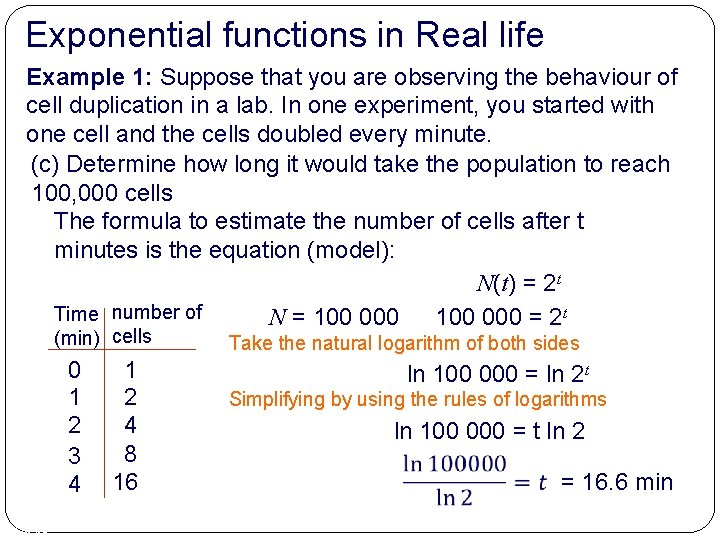
Exponential functions in Real life Example 1: Suppose that you are observing the behaviour of cell duplication in a lab. In one experiment, you started with one cell and the cells doubled every minute. (c) Determine how long it would take the population to reach 100, 000 cells The formula to estimate the number of cells after t minutes is the equation (model): N(t) = 2 t Time number of N = 100 000 = 2 t (min) cells 0 1 2 3 4 5 of 48 1 2 4 8 16 Take the natural logarithm of both sides ln 100 000 = ln 2 t Simplifying by using the rules of logarithms ln 100 000 = t ln 2 = 16. 6 min
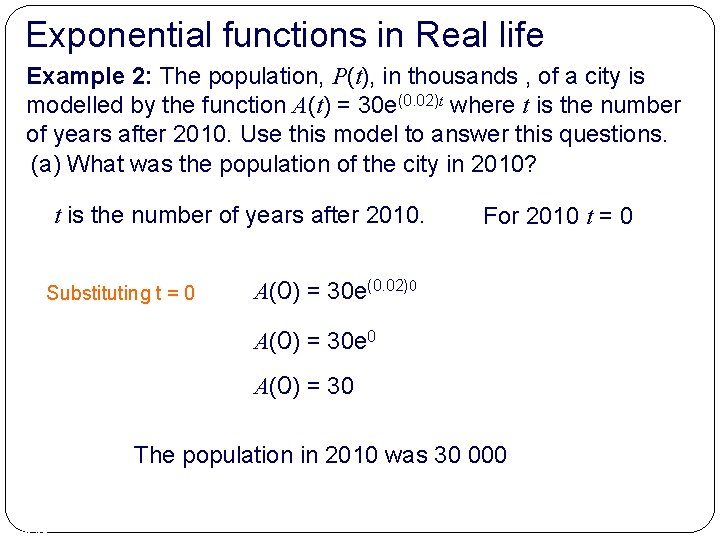
Exponential functions in Real life Example 2: The population, P(t), in thousands , of a city is modelled by the function A(t) = 30 e(0. 02)t where t is the number of years after 2010. Use this model to answer this questions. (a) What was the population of the city in 2010? t is the number of years after 2010. Substituting t = 0 For 2010 t = 0 A(0) = 30 e(0. 02)0 A(0) = 30 e 0 A(0) = 30 The population in 2010 was 30 000 6 of 48
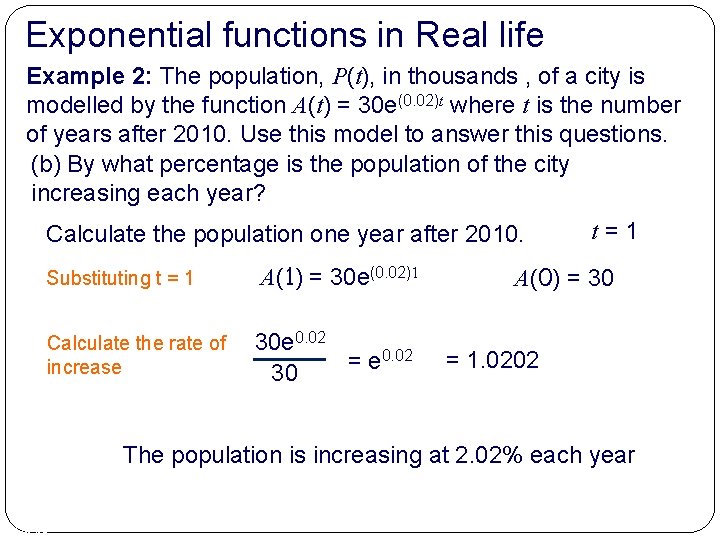
Exponential functions in Real life Example 2: The population, P(t), in thousands , of a city is modelled by the function A(t) = 30 e(0. 02)t where t is the number of years after 2010. Use this model to answer this questions. (b) By what percentage is the population of the city increasing each year? Calculate the population one year after 2010. Substituting t = 1 Calculate the rate of increase A(1) = 30 e(0. 02)1 30 e 0. 02 = e 30 t=1 A(0) = 30 = 1. 0202 The population is increasing at 2. 02% each year 7 of 48
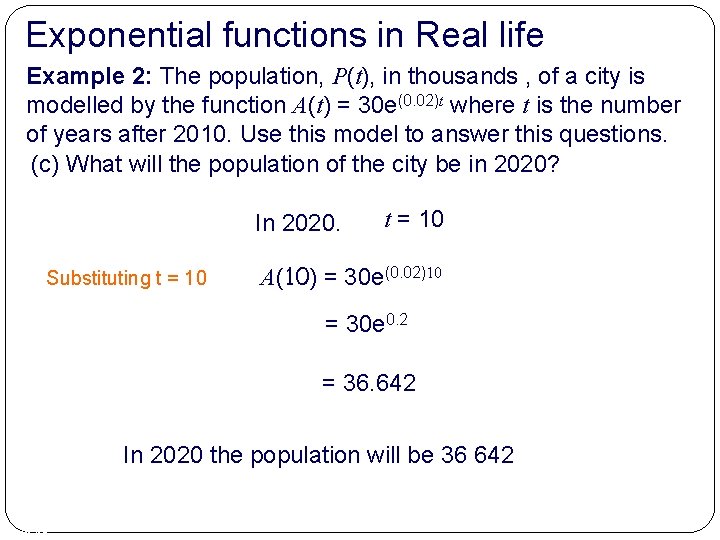
Exponential functions in Real life Example 2: The population, P(t), in thousands , of a city is modelled by the function A(t) = 30 e(0. 02)t where t is the number of years after 2010. Use this model to answer this questions. (c) What will the population of the city be in 2020? In 2020. Substituting t = 10 A(10) = 30 e(0. 02)10 = 30 e 0. 2 = 36. 642 In 2020 the population will be 36 642 8 of 48
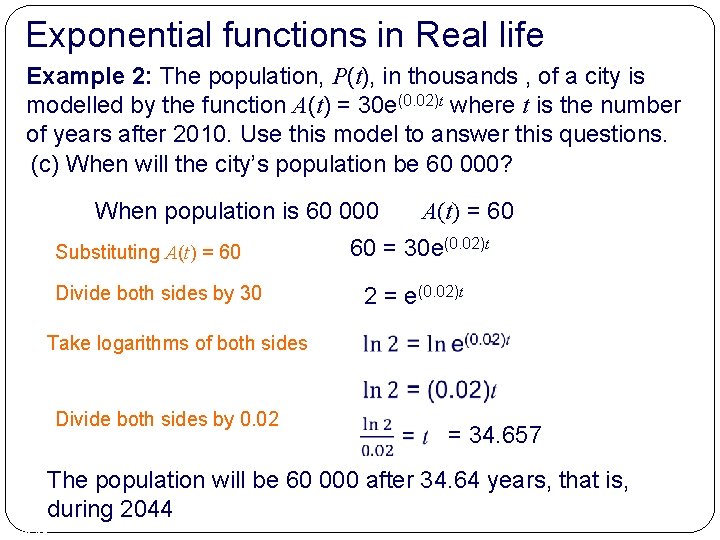
Exponential functions in Real life Example 2: The population, P(t), in thousands , of a city is modelled by the function A(t) = 30 e(0. 02)t where t is the number of years after 2010. Use this model to answer this questions. (c) When will the city’s population be 60 000? When population is 60 000 Substituting A(t) = 60 Divide both sides by 30 A(t) = 60 60 = 30 e(0. 02)t 2 = e(0. 02)t Take logarithms of both sides Divide both sides by 0. 02 = 34. 657 The population will be 60 000 after 34. 64 years, that is, during 2044 9 of 48
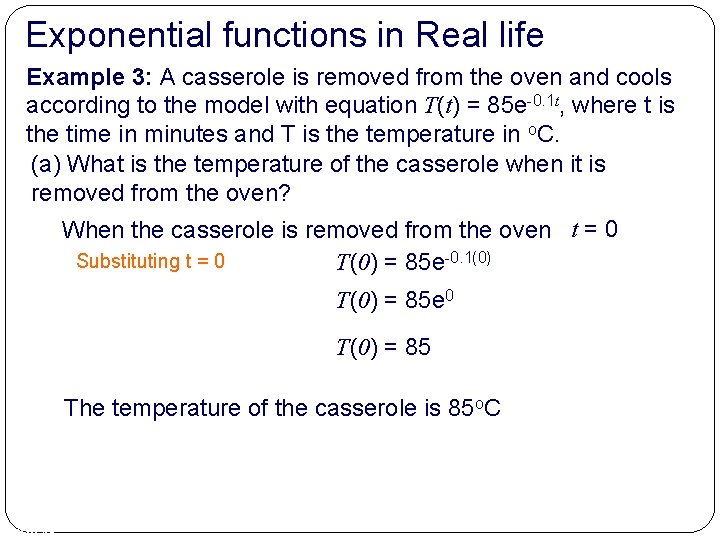
Exponential functions in Real life Example 3: A casserole is removed from the oven and cools according to the model with equation T(t) = 85 e-0. 1 t, where t is the time in minutes and T is the temperature in o. C. (a) What is the temperature of the casserole when it is removed from the oven? When the casserole is removed from the oven t = 0 Substituting t = 0 T(0) = 85 e-0. 1(0) T(0) = 85 e 0 T(0) = 85 The temperature of the casserole is 85 o. C 10 of 48
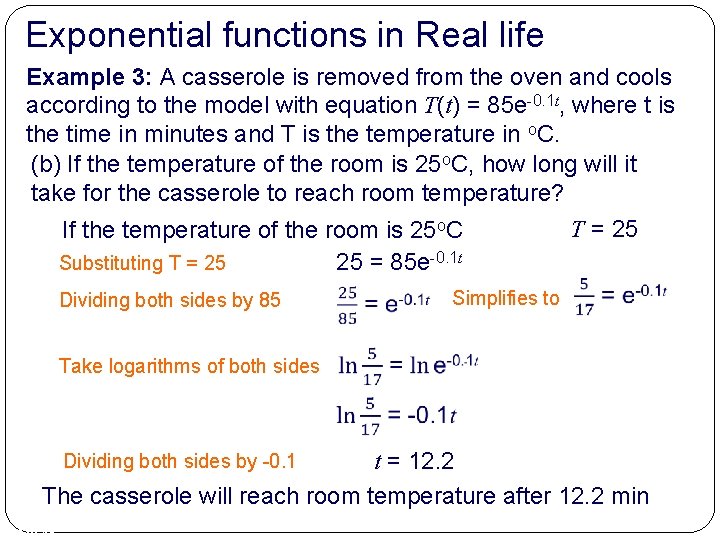
Exponential functions in Real life Example 3: A casserole is removed from the oven and cools according to the model with equation T(t) = 85 e-0. 1 t, where t is the time in minutes and T is the temperature in o. C. (b) If the temperature of the room is 25 o. C, how long will it take for the casserole to reach room temperature? If the temperature of the room is 25 o. C Substituting T = 25 25 = 85 e-0. 1 t Dividing both sides by 85 T = 25 Simplifies to Take logarithms of both sides t = 12. 2 The casserole will reach room temperature after 12. 2 min Dividing both sides by -0. 1 11 of 48