
21 4 DNA Replication The function of DNA
- Slides: 10
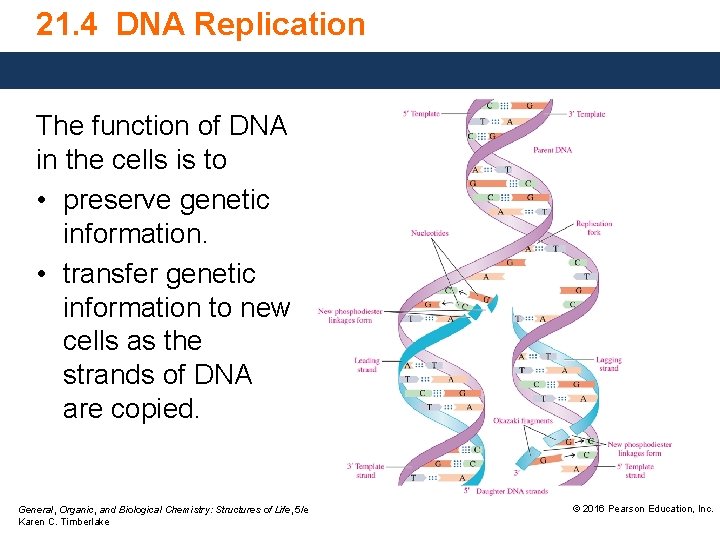
21. 4 DNA Replication The function of DNA in the cells is to • preserve genetic information. • transfer genetic information to new cells as the strands of DNA are copied. General, Organic, and Biological Chemistry: Structures of Life, 5/e Karen C. Timberlake © 2016 Pearson Education, Inc.
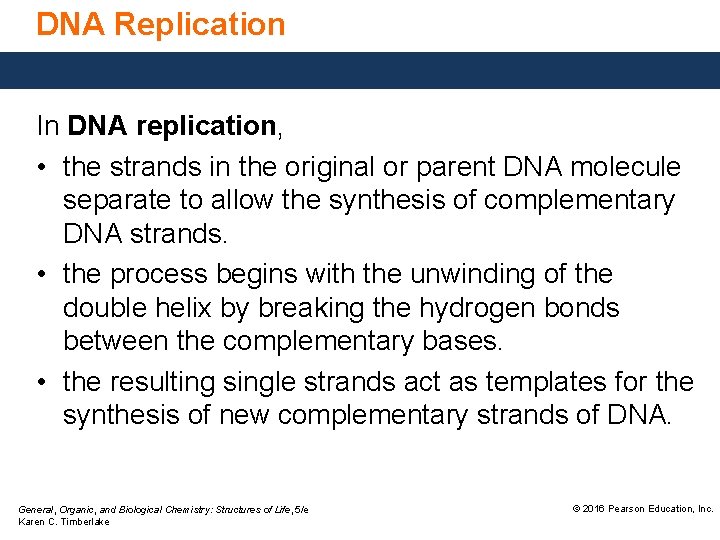
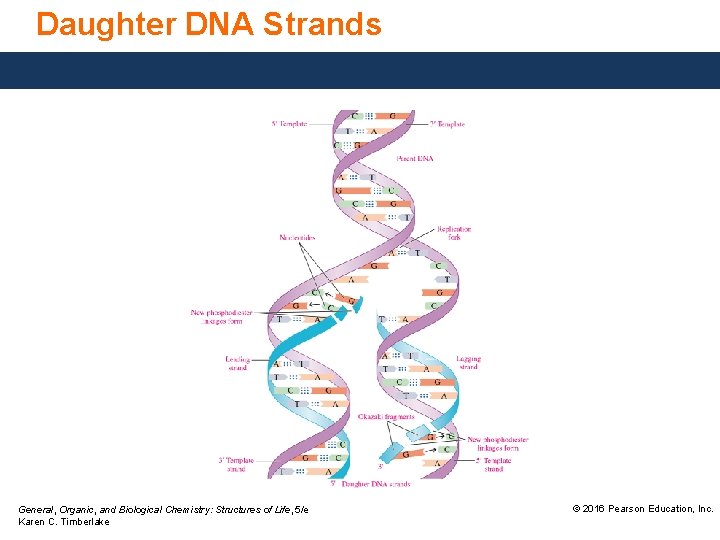
DNA Replication In DNA replication, • the strands in the original or parent DNA molecule separate to allow the synthesis of complementary DNA strands. • the process begins with the unwinding of the double helix by breaking the hydrogen bonds between the complementary bases. • the resulting single strands act as templates for the synthesis of new complementary strands of DNA. General, Organic, and Biological Chemistry: Structures of Life, 5/e Karen C. Timberlake © 2016 Pearson Education, Inc.
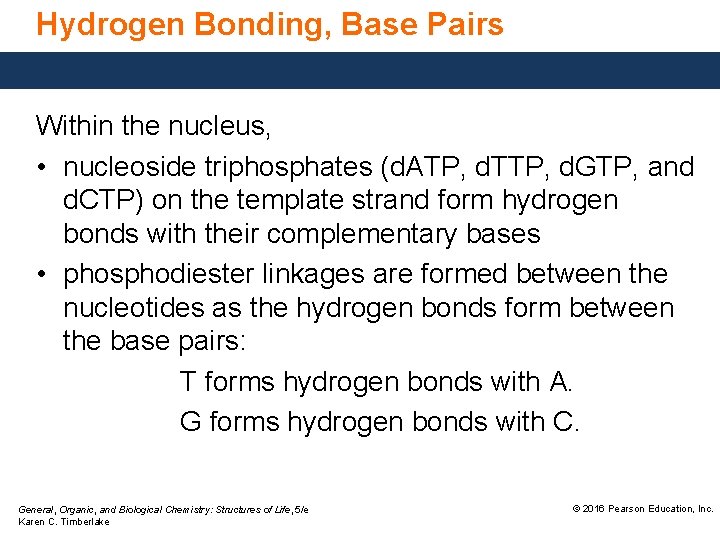
Hydrogen Bonding, Base Pairs Within the nucleus, • nucleoside triphosphates (d. ATP, d. TTP, d. GTP, and d. CTP) on the template strand form hydrogen bonds with their complementary bases • phosphodiester linkages are formed between the nucleotides as the hydrogen bonds form between the base pairs: T forms hydrogen bonds with A. G forms hydrogen bonds with C. General, Organic, and Biological Chemistry: Structures of Life, 5/e Karen C. Timberlake © 2016 Pearson Education, Inc.
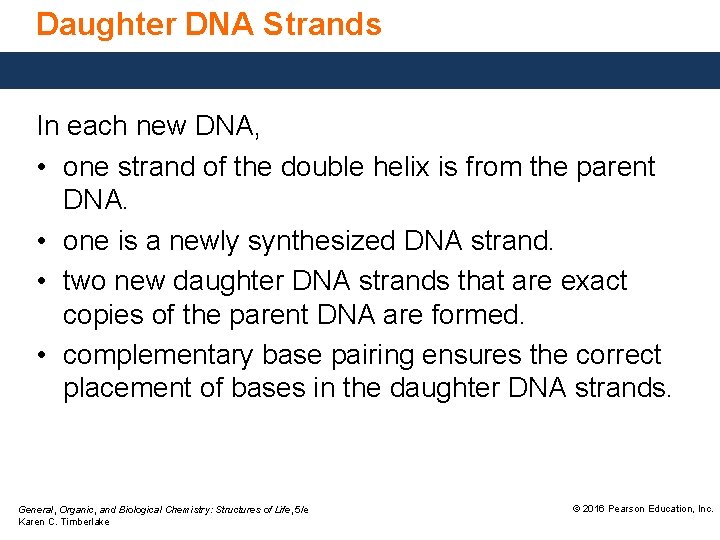
Daughter DNA Strands In each new DNA, • one strand of the double helix is from the parent DNA. • one is a newly synthesized DNA strand. • two new daughter DNA strands that are exact copies of the parent DNA are formed. • complementary base pairing ensures the correct placement of bases in the daughter DNA strands. General, Organic, and Biological Chemistry: Structures of Life, 5/e Karen C. Timberlake © 2016 Pearson Education, Inc.
Daughter DNA Strands General, Organic, and Biological Chemistry: Structures of Life, 5/e Karen C. Timberlake © 2016 Pearson Education, Inc.
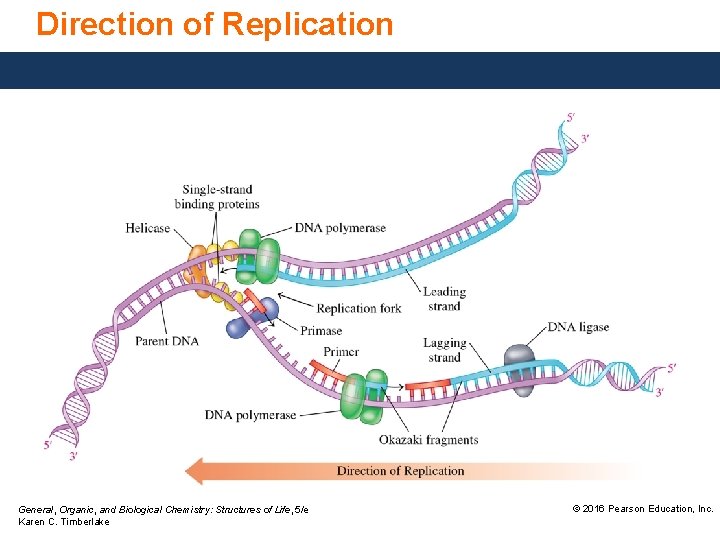
Direction of Replication During DNA replication, • helicase unwinds the parent DNA at several sections. • DNA polymerase catalyzes the replication process at each of the open DNA sections called replication forks. • the polymerase moves in the 3′– 5′direction, catalyzing the formation of new phosphodiester linkages. • the lagging strand (growing in the 5′– 3′ direction) is synthesized in short sections called Okazaki fragments. • DNA ligase joins the Okazaki fragments. General, Organic, and Biological Chemistry: Structures of Life, 5/e Karen C. Timberlake © 2016 Pearson Education, Inc.
Direction of Replication General, Organic, and Biological Chemistry: Structures of Life, 5/e Karen C. Timberlake © 2016 Pearson Education, Inc.
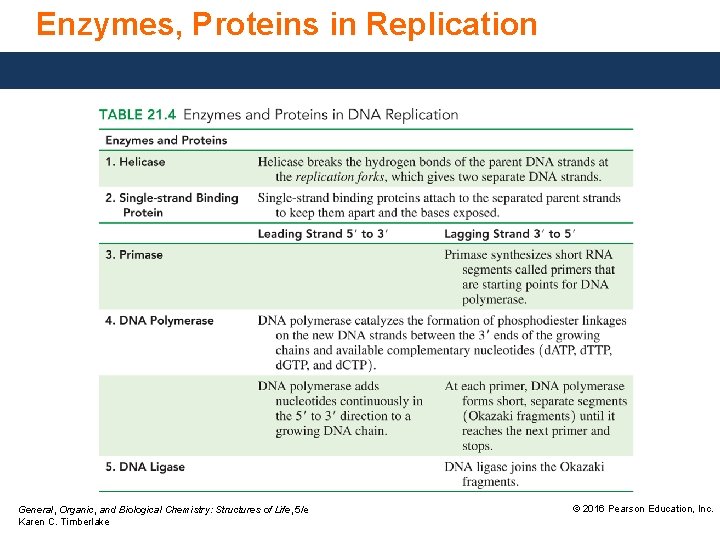
Enzymes, Proteins in Replication General, Organic, and Biological Chemistry: Structures of Life, 5/e Karen C. Timberlake © 2016 Pearson Education, Inc.
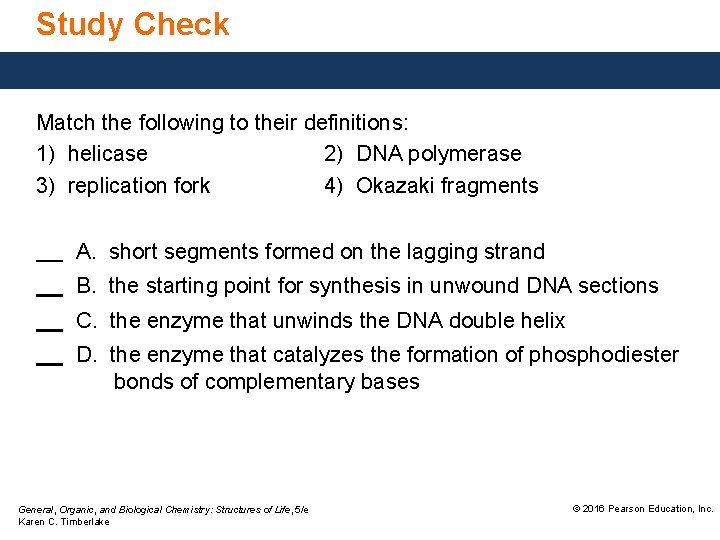
Study Check Match the following to their definitions: 1) helicase 2) DNA polymerase 3) replication fork 4) Okazaki fragments A. short segments formed on the lagging strand B. the starting point for synthesis in unwound DNA sections C. the enzyme that unwinds the DNA double helix D. the enzyme that catalyzes the formation of phosphodiester bonds of complementary bases General, Organic, and Biological Chemistry: Structures of Life, 5/e Karen C. Timberlake © 2016 Pearson Education, Inc.
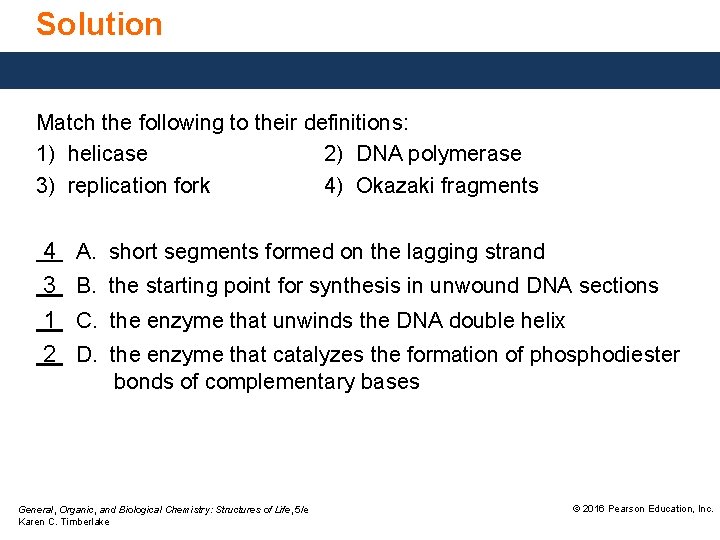
Solution Match the following to their definitions: 1) helicase 2) DNA polymerase 3) replication fork 4) Okazaki fragments 4 3 1 2 A. short segments formed on the lagging strand B. the starting point for synthesis in unwound DNA sections C. the enzyme that unwinds the DNA double helix D. the enzyme that catalyzes the formation of phosphodiester bonds of complementary bases General, Organic, and Biological Chemistry: Structures of Life, 5/e Karen C. Timberlake © 2016 Pearson Education, Inc.